Custom Walk in Montpellier, France by jean_marier_94edc created on 2025-06-07
Guide Location: France » Montpellier
Guide Type: Custom Walk
# of Sights: 7
Tour Duration: 2 Hour(s)
Travel Distance: 3.7 Km or 2.3 Miles
Share Key: 2MMZU
Guide Type: Custom Walk
# of Sights: 7
Tour Duration: 2 Hour(s)
Travel Distance: 3.7 Km or 2.3 Miles
Share Key: 2MMZU
How It Works
Please retrieve this walk in the GPSmyCity app. Once done, the app will guide you from one tour stop to the next as if you had a personal tour guide. If you created the walk on this website or come to the page via a link, please follow the instructions below to retrieve the walk in the app.
Retrieve This Walk in App
Step 1. Download the app "GPSmyCity: Walks in 1K+ Cities" on Apple App Store or Google Play Store.



Step 2. In the GPSmyCity app, download(or launch) the guide "Montpellier Map and Walking Tours".
Step 3. Tap the menu button located at upper right corner of the "Walks" screen and select "Retrieve custom walk". Enter the share key: 2MMZU
1) Anatomy Museum
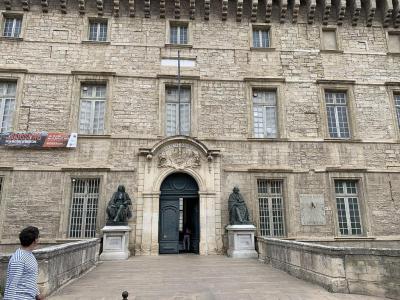
The Anatomy Museum in Montpellier is a historic institution dating back to 1794, making it one of the oldest and most prestigious anatomy museums in the country. Nestled within the Faculty of Medicine, this museum serves as a testament to the evolution of medical science, holding a collection that initially aimed to educate and train future surgeons.
The museum's collection boasts approximately 5,000 anatomical specimens, ranging from wax models and formaldehyde-preserved specimens to animal skeletons and surgical instruments. As visitors wander through its elegantly designed gallery, featuring majestic marble columns and the solemn portraits of pioneering doctors, they are offered a glimpse into the history of a discipline that has been taught in Montpellier since the 13th century.
One of the most captivating highlights of the museum is the Anatomical Theatre, a reconstructed surgical space that evokes the atmosphere of early 19th-century medical procedures. This unique feature, combined with the various deformed figures and anatomical preparations floating in yellowing fluids, provides an insight into the study of human anatomy in its most raw and unfiltered form.
Today, the Anatomy Museum is considered the largest of its kind in France, housing over 13,000 items that meticulously depict the human body and the diseases that afflict it. Each exhibit, recognized as a historic monument, serves as a vivid reminder of the medical field’s relentless pursuit of knowledge and its exploration into the mysteries of human physiology.
The museum's collection boasts approximately 5,000 anatomical specimens, ranging from wax models and formaldehyde-preserved specimens to animal skeletons and surgical instruments. As visitors wander through its elegantly designed gallery, featuring majestic marble columns and the solemn portraits of pioneering doctors, they are offered a glimpse into the history of a discipline that has been taught in Montpellier since the 13th century.
One of the most captivating highlights of the museum is the Anatomical Theatre, a reconstructed surgical space that evokes the atmosphere of early 19th-century medical procedures. This unique feature, combined with the various deformed figures and anatomical preparations floating in yellowing fluids, provides an insight into the study of human anatomy in its most raw and unfiltered form.
Today, the Anatomy Museum is considered the largest of its kind in France, housing over 13,000 items that meticulously depict the human body and the diseases that afflict it. Each exhibit, recognized as a historic monument, serves as a vivid reminder of the medical field’s relentless pursuit of knowledge and its exploration into the mysteries of human physiology.
2) Montpellier Cathedral (must see)
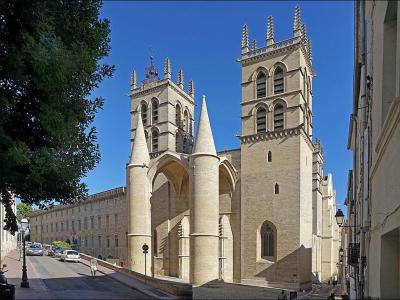
Saint Peter's Cathedral is the enlargement of the former Benedictine convent chapel dedicated to Saints Benedict and Germain, founded by Pope Urban V in 1364. The chapel became a cathedral in 1536. The building is in the center of the old town. It is a Gothic style version of a medieval "fortress" cathedral.
Four imposing towers are set at the corners of the nave. Before the entrance is a great porch supported by two massive cylindrical pillars topped with inverted cone-shaped spires. The pillars are connected to the facade by a vaulted roof. The main entrance itself is flanked by two pilasters with conical tops.
The church is a single vessel with one nave. There are five bays harboring 14 side chapels. The chapels are dedicated to: Our Lady, Saints Germain, Victor, Cecilia, Martin, Catherine, Peter, Magdalene, Lazarus and Michael. We must also not overlook Saint Ursula and the eleven thousand virgins, the Holy Cross and Saint Blaise.
The high altar is veiled with a vermeil altarpiece. There are two sacristies, major and minor, containing books, relics, reliquaries and sacred vessels. There are relics of Saint Germain and Saint Blaise and Saint Benedict's silver arm.
In 1906 the cathedral was classified as a historical monument. In 2002, by decree of the Congregation of Bishops, it became a metropolitan cathedral.
Four imposing towers are set at the corners of the nave. Before the entrance is a great porch supported by two massive cylindrical pillars topped with inverted cone-shaped spires. The pillars are connected to the facade by a vaulted roof. The main entrance itself is flanked by two pilasters with conical tops.
The church is a single vessel with one nave. There are five bays harboring 14 side chapels. The chapels are dedicated to: Our Lady, Saints Germain, Victor, Cecilia, Martin, Catherine, Peter, Magdalene, Lazarus and Michael. We must also not overlook Saint Ursula and the eleven thousand virgins, the Holy Cross and Saint Blaise.
The high altar is veiled with a vermeil altarpiece. There are two sacristies, major and minor, containing books, relics, reliquaries and sacred vessels. There are relics of Saint Germain and Saint Blaise and Saint Benedict's silver arm.
In 1906 the cathedral was classified as a historical monument. In 2002, by decree of the Congregation of Bishops, it became a metropolitan cathedral.
3) Fabre Museum (must see)
Francois-Xavier Fabre, student of Jacques-Louis David, winner of the Rome Prize for art in 1787, married the Princess Louise of Stolberg-Gedem. She was very rich. When she passed away in 1824, Francois inherited her wealth and used it to found an art school in his hometown of Montpellier.
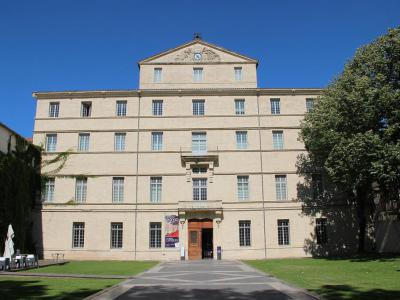
Back in 1802, Montpellier received a gift of 30 paintings. This was the beginning of small city museum. Fabre died in 1837. He left 100 more paintings to the museum. His collections formed the basis of the Fabre Museum. The museum is housed in a large four-story building close to the Comedy Square in the center of town.
Other renown artists contributed to the collection. The museum is classified as a Museum of France by the French Ministry of Culture.
The museum holds an impressive collection of ancient European ceramics and paintings from the 15th to the 20th centuries. Painters and sculptors from France, Italy, Spain, Britain, the Low Countries and other European nations are well represented.
Back in 1802, Montpellier received a gift of 30 paintings. This was the beginning of small city museum. Fabre died in 1837. He left 100 more paintings to the museum. His collections formed the basis of the Fabre Museum. The museum is housed in a large four-story building close to the Comedy Square in the center of town.
Other renown artists contributed to the collection. The museum is classified as a Museum of France by the French Ministry of Culture.
The museum holds an impressive collection of ancient European ceramics and paintings from the 15th to the 20th centuries. Painters and sculptors from France, Italy, Spain, Britain, the Low Countries and other European nations are well represented.
4) Place de la Comédie (Comedy Square) (must see)
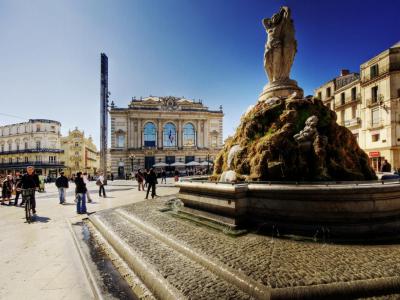
Comedy Square is called a square. But it is not a square. It is an oval. For this reason, locals often refer to it as "the Egg". It is shaped like an egg and it is one of the largest "squares" in Europe. It is located in the heart of the medieval city.
The square extends across the space once occupied by the ancient fortifications of Montpellier, almost touching the Joffre High School (formerly the citadel of Montpellier) and the Charles de Gaulle Esplanade in the east. It is about 756 feet long by 164 feet wide.
The earliest mention of the square is 1755. It was named for the Municipal Theatre, Opera Comedy. The theater burned down twice, the first time in 1785 and then again in 1881. Each time it was rebuilt.
In 1790 The fountain and sculpture of the three Graces, Euphrosyne, Aglaea and Thalia, by the well known French sculptor Étienne Dantoine, was installed in the square. The Graces were the daughters of Zeus. Thalia was Youth, Euphrosyne was Humor and Aglaea was Elegance; three qualities prized in France.
The square extends across the space once occupied by the ancient fortifications of Montpellier, almost touching the Joffre High School (formerly the citadel of Montpellier) and the Charles de Gaulle Esplanade in the east. It is about 756 feet long by 164 feet wide.
The earliest mention of the square is 1755. It was named for the Municipal Theatre, Opera Comedy. The theater burned down twice, the first time in 1785 and then again in 1881. Each time it was rebuilt.
In 1790 The fountain and sculpture of the three Graces, Euphrosyne, Aglaea and Thalia, by the well known French sculptor Étienne Dantoine, was installed in the square. The Graces were the daughters of Zeus. Thalia was Youth, Euphrosyne was Humor and Aglaea was Elegance; three qualities prized in France.
5) Water Tower
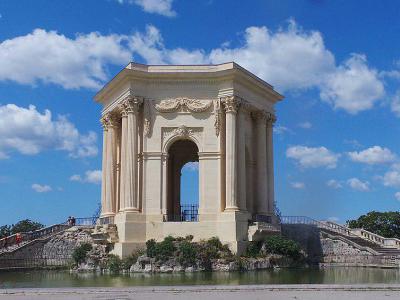
The Water Tower in Peyrou Park, Montpellier, stands as a striking example of neo-Classical architecture. Located at the terminus of the Montpellier Aqueduct, this hexagonal tower served as a reservoir for the freshwater transported from the Lez spring, carried by the 14-kilometer-long Saint-Clément aqueduct designed by Henri Pitot. The water tower, completed in 1774 by architect Jean Giral, is adorned with Corinthian columns and arches, adding a touch of grandeur to its functional purpose.
Rising to a height of approximately 50 feet, the pale ochre structure is flanked by ornate stone staircases, accentuating its elegance. At night, the tower illuminates beautifully, creating a mesmerizing focal point for the Peyrou promenade. Originally constructed in 1766 to support a pre-existing reservoir built in 1753, the Water Tower has since become an iconic feature of the park, along with the triumphal arch, the statue of Louis XIV, and the ancient arches of the Roman aqueduct, Les Arceaux.
Beyond its architectural significance, the Water Tower is linked to a historical anecdote: a rare portrait of Jean Moulin, a key figure in the French Resistance during World War II, was taken at the foot of the aqueduct in 1939. Captured by his childhood friend Marcel Bernard, the photograph shows Moulin during his time as prefect of Eure-et-Loir.
Today, the Water Tower and its surrounding ensemble are recognized as Historic Monuments, offering visitors panoramic views of Montpellier’s historic center, known as the Ecusson, and the surrounding landscapes. The tower stands as a testament to Montpellier’s rich heritage and classical beauty.
Rising to a height of approximately 50 feet, the pale ochre structure is flanked by ornate stone staircases, accentuating its elegance. At night, the tower illuminates beautifully, creating a mesmerizing focal point for the Peyrou promenade. Originally constructed in 1766 to support a pre-existing reservoir built in 1753, the Water Tower has since become an iconic feature of the park, along with the triumphal arch, the statue of Louis XIV, and the ancient arches of the Roman aqueduct, Les Arceaux.
Beyond its architectural significance, the Water Tower is linked to a historical anecdote: a rare portrait of Jean Moulin, a key figure in the French Resistance during World War II, was taken at the foot of the aqueduct in 1939. Captured by his childhood friend Marcel Bernard, the photograph shows Moulin during his time as prefect of Eure-et-Loir.
Today, the Water Tower and its surrounding ensemble are recognized as Historic Monuments, offering visitors panoramic views of Montpellier’s historic center, known as the Ecusson, and the surrounding landscapes. The tower stands as a testament to Montpellier’s rich heritage and classical beauty.
6) Promenade du Peyrou (Peyrou Promenade) (must see)
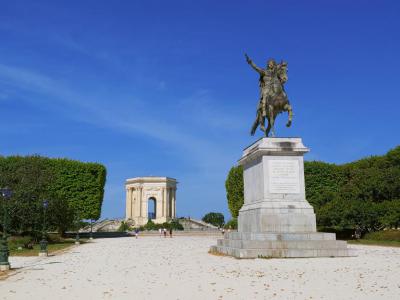
At the edge of the old town the city, is the Peyrou Promenade. The Triumph Arch honoring Louis XIV is here. There is also a statue of Louis on horseback erected in 1718. And close by is the neoclassical water tower and the 18th century aqueduct, reaching 14 kilometers to the Saint Clement spring.
The park dates from 1774, when Louis ascended the throne of France. It was designed and laid out by architect Jean Giral. Visitors to the park are rewarded with a panoramic view of the city and its surroundings. The Aqueduct of Saint Clement and its reservoir date from 1753. The cistern, called the Water Castle, was added in 1766.
There are the statues of children and a Lion by sculptor Injalbert of 1883. In 1927 a walk-in annualized sun dial was installed by Pierre Humbert. The promenade is 953 feet long and 529 feet in width. It has four entrances, three on the east side and one above the stairs on the west side. The main entrance is on the Francois Frank Street.
The park dates from 1774, when Louis ascended the throne of France. It was designed and laid out by architect Jean Giral. Visitors to the park are rewarded with a panoramic view of the city and its surroundings. The Aqueduct of Saint Clement and its reservoir date from 1753. The cistern, called the Water Castle, was added in 1766.
There are the statues of children and a Lion by sculptor Injalbert of 1883. In 1927 a walk-in annualized sun dial was installed by Pierre Humbert. The promenade is 953 feet long and 529 feet in width. It has four entrances, three on the east side and one above the stairs on the west side. The main entrance is on the Francois Frank Street.
7) Plant Garden (must see)
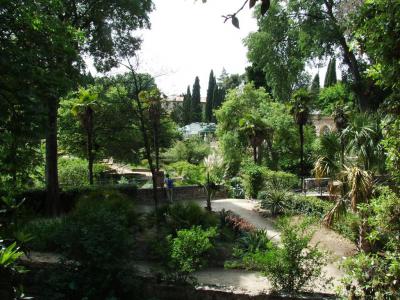
The Plant Garden (Jardin des Plantes) in Montpellier, spanning 4.5 hectares, is a historic botanical garden and arboretum located on Boulevard Henri IV in Montpellier. As the oldest botanical garden in France, it was established in 1593 by royal decree from King Henri IV, under the direction of Pierre Richer de Belleval, a professor of botany and anatomy. The garden is inspired by the Orto Botanico di Padova in Italy, the world’s first university botanical garden, and later became the model for the Jardin des Plantes de Paris, created in 1626.
Initially designed to support the teaching of botany and the study of plants used in traditional medicine, the garden was almost destroyed during the siege of Montpellier in 1622 but was restored a few years later. Throughout the 19th century, it was further expanded and embellished. The orangery, designed by Claude-Mathieu Delagardette, was completed in 1804, while the arboretum, landscaped in 1810, features a diverse collection of old and rare trees. The English Garden, established in 1859, added a picturesque pond and greenhouse, and the Martins Greenhouse, a monumental structure, opened in 1860.
Today, the garden hosts around 2,680 plant species, including 500 native to the Mediterranean region. Of these, about 2,000 species thrive outdoors, while 1,000 grow under glass. The garden’s collection includes notable species such as a 400-year-old Phillyrea latifolia, a green olive tree in the family Oleaceae, and a mature Ginkgo biloba, planted in 1795 and later grafted to produce seeds for the first time in France.
Despite its historical significance, parts of the garden, including the orangery, are currently under renovation, and some sections show signs of neglect. However, the garden’s serene pathways, architectural ruins, and ancient trees offer visitors an enchanting experience, even in its less maintained state. Several "beautiful trees" are marked with information boards that describe their characteristics, adding an educational dimension to the visit. This historical and botanical gem continues to serve as a resource for botanical research and education, despite its current need for restoration and renewed support.
Initially designed to support the teaching of botany and the study of plants used in traditional medicine, the garden was almost destroyed during the siege of Montpellier in 1622 but was restored a few years later. Throughout the 19th century, it was further expanded and embellished. The orangery, designed by Claude-Mathieu Delagardette, was completed in 1804, while the arboretum, landscaped in 1810, features a diverse collection of old and rare trees. The English Garden, established in 1859, added a picturesque pond and greenhouse, and the Martins Greenhouse, a monumental structure, opened in 1860.
Today, the garden hosts around 2,680 plant species, including 500 native to the Mediterranean region. Of these, about 2,000 species thrive outdoors, while 1,000 grow under glass. The garden’s collection includes notable species such as a 400-year-old Phillyrea latifolia, a green olive tree in the family Oleaceae, and a mature Ginkgo biloba, planted in 1795 and later grafted to produce seeds for the first time in France.
Despite its historical significance, parts of the garden, including the orangery, are currently under renovation, and some sections show signs of neglect. However, the garden’s serene pathways, architectural ruins, and ancient trees offer visitors an enchanting experience, even in its less maintained state. Several "beautiful trees" are marked with information boards that describe their characteristics, adding an educational dimension to the visit. This historical and botanical gem continues to serve as a resource for botanical research and education, despite its current need for restoration and renewed support.
