Custom Walk in Luxembourg, Luxembourg by swintog_e6ed9 created on 2025-06-07
Guide Location: Luxembourg » Luxembourg
Guide Type: Custom Walk
# of Sights: 8
Tour Duration: 2 Hour(s)
Travel Distance: 4.1 Km or 2.5 Miles
Share Key: JHL5P
Guide Type: Custom Walk
# of Sights: 8
Tour Duration: 2 Hour(s)
Travel Distance: 4.1 Km or 2.5 Miles
Share Key: JHL5P
How It Works
Please retrieve this walk in the GPSmyCity app. Once done, the app will guide you from one tour stop to the next as if you had a personal tour guide. If you created the walk on this website or come to the page via a link, please follow the instructions below to retrieve the walk in the app.
Retrieve This Walk in App
Step 1. Download the app "GPSmyCity: Walks in 1K+ Cities" on Apple App Store or Google Play Store.



Step 2. In the GPSmyCity app, download(or launch) the guide "Luxembourg Map and Walking Tours".
Step 3. Tap the menu button located at upper right corner of the "Walks" screen and select "Retrieve custom walk". Enter the share key: JHL5P
1) Notre-Dame Cathedral (must see)
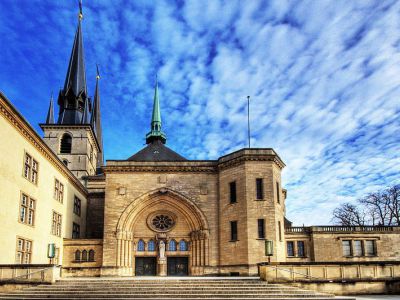
Nestled in the historic quarter of Ville Haute, the Notre-Dame Cathedral is a timeless gem combining architectural elegance and spiritual depth. Originally built as a Jesuit church between 1613 and 1621, under the direction of Brother Jean du Blocq and Ulrich Job, it was granted cathedral status in 1870 and stands today as the only cathedral in the Grand Duchy. Its façade, with three distinct towers added during the 1935–38 expansion, marks a striking silhouette on the city skyline.
This sacred space delights visitors with a rich mix of late Gothic, Renaissance, and Baroque design elements-from the soaring pointed arches and cylindrical pillars to the ornate alabaster carvings and sculpted pulpit that brings biblical stories to life. Inside, the cloistered nave and choir are illuminated by masterful stained‑glass windows, crafted by artists such as Louis Barillet and Josef Oberberger, which bathe the interior in vibrant, multicolored light.
At the heart of the cathedral lies the venerated statue of Our Lady of Luxembourg-also known as “Consolatrix Afflictorum”-the nation’s patron saint. This 16th-century wooden Madonna and Child holds deep religious and patriotic significance. It is paraded through the streets during the annual Octave pilgrimage in spring, a culminating tradition that dazzles with devotion and local festivity. The crypt also contains the tombs of Luxembourg’s Grand Dukes and prominent national figures.
Admission is free, and the cathedral is conveniently open daily-typically from early morning until evening-with optional audio-guide tours available in multiple languages. Whether you're drawn by architectural grandeur, spiritual solace, or cultural heritage, Notre‑Dame Cathedral offers a powerful and memorable welcome to Luxembourg City.
Why You Should Visit:
Visitors who are interested in art or Gothic architecture will love this stop. The stained glass windows are gorgeous, even in dim light.
Tip:
Anyone considering the rooftop trip – make sure you fit, as it's a spiral staircase top to bottom with only a brief rest area in a gift shop. Fantastic view from the top, but a trek! Don't forget to also visit the crypt, which is decidedly cooler on hot days.
This sacred space delights visitors with a rich mix of late Gothic, Renaissance, and Baroque design elements-from the soaring pointed arches and cylindrical pillars to the ornate alabaster carvings and sculpted pulpit that brings biblical stories to life. Inside, the cloistered nave and choir are illuminated by masterful stained‑glass windows, crafted by artists such as Louis Barillet and Josef Oberberger, which bathe the interior in vibrant, multicolored light.
At the heart of the cathedral lies the venerated statue of Our Lady of Luxembourg-also known as “Consolatrix Afflictorum”-the nation’s patron saint. This 16th-century wooden Madonna and Child holds deep religious and patriotic significance. It is paraded through the streets during the annual Octave pilgrimage in spring, a culminating tradition that dazzles with devotion and local festivity. The crypt also contains the tombs of Luxembourg’s Grand Dukes and prominent national figures.
Admission is free, and the cathedral is conveniently open daily-typically from early morning until evening-with optional audio-guide tours available in multiple languages. Whether you're drawn by architectural grandeur, spiritual solace, or cultural heritage, Notre‑Dame Cathedral offers a powerful and memorable welcome to Luxembourg City.
Why You Should Visit:
Visitors who are interested in art or Gothic architecture will love this stop. The stained glass windows are gorgeous, even in dim light.
Tip:
Anyone considering the rooftop trip – make sure you fit, as it's a spiral staircase top to bottom with only a brief rest area in a gift shop. Fantastic view from the top, but a trek! Don't forget to also visit the crypt, which is decidedly cooler on hot days.
2) Place Guillaume II
Place Guillaume II, affectionately known by locals as “Knuedler”, is one of the most iconic public squares in Luxembourg City’s historic Ville Haute (Upper Town). Originally the site of a Franciscan monastery dating from the 13th century, its name derives from the knot worn in the friars’ belts (Luxembourgish knued). After the monastery was confiscated by the French in 1797 and later demolished, the square was redeveloped, eventually gifted to the city by Napoleon in the early 19th century.
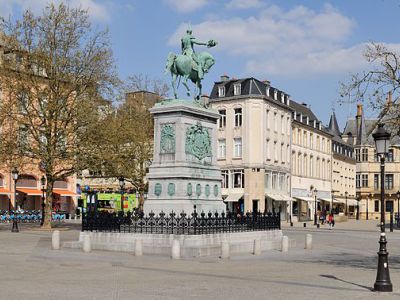
The western edge of Place Guillaume II is dominated by the elegant neoclassical City Hall (Hôtel de Ville), completed in 1838 and featuring distinctive twin lion sculptures added in 1938 by Auguste Trémont. On the eastern side, you’ll find the striking equestrian statue of Grand Duke William II, erected in 1884 to commemorate the ruler who granted Luxembourg its first parliamentary constitution. The pedestal is adorned with heraldic symbols representing the House of Orange‑Nassau and all twelve cantons of the Grand Duchy.
Today, the square buzzes with life, especially on Wednesdays and Saturdays, when a lively farmers’ market springs up, featuring local gardeners and vendors selling produce, flowers, cheese, preserves, and more. Beyond its market charm, Knuedler hosts seasonal open-air concerts and cultural events, including the long-running Rock um Knuedler festival, which attracted up to 10,000 guests before recent interruptions-celebrated for bringing international acts to the heart of the city.
A stroll through Place Guillaume II is more than just sightseeing-it’s an immersion into Luxembourg’s past and present. From its medieval roots and historic architecture to its everyday vibrancy as a community hub, this square captures the spirit of the city.
The western edge of Place Guillaume II is dominated by the elegant neoclassical City Hall (Hôtel de Ville), completed in 1838 and featuring distinctive twin lion sculptures added in 1938 by Auguste Trémont. On the eastern side, you’ll find the striking equestrian statue of Grand Duke William II, erected in 1884 to commemorate the ruler who granted Luxembourg its first parliamentary constitution. The pedestal is adorned with heraldic symbols representing the House of Orange‑Nassau and all twelve cantons of the Grand Duchy.
Today, the square buzzes with life, especially on Wednesdays and Saturdays, when a lively farmers’ market springs up, featuring local gardeners and vendors selling produce, flowers, cheese, preserves, and more. Beyond its market charm, Knuedler hosts seasonal open-air concerts and cultural events, including the long-running Rock um Knuedler festival, which attracted up to 10,000 guests before recent interruptions-celebrated for bringing international acts to the heart of the city.
A stroll through Place Guillaume II is more than just sightseeing-it’s an immersion into Luxembourg’s past and present. From its medieval roots and historic architecture to its everyday vibrancy as a community hub, this square captures the spirit of the city.
3) Grand Ducal Palace (must see)
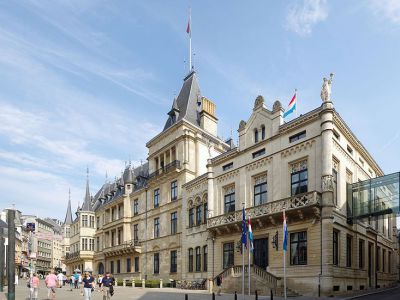
Nestled in the heart of Luxembourg City’s medieval Old Town, the Grand Ducal Palace is a striking example of Flemish Renaissance architecture that has served as the official seat of Luxembourg’s monarchy since 1890. Originally built as the city hall in 1572–1573 on the ruins of an earlier 1418 structure, the palace evolved from municipal government offices to the residence and workplace of the Grand Duke and his family.
Inside, the first floor of the palace boasts lavishly decorated state rooms such as the grand staircase, reception halls, dining rooms, and the Salon des Rois, where the Grand Duke hosts official events and welcomes dignitaries. Each room reflects both historical prestige and modern elegance, thanks to restorations undertaken in the 1960s and a comprehensive renovation between 1991 and 1996. While the palace remains the head of state’s primary workplace, its principal residence lies at Berg Castle in Colmar‑Berg.
Tourists can explore the interior during one of the exclusive guided tours available annually from mid‑July through the end of August. These 75‑minute tours-guided by the Luxembourg City Tourist Office-offer rare access to the Duke’s office, the formal dining room, and the regal Salon des Rois.
For visitors to Luxembourg City, the palace serves as a powerful symbol of the nation’s living heritage. Its magnificent façade, presence within the UNESCO‑listed Old Quarters and Fortifications, and central location make it an unmissable landmark-especially when combined with a scenic stroll through Ville Haute or a relaxing pause at one of the charming nearby cafés.
Why You Should Visit:
The palace is a local landmark right in the heart of Ville-Haute. When visiting Luxembourg, you will inevitably stop and take a look from street level. Keep an eye out for the palace guards' ceremonies.
Tips:
The palace is open for guided tours only during July and August. Ask for information at the information center at Place Guillaume II. Like at Buckingham Palace, you can take pictures with the guard if you wish.
Inside, the first floor of the palace boasts lavishly decorated state rooms such as the grand staircase, reception halls, dining rooms, and the Salon des Rois, where the Grand Duke hosts official events and welcomes dignitaries. Each room reflects both historical prestige and modern elegance, thanks to restorations undertaken in the 1960s and a comprehensive renovation between 1991 and 1996. While the palace remains the head of state’s primary workplace, its principal residence lies at Berg Castle in Colmar‑Berg.
Tourists can explore the interior during one of the exclusive guided tours available annually from mid‑July through the end of August. These 75‑minute tours-guided by the Luxembourg City Tourist Office-offer rare access to the Duke’s office, the formal dining room, and the regal Salon des Rois.
For visitors to Luxembourg City, the palace serves as a powerful symbol of the nation’s living heritage. Its magnificent façade, presence within the UNESCO‑listed Old Quarters and Fortifications, and central location make it an unmissable landmark-especially when combined with a scenic stroll through Ville Haute or a relaxing pause at one of the charming nearby cafés.
Why You Should Visit:
The palace is a local landmark right in the heart of Ville-Haute. When visiting Luxembourg, you will inevitably stop and take a look from street level. Keep an eye out for the palace guards' ceremonies.
Tips:
The palace is open for guided tours only during July and August. Ask for information at the information center at Place Guillaume II. Like at Buckingham Palace, you can take pictures with the guard if you wish.
4) Chemin de la Corniche (Walls of the Corniche) (must see)
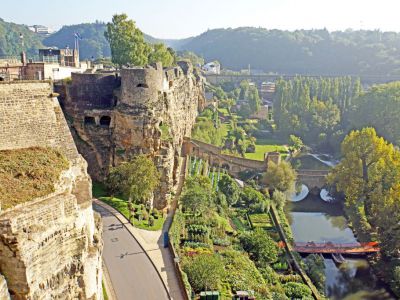
The Walls of the Corniche (Chemin de la Corniche) is a historic promenade, often hailed as “the most beautiful balcony in Europe” thanks to Luxembourg writer Batty Weber. This elegant pathway stretches along the old city ramparts-built in the 17th century by the Spaniards and French-gracefully perched above the Alzette valley. From its vantage point on the Bock promontory to the lower sections around the Holy Ghost Citadel, the corniche offers a stunning vantage over the terraced rooftops of Ville Haute and the storybook quarter of Grund below.
Walking the corniche feels like stepping into a living postcard. Visitors are treated to panoramic views of the Alzette River, the charming Grund neighborhood, and the verdant Rham Plateau. The stone pathway, once equipped with staircases to navigate steep inclines, was leveled off in the late 19th century following the fortress's dismantling of 1867. This transformation revealed unobstructed vistas-shields, and loopholes were removed-so that the beauty of Luxembourg’s dramatic terrain could fully shine.
Steeped in deep history, the corniche traces the remnants of a city fortress that spanned nearly a millennium. From the 10th-century castle of Count Siegfried to the sprawling ramparts heightened by Vauban’s expertise and later scaled back by the Treaty of London’s decree, this area still preserves pieces of its defensive past-walls, towers, casemates, and cobbled ancient paths. As part of the Old Quarters and Fortifications of Luxembourg, a UNESCO World Heritage site since 1994, the corniche forms a captivating chapter in the city’s resilient narrative.
For tourists, the Walls of the Corniche is a must-do stroll. It’s ideal for early mornings or twilight walks when sunlight bathes the valley and rooftops in golden hues. Interpretive plaques, scenic viewpoints, and access to the Grund via elevators or stairways enrich the experience. Along the path, you’ll be just steps from key landmarks-Saint Michael’s Church, the Bock bridge, and the Neumunster Abbey-each one anchoring the corniche within Luxembourg’s intimate tapestry of culture, architecture, and breathtaking beauty.
Walking the corniche feels like stepping into a living postcard. Visitors are treated to panoramic views of the Alzette River, the charming Grund neighborhood, and the verdant Rham Plateau. The stone pathway, once equipped with staircases to navigate steep inclines, was leveled off in the late 19th century following the fortress's dismantling of 1867. This transformation revealed unobstructed vistas-shields, and loopholes were removed-so that the beauty of Luxembourg’s dramatic terrain could fully shine.
Steeped in deep history, the corniche traces the remnants of a city fortress that spanned nearly a millennium. From the 10th-century castle of Count Siegfried to the sprawling ramparts heightened by Vauban’s expertise and later scaled back by the Treaty of London’s decree, this area still preserves pieces of its defensive past-walls, towers, casemates, and cobbled ancient paths. As part of the Old Quarters and Fortifications of Luxembourg, a UNESCO World Heritage site since 1994, the corniche forms a captivating chapter in the city’s resilient narrative.
For tourists, the Walls of the Corniche is a must-do stroll. It’s ideal for early mornings or twilight walks when sunlight bathes the valley and rooftops in golden hues. Interpretive plaques, scenic viewpoints, and access to the Grund via elevators or stairways enrich the experience. Along the path, you’ll be just steps from key landmarks-Saint Michael’s Church, the Bock bridge, and the Neumunster Abbey-each one anchoring the corniche within Luxembourg’s intimate tapestry of culture, architecture, and breathtaking beauty.
5) Pfaffenthal Panoramic Elevator (must see)
Luxembourg is a city built on many levels, with the historic old city built on the plateau and other communities sitting below in deep gorges. Connecting the different parts of town for pedestrians and cyclists has always been a challenge from a planning perspective.
The Pfaffenthal Panoramic Elevator was begun in 2006, but due to various delays, it wasn't completed until 2017. Along with the Grund public elevator and the Pfaffenthal-Kirchberg funicular, the city is connected to the Alzette and Petrusse river valleys below.
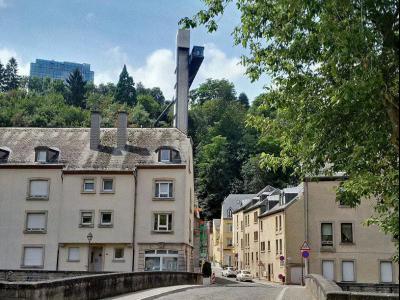
The elevator's main shaft is about 60 meters tall, and it is built right into the Cote d'Eich hillside. Seventy-two anchor bolts are drilled as far as 30 meters into the bedrock, and the terrain is reinforced with concrete. The footbridge leading to the elevator in Pescatore Park has an observation platform that extends out over the Alzette Valley. It also has window panels and clear glass flooring, allowing for some stunning views.
Why You Should Visit:
The glass-walled elevator is a quick and easy way to connect to the community of Pfaffenthal, but that's far from the only reason to take the ride. The elevator provides some of the most beautiful panoramic views to be found anywhere in the city.
Tips:
Even if you don't plan to ride the elevator, take the trip out on the footbridge to check out the observation deck.
If you'd like to visit the Pfaffenthal section of town, consider going down on the elevator and back up via the Pfaffenthal-Kirchberg funicular. In this part of town, you'll find the Grand-Duchess Charlotte bridge, several parks, and Fort Niedergrünewald.
The Pfaffenthal Panoramic Elevator was begun in 2006, but due to various delays, it wasn't completed until 2017. Along with the Grund public elevator and the Pfaffenthal-Kirchberg funicular, the city is connected to the Alzette and Petrusse river valleys below.
The elevator's main shaft is about 60 meters tall, and it is built right into the Cote d'Eich hillside. Seventy-two anchor bolts are drilled as far as 30 meters into the bedrock, and the terrain is reinforced with concrete. The footbridge leading to the elevator in Pescatore Park has an observation platform that extends out over the Alzette Valley. It also has window panels and clear glass flooring, allowing for some stunning views.
Why You Should Visit:
The glass-walled elevator is a quick and easy way to connect to the community of Pfaffenthal, but that's far from the only reason to take the ride. The elevator provides some of the most beautiful panoramic views to be found anywhere in the city.
Tips:
Even if you don't plan to ride the elevator, take the trip out on the footbridge to check out the observation deck.
If you'd like to visit the Pfaffenthal section of town, consider going down on the elevator and back up via the Pfaffenthal-Kirchberg funicular. In this part of town, you'll find the Grand-Duchess Charlotte bridge, several parks, and Fort Niedergrünewald.
6) Cimetière Notre-Dame (Notre-Dame Cemetery)
Nestled in the leafy Limpertsberg district, Notre-Dame Cemetery (also known locally as Nikloskierfecht) has welcomed mourners since the late 18th century, with origins tracing back to 1691 and formal establishment between 1779 and 1780 following the demolition of the old Saint Nicholas church in the city center. Today, it stands as Luxembourg City’s largest cemetery, meticulously maintained and open to visitors from April to September and October to March.
Upon entry, visitors are greeted by striking funerary art-marble angels, Celtic crosses, and ornate mausoleums-that paint poignant memories in stone. Among the most striking is “The Political Prisoner,” a bronze statue by esteemed Luxembourg sculptor Lucien Wercollier, part of the National Monument of Resistance and Deportation (Hinzert Cross), erected to honor those who died opposing Nazi tyranny.
The cemetery is also the final resting place of many luminaries who shaped Luxembourg’s heritage-Jean‑Antoine Zinnen, composer of the national anthem; “Captain” Wilhelm Voigt, better known as Hauptmann von Köpenick; former Prime Minister Paul Eyschen; and numerous artists, politicians, and military figures. In recent years, the city has enhanced the experience by installing QR codes on select tombs, offering insightful biographies via smartphone, perfect for the historically curious traveler.
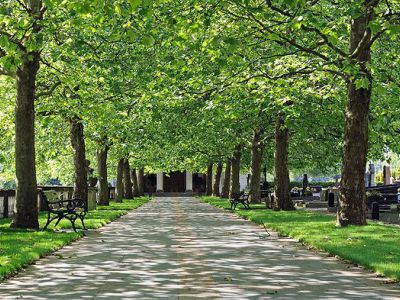
A stroll along the tree‑lined pathways reveals not only Luxembourg’s past but also its values-honoring resistance, celebrating the arts, and preserving collective memory. The cemetery’s thoughtful renovation, including a new visitor services building that respects the character of its heritage, underscores its dual role as both solemn resting place and cultural landmark.
Upon entry, visitors are greeted by striking funerary art-marble angels, Celtic crosses, and ornate mausoleums-that paint poignant memories in stone. Among the most striking is “The Political Prisoner,” a bronze statue by esteemed Luxembourg sculptor Lucien Wercollier, part of the National Monument of Resistance and Deportation (Hinzert Cross), erected to honor those who died opposing Nazi tyranny.
The cemetery is also the final resting place of many luminaries who shaped Luxembourg’s heritage-Jean‑Antoine Zinnen, composer of the national anthem; “Captain” Wilhelm Voigt, better known as Hauptmann von Köpenick; former Prime Minister Paul Eyschen; and numerous artists, politicians, and military figures. In recent years, the city has enhanced the experience by installing QR codes on select tombs, offering insightful biographies via smartphone, perfect for the historically curious traveler.
A stroll along the tree‑lined pathways reveals not only Luxembourg’s past but also its values-honoring resistance, celebrating the arts, and preserving collective memory. The cemetery’s thoughtful renovation, including a new visitor services building that respects the character of its heritage, underscores its dual role as both solemn resting place and cultural landmark.
7) St. Peter and Paul Church
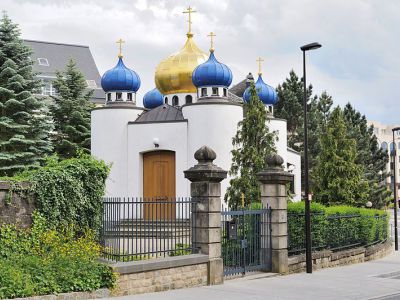
The Russian Orthodox Church of Saints Peter and Paul offers a charming yet profound experience for visitors. This is the first Russian Orthodox church in Luxembourg, consecrated on July 12, 1982, and serving under the Western European Diocese of the Russian Orthodox Church Outside Russia. Though modest in size, its blue and gold onion domes rise from the rooftops nearby, catching the eye of passersby and inviting travelers to explore the culture of a religious minority in Luxembourg.
The church owes its origin to Russian émigrés, mostly former soldiers of General Lavr Kornilov, who settled in Luxembourg in the late 1920s and began worshipping in makeshift quarters until the parish was formally founded in 1928. After securing a plot of land in 1975, Archbishop Anthony laid the cornerstone in 1979; the building that stands today was largely realized through the dedication and donations of parishioners and support from the Orthodox community in Geneva. Since its consecration, Father Sergey Pukh has shepherded the community, maintaining continuity from those early days.
Inside, the church features a traditional Orthodox layout, including an iconostasis, richly colored icons, liturgical textiles, and an atmosphere of peaceful reflection. While it may not rival Luxembourg’s grand cathedrals in scale, its intimate setting and cultural significance make it a worthwhile stop on a walking tour of Upper Town (Ville-Haute).
For travellers exploring Luxembourg’s diverse spiritual heritage, the Saints Peter and Paul Church is a unique encounter-a slice of Russian Orthodox tradition set against Luxembourg’s mix of German, French, and local influences. Its elegant domes, quiet sanctuary, and story of community resilience make it not just a sight to see but a narrative to experience.
The church owes its origin to Russian émigrés, mostly former soldiers of General Lavr Kornilov, who settled in Luxembourg in the late 1920s and began worshipping in makeshift quarters until the parish was formally founded in 1928. After securing a plot of land in 1975, Archbishop Anthony laid the cornerstone in 1979; the building that stands today was largely realized through the dedication and donations of parishioners and support from the Orthodox community in Geneva. Since its consecration, Father Sergey Pukh has shepherded the community, maintaining continuity from those early days.
Inside, the church features a traditional Orthodox layout, including an iconostasis, richly colored icons, liturgical textiles, and an atmosphere of peaceful reflection. While it may not rival Luxembourg’s grand cathedrals in scale, its intimate setting and cultural significance make it a worthwhile stop on a walking tour of Upper Town (Ville-Haute).
For travellers exploring Luxembourg’s diverse spiritual heritage, the Saints Peter and Paul Church is a unique encounter-a slice of Russian Orthodox tradition set against Luxembourg’s mix of German, French, and local influences. Its elegant domes, quiet sanctuary, and story of community resilience make it not just a sight to see but a narrative to experience.
8) Place d'Armes
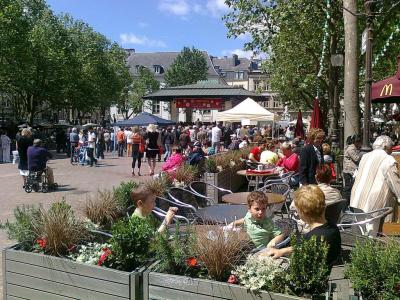
The original town square of the old town is still the heart of the community. Here, you'll find locals and visitors out and about, enjoying the fresh air and sunshine during the warm summer months. Many restaurants and cafés have outdoor patios, and this whole part of town is a pedestrian-only zone. You'll often find live music or open-air markets going on.
On the square's eastern side is the Cercle, which was initially designed as an administrative building. It was the site of the European Court of Justice but is now a venue for cultural events. Outside of it, you will find a sculpture of Countess Ermisinde with the 1244 Charter of Emancipation that guaranteed citizen's rights.
On the opposite end, there are monuments dedicated to two of Luxembourg's poets, Dicks and Michel Lentz. The lion on the monument represents the Grand Duchy, and the national motto is inscribed on the pillar. It translates, "We want to stay what we are."
The square gets its name from its historical purpose of being a gathering spot and parade ground for troops. The spot was laid out after a massive fire destroyed much of Ville-Haute in 1554. Dutch military engineer Sebastian van Noyen created the first version of the square called New Market.
In 1671, Spanish engineer Jean Charles de Landas used the area as a parade spot for the garrison. Flagstones and lime trees were added under Louis XIV.
On the square's eastern side is the Cercle, which was initially designed as an administrative building. It was the site of the European Court of Justice but is now a venue for cultural events. Outside of it, you will find a sculpture of Countess Ermisinde with the 1244 Charter of Emancipation that guaranteed citizen's rights.
On the opposite end, there are monuments dedicated to two of Luxembourg's poets, Dicks and Michel Lentz. The lion on the monument represents the Grand Duchy, and the national motto is inscribed on the pillar. It translates, "We want to stay what we are."
The square gets its name from its historical purpose of being a gathering spot and parade ground for troops. The spot was laid out after a massive fire destroyed much of Ville-Haute in 1554. Dutch military engineer Sebastian van Noyen created the first version of the square called New Market.
In 1671, Spanish engineer Jean Charles de Landas used the area as a parade spot for the garrison. Flagstones and lime trees were added under Louis XIV.
