Custom Walk in Malaga, Spain by ersinenm9687 created on 2025-06-20
Guide Location: Spain » Malaga
Guide Type: Custom Walk
# of Sights: 15
Tour Duration: 3 Hour(s)
Travel Distance: 3.5 Km or 2.2 Miles
Share Key: UGDB2
Guide Type: Custom Walk
# of Sights: 15
Tour Duration: 3 Hour(s)
Travel Distance: 3.5 Km or 2.2 Miles
Share Key: UGDB2
How It Works
Please retrieve this walk in the GPSmyCity app. Once done, the app will guide you from one tour stop to the next as if you had a personal tour guide. If you created the walk on this website or come to the page via a link, please follow the instructions below to retrieve the walk in the app.
Retrieve This Walk in App
Step 1. Download the app "GPSmyCity: Walks in 1K+ Cities" on Apple App Store or Google Play Store.



Step 2. In the GPSmyCity app, download(or launch) the guide "Malaga Map and Walking Tours".
Step 3. Tap the menu button located at upper right corner of the "Walks" screen and select "Retrieve custom walk". Enter the share key: UGDB2
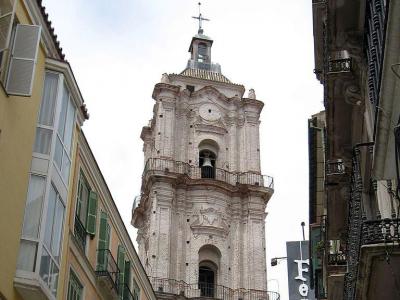
1) Iglesia de San Juan Bautista (Saint John Baptist Church)
This parish church presides over one of the four parishes established in Malaga after the defeat of the Moors in 1487. Two fraternities that go on procession on Holy Week have chapels within the building. The fraternity of sorrows of San Juan occupies the sacramental chapel and a chapel in the right aisle and the Fused brotherhood occupies four chapels, three in the left aisle and one at the foot of the right aisle.
The church was constructed combining Gothic and Mujedar architectural styles with Moorish arches and pillars. A tower was completed in 1543. The 1680 earthquake damaged the structure including the tower. A baroque style tower porch leading to the building was erected at the entrance of the church in 1770 and reconstruction of the church was completed in 1780. The tower porch has a rectangular shape with an elliptical dome. The chapels and altarpiece of the church are richly carved. There is a splendid 17th-century statue of San Juan by the artist, Franciso Ortiz.
The building has undergone periodic restoration. Extensive repairs were carried out in 1962. Recently, the interiors were given a makeover and the church was repainted from beige to the original white.
Why You Should Visit:
Stands out for its huge tower and very unusual exterior murals from the 18th century.
The interior is a soft shade of blue and also impressive, including the richly decorated altar.
The church was constructed combining Gothic and Mujedar architectural styles with Moorish arches and pillars. A tower was completed in 1543. The 1680 earthquake damaged the structure including the tower. A baroque style tower porch leading to the building was erected at the entrance of the church in 1770 and reconstruction of the church was completed in 1780. The tower porch has a rectangular shape with an elliptical dome. The chapels and altarpiece of the church are richly carved. There is a splendid 17th-century statue of San Juan by the artist, Franciso Ortiz.
The building has undergone periodic restoration. Extensive repairs were carried out in 1962. Recently, the interiors were given a makeover and the church was repainted from beige to the original white.
Why You Should Visit:
Stands out for its huge tower and very unusual exterior murals from the 18th century.
The interior is a soft shade of blue and also impressive, including the richly decorated altar.
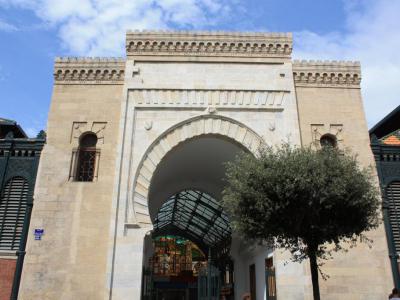
2) Mercado de Atarazanas (Shipyards Market) (must see)
When is a shipyard not a shipyard? When there are no ships in the yard, or there is no yard and there is no water and it's really a market. But during the rule of Mohammed V (1354-1391} the market was actually a shipyard. With seven stone horseshoe arches, it was among the most impressive buildings around.
Only one arch is still there. It serves as the entrance to the Shipyards Market. There are a couple of small shields at the top of the arch with the inscription in Arabic, "Only God is the victor, glory be to Him."
When the Catholics took over the city in 1487 the Atarazanas was used as a convent. The sea was much closer then and the waves and the ships were perhaps too distracting. The convent was given up in favor of a military storage facility. Then it was a hospital and then a medical school. In 1868 the government said, "tear it down. Make a market."
Along came architect Joaquin Rucoba. He rebuilt the Atarazanas, keeping only one arch as the main entrance in the center of the south facade. The new market was done in an Arabic style with arched windows and panels and iron for stone. It also has inside a huge stained glass window showing the main sights of Malaga.
The market is bustling every day except Sunday from 8am to 2pm. Meats, fish, fresh fruit and vegetables are available in separate stalls. The market is not only a place for local products, it is also famous for its tapas.
Only one arch is still there. It serves as the entrance to the Shipyards Market. There are a couple of small shields at the top of the arch with the inscription in Arabic, "Only God is the victor, glory be to Him."
When the Catholics took over the city in 1487 the Atarazanas was used as a convent. The sea was much closer then and the waves and the ships were perhaps too distracting. The convent was given up in favor of a military storage facility. Then it was a hospital and then a medical school. In 1868 the government said, "tear it down. Make a market."
Along came architect Joaquin Rucoba. He rebuilt the Atarazanas, keeping only one arch as the main entrance in the center of the south facade. The new market was done in an Arabic style with arched windows and panels and iron for stone. It also has inside a huge stained glass window showing the main sights of Malaga.
The market is bustling every day except Sunday from 8am to 2pm. Meats, fish, fresh fruit and vegetables are available in separate stalls. The market is not only a place for local products, it is also famous for its tapas.
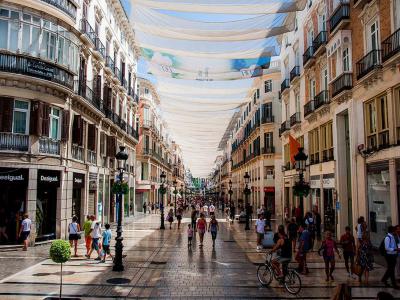
3) Calle Larios (Larios Street) (must see)
Someone in Malaga really liked Chicago buildings in the 1880s. Chief suspect might be Jose Maria Sancha, architect and designer of Calle Larios. Or, the Chicago architecture fan might also be Sancha's colleague, Manuel Rivera. But no. Building design was by Chicago enthusiast and Spanish Architect, Eduardo Strachan Viana-Cardenas.
The street is pedestrianized to encourage strolling and shopping, especially shopping. It extends from the Constitution Square in the north to Alameda Principal in the south. It is reputed to be the most expensive street to live on in Malaga, and one of the most expensive to live on throughout Spain.
In 1880 a corporation formed by the city to fund creation of the street raised over one million pesetas. Shares were 25,000 pesetas each. Most were purchased by the Larios family. It was to no-one's surprise that the street was named for Manuel Larios. A statue of him by Mariano Benlliure is at the south end of the street.
During the time of the Second Republic the street was briefly renamed "Calle 14 de Abril" for the date of the introduction of democracy. In the Spanish civil war the street was bombed but spared much architectural damage.
Larios Street is very popular. It is lined with banks, cafes and businesses. Besides the statue of Manuel Larios there is the sculpture of the Quiromantic Dove, by Jose Sigal.
The street is pedestrianized to encourage strolling and shopping, especially shopping. It extends from the Constitution Square in the north to Alameda Principal in the south. It is reputed to be the most expensive street to live on in Malaga, and one of the most expensive to live on throughout Spain.
In 1880 a corporation formed by the city to fund creation of the street raised over one million pesetas. Shares were 25,000 pesetas each. Most were purchased by the Larios family. It was to no-one's surprise that the street was named for Manuel Larios. A statue of him by Mariano Benlliure is at the south end of the street.
During the time of the Second Republic the street was briefly renamed "Calle 14 de Abril" for the date of the introduction of democracy. In the Spanish civil war the street was bombed but spared much architectural damage.
Larios Street is very popular. It is lined with banks, cafes and businesses. Besides the statue of Manuel Larios there is the sculpture of the Quiromantic Dove, by Jose Sigal.
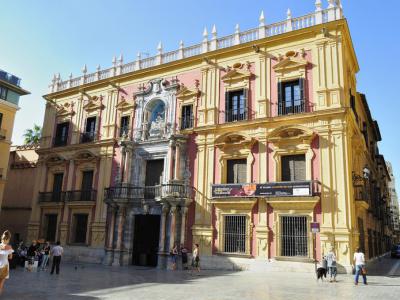
4) Palacio Episcopal de Málaga (Episcopal Palace)
Two palaces make up the Palacio Episcopal de Malaga that stands on the Plaza de Obispo. It is the seat of the Archbishop of Malaga. There are many intricately decorated buildings within the complex making the entire structure a work of art. It is regarded as the finest example of baroque architecture in Andalusia.
The first palace in the complex was built in the 16th century. The second was constructed in the 18th century by Bishop Lasso de Castilla. Architects Antonio Ramos and Jose Martin de Aldehuela designed the building including the ornate Baroque marble façade in colors of pink, white and grey. There is an interior covered patio leading to a grand staircase. On the side, the Bishop’s private patio has 18th century tile work and small tiled fountains. On the third floor is a vaulted ledge that has a beautiful alabaster sculpture of the Virgen de las Angustias by Fernando Ortiz and Manuel Augustin Valero.
The Palacio Episcopal today houses the offices of the Bishop on the top floor. The lower floors are used by the Government of Andalusia for large art exhibitions. The spaces within the building are also used for meetings and other public purposes. There is also a Diocesan Museum of Sacred Art within the complex.
The first palace in the complex was built in the 16th century. The second was constructed in the 18th century by Bishop Lasso de Castilla. Architects Antonio Ramos and Jose Martin de Aldehuela designed the building including the ornate Baroque marble façade in colors of pink, white and grey. There is an interior covered patio leading to a grand staircase. On the side, the Bishop’s private patio has 18th century tile work and small tiled fountains. On the third floor is a vaulted ledge that has a beautiful alabaster sculpture of the Virgen de las Angustias by Fernando Ortiz and Manuel Augustin Valero.
The Palacio Episcopal today houses the offices of the Bishop on the top floor. The lower floors are used by the Government of Andalusia for large art exhibitions. The spaces within the building are also used for meetings and other public purposes. There is also a Diocesan Museum of Sacred Art within the complex.
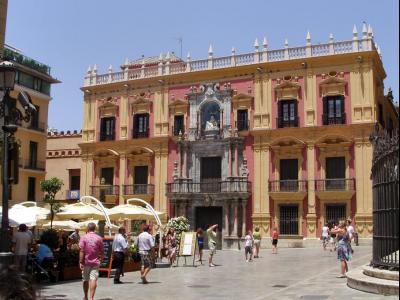
5) Plaza del Obispo de Malaga (Bishop's Square)
The Bishop's Square (Plaza del Obispo) is a historic and architectural gem in the heart of Malaga. Situated in front of the main façade of the Cathedral of Malaga, famously known as La Manquita, and adjacent to the Episcopal Palace, this square forms a striking ensemble of Baroque artistry.
The origins of the square may date back to Malaga's Muslim period, but its current appearance was shaped during the 18th century, with the completion of the cathedral's main façade and the episcopal palace. In the late 20th century, significant renovations were undertaken, including the restoration of some of its surrounding buildings. These works also unearthed remnants of late Roman and Byzantine walls, highlighting the square's deep historical layers.
At the center of the square is a fountain dating to 1785, a masterpiece of grey marble that complements the façade of the Episcopal Palace. The fountain features two elegant basins and a pineapple-shaped top from which water flows. Originally designed to provide water to residents via the San Telmo aqueduct, it remains an iconic feature. A 1998 restoration removed the planter surrounding the fountain, replacing it with a stone base for improved accessibility and aesthetics.
The Episcopal Palace, initiated in 1762, dominates the square with its striking Baroque design. Across the square, the Cathedral of Malaga rises with its majestic marble façade and staircase leading down to the square, separated by an ornate gate. The harmonious interplay between these structures makes Bishop's Square one of Málaga's most visually compelling spaces.
Renowned as Malaga’s Baroque centerpiece, the Bishop's Square has also served as a cinematic setting. It notably appeared in the 2004 feature film The Bridge of San Luis Rey (El Puente de San Luis Rey), which portrayed an 18th-century city in colonial Peru.
With its historical charm, architectural grandeur, and cultural significance, the Bishop's Square remains a must-visit site, offering a glimpse into Malaga's rich history and artistic heritage.
The origins of the square may date back to Malaga's Muslim period, but its current appearance was shaped during the 18th century, with the completion of the cathedral's main façade and the episcopal palace. In the late 20th century, significant renovations were undertaken, including the restoration of some of its surrounding buildings. These works also unearthed remnants of late Roman and Byzantine walls, highlighting the square's deep historical layers.
At the center of the square is a fountain dating to 1785, a masterpiece of grey marble that complements the façade of the Episcopal Palace. The fountain features two elegant basins and a pineapple-shaped top from which water flows. Originally designed to provide water to residents via the San Telmo aqueduct, it remains an iconic feature. A 1998 restoration removed the planter surrounding the fountain, replacing it with a stone base for improved accessibility and aesthetics.
The Episcopal Palace, initiated in 1762, dominates the square with its striking Baroque design. Across the square, the Cathedral of Malaga rises with its majestic marble façade and staircase leading down to the square, separated by an ornate gate. The harmonious interplay between these structures makes Bishop's Square one of Málaga's most visually compelling spaces.
Renowned as Malaga’s Baroque centerpiece, the Bishop's Square has also served as a cinematic setting. It notably appeared in the 2004 feature film The Bridge of San Luis Rey (El Puente de San Luis Rey), which portrayed an 18th-century city in colonial Peru.
With its historical charm, architectural grandeur, and cultural significance, the Bishop's Square remains a must-visit site, offering a glimpse into Malaga's rich history and artistic heritage.
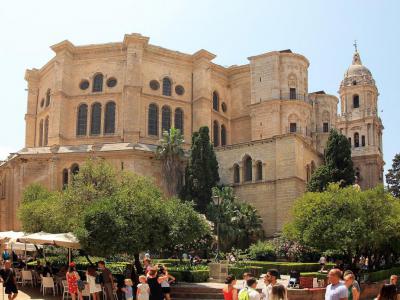
6) Catedral de Málaga (Malaga Cathedral) (must see)
Malaga Cathedral has the nickname, "La Manquita" or "the One-armed Lady." The "arms" of the Cathedral are its towers. The north tower of the cathedral is 276 feet high. The south tower is unfinished. A plaque at the stunted south tower explains why. The funds earmarked for the tower were given to the American revolutionaries instead.
This windfall for the Americans occurred through the good offices of Luis de Unzaga, who was governor of what is now Louisiana, with connections to King Carlos III of Spain. So, the cathedral has been short-armed since at least 1776. Groundbreaking for the cathedral took place in 1528. It was considered finished in 1782.
The cathedral is designed by Diego de Siloe in the Renaissance tradition, inside and out. De Siloe learned the Italian Renaissance styles in Naples in 1517. He combined these elements with Spanish Gothic and Arab architectural motifs. The cathedral has a nave and two aisles. The stalls of the choir are the work of Pedro de Mena.
The facade of the cathedral differs from the rest of the building in that it is in Baroque style. It is in two levels. There are three arches on the lower level with portals flanked by marble columns. Medallions above the doors represent the patron saints of Malaga, Cyriacus and Paula and the Annunciation of the Virgin.
Why You Should Visit:
Richly decorated and architecturally interesting. Very interesting chapels all around inside and the views from the bell tower over the city and beyond should definitely not be missed if you are fit.
This windfall for the Americans occurred through the good offices of Luis de Unzaga, who was governor of what is now Louisiana, with connections to King Carlos III of Spain. So, the cathedral has been short-armed since at least 1776. Groundbreaking for the cathedral took place in 1528. It was considered finished in 1782.
The cathedral is designed by Diego de Siloe in the Renaissance tradition, inside and out. De Siloe learned the Italian Renaissance styles in Naples in 1517. He combined these elements with Spanish Gothic and Arab architectural motifs. The cathedral has a nave and two aisles. The stalls of the choir are the work of Pedro de Mena.
The facade of the cathedral differs from the rest of the building in that it is in Baroque style. It is in two levels. There are three arches on the lower level with portals flanked by marble columns. Medallions above the doors represent the patron saints of Malaga, Cyriacus and Paula and the Annunciation of the Virgin.
Why You Should Visit:
Richly decorated and architecturally interesting. Very interesting chapels all around inside and the views from the bell tower over the city and beyond should definitely not be missed if you are fit.
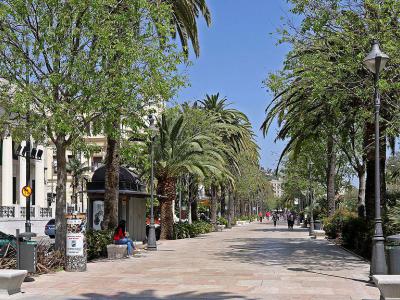
7) Parque de Malaga (Park of Malaga) (must see)
Designed as a flourishing Mediterranean garden, replete with tropical and subtropical species, Park of Malaga is one of the most outstanding parks in Europe. It has botanical contributions from five continents. The park was established in the late 19th century on land reclaimed from the sea.
There is a promenade running through the park lined with Baroque and Renaissance gardens on each side. Benches are covered with Sevillian tiles. Busts and obelisks are dedicated to people of Malaga. There are fountains like Muneca Fountain and Fountain of the Nymph. The Fountain of the Three Graces is in the General Torrijos Square.
The park reaches from the General Torrijos Square to the Marina Square. It lies between the Alameda Principal and the Paseo de Espana alongside Guadiaro Quay. There are three walkways. One on the north side of the Alameda Principal Extension and two on the south side.
The park covers 97,500 square feet, including the rose garden and trees by the City Council and the gardens of the Dark Gate. It is intended to be a place of serenity, marked with gardens, benches, a small open-air theatre, fountains and children's parks. It is also a refuge for the footsore tourist.
There is a promenade running through the park lined with Baroque and Renaissance gardens on each side. Benches are covered with Sevillian tiles. Busts and obelisks are dedicated to people of Malaga. There are fountains like Muneca Fountain and Fountain of the Nymph. The Fountain of the Three Graces is in the General Torrijos Square.
The park reaches from the General Torrijos Square to the Marina Square. It lies between the Alameda Principal and the Paseo de Espana alongside Guadiaro Quay. There are three walkways. One on the north side of the Alameda Principal Extension and two on the south side.
The park covers 97,500 square feet, including the rose garden and trees by the City Council and the gardens of the Dark Gate. It is intended to be a place of serenity, marked with gardens, benches, a small open-air theatre, fountains and children's parks. It is also a refuge for the footsore tourist.
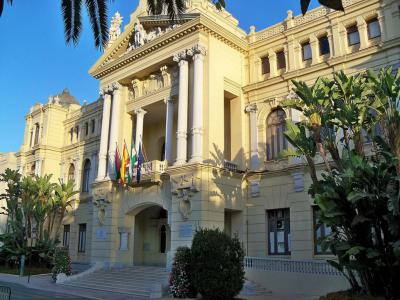
8) Ayuntamiento de Málaga (Malaga City Hall)
This baroque style structure is one of the most beautiful government buildings in Spain. The façade and interiors have many beautifully preserved works of art by well known local artists. It is located in an elegantly landscaped garden near the Alcazaba fortress.
Two local architects, Fernando Guerrero Strachan and Manuel Rivera Vera, designed the Ayuntamiento de Málaga. Intended for housing the offices of the local government, this Neo-Baroque structure was completed in 1919. The building has three floors and a clock tower. The façade is covered with sculptures of men, garlands of fruits and vegetables created by artist Diego Garcia Carreras. The interior is full of artistic and architectural treasures including the sculpture of a woman who represents the city surrounded by figures representing architecture, commerce, fishing and the sea.
The first floor has stained glass windows that represent the history of Malaga. The second floor has the offices of the mayor, the council meeting room and the famous Hall of Mirrors with Neo-Rococo designed mirror frames and a ceiling with paintings by well-known artists. The Hall of Mirrors is the best-known part of the building. The corridors of the second floor have portraits of all the 20th-century Mayors of Málaga painted by prominent artists.
Visitors require special permission enter the building to view its magnificent interior art and architecture.
Two local architects, Fernando Guerrero Strachan and Manuel Rivera Vera, designed the Ayuntamiento de Málaga. Intended for housing the offices of the local government, this Neo-Baroque structure was completed in 1919. The building has three floors and a clock tower. The façade is covered with sculptures of men, garlands of fruits and vegetables created by artist Diego Garcia Carreras. The interior is full of artistic and architectural treasures including the sculpture of a woman who represents the city surrounded by figures representing architecture, commerce, fishing and the sea.
The first floor has stained glass windows that represent the history of Malaga. The second floor has the offices of the mayor, the council meeting room and the famous Hall of Mirrors with Neo-Rococo designed mirror frames and a ceiling with paintings by well-known artists. The Hall of Mirrors is the best-known part of the building. The corridors of the second floor have portraits of all the 20th-century Mayors of Málaga painted by prominent artists.
Visitors require special permission enter the building to view its magnificent interior art and architecture.
9) Rectory of the University of Malaga
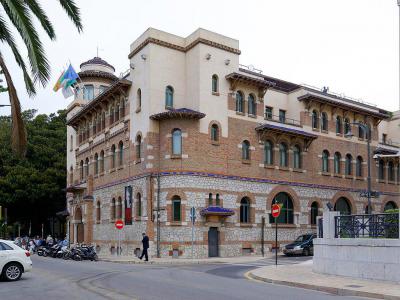
The Rectory of the University of Malaga (Rectorado de la Universidad de Málaga) is housed in the Old Post Office building in the city. The style of the structure has Moorish elements that came to be known as Neo Mujedar.
The Cassa de Correos or Post office opened its doors in 1923. It was purpose built based on the plan of architect, Teodoro de Anasagasti y Algan. The building is the finest example of Neo Mujedar architecture in Malaga. The layout of the structure is square with rounded corners and cylindrical towers. The brick and stone façade is enhanced by ornamentation using cobalt blue tiles. To add to the Mujedar atmosphere, cobalt blue tiles are used in the interior especially around windows. An inner patio has a glass ceiling. From the patio visitors can see pits where a fish sauce called Garum was produced. Garum was historically exported to Rome, where it was considered a delicacy.
Until 1986, the building served as the main post office of the city. It then became the office of the Rector of the University of Malaga. The Rectorado de la Universidad de Malaga has a large exhibition hall on the first floor where free exhibitions are held by university scholars.
The Cassa de Correos or Post office opened its doors in 1923. It was purpose built based on the plan of architect, Teodoro de Anasagasti y Algan. The building is the finest example of Neo Mujedar architecture in Malaga. The layout of the structure is square with rounded corners and cylindrical towers. The brick and stone façade is enhanced by ornamentation using cobalt blue tiles. To add to the Mujedar atmosphere, cobalt blue tiles are used in the interior especially around windows. An inner patio has a glass ceiling. From the patio visitors can see pits where a fish sauce called Garum was produced. Garum was historically exported to Rome, where it was considered a delicacy.
Until 1986, the building served as the main post office of the city. It then became the office of the Rector of the University of Malaga. The Rectorado de la Universidad de Malaga has a large exhibition hall on the first floor where free exhibitions are held by university scholars.
10) Alcazaba of Malaga (Malaga Fortress) (must see)
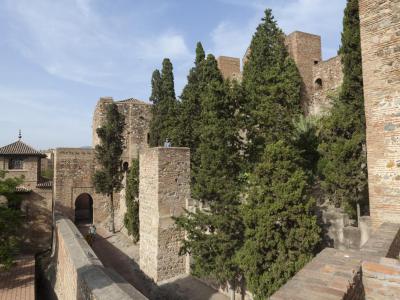
The Malaga Fortress is built on a hill near the center of Malaga. As a military installation, it is ideally situated. It overlooks both the city below and the sea. It is enclosed by two massive walls of stone. It was also attached to the city ramparts and it has strategically located defensive towers.
The outer fortress is accessed by the Vault Gate. The gate was designed to double back on itself, making it difficult for intruders to enter. These days, however, visitors may use the elevator.
A pathway leads up past gardens and ornate fountains through the Gate of Columns or Tower of Christ and then turns abruptly once again with intruders in mind. The inner fortress can be reached by the Gate of the Granada Quarters, which defends the western edge of the palace. The Tower of Tribute takes care of the eastern edge.
Inside this second defensive wall is the palace itself and houses which were built on three patios in the 11th, 13th and 14th centuries. Among them are the Quarters of Granada. The Quarters would serve as residences of governors and as Royal Apartments.
The Malaga Fortress is located at the foot the Gibralfaro hill. It is connected to the Arab defenses by a walled-in passageway called Coracha. The Roman Theatre and the customs building share a space. Here is the opportunity to compare Roman, Renaissance and Arab construction together.
Arab historians claim the palace was built by 1063 by order of King Badis of the Berber Taifa of Granada. Building materials were transported to the site for general construction and the columns while the old Roman theatre supplied materials for capitals and other like uses.
Ferdinand and Isabella seized Malaga in 1487 by one of the longest sieges of the Reconquest. They entered the fortress and raised their royal standard at the Tower of Tribute. That was the day Spain became Spain.
The outer fortress is accessed by the Vault Gate. The gate was designed to double back on itself, making it difficult for intruders to enter. These days, however, visitors may use the elevator.
A pathway leads up past gardens and ornate fountains through the Gate of Columns or Tower of Christ and then turns abruptly once again with intruders in mind. The inner fortress can be reached by the Gate of the Granada Quarters, which defends the western edge of the palace. The Tower of Tribute takes care of the eastern edge.
Inside this second defensive wall is the palace itself and houses which were built on three patios in the 11th, 13th and 14th centuries. Among them are the Quarters of Granada. The Quarters would serve as residences of governors and as Royal Apartments.
The Malaga Fortress is located at the foot the Gibralfaro hill. It is connected to the Arab defenses by a walled-in passageway called Coracha. The Roman Theatre and the customs building share a space. Here is the opportunity to compare Roman, Renaissance and Arab construction together.
Arab historians claim the palace was built by 1063 by order of King Badis of the Berber Taifa of Granada. Building materials were transported to the site for general construction and the columns while the old Roman theatre supplied materials for capitals and other like uses.
Ferdinand and Isabella seized Malaga in 1487 by one of the longest sieges of the Reconquest. They entered the fortress and raised their royal standard at the Tower of Tribute. That was the day Spain became Spain.
11) Teatro Romano (Roman Theatre)
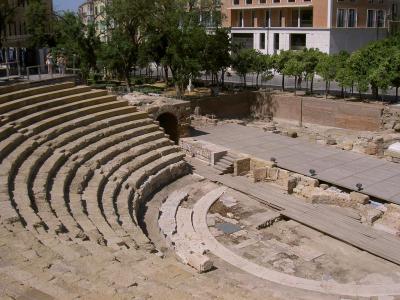
The Teatro Romano (or Roman Theater) was discovered while laying the gardens of the Palace archive and Libraries of Malaga. The theater is still in the process of restoration and preservation by archaeologists.
The theater dates back to the 1st century and was constructed during the reign of the Roman Emperor Augustus. At the time, Spain formed the Roman province of Hispania. The theater was used till the 3rd century. The remains were found in 1951 and the building in the location was demolished to facilitate excavation.
The radius of the semicircular space to seat spectators is 31 meters and the theatre is 16 meters high. It is divided by aisles. There is also a 15-meter semicircular space where the orchestra performed. Excavation is still in progress and signs of a larger Roman site are slowly visible. The present theater is a reproduction, although some of the old walls are preserved. The Moors used the stones from the original structure to build the Alcazaba Fortress.
There is a modern interpretation center inaugurated in 2010 where an audio-visual presentation of Roman history and details of the objects found during the excavation are related for the benefit of visitors. The Teatro Romano is located just below the Alcazaba. Visitors can get a full view of the Roman Theater from the top of the fortress.
Tip:
The best views are from the normal public pedestrianized walkways that pass by this the Roman amphitheater.
The theater dates back to the 1st century and was constructed during the reign of the Roman Emperor Augustus. At the time, Spain formed the Roman province of Hispania. The theater was used till the 3rd century. The remains were found in 1951 and the building in the location was demolished to facilitate excavation.
The radius of the semicircular space to seat spectators is 31 meters and the theatre is 16 meters high. It is divided by aisles. There is also a 15-meter semicircular space where the orchestra performed. Excavation is still in progress and signs of a larger Roman site are slowly visible. The present theater is a reproduction, although some of the old walls are preserved. The Moors used the stones from the original structure to build the Alcazaba Fortress.
There is a modern interpretation center inaugurated in 2010 where an audio-visual presentation of Roman history and details of the objects found during the excavation are related for the benefit of visitors. The Teatro Romano is located just below the Alcazaba. Visitors can get a full view of the Roman Theater from the top of the fortress.
Tip:
The best views are from the normal public pedestrianized walkways that pass by this the Roman amphitheater.
12) Plaza de la Merced (Merced Square) (must see)
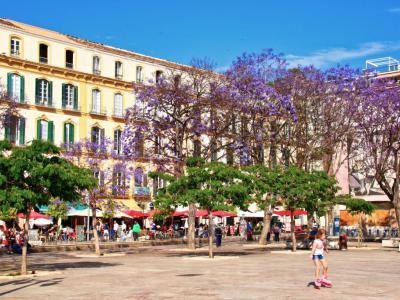
Merced Square is a part of the neighborhood of La Merced in Malaga. In August of 1487 the formal surrender of the city by the Moors took place in this square. The procession was led by Bishop Pedro de Toledo. There were the Catholic Monarchs, knights, nobility, and freed Christian captives. It was quite a party.
In 1507 the Mercedarian Friars arrived at the Square. They built a church and a large convent. It was the mission of the Mercedarians to free Christians slaves from captivity. The square is outside of the old Moorish city walls. It is a true square, laid down by Roman builders, not formed by a simple confluence of streets.
In the center of the square is the Monument to Torrijos, erected in the 19th century. Rafael Mitjana designed the monument to memorialize General Jose Maria Torrijos and 48 of his followers who were executed by order of Ferdinand VII. The base of the monument houses the remains of General Torrijos and his men.
There is a statue of Pablo Picasso in the square. He is sitting on a bench with his notebook and pencil. He sits to one side, leaving plenty of room for anyone who would like to sit next to him. The house Picasso was born in is Number 15 of the Plaza. It is now a museum and the office of the Pablo Ruiz Picasso Foundation.
Why You Should Visit:
Very pretty square wherein you can get a good look at and sit next to Picasso himself for a photo opportunity.
The understated element is its proximity to a range of bars & restaurants that bedeck the area immediately surrounding.
In 1507 the Mercedarian Friars arrived at the Square. They built a church and a large convent. It was the mission of the Mercedarians to free Christians slaves from captivity. The square is outside of the old Moorish city walls. It is a true square, laid down by Roman builders, not formed by a simple confluence of streets.
In the center of the square is the Monument to Torrijos, erected in the 19th century. Rafael Mitjana designed the monument to memorialize General Jose Maria Torrijos and 48 of his followers who were executed by order of Ferdinand VII. The base of the monument houses the remains of General Torrijos and his men.
There is a statue of Pablo Picasso in the square. He is sitting on a bench with his notebook and pencil. He sits to one side, leaving plenty of room for anyone who would like to sit next to him. The house Picasso was born in is Number 15 of the Plaza. It is now a museum and the office of the Pablo Ruiz Picasso Foundation.
Why You Should Visit:
Very pretty square wherein you can get a good look at and sit next to Picasso himself for a photo opportunity.
The understated element is its proximity to a range of bars & restaurants that bedeck the area immediately surrounding.
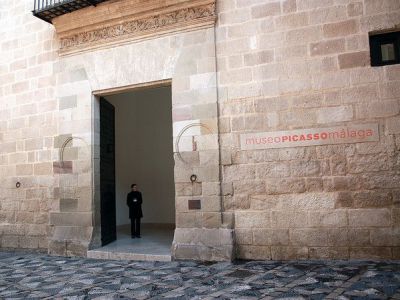
13) Museo Picasso Málaga (Picasso Museum) (must see)
Pablo Picasso's father, Jose Ruiz, was the curator of the city museum of Malaga. The museum was not often open to the public because of limited budgets. Part of Jose's compensation was the exclusive use of a room in the building as an art studio. Pablo did his first sketches in that room, working with his father.
Now Picasso has a museum in Paris, and another in Barcelona. He has several of them but the Picasso Museum in Malaga is close to home. Six hundred feet away from the Picasso Museum is the Merced Square where he was born. In 2003 the Picasso Museum had its grand opening with the King and Queen of Spain in attendance.
The Buenavista Palace that housed the museum was built in the 16th century. It was built for one Diego de Cazalla. Under the Palace were the remains of a Nasrid palace which have partially survived.
The 20th century conversion of the dilapidated palace into a museum was a challenging project led by architect Richard Gluckman. The palace alone was not large enough to accommodate all the functions of a proper museum. It was necessary to acquire two neighboring houses that had fallen into disrepair.
Christine Picasso, widow of the artist's eldest son Paulo Ruiz-Picasso, and her son Bernard have donated 155 of Picasso's works to the Museum. The collection includes early studies in Cubism and his later re-doing of Old Masters. Additional pieces are on loan. There are documents, photos and a library with nearly a thousand titles devoted to Picasso.
Tip:
It is possible to get in for free on a Sunday at noon but be aware the queues can be huge and the wait is long.
Now Picasso has a museum in Paris, and another in Barcelona. He has several of them but the Picasso Museum in Malaga is close to home. Six hundred feet away from the Picasso Museum is the Merced Square where he was born. In 2003 the Picasso Museum had its grand opening with the King and Queen of Spain in attendance.
The Buenavista Palace that housed the museum was built in the 16th century. It was built for one Diego de Cazalla. Under the Palace were the remains of a Nasrid palace which have partially survived.
The 20th century conversion of the dilapidated palace into a museum was a challenging project led by architect Richard Gluckman. The palace alone was not large enough to accommodate all the functions of a proper museum. It was necessary to acquire two neighboring houses that had fallen into disrepair.
Christine Picasso, widow of the artist's eldest son Paulo Ruiz-Picasso, and her son Bernard have donated 155 of Picasso's works to the Museum. The collection includes early studies in Cubism and his later re-doing of Old Masters. Additional pieces are on loan. There are documents, photos and a library with nearly a thousand titles devoted to Picasso.
Tip:
It is possible to get in for free on a Sunday at noon but be aware the queues can be huge and the wait is long.

14) Plaza de la Constitución (Constitution Square)
This is the beating heart of Malaga. The square in a sense has always been there. It was there at the time of the Reconquest, when it was called the Four Streets Square. Before 1812 it was named "Main Town Square." The city hall was once here along with the Mayor's home, the jail and the Covent de los Augustins.
In 2002 the Square and Larios Street were changed into pedestrian areas. Each year in August the Square becomes the site of the Feast of Malaga. The fair celebrates the victory of the Catholic Monarchs, Ferdinand and Isabella in 1487 by the procession of the statue of the Virgin of Victory.
The statue is a gift of Isabella to the city. It is paraded from the Cathedral to the Church of Saint James Apostle. The procession simulates the entry of the Monarchs and their army. This is accompanied by shows of plants and flowers, regattas, concerts and (wait for it) bullfights. Holy Week and New Year are also celebrated in the Square.
Off to the side in the square is the Fountain of Genova. It is also known as the fountain of Charles V. It was brought to Malaga in the 1600s. Is it Genoese? It is certainly Italian. The mayor of the city paid nearly 1,000 ducats for it. What is that in today's money? One 1492 ducat (gold) is worth $1,000. Do the math.
Why You Should Visit:
Oozing character and history no matter from which direction it's viewed – a truly classic square.
In 2002 the Square and Larios Street were changed into pedestrian areas. Each year in August the Square becomes the site of the Feast of Malaga. The fair celebrates the victory of the Catholic Monarchs, Ferdinand and Isabella in 1487 by the procession of the statue of the Virgin of Victory.
The statue is a gift of Isabella to the city. It is paraded from the Cathedral to the Church of Saint James Apostle. The procession simulates the entry of the Monarchs and their army. This is accompanied by shows of plants and flowers, regattas, concerts and (wait for it) bullfights. Holy Week and New Year are also celebrated in the Square.
Off to the side in the square is the Fountain of Genova. It is also known as the fountain of Charles V. It was brought to Malaga in the 1600s. Is it Genoese? It is certainly Italian. The mayor of the city paid nearly 1,000 ducats for it. What is that in today's money? One 1492 ducat (gold) is worth $1,000. Do the math.
Why You Should Visit:
Oozing character and history no matter from which direction it's viewed – a truly classic square.

15) Museo Carmen Thyssen Malaga (Carmen Thyssen Museum) (must see)
The Carmen Thyssen Museum (Museo Carmen Thyssen Malaga), located in the heart of Malaga, is a celebrated cultural institution dedicated to 19th-century Spanish painting, with a special emphasis on Andalusian art. This museum stems from the personal collection of Carmen Cervera, the fifth wife of Baron Hans Heinrich Thyssen-Bornemisza, who began her journey as an art collector in the 1980s.
Cervera’s collection complements the broader Thyssen family art collection displayed at the Thyssen-Bornemisza Museum in Madrid since 1992. In 1999, she agreed to exhibit her works at the Madrid Museum temporarily while a permanent home for her collection was sought. The solution came in the form of the Carmen Thyssen Museum in Malaga, which officially opened to the public on March 24, 2011.
Housed within the 16th-century Baroque Villalon Palace, the museum combines historical charm with modern design. RG Associate Architects undertook the extensive project, reconstructing parts of the palace and adding purpose-built exhibition spaces. The museum spans 7,147 square meters, with 5,185 square meters allocated for exhibitions, including three rooms for its permanent collection and two dedicated to temporary displays. The Old Masters collection is displayed in the palace itself.
The site is also archaeologically significant. Excavations since 2005 have unearthed Roman-era remains, offering insight into continuous occupation from the 1st to the 5th century AD. Highlights include a suburban villa featuring a fish-salting factory, a monumental nymphaeum adorned with fish-themed wall paintings, geometric mosaics, and remnants of a bronze sculpture. The area later saw periods of abandonment, a brief revival for fish production in the 5th century, and eventually became a necropolis during the Byzantine era.
The Carmen Thyssen Museum stands as a beacon of art and history, intertwining Andalusian heritage with contemporary appreciation for Spanish painting, making it a must-visit cultural landmark in Malaga.
Cervera’s collection complements the broader Thyssen family art collection displayed at the Thyssen-Bornemisza Museum in Madrid since 1992. In 1999, she agreed to exhibit her works at the Madrid Museum temporarily while a permanent home for her collection was sought. The solution came in the form of the Carmen Thyssen Museum in Malaga, which officially opened to the public on March 24, 2011.
Housed within the 16th-century Baroque Villalon Palace, the museum combines historical charm with modern design. RG Associate Architects undertook the extensive project, reconstructing parts of the palace and adding purpose-built exhibition spaces. The museum spans 7,147 square meters, with 5,185 square meters allocated for exhibitions, including three rooms for its permanent collection and two dedicated to temporary displays. The Old Masters collection is displayed in the palace itself.
The site is also archaeologically significant. Excavations since 2005 have unearthed Roman-era remains, offering insight into continuous occupation from the 1st to the 5th century AD. Highlights include a suburban villa featuring a fish-salting factory, a monumental nymphaeum adorned with fish-themed wall paintings, geometric mosaics, and remnants of a bronze sculpture. The area later saw periods of abandonment, a brief revival for fish production in the 5th century, and eventually became a necropolis during the Byzantine era.
The Carmen Thyssen Museum stands as a beacon of art and history, intertwining Andalusian heritage with contemporary appreciation for Spanish painting, making it a must-visit cultural landmark in Malaga.
