Custom Walk in Marrakech, Morocco by amyfyeager_53f73 created on 2025-06-21
Guide Location: Morocco » Marrakech
Guide Type: Custom Walk
# of Sights: 13
Tour Duration: 4 Hour(s)
Travel Distance: 9 Km or 5.6 Miles
Share Key: GY8Z5
Guide Type: Custom Walk
# of Sights: 13
Tour Duration: 4 Hour(s)
Travel Distance: 9 Km or 5.6 Miles
Share Key: GY8Z5
How It Works
Please retrieve this walk in the GPSmyCity app. Once done, the app will guide you from one tour stop to the next as if you had a personal tour guide. If you created the walk on this website or come to the page via a link, please follow the instructions below to retrieve the walk in the app.
Retrieve This Walk in App
Step 1. Download the app "GPSmyCity: Walks in 1K+ Cities" on Apple App Store or Google Play Store.



Step 2. In the GPSmyCity app, download(or launch) the guide "Marrakech Map and Walking Tours".
Step 3. Tap the menu button located at upper right corner of the "Walks" screen and select "Retrieve custom walk". Enter the share key: GY8Z5
1) Le Jardin Secret (The Secret Garden) (must see)
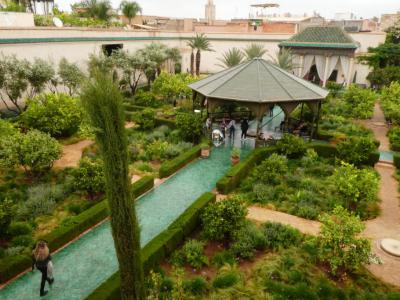
The Secret Garden, tucked within the heart of Marrakech’s medina, is a serene historic complex that traces its origins back several centuries. The site was once part of a grand Saadian-era palace from the 16th century, built for powerful local dignitaries when Marrakech flourished as an imperial capital. After the fall of the Saadian dynasty, the estate changed hands multiple times and was repeatedly rebuilt, most notably during the 19th century when it became a refined aristocratic residence. Over time, the property fell into neglect, hidden behind high walls and largely forgotten until a major restoration project in the early 21st century brought it back to life and opened it to the public.
Today, The Secret Garden offers a peaceful contrast to the lively crowds of the surrounding souks. Its charm lies in its two distinct garden spaces, each reflecting traditional Islamic landscape design. As you step through the glass doors of the main entrance, you are first met by the shade of the smaller garden. This is the Exotic Garden, which features rare species from around the world—succulents, palms, and tropical plants—working together to create an intimate, almost hidden-oasis atmosphere. The larger Islamic Garden can be reached by walking along a narrow path to the right of a red pavilion, which is easily visible while exploring the Exotic Garden. The Islamic Garden follows a geometric layout inspired by Quranic descriptions of paradise, divided by pathways and fed by a historic hydraulic system that once supplied water to the palace. Shaded by olive trees, cypresses, and fruit trees, it showcases native Moroccan plants arranged with elegant symmetry.
Architectural elements also enrich the space. Restored pavilions located at both ends of the main garden display intricate zellige tilework, carved cedar, and elegant wooden balconies typical of 19th-century Moroccan mansions. Last but not least, a view from the tall tower on the western edge of the main garden brings everything into a single frame. As you enter the Islamic Garden, the tower appears to the right of the space’s far end. Second only to the Koutoubia Minaret in height, it offers one of the medina’s best panoramic viewpoints, with sweeping views of red rooftops, nearby minarets, and the distant silhouette of the Atlas Mountains.
Today, The Secret Garden offers a peaceful contrast to the lively crowds of the surrounding souks. Its charm lies in its two distinct garden spaces, each reflecting traditional Islamic landscape design. As you step through the glass doors of the main entrance, you are first met by the shade of the smaller garden. This is the Exotic Garden, which features rare species from around the world—succulents, palms, and tropical plants—working together to create an intimate, almost hidden-oasis atmosphere. The larger Islamic Garden can be reached by walking along a narrow path to the right of a red pavilion, which is easily visible while exploring the Exotic Garden. The Islamic Garden follows a geometric layout inspired by Quranic descriptions of paradise, divided by pathways and fed by a historic hydraulic system that once supplied water to the palace. Shaded by olive trees, cypresses, and fruit trees, it showcases native Moroccan plants arranged with elegant symmetry.
Architectural elements also enrich the space. Restored pavilions located at both ends of the main garden display intricate zellige tilework, carved cedar, and elegant wooden balconies typical of 19th-century Moroccan mansions. Last but not least, a view from the tall tower on the western edge of the main garden brings everything into a single frame. As you enter the Islamic Garden, the tower appears to the right of the space’s far end. Second only to the Koutoubia Minaret in height, it offers one of the medina’s best panoramic viewpoints, with sweeping views of red rooftops, nearby minarets, and the distant silhouette of the Atlas Mountains.

2) Marrakech Souks (Marrakech Market) (must see)
The Marrakech Market — commonly referred to simply as the souks of the medina — is one of the oldest and most characteristic trading networks in North Africa. Its history stretches back to the 11th and 12th centuries, when the Almoravids and later the Almohads established Marrakech as a major imperial capital. As caravans arrived from the Sahara, the Atlas Mountains, and cities across North Africa and Andalusia, the medina developed into a dense commercial maze where every profession had its own dedicated street or quarter. Over time, these clustered craft guilds formed the interconnected market system that survives today.
For centuries, the souks functioned as Marrakech’s economic engine. Goods such as leather, wool, spices, metals, pottery, and textiles were crafted and traded in the very same alleys where artisans still work today. Many workshops are family-run and passed down through generations, preserving traditional techniques such as hand-dyeing wool for carpets, hammering brass lanterns, and carving cedarwood.
Entering the Marrakech Market brings you into a vibrant, sensory world. Narrow lanes unfold into covered passages where sunlight filters through reed roofs, illuminating stacks of rugs, rows of bright traditional slippers, woven baskets, and intricate metalwork. The smell of saffron, mint, and sandalwood fills the air as spice merchants display pyramids of colourful powders. Leather tanneries supply stalls selling bags and belts, while textile souks offer handwoven blankets and traditional garments. Artisans often work just steps from their storefronts, allowing visitors to watch pottery being shaped, wood being carved, or silver jewellery being polished.
Beyond shopping, the souks offer a rich cultural experience. Merchants engage in friendly bargaining, herbalists explain traditional remedies, and local women select ingredients for home cooking. Squares and intersections become informal meeting places where cafés spill onto the street, serving some of the best mint tea in the city. Walk with confidence, and you’ll quickly feel at home in the lively rhythm of the medina’s markets.
For centuries, the souks functioned as Marrakech’s economic engine. Goods such as leather, wool, spices, metals, pottery, and textiles were crafted and traded in the very same alleys where artisans still work today. Many workshops are family-run and passed down through generations, preserving traditional techniques such as hand-dyeing wool for carpets, hammering brass lanterns, and carving cedarwood.
Entering the Marrakech Market brings you into a vibrant, sensory world. Narrow lanes unfold into covered passages where sunlight filters through reed roofs, illuminating stacks of rugs, rows of bright traditional slippers, woven baskets, and intricate metalwork. The smell of saffron, mint, and sandalwood fills the air as spice merchants display pyramids of colourful powders. Leather tanneries supply stalls selling bags and belts, while textile souks offer handwoven blankets and traditional garments. Artisans often work just steps from their storefronts, allowing visitors to watch pottery being shaped, wood being carved, or silver jewellery being polished.
Beyond shopping, the souks offer a rich cultural experience. Merchants engage in friendly bargaining, herbalists explain traditional remedies, and local women select ingredients for home cooking. Squares and intersections become informal meeting places where cafés spill onto the street, serving some of the best mint tea in the city. Walk with confidence, and you’ll quickly feel at home in the lively rhythm of the medina’s markets.
3) Ben Youssef Madrasa (must see)
Ben Youssef Madrasa is one of Marrakech’s most celebrated historic monuments and one of the largest and finest Islamic colleges ever built in North Africa. Madrasa means “centre of learning” and can refer to a school, a college, or a university. Founded in the 14th century under the Marinid dynasty and later rebuilt in the mid-16th century by the Saadian sultans, the madrasa served for centuries as a centre of religious scholarship, attracting students from across Morocco and the wider Arab world. At its peak, it housed around 150 students, many of whom lived in tiny dormitory cells arranged around the upper floors.
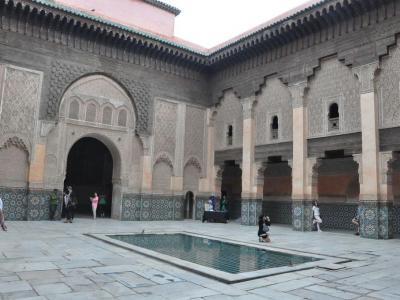
After you walk through the entrance passage, you enter the central courtyard of the madrasa. Like most of Marrakech’s architectural gems, the vast courtyard is the heart of the complex, with all other parts radiating from it. The space is paved in marble, with a large reflecting pool that mirrors the surrounding ornamentation. Every surface seems carefully considered: walls covered in carved cedarwood, stucco panels etched with flowing Arabic calligraphy, and geometric tilework forming dazzling patterns. The beauty of the space was meant to inspire contemplation, discipline, and spiritual focus—qualities essential to the life of a Quranic scholar.
Equally striking is the contrast between the madrasa’s grand public spaces and its modest student quarters. The small, bare rooms offer a poignant reminder of the austere lives led by students who devoted themselves entirely to study. The rooms are arranged on two levels: the lower dormitory cells are accessible via doorways off the courtyard, while the upper ones can be reached by staircases located in the corners of the same courtyard.
Although the madrasa ceased operating as a school in the 1960s, it remains one of Marrakech’s cultural treasures. Its meticulous restoration allows visitors to appreciate the artistry of Saadian craftsmanship and the atmosphere of learning that once animated its halls. For anyone interested in Moroccan architecture, Islamic art, or the intellectual history of the Maghreb, Ben Youssef Madrasa offers an unforgettable window into the city’s past.
After you walk through the entrance passage, you enter the central courtyard of the madrasa. Like most of Marrakech’s architectural gems, the vast courtyard is the heart of the complex, with all other parts radiating from it. The space is paved in marble, with a large reflecting pool that mirrors the surrounding ornamentation. Every surface seems carefully considered: walls covered in carved cedarwood, stucco panels etched with flowing Arabic calligraphy, and geometric tilework forming dazzling patterns. The beauty of the space was meant to inspire contemplation, discipline, and spiritual focus—qualities essential to the life of a Quranic scholar.
Equally striking is the contrast between the madrasa’s grand public spaces and its modest student quarters. The small, bare rooms offer a poignant reminder of the austere lives led by students who devoted themselves entirely to study. The rooms are arranged on two levels: the lower dormitory cells are accessible via doorways off the courtyard, while the upper ones can be reached by staircases located in the corners of the same courtyard.
Although the madrasa ceased operating as a school in the 1960s, it remains one of Marrakech’s cultural treasures. Its meticulous restoration allows visitors to appreciate the artistry of Saadian craftsmanship and the atmosphere of learning that once animated its halls. For anyone interested in Moroccan architecture, Islamic art, or the intellectual history of the Maghreb, Ben Youssef Madrasa offers an unforgettable window into the city’s past.
4) Souk Zrabia (Carpet Market)
The bustling markets worldwide exude a consistent air of chaos, yet stepping into the souks – the vibrant heart and soul of Marrakech's finest markets – takes this frenzy to an unparalleled level. If the concept of a 'souk' is foreign to you, take a moment to unwind with a soothing mint tea at one of the quaint cafes scattered across the square. Prepare yourself for an immersive encounter that lies ahead. Exploring the souks is undoubtedly among the top activities in Marrakech, destined to etch a vivid recollection of Morocco's visuals, sounds, and aromas into your memory.
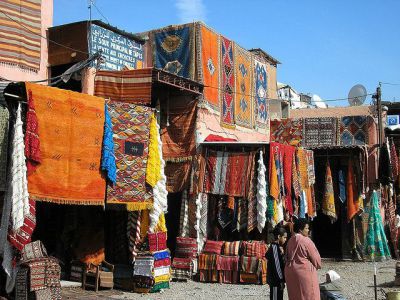
Adjacent to Rahba Kedima, a pathway on the left leads to yet another bustling square. This space, once utilized for slave trading but now transformed into one of Marrakech's premier markets, harbors the covered carpet souk known as Souk Zrabi. A diverse array of carpets and rugs awaits your selection here. Eager vendors stand ready to narrate the intricate lineage of Moroccan carpet craftsmanship. Should you hold a penchant for exquisite rugs, this locale beckons as your ultimate sourcing destination.
Historically, this market hosted slave auctions every Wednesday, Thursday, and Friday, primarily trading sub-Saharan Africans under the purview of Arab slavers, until the French takeover in 1912. In contrast to the vigour of other Marrakech markets, the ambiance here adopts a more serene quality, affording you the pleasure of perusing merchandise without enduring the pressures of an insistent salesperson.
Adjacent to Rahba Kedima, a pathway on the left leads to yet another bustling square. This space, once utilized for slave trading but now transformed into one of Marrakech's premier markets, harbors the covered carpet souk known as Souk Zrabi. A diverse array of carpets and rugs awaits your selection here. Eager vendors stand ready to narrate the intricate lineage of Moroccan carpet craftsmanship. Should you hold a penchant for exquisite rugs, this locale beckons as your ultimate sourcing destination.
Historically, this market hosted slave auctions every Wednesday, Thursday, and Friday, primarily trading sub-Saharan Africans under the purview of Arab slavers, until the French takeover in 1912. In contrast to the vigour of other Marrakech markets, the ambiance here adopts a more serene quality, affording you the pleasure of perusing merchandise without enduring the pressures of an insistent salesperson.
5) Marrakech Medina (Old City) (must see)
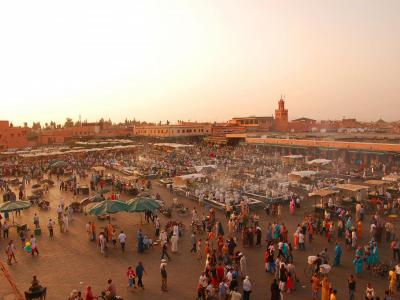
The oldest sector of Marrakech is the Medina, encircled by protective walls. Entry into this district is via one of numerous gateways, and it boasts a wealth of age-old wonders to be explored, promising an enchanting experience.
Marrakech's Medina is a UNESCO site, a vibrant historic market with a fortified city. It's a bustling African hub for commerce and tourism, backed by King Mohammed VI's goal to attract 20 million visitors by 2020.
Within the Medina, you'll encounter at least eight principal historical gates: Bab Doukkala, Bab el-Khemis, Bab ad-Debbagh, Bab Aylan, Bab Aghmat, Bab er-Robb, Bab el-Makhzen, and Bab el-'Arissa. These gateways trace back to the 12th century during the Almoravid era, although many have been subject to modifications since then.
In the time before the rise of the Almoravid Dynasty, the capital of present-day Morocco was situated in Aghmat, now an archaeological site located 30 km from Marrakech. Following the Almoravides' conquest of the city in 1062 and their establishment of rule, their leader Abou Bakir ibn Umar sought to create a new capital.
Two rival cities vied to be the new capital, with ibn Umar choosing a plain near the River Tensift to prevent further rivalry. By 1070, the new capital emerged, adorned with palm trees, orange groves, and houses along alleys. Fearing rival tribes like the Almohades, the sultan built a defensive wall around the city.
The Almohades ultimately captured the Medina in 1147, resulting in the destruction and subsequent reconstruction of numerous splendid edifices to align with the new dynasty's vision. The Medina retained its status as Morocco's capital until the fall of the Almohad Dynasty in 1269. It once again held the capital designation between the 16th and 17th centuries, as well as in 1792.
The city's expansion occurred organically beyond the confines of the Medina. Here, remnants of ancient palaces, the Koutoubia Mosque, the Ben Youssef Madrasa, and the renowned Saadian Tombs still stand, testifying to the grandeur of the Moroccan Empire.
Marrakech's Medina is a UNESCO site, a vibrant historic market with a fortified city. It's a bustling African hub for commerce and tourism, backed by King Mohammed VI's goal to attract 20 million visitors by 2020.
Within the Medina, you'll encounter at least eight principal historical gates: Bab Doukkala, Bab el-Khemis, Bab ad-Debbagh, Bab Aylan, Bab Aghmat, Bab er-Robb, Bab el-Makhzen, and Bab el-'Arissa. These gateways trace back to the 12th century during the Almoravid era, although many have been subject to modifications since then.
In the time before the rise of the Almoravid Dynasty, the capital of present-day Morocco was situated in Aghmat, now an archaeological site located 30 km from Marrakech. Following the Almoravides' conquest of the city in 1062 and their establishment of rule, their leader Abou Bakir ibn Umar sought to create a new capital.
Two rival cities vied to be the new capital, with ibn Umar choosing a plain near the River Tensift to prevent further rivalry. By 1070, the new capital emerged, adorned with palm trees, orange groves, and houses along alleys. Fearing rival tribes like the Almohades, the sultan built a defensive wall around the city.
The Almohades ultimately captured the Medina in 1147, resulting in the destruction and subsequent reconstruction of numerous splendid edifices to align with the new dynasty's vision. The Medina retained its status as Morocco's capital until the fall of the Almohad Dynasty in 1269. It once again held the capital designation between the 16th and 17th centuries, as well as in 1792.
The city's expansion occurred organically beyond the confines of the Medina. Here, remnants of ancient palaces, the Koutoubia Mosque, the Ben Youssef Madrasa, and the renowned Saadian Tombs still stand, testifying to the grandeur of the Moroccan Empire.
6) Jemaa el-Fnaa Square (must see)
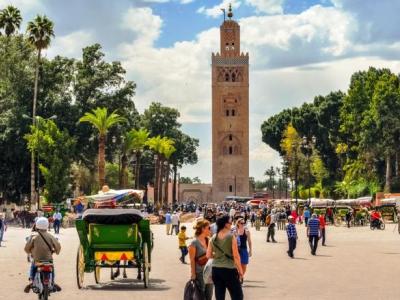
Jemaa el-Fnaa is the beating heart of Marrakech and one of the most iconic public squares in the world. It has served as a central gathering place for more than a thousand years. The name is often translated as “Assembly of the Dead” or “Place of the Vanished,” likely referring to its early use as a site for public executions during the rule of the Almoravids and Almohads in the 11th and 12th centuries. Over time, however, Jemaa el-Fnaa transformed from a grim ceremonial ground into a vibrant crossroads of trade, storytelling, and culture.
By the medieval period, the square had become a lively open market where caravans arriving from the Sahara, the Atlas Mountains, and coastal cities converged. Merchants sold spices, leather, textiles, and medicinal herbs, while musicians, poets, and snake charmers entertained crowds — traditions that have endured to this day. This unique blend led UNESCO to declare Jemaa el-Fnaa a Masterpiece of the Oral and Intangible Heritage of Humanity in 2001, recognizing its role in preserving Moroccan cultural traditions.
Visitors can watch snake charmers coax cobras to the rhythm of desert flutes, listen to traditional storytellers recount ancient folktales in Moroccan Arabic, or sip mint tea while observing the shifting rhythms of daily life. Barbary macaques may be placed on your shoulder for a souvenir photograph, and bargaining is part of the experience. The square also serves as a gateway into the surrounding maze of souks, where carpets, lanterns, spices, and silver jewelry await discovery.
By the medieval period, the square had become a lively open market where caravans arriving from the Sahara, the Atlas Mountains, and coastal cities converged. Merchants sold spices, leather, textiles, and medicinal herbs, while musicians, poets, and snake charmers entertained crowds — traditions that have endured to this day. This unique blend led UNESCO to declare Jemaa el-Fnaa a Masterpiece of the Oral and Intangible Heritage of Humanity in 2001, recognizing its role in preserving Moroccan cultural traditions.
Visitors can watch snake charmers coax cobras to the rhythm of desert flutes, listen to traditional storytellers recount ancient folktales in Moroccan Arabic, or sip mint tea while observing the shifting rhythms of daily life. Barbary macaques may be placed on your shoulder for a souvenir photograph, and bargaining is part of the experience. The square also serves as a gateway into the surrounding maze of souks, where carpets, lanterns, spices, and silver jewelry await discovery.
7) Bahia Palace (must see)
The Bahia Palace in Marrakech is one of the finest examples of late 19th-century Moroccan architecture, built to showcase the wealth and status of its owners. Construction began in the 1860s under the grand vizier of Sultan Muhammad IV and was later expanded by his son, Ba Ahmed, who served as regent of Morocco until 1900. The name “Bahia,” meaning “brilliance” in Arabic, reflects the intention behind the palace: to create a masterpiece of beauty, craftsmanship, and luxury. Although much of its original furniture and decoration was removed after Ba Ahmed’s death, the palace itself remains an exceptional expression of power and refined taste.
What makes the Bahia Palace particularly fascinating is not just its scale but its intricate design. The complex includes grand reception halls, intimate private rooms, open courtyards, gardens of cypress and orange trees, and elaborate decorative details at every turn. Carved cedar ceilings, zellige tilework, stucco patterns, and painted wooden panels demonstrate the highest level of craftsmanship of the period. Unlike traditional palaces arranged along a strict central axis, the Bahia consists of multiple irregular wings added over time, giving it a layered and almost labyrinthine character.
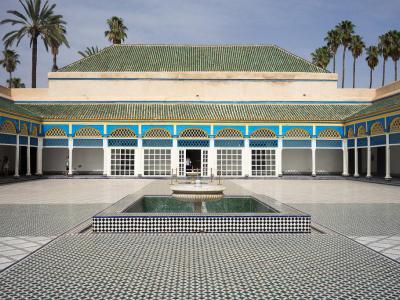
As you enter the palace grounds through a horseshoe archway, you are met by a path lined with orange trees, cypresses, hibiscus, and palms. The Grand Courtyard is the highlight of the palace and can be reached by walking straight ahead from the main entrance through a sequence of smaller rooms and courtyards. Once there, you can admire the delicate blue and yellow arches surrounding the courtyard. Together with the central fountain and the marble-tiled floor, the Grand Courtyard blends beautifully with the open sky above.
The palace carries strong cultural resonance, embodying the height of 19th-century Moroccan aristocratic life on the eve of the French Protectorate.
What makes the Bahia Palace particularly fascinating is not just its scale but its intricate design. The complex includes grand reception halls, intimate private rooms, open courtyards, gardens of cypress and orange trees, and elaborate decorative details at every turn. Carved cedar ceilings, zellige tilework, stucco patterns, and painted wooden panels demonstrate the highest level of craftsmanship of the period. Unlike traditional palaces arranged along a strict central axis, the Bahia consists of multiple irregular wings added over time, giving it a layered and almost labyrinthine character.
As you enter the palace grounds through a horseshoe archway, you are met by a path lined with orange trees, cypresses, hibiscus, and palms. The Grand Courtyard is the highlight of the palace and can be reached by walking straight ahead from the main entrance through a sequence of smaller rooms and courtyards. Once there, you can admire the delicate blue and yellow arches surrounding the courtyard. Together with the central fountain and the marble-tiled floor, the Grand Courtyard blends beautifully with the open sky above.
The palace carries strong cultural resonance, embodying the height of 19th-century Moroccan aristocratic life on the eve of the French Protectorate.
8) El Badi Palace (must see)
El Badi Palace is one of the city’s most evocative historical sites—less a traditional palace today than a grand ruin that invites the imagination to travel back to Morocco’s golden age. It was commissioned in the late 16th century by Sultan Ahmad al-Mansur of the Saadian dynasty, who ordered its construction after his victory over the Portuguese at the Battle of the Three Kings in 1578. Built with the finest materials available—Italian marble, gold from Sudan, carved cedarwood, and onyx—it took roughly 25 years to complete and was intended to symbolize the sultan’s wealth, power, and refined taste. Its name, “El Badi,” meaning “The Incomparable,” reflects that ambition.
In its prime, the palace featured more than 300 rooms, vast reception halls, sunken gardens, fountains, pavilions, and a massive courtyard surrounded by richly decorated chambers. Diplomats and dignitaries described it as one of the most magnificent residences of its time. However, its glory was short-lived. When the Alaouite dynasty came to power in the 17th century, Sultan Moulay Ismail stripped El Badi of its precious materials to embellish his own palace in Meknes, leaving behind the monumental shell that still stands today.
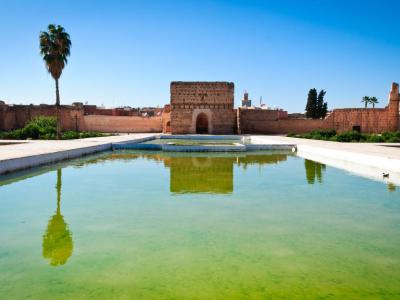
The enormous courtyard with its pools and orange trees remains the palace's focal point. The courtyard is hard to miss as its size is almost two hectars. A water basin sits at the center and is surrounded by four sunken gardens that can be accessed by stairs. Upon entering the palace, the best vantage point is a terrace immediately on the left that offers sweeping views of the palace's elements and the surrounding old town.
Throughout the palace's ruins, remnants of carved decor, fragments of tilework, and traces of stucco work hint at former splendor. Despite the loss of its former embellishments, the palace is enlivened by a colony of storks who made the ruins' ramparts their home. They truly have some good taste.
El Badi Palace invites you to explore its treasures that have been taken away by time. Fill the gaps by using your imagination and you are in for a memorable experience.
In its prime, the palace featured more than 300 rooms, vast reception halls, sunken gardens, fountains, pavilions, and a massive courtyard surrounded by richly decorated chambers. Diplomats and dignitaries described it as one of the most magnificent residences of its time. However, its glory was short-lived. When the Alaouite dynasty came to power in the 17th century, Sultan Moulay Ismail stripped El Badi of its precious materials to embellish his own palace in Meknes, leaving behind the monumental shell that still stands today.
The enormous courtyard with its pools and orange trees remains the palace's focal point. The courtyard is hard to miss as its size is almost two hectars. A water basin sits at the center and is surrounded by four sunken gardens that can be accessed by stairs. Upon entering the palace, the best vantage point is a terrace immediately on the left that offers sweeping views of the palace's elements and the surrounding old town.
Throughout the palace's ruins, remnants of carved decor, fragments of tilework, and traces of stucco work hint at former splendor. Despite the loss of its former embellishments, the palace is enlivened by a colony of storks who made the ruins' ramparts their home. They truly have some good taste.
El Badi Palace invites you to explore its treasures that have been taken away by time. Fill the gaps by using your imagination and you are in for a memorable experience.
9) Koutoubia Mosque and Minaret (must see)
The Koutoubia Mosque and its soaring minaret are the most recognizable landmarks of Marrakech, standing at the edge of the bustling Jemaa el-Fnaa square and marking the spiritual heart of the city. Construction began in 1150, shortly after the Almohad dynasty seized Marrakech from the Almoravids. The mosque was built on the site of an earlier structure and later expanded, with its final form taking shape by the late 12th century. Its name, “Koutoubia,” comes from the Arabic term meaning “booksellers,” because it once stood beside a thriving market of manuscript vendors and scholars.
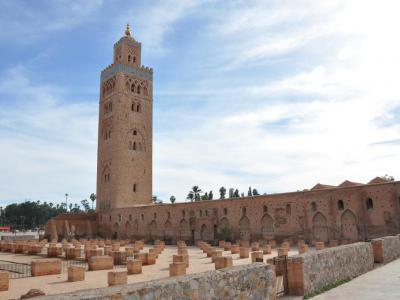
The minaret, rising approximately 77 meters including its spire, is a masterpiece of Almohad architecture and a model for later towers, including the Giralda in Seville and the Hassan Tower in Rabat. Built of red sandstone, it features harmonious proportions, decorative arches, and intricate geometric stonework, topped with a golden finial of four copper spheres. Its design reflects both the religious ambition and political authority of the Almohad empire, which sought to redefine Islamic architecture across North Africa and Al-Andalus.
The mosque itself is still in active use and not accessible to non-Muslims, but its exterior and surroundings offer much to appreciate. The gardens surrounding the mosque, known as the Koutoubia Gardens or Lalla Hasna Park, provide shaded paths, fountains, and views of the minaret framed by palms and roses. At sunset, when the tower glows softly against the sky and the call to prayer echoes across the city, the site becomes one of the most atmospheric places in Marrakech.
A Marrakech walking tour cannot be complete without its symbol. Wherever your legs take you, the Koutoubia Mosque is watching over you and is making sure that you will come back to take in the liveliness of its surroundings.
The minaret, rising approximately 77 meters including its spire, is a masterpiece of Almohad architecture and a model for later towers, including the Giralda in Seville and the Hassan Tower in Rabat. Built of red sandstone, it features harmonious proportions, decorative arches, and intricate geometric stonework, topped with a golden finial of four copper spheres. Its design reflects both the religious ambition and political authority of the Almohad empire, which sought to redefine Islamic architecture across North Africa and Al-Andalus.
The mosque itself is still in active use and not accessible to non-Muslims, but its exterior and surroundings offer much to appreciate. The gardens surrounding the mosque, known as the Koutoubia Gardens or Lalla Hasna Park, provide shaded paths, fountains, and views of the minaret framed by palms and roses. At sunset, when the tower glows softly against the sky and the call to prayer echoes across the city, the site becomes one of the most atmospheric places in Marrakech.
A Marrakech walking tour cannot be complete without its symbol. Wherever your legs take you, the Koutoubia Mosque is watching over you and is making sure that you will come back to take in the liveliness of its surroundings.
10) La Maison Arabe
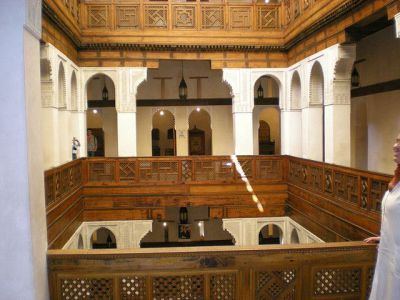
Nestled within Marrakech's vibrant Medina, lies La Maison Arabe-an oasis of luxury. This 5-star establishment is situated just a stone's throw away from the renowned Jemaa El Fna square. This exquisite riad extends an invitation to experience an extraordinary sojourn in a serene, authentic, and elegantly crafted environment. Choose from 26 beautifully decorated rooms and suites that combine traditional Moroccan style with a modern twist.
At La Maison Arabe, savor the delights of two distinguished dining establishments. The first, known as "The Restaurant," offers a symphony of traditional flavors set against the backdrop of Arab-Andalusian melodies. Meanwhile, "Les Trois Saveurs" promises a gastronomic voyage through French, Moroccan, and Asian culinary treasures.
Find solace amidst the verdant gardens of the kasbah and take pleasure in their tranquil pools-one nestled within the heart of the medina, the other gracing the landscapes of the Country Club, a mere 15-minute shuttle ride away.
Unwind at the spa, where genuine Moroccan treatments await to provide you with a rejuvenating interlude. Delve into the art of traditional cooking through immersive classes or unwind with a delightful cocktail at the piano bar.
At La Maison Arabe, savor the delights of two distinguished dining establishments. The first, known as "The Restaurant," offers a symphony of traditional flavors set against the backdrop of Arab-Andalusian melodies. Meanwhile, "Les Trois Saveurs" promises a gastronomic voyage through French, Moroccan, and Asian culinary treasures.
Find solace amidst the verdant gardens of the kasbah and take pleasure in their tranquil pools-one nestled within the heart of the medina, the other gracing the landscapes of the Country Club, a mere 15-minute shuttle ride away.
Unwind at the spa, where genuine Moroccan treatments await to provide you with a rejuvenating interlude. Delve into the art of traditional cooking through immersive classes or unwind with a delightful cocktail at the piano bar.

11) Majorelle Garden (must see)
When you visit the Museum of Islamic Art, you will first go through Majorelle Gardens and it is a good place to linger for a while.
Jacques Majorelle was a French artist, specializing in Art Nouveau paintings. He lived in Morocco for many years in his lovely house in Marrakech, where he laid out the gardens and opened them to the public in 1947.
The beautiful botanical gardens cover 12 acres with the house, which is painted in bold Cobalt called Bleu Majorelle. Most of the stonework in the gardens is in the same color, with jardinières painted in bright yellow, orange and green.
The gardens are home to over 15 different species of native birds, and goldfish, turtles and frogs abound in the ponds. You can follow the shady paths and admire the fountains, or relax on one of the many benches. There is a wonderful bamboo plantation, olive and banana trees, palms and bougainvilleas that add a slash of bright red and pink.
The gardens are an oasis of calm, but likely to be full of visitors, especially during the afternoon. There is a very good café serving mint tea and coffee and a shop where you can buy souvenirs and prints of Majorelle’s work.
After the artist’s death, the gardens became rather overgrown and abandoned-looking. The land was bought in 1980 by Yves Saint Laurent and Pierre Bergé, who restored the gardens to their former splendor. Yves Saint Laurent’s ashes were scattered here and there is a small memorial to him. The gardens are now managed by the YSL Foundation.
Why You Should Visit:
Blue is the main color here and it goes beautifully with the different plants and garden settings. Even with some crowds, you can still manage to take a few good pictures.
The YSL memorial, the Berber Museum, the water features, the bookstore, and the café are all fabulous.
Tip:
Buy a combination ticket at the YSL museum about 100 yards down the road. You can skip the line!
Jacques Majorelle was a French artist, specializing in Art Nouveau paintings. He lived in Morocco for many years in his lovely house in Marrakech, where he laid out the gardens and opened them to the public in 1947.
The beautiful botanical gardens cover 12 acres with the house, which is painted in bold Cobalt called Bleu Majorelle. Most of the stonework in the gardens is in the same color, with jardinières painted in bright yellow, orange and green.
The gardens are home to over 15 different species of native birds, and goldfish, turtles and frogs abound in the ponds. You can follow the shady paths and admire the fountains, or relax on one of the many benches. There is a wonderful bamboo plantation, olive and banana trees, palms and bougainvilleas that add a slash of bright red and pink.
The gardens are an oasis of calm, but likely to be full of visitors, especially during the afternoon. There is a very good café serving mint tea and coffee and a shop where you can buy souvenirs and prints of Majorelle’s work.
After the artist’s death, the gardens became rather overgrown and abandoned-looking. The land was bought in 1980 by Yves Saint Laurent and Pierre Bergé, who restored the gardens to their former splendor. Yves Saint Laurent’s ashes were scattered here and there is a small memorial to him. The gardens are now managed by the YSL Foundation.
Why You Should Visit:
Blue is the main color here and it goes beautifully with the different plants and garden settings. Even with some crowds, you can still manage to take a few good pictures.
The YSL memorial, the Berber Museum, the water features, the bookstore, and the café are all fabulous.
Tip:
Buy a combination ticket at the YSL museum about 100 yards down the road. You can skip the line!
12) Majorelle Museums (YSL Museum / Berber Museum) (must see)
If you have any interest in fashion, you'll definitely want to check out the Majorelle Garden's Yves Saint Laurent Musem. The garden itself, abundant with varied and unusually-shaped cacti and palm trees, had been taken over and revived by YSL years after the death of the artist Jacques Majorelle, and you can spend several hours transfixed by its magical beauty. The stunning YSL Museum is also breathtaking, featuring fully accessorized and clothed black mannequins, exhibiting the strong influence Moroccan colors and textiles had on YSL's design aesthetics. There is also a large display case with YSL's iconic jewelry and other accessories, as well as a wonderful and informative short movie to view and a changing art exhibit that features one artist.
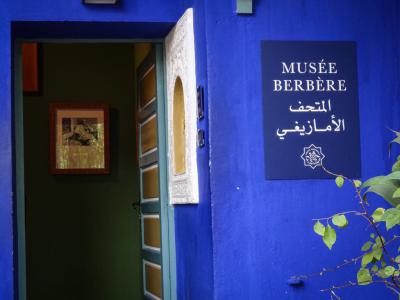
The Berber Museum, on the other hand, provides a comprehensive overview of the traditional dress and ornamentation of the Berber people. It is only small but the interest value is huge, and you can stand and inspect (if the crowds of people allow) the costumes and jewels closely in a way that you can't when you see people on the street wearing the same things – they certainly don't like being photographed. And actually, for that matter, no photography is allowed in the museum; however, in this collection, you can clearly see some of the vast source of YSL's inspiration.
Tip:
Avoid the long queue at the ticket booth for the Jardin Majorelle and head straight for their website (or the on-site YSL museum), where you can buy combination tickets of museums and garden (note that online purchases must be made at least 24 hours prior the visit).
The Berber Museum, on the other hand, provides a comprehensive overview of the traditional dress and ornamentation of the Berber people. It is only small but the interest value is huge, and you can stand and inspect (if the crowds of people allow) the costumes and jewels closely in a way that you can't when you see people on the street wearing the same things – they certainly don't like being photographed. And actually, for that matter, no photography is allowed in the museum; however, in this collection, you can clearly see some of the vast source of YSL's inspiration.
Tip:
Avoid the long queue at the ticket booth for the Jardin Majorelle and head straight for their website (or the on-site YSL museum), where you can buy combination tickets of museums and garden (note that online purchases must be made at least 24 hours prior the visit).
13) Gueliz
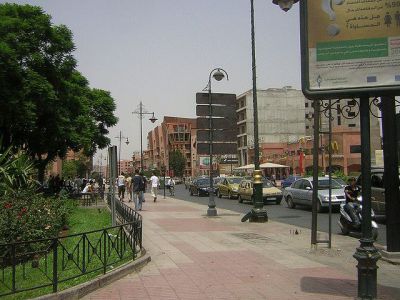
In contrast to the ancient Medina, Guéliz Marrakech stands as the vibrant hub of the Ochre City's contemporary commercial hub. Positioned to the west of the Medina, a mere 20-minute stroll from Place Jemaa el Fna (accessible through Boulevard Al Yarmouk), Guéliz presents an array of attractions to its visitors. Its focal points encompass shopping, dining, an array of exceptional art galleries, and captivating gardens.
The district of Guéliz originated from the 1912 "Protectorat" agreement between France and Morocco. Louis Hubert Gonzalve Lyautey, a French general, envisioned modernizing Marrakech by creating Guéliz, derived from the French word "église" (church). It started as a small French military camp and grew into a prominent new area near the ancient Medina, featuring art-deco style architecture by French architect Henri Prost and others. The district's growth included charming villas, wide avenues, plazas, and a central marketplace, while adhering to a height limit of three stories.
Today, the boulevards and lanes that harken back to the French colonial era are brimming with a plethora of upscale Moroccan, European, and international restaurants. Chic bars, nightclubs, art galleries, concept stores, and both mainstream and designer fashion boutiques also color the landscape.
Among the grandeur of Art Deco and Colonial-style facades, the district's principal tree-lined thoroughfare, Boulevard Mohammed VI (originally christened "Avenue de France"), holds a special allure. It has captured the hearts of both locals and tourists alike, inviting leisurely evening strolls in adjacent parks, the chance to bask in the perennial splendor of exotic flora, opportunities for lavish boutique shopping, and the enjoyment of Moroccan tea or coffee in the shaded alcoves of sprawling cafes.
The district of Guéliz originated from the 1912 "Protectorat" agreement between France and Morocco. Louis Hubert Gonzalve Lyautey, a French general, envisioned modernizing Marrakech by creating Guéliz, derived from the French word "église" (church). It started as a small French military camp and grew into a prominent new area near the ancient Medina, featuring art-deco style architecture by French architect Henri Prost and others. The district's growth included charming villas, wide avenues, plazas, and a central marketplace, while adhering to a height limit of three stories.
Today, the boulevards and lanes that harken back to the French colonial era are brimming with a plethora of upscale Moroccan, European, and international restaurants. Chic bars, nightclubs, art galleries, concept stores, and both mainstream and designer fashion boutiques also color the landscape.
Among the grandeur of Art Deco and Colonial-style facades, the district's principal tree-lined thoroughfare, Boulevard Mohammed VI (originally christened "Avenue de France"), holds a special allure. It has captured the hearts of both locals and tourists alike, inviting leisurely evening strolls in adjacent parks, the chance to bask in the perennial splendor of exotic flora, opportunities for lavish boutique shopping, and the enjoyment of Moroccan tea or coffee in the shaded alcoves of sprawling cafes.
