Custom Walk in Amsterdam, Netherlands by lisaevreinoff_85a47 created on 2025-06-30
Guide Location: Netherlands » Amsterdam
Guide Type: Custom Walk
# of Sights: 10
Tour Duration: 2 Hour(s)
Travel Distance: 3.7 Km or 2.3 Miles
Share Key: G664T
Guide Type: Custom Walk
# of Sights: 10
Tour Duration: 2 Hour(s)
Travel Distance: 3.7 Km or 2.3 Miles
Share Key: G664T
How It Works
Please retrieve this walk in the GPSmyCity app. Once done, the app will guide you from one tour stop to the next as if you had a personal tour guide. If you created the walk on this website or come to the page via a link, please follow the instructions below to retrieve the walk in the app.
Retrieve This Walk in App
Step 1. Download the app "GPSmyCity: Walks in 1K+ Cities" on Apple App Store or Google Play Store.



Step 2. In the GPSmyCity app, download(or launch) the guide "Amsterdam Map and Walking Tours".
Step 3. Tap the menu button located at upper right corner of the "Walks" screen and select "Retrieve custom walk". Enter the share key: G664T
1) Begijnhof – Beguine Courtyard
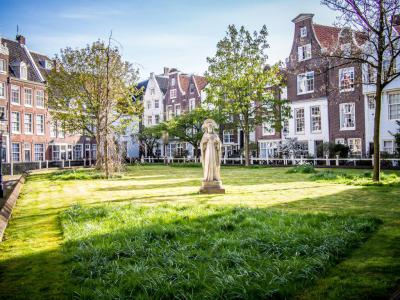
The Beguine Courtyard of the Begijnhof Chapel, one of Amsterdam's most ancient hidden courtyards, holds the distinction of being the sole inner court in the city founded during the Middle Ages and situated within the Singel-the innermost canal of Amsterdam's circular canal system. Adorned with manicured gardens, this courtyard sits at medieval street level, which places it a meter lower than the rest of the old city center. As the name suggests, it originally belonged to a community of Beguines-laywomen leading a semi-monastic life dedicated to prayer and charitable endeavors.
A cluster of historical edifices, predominantly private residences, surrounds the courtyard. These are tall townhouses, characterized by the distinctive Amsterdam architectural style, accentuating the court's relatively secluded ambiance. Unlike most courtyards, the buildings here are not arranged in rows connecting one dwelling to another; instead, there are 47 traditional townhouses, many adorned with facades dating back to the 17th and 18th centuries. However, the structures themselves often have origins predating this period, with eighteen of them retaining their original Gothic wooden framework.
During medieval times, the courtyard was entirely encircled by canals, offering only one entrance accessible via a bridge. Today, remnants of this entrance, known as the Begijnesloot, are still visible, thanks to a restoration effort in 1907. The stone doorway prominently displays the figure of Saint Ursula, the patron saint of Amsterdam's Beguines. Meanwhile, the entrance on Spuistraat, which was constructed at a later date, underwent significant changes in the 19th century.
A cluster of historical edifices, predominantly private residences, surrounds the courtyard. These are tall townhouses, characterized by the distinctive Amsterdam architectural style, accentuating the court's relatively secluded ambiance. Unlike most courtyards, the buildings here are not arranged in rows connecting one dwelling to another; instead, there are 47 traditional townhouses, many adorned with facades dating back to the 17th and 18th centuries. However, the structures themselves often have origins predating this period, with eighteen of them retaining their original Gothic wooden framework.
During medieval times, the courtyard was entirely encircled by canals, offering only one entrance accessible via a bridge. Today, remnants of this entrance, known as the Begijnesloot, are still visible, thanks to a restoration effort in 1907. The stone doorway prominently displays the figure of Saint Ursula, the patron saint of Amsterdam's Beguines. Meanwhile, the entrance on Spuistraat, which was constructed at a later date, underwent significant changes in the 19th century.
2) Munttoren (Mint Tower)
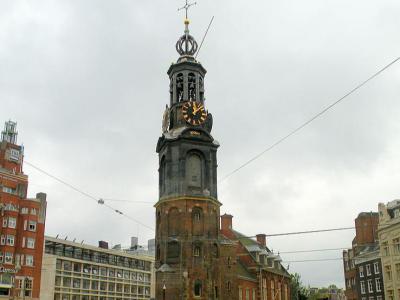
This tower served as both a boundary marker for the medieval walled city and one of its original gates. Back in the Middle Ages, the city walls were surrounded by a moat known as the Singel canal. Prior to around 1500, the area beyond this point was essentially just soggy fields and a handful of farms on reclaimed land. The steeple was actually added later, in 1620, as you can see below the clock face.
Erected during the latter part of the 15th century, the tower underwent significant renovations throughout the centuries. It managed to survive a big fire in 1618, which destroyed most of the city's walls, almost unscathed; however, it was rebuilt in the Renaissance style the following year. Hendrick de Keyser, a renowned Dutch architect and sculptor, was in charge of the reconstruction and added the elegant eight-sided top section. They also incorporated four clock faces and a set of bells, although the original bells are now on display in the Amsterdam Museum, having been replaced with newer ones. The tower chimes every quarter of an hour, and on Saturdays between 2 and 3pm, you can enjoy a live bell concerto.
The construction got its curious name in the 17th century during a time when the Dutch were in conflict with England and France. Since most of Dutch territory was occupied and there was a high risk of losing valuable resources, they needed a place to make money quickly, so they turned this tower into a makeshift mint. And that's how its uniqueness became etched into Amsterdam's rich tapestry of stories.
Erected during the latter part of the 15th century, the tower underwent significant renovations throughout the centuries. It managed to survive a big fire in 1618, which destroyed most of the city's walls, almost unscathed; however, it was rebuilt in the Renaissance style the following year. Hendrick de Keyser, a renowned Dutch architect and sculptor, was in charge of the reconstruction and added the elegant eight-sided top section. They also incorporated four clock faces and a set of bells, although the original bells are now on display in the Amsterdam Museum, having been replaced with newer ones. The tower chimes every quarter of an hour, and on Saturdays between 2 and 3pm, you can enjoy a live bell concerto.
The construction got its curious name in the 17th century during a time when the Dutch were in conflict with England and France. Since most of Dutch territory was occupied and there was a high risk of losing valuable resources, they needed a place to make money quickly, so they turned this tower into a makeshift mint. And that's how its uniqueness became etched into Amsterdam's rich tapestry of stories.
3) Spinhuis
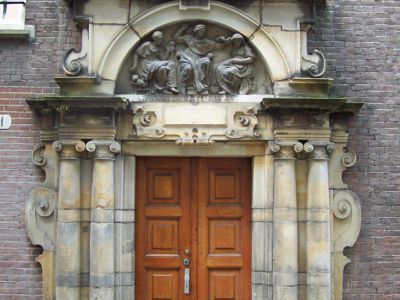
Once a residence designated for the rehabilitation of "fallen women", the Spinhuis has since been repurposed into office spaces. Remarkably, the original front door has endured the passage of time, adorned with an inscription by the 17th-century Dutch poet Pieter Cornelisz Hooft: "Weep not, for my intention is not to seek vengeance for transgressions but to compel you towards virtue. My hand may be stern, yet my heart is gentle."
Such moral admonitions are unlikely to have garnered favor with the incarcerated women who endured long hours and rigorous discipline toiling away on the Spinhuis's looms and spinning wheels. Interestingly, institutions of this nature were once featured on tourist routes; for a nominal fee, the public was granted the privilege of observing these women at work. During carnival festivities, admission was free, attracting sizable crowds who came to taunt and ridicule. The rationale behind this practice was the belief that public shame was an integral part of the reformative process. However, in reality, the municipal authorities unofficially tolerated brothels, and these incarcerated women had been singled out for exemplary punishment.
Such moral admonitions are unlikely to have garnered favor with the incarcerated women who endured long hours and rigorous discipline toiling away on the Spinhuis's looms and spinning wheels. Interestingly, institutions of this nature were once featured on tourist routes; for a nominal fee, the public was granted the privilege of observing these women at work. During carnival festivities, admission was free, attracting sizable crowds who came to taunt and ridicule. The rationale behind this practice was the belief that public shame was an integral part of the reformative process. However, in reality, the municipal authorities unofficially tolerated brothels, and these incarcerated women had been singled out for exemplary punishment.
4) De Waag (Weigh House)
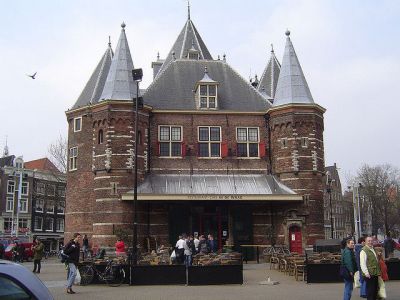
The Weigh House, a medieval trading hub dating back to 1488, began as a customs house, where goldsmiths and silversmiths worked their magic on the upper floors. Today, it’s home to a lively bar and restaurant, but inside you can still marvel at the hefty timber beams and what’s left of the old weighing scales.
Originally, this building was taller, but the 16th-century city planners had other ideas. When Amsterdam’s defensive walls came down, the gatehouse lost its fortification and its height. The surrounding moat was filled in, creating a bustling market square, and the ground level was raised, leaving the Weigh House looking quite different than it did in its heyday.
Even so, the building remained at the heart of Amsterdam’s cultural life. It was here that Rembrandt van Rijn painted “The Anatomy Lesson of Dr. Nicolas Tulp,” the work that launched his legendary career. Over the centuries, the Weighing House served many roles, hosting museums, city institutions, and even a fire brigade. In 1996, it found new purpose under the care of the Waag (“Weigh House”) Society, ensuring its historic charm endures for generations to come.
Originally, this building was taller, but the 16th-century city planners had other ideas. When Amsterdam’s defensive walls came down, the gatehouse lost its fortification and its height. The surrounding moat was filled in, creating a bustling market square, and the ground level was raised, leaving the Weigh House looking quite different than it did in its heyday.
Even so, the building remained at the heart of Amsterdam’s cultural life. It was here that Rembrandt van Rijn painted “The Anatomy Lesson of Dr. Nicolas Tulp,” the work that launched his legendary career. Over the centuries, the Weighing House served many roles, hosting museums, city institutions, and even a fire brigade. In 1996, it found new purpose under the care of the Waag (“Weigh House”) Society, ensuring its historic charm endures for generations to come.
5) Zeedijk
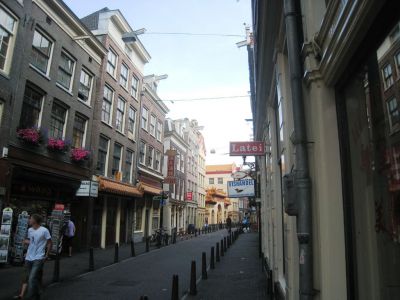
Curling along the northern perimeter of the Red Light District, you'll find Zeedijk, originally conceived as a protective dike against the encroaching sea. Today, it thrives as a bustling thoroughfare, though not too long ago, it was plagued by drug addiction and deemed unsafe after nightfall, rendering it off-limits. Nevertheless, diligent efforts have transformed it into the vibrant epicenter of Amsterdam's relatively compact yet lively Chinatown.
Zeedijk hosts an array of Chinese, Thai, and Vietnamese eateries, as well as a prominent Buddhist temple, the flamboyant Fo Guang Shan He Hua, located towards the southern end at #106. Up north, the street neighbors the Prins Hendrik Hotel, where the legendary Chet Baker drew his final breath. Beyond these attractions, do not miss the opportunity to behold Amsterdam's last-standing wooden houses, a unique sight found exclusively in this vicinity.
Certainly, there's a wealth of enjoyable experiences to explore in and around this neighborhood, engaging your senses of sight, sound, smell, and taste. Notable establishments include Nam Kee, a Chinese restaurant at #111-113, renowned for its exceptional cuisine and prompt service; Bird Thais Restaurant at #72-74, consistently packed and rightfully so, as it draws patrons from far and wide with its authentic Thai dishes; Cultureel Eetcafé 'Skek at #4-8, managed by students and offering hearty salads to gourmet burgers; and In't Aepjen at #1, a historical bar dating back to the era when Zeedijk was a haunt for sailors, trading rather than using currency while gambling away their last guilders.
Zeedijk hosts an array of Chinese, Thai, and Vietnamese eateries, as well as a prominent Buddhist temple, the flamboyant Fo Guang Shan He Hua, located towards the southern end at #106. Up north, the street neighbors the Prins Hendrik Hotel, where the legendary Chet Baker drew his final breath. Beyond these attractions, do not miss the opportunity to behold Amsterdam's last-standing wooden houses, a unique sight found exclusively in this vicinity.
Certainly, there's a wealth of enjoyable experiences to explore in and around this neighborhood, engaging your senses of sight, sound, smell, and taste. Notable establishments include Nam Kee, a Chinese restaurant at #111-113, renowned for its exceptional cuisine and prompt service; Bird Thais Restaurant at #72-74, consistently packed and rightfully so, as it draws patrons from far and wide with its authentic Thai dishes; Cultureel Eetcafé 'Skek at #4-8, managed by students and offering hearty salads to gourmet burgers; and In't Aepjen at #1, a historical bar dating back to the era when Zeedijk was a haunt for sailors, trading rather than using currency while gambling away their last guilders.
6) Schreierstoren (Weeper's Tower)
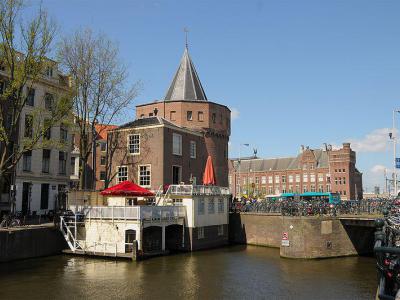
Just a short stroll from Saint Nicholas Church stands one of the last remaining pieces of Amsterdam’s medieval defenses. Built in the 15th century, this sturdy tower was originally tasked with watching over the River IJ and protecting the city. Legend claims that it was a gathering spot for tearful women bidding farewell to loved ones heading off to sea. But, like many good stories, this one is likely more myth than history. In reality, the tower's name is thought to come from its sharp angle, not from any weeping women.
A weathered plaque on the structure’s wall adds to the legend. Some say the figure on it represents a sorrowful woman; others argue it’s a symbol of Amsterdam itself-a virgin standing guard over the city. More recent history is marked by another plaque: one that commemorates Henry Hudson’s departure from this spot in 1609. On that fateful voyage, he stumbled upon the river and island that would become Manhattan. The settlement he established there was called New Amsterdam until the English took over in 1664, renaming it New York.
A weathered plaque on the structure’s wall adds to the legend. Some say the figure on it represents a sorrowful woman; others argue it’s a symbol of Amsterdam itself-a virgin standing guard over the city. More recent history is marked by another plaque: one that commemorates Henry Hudson’s departure from this spot in 1609. On that fateful voyage, he stumbled upon the river and island that would become Manhattan. The settlement he established there was called New Amsterdam until the English took over in 1664, renaming it New York.
7) National Monument on Dam Square
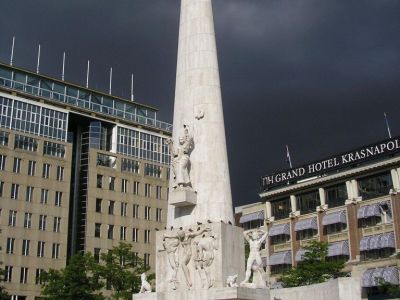
Crafted by the renowned Dutch architect Jacobus Oud, Dam Square proudly hosts a 22-meter (70-foot) tall obelisk, serving as a poignant memorial to the Second World War. Behind this solemn monument, urns hold soil collected from cemeteries and execution sites. The structure has become a national symbol, where each year, on May 4th, the Remembrance of the Dead ceremony takes place.
While this obelisk garners attention from numerous visitors, only a select few truly grasp its intricate symbolism. Adorned with exquisite details arranged in concentric circles, the obelisk features sculptures depicting men, howling dogs, and birds. On the front side, two male figures symbolize the Dutch Resistance Movement, while the left and right sides represent intellectuals and the working class, respectively. Dogs are emblematic of loyalty and suffering, while a woman with a child represents victory, peace, and new beginnings. Meanwhile, doves ascending to the skies symbolize freedom and liberation.
Why You Should Explore:
One of the most important European symbols that recall the immense tragedy of the Second World War. A tranquil spot for a brief pause while you explore other attractions in the vicinity.
While this obelisk garners attention from numerous visitors, only a select few truly grasp its intricate symbolism. Adorned with exquisite details arranged in concentric circles, the obelisk features sculptures depicting men, howling dogs, and birds. On the front side, two male figures symbolize the Dutch Resistance Movement, while the left and right sides represent intellectuals and the working class, respectively. Dogs are emblematic of loyalty and suffering, while a woman with a child represents victory, peace, and new beginnings. Meanwhile, doves ascending to the skies symbolize freedom and liberation.
Why You Should Explore:
One of the most important European symbols that recall the immense tragedy of the Second World War. A tranquil spot for a brief pause while you explore other attractions in the vicinity.
8) Dam Square (must see)
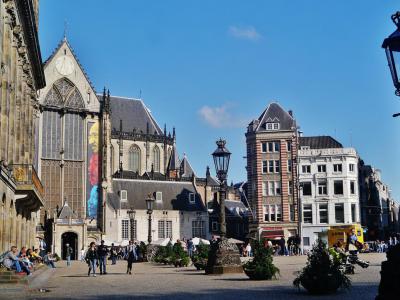
Dam Square, or the Dam, is a central town square in Amsterdam, known for its significant buildings and frequent events. Positioned in the historical heart of Amsterdam, it sits on the site of the original dam on the Amstel River. The square extends some 200 meters from west to east and 100 meters from north to south, connecting Damrak and Rokin streets that trace the Amstel's original course.
The square is also the termination point for other notable streets like New Dike, Calf Street, and Dam Street, with the main red-light district, De Wallen, just beyond its northeast corner. Prominent features on Dam Square include the neoclassical Royal Palace, the 15th-century Gothic New Church, the Madame Tussauds Wax Museum, and the National Monument which honors World War II victims, all of which collectively turn the Dam into a major tourist hub.
The name "Amsterdam" originates from a dam built on the Amstel River around 1270. This dam, integral to the city's development, included a discharge sluice and later locks to facilitate navigation and control water levels. By 1275, the settlement was significant enough to be recorded in connection with a road toll granted by the count of Holland, Floris V. Over time, the dam expanded to accommodate a town square, now known as Dam Square. Eventually, the area became a hub for commercial and governmental activities, featuring a large fish market and a town hall.
Significant changes occurred over the centuries, including the demolition of a weigh house in 1808 to clear the view for Louis Bonaparte’s Royal Palace and the infilling of Damrak Avenue in the 19th century. The square also hosted the Beurs van Zocher stock exchange until 1903. Today, the De Bijenkorf department store has been in its place since 1914. Dam Square has also been a site for national events – such as the National Memorial Day commemorations at the National Monument unveiled in 1956, and public demonstrations, – maintaining its status as a national and cultural gathering spot for the Dutch.
Tip:
For those in need of a restroom, free and well-maintained toilets are available at the De Bijenkorf shop on the 5th floor.
The square is also the termination point for other notable streets like New Dike, Calf Street, and Dam Street, with the main red-light district, De Wallen, just beyond its northeast corner. Prominent features on Dam Square include the neoclassical Royal Palace, the 15th-century Gothic New Church, the Madame Tussauds Wax Museum, and the National Monument which honors World War II victims, all of which collectively turn the Dam into a major tourist hub.
The name "Amsterdam" originates from a dam built on the Amstel River around 1270. This dam, integral to the city's development, included a discharge sluice and later locks to facilitate navigation and control water levels. By 1275, the settlement was significant enough to be recorded in connection with a road toll granted by the count of Holland, Floris V. Over time, the dam expanded to accommodate a town square, now known as Dam Square. Eventually, the area became a hub for commercial and governmental activities, featuring a large fish market and a town hall.
Significant changes occurred over the centuries, including the demolition of a weigh house in 1808 to clear the view for Louis Bonaparte’s Royal Palace and the infilling of Damrak Avenue in the 19th century. The square also hosted the Beurs van Zocher stock exchange until 1903. Today, the De Bijenkorf department store has been in its place since 1914. Dam Square has also been a site for national events – such as the National Memorial Day commemorations at the National Monument unveiled in 1956, and public demonstrations, – maintaining its status as a national and cultural gathering spot for the Dutch.
Tip:
For those in need of a restroom, free and well-maintained toilets are available at the De Bijenkorf shop on the 5th floor.
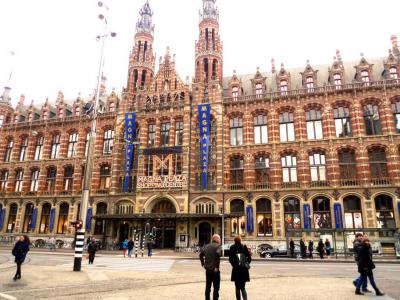
9) Magna Plaza
Magna Plaza is a grand 19th-century edifice located behind the Royal Palace on Dam Square. Constructed between 1895 and 1899, it showcases a blend of Neo-Gothic and Neo-Renaissance architectural styles. The building was designed by Cornelis Hendrik Peters and has been listed as a national heritage site of the Netherlands since 1974.
The structure is notable for its elaborate brick exterior adorned with polychromatic brickwork and dressed stone around windows and doors. The roof is distinguished by several dormers, each topped with crow-stepped gables, contributing to its nickname "Perenburg" (or “pear-castle”) due to the pear-shaped crowns atop its towers.
Originally serving as Amsterdam's central post office, the building symbolized the city’s economic resurgence in the late 19th century, a period marked by significant developments like the opening of the North Sea Canal and the hosting of a World's Fair in 1883.
In 1987, plans to transform this historic post office into a luxurious shopping mall were announced by Larmag, a Swedish real estate developer. The renovations, which began in 1991, involved meticulous exterior restorations and a complete rebuild of the interior while preserving the structural and decorative elements. Named after Larmag's CEO, Lars-Erik Magnusson, Magna Plaza opened on August 17, 1992, as a shopping center.
Today, Magna Plaza offers a shopping experience across four floors, complemented by several cafes and a variety of stores. Despite its commercial function, the building remains an architectural gem worth visiting for its aesthetic and historical significance alone.
The structure is notable for its elaborate brick exterior adorned with polychromatic brickwork and dressed stone around windows and doors. The roof is distinguished by several dormers, each topped with crow-stepped gables, contributing to its nickname "Perenburg" (or “pear-castle”) due to the pear-shaped crowns atop its towers.
Originally serving as Amsterdam's central post office, the building symbolized the city’s economic resurgence in the late 19th century, a period marked by significant developments like the opening of the North Sea Canal and the hosting of a World's Fair in 1883.
In 1987, plans to transform this historic post office into a luxurious shopping mall were announced by Larmag, a Swedish real estate developer. The renovations, which began in 1991, involved meticulous exterior restorations and a complete rebuild of the interior while preserving the structural and decorative elements. Named after Larmag's CEO, Lars-Erik Magnusson, Magna Plaza opened on August 17, 1992, as a shopping center.
Today, Magna Plaza offers a shopping experience across four floors, complemented by several cafes and a variety of stores. Despite its commercial function, the building remains an architectural gem worth visiting for its aesthetic and historical significance alone.
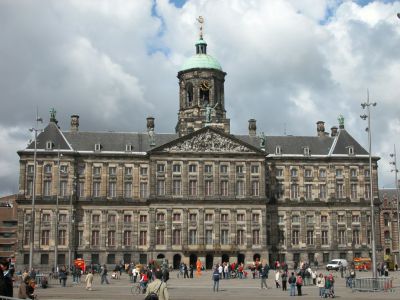
10) Koninklijk Paleis (Royal Palace of Amsterdam) (must see)
The Royal Palace of Amsterdam is a historic monument on Dam Square and is one of the four palaces in the Netherlands still left at the disposal of the Dutch Royal Family.
Its inception dates back to 1655. Back then, the city had recently thwarted William of Orange's attempts to subdue it and the city council sought a residence that would symbolize Amsterdam's municipal authority and pride. This led to a remarkably forward-thinking design-the Dutch interpretation of the classical principles revived during the Italian Renaissance. The architectural project led by Jacob van Campen implied over 13,500 wooden piles to support the building.
Initially designed as the town hall overlooking the bustling Damrak wharves, it was converted into a royal palace by King Louis I of Holland, brother of Napoleon Bonaparte, in 1806.
In 1936, the building was designated a property of the Kingdom of the Netherlands. Today, it serves a ceremonial role for the monarchy, hosting state visits, official functions, and award ceremonies. The palace also played a pivotal role during the investiture of Queen Beatrix in 1980.
The building's distinctive sandstone façade has darkened over time. Astride the rear of it is a 6-meter statue of Atlas carrying the globe.
The interior is equally opulent, notably in the Citizens' Hall, featuring an arcaded marble chamber where the enthroned figure of Amsterdam presides over the earthly and celestial realms. Three circular, inlaid marble maps, depicting the eastern and western hemispheres, as well as the northern sky, lie at her feet. Other allegorical figures include Wisdom and Strength, flanking "Amsterdam" on her left and right, while the reliefs on either side of the central group portray the principles of good governance. On the left, the god Amphion plays his lyre, persuading stones to form a wall; and on the right, Mercury seeks to lull Argos to sleep, thus emphasizing the importance of vigilance.
Tip:
Before your visit, be sure to check online for opening hours, as the palace may occasionally be closed due to royal events.
Free entry for those under 18 and discounts for seniors and students are available.
Its inception dates back to 1655. Back then, the city had recently thwarted William of Orange's attempts to subdue it and the city council sought a residence that would symbolize Amsterdam's municipal authority and pride. This led to a remarkably forward-thinking design-the Dutch interpretation of the classical principles revived during the Italian Renaissance. The architectural project led by Jacob van Campen implied over 13,500 wooden piles to support the building.
Initially designed as the town hall overlooking the bustling Damrak wharves, it was converted into a royal palace by King Louis I of Holland, brother of Napoleon Bonaparte, in 1806.
In 1936, the building was designated a property of the Kingdom of the Netherlands. Today, it serves a ceremonial role for the monarchy, hosting state visits, official functions, and award ceremonies. The palace also played a pivotal role during the investiture of Queen Beatrix in 1980.
The building's distinctive sandstone façade has darkened over time. Astride the rear of it is a 6-meter statue of Atlas carrying the globe.
The interior is equally opulent, notably in the Citizens' Hall, featuring an arcaded marble chamber where the enthroned figure of Amsterdam presides over the earthly and celestial realms. Three circular, inlaid marble maps, depicting the eastern and western hemispheres, as well as the northern sky, lie at her feet. Other allegorical figures include Wisdom and Strength, flanking "Amsterdam" on her left and right, while the reliefs on either side of the central group portray the principles of good governance. On the left, the god Amphion plays his lyre, persuading stones to form a wall; and on the right, Mercury seeks to lull Argos to sleep, thus emphasizing the importance of vigilance.
Tip:
Before your visit, be sure to check online for opening hours, as the palace may occasionally be closed due to royal events.
Free entry for those under 18 and discounts for seniors and students are available.
