Custom Walk in Graz, Austria by sekoza_68da3 created on 2025-07-09
Guide Location: Austria » Graz
Guide Type: Custom Walk
# of Sights: 10
Tour Duration: 4 Hour(s)
Travel Distance: 9.7 Km or 6 Miles
Share Key: BN6L8
Guide Type: Custom Walk
# of Sights: 10
Tour Duration: 4 Hour(s)
Travel Distance: 9.7 Km or 6 Miles
Share Key: BN6L8
How It Works
Please retrieve this walk in the GPSmyCity app. Once done, the app will guide you from one tour stop to the next as if you had a personal tour guide. If you created the walk on this website or come to the page via a link, please follow the instructions below to retrieve the walk in the app.
Retrieve This Walk in App
Step 1. Download the app "GPSmyCity: Walks in 1K+ Cities" on Apple App Store or Google Play Store.



Step 2. In the GPSmyCity app, download(or launch) the guide "Graz Map and Walking Tours".
Step 3. Tap the menu button located at upper right corner of the "Walks" screen and select "Retrieve custom walk". Enter the share key: BN6L8
1) Schloss Eggenberg (Eggenberg Castle) (must see)
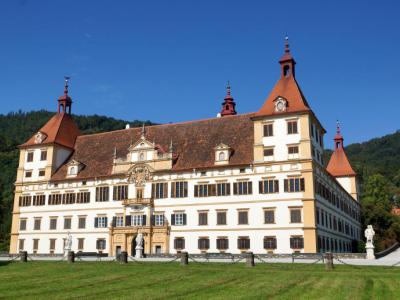
In 1625, Prince Hans Ulrich von Eggenberg wanted to build a house that would mean everything to him. In the chaotic age that he lived in he felt the desire to have a home that would be the whole universe. He built Eggenberg Castle. On the edge of Graz is a beautiful park. The Eggenberg Castle sits there, reflecting the cosmos.
The castle has 365 windows, 31 rooms on each floor, 24 state rooms having 52 doors and four corner towers. The building reflects all aspects of time: the seasons, weeks, days, hours, minutes all based on the Gregorian calendar.
The paintings of the Planet Hall (1678) have astronomical symbols. On the ceiling, painter Hans Adam Weisenkircher assigned celestial bodies to days, gods, metals and Eggenbergers themselves. There is a triumphant general and an imperial envoy. The twelve signs of the Zodiac adorn the walls.
Hans Ulrich brought elements of the ancient Eggenberger Castle into his new palace. All diagonals drawn through the building intersect at the old Gothic chapel. In the 18th century the Castle theatre was converted into a baroque church.
Peacocks in full display stalk about the grounds. There is a Planet Garden in the park which continues the cosmos motif.
The Eggenberg Castle is run by the Joanneum, the Provincial Museum of Styria. Important collections include the Lapidarium with the largest collection of Roman stones in Austria. There are also the departments of early history, the coin collection and the art gallery with art from the Romanesque and late Baroque periods.
In 1717 Johann Christian II von Eggenberg died of appendicitis. He was 13. His father and grandfather had died before him. With Johann's death The Eggenberger dynasty came to an end. Only the castle remains to carry on the Eggenberg name.
The castle has 365 windows, 31 rooms on each floor, 24 state rooms having 52 doors and four corner towers. The building reflects all aspects of time: the seasons, weeks, days, hours, minutes all based on the Gregorian calendar.
The paintings of the Planet Hall (1678) have astronomical symbols. On the ceiling, painter Hans Adam Weisenkircher assigned celestial bodies to days, gods, metals and Eggenbergers themselves. There is a triumphant general and an imperial envoy. The twelve signs of the Zodiac adorn the walls.
Hans Ulrich brought elements of the ancient Eggenberger Castle into his new palace. All diagonals drawn through the building intersect at the old Gothic chapel. In the 18th century the Castle theatre was converted into a baroque church.
Peacocks in full display stalk about the grounds. There is a Planet Garden in the park which continues the cosmos motif.
The Eggenberg Castle is run by the Joanneum, the Provincial Museum of Styria. Important collections include the Lapidarium with the largest collection of Roman stones in Austria. There are also the departments of early history, the coin collection and the art gallery with art from the Romanesque and late Baroque periods.
In 1717 Johann Christian II von Eggenberg died of appendicitis. He was 13. His father and grandfather had died before him. With Johann's death The Eggenberger dynasty came to an end. Only the castle remains to carry on the Eggenberg name.
2) Hauptplatz (Main Square) (must see)
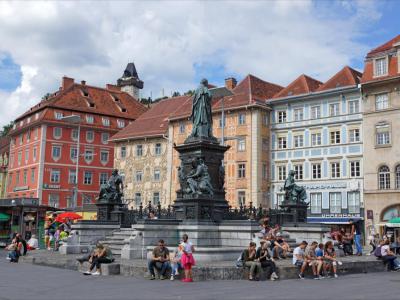
The Main Square of Graz has been a focal point and magnet for visitors and locals since 1160 when it was built by Duke Otakar III. The attractions and watering holes of Graz are easily accessible from the Main Square.
The Square is a trapezoid shaped market square surrounded by houses built in medieval and late Gothic styles. Some facades are Gothic, Baroque, and Biedermeier. Notable houses include: The White House (built in 1710); The Eagle Pharmacy (built in 1535); and the Citizens' Home to the Great Christoph (built in 17th century); numbers 3, 4, and 6, respectively.
The standout house is the Luegg House, with a grandiloquent stucco facade built in 15th century. The palace of the Sturgkh merchant family built 1532 is in various styles, including 20th century touches.
Since 1878 the Franz Ponninger fountain monument of Archduke Johann von Osterreich has dominated the square. The statue of the Archduke is flanked by four female figures. They represent the rivers Mur, Enns, Drava, and Sann. Fountain basins are on the corners. The base holds allegorical bronze reliefs.
Until the late 18th century the Square was also used for public punishments, including executions. Offenders could be pilloried before the town hall to amuse the innocent. Executions were big events. Commoners were done in the Square. Nobility were executed in the town hall, no tea with the Mayer.
Since 1965 the Square has been pedestrianized but some cycling is allowed. The Square is also served by prams (electric trolleys).
The Square is a trapezoid shaped market square surrounded by houses built in medieval and late Gothic styles. Some facades are Gothic, Baroque, and Biedermeier. Notable houses include: The White House (built in 1710); The Eagle Pharmacy (built in 1535); and the Citizens' Home to the Great Christoph (built in 17th century); numbers 3, 4, and 6, respectively.
The standout house is the Luegg House, with a grandiloquent stucco facade built in 15th century. The palace of the Sturgkh merchant family built 1532 is in various styles, including 20th century touches.
Since 1878 the Franz Ponninger fountain monument of Archduke Johann von Osterreich has dominated the square. The statue of the Archduke is flanked by four female figures. They represent the rivers Mur, Enns, Drava, and Sann. Fountain basins are on the corners. The base holds allegorical bronze reliefs.
Until the late 18th century the Square was also used for public punishments, including executions. Offenders could be pilloried before the town hall to amuse the innocent. Executions were big events. Commoners were done in the Square. Nobility were executed in the town hall, no tea with the Mayer.
Since 1965 the Square has been pedestrianized but some cycling is allowed. The Square is also served by prams (electric trolleys).
3) Landeszeughaus (Styrian Armory) (must see)
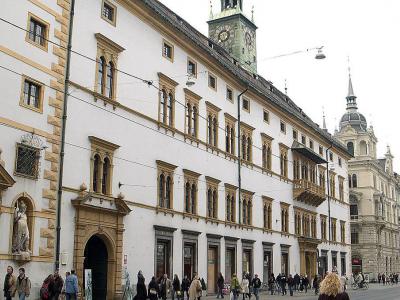
In the Inner City of Old Graz, just off the Main Square at number 16 Herrengasse, is the Styrian Armoury, the largest historical armory in the world. It was built by Tyrolean architect Antonio Solar in the years 1642-1645. The state of Styria was often at war with elements of the Ottoman Empire. An armory was needed to stockpile weapons.
The armory today has a collection on four floors of more than 32,000 historic pieces of armor and weaponry, including cannons, muskets, lances, halberds, partisans, swords, sabres, more than enough helmets and some strange-looking horse armor. The Styrian Armoury was a leading arms depot of the Hapbsburg empire.
By 1699 conflict with the Ottomans had ended with the Treaty of Karlowitz. Furthermore, the technology of battle had changed significantly. The amory ceased to be vital to the defense of Graz. In 1745 Habsburg Empress Maria Theresa was centralizing the defenses of Austria. She wanted to move the weaponry in Styrian Armoury to Vienna.
The Styrian estates petitioned to keep the weaponry of Styrian Armoury as a memorial to Styria's past. The petition was allowed. The weaponry of Graz was not used in earnest until the revolution of 1848. Some weapons were used but not perhaps so much armor.
In 1879 Dr Fritz Pichler and Franz, Count Meran arranged the exhibits according to the 17th century system. In 1892 the Styrian Armoury was absorbed into the Joanneum Universal Museum.
The armory today has a collection on four floors of more than 32,000 historic pieces of armor and weaponry, including cannons, muskets, lances, halberds, partisans, swords, sabres, more than enough helmets and some strange-looking horse armor. The Styrian Armoury was a leading arms depot of the Hapbsburg empire.
By 1699 conflict with the Ottomans had ended with the Treaty of Karlowitz. Furthermore, the technology of battle had changed significantly. The amory ceased to be vital to the defense of Graz. In 1745 Habsburg Empress Maria Theresa was centralizing the defenses of Austria. She wanted to move the weaponry in Styrian Armoury to Vienna.
The Styrian estates petitioned to keep the weaponry of Styrian Armoury as a memorial to Styria's past. The petition was allowed. The weaponry of Graz was not used in earnest until the revolution of 1848. Some weapons were used but not perhaps so much armor.
In 1879 Dr Fritz Pichler and Franz, Count Meran arranged the exhibits according to the 17th century system. In 1892 the Styrian Armoury was absorbed into the Joanneum Universal Museum.
4) Glockenspiel (Carillon)
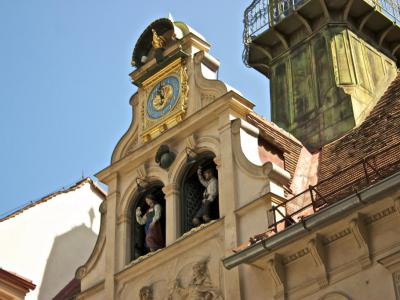
In Glockenspielplatz 4 one can find the Carillon. Come dance with me! And dance they do! Three times a day, at 11 am, 3pm, and 6 pm. A young maiden and a strapping boy emerge from their gable hideouts. Dressed in traditional costumes they dance to the melodies of the 24 bells of the carillon.
Wine and spirits dealer Gottfried Maurer bought a house in Fliegenplatz square in 1884. Herr Maurer traveled a lot for business, mostly to North Germany and Belgium. In his travels he had become fascinated by carillons. So he had a carillon installed in his new house in Graz. The bells tolled for the first time on Christmas Eve in 1905.
In 1929 Herr Maurer willed the glockenspiel to the city of Graz, provided that the mechanism be maintained in perpetuity. World War II silenced the bells for a while. They were melted down for armaments. Finally, in 1956, the music of the carillon was restored.
The carillon plays three times every day but the tunes are not always the same. Changing the positions of the 800 pins on the carillon barrel produces new melodies. One can have Alpine, Folk, yodeling, Christmas carols, modern airs but no Rap. The two tireless dancers never fail to appear, twirling, smiling and always in tempo.
As the music approaches its climax, a golden rooster appears above the dancers, crowing his approval. Herr Maurer wanted a rooster like the one he saw in Munich. He got it.
Wine and spirits dealer Gottfried Maurer bought a house in Fliegenplatz square in 1884. Herr Maurer traveled a lot for business, mostly to North Germany and Belgium. In his travels he had become fascinated by carillons. So he had a carillon installed in his new house in Graz. The bells tolled for the first time on Christmas Eve in 1905.
In 1929 Herr Maurer willed the glockenspiel to the city of Graz, provided that the mechanism be maintained in perpetuity. World War II silenced the bells for a while. They were melted down for armaments. Finally, in 1956, the music of the carillon was restored.
The carillon plays three times every day but the tunes are not always the same. Changing the positions of the 800 pins on the carillon barrel produces new melodies. One can have Alpine, Folk, yodeling, Christmas carols, modern airs but no Rap. The two tireless dancers never fail to appear, twirling, smiling and always in tempo.
As the music approaches its climax, a golden rooster appears above the dancers, crowing his approval. Herr Maurer wanted a rooster like the one he saw in Munich. He got it.
5) Stiegenkirche (Staircase Church)
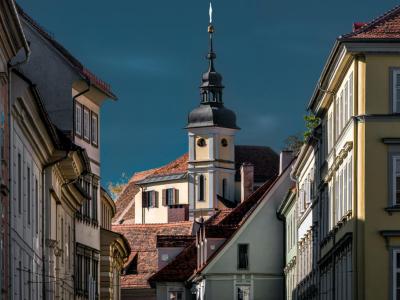
The Staircase Church (Stiegenkirche) is a Roman Catholic church situated in the heart of Graz. Originally serving as the monastery church for the Augustinian Hermits, it holds a rich historical background intertwined with Graz's architectural and cultural development.
Dating back to the 14th century, the origins of the Staircase Church are marked by its unique architectural feature-accessibility solely through a staircase located at No. 21 Sporgasse. Initially affiliated with the Parish of Saint Paul, it later came under the care of the Augustinian Hermits. Under the direction of Archangelo Carlone, a new structure was built, preserving the original staircase that bestowed upon the church its distinctive name.
Significant reconstruction took place between 1613 and 1628, adapting to the evolving needs and aesthetics of the time while preserving its historical essence. Notably, the staircase was crafted by Antonio Solar, likely completed by 1636, contributing to the church's unique architectural character.
The Staircase Church is Graz's oldest parish church. Despite periods of decline in the mid-16th century, worship ceased in 1554. However, in 1588, Archduke Charles II revitalized the church by entrusting it to his chaplain, Aurelius Mancinus Pergola. Construction of a new church and monastery was completed by 1627, marking a revival of religious and communal life.
Further renovations in 1962, led by architect Kurt Weber-Mzell, and an interior redesign by the Diocesan Liturgical Commission and the Association of Architects during the Austrian Catholic Day, have preserved the Staircase Church as a vibrant and sacred space, reflecting both its historical significance and its contemporary role in Graz's religious life.
Dating back to the 14th century, the origins of the Staircase Church are marked by its unique architectural feature-accessibility solely through a staircase located at No. 21 Sporgasse. Initially affiliated with the Parish of Saint Paul, it later came under the care of the Augustinian Hermits. Under the direction of Archangelo Carlone, a new structure was built, preserving the original staircase that bestowed upon the church its distinctive name.
Significant reconstruction took place between 1613 and 1628, adapting to the evolving needs and aesthetics of the time while preserving its historical essence. Notably, the staircase was crafted by Antonio Solar, likely completed by 1636, contributing to the church's unique architectural character.
The Staircase Church is Graz's oldest parish church. Despite periods of decline in the mid-16th century, worship ceased in 1554. However, in 1588, Archduke Charles II revitalized the church by entrusting it to his chaplain, Aurelius Mancinus Pergola. Construction of a new church and monastery was completed by 1627, marking a revival of religious and communal life.
Further renovations in 1962, led by architect Kurt Weber-Mzell, and an interior redesign by the Diocesan Liturgical Commission and the Association of Architects during the Austrian Catholic Day, have preserved the Staircase Church as a vibrant and sacred space, reflecting both its historical significance and its contemporary role in Graz's religious life.
6) Sporgasse (Spor Street) (must see)
Spor Street is older than Graz. It began its career as a street for commerce in Roman times. It was originally a trade route called the Strata Hungarica. It extended from the Murtal to the Roman provincial capital. The name Spor refers to the word "spur." Spur makers and armorers lived here in the 14th century.
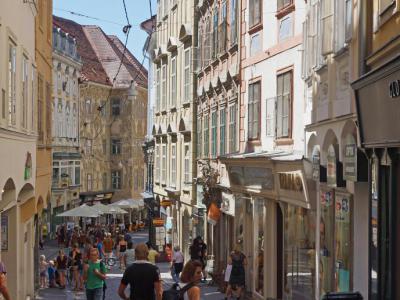
The street today is mainly a pedestrianized shopping street lined with historical buildings. On the edge of the Main Square is the 15th and 16th century stuccoed, baroque Luegg-haus. Opposite is the Art Nouveau House with a 16th century core and a flowery Art Nouveau facade (built in 1900).
Nearby the Art Nouveau House is the Baroque and Rococo facade of the "Inn To the Roman Emperor." It was built in the 15th century and rebuilt in 1755. The Staircase church is the oldest parish church in Graz, first noted in a document in 1343. The House of the Teutonic Knights, built in the 15th century, has an inner courtyard with pillar arcades.
The Palace Saurai is at the upper end of the street. It is from 1566. There is a statue of a sword-wielding Turk in front. The "Golden Pate Inn" with a round bay window and arched stone gates dates from the 17th century. Queen Elizabeth II had dinner there in 1967.
Today, ancient Spor Street lives up to its history as a street for commerce. It is a busy no-cars shopping zone with stores offering exotically flavored ice creams, sneakers, shoes, watches and jewelry, baked goods and Italian fashions. And the list goes on.
The street today is mainly a pedestrianized shopping street lined with historical buildings. On the edge of the Main Square is the 15th and 16th century stuccoed, baroque Luegg-haus. Opposite is the Art Nouveau House with a 16th century core and a flowery Art Nouveau facade (built in 1900).
Nearby the Art Nouveau House is the Baroque and Rococo facade of the "Inn To the Roman Emperor." It was built in the 15th century and rebuilt in 1755. The Staircase church is the oldest parish church in Graz, first noted in a document in 1343. The House of the Teutonic Knights, built in the 15th century, has an inner courtyard with pillar arcades.
The Palace Saurai is at the upper end of the street. It is from 1566. There is a statue of a sword-wielding Turk in front. The "Golden Pate Inn" with a round bay window and arched stone gates dates from the 17th century. Queen Elizabeth II had dinner there in 1967.
Today, ancient Spor Street lives up to its history as a street for commerce. It is a busy no-cars shopping zone with stores offering exotically flavored ice creams, sneakers, shoes, watches and jewelry, baked goods and Italian fashions. And the list goes on.
7) Uhrturm (Clock Tower) (must see)
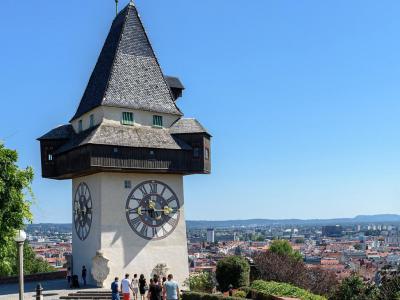
The tower housing the Graz clock dates from the 13th century. It is first mentioned as a fortification in 1265. The clock itself was installed in 1569. A wooden battlement and walk encircle the tower. Fire watchmen used the battlement to keep a watchful eye on the city.
In 1712 a second dial was added on the north side of the tower and new clockwork developed by Michael Sylvester Funck. The hour hand was larger than the minute hand so the hours could be more easily read from far off.
During the War of the Fifth Coalition in 1809, the Tower fell into the hands of Napoleon. The fortifications were to be demolished by the Armistice of Znaim. However, the citizens of Graz were able to pay a ransom for the tower and clock.
The Clock Tower underwent a thorough restoration between 2008 and 2011. The battlements were renewed, and the clock dials and hands repaired. Three bells are kept in the tower. The hourly bell installed in 1382 is the oldest bell in Graz. The fire bell installed in 1645 tolled out the locations of fires. The poor sinners' bell installed in 1450 was rung for executions or curfew.
Below the tower is a stone dog. In 1481 a barking dog saved Kunigunde, daughter of Emperor Friedrich III, from dishonor by mercenaries of Matthias Corvinus, King of Hungary. The brave watch dog is memorialized as a stone watch dog.
In 1712 a second dial was added on the north side of the tower and new clockwork developed by Michael Sylvester Funck. The hour hand was larger than the minute hand so the hours could be more easily read from far off.
During the War of the Fifth Coalition in 1809, the Tower fell into the hands of Napoleon. The fortifications were to be demolished by the Armistice of Znaim. However, the citizens of Graz were able to pay a ransom for the tower and clock.
The Clock Tower underwent a thorough restoration between 2008 and 2011. The battlements were renewed, and the clock dials and hands repaired. Three bells are kept in the tower. The hourly bell installed in 1382 is the oldest bell in Graz. The fire bell installed in 1645 tolled out the locations of fires. The poor sinners' bell installed in 1450 was rung for executions or curfew.
Below the tower is a stone dog. In 1481 a barking dog saved Kunigunde, daughter of Emperor Friedrich III, from dishonor by mercenaries of Matthias Corvinus, King of Hungary. The brave watch dog is memorialized as a stone watch dog.
8) Schlossberg (Castle Hill) (must see)
A legend says the Devil made Castle Hill. He promised to make a high hill in exchange for one soul. He flew over the town carrying a huge rock. But it was Easter Sunday. He had no power to take a soul. Enraged, he threw the rock down. It was smashed. The biggest piece became Castle Hill.
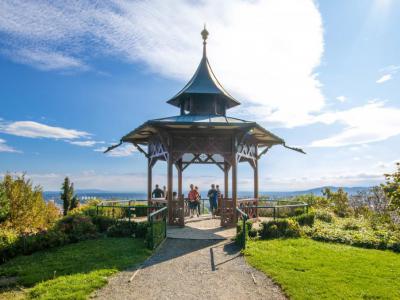
In the center of the city of Graz, the Castle Hill towers to 1,554 feet above sea level. The hill is forested and topped by a fortress. Today it is a public park with awesome views of things below. It is often the venue for entertainments, cafes and restaurants. Management is provided by Holding Graz, the city utility company.
As early as the 10th century there are mentions of the fortifications of Castle Hill. In the 15th century a 1,300 foot long fortification was built by architects from Italy. A cable lift was used to raise stones to the top of the hill. The castle was demolished in 1809 by order of Napoleon.
Ludwig von Welden turned the ruins of the castle in a park in 1839. The park holds the clock tower and two bastions from the old castle. A funicular railway has its terminus next to a hilltop restaurant with spectacular views. On the west side of the tower are two small cafes. One of the bastions has a open-air stage for performances.
The summit and tower can also be reached by elevator or by hiking up steep stairs one one side of the mountain or by a winding path on the other side.
Each year the Elevate Festival of music, art and politics takes place in various places around the Castle Hill. A tunnel through the Castle Hill connects to the elevator. A second tunnel runs parallel to the elevator tunnel. It connects Castle Hill to Karmeiter Square. In this tunnel is the fairytale Express, a train ride for children.
On the mountaintop is the Casemate Stage. This is a free venue for concerts. It has a retractable roof and a capacity for 1,310 happy fans.
In the center of the city of Graz, the Castle Hill towers to 1,554 feet above sea level. The hill is forested and topped by a fortress. Today it is a public park with awesome views of things below. It is often the venue for entertainments, cafes and restaurants. Management is provided by Holding Graz, the city utility company.
As early as the 10th century there are mentions of the fortifications of Castle Hill. In the 15th century a 1,300 foot long fortification was built by architects from Italy. A cable lift was used to raise stones to the top of the hill. The castle was demolished in 1809 by order of Napoleon.
Ludwig von Welden turned the ruins of the castle in a park in 1839. The park holds the clock tower and two bastions from the old castle. A funicular railway has its terminus next to a hilltop restaurant with spectacular views. On the west side of the tower are two small cafes. One of the bastions has a open-air stage for performances.
The summit and tower can also be reached by elevator or by hiking up steep stairs one one side of the mountain or by a winding path on the other side.
Each year the Elevate Festival of music, art and politics takes place in various places around the Castle Hill. A tunnel through the Castle Hill connects to the elevator. A second tunnel runs parallel to the elevator tunnel. It connects Castle Hill to Karmeiter Square. In this tunnel is the fairytale Express, a train ride for children.
On the mountaintop is the Casemate Stage. This is a free venue for concerts. It has a retractable roof and a capacity for 1,310 happy fans.
9) Mursteg Footbridge
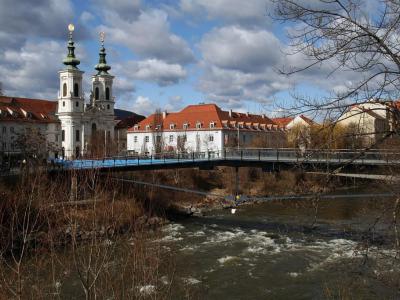
The Mursteg Footbridge in Graz stands as a testament to the innovative fusion of engineering prowess and aesthetic vision. Constructed in 1992 by the acclaimed architects Günther Domenig and Hermann Eisenköck, this steel suspension bridge offers a modern and functional link across the Mur River, catering exclusively to pedestrians and cyclists.
The footbridge is more than just a pathway; it represents a piece of contemporary art nestled within the historic and picturesque setting of Graz. This city, known as the capital of Styria, is renowned for its rich architectural tapestry, where Renaissance and Baroque styles merge seamlessly in the old medieval city center.
Adding to the city's modern architectural marvels is the Mursteg Footbridge. It stands in harmony with other futuristic landmarks such as the Island in the Mur, an artificial floating platform that also serves as a cultural and recreational space. Framed by the verdant outline of trees, hills, and the expansive sky, the bridge and the island create a visual spectacle that contrasts yet complements the city's historical backdrop.
The Mursteg Footbridge, with its innovative design and strategic location over the River Mur, thus serves as a symbol of Graz's ongoing dialogue between its historical roots and contemporary aspirations.
The footbridge is more than just a pathway; it represents a piece of contemporary art nestled within the historic and picturesque setting of Graz. This city, known as the capital of Styria, is renowned for its rich architectural tapestry, where Renaissance and Baroque styles merge seamlessly in the old medieval city center.
Adding to the city's modern architectural marvels is the Mursteg Footbridge. It stands in harmony with other futuristic landmarks such as the Island in the Mur, an artificial floating platform that also serves as a cultural and recreational space. Framed by the verdant outline of trees, hills, and the expansive sky, the bridge and the island create a visual spectacle that contrasts yet complements the city's historical backdrop.
The Mursteg Footbridge, with its innovative design and strategic location over the River Mur, thus serves as a symbol of Graz's ongoing dialogue between its historical roots and contemporary aspirations.
10) Murinsel (Island in the Mur) (must see)
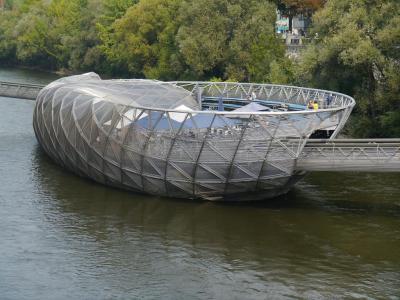
New York artist Vito Acconci, creator of Murinsel, describes it as, "A bowl that morphs into a dome that morphs into a bowl." "Murinsel" means "Island in the Mur." It is an other-worldly steel and glass dome/bowl attached to the river banks by footbridges. It was built when Graz became the 2003 European Capital of Culture.
Vito's goal was to design an accessible floating island. It is more of a ship than an island. It is firmly anchored to the riverbed and moored to each bank of the river by footbridges. The form is twisted and curved. It looks like a partially opened sea shell.
As visitors emerge from the footbridges they reach an open amphitheater, Sky blue benches rise up the sides of the amphitheater. They are curved in flowing layers, mimicking the river below. Under the glass dome walkways and tunnels swirl around the inner shell, connecting to the footbridges.
There is a blue and white cafe awaiting visitors. But first, the is a three dimensional maze featuring an array of ropes and a slide. What is an island without ropes and a slide?
The insel reconnects the river to the city. It is an island of "riparian delights" glowing blue in the night.
Vito's goal was to design an accessible floating island. It is more of a ship than an island. It is firmly anchored to the riverbed and moored to each bank of the river by footbridges. The form is twisted and curved. It looks like a partially opened sea shell.
As visitors emerge from the footbridges they reach an open amphitheater, Sky blue benches rise up the sides of the amphitheater. They are curved in flowing layers, mimicking the river below. Under the glass dome walkways and tunnels swirl around the inner shell, connecting to the footbridges.
There is a blue and white cafe awaiting visitors. But first, the is a three dimensional maze featuring an array of ropes and a slide. What is an island without ropes and a slide?
The insel reconnects the river to the city. It is an island of "riparian delights" glowing blue in the night.
