Custom Walk in Istanbul, Turkey by sudenazaydn34_367ee created on 2025-07-20
Guide Location: Turkey » Istanbul
Guide Type: Custom Walk
# of Sights: 6
Tour Duration: 2 Hour(s)
Travel Distance: 3.7 Km or 2.3 Miles
Share Key: GUK2B
Guide Type: Custom Walk
# of Sights: 6
Tour Duration: 2 Hour(s)
Travel Distance: 3.7 Km or 2.3 Miles
Share Key: GUK2B
How It Works
Please retrieve this walk in the GPSmyCity app. Once done, the app will guide you from one tour stop to the next as if you had a personal tour guide. If you created the walk on this website or come to the page via a link, please follow the instructions below to retrieve the walk in the app.
Retrieve This Walk in App
Step 1. Download the app "GPSmyCity: Walks in 1K+ Cities" on Apple App Store or Google Play Store.



Step 2. In the GPSmyCity app, download(or launch) the guide "Istanbul Map and Walking Tours".
Step 3. Tap the menu button located at upper right corner of the "Walks" screen and select "Retrieve custom walk". Enter the share key: GUK2B
1) Dolmabahce Clock Tower
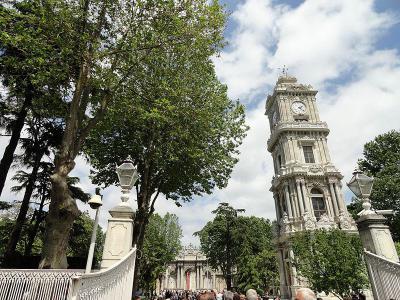
Right across the Treasury Gate of the Dolmabahçe Palace stands a beautiful four-sided clocktower built by Sultan Abdul Hamid II shortly after the palace was completed. The Sultan built clocktowers in many cities for his citizens but as the bells chimed every hour and reminded people of churches, they initially resented them. Their perception changed only upon realizing how helpful these clocks were in organizing their lives.
The tower itself is four floors high. Each story has a different size, embellishment and design, resulting in an interestingly Ottoman Neo-Baroque. Looking closely, you will notice eastern numerals on the faces of the clock and the tughra (calligraphic monogram) of the Sultan on two sides. The Ottomans had a fascination with clocks and here, too, the Sultan got a top-quality French clock installed by the court clock master, Johann Mayer.
Tip:
There is a café in the Clock Tower, and toilets near both entrances. Access inside is only granted if you pay the Palace ticket.
The tower itself is four floors high. Each story has a different size, embellishment and design, resulting in an interestingly Ottoman Neo-Baroque. Looking closely, you will notice eastern numerals on the faces of the clock and the tughra (calligraphic monogram) of the Sultan on two sides. The Ottomans had a fascination with clocks and here, too, the Sultan got a top-quality French clock installed by the court clock master, Johann Mayer.
Tip:
There is a café in the Clock Tower, and toilets near both entrances. Access inside is only granted if you pay the Palace ticket.
2) Dolmabahce Mosque
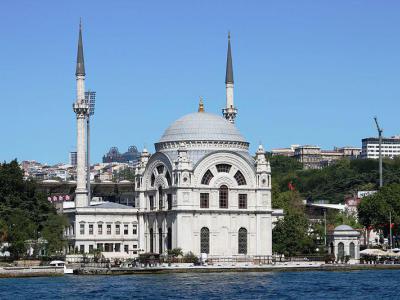
The Dolmabahçe Mosque in Istanbul's Beyoğlu area is a prime example of Ottoman design, complementing the nearby historical Dolmabahçe Palace. It was started in 1853 at the request of Queen Mother Bezmialem Valide Sultan, aiming to showcase the impressive architectural skills of the Ottoman era and to provide a place for worship. The design was the work of Garabet Balyan, who used a mix of Baroque, Rococo, and Empire styles to create something truly special. Unfortunately, the project faced a setback when Queen Bezmi passed away, leading her son, Sultan Abdülmecid, to finish the mosque in 1855.
Its prime location by the Bosphorus makes the Dolmabahçe Mosque a great spot for views, adding to the experience of those who visit. It's easily recognized by its large dome and two tall minarets that stand symmetrically, making it a notable feature against the city's skyline. The outside of the mosque is covered with many glass windows, which let in plenty of light and show off the size and design of the building.
The mosque's exterior clearly exhibits Baroque style. But it's the inside that really draws people in. The walls are decorated with beautiful Arabic calligraphy that includes important Islamic phrases, set against a colorful backdrop. The mosque's interior, adorned with intricate gold designs, floral patterns on the ceiling, and a captivating chandelier, is simply breathtaking. The floor is marble and covered with carpets for prayer, adding to the mosque's serene atmosphere.
In a twist of history, the mosque was used as the Naval Museum from 1956 to 1960, which was a departure from its original religious function, before it went back to being a mosque in 1967. Recent changes, like the expansion of nearby roads, have led to the loss of its original courtyard and sebil, altering its historical look slightly. Despite these changes, the Dolmabahçe Mosque continues to be a standout piece of Ottoman architecture and a place of spiritual importance, attracting visitors and worshippers with its history and beauty.
Tip:
The entrance is not charged for, but make sure not to step on the carpet with shoes on!
Its prime location by the Bosphorus makes the Dolmabahçe Mosque a great spot for views, adding to the experience of those who visit. It's easily recognized by its large dome and two tall minarets that stand symmetrically, making it a notable feature against the city's skyline. The outside of the mosque is covered with many glass windows, which let in plenty of light and show off the size and design of the building.
The mosque's exterior clearly exhibits Baroque style. But it's the inside that really draws people in. The walls are decorated with beautiful Arabic calligraphy that includes important Islamic phrases, set against a colorful backdrop. The mosque's interior, adorned with intricate gold designs, floral patterns on the ceiling, and a captivating chandelier, is simply breathtaking. The floor is marble and covered with carpets for prayer, adding to the mosque's serene atmosphere.
In a twist of history, the mosque was used as the Naval Museum from 1956 to 1960, which was a departure from its original religious function, before it went back to being a mosque in 1967. Recent changes, like the expansion of nearby roads, have led to the loss of its original courtyard and sebil, altering its historical look slightly. Despite these changes, the Dolmabahçe Mosque continues to be a standout piece of Ottoman architecture and a place of spiritual importance, attracting visitors and worshippers with its history and beauty.
Tip:
The entrance is not charged for, but make sure not to step on the carpet with shoes on!
3) Taksim Square
Every major city loves to show off its main square, and Istanbul’s Taksim doesn’t just show off - it practically shimmies. Its name means “division” or “distribution,” a nod to the days when the city’s vital water supply lines gathered here right beneath everyone’s feet. Today, it’s more about the distribution of selfies, street snacks, and general human chaos - the good kind...
This place is also the grand starting point for Istiklal Avenue, a pedestrian shopping street that could drain anyone’s wallet and patience in equal measure. Yes, you’ll spot the usual international fast-food chains, but don’t worry - kebabs, baklava, roasted corn, warm chestnuts, and stretchy Turkish ice-cream are all here to remind you which country you’re in. With hundreds of shops crammed along the route, Taksim is also a transportation jackpot: metro, tram, buses, and taxis swirling around like pieces in a very caffeinated board game.
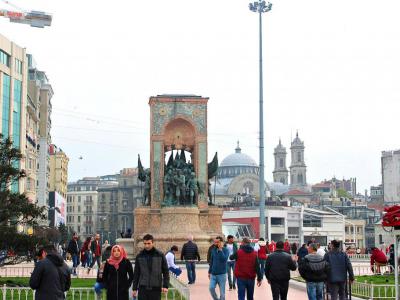
At the heart of the square stands the Monument to the Republic, surrounded by proud locals snapping photos of Mustafa Kemal Atatürk - father of the nation, reformer, and champion of stern yet photogenic poses. One side shows him as a soldier, the other as a statesman; both sides insist he knew what he was doing...
When the sun dips, expect the soundtrack to shift. Groups gather to sing, dance, and fill the air with more energy than a double-shot Turkish coffee. The transformation is instant and addictive.
Quick tip: the side streets hide great cafés and quirky shops worth a detour. And if you hail a taxi, glance at the meter first - consider it your pre-ride cardio. Beware of scammers and pickpockets - keep your belongings close, your eyes open, and enjoy the spectacle that is Taksim Square.
This place is also the grand starting point for Istiklal Avenue, a pedestrian shopping street that could drain anyone’s wallet and patience in equal measure. Yes, you’ll spot the usual international fast-food chains, but don’t worry - kebabs, baklava, roasted corn, warm chestnuts, and stretchy Turkish ice-cream are all here to remind you which country you’re in. With hundreds of shops crammed along the route, Taksim is also a transportation jackpot: metro, tram, buses, and taxis swirling around like pieces in a very caffeinated board game.
At the heart of the square stands the Monument to the Republic, surrounded by proud locals snapping photos of Mustafa Kemal Atatürk - father of the nation, reformer, and champion of stern yet photogenic poses. One side shows him as a soldier, the other as a statesman; both sides insist he knew what he was doing...
When the sun dips, expect the soundtrack to shift. Groups gather to sing, dance, and fill the air with more energy than a double-shot Turkish coffee. The transformation is instant and addictive.
Quick tip: the side streets hide great cafés and quirky shops worth a detour. And if you hail a taxi, glance at the meter first - consider it your pre-ride cardio. Beware of scammers and pickpockets - keep your belongings close, your eyes open, and enjoy the spectacle that is Taksim Square.
4) Istiklal Caddesi (Independence Avenue) (must see)
Welcome to the most organic facet of modern Istanbul - Istiklal Avenue - a mosaic of cultures and ideas that feels both Turkish and unmistakably European. Indeed, here East meets West, sharing a drink, grabbing a bite, and staying up past midnight. In this collision of life, languages, and late-night pastry shops, embassies stand shoulder to shoulder with indie bookstores, street musicians jam beside polished art galleries, and the air hums with both espresso machines and the murmur of ten thousand footsteps.
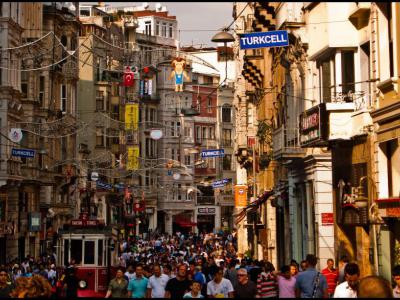
Moving through Istiklal, you can't miss the sight capturing everyone’s attention - the nostalgic red tram. The only vehicle allowed here, it quietly glides down the middle, linking Taksim and Tünel squares. Its slow pace contrasts with the endless flow of people from every corner of the world. Riding it isn’t about distance; it’s about presence - sharing a moment with Istanbul’s glorious chaos.
Look left, right, and a little skyward. All along this avenue, history and art live side by side. Historic cinemas such as Atlas and Beyoğlu still light their marquees, and elegant passages like Çiçek and Hazzopulo recall the Belle Époque charm of old Istanbul. The Church of Saint Antoine, with its Venetian Gothic façade, stands as a reminder of the city’s layered faiths and communities. Nearby, galleries such as SALT Beyoğlu, ARTER, and the Mısır Apartments bring contemporary energy to the street’s historic architecture.
Take a turn down any alley, and Istanbul will reward your curiosity. Here, the tempo softens with small smoky taverns, cafés, and rooftop terraces inviting visitors to pause - to taste, to listen, to observe. The hum of conversation, the scent of coffee, the echo of live music: all merge into one continuous story of Istanbul - vibrant, diverse, and always in motion. Indeed, this street doesn’t walk - it dances.
Just remember - keep your wallet close, your eyes anywhere but in front of you (a neat trick that clears your path), and avoid walking the minor alleys after midnight.
Moving through Istiklal, you can't miss the sight capturing everyone’s attention - the nostalgic red tram. The only vehicle allowed here, it quietly glides down the middle, linking Taksim and Tünel squares. Its slow pace contrasts with the endless flow of people from every corner of the world. Riding it isn’t about distance; it’s about presence - sharing a moment with Istanbul’s glorious chaos.
Look left, right, and a little skyward. All along this avenue, history and art live side by side. Historic cinemas such as Atlas and Beyoğlu still light their marquees, and elegant passages like Çiçek and Hazzopulo recall the Belle Époque charm of old Istanbul. The Church of Saint Antoine, with its Venetian Gothic façade, stands as a reminder of the city’s layered faiths and communities. Nearby, galleries such as SALT Beyoğlu, ARTER, and the Mısır Apartments bring contemporary energy to the street’s historic architecture.
Take a turn down any alley, and Istanbul will reward your curiosity. Here, the tempo softens with small smoky taverns, cafés, and rooftop terraces inviting visitors to pause - to taste, to listen, to observe. The hum of conversation, the scent of coffee, the echo of live music: all merge into one continuous story of Istanbul - vibrant, diverse, and always in motion. Indeed, this street doesn’t walk - it dances.
Just remember - keep your wallet close, your eyes anywhere but in front of you (a neat trick that clears your path), and avoid walking the minor alleys after midnight.
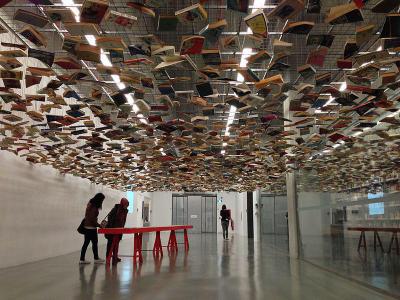
5) Istanbul Modern (Art Museum)
Here, on the edge of the Sea of Marmara, Istanbul reimagines itself. The Istanbul Modern is a thought-provoking manifesto in glass and light that gleams with a cool, contemporary shimmer. Inside its walls - a sharp contrast to the centuries-old minarets, domes, and Ottoman arches - this museum gives voice to the artists who’ve been left out of the global modern art conversation, displaying their work in a space that feels equal parts gallery, think-tank, and seaside escape...
Housed in a former maritime warehouse, it keeps things humble on the exterior - looking more like a cargo terminal than a castle. But step inside, and the openness, the light, the views of the city skyline all make sense.
The museum stretches across two airy floors. The upper level is home to its permanent collection - a vivid showcase of Turkish creativity - alongside classrooms, a design-forward gift shop, and a café with waterfront calm. Below, rotating exhibitions, Istanbul Modern Cinema, and a serene library keep the dialogue between film, art, and memory alive.
The ticket may cost a little extra by local standards, but what you gain here - the atmosphere and curation - more than balances the scales. And that nice little café – a must for any museum worth its salt – delivers a pleasant addition to a day of cultural exploration without emptying your wallet.
You can wander freely or take an audio guide - available in both English and Turkish - that will walk you through the highlights in about 45 minutes, making this a perfect pit stop for both casual wanderers and deep thinkers.
Indeed, if you're looking for a fresh angle on Turkish identity and artistic expression, this is the place. And before you leave, stop by the gift shop - a hidden trove of inspired keepsakes, including jewelry that might just rival the art upstairs...
Housed in a former maritime warehouse, it keeps things humble on the exterior - looking more like a cargo terminal than a castle. But step inside, and the openness, the light, the views of the city skyline all make sense.
The museum stretches across two airy floors. The upper level is home to its permanent collection - a vivid showcase of Turkish creativity - alongside classrooms, a design-forward gift shop, and a café with waterfront calm. Below, rotating exhibitions, Istanbul Modern Cinema, and a serene library keep the dialogue between film, art, and memory alive.
The ticket may cost a little extra by local standards, but what you gain here - the atmosphere and curation - more than balances the scales. And that nice little café – a must for any museum worth its salt – delivers a pleasant addition to a day of cultural exploration without emptying your wallet.
You can wander freely or take an audio guide - available in both English and Turkish - that will walk you through the highlights in about 45 minutes, making this a perfect pit stop for both casual wanderers and deep thinkers.
Indeed, if you're looking for a fresh angle on Turkish identity and artistic expression, this is the place. And before you leave, stop by the gift shop - a hidden trove of inspired keepsakes, including jewelry that might just rival the art upstairs...
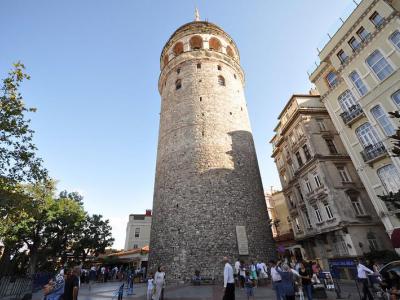
6) Galata Tower (must see)
The Galata Tower, one of Istanbul’s most recognizable landmarks, rises above the city as a lasting emblem of power, endurance, and transformation. Erected in 1348 by Genoese merchants, it originally bore the name the “Tower of Christ” and served both as a watchtower and defensive stronghold for the independent Genoese colony of Galata, located across the Golden Horn from Byzantine Constantinople. Standing nine stories tall and approximately 67 meters high, the stone tower was the tallest structure of its time and offered an unmatched panoramic view of the city and sea. Even today, its circular viewing platform provides visitors with a 360-degree perspective of Istanbul’s skyline, encompassing the Bosphorus, Golden Horn, and the city’s historic landmarks.
When the Ottomans conquered Constantinople in 1453, the tower’s purpose evolved to meet new needs. Sultan Mehmed II converted it into a fire watchtower, capitalizing on its strategic vantage point to spot fires that frequently broke out in the city’s wooden neighborhoods. Over the centuries, it also served as a prison for sailors, a warehouse, and briefly as an observatory. These changing uses reflected the Ottoman practice of adapting existing structures to fit new civic or administrative functions, integrating the Genoese-built monument into the life of the empire.
Perhaps the most famous tale linked to the Galata Tower is that of Hezarfen Ahmed Çelebi, a 17th-century Ottoman aviator who reportedly leapt from its summit wearing artificial wings and glided across the Bosphorus. Though likely embellished, the story captures the inventive spirit and imagination long associated with Istanbul’s cultural identity.
Throughout its history, the tower suffered multiple fires, notably in 1794 and 1831, prompting major restorations that eventually gave it its distinctive conical roof. It continued to function as a fire lookout post until the 1960s before being restored once more and opened to the public as a museum and viewpoint.
Today, the Galata Tower remains a highlight for visitors who can ascend by elevator to its observation deck, enjoy a drink at the café, or dine at the restaurant offering evening cabaret shows. Surrounded by lively streets, music shops, and historic charm, the tower encapsulates nearly seven centuries of Istanbul’s layered heritage-where Genoese ambition, Ottoman resilience, and modern vitality meet in a single, soaring monument.
When the Ottomans conquered Constantinople in 1453, the tower’s purpose evolved to meet new needs. Sultan Mehmed II converted it into a fire watchtower, capitalizing on its strategic vantage point to spot fires that frequently broke out in the city’s wooden neighborhoods. Over the centuries, it also served as a prison for sailors, a warehouse, and briefly as an observatory. These changing uses reflected the Ottoman practice of adapting existing structures to fit new civic or administrative functions, integrating the Genoese-built monument into the life of the empire.
Perhaps the most famous tale linked to the Galata Tower is that of Hezarfen Ahmed Çelebi, a 17th-century Ottoman aviator who reportedly leapt from its summit wearing artificial wings and glided across the Bosphorus. Though likely embellished, the story captures the inventive spirit and imagination long associated with Istanbul’s cultural identity.
Throughout its history, the tower suffered multiple fires, notably in 1794 and 1831, prompting major restorations that eventually gave it its distinctive conical roof. It continued to function as a fire lookout post until the 1960s before being restored once more and opened to the public as a museum and viewpoint.
Today, the Galata Tower remains a highlight for visitors who can ascend by elevator to its observation deck, enjoy a drink at the café, or dine at the restaurant offering evening cabaret shows. Surrounded by lively streets, music shops, and historic charm, the tower encapsulates nearly seven centuries of Istanbul’s layered heritage-where Genoese ambition, Ottoman resilience, and modern vitality meet in a single, soaring monument.
