Custom Walk in Valencia, Spain by jwatvol_f585b created on 2025-07-28
Guide Location: Spain » Valencia
Guide Type: Custom Walk
# of Sights: 7
Tour Duration: 1 Hour(s)
Travel Distance: 1.8 Km or 1.1 Miles
Share Key: 3XA7X
Guide Type: Custom Walk
# of Sights: 7
Tour Duration: 1 Hour(s)
Travel Distance: 1.8 Km or 1.1 Miles
Share Key: 3XA7X
How It Works
Please retrieve this walk in the GPSmyCity app. Once done, the app will guide you from one tour stop to the next as if you had a personal tour guide. If you created the walk on this website or come to the page via a link, please follow the instructions below to retrieve the walk in the app.
Retrieve This Walk in App
Step 1. Download the app "GPSmyCity: Walks in 1K+ Cities" on Apple App Store or Google Play Store.



Step 2. In the GPSmyCity app, download(or launch) the guide "Valencia Map and Walking Tours".
Step 3. Tap the menu button located at upper right corner of the "Walks" screen and select "Retrieve custom walk". Enter the share key: 3XA7X
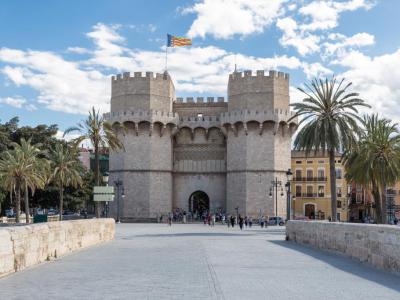
1) Torres de Serranos (Serranos Towers) (must see)
One of the last standing pieces of Valencia’s medieval walls, the gateway known today as the Serranos Towers dates back to the 14th century. Its design was inspired by a monastery in Catalonia, blending solid defensive features with an unmistakable decorative flair. The twin towers, crowned with battlements, seem poised for battle, yet the ornate Gothic stonework above the arch suggests something far more ceremonial. And in fact, it wasn’t just a fortification, but served as a grand entrance for royalty and visiting dignitaries.
Interestingly, the rear of the structure was intentionally left open. The idea was simple: to prevent the towers from being turned against the city’s own people in case of revolt. From the square behind, you can spot the chambers that once held noble prisoners between the 16th and 19th centuries. Four stone gargoyles jut from the rear wall, watching over the scene with silent, stony faces.
During the Spanish Civil War, the towers were repurposed as a secure vault, protecting priceless artworks from the Prado Museum in Madrid. Despite the turmoil, they emerged relatively unscathed and remain one of Valencia’s iconic monuments.
You can climb the winding staircases up to the terraces, where wide views stretch across the old town, the Turia Garden, and beyond. Occasionally, there are exhibitions or small historical displays inside, but the real pleasure is simply moving through the spaces, taking in the craftsmanship and the cityscape beyond the walls.
Well preserved and open to the public, the Serranos Towers have a quiet, welcoming presence, like an old guardian who still takes pride in watching over the city.
Interestingly, the rear of the structure was intentionally left open. The idea was simple: to prevent the towers from being turned against the city’s own people in case of revolt. From the square behind, you can spot the chambers that once held noble prisoners between the 16th and 19th centuries. Four stone gargoyles jut from the rear wall, watching over the scene with silent, stony faces.
During the Spanish Civil War, the towers were repurposed as a secure vault, protecting priceless artworks from the Prado Museum in Madrid. Despite the turmoil, they emerged relatively unscathed and remain one of Valencia’s iconic monuments.
You can climb the winding staircases up to the terraces, where wide views stretch across the old town, the Turia Garden, and beyond. Occasionally, there are exhibitions or small historical displays inside, but the real pleasure is simply moving through the spaces, taking in the craftsmanship and the cityscape beyond the walls.
Well preserved and open to the public, the Serranos Towers have a quiet, welcoming presence, like an old guardian who still takes pride in watching over the city.
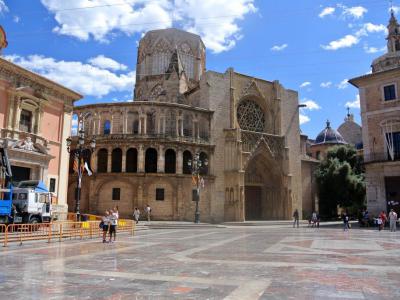
2) Plaza de la Virgen (Virgin Plaza) (must see)
Visitors tend to find their way back to this charming square, drawn in by the constant buzz of activity. Many come to admire the Cathedral or to honour Our Lady of the Forsaken at the pink basilica that bears her name. Once the Roman forum of ancient Valencia, the plaza now centres around an elegant fountain-perfect for sitting nearby and taking in the rhythm of daily life.
At the heart of the fountain sits Neptune, reclining and watchful, symbolising the Turia River. Surrounding him, eight maidens pour water from their jars, representing the region’s ancient irrigation canals. Come Thursday at noon, a centuries-old tradition unfolds as the Water Court gathers at the Apostles’ Gate to settle agricultural water disputes-a ritual so deeply rooted in local life, it’s been recognised by UNESCO as part of humanity’s intangible heritage.
Each March, during the Fallas festival, the plaza bursts into colour for the so-called “Offering of Flowers”. Locals arrive in traditional dress, laying floral offerings at the Virgin’s feet, transforming the space into a sea of colour and devotion.. And for those lingering a bit longer, nearby terraces serve up local treats-perhaps a chilled horchata paired with sweet fartons.
At the heart of the fountain sits Neptune, reclining and watchful, symbolising the Turia River. Surrounding him, eight maidens pour water from their jars, representing the region’s ancient irrigation canals. Come Thursday at noon, a centuries-old tradition unfolds as the Water Court gathers at the Apostles’ Gate to settle agricultural water disputes-a ritual so deeply rooted in local life, it’s been recognised by UNESCO as part of humanity’s intangible heritage.
Each March, during the Fallas festival, the plaza bursts into colour for the so-called “Offering of Flowers”. Locals arrive in traditional dress, laying floral offerings at the Virgin’s feet, transforming the space into a sea of colour and devotion.. And for those lingering a bit longer, nearby terraces serve up local treats-perhaps a chilled horchata paired with sweet fartons.
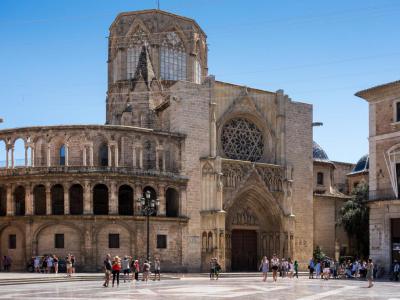
3) La Catedral (Valencia Cathedral) (must see)
As the centrepiece of Valencia’s old town, the Cathedral is quite modest on the outside, but full of surprises within. Built after the 13th-century Christian reconquest atop a mosque, it blends styles from several eras. The main body is Gothic, while the side chapels reflect an 18th-century renovation with neoclassical Corinthian columns. Brick walls and bare capitals give the nave an understated, austere quality. But at the center of the building, where the transept crosses the nave, things become more visually arresting. Instead of a traditional dome, an octagonal tower rises, pierced with alabaster windows and ringed by two tiers of pointed arches-remarkable works of 14th- and 15th-century stonecraft.
Above the high altar, recently uncovered Renaissance frescoes show musical angels in a deep-blue, star-filled sky. Elsewhere, the richly carved walnut choir stalls and the painted altarpiece display vivid biblical scenes. Don’t miss the alabaster statue of the Virgin known as “Our Lady of the Choir”. She is especially revered by expectant mothers, who circle the cathedral nine times in hopes of a safe and healthy delivery.
But the most famous artifact of all lies tucked away in a star-vaulted side chamber: what many believe to be the Holy Grail. Displayed behind an elaborate Gothic screen, the relic is a simple agate cup, dating to the 1st century BCE. It’s been fitted with medieval handles and has passed through royal and religious hands over the centuries.
The cathedral also houses a museum, where Roman foundations and medieval remains can be viewed in the basement. Upstairs, you’ll find an impressive collection of religious art-including pieces by Vicente Macip and his son, Juan de Juanes-showing just how dramatically artistic styles shifted from one generation to the next. Among the highlights are 14th-century carved apostles, early versions of the figures that now adorn the cathedral’s main entrance.
Above the high altar, recently uncovered Renaissance frescoes show musical angels in a deep-blue, star-filled sky. Elsewhere, the richly carved walnut choir stalls and the painted altarpiece display vivid biblical scenes. Don’t miss the alabaster statue of the Virgin known as “Our Lady of the Choir”. She is especially revered by expectant mothers, who circle the cathedral nine times in hopes of a safe and healthy delivery.
But the most famous artifact of all lies tucked away in a star-vaulted side chamber: what many believe to be the Holy Grail. Displayed behind an elaborate Gothic screen, the relic is a simple agate cup, dating to the 1st century BCE. It’s been fitted with medieval handles and has passed through royal and religious hands over the centuries.
The cathedral also houses a museum, where Roman foundations and medieval remains can be viewed in the basement. Upstairs, you’ll find an impressive collection of religious art-including pieces by Vicente Macip and his son, Juan de Juanes-showing just how dramatically artistic styles shifted from one generation to the next. Among the highlights are 14th-century carved apostles, early versions of the figures that now adorn the cathedral’s main entrance.
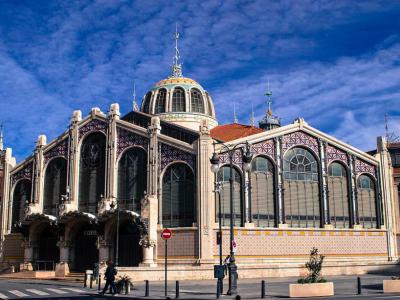
4) Mercado Central (Central Market) (must see)
Europe’s largest covered market-and arguably one of its most striking-Valencia’s Central Market is housed in a remarkable Modernista structure right in the heart of the Historic Center. While it may sit in a highly visited area, this market remains firmly rooted in everyday life, buzzing with locals who come here to stock up on hams, cheeses, vegetables, and fresh Mediterranean seafood. You’ll not only get a taste of authentic local life, but also the chance to discover regional specialties, and maybe even pick up a few souvenirs.
Though built for practical commerce, the building is anything but ordinary. Decorative flourishes in ceramic, brick, and stained glass come together in celebration of early 20th-century design. Look up, and you’ll even spot the red and yellow stripes of the Valencian flag worked into the architecture.
When it opened in 1928, the market hosted over 1,000 stalls. That number has since consolidated to around 700, still offering more than enough variety for a curious shopper or hungry traveler. For the full atmosphere, aim to visit around mid-morning, when the place comes alive with the rhythm of daily trade: voices calling out orders in Valencian, and baskets brimming with fresh produce. If you’re not heading out to the countryside to buy oranges, this is the place to grab some.
Many stalls sell herbs, spices, dried fruit, and nuts, while others surprise with items like ostrich meat or giant eggs. A separate section is devoted entirely to fish and seafood, and more adventurous food lovers might seek out snails, sweetbreads, or tripe.
Though built for practical commerce, the building is anything but ordinary. Decorative flourishes in ceramic, brick, and stained glass come together in celebration of early 20th-century design. Look up, and you’ll even spot the red and yellow stripes of the Valencian flag worked into the architecture.
When it opened in 1928, the market hosted over 1,000 stalls. That number has since consolidated to around 700, still offering more than enough variety for a curious shopper or hungry traveler. For the full atmosphere, aim to visit around mid-morning, when the place comes alive with the rhythm of daily trade: voices calling out orders in Valencian, and baskets brimming with fresh produce. If you’re not heading out to the countryside to buy oranges, this is the place to grab some.
Many stalls sell herbs, spices, dried fruit, and nuts, while others surprise with items like ostrich meat or giant eggs. A separate section is devoted entirely to fish and seafood, and more adventurous food lovers might seek out snails, sweetbreads, or tripe.
5) Lonja de la Seda (The Silk Exchange) (must see)
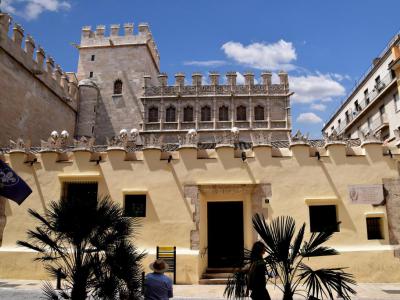
Just across from the Central Market is one of the city’s most beloved landmarks-a true cathedral of commerce. Known as the Silk Exchange, this grand structure was originally built for the silk trade and later used for broader commercial exchanges. A symbol of Valencia’s golden age in the late 15th century, it’s also one Europe’s finest examples of secular Gothic architecture.
The facade alone is a marvel of craftsmanship-elaborate stone carvings, delicate tracery, and distinctive windows line the walls. You’ll also notice a parade of gargoyles on the balustrades-28 in total, in the shape of winged creatures, beasts, and bats.
A central tower divides the structure into three main sections. Inside the tower, there’s a small chapel and a former debtor’s prison-used to hold merchants who failed to pay what they owed. To the left of the tower were two key institutions: one overseeing maritime trade, the other an early banking body that helped fund the construction. It’s well worth venturing inside to admire the ceilings-especially the Golden Hall upstairs, where a richly painted and gilded wooden ceiling dazzles with scenes of music, prophets, and mythological creatures.
But the soul of the building lies in the Transactions Hall, just to the right of the tower. Here, eight soaring spiral columns support a vaulted ceiling in a room divided into three aisles. Along the walls, a carved inscription proclaims: “I am a famous house which took fifteen years to build. See how fine a thing commerce can be when its words are not deceitful, when it keeps its oaths and does not practise usury. The merchant who lives in such a way will have riches and enjoy eternal life.”
When you’re done exploring, take a moment to relax under the orange trees in the peaceful courtyard-an ideal spot to catch your breath before moving on with your walking tour.
The facade alone is a marvel of craftsmanship-elaborate stone carvings, delicate tracery, and distinctive windows line the walls. You’ll also notice a parade of gargoyles on the balustrades-28 in total, in the shape of winged creatures, beasts, and bats.
A central tower divides the structure into three main sections. Inside the tower, there’s a small chapel and a former debtor’s prison-used to hold merchants who failed to pay what they owed. To the left of the tower were two key institutions: one overseeing maritime trade, the other an early banking body that helped fund the construction. It’s well worth venturing inside to admire the ceilings-especially the Golden Hall upstairs, where a richly painted and gilded wooden ceiling dazzles with scenes of music, prophets, and mythological creatures.
But the soul of the building lies in the Transactions Hall, just to the right of the tower. Here, eight soaring spiral columns support a vaulted ceiling in a room divided into three aisles. Along the walls, a carved inscription proclaims: “I am a famous house which took fifteen years to build. See how fine a thing commerce can be when its words are not deceitful, when it keeps its oaths and does not practise usury. The merchant who lives in such a way will have riches and enjoy eternal life.”
When you’re done exploring, take a moment to relax under the orange trees in the peaceful courtyard-an ideal spot to catch your breath before moving on with your walking tour.
6) Iglesia de San Nicolas de Bari (Church of St. Nicholas of Bari) (must see)
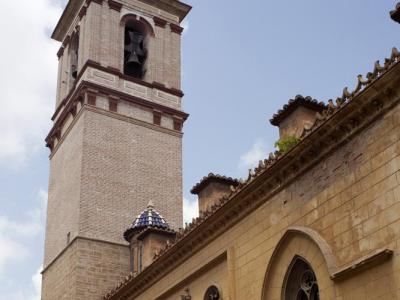
Often referred to as Valencia’s own “Sistine Chapel,” this church may seem unassuming from the outside with its Gothic façade-but step inside, and you're instantly surrounded by a breathtaking world of Baroque splendor. The walls and ceilings are covered in intricate frescoes, rich in color and detail, creating an atmosphere that feels more like a grand canvas than a place of worship.
Founded in the mid-13th century after the Christian reconquest of the city, the church was built on the site of a former mosque and dedicated to Saint Nicholas of Bari by the Dominicans. Later on, Saint Peter Martyr was added as co-patron, further deepening its symbolic importance.
Between 1690 and 1700, the interior was completely transformed. Nearly 2,000 square meters of frescoes were painted across the vaults and upper walls-scenes from the lives of both saints woven together with allegories of Christian virtues. The result is a powerful visual narrative that draws the eye and holds your attention from every angle.
Architecturally, the interior design features a single nave lined with six side chapels, each containing remarkable works of art by noted Spanish painters. A major restoration effort, completed in 2016, brought the frescoes back to life: layers of grime were carefully removed, revealing the original vibrancy and fine detail. Visitors today can admire the seamless blend of Gothic structure and Baroque artistry-a rare pairing that gives the church its unique identity.
Founded in the mid-13th century after the Christian reconquest of the city, the church was built on the site of a former mosque and dedicated to Saint Nicholas of Bari by the Dominicans. Later on, Saint Peter Martyr was added as co-patron, further deepening its symbolic importance.
Between 1690 and 1700, the interior was completely transformed. Nearly 2,000 square meters of frescoes were painted across the vaults and upper walls-scenes from the lives of both saints woven together with allegories of Christian virtues. The result is a powerful visual narrative that draws the eye and holds your attention from every angle.
Architecturally, the interior design features a single nave lined with six side chapels, each containing remarkable works of art by noted Spanish painters. A major restoration effort, completed in 2016, brought the frescoes back to life: layers of grime were carefully removed, revealing the original vibrancy and fine detail. Visitors today can admire the seamless blend of Gothic structure and Baroque artistry-a rare pairing that gives the church its unique identity.
7) Barrio del Carmen (must see)
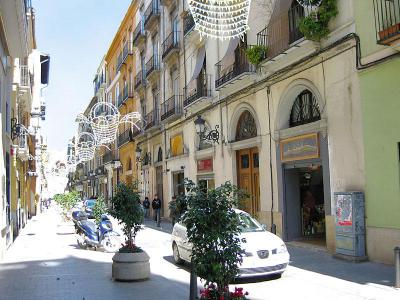
The El Carmen district in Valencia's historic center is the city's most famous neighborhood. Named after the church and convent of Carmen Calzado, it is a paradise for Mediterranean cuisine and leisure. With its rich history, medieval architecture, artistic heritage, and local legends, El Carmen is a perfect blend of history and leisure.
In the 11th century, the area beyond the Arab wall became an active agricultural hub. Houses emerged alongside existing farms. El Carmen, located outside the wall, now displays visible remnants of the Islamic fortification. The neighborhood integrated these remnants into its buildings, such as the wall section near Angel and Los Navarros squares, Calle de la Cruz, and even the Montaner bakery.
This neighborhood is home to top museums and architectural treasures. One gem is the Portal de la Valldigna, an ancient entrance to the Moorish quarter. The Church of San Nicolás de Bari and San Pedro Mártir is a must-see attraction with stunning mural paintings likened to Valencia's Sistine Chapel.
The Convento del Carmen is now the Centre del Carme Cultura Contemporània, a modern museum. The renowned IVAM is also a leading art institution. La Beneficencia houses impressive collections of artifacts. It's ironic that this ancient district is now Valencia's hub of modern art.
Another point of interest is the Central Market, a grand temple of local produce adorned with modernist decorations. It is widely regarded as the premier showcase for fresh food in Europe.
El Carmen is also home to the only two surviving access gates to the medieval city: Serranos and Quart. These gates used to close when the bells announced the onset of nightfall, and those who lost track of time had no choice but to sleep "under the Valencia moon."
With a millennium of history, there's much to explore. Grab souvenirs and then enjoy the neighborhood's diverse shops, like the Mercado de Tapinería. Hungry? Head to Mossen Sorell Market for local delicacies and a refreshing vermouth.
In the 11th century, the area beyond the Arab wall became an active agricultural hub. Houses emerged alongside existing farms. El Carmen, located outside the wall, now displays visible remnants of the Islamic fortification. The neighborhood integrated these remnants into its buildings, such as the wall section near Angel and Los Navarros squares, Calle de la Cruz, and even the Montaner bakery.
This neighborhood is home to top museums and architectural treasures. One gem is the Portal de la Valldigna, an ancient entrance to the Moorish quarter. The Church of San Nicolás de Bari and San Pedro Mártir is a must-see attraction with stunning mural paintings likened to Valencia's Sistine Chapel.
The Convento del Carmen is now the Centre del Carme Cultura Contemporània, a modern museum. The renowned IVAM is also a leading art institution. La Beneficencia houses impressive collections of artifacts. It's ironic that this ancient district is now Valencia's hub of modern art.
Another point of interest is the Central Market, a grand temple of local produce adorned with modernist decorations. It is widely regarded as the premier showcase for fresh food in Europe.
El Carmen is also home to the only two surviving access gates to the medieval city: Serranos and Quart. These gates used to close when the bells announced the onset of nightfall, and those who lost track of time had no choice but to sleep "under the Valencia moon."
With a millennium of history, there's much to explore. Grab souvenirs and then enjoy the neighborhood's diverse shops, like the Mercado de Tapinería. Hungry? Head to Mossen Sorell Market for local delicacies and a refreshing vermouth.
