Custom Walk in Malaga, Spain by graham_maycock_62e43 created on 2025-08-07
Guide Location: Spain » Malaga
Guide Type: Custom Walk
# of Sights: 6
Tour Duration: 5 Hour(s)
Travel Distance: 13.1 Km or 8.1 Miles
Share Key: EB343
Guide Type: Custom Walk
# of Sights: 6
Tour Duration: 5 Hour(s)
Travel Distance: 13.1 Km or 8.1 Miles
Share Key: EB343
How It Works
Please retrieve this walk in the GPSmyCity app. Once done, the app will guide you from one tour stop to the next as if you had a personal tour guide. If you created the walk on this website or come to the page via a link, please follow the instructions below to retrieve the walk in the app.
Retrieve This Walk in App
Step 1. Download the app "GPSmyCity: Walks in 1K+ Cities" on Apple App Store or Google Play Store.



Step 2. In the GPSmyCity app, download(or launch) the guide "Malaga Map and Walking Tours".
Step 3. Tap the menu button located at upper right corner of the "Walks" screen and select "Retrieve custom walk". Enter the share key: EB343
1) Calle Larios (Larios Street) (must see)
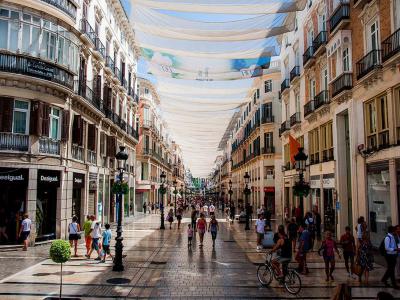
Larios Street is Málaga’s most prominent urban axis, created in the late 19th century as part of a major modernisation effort that reshaped the historic centre. Before its construction, this area was a dense network of narrow medieval streets prone to flooding and poor sanitation. The project was driven by the Larios family, influential industrialists and financiers. Opened in 1891, the street introduced a new sense of order and scale to the city, cutting a straight line between the port area and the heart of Málaga. Its uniform façades were inspired by Chicago-style commercial architecture.
From the outset, the street’s ground floors were reserved for shops and businesses, while the upper levels housed offices and select apartments. Over time, it became the city’s main commercial and social corridor, closely associated with public celebrations, processions, and everyday life. Today, it remains pedestrian-only and continues to serve as Málaga’s primary stage for major events, including Holy Week processions, the August Fair, and seasonal light installations that transform the street after dark.
Larios Street offers more than shopping, even if retail remains its primary function. Its gentle slope provides a clear visual link between the old town and the sea, while the consistent architectural rhythm makes it easy to appreciate the scale of the late 19th-century expansion. Stepping off the main avenue leads quickly into smaller streets, historic plazas, and nearby landmarks such as the cathedral and the central markets. As a result, Larios Street works both as a destination in itself and as a practical starting point for exploring Málaga’s historic centre.
From the outset, the street’s ground floors were reserved for shops and businesses, while the upper levels housed offices and select apartments. Over time, it became the city’s main commercial and social corridor, closely associated with public celebrations, processions, and everyday life. Today, it remains pedestrian-only and continues to serve as Málaga’s primary stage for major events, including Holy Week processions, the August Fair, and seasonal light installations that transform the street after dark.
Larios Street offers more than shopping, even if retail remains its primary function. Its gentle slope provides a clear visual link between the old town and the sea, while the consistent architectural rhythm makes it easy to appreciate the scale of the late 19th-century expansion. Stepping off the main avenue leads quickly into smaller streets, historic plazas, and nearby landmarks such as the cathedral and the central markets. As a result, Larios Street works both as a destination in itself and as a practical starting point for exploring Málaga’s historic centre.
2) Historic Botanical Garden of The Conception (must see)
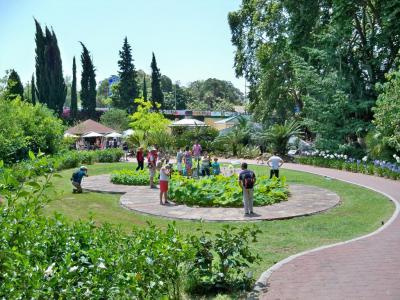
The Historic Botanical Garden of the Conception (Jardin Botanico Historico La Concepcion) is a lush oasis of subtropical beauty with over 150 years of history. Situated at the northern gateway to Malaga, this unique site stands out as one of Europe's few subtropical botanical gardens, boasting more than 50,000 plants from over 2,000 species. The garden features an impressive collection of palms, bamboo, aquatic plants, and other botanical treasures, all anchored by its historic core.
Established in 1855, the Conception was the creation of Jorge Loring y Oyarzabal and Amalia Heredia Livermore, prominent figures of Malaga’s 19th-century upper bourgeoisie. Jorge Loring, a successful businessman and influential politician, partnered with his wife Amalia, a cultured enthusiast of plants, books, and archaeology, to develop this estate. Their vision transformed the Conception into both a botanical haven and a repository of archaeological artifacts, including Roman sculptures and mosaics.
The design of the garden was greatly influenced by the expertise of French gardener Chamoussant and other skilled botanists. Following the financial decline of the Loring-Heredia family, the estate was acquired in 1911 by the Echevarria Azcarate family, who expanded the garden’s collection and enhanced its beauty. In 1943, the site was recognized as a historical-artistic garden and later declared an Asset of Cultural Interest.
The City of Malaga purchased the property in 1990, initiating extensive restoration work that culminated in its public opening in 1994. The garden was revitalized, blending its historic charm with modern botanical features. Spanning 55 hectares, the Conception includes a 25-hectare historical garden surrounded by thematic gardens and a natural Mediterranean forest.
The modern sections incorporate features such as the "Around the World in Eighty Trees" route, a palm tree world map, and dedicated areas for cacti, succulents, orchids, and carnivorous plants. These additions reflect a systematic approach to botanical study, enriching the garden's academic and ecological value.
Today, the Historic Botanical Garden of the Conception serves as both a serene retreat and an educational hub. It invites visitors to immerse themselves in the beauty of nature while appreciating the cultural and scientific heritage that has shaped this remarkable space.
Established in 1855, the Conception was the creation of Jorge Loring y Oyarzabal and Amalia Heredia Livermore, prominent figures of Malaga’s 19th-century upper bourgeoisie. Jorge Loring, a successful businessman and influential politician, partnered with his wife Amalia, a cultured enthusiast of plants, books, and archaeology, to develop this estate. Their vision transformed the Conception into both a botanical haven and a repository of archaeological artifacts, including Roman sculptures and mosaics.
The design of the garden was greatly influenced by the expertise of French gardener Chamoussant and other skilled botanists. Following the financial decline of the Loring-Heredia family, the estate was acquired in 1911 by the Echevarria Azcarate family, who expanded the garden’s collection and enhanced its beauty. In 1943, the site was recognized as a historical-artistic garden and later declared an Asset of Cultural Interest.
The City of Malaga purchased the property in 1990, initiating extensive restoration work that culminated in its public opening in 1994. The garden was revitalized, blending its historic charm with modern botanical features. Spanning 55 hectares, the Conception includes a 25-hectare historical garden surrounded by thematic gardens and a natural Mediterranean forest.
The modern sections incorporate features such as the "Around the World in Eighty Trees" route, a palm tree world map, and dedicated areas for cacti, succulents, orchids, and carnivorous plants. These additions reflect a systematic approach to botanical study, enriching the garden's academic and ecological value.
Today, the Historic Botanical Garden of the Conception serves as both a serene retreat and an educational hub. It invites visitors to immerse themselves in the beauty of nature while appreciating the cultural and scientific heritage that has shaped this remarkable space.
3) Bodega Bar - El Pimpi
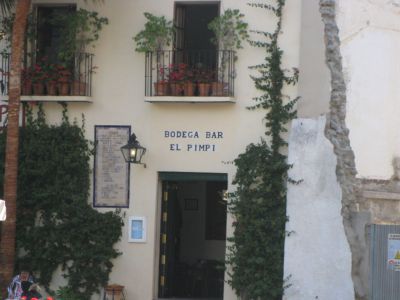
Founded in 1971, El Pimpi is more than just a wine cellar; it’s a celebration of Malaga’s rich cultural heritage and a cornerstone of southern Spanish tradition. Nestled in an 18th-century building that rests upon an ancient Roman road, this iconic venue seamlessly blends history, gastronomy, and the vibrant spirit of Malaga.
The name "El Pimpi" pays homage to a beloved local figure who historically assisted the sailors and passengers arriving at Malaga’s port. True to its roots, the wine cellar has become a hub for Malaguenos-young and old-and an essential stop for visitors seeking an authentic taste of the city’s essence.
El Pimpi’s charm lies not only in its delectable local wines and dishes but also in its uniquely Malagueno ambiance. The establishment is a labyrinth of halls and patios, each radiating its character and inviting atmosphere. From the moment you step inside, the decor transports you to a Malaga of yesteryears, with walls adorned by memories of cultural and artistic luminaries who have graced its spaces.
In its over 50 years of existence, El Pimpi has earned its place as a meeting spot for locals and a magnet for international celebrities, all drawn to its reputation for excellence. Whether you’re savoring a glass of Malaga wine, indulging in the local cuisine, or simply soaking in the ambiance, a visit to El Pimpi is to step into the beating heart of Malaga’s tradition and hospitality.
The name "El Pimpi" pays homage to a beloved local figure who historically assisted the sailors and passengers arriving at Malaga’s port. True to its roots, the wine cellar has become a hub for Malaguenos-young and old-and an essential stop for visitors seeking an authentic taste of the city’s essence.
El Pimpi’s charm lies not only in its delectable local wines and dishes but also in its uniquely Malagueno ambiance. The establishment is a labyrinth of halls and patios, each radiating its character and inviting atmosphere. From the moment you step inside, the decor transports you to a Malaga of yesteryears, with walls adorned by memories of cultural and artistic luminaries who have graced its spaces.
In its over 50 years of existence, El Pimpi has earned its place as a meeting spot for locals and a magnet for international celebrities, all drawn to its reputation for excellence. Whether you’re savoring a glass of Malaga wine, indulging in the local cuisine, or simply soaking in the ambiance, a visit to El Pimpi is to step into the beating heart of Malaga’s tradition and hospitality.
4) Alcazaba of Malaga (Malaga Fortress) (must see)
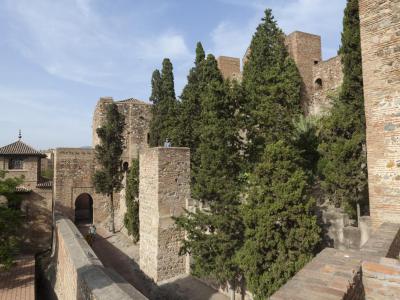
The Málaga Fortress, commonly known as the Alcazaba, is a defining reminder of the city’s Islamic past. Built in the 11th century during Muslim rule in al-Andalus, it functioned both as a military stronghold and as a residence for governors. Its commanding position above the old city and port allowed control over maritime traffic and inland routes. The complex was expanded and reinforced over time, particularly under the Nasrid dynasty, before being taken by the Catholic Monarchs in 1487 after one of the longest sieges of the Reconquest. King Ferdinand II and Queen Isabella I entered the fortress and raised their royal standard on the Tower of Tribute, a moment often cited as a turning point in the formation of unified Spain.
The fortress is organised as a carefully layered defensive system. Access to the outer enclosure is gained through the Vault Gate, designed with a sharp double-back turn intended to slow and expose intruders-though today visitors can bypass this ascent using an elevator located on Guillén Sotelo Street, behind the City Hall. From the Vault Gate, a rising path leads past gardens and ornate fountains to the Gate of Columns. After passing through the Gate of Columns, the path opens to the left toward the Christ Gate. Once through this gate, you enter the Parade Ground. Here, on the opposite side of the Christ Gate, the Gate of the Granada Quarters leads toward the palatial heart of the Alcazaba.
Beyond the Gate of the Granada Quarters lies the Courtyard of the Jets. On the western side of the courtyard, the 11th-century Taifa Palace comes into view. Its defining feature is the Southern Pavilion, which displays Caliphal-style horseshoe arches of particular elegance.
Moving to the northwestern side of the Courtyard of the Jets brings you into the Orange Tree Courtyard-a quiet space that once served as the entrance hall to the palaces. Continuing north, you encounter the more delicate architecture of the 13th-century Nasrid period. This section is centred around the Pool Palace, where a long reflecting pool and finely carved plaster arches define the space. The rooms surrounding this courtyard now house a small Archaeological Museum, displaying Moorish ceramics and artefacts uncovered during excavations.
The fortress is organised as a carefully layered defensive system. Access to the outer enclosure is gained through the Vault Gate, designed with a sharp double-back turn intended to slow and expose intruders-though today visitors can bypass this ascent using an elevator located on Guillén Sotelo Street, behind the City Hall. From the Vault Gate, a rising path leads past gardens and ornate fountains to the Gate of Columns. After passing through the Gate of Columns, the path opens to the left toward the Christ Gate. Once through this gate, you enter the Parade Ground. Here, on the opposite side of the Christ Gate, the Gate of the Granada Quarters leads toward the palatial heart of the Alcazaba.
Beyond the Gate of the Granada Quarters lies the Courtyard of the Jets. On the western side of the courtyard, the 11th-century Taifa Palace comes into view. Its defining feature is the Southern Pavilion, which displays Caliphal-style horseshoe arches of particular elegance.
Moving to the northwestern side of the Courtyard of the Jets brings you into the Orange Tree Courtyard-a quiet space that once served as the entrance hall to the palaces. Continuing north, you encounter the more delicate architecture of the 13th-century Nasrid period. This section is centred around the Pool Palace, where a long reflecting pool and finely carved plaster arches define the space. The rooms surrounding this courtyard now house a small Archaeological Museum, displaying Moorish ceramics and artefacts uncovered during excavations.
5) Castillo de Gibralfaro (Gibralfaro Castle) (must see)
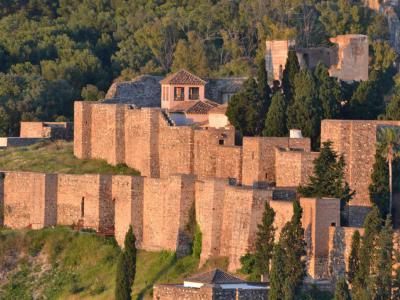
Gibralfaro Castle rises above Málaga on a hill that reaches about 131 metres in height, overlooking the city, the port, and the Mediterranean Sea. Built in the mid-14th century during the Nasrid period, the fortress was intended to reinforce the defence of the Alcazaba below and to control both land and sea approaches. The site held strategic importance long before the castle itself: the Moors erected the fortress near an earlier lighthouse constructed by the Phoenicians. Its name reflects this layered history, combining the Arabic word gabel, meaning “rock,” with the Greek word faro, meaning “lighthouse.” Today, the castle’s silhouette is so closely tied to the city that it appears on the official seal and flag of Málaga.
The fortress played a decisive role during the Reconquest. In 1487, the Catholic Monarchs Ferdinand and Isabella laid siege to Gibralfaro for three months. The stronghold resisted until hunger forced the Moorish garrison to surrender. Notably, this siege marked the first time that both attacking and defending armies made use of gunpowder, signalling a turning point in warfare. After the conquest, the castle remained under Christian control, although its military importance gradually declined.
Gibralfaro Castle offers insight into both military life and daily survival within a fortress. After passing through the main gate, you encounter the former gunpowder magazine immediately to your left. Today, it houses a small military museum displaying uniforms, weapons, and a detailed model of the city during the Islamic period. Exiting the museum and continuing straight ahead brings you to the Upper Courtyard. One of its key features is the Airon Well, carved roughly 40 metres into solid rock during the Phoenician era. The well is easy to identify by its small, rounded fountain head rising about one metre above the ground. Nearby stands the Main Tower, approximately 17 metres tall, which can be accessed from the southeastern part of the courtyard.
Arguably, the castle’s greatest attraction is its ramparts. Visitors can climb onto them and walk the full perimeter of the battlements. Although staircases throughout the complex provide access to the walls, the most effective route begins at the top of the Main Tower. From there, walking clockwise along the walls ensures that no viewpoints are missed. The panoramic views take in the Port of Málaga, the Alcazaba below, and Málaga Cathedral, offering one of the most comprehensive outlooks in the city.
The fortress played a decisive role during the Reconquest. In 1487, the Catholic Monarchs Ferdinand and Isabella laid siege to Gibralfaro for three months. The stronghold resisted until hunger forced the Moorish garrison to surrender. Notably, this siege marked the first time that both attacking and defending armies made use of gunpowder, signalling a turning point in warfare. After the conquest, the castle remained under Christian control, although its military importance gradually declined.
Gibralfaro Castle offers insight into both military life and daily survival within a fortress. After passing through the main gate, you encounter the former gunpowder magazine immediately to your left. Today, it houses a small military museum displaying uniforms, weapons, and a detailed model of the city during the Islamic period. Exiting the museum and continuing straight ahead brings you to the Upper Courtyard. One of its key features is the Airon Well, carved roughly 40 metres into solid rock during the Phoenician era. The well is easy to identify by its small, rounded fountain head rising about one metre above the ground. Nearby stands the Main Tower, approximately 17 metres tall, which can be accessed from the southeastern part of the courtyard.
Arguably, the castle’s greatest attraction is its ramparts. Visitors can climb onto them and walk the full perimeter of the battlements. Although staircases throughout the complex provide access to the walls, the most effective route begins at the top of the Main Tower. From there, walking clockwise along the walls ensures that no viewpoints are missed. The panoramic views take in the Port of Málaga, the Alcazaba below, and Málaga Cathedral, offering one of the most comprehensive outlooks in the city.
6) Catedral de Málaga (Malaga Cathedral) (must see)
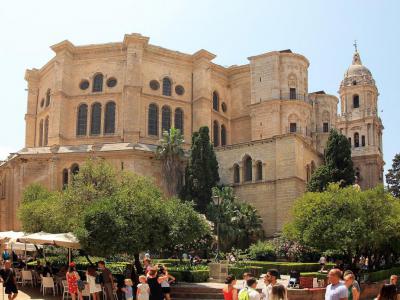
Málaga Cathedral stands at the heart of the historic centre and reflects the city’s transition from Islamic rule to Christian Spain. Construction began in 1528 on the site of the former Great Mosque, following the Christian conquest of the city in 1487. Built over more than two centuries, the cathedral brings together several architectural phases, with a predominantly Renaissance structure later enriched by Baroque elements. The project was never fully completed, a circumstance that earned it the nickname “the One-Armed Lady,” referring to the unfinished south tower. A plaque near the truncated tower explains why: funds originally intended for its completion were diverted in the late 18th century to support the American revolutionaries, a transfer facilitated by Luis de Unzaga, then governor of what is now Louisiana, through his connections to King Carlos III of Spain. As a result, the cathedral has remained “short-armed” since at least 1782.
The main façade differs from the rest of the building because of its pronounced Baroque character. Arranged on two levels, it features three large arches on the lower tier, with portals flanked by marble columns. Above them, medallions depict Málaga’s patron saints, Cyriacus and Paula, alongside a representation of the Annunciation.
Once you step inside the main nave, head toward the centre of the church to find the choir stalls. They are located in the central aisle, between the main entrance and the high altar. The sculptural works feature 42 intricately carved wooden figures of saints and religious subjects. Most of the seats were carved in the 17th century, and their craftsmanship is unique. Take a moment to notice the small ledges beneath the seats, used as misericords for leaning during long services.
Another cathedral highlight is the twin organs. As you face the choir stalls, look to your left and right-the two organs flank the choir. These massive, 18th-century Epistle and Gospel organs contain over 10,000 pipes combined. They are rare for their perfect symmetry and are still used for concerts today.
The experience extends beyond the nave. Access to the roof offers broad views across the old town, the port, and the Alcazaba. Roof access is available only via guided tour, and the staircase leading to the roof can be reached from the Orange Tree Courtyard, located north of the cathedral.
Editor’s note: The cathedral’s rooftop visits are suspended until 2027, due to repair works being carried out on the roof.
The main façade differs from the rest of the building because of its pronounced Baroque character. Arranged on two levels, it features three large arches on the lower tier, with portals flanked by marble columns. Above them, medallions depict Málaga’s patron saints, Cyriacus and Paula, alongside a representation of the Annunciation.
Once you step inside the main nave, head toward the centre of the church to find the choir stalls. They are located in the central aisle, between the main entrance and the high altar. The sculptural works feature 42 intricately carved wooden figures of saints and religious subjects. Most of the seats were carved in the 17th century, and their craftsmanship is unique. Take a moment to notice the small ledges beneath the seats, used as misericords for leaning during long services.
Another cathedral highlight is the twin organs. As you face the choir stalls, look to your left and right-the two organs flank the choir. These massive, 18th-century Epistle and Gospel organs contain over 10,000 pipes combined. They are rare for their perfect symmetry and are still used for concerts today.
The experience extends beyond the nave. Access to the roof offers broad views across the old town, the port, and the Alcazaba. Roof access is available only via guided tour, and the staircase leading to the roof can be reached from the Orange Tree Courtyard, located north of the cathedral.
Editor’s note: The cathedral’s rooftop visits are suspended until 2027, due to repair works being carried out on the roof.
