Custom Walk in Prague, Czech Republic by benkra653277 created on 2025-08-06
Guide Location: Czech Republic » Prague
Guide Type: Custom Walk
# of Sights: 8
Tour Duration: 4 Hour(s)
Travel Distance: 8.5 Km or 5.3 Miles
Share Key: V6WSZ
Guide Type: Custom Walk
# of Sights: 8
Tour Duration: 4 Hour(s)
Travel Distance: 8.5 Km or 5.3 Miles
Share Key: V6WSZ
How It Works
Please retrieve this walk in the GPSmyCity app. Once done, the app will guide you from one tour stop to the next as if you had a personal tour guide. If you created the walk on this website or come to the page via a link, please follow the instructions below to retrieve the walk in the app.
Retrieve This Walk in App
Step 1. Download the app "GPSmyCity: Walks in 1K+ Cities" on Apple App Store or Google Play Store.



Step 2. In the GPSmyCity app, download(or launch) the guide "Prague Map and Walking Tours".
Step 3. Tap the menu button located at upper right corner of the "Walks" screen and select "Retrieve custom walk". Enter the share key: V6WSZ
1) Wenceslas Square
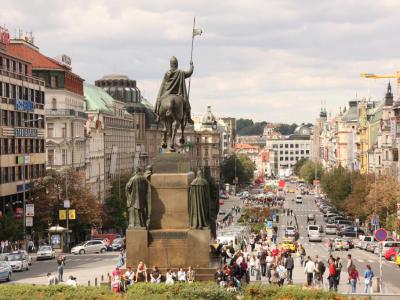
A prominent symbol of Czech identity, Wenceslas Square stretches like a lengthy rectangle, traversing from the northwest edge of the New Town to the neo-Renaissance-style National Museum at its southeastern tip.
Originating in the 14th century alongside the establishment of the New Town by Charles IV, the square initially served as a horse market. In the 19th century national revival, it received its current name along with a very fine statue of Saint Wenceslas (“The Good King”) atop his steed, encircled by figures of Saint Agnes of Bohemia, Saint Prokop, Saint Adalbert of Prague, and Saint Ludmila.
Due to its historical significance and central location, Wenceslas Square has been a gathering point for various events throughout history, from Nazi demonstrations to national celebrations and pivotal moments like the Velvet Revolution of 1989.
Today, the square is as busy a spot is ever, attracting locals and tourists alike to visit landmarks such as the National Museum and Prague State Opera, as well as a plethora of offices, hotels, shops, clubs, and eateries flanking its sides.
Tip:
For the quintessential photo of Wenceslas Square, position yourself with Saint Wenceslas' statue behind you. Keep an eye out for the Marks & Spencer shop sign, too, as it marks the balcony where Václav Havel addressed the crowds during the Velvet Revolution in 1989.
Originating in the 14th century alongside the establishment of the New Town by Charles IV, the square initially served as a horse market. In the 19th century national revival, it received its current name along with a very fine statue of Saint Wenceslas (“The Good King”) atop his steed, encircled by figures of Saint Agnes of Bohemia, Saint Prokop, Saint Adalbert of Prague, and Saint Ludmila.
Due to its historical significance and central location, Wenceslas Square has been a gathering point for various events throughout history, from Nazi demonstrations to national celebrations and pivotal moments like the Velvet Revolution of 1989.
Today, the square is as busy a spot is ever, attracting locals and tourists alike to visit landmarks such as the National Museum and Prague State Opera, as well as a plethora of offices, hotels, shops, clubs, and eateries flanking its sides.
Tip:
For the quintessential photo of Wenceslas Square, position yourself with Saint Wenceslas' statue behind you. Keep an eye out for the Marks & Spencer shop sign, too, as it marks the balcony where Václav Havel addressed the crowds during the Velvet Revolution in 1989.
2) Grand Hotel Evropa
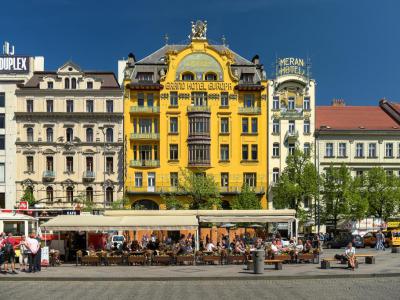
Perched on the edge of the renowned Wenceslas Square, this building stands as one of Prague's most striking architectural landmarks. Originally constructed in 1872 in the neo-Renaissance style, subsequent renovations in 1903–05 saw it transformed into a geometric Art Nouveau masterpiece, reflecting the trends of the time. Notably, Franz Kafka hosted his only author reading in Prague here in 1912.
In 1924, restaurateur Karel Šroubek acquired the property, renaming it Hotel Šroubek. It quickly gained renown throughout Czechoslovakia and beyond as a prestigious, luxurious, and modern establishment. After nationalization three decades later, it became known as Grand Hotel Evropa; however, over time, it fell into disrepair until its denationalization in 1989.
Since 2016, extensive reconstruction has been underway, including the addition of a new eight-story building in the courtyard, aimed at expanding its capacity. This expansion includes conference facilities, a wellness complex, and a panoramic restaurant. Despite these changes, the building's symmetrical Art Nouveau facade remains beautifully preserved, adorned with intricate plant motifs and topped with a golden sculpture bearing a globe-shaped lamp symbolizing Europe.
The hotel's ornate interior, beloved by filmmakers, has been featured in various movies, including "Titanic" and "Mission Impossible."
In 1924, restaurateur Karel Šroubek acquired the property, renaming it Hotel Šroubek. It quickly gained renown throughout Czechoslovakia and beyond as a prestigious, luxurious, and modern establishment. After nationalization three decades later, it became known as Grand Hotel Evropa; however, over time, it fell into disrepair until its denationalization in 1989.
Since 2016, extensive reconstruction has been underway, including the addition of a new eight-story building in the courtyard, aimed at expanding its capacity. This expansion includes conference facilities, a wellness complex, and a panoramic restaurant. Despite these changes, the building's symmetrical Art Nouveau facade remains beautifully preserved, adorned with intricate plant motifs and topped with a golden sculpture bearing a globe-shaped lamp symbolizing Europe.
The hotel's ornate interior, beloved by filmmakers, has been featured in various movies, including "Titanic" and "Mission Impossible."
3) Franz Kafka's Rotating Head (must see)
Despite writing in German and experiencing minimal publication during his lifetime, Franz Kafka embodies the essence of Prague. Many of his unsettling novels appear to anticipate the Communist era, and his profound influence extends to other artists in the city.
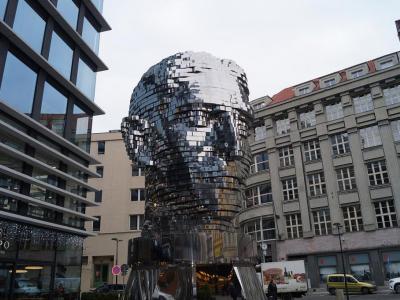
Keep an eye out for the colossal Kafka head located outside the Quadrio shopping center, crafted by David Černý. This kinetic sculpture, standing at 11 meters tall and composed of 42 rotating panels, rotates for 15 minutes at the top of each hour. Each layer operates independently, rendering it one of the most futuristic art installations across Europe.
Tip:
Arrive 10 minutes early to secure a prime spot for photography or filming!
Keep an eye out for the colossal Kafka head located outside the Quadrio shopping center, crafted by David Černý. This kinetic sculpture, standing at 11 meters tall and composed of 42 rotating panels, rotates for 15 minutes at the top of each hour. Each layer operates independently, rendering it one of the most futuristic art installations across Europe.
Tip:
Arrive 10 minutes early to secure a prime spot for photography or filming!
4) Klementinum
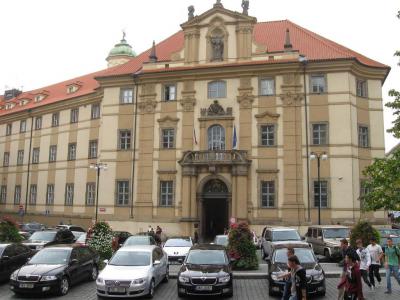
Touted as the most exquisite library globally, this magnificent institution lives up to its reputation. While its roots trace back to the 12th and 13th centuries, it gained prominence as the bastion of the Jesuits, who held sway over it for over two centuries from the early 1600s.
Although many sections remain off-limits to the public, the Baroque Library stands as a captivating jewel within, adorned with captivating ceiling murals depicting the tiers of knowledge, with the "Dome of Wisdom" as its focal point.
Adjacent lies the Mirror Chapel, a symphony of reflective surfaces renowned for its impeccable acoustics. Once graced by the presence of Mozart, it continues to reverberate with chamber music concerts, a tradition upheld by the library itself on fortunate occasions.
Nestled amidst the complex, the Astronomical Tower offers stunning panoramic vistas of the Old Town, a testament to its storied past as a haven for groundbreaking astronomer Johannes Kepler and its subsequent role as the esteemed "Prague Meridian", setting the daily time.
Today, guided tours (available in English) offer exclusive access to this architectural marvel, allowing glimpses of its beauty and historic astronomical instruments every half hour.
Although many sections remain off-limits to the public, the Baroque Library stands as a captivating jewel within, adorned with captivating ceiling murals depicting the tiers of knowledge, with the "Dome of Wisdom" as its focal point.
Adjacent lies the Mirror Chapel, a symphony of reflective surfaces renowned for its impeccable acoustics. Once graced by the presence of Mozart, it continues to reverberate with chamber music concerts, a tradition upheld by the library itself on fortunate occasions.
Nestled amidst the complex, the Astronomical Tower offers stunning panoramic vistas of the Old Town, a testament to its storied past as a haven for groundbreaking astronomer Johannes Kepler and its subsequent role as the esteemed "Prague Meridian", setting the daily time.
Today, guided tours (available in English) offer exclusive access to this architectural marvel, allowing glimpses of its beauty and historic astronomical instruments every half hour.
5) Letna Park
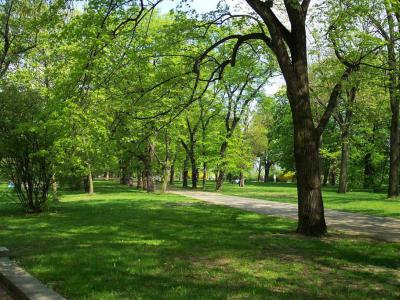
Perched above the Vltava's left bank, the expansive, verdant Letná plateau offers a quintessential panoramic vista of the Old Town and the multitude of bridges spanning the river.
Dominating the park's central expanse stands an immense concrete pedestal, now occupied by a colossal working metronome, rumored to have begun its rhythmic countdown since the 1989 Velvet Revolution. Once, from this very pedestal, the world's largest statue of Stalin gazed down upon the denizens of Old Town Square below. However, erected in 1955, the statue met its demise just seven years later in 1962 when it was dramatically demolished.
During fair weather, visitors can relish in the ambiance of the park's eastern end, where a sizable and popular beer garden beckons. Czechs and expatriates alike flock to the area, engaging in games upon the lush greenery.
Towards the rear of the park, bordering the Generali Arena, the home of the football club Sparta, stretches a vast open space often utilized for the Czech Republic's most significant protests. Notably, this area eclipses even the renowned Wenceslas Square in size and has borne witness to historic events, including the pivotal moments heralding the end of communism in 1989.
Adjacent to the park lies the National Technical Museum, along with a myriad of new brunch and coffee establishments, adding to the allure of this vibrant locale.
Dominating the park's central expanse stands an immense concrete pedestal, now occupied by a colossal working metronome, rumored to have begun its rhythmic countdown since the 1989 Velvet Revolution. Once, from this very pedestal, the world's largest statue of Stalin gazed down upon the denizens of Old Town Square below. However, erected in 1955, the statue met its demise just seven years later in 1962 when it was dramatically demolished.
During fair weather, visitors can relish in the ambiance of the park's eastern end, where a sizable and popular beer garden beckons. Czechs and expatriates alike flock to the area, engaging in games upon the lush greenery.
Towards the rear of the park, bordering the Generali Arena, the home of the football club Sparta, stretches a vast open space often utilized for the Czech Republic's most significant protests. Notably, this area eclipses even the renowned Wenceslas Square in size and has borne witness to historic events, including the pivotal moments heralding the end of communism in 1989.
Adjacent to the park lies the National Technical Museum, along with a myriad of new brunch and coffee establishments, adding to the allure of this vibrant locale.
6) Wallenstein Palace and Gardens
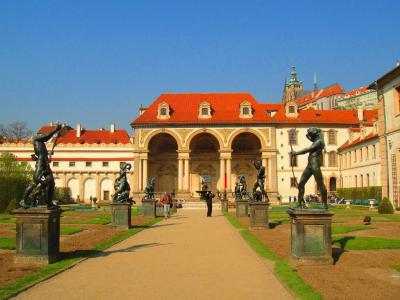
Feast your eyes on one of Prague’s grandest Baroque treasures-a 17th-century palace that marked the city’s first step into this dramatic architectural style. With high walls, lavish fountains, and elegant symmetry, the Wallenstein Palace and its gardens offer a full-blown sensory experience. Step into the vaulted Renaissance garden hall that opens out to the greenery, and you’ll instantly feel the aristocratic flair that once defined the place.
As you stroll through the carefully manicured paths, take in the statues and fountains scattered across the grounds-heroic warriors frozen mid-battle, mythological gods locked in eternal drama, and beasts frozen in defeat. And just when you think you’ve seen it all, you come upon the Grotto-a surreal wall of twisting dripstone that looks like it leapt straight from a dream. Faces emerge from the shadows, odd little creatures peek through the formations, and if you look closely, the rock even hints at mysterious doorways and hidden passages. It’s equal parts nature, fantasy, and architectural theater.
The man behind all of this splendor was Albrecht von Wallenstein, a military genius who rose to power during the chaos of the Thirty Years’ War. In 1622, with the Swedes and Protestant armies threatening, Emperor Ferdinand II turned to Wallenstein for help. Newly enriched by marriage and ambitious as ever, Wallenstein offered to raise and fund an army of twenty thousand men-no small favor. In gratitude, the emperor rewarded him with vast estates, including the land where this palace now stands.
He didn’t hesitate to clear the way, demolishing over twenty houses, a brickworks, and several gardens to make room for his vision. And what a vision it was-Wallenstein set out to rival Prague Castle itself. Today, much of the palace is home to the Czech Senate, with rooms like the Knight’s Hall still bearing his larger-than-life presence. There, he’s immortalized in a fresco as Mars, the Roman god of war, charging ahead in a chariot. The old riding school has also found new life as a space for art exhibitions, bridging the palace’s past with its cultural present.
Access to the interiors is limited to weekends, but the gardens welcome visitors every day. Look out for the understated entry points-they’re easy to miss, but what lies beyond is anything but forgettable. And if you’re visiting in summer, don’t miss the open-air concerts and theater performances that bring new life to these historic grounds.
As you stroll through the carefully manicured paths, take in the statues and fountains scattered across the grounds-heroic warriors frozen mid-battle, mythological gods locked in eternal drama, and beasts frozen in defeat. And just when you think you’ve seen it all, you come upon the Grotto-a surreal wall of twisting dripstone that looks like it leapt straight from a dream. Faces emerge from the shadows, odd little creatures peek through the formations, and if you look closely, the rock even hints at mysterious doorways and hidden passages. It’s equal parts nature, fantasy, and architectural theater.
The man behind all of this splendor was Albrecht von Wallenstein, a military genius who rose to power during the chaos of the Thirty Years’ War. In 1622, with the Swedes and Protestant armies threatening, Emperor Ferdinand II turned to Wallenstein for help. Newly enriched by marriage and ambitious as ever, Wallenstein offered to raise and fund an army of twenty thousand men-no small favor. In gratitude, the emperor rewarded him with vast estates, including the land where this palace now stands.
He didn’t hesitate to clear the way, demolishing over twenty houses, a brickworks, and several gardens to make room for his vision. And what a vision it was-Wallenstein set out to rival Prague Castle itself. Today, much of the palace is home to the Czech Senate, with rooms like the Knight’s Hall still bearing his larger-than-life presence. There, he’s immortalized in a fresco as Mars, the Roman god of war, charging ahead in a chariot. The old riding school has also found new life as a space for art exhibitions, bridging the palace’s past with its cultural present.
Access to the interiors is limited to weekends, but the gardens welcome visitors every day. Look out for the understated entry points-they’re easy to miss, but what lies beyond is anything but forgettable. And if you’re visiting in summer, don’t miss the open-air concerts and theater performances that bring new life to these historic grounds.
7) Vrtba Garden
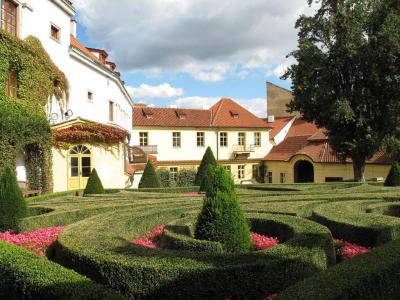
A discreet entrance on bustling Karmelitská Street leads to a captivating retreat boasting stunning views of Malá Strana. The unassuming door opens to the cozy courtyard of Vrtba Palace, flanked by two Renaissance wings. The left wing dates back to 1575, while the right one was erected in 1591. Originally owned by a Bohemian noble later executed by the Habsburgs, the latter wing was acquired by Count Sezima of Vrtba, who transformed it into a late-Renaissance palace by merging it with the adjacent property.
A century later, the enchanting Vrtba Garden was born, ascending in five tiers behind the courtyard. Featuring statues and formal terraces, it culminates in a pavilion embellished with seashell motifs at the summit-a sought-after venue for weddings, receptions, and occasional concerts. Notably, the garden's upper section is adjacent to the U.S. Embassy's property, often marked by the sight of the American flag.
The courtyard entrance is marked by the imposing stone figure of Atlas, crafted by Mathias Braun, a prominent figure among Czech baroque sculptors, whose workshop produced many of the mythological statues adorning the palace grounds.
A century later, the enchanting Vrtba Garden was born, ascending in five tiers behind the courtyard. Featuring statues and formal terraces, it culminates in a pavilion embellished with seashell motifs at the summit-a sought-after venue for weddings, receptions, and occasional concerts. Notably, the garden's upper section is adjacent to the U.S. Embassy's property, often marked by the sight of the American flag.
The courtyard entrance is marked by the imposing stone figure of Atlas, crafted by Mathias Braun, a prominent figure among Czech baroque sculptors, whose workshop produced many of the mythological statues adorning the palace grounds.
8) Dancing House (must see)
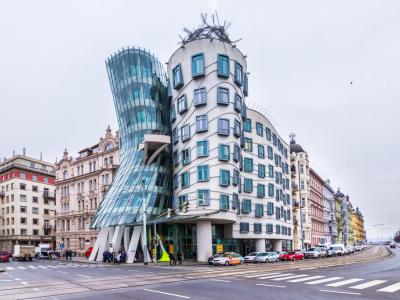
One of Prague's most renowned modern landmarks, the Dancing House is the nickname given to the Nationale-Nederlanden building in downtown. Designed collaboratively by Canadian-American architect Frank Gehry (known for his work on the Guggenheim Bilbao) and his Croatian-Czech partner Vlado Milunić, the building occupies a vacant riverfront plot that was once the site of a structure destroyed during the Bombing of Prague in 1945. Completed in 1996, its unconventional design sparked controversy upon unveiling.
Supported by Czech President Václav Havel, who had resided nearby for many years, the building was envisioned as a hub of cultural activity. Originally dubbed "Fred and Ginger" after the iconic dance duo Fred Astaire and Ginger Rogers, due to its resemblance to a pair of dancers, the structure stands in stark contrast to Prague's predominant Baroque, Gothic, and Art Nouveau architecture. Yet, the intertwined glass and stone towers flanking the Vltava River symbolize the city's delicate balance between its rich historical heritage and its evolving modern identity.
Playfully nicknamed the "Drunk House" by locals, it now houses a hotel and a top-floor restaurant offering panoramic views of the city. Even if you don’t plan to stay or dine there, admiring the building itself, whether from the near or far side of the river, is well worth it.
Tip:
Take the elevator to the Glass Bar on the top floor and enjoy any beverage to gain access to the 360-degree viewing platform.
Supported by Czech President Václav Havel, who had resided nearby for many years, the building was envisioned as a hub of cultural activity. Originally dubbed "Fred and Ginger" after the iconic dance duo Fred Astaire and Ginger Rogers, due to its resemblance to a pair of dancers, the structure stands in stark contrast to Prague's predominant Baroque, Gothic, and Art Nouveau architecture. Yet, the intertwined glass and stone towers flanking the Vltava River symbolize the city's delicate balance between its rich historical heritage and its evolving modern identity.
Playfully nicknamed the "Drunk House" by locals, it now houses a hotel and a top-floor restaurant offering panoramic views of the city. Even if you don’t plan to stay or dine there, admiring the building itself, whether from the near or far side of the river, is well worth it.
Tip:
Take the elevator to the Glass Bar on the top floor and enjoy any beverage to gain access to the 360-degree viewing platform.
