Custom Walk in Chicago, Illinois by christianece_cf72e created on 2025-08-20
Guide Location: USA » Chicago
Guide Type: Custom Walk
# of Sights: 11
Tour Duration: 13 Hour(s)
Travel Distance: 34.5 Km or 21.4 Miles
Share Key: Z3ZJG
Guide Type: Custom Walk
# of Sights: 11
Tour Duration: 13 Hour(s)
Travel Distance: 34.5 Km or 21.4 Miles
Share Key: Z3ZJG
How It Works
Please retrieve this walk in the GPSmyCity app. Once done, the app will guide you from one tour stop to the next as if you had a personal tour guide. If you created the walk on this website or come to the page via a link, please follow the instructions below to retrieve the walk in the app.
Retrieve This Walk in App
Step 1. Download the app "GPSmyCity: Walks in 1K+ Cities" on Apple App Store or Google Play Store.



Step 2. In the GPSmyCity app, download(or launch) the guide "Chicago Map and Walking Tours".
Step 3. Tap the menu button located at upper right corner of the "Walks" screen and select "Retrieve custom walk". Enter the share key: Z3ZJG
1) Wells Street
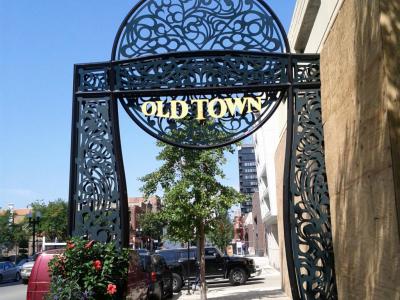
Wells Street is the main drag of Chicago's charming Old Town, whose epicenter sits at the crossroads of Wells Street and North Avenue. On the southeast corner, extending gracefully from this juncture, lies a fine neighborhood of time-honored townhouses (late 1800s to early 1900s) lined along three streets: Dearborn, State, and Astor.
Wells Street boasts an array of dependable dining establishments and watering holes, but the ambiance here is decidedly more laid-back, with prices that won't send your wallet into a tailspin, unlike the posh locales of River North or the Magnificent Mile. If you're in the mood for brunch, NOOKIES is the undisputed champion, drawing a loyal crowd of locals who bask in the embrace of its exceedingly affable staff. The menu offers an array of breakfast, lunch, and dinner options, and the portions are so generous that they provide takeout containers for your impending leftovers. When the sun graces Chicago with its presence, there's even a smattering of outdoor seating.
For those seeking an authentic Irish pub experience (because who wouldn't want one in Chicago?), the perfectly situated DECLAN'S is a must, purporting to be the official bar of the University of Notre Dame. Meanwhile, the OLD TOWN PUB offers not only reasonable prices but also surprisingly delightful fare and libations. Step inside, and you'll discover a subtle charm that permeates its interior.
Tip:
Mark your calendar for the second weekend in June when the Old Town Art Fair and the Wells Street Art Festival set the neighborhood ablaze with creativity. These events showcase the remarkable work of local artists, complete with a live music stage, food vendors, and children's theater, unfolding between North Avenue and Division Street, from 10 AM to 10 PM daily.
Wells Street boasts an array of dependable dining establishments and watering holes, but the ambiance here is decidedly more laid-back, with prices that won't send your wallet into a tailspin, unlike the posh locales of River North or the Magnificent Mile. If you're in the mood for brunch, NOOKIES is the undisputed champion, drawing a loyal crowd of locals who bask in the embrace of its exceedingly affable staff. The menu offers an array of breakfast, lunch, and dinner options, and the portions are so generous that they provide takeout containers for your impending leftovers. When the sun graces Chicago with its presence, there's even a smattering of outdoor seating.
For those seeking an authentic Irish pub experience (because who wouldn't want one in Chicago?), the perfectly situated DECLAN'S is a must, purporting to be the official bar of the University of Notre Dame. Meanwhile, the OLD TOWN PUB offers not only reasonable prices but also surprisingly delightful fare and libations. Step inside, and you'll discover a subtle charm that permeates its interior.
Tip:
Mark your calendar for the second weekend in June when the Old Town Art Fair and the Wells Street Art Festival set the neighborhood ablaze with creativity. These events showcase the remarkable work of local artists, complete with a live music stage, food vendors, and children's theater, unfolding between North Avenue and Division Street, from 10 AM to 10 PM daily.
2) ROOF on theWit
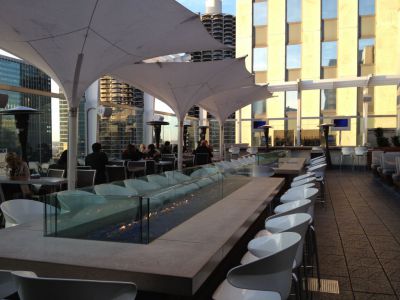
Tucked away amidst the towering skyscrapers of the Loop, right where you can enjoy eye-popping views of the city, the meandering "L" train, the snaking Chicago River, and the vast Lake Michigan, the Wit is a swanky collection of lounge bars perched on the 27th floor of theWit Hotel. Cozy up by an open fire, soak in the ultra-hip atmosphere, and gaze at those jaw-dropping vistas, all while sipping on a fancy cocktail. The floor-to-ceiling glass windows turn the indoor space into a captivating sight as well. With DJs spinning tunes that range from eclectic to electric, and a menu filled with small bites, this spot has all the ingredients for a memorable time.
3) Harold's Chicken Shack
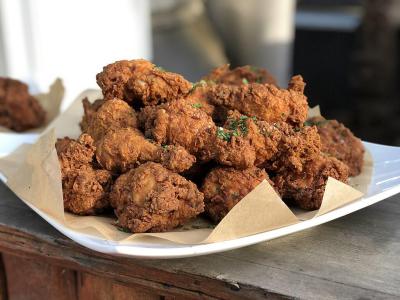
Harold's Chicken Shack, founded by Harold Pierce, is a well-known fast-food chain specializing in fried chicken. Since its inception over 50 years ago, it has become a staple in Chicago and is now expanding to other parts of the country. The story goes that Harold, as a child, vowed never to be without chicken after a preacher ate the last piece at a family dinner.
Harold Pierce initially worked as a chauffeur. By 1950, he and his wife Hilda were running a small restaurant called H&H on 39th Street, known for chicken feet and dumplings. With the help of his friend Gene Rosen, who owned a poultry shop, Pierce launched Harold's Chicken Shack on 47th and Greenwood.
The chain grew primarily out of necessity, as larger fast-food chains avoided African-American neighborhoods. Despite legal and social barriers, Harold's thrived and became a great example of a successful black-owned business serving the black community. Pierce franchised the idea to friends and family, leading to a variety of techniques and flavors across different locations.
The chefs at Harold's Chicken Shack know how to create authentic and tasty food. It is recommended to try one of their specialties, such as Chicken Bucket, Half Chicken Mix Dinner, Popcorn Chicken Dinner, or Chicken Tenders Dinner.
Harold Pierce initially worked as a chauffeur. By 1950, he and his wife Hilda were running a small restaurant called H&H on 39th Street, known for chicken feet and dumplings. With the help of his friend Gene Rosen, who owned a poultry shop, Pierce launched Harold's Chicken Shack on 47th and Greenwood.
The chain grew primarily out of necessity, as larger fast-food chains avoided African-American neighborhoods. Despite legal and social barriers, Harold's thrived and became a great example of a successful black-owned business serving the black community. Pierce franchised the idea to friends and family, leading to a variety of techniques and flavors across different locations.
The chefs at Harold's Chicken Shack know how to create authentic and tasty food. It is recommended to try one of their specialties, such as Chicken Bucket, Half Chicken Mix Dinner, Popcorn Chicken Dinner, or Chicken Tenders Dinner.
4) Chinatown Gate
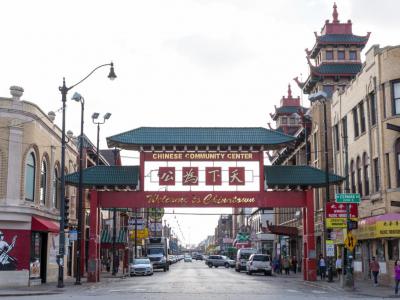
Chicago's vibrant Chinese enclave is fittingly anchored by the Chinatown Gate. Erected in 1975, it was conceived by architect Peter Fung, drawing inspiration from a gate found in Beijing. Its ornate tiles at the pinnacle are hand-painted with characters that convey the message, "The world belongs to the commonwealth". This phrase harkens back to the early 20th century, a pivotal period during China's transition to a republic, while also serving as a tribute to the enduring spirit of Chicago's pioneering Chinese settlers.
The gate stands on South Wentworth Avenue, the main thoroughfare of Chinatown. Along this vibrant street you will find a plethora of restaurants, bakeries, grocery stores, as well as shops specializing in Chinese traditional medicine. In addition to the myriad Chinese dining options, you'll discover a rich tapestry of eateries offering Vietnamese, Thai, and Japanese cuisine, enriching the culinary mosaic.
The gate stands on South Wentworth Avenue, the main thoroughfare of Chinatown. Along this vibrant street you will find a plethora of restaurants, bakeries, grocery stores, as well as shops specializing in Chinese traditional medicine. In addition to the myriad Chinese dining options, you'll discover a rich tapestry of eateries offering Vietnamese, Thai, and Japanese cuisine, enriching the culinary mosaic.
5) Nine Dragon Wall
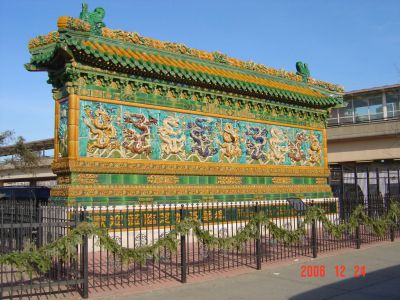
Inspired by the renowned wall within Beijing's Beihai Park, this impressive structure, erected in 2004, features a magnificent display of nine prominent dragons alongside an additional 500 smaller ones, all adorned in vibrant shades of red, gold, and blue, symbolizing the auspicious concept of good fortune. It's noteworthy that in ancient Chinese belief, the number "9" held the highest esteem, and the dragon was considered the essence of all creative forces. The reverence for the number "9" extends to most Chinese art and literature, where it was frequently used to convey profound or auspicious meanings. In mathematics, "9" is unique because any multiple of 9 will always reduce to 9 when its digits are added together. This mathematical property may have contributed to the number's significance.
As a prominent emblem of Chicago's Chinatown, this wall ranks among the four global replicas of the original in Beijing and was actually crafted from imported glazed tiles from China. Such walls are typically found gracing the precincts of imperial Chinese palaces and gardens, as emperors were believed to be the earthly representative of the heavens, and their throne was often referred to as the "Dragon Throne."; however, you'll discover this replica conveniently located near the entrance to Chinatown, adjacent to the "L" stop. If you have an appreciation for Asian architectural aesthetics (and beyond), you'll find this wall to be a truly captivating sight. Although partially enclosed by a gate, you can easily peer over it to capture some great photographs.
As a prominent emblem of Chicago's Chinatown, this wall ranks among the four global replicas of the original in Beijing and was actually crafted from imported glazed tiles from China. Such walls are typically found gracing the precincts of imperial Chinese palaces and gardens, as emperors were believed to be the earthly representative of the heavens, and their throne was often referred to as the "Dragon Throne."; however, you'll discover this replica conveniently located near the entrance to Chinatown, adjacent to the "L" stop. If you have an appreciation for Asian architectural aesthetics (and beyond), you'll find this wall to be a truly captivating sight. Although partially enclosed by a gate, you can easily peer over it to capture some great photographs.
6) Laird Bell Law Quadrangle
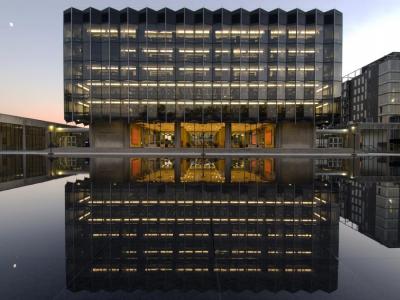
Home to the Law School, this complex designed by Finnish-American architect Eero Saarinen stands as his most significant contribution to the University of Chicago campus. In line with the tradition of grouping buildings of similar disciplines around a central court, Saarinen orchestrated the creation of four structures: Constitution Hall, a classroom building, the law library, and the administration building, all encircling a reflective pool and fountain. In November 1960, Saarinen was quoted in 'Architectural Record', expressing the intention to create a harmonious relationship with the Gothic dormitories by emphasizing a small, fragmented scale, a dynamic silhouette, and notably, verticality in the library's design.
Recognized as a pinnacle of modern architecture, this complex aligns with the Modernist emphasis on horizontal lines and interconnected spaces. Saarinen employed the same Indiana limestone used in the Gothic buildings nearby, while the adjacent fountain and landscaping by Dan Kiley added a touch of softness to the Mondrian-like order, maintaining the architectural balance.
In the same vicinity, the bronze sculpture 'Construction in the Third and Fourth Dimension' (1961–62), commissioned for this space, was crafted by Antoine Pevsner, a Russian-born sculptor known for his work in Cubist and Constructivist styles. As early as 1920, Pevsner advocated for art to engage in four dimensions, including time. In this sculpture, Pevsner exploited the distortion of flat metal planes, which theoretically could extend infinitely. The surface's striations also hint at the potential for the infinite.
A comprehensive renovation and modernization project in 2008 restored these structures to their former glory while adapting them to contemporary requirements. The D'Angelo Law Library tower, the standout feature of the complex, and the reflecting pool both received impressive makeovers and earned the 2008 Richard H. Driehaus Foundation Preservation Award for Rehabilitation.
Recognized as a pinnacle of modern architecture, this complex aligns with the Modernist emphasis on horizontal lines and interconnected spaces. Saarinen employed the same Indiana limestone used in the Gothic buildings nearby, while the adjacent fountain and landscaping by Dan Kiley added a touch of softness to the Mondrian-like order, maintaining the architectural balance.
In the same vicinity, the bronze sculpture 'Construction in the Third and Fourth Dimension' (1961–62), commissioned for this space, was crafted by Antoine Pevsner, a Russian-born sculptor known for his work in Cubist and Constructivist styles. As early as 1920, Pevsner advocated for art to engage in four dimensions, including time. In this sculpture, Pevsner exploited the distortion of flat metal planes, which theoretically could extend infinitely. The surface's striations also hint at the potential for the infinite.
A comprehensive renovation and modernization project in 2008 restored these structures to their former glory while adapting them to contemporary requirements. The D'Angelo Law Library tower, the standout feature of the complex, and the reflecting pool both received impressive makeovers and earned the 2008 Richard H. Driehaus Foundation Preservation Award for Rehabilitation.
7) Rockefeller Memorial Chapel
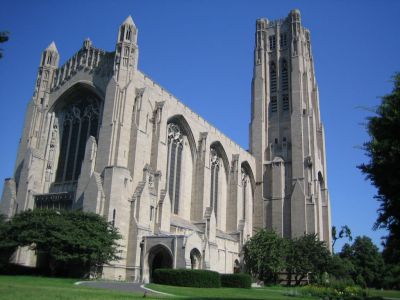
Standing tall above the Midway Plaisance, this massive limestone church crafted from loadbearing masonry limestone employs classical Gothic architectural elements such as arches and buttresses. Bertram Grosvenor Goodhue, a nationally renowned advocate of the Gothic Revival and Arts and Crafts movements, envisioned this design as his interpretation of Modern Gothic.
The university administration played a significant role in the design process, with President Ernest DeWitt Burton even embarking on tours of famous English cathedrals to ensure the design's appropriateness. The most noticeable departure from medieval Gothic lies in the proportions, characterized by unusually wide bays and tall clerestory windows above low side aisles, as well as an abundance of smooth, flat surfaces. A central feature of the chapel is its tower, accessible via a climb of 271 steps, offering impressive views and housing a carillon frequently used for concerts. Within the main building, Bond Chapel is a popular venue for artistic and musical events.
The interior has a serene and calming color palette, along with a unique example of Guastavino tile vaulting, where the tiles serve a structural rather than purely decorative purpose. The sculptural elements encompass religious figures, allegorical representations, historical figures, coats of arms, and inscriptions. A statue of Goodhue on the east transept wall symbolizes architecture, with Rockefeller Chapel in his hands and West Point Chapel in the background. Opposite him stands Bach, representing music. Choral performances are a beloved tradition at the chapel, often featuring music associated with the traditional Church seasons.
The university administration played a significant role in the design process, with President Ernest DeWitt Burton even embarking on tours of famous English cathedrals to ensure the design's appropriateness. The most noticeable departure from medieval Gothic lies in the proportions, characterized by unusually wide bays and tall clerestory windows above low side aisles, as well as an abundance of smooth, flat surfaces. A central feature of the chapel is its tower, accessible via a climb of 271 steps, offering impressive views and housing a carillon frequently used for concerts. Within the main building, Bond Chapel is a popular venue for artistic and musical events.
The interior has a serene and calming color palette, along with a unique example of Guastavino tile vaulting, where the tiles serve a structural rather than purely decorative purpose. The sculptural elements encompass religious figures, allegorical representations, historical figures, coats of arms, and inscriptions. A statue of Goodhue on the east transept wall symbolizes architecture, with Rockefeller Chapel in his hands and West Point Chapel in the background. Opposite him stands Bach, representing music. Choral performances are a beloved tradition at the chapel, often featuring music associated with the traditional Church seasons.
8) Buckingham Fountain (must see)
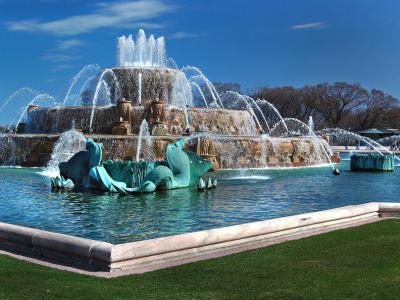
Right in the thick of Chicago’s downtown grid, amid suits and skyscrapers, you’ll find Grant Park showing off its true showstopper: one of the largest fountains in the world! And no, it's not just there to impress tourists. This aquatic giant was a lavish gift from Kate Sturges Buckingham, a 20th-century American art collector and philanthropist, who had some serious cash to splash thanks to her family's grain empire. She dedicated it to her brother, with whom she shared a deep love for art (and apparently, dramatic gestures).
What you get is less “sprinkler system” and more “sculptural fever dream.” Imagine a three-tiered marble wedding cake dressed in pink seashells, ringed with gleeful fish spraying water like it’s going out of style, and four bronze sea horses rearing back in dramatic flair - each repping one of the states touching Lake Michigan. It all came together in 1927, channeling Versailles vibes, only bigger. Because this is Chicago...
Now, if you want the full Buckingham Fountain experience, show up between May and October. That’s when the real magic happens - hourly water shows with lights that shimmer and shift like the fountain’s throwing its own rave. Stick around long enough, and you'll see the center jet shooting 150 feet into the air like it’s trying to signal the moon.
Tip break:
While here, don’t just stare at the spray. Head west across Columbus Drive and give a nod to the quietly dignified Lincoln statue - seated, reflective, and looking like he’s contemplating the next big speech. Sculpted by Augustus Saint-Gaudens in 1926, it’s the introvert to the fountain’s extrovert. Then swing by Congress Parkway near Michigan Avenue, where The Bowman and the Spearman strike a pose. These towering bronze Indian warriors aren’t just decorative-they're 17 feet of pure stoic intensity.
What you get is less “sprinkler system” and more “sculptural fever dream.” Imagine a three-tiered marble wedding cake dressed in pink seashells, ringed with gleeful fish spraying water like it’s going out of style, and four bronze sea horses rearing back in dramatic flair - each repping one of the states touching Lake Michigan. It all came together in 1927, channeling Versailles vibes, only bigger. Because this is Chicago...
Now, if you want the full Buckingham Fountain experience, show up between May and October. That’s when the real magic happens - hourly water shows with lights that shimmer and shift like the fountain’s throwing its own rave. Stick around long enough, and you'll see the center jet shooting 150 feet into the air like it’s trying to signal the moon.
Tip break:
While here, don’t just stare at the spray. Head west across Columbus Drive and give a nod to the quietly dignified Lincoln statue - seated, reflective, and looking like he’s contemplating the next big speech. Sculpted by Augustus Saint-Gaudens in 1926, it’s the introvert to the fountain’s extrovert. Then swing by Congress Parkway near Michigan Avenue, where The Bowman and the Spearman strike a pose. These towering bronze Indian warriors aren’t just decorative-they're 17 feet of pure stoic intensity.
9) Oak Street Beach
Back in the late 1800s, Chicago's Lake Shore was all peace and quiet, gently sloping from Oak Street to the Chicago River and providing a serene haven for Lakeshore property owners. Then along came George Streeter, a Civil War veteran, carnival enthusiast, steamboat captain, and the brassiest of con-men. His boat, the Reutan, packed with cargo and passengers, found itself marooned on a sandbar.
Now, most folks would've been flustered by such a mishap, but not our George, who decided to get creative! He took that stranded ship, its cargo, and a heap of trash, and voilà, he conjured up a small island, declaring it his very own ship-trash-pier-sand island. Naturally, this led to some heated disputes, including good old-fashioned gunfights. Long story short, George was eventually given the boot. The land he left behind was filled in and got christened Streeterville, which just so happens to be the present site of the 360 Chicago Observation Deck and the illustrious Chicago Water Tower.
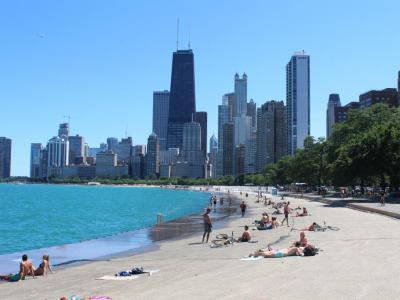
Back in the day when this area was a resort, the legendary Drake Hotel made its grand debut in 1920 as a beachfront property. Guests could effortlessly saunter from the changing rooms on the arcade level straight onto the sandy shores. Sadly, the construction of Lake Shore Drive separated the beach from the neighborhood, but fret not – a nifty tunnel ensures easy access, and it remains a primo spot to plop down your towel and take a refreshing dip. Since the sand is in short supply, locals have mastered the art of spreading out on towels along the concrete walkway and taking the plunge when things heat up. And if you fancy a bike ride, a pit stop for snacks, or a visit to the restrooms, you're in luck – these amenities are available seasonally, along with changing rooms, bathrooms, volleyball courts, plus the Oak Street Beach Restaurant, which offers a casual (though somewhat pricey) menu, along with great views of the lake and skyline.
So, there you have it, the story of Oak Street Beach, complete with battles, beachfront hotels, and a whole lot of sun-soaked fun!
Now, most folks would've been flustered by such a mishap, but not our George, who decided to get creative! He took that stranded ship, its cargo, and a heap of trash, and voilà, he conjured up a small island, declaring it his very own ship-trash-pier-sand island. Naturally, this led to some heated disputes, including good old-fashioned gunfights. Long story short, George was eventually given the boot. The land he left behind was filled in and got christened Streeterville, which just so happens to be the present site of the 360 Chicago Observation Deck and the illustrious Chicago Water Tower.
Back in the day when this area was a resort, the legendary Drake Hotel made its grand debut in 1920 as a beachfront property. Guests could effortlessly saunter from the changing rooms on the arcade level straight onto the sandy shores. Sadly, the construction of Lake Shore Drive separated the beach from the neighborhood, but fret not – a nifty tunnel ensures easy access, and it remains a primo spot to plop down your towel and take a refreshing dip. Since the sand is in short supply, locals have mastered the art of spreading out on towels along the concrete walkway and taking the plunge when things heat up. And if you fancy a bike ride, a pit stop for snacks, or a visit to the restrooms, you're in luck – these amenities are available seasonally, along with changing rooms, bathrooms, volleyball courts, plus the Oak Street Beach Restaurant, which offers a casual (though somewhat pricey) menu, along with great views of the lake and skyline.
So, there you have it, the story of Oak Street Beach, complete with battles, beachfront hotels, and a whole lot of sun-soaked fun!
10) West Burton Place Historic District
Just a hop and a skip away from the rigorously planned Carl Sandburg Village lies a charmingly chaotic realm that can only be described as Old Town's artistic birthplace. It all began in 1927 when a lively congregation of artists and craftsmen decided to breathe new life into the streets of West Burton Place.
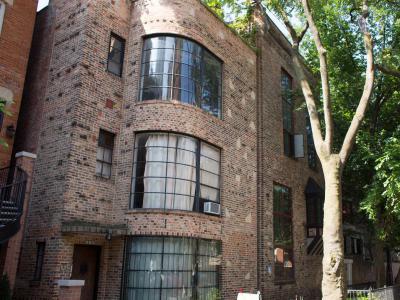
Their canvas primarily consisted of Victorian houses, like the still-standing #147 and #164–166 (both dating back to 1881), which they transformed with an exuberant and freewheeling artistic flair. Some houses received a mere touch-up, while others were enveloped in brick, adorned with new wings, and molded into entirely new forms. These visionaries, though short on funds, possessed an abundance of imagination. They scoured Maxwell Street flea markets in search of tiles, copper bathtubs, wooden doors, and assorted hardware to bring their visions to life. Construction was a slow, apartment-by-apartment process, with rental income funneling into these painstaking unit conversions. Some dwellings were never truly finished, as their owners continued to infuse them with new artistic creations. Grateful tenants and homeowners alike have since preserved and further embellished these structures. In 2016, architect P. K. VanderBeke successfully advocated for and obtained city landmark status for the entire block.
Among the treasures on this artistic avenue is Theophil Studios, located at #143. Here, artist Theophil Reuther transformed a 1892 house into a Modern masterpiece with stucco facades adorned by red-brick accents, porthole windows, and decorative plaques. The real highlight, however, is the sprawling Carl Street Studios at #155. Loosely inspired by the Montmartre studios in Paris, this labyrinthine creation is the brainchild of the versatile Art Deco artist and craftsman, Edgar Miller. Behind its whimsical brick wall, you'll discover a maze of tile-studded sidewalks, intricately carved wooden doors and staircases, narrow winding passages, stained glass windows, and a pair of charming courtyard gardens complete with serene koi ponds!
Their canvas primarily consisted of Victorian houses, like the still-standing #147 and #164–166 (both dating back to 1881), which they transformed with an exuberant and freewheeling artistic flair. Some houses received a mere touch-up, while others were enveloped in brick, adorned with new wings, and molded into entirely new forms. These visionaries, though short on funds, possessed an abundance of imagination. They scoured Maxwell Street flea markets in search of tiles, copper bathtubs, wooden doors, and assorted hardware to bring their visions to life. Construction was a slow, apartment-by-apartment process, with rental income funneling into these painstaking unit conversions. Some dwellings were never truly finished, as their owners continued to infuse them with new artistic creations. Grateful tenants and homeowners alike have since preserved and further embellished these structures. In 2016, architect P. K. VanderBeke successfully advocated for and obtained city landmark status for the entire block.
Among the treasures on this artistic avenue is Theophil Studios, located at #143. Here, artist Theophil Reuther transformed a 1892 house into a Modern masterpiece with stucco facades adorned by red-brick accents, porthole windows, and decorative plaques. The real highlight, however, is the sprawling Carl Street Studios at #155. Loosely inspired by the Montmartre studios in Paris, this labyrinthine creation is the brainchild of the versatile Art Deco artist and craftsman, Edgar Miller. Behind its whimsical brick wall, you'll discover a maze of tile-studded sidewalks, intricately carved wooden doors and staircases, narrow winding passages, stained glass windows, and a pair of charming courtyard gardens complete with serene koi ponds!
11) St. Michael's Church
By tradition, if the chimes of Saint Michael's bells reach your ears, you'll know you're in Old Town. Owing to its thick, redbrick walls, this 19th-century Romanesque monument, founded and maintained by German immigrants, was among the six select buildings that survived the path of the 1871 Great Chicago Fire. Although there is a small memorial dedicated to Catholic war veterans on its grounds, it has become a haven for the local Puerto Rican community.
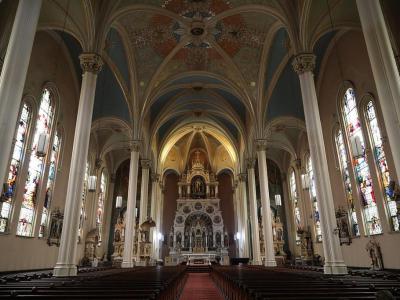
The church is distinguished by a commanding bell tower adorned with a sizable four-faced clock and an ensemble of five bells, each weighing between 2,500 to 6,000 pounds (or 1.1 to 2.7 tons). Visitors have the opportunity to explore the beautiful Bavarian Baroque interior with tall, thin stained-glass windows crafted by the Mayer Window Institute of Munich, along with vivid frescoes and a carving depicting "The Last Supper" (acquired from the 1893 World's Columbian Exposition). A functional Kilgen pipe organ adds to the sensory richness of the space; however, the crowning jewel is the magnificent high altar, along with four subsidiary altars, portraying Saint Michael flanked by archangels Raphael and Gabriel, capturing the moment of Lucifer's expulsion from heaven.
The church is distinguished by a commanding bell tower adorned with a sizable four-faced clock and an ensemble of five bells, each weighing between 2,500 to 6,000 pounds (or 1.1 to 2.7 tons). Visitors have the opportunity to explore the beautiful Bavarian Baroque interior with tall, thin stained-glass windows crafted by the Mayer Window Institute of Munich, along with vivid frescoes and a carving depicting "The Last Supper" (acquired from the 1893 World's Columbian Exposition). A functional Kilgen pipe organ adds to the sensory richness of the space; however, the crowning jewel is the magnificent high altar, along with four subsidiary altars, portraying Saint Michael flanked by archangels Raphael and Gabriel, capturing the moment of Lucifer's expulsion from heaven.
