Custom Walk in Budapest, Hungary by christine_wittkopp64_b6eda created on 2025-08-30
Guide Location: Hungary » Budapest
Guide Type: Custom Walk
# of Sights: 11
Tour Duration: 2 Hour(s)
Travel Distance: 2.5 Km or 1.6 Miles
Share Key: C47F7
Guide Type: Custom Walk
# of Sights: 11
Tour Duration: 2 Hour(s)
Travel Distance: 2.5 Km or 1.6 Miles
Share Key: C47F7
How It Works
Please retrieve this walk in the GPSmyCity app. Once done, the app will guide you from one tour stop to the next as if you had a personal tour guide. If you created the walk on this website or come to the page via a link, please follow the instructions below to retrieve the walk in the app.
Retrieve This Walk in App
Step 1. Download the app "GPSmyCity: Walks in 1K+ Cities" on Apple App Store or Google Play Store.



Step 2. In the GPSmyCity app, download(or launch) the guide "Budapest Map and Walking Tours".
Step 3. Tap the menu button located at upper right corner of the "Walks" screen and select "Retrieve custom walk". Enter the share key: C47F7
1) Great Synagogue (Dohany Street Synagogue) (must see)
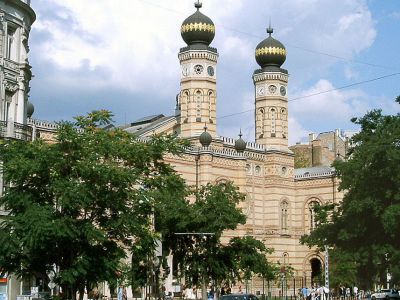
Built in the 1850s for the Neolog Jewish community, this synagogue ranks as the second-largest in the world, second only to Temple Emanu-El in New York. Much like the one on nearby Rumbach Street, it was designed by Viennese architect Ludwig Forster, embracing a richly detailed Moorish Revival style. The building forms part of a larger Jewish Quarter complex that includes the Heroes’ Temple, a graveyard, a Holocaust memorial, and the Jewish Museum. During World War II, Dohány Street marked the boundary of the Budapest Ghetto, and even today, the area carries a profound sense of remembrance.
The synagogue suffered heavy damage during the war and endured years of neglect under communist rule. It wasn’t until the 1990s that an extensive restoration finally returned it to its former grandeur. The twin octagonal towers, flanking the main entrance and crowned with onion domes, now make this structure visible all over the city. Inside, the vast nave stretches nearly 40 feet high, revealing Gothic, Romantic, and Byzantine influences. A new mechanical organ fills the space, replacing the original one crafted in the 19th century.
As is traditional, the ground floor seating is reserved for men, while women are seated in the upper galleries. In all, the building can accommodate up to 3,000 worshippers.
Those curious about Jewish history will find much to explore here. Next door is the Jewish Heroes’ Mausoleum, and upstairs, the museum and archives offer informative and thought-provoking exhibits. In the adjacent graveyard, victims of the Holocaust are laid to rest alongside non-Jews who risked their lives to save others. The neighboring park holds a memorial honoring these courageous individuals.
Tip: The synagogue offers guided group tours in several languages. Visitors are asked to observe a modest dress code; if needed, special coverings are provided at the entrance.
The synagogue suffered heavy damage during the war and endured years of neglect under communist rule. It wasn’t until the 1990s that an extensive restoration finally returned it to its former grandeur. The twin octagonal towers, flanking the main entrance and crowned with onion domes, now make this structure visible all over the city. Inside, the vast nave stretches nearly 40 feet high, revealing Gothic, Romantic, and Byzantine influences. A new mechanical organ fills the space, replacing the original one crafted in the 19th century.
As is traditional, the ground floor seating is reserved for men, while women are seated in the upper galleries. In all, the building can accommodate up to 3,000 worshippers.
Those curious about Jewish history will find much to explore here. Next door is the Jewish Heroes’ Mausoleum, and upstairs, the museum and archives offer informative and thought-provoking exhibits. In the adjacent graveyard, victims of the Holocaust are laid to rest alongside non-Jews who risked their lives to save others. The neighboring park holds a memorial honoring these courageous individuals.
Tip: The synagogue offers guided group tours in several languages. Visitors are asked to observe a modest dress code; if needed, special coverings are provided at the entrance.
2) Tree of Life / Holocaust Memorial Park
Tucked just behind Budapest’s Great Synagogue, the Holocaust Memorial Park stands as a tribute to those who risked everything during World War II to protect Hungary’s Jewish population from Nazi persecution. Honored here are those recognized as “Righteous Among the Nations”-individuals who, through courage and compassion, saved lives in the darkest of times.
Among them is Raoul Wallenberg, the Swedish diplomat whose tireless efforts helped thousands and whose mysterious disappearance remains one of history’s enigmas. Also remembered is Ángel Sanz Briz, a Spanish consular officer who quietly issued passports and transformed the Spanish embassy into a safe haven, saving over 5,000 lives in the process.
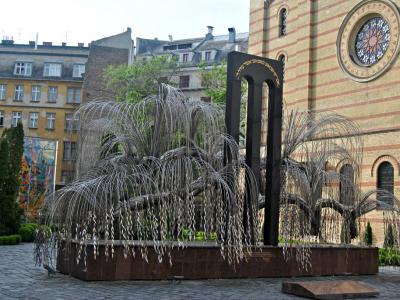
At the heart of the park stands the Tree of Life, a powerful sculpture shaped like a weeping willow-long a symbol of mourning in Hungarian Jewish tradition. Each of its leaves bears the name of a Holocaust victim buried nearby, a silent forest of remembrance that speaks louder than words.
The park was created during the 1990s, following Hungary’s return to democracy. The Tree of Life itself was completed in 1996, made possible by a donation from Estée Lauder, the famed cosmetics entrepreneur with Hungarian-Jewish roots.
Even from a distance, the tree catches the eye with its shimmering metal leaves. To step closer, you’ll need to pay a modest admission fee, but the experience is one worth taking time for.
Among them is Raoul Wallenberg, the Swedish diplomat whose tireless efforts helped thousands and whose mysterious disappearance remains one of history’s enigmas. Also remembered is Ángel Sanz Briz, a Spanish consular officer who quietly issued passports and transformed the Spanish embassy into a safe haven, saving over 5,000 lives in the process.
At the heart of the park stands the Tree of Life, a powerful sculpture shaped like a weeping willow-long a symbol of mourning in Hungarian Jewish tradition. Each of its leaves bears the name of a Holocaust victim buried nearby, a silent forest of remembrance that speaks louder than words.
The park was created during the 1990s, following Hungary’s return to democracy. The Tree of Life itself was completed in 1996, made possible by a donation from Estée Lauder, the famed cosmetics entrepreneur with Hungarian-Jewish roots.
Even from a distance, the tree catches the eye with its shimmering metal leaves. To step closer, you’ll need to pay a modest admission fee, but the experience is one worth taking time for.
3) Szimpla Kert
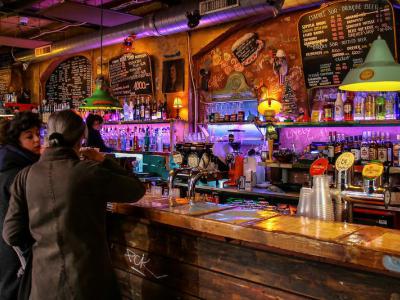
Arguably Budapest's number-one ruin pub, Szimpla Kert also inspired all other pubs of its kind in Budapest. This place is not so much a bar, more a labyrinth of bars in three buildings forming a C-shape with a central courtyard. The bars in the courtyard are serving hundreds of people, so grab a drink at any of them, as you're free to walk with it to any area.
Step up a metal staircase to the mezzanine floor that joins the buildings together in a hard-to-describe network of dozens more bars, tropical plants, hipster art and strange sights, e.g. a woman selling carrots, people on cushions in one room watching a chilled out movie, a futuristic gin laboratory, and rough and ready bars serving up beers/shots for cheap prices.
This bar is perfect for a cool couple's night to get lost in one of the quieter corners and people-watch, or if you're a larger group of friends looking to party hard, you can immerse yourself fully in the experience, crawling from one bar to the next. With staircases, multiple levels and lots of places to get lost, just have a meetup point planned if things get too wild!
Tip:
Don't miss the Sunday farmers' market and all-you-can-eat brunch! The food on offer is fresh, local, delicious and plentiful.
Step up a metal staircase to the mezzanine floor that joins the buildings together in a hard-to-describe network of dozens more bars, tropical plants, hipster art and strange sights, e.g. a woman selling carrots, people on cushions in one room watching a chilled out movie, a futuristic gin laboratory, and rough and ready bars serving up beers/shots for cheap prices.
This bar is perfect for a cool couple's night to get lost in one of the quieter corners and people-watch, or if you're a larger group of friends looking to party hard, you can immerse yourself fully in the experience, crawling from one bar to the next. With staircases, multiple levels and lots of places to get lost, just have a meetup point planned if things get too wild!
Tip:
Don't miss the Sunday farmers' market and all-you-can-eat brunch! The food on offer is fresh, local, delicious and plentiful.
4) Kazinczy Street
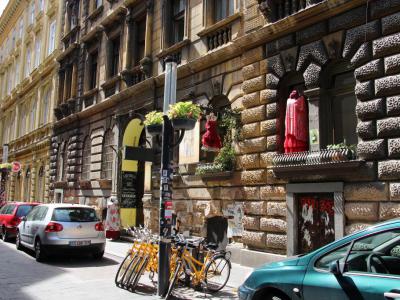
Right in the heart of Budapest’s Jewish Quarter, Kazinczy Street bursts with a colorful mix of cultural heritage, one-of-a-kind events, a very diverse gastronomy scene, and buzzing nightlife venues. As you walk along, you’ll come across the Orthodox Synagogue, cozy kosher restaurants, and bakeries serving up traditional Jewish dishes and pastries. Many of the buildings, along with various monuments, quietly tell the story of the neighborhood’s past.
If you’re hungry for a taste of tradition, head over to CARMEL, where whitewashed walls frame a large dining space and classic favorites like chicken soup, cholent, and fish dishes are always on the menu. MACESZ BISTRO is another strong choice for a sit-down meal. But if you’re craving something quick and authentically Hungarian, BORS GASTRO BAR has you covered with some of the best street food in town. For even more variety, STREET FOOD KARAVAN offers an incredible lineup of international flavors, all easy on the wallet.
Within easy striking distance, you will also find the street’s famous ruin pubs. Places like SZIMPLA KERT, ELLATO KERT, and KŐLEVES serve up cheap eats and drinks in quirky, retro settings that feel like a cross between an art project and a secret garden. SZIMPLA KERT, one of the pioneers, hosts live music, film nights, and even a farmers’ market every Sunday - a true reflection of the neighborhood’s creative energy.
Art lovers will want to keep an eye out for colorful street murals, while history enthusiasts can visit the nearby Hungarian Electrotechnical Museum. And if you happen to be in town at the start of summer, don’t miss Judafest - a lively celebration of Hungarian Jewish culture, packed with music, food, and tradition.
If you’re hungry for a taste of tradition, head over to CARMEL, where whitewashed walls frame a large dining space and classic favorites like chicken soup, cholent, and fish dishes are always on the menu. MACESZ BISTRO is another strong choice for a sit-down meal. But if you’re craving something quick and authentically Hungarian, BORS GASTRO BAR has you covered with some of the best street food in town. For even more variety, STREET FOOD KARAVAN offers an incredible lineup of international flavors, all easy on the wallet.
Within easy striking distance, you will also find the street’s famous ruin pubs. Places like SZIMPLA KERT, ELLATO KERT, and KŐLEVES serve up cheap eats and drinks in quirky, retro settings that feel like a cross between an art project and a secret garden. SZIMPLA KERT, one of the pioneers, hosts live music, film nights, and even a farmers’ market every Sunday - a true reflection of the neighborhood’s creative energy.
Art lovers will want to keep an eye out for colorful street murals, while history enthusiasts can visit the nearby Hungarian Electrotechnical Museum. And if you happen to be in town at the start of summer, don’t miss Judafest - a lively celebration of Hungarian Jewish culture, packed with music, food, and tradition.
5) Orthodox Synagogue
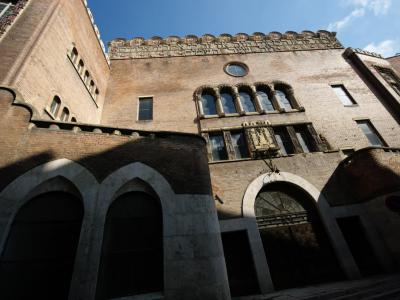
Nestled in a quiet corner of Budapest’s 8th District, the Orthodox Synagogue is both a physical and spiritual heart of the local Jewish community. Around it, you’ll find a cozy network that includes a kosher restaurant, a school, and a prayer room. Not far away, there’s also a mikvah - a ritual Jewish bath dating back to 1913, and the only one of its kind in the entire city.
The congregation here belongs to a distinctive branch of Hungarian Orthodox Judaism, an offshoot of Conservative Judaism. They’ve preserved many traditions brought over by Jewish immigrants from Germany and Moravia, blended with a deep Hassidic influence that traces its roots to Poland and Galatia.
From the outside, the synagogue’s Art Nouveau façade shows its age. But step inside, and you’re greeted by a beautifully restored interior, alive with bright colors and traditional Hungarian motifs. An unusually designed Bimah - something like an altar - stands at the center, surrounded by original stained glass windows placed high under the roof. There’s a small fee to enter, and from the main door to the right, you can also access the side and rear courtyards. It’s well worth a look: the side walls are lined with historic photos that tell the story of the building, and in the rear courtyard, you’ll come across a striking metal wedding canopy.
The congregation here belongs to a distinctive branch of Hungarian Orthodox Judaism, an offshoot of Conservative Judaism. They’ve preserved many traditions brought over by Jewish immigrants from Germany and Moravia, blended with a deep Hassidic influence that traces its roots to Poland and Galatia.
From the outside, the synagogue’s Art Nouveau façade shows its age. But step inside, and you’re greeted by a beautifully restored interior, alive with bright colors and traditional Hungarian motifs. An unusually designed Bimah - something like an altar - stands at the center, surrounded by original stained glass windows placed high under the roof. There’s a small fee to enter, and from the main door to the right, you can also access the side and rear courtyards. It’s well worth a look: the side walls are lined with historic photos that tell the story of the building, and in the rear courtyard, you’ll come across a striking metal wedding canopy.
6) Carl Lutz Memorial
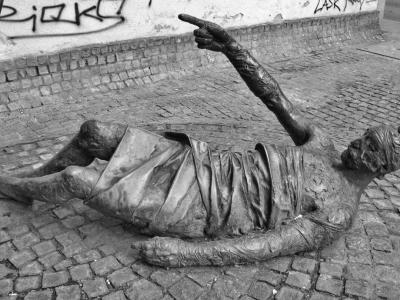
As you wander through the old Budapest Ghetto, you might stumble upon a quiet memorial, partly hidden among the trees, dedicated to Swiss diplomat Carl Lutz. Created in 1991 by sculptor Tamás Szabó, the piece shows two bronze figures: an angel above, sending a bolt of cloth down to a figure lying helpless below.
During his time as Swiss Vice-Consul in Budapest, from 1942 to the end of World War II, Carl Lutz saved thousands of Jewish lives. He negotiated a special deal with both the Nazis and the Hungarian government, allowing him to issue safe-conduct passes to British-controlled Palestine. Cleverly stretching the limits of his authority, he treated each pass as covering not just one person, but entire families, issuing tens of thousands of protective letters, each numbered between one and eight thousand. Beyond that, he established around 76 “safe houses” across Budapest, declaring them extensions of the Swiss legation-thus making them off-limits to Nazi and Hungarian forces. One of the best-known of these was the “Glass House” on Vadász Street, where nearly 3,000 Jews found shelter.
In 1965, Yad Vashem, Israel’s official memorial to Holocaust victims, recognized Carl Lutz as one of the "Righteous Among the Nations" for his extraordinary courage and compassion.
During his time as Swiss Vice-Consul in Budapest, from 1942 to the end of World War II, Carl Lutz saved thousands of Jewish lives. He negotiated a special deal with both the Nazis and the Hungarian government, allowing him to issue safe-conduct passes to British-controlled Palestine. Cleverly stretching the limits of his authority, he treated each pass as covering not just one person, but entire families, issuing tens of thousands of protective letters, each numbered between one and eight thousand. Beyond that, he established around 76 “safe houses” across Budapest, declaring them extensions of the Swiss legation-thus making them off-limits to Nazi and Hungarian forces. One of the best-known of these was the “Glass House” on Vadász Street, where nearly 3,000 Jews found shelter.
In 1965, Yad Vashem, Israel’s official memorial to Holocaust victims, recognized Carl Lutz as one of the "Righteous Among the Nations" for his extraordinary courage and compassion.
7) Rumbach Street Synagogue
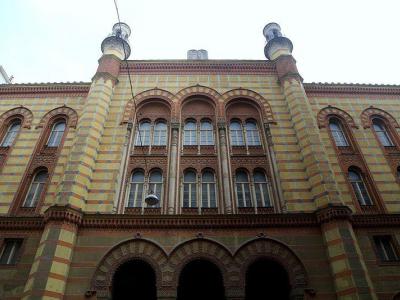
Located in downtown Budapest, within the historic Belváros district, this striking synagogue has been the spiritual home for Hungary’s Neolog Jewish community since the late 1800s. Designed by Otto Wagner-famed for his Art Nouveau landmarks in Vienna-the building draws strong influence from North African and Arabic styles. Its octagonal columns, reminiscent of minarets, and its domed form echo the design of Jerusalem’s Dome of the Rock, though not as a replica-more as a respectful architectural tribute.
The exterior is a feast for the eyes. Ornamental brickwork in rich, earthy tones plays alongside carved stone, stucco details, and beautifully worked iron. A pair of stone tablets representing the Ten Commandments rests above the entrance, while arched windows feature the Star of David in stained glass, framed by Eastern-style curves that add a rhythmic elegance to the façade.
Inside, the space opens into a luminous nave with high ceilings, an ornate dome, vibrant stained glass, and intricate arabesques that flow across the walls. Though the building was severely damaged during World War II and stood dormant for nearly six decades, it has been fully restored thanks to a grant from the Budapest Government. Since the 2021 renovation, the synagogue has embraced a second life-not only as a place of remembrance but as a lively cultural venue. Visitors now come for concerts, theatrical performances, photography exhibitions, and other events that breathe new energy into this historic space.
The exterior is a feast for the eyes. Ornamental brickwork in rich, earthy tones plays alongside carved stone, stucco details, and beautifully worked iron. A pair of stone tablets representing the Ten Commandments rests above the entrance, while arched windows feature the Star of David in stained glass, framed by Eastern-style curves that add a rhythmic elegance to the façade.
Inside, the space opens into a luminous nave with high ceilings, an ornate dome, vibrant stained glass, and intricate arabesques that flow across the walls. Though the building was severely damaged during World War II and stood dormant for nearly six decades, it has been fully restored thanks to a grant from the Budapest Government. Since the 2021 renovation, the synagogue has embraced a second life-not only as a place of remembrance but as a lively cultural venue. Visitors now come for concerts, theatrical performances, photography exhibitions, and other events that breathe new energy into this historic space.
8) Gozsdu Courtyard (Gozsdu-udvar)
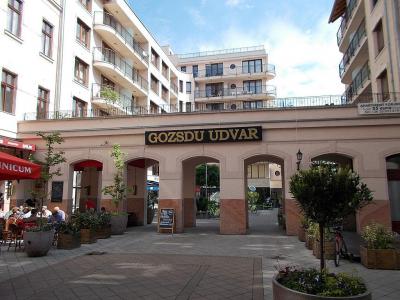
Tucked away in the heart of Budapest’s historic Jewish Quarter, Gozsdu Courtyard is one of the city’s most energetic and eclectic gathering spots. Originally built in the early 1900s, the complex was funded by Emanuil Gojdu, a Romanian-Hungarian lawyer who left his wealth to support local communities. The clever architectural design, with its series of six interconnected courtyards, was both practical and elegant, blending residential living with small shops and artisan workshops.
Today, the courtyard has reinvented itself as a maze of cafés, bars, restaurants, art galleries, and boutique shops. It’s an ideal place for a laid-back brunch, an afternoon stroll through pop-up artisan markets, or diving headfirst into the buzzing nightlife scene. Sipping craft cocktails, catching live music, or simply people-watching from a sunny terrace, you’ll always feel the electric pulse running through the space.
By day, Gozsdu offers a relaxed, family-friendly vibe. Coffee aromas mingle with the sounds of street musicians, and you might stumble upon vintage treasures or quirky art exhibits. But when the sun sets, the atmosphere shifts. Fairy lights flicker overhead, the patios come alive, and a lively soundtrack of laughter, clinking glasses, and music fills the air.
The courtyard’s location also places you right at the heart of the Old Jewish Quarter, just steps from cultural landmarks like the Dohány Street Synagogue, the Jewish Museum, and several important memorials scattered through the neighborhood.
Tip: For a few standout spots, check out DIVINO Wine Bar with its excellent range of Hungarian wines, CAFE VIAN for an impressively varied menu, 2 SPAGHI – one of the best pasta places outside of Italy, and the buzzing SPILER ‘bistropub’ which excels by its unique interior ambiance (plus SPILER SHANGHAI across the street for an Asian twist). Most offer both indoor and outdoor seating-perfect for soaking up the atmosphere any time of day.
Today, the courtyard has reinvented itself as a maze of cafés, bars, restaurants, art galleries, and boutique shops. It’s an ideal place for a laid-back brunch, an afternoon stroll through pop-up artisan markets, or diving headfirst into the buzzing nightlife scene. Sipping craft cocktails, catching live music, or simply people-watching from a sunny terrace, you’ll always feel the electric pulse running through the space.
By day, Gozsdu offers a relaxed, family-friendly vibe. Coffee aromas mingle with the sounds of street musicians, and you might stumble upon vintage treasures or quirky art exhibits. But when the sun sets, the atmosphere shifts. Fairy lights flicker overhead, the patios come alive, and a lively soundtrack of laughter, clinking glasses, and music fills the air.
The courtyard’s location also places you right at the heart of the Old Jewish Quarter, just steps from cultural landmarks like the Dohány Street Synagogue, the Jewish Museum, and several important memorials scattered through the neighborhood.
Tip: For a few standout spots, check out DIVINO Wine Bar with its excellent range of Hungarian wines, CAFE VIAN for an impressively varied menu, 2 SPAGHI – one of the best pasta places outside of Italy, and the buzzing SPILER ‘bistropub’ which excels by its unique interior ambiance (plus SPILER SHANGHAI across the street for an Asian twist). Most offer both indoor and outdoor seating-perfect for soaking up the atmosphere any time of day.
9) Hungarian State Opera House
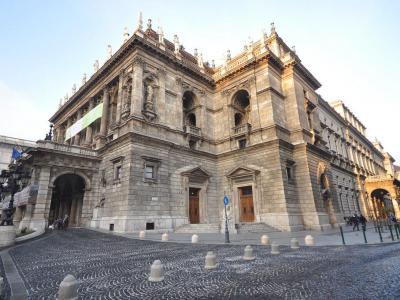
Set at the heart of Pest, on Andrassy Avenue, the Hungarian State Opera was officially opened to the public in 1884. Designed by Miklós Ybl, a key figure of 19th-century Hungarian architecture, this grand and elegant edifice represents a blend of Baroque, Renaissance and Revival styles and took nearly a decade to build, skillfully planted into the ensemble of affluent mansions nearby.
Although nowhere near the world's major concert halls in terms of size, the Hungarian Opera House is definitely one of the most beautiful. Flanking the building's main entrance, inside the niches, are the statues of Ferenc Erkel, author of the Hungarian National Anthem, and Ferenc Liszt, the most acclaimed Hungarian composer and reputedly one of the best pianists of his time. On the balustrade, surrounding the roof, are the 16 statues of Europe's greatest composers, such as Beethoven, Mozart, Verdi, Bizet, Puccini and Tchaikovsky. On the inside, the building is just as grand as it is on the outside, replete with marble columns and staircases, vaulted ceilings and lavish gold plating, complete with a rich chandelier weighing several tons(!), and ornate frescoes depicting scenes from the Greek mythology, not to mention the wealth of finest oil paintings and sculptures to be found in Budapest added to the decoration.
The acoustics here are said to be among the best in the world, ranked #3 in Europe after La Scala in Milan and Palais Garnier in Paris.
If you can't get a ticket or if opera isn't one of your things yet, consider taking a guided tour, run three times a day, to get a sense of what the high-society life in Budapest was like back in its heyday in the late 19th century. The tour will take you to the private balconies, smoking room, royal private staircase, and the bar area lavishly clad in crystal and Croatian marble.
Otherwise, if you're an opera fan, try to book yourself a ticket – if lucky, you just might succeed. The tickets are surprisingly not as pricey as you may think, but still, be prepared to dress up to the nines as it is a rather glamorous affair, after all.
Tip:
Combine with the nearby Mai Manó House of Photography, if only to have a look at the building from the outside.
Editor's note:
The building is being renovated until 2020, therefore Opera House performances temporarily take place at the Erkel Theatre. However, the Opera Shop and certain parts of the building can be visited even during renovation.
Although nowhere near the world's major concert halls in terms of size, the Hungarian Opera House is definitely one of the most beautiful. Flanking the building's main entrance, inside the niches, are the statues of Ferenc Erkel, author of the Hungarian National Anthem, and Ferenc Liszt, the most acclaimed Hungarian composer and reputedly one of the best pianists of his time. On the balustrade, surrounding the roof, are the 16 statues of Europe's greatest composers, such as Beethoven, Mozart, Verdi, Bizet, Puccini and Tchaikovsky. On the inside, the building is just as grand as it is on the outside, replete with marble columns and staircases, vaulted ceilings and lavish gold plating, complete with a rich chandelier weighing several tons(!), and ornate frescoes depicting scenes from the Greek mythology, not to mention the wealth of finest oil paintings and sculptures to be found in Budapest added to the decoration.
The acoustics here are said to be among the best in the world, ranked #3 in Europe after La Scala in Milan and Palais Garnier in Paris.
If you can't get a ticket or if opera isn't one of your things yet, consider taking a guided tour, run three times a day, to get a sense of what the high-society life in Budapest was like back in its heyday in the late 19th century. The tour will take you to the private balconies, smoking room, royal private staircase, and the bar area lavishly clad in crystal and Croatian marble.
Otherwise, if you're an opera fan, try to book yourself a ticket – if lucky, you just might succeed. The tickets are surprisingly not as pricey as you may think, but still, be prepared to dress up to the nines as it is a rather glamorous affair, after all.
Tip:
Combine with the nearby Mai Manó House of Photography, if only to have a look at the building from the outside.
Editor's note:
The building is being renovated until 2020, therefore Opera House performances temporarily take place at the Erkel Theatre. However, the Opera Shop and certain parts of the building can be visited even during renovation.
10) Franz Liszt Square
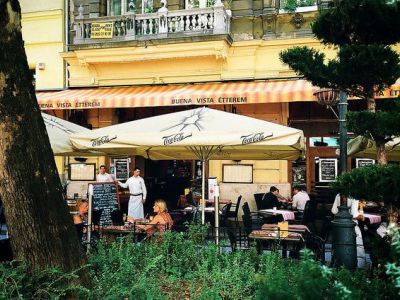
Anchored by the Academy of Music, the Franz List Square is ideal for meetings, short strolls, a great coffee, lunch, or dinner. Popular with locals and tourists alike, especially on summer evenings, this leafy, relaxed pedestrian area is surrounded by restaurants and cafés like the famous Menza (known for its traditional Hungarian favorites and nice wine), the bright, wood-floored Café Vian (praised for its perfect food and service, plus live music), Seasons Bistro (one of Budapest's best kept secrets), Incognito (good for drinks and chill), Korhely faloda és daloda (known to make meat-eaters extremely pleased), etc.
Franz Liszt's statue in the center of the square captures both the essence of the famous composer and the size of his hands, which alludes to his skill on the piano. which allude to his skill on the piano. Unveiled in 1986, it is the work of prize-winning sculptor László Marton, who also sculpted the Little Princess statue on the Danube promenade. Other artworks in the square include a bronze statue to Hungarian poet Endre Ady and a very unusual work dedicated to Sir Georg Solti, a Hungarian-born conductor and a long-serving music director of the Chicago Symphony Orchestra.
On the corner of Andrassy ut 45, there is also a place called the Irok Boltja ("Writer's Bookshop"), where you can find some of the best literary events in Budapest. It is definitely a meeting place for famous and not so famous writers, people who love to read, and even just the curious.
Franz Liszt's statue in the center of the square captures both the essence of the famous composer and the size of his hands, which alludes to his skill on the piano. which allude to his skill on the piano. Unveiled in 1986, it is the work of prize-winning sculptor László Marton, who also sculpted the Little Princess statue on the Danube promenade. Other artworks in the square include a bronze statue to Hungarian poet Endre Ady and a very unusual work dedicated to Sir Georg Solti, a Hungarian-born conductor and a long-serving music director of the Chicago Symphony Orchestra.
On the corner of Andrassy ut 45, there is also a place called the Irok Boltja ("Writer's Bookshop"), where you can find some of the best literary events in Budapest. It is definitely a meeting place for famous and not so famous writers, people who love to read, and even just the curious.
11) Oktogon
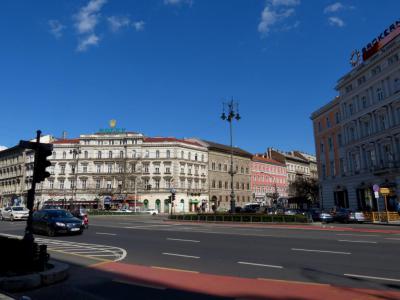
One of the busiest junctions in Budapest, the eight-sided Oktogon once rejoiced in the name of Mussolini Square, while under the communist regime it was called November 7 Square after the date of the Bolshevik revolution. Now kids called it the "American Square" as it is surrounded by fast-food chains (McDonald's, TGI Fridays, Starbucks, and the world's largest Burger King), some of which are even open 24/7. Add to these the taxis and buses running non-stop along the Nagykörút through to the wee hours, and you've got yourself a square (and intersection) that hardly ever sleeps.
While here, you may wonder why the Batthyány Mansion (Teréz körút 13) is adorned with wrought iron rings and looks somewhat familiar from architecture books. Apparently, the building is a proportionally reduced copy of the Palazzo Strozzi in Florence, with some details being modified – but even so, "stumbling" upon it is an interesting experience.
Walking on Andrassy Avenue from Oktogon to Heroes' Square is always a pleasure. On this route, many beautiful buildings can be seen, and the atmosphere of Budapest's city center can certainly be felt.
Tip:
If you plan on having a good burger to a medium price, but guaranteed quality, Bamba Marha Burger Bar (11:30am–10pm) is your place to be!
While here, you may wonder why the Batthyány Mansion (Teréz körút 13) is adorned with wrought iron rings and looks somewhat familiar from architecture books. Apparently, the building is a proportionally reduced copy of the Palazzo Strozzi in Florence, with some details being modified – but even so, "stumbling" upon it is an interesting experience.
Walking on Andrassy Avenue from Oktogon to Heroes' Square is always a pleasure. On this route, many beautiful buildings can be seen, and the atmosphere of Budapest's city center can certainly be felt.
Tip:
If you plan on having a good burger to a medium price, but guaranteed quality, Bamba Marha Burger Bar (11:30am–10pm) is your place to be!
