Custom Walk in Southampton, England by sharee_merkley52_c4389 created on 2025-09-07
Guide Location: England » Southampton
Guide Type: Custom Walk
# of Sights: 8
Tour Duration: 2 Hour(s)
Travel Distance: 5 Km or 3.1 Miles
Share Key: 5GLEY
Guide Type: Custom Walk
# of Sights: 8
Tour Duration: 2 Hour(s)
Travel Distance: 5 Km or 3.1 Miles
Share Key: 5GLEY
How It Works
Please retrieve this walk in the GPSmyCity app. Once done, the app will guide you from one tour stop to the next as if you had a personal tour guide. If you created the walk on this website or come to the page via a link, please follow the instructions below to retrieve the walk in the app.
Retrieve This Walk in App
Step 1. Download the app "GPSmyCity: Walks in 1K+ Cities" on Apple App Store or Google Play Store.



Step 2. In the GPSmyCity app, download(or launch) the guide "Southampton Map and Walking Tours".
Step 3. Tap the menu button located at upper right corner of the "Walks" screen and select "Retrieve custom walk". Enter the share key: 5GLEY
1) Southampton Old Cemetery
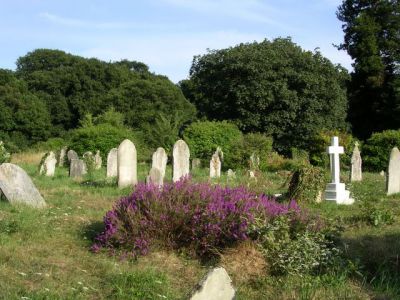
Southampton Old Cemetery, formerly known as The Cemetery by the Common and Hill Lane Cemetery, is a historically significant burial ground that spans 27 acres (11 hectares) of land originally acquired from Southampton Common in 1843. The cemetery was established following an Act of Parliament and opened on 7 May 1846 after the Bishop of Winchester consecrated part of the grounds.
The cemetery features distinct sections for various religious and nonconformist groups. While one area was consecrated for Anglican burials, another was left unconsecrated for Dissenters and agnostics, and a separate part was designated for the Hebrew community. By 1856, Roman Catholics were also allotted a portion of the cemetery for their use.
John Claudius Loudon, a prominent landscaper known for his work on cemeteries like Histon Road Cemetery in Cambridge and Bath Abbey Cemetery, was initially involved in the project. Although Southampton Town Council paid him £37 for his services, they ultimately chose not to use his proposed layout.
The cemetery is home to 60 headstones associated with the RMS Titanic, despite no bodies being returned to Southampton following the disaster. Additionally, there is a memorial to RMS Rhone, which was wrecked in a hurricane off Salt Island in the British Virgin Islands in 1867, leading to the tragic loss of over 120 lives. Today, Southampton Old Cemetery still accommodates 6 to 8 burials annually in existing family plots, serving as a historical reminder of the city’s maritime and social history.
The cemetery features distinct sections for various religious and nonconformist groups. While one area was consecrated for Anglican burials, another was left unconsecrated for Dissenters and agnostics, and a separate part was designated for the Hebrew community. By 1856, Roman Catholics were also allotted a portion of the cemetery for their use.
John Claudius Loudon, a prominent landscaper known for his work on cemeteries like Histon Road Cemetery in Cambridge and Bath Abbey Cemetery, was initially involved in the project. Although Southampton Town Council paid him £37 for his services, they ultimately chose not to use his proposed layout.
The cemetery is home to 60 headstones associated with the RMS Titanic, despite no bodies being returned to Southampton following the disaster. Additionally, there is a memorial to RMS Rhone, which was wrecked in a hurricane off Salt Island in the British Virgin Islands in 1867, leading to the tragic loss of over 120 lives. Today, Southampton Old Cemetery still accommodates 6 to 8 burials annually in existing family plots, serving as a historical reminder of the city’s maritime and social history.
2) Titanic Engineers' Memorial (must see)
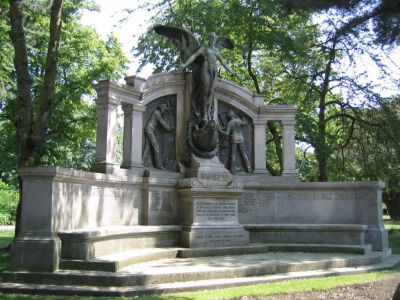
The Titanic Engineers' Memorial, located in East (Andrews) Park, Southampton, is a tribute to the heroic engineers who perished in the tragic sinking of the RMS Titanic on 15 April 1912. Unveiled on 22 April 1914 by Sir Archibald Denny, president of the Institute of Marine Engineers, the memorial was attended by a crowd of approximately 100,000 Southampton residents, reflecting the profound impact of the disaster on the local community.
The memorial, made of bronze and Kemnay granite, was funded by global donations and created by Whitehead and Son of Kennington Oval, London. Sculptor Ferdinand Victor Blundstone oversaw the design, while the striking bronze statue of Nike, the Greek Winged Goddess of Victory, was crafted by Trieste-born artist Romeo Rathmann. The memorial honors Joseph Bell, the Chief Engineer Officer of the Titanic, and his 24 engineers, 6 electrical engineers, 2 boilermakers, a plumber, and a clerk, all of whom died performing their duties as the ship sank.
The statue serves as a poignant reminder of the bravery of these men, who, as Sir Archibald Denny noted during the unveiling, continued their work to the end, knowing their efforts could only delay the inevitable. None survived the disaster, but their legacy endures through this Grade II listed monument, which was restored in 2010 through a collaboration between Southampton City Council and the TV production company Twenty Twenty Television.
Located near the Titanic Engineers' Memorial is the Titanic Musicians' Memorial, commemorating Wallace Hartley and the musicians who famously played as the ship went down, further cementing Southampton's connection to the Titanic tragedy.
The memorial, made of bronze and Kemnay granite, was funded by global donations and created by Whitehead and Son of Kennington Oval, London. Sculptor Ferdinand Victor Blundstone oversaw the design, while the striking bronze statue of Nike, the Greek Winged Goddess of Victory, was crafted by Trieste-born artist Romeo Rathmann. The memorial honors Joseph Bell, the Chief Engineer Officer of the Titanic, and his 24 engineers, 6 electrical engineers, 2 boilermakers, a plumber, and a clerk, all of whom died performing their duties as the ship sank.
The statue serves as a poignant reminder of the bravery of these men, who, as Sir Archibald Denny noted during the unveiling, continued their work to the end, knowing their efforts could only delay the inevitable. None survived the disaster, but their legacy endures through this Grade II listed monument, which was restored in 2010 through a collaboration between Southampton City Council and the TV production company Twenty Twenty Television.
Located near the Titanic Engineers' Memorial is the Titanic Musicians' Memorial, commemorating Wallace Hartley and the musicians who famously played as the ship went down, further cementing Southampton's connection to the Titanic tragedy.
3) Bargate
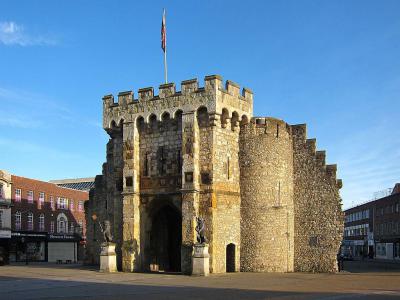
Bargate is an impressive medieval gatehouse that was built around 1180. Located in the center of High Street, Bargate was the traditional entrance and main gateway to Southampton. Bargate is praised as the finest and most complex gateway in England.
Bargate was built with flint and stone. In 1280, builders added imposing drum towers on the north side. Then, in the early 1400s, the north front was added.
At some point during the 1400s, Southampton began using Bargate as a prison. Then, during the 16th century, Southampton's court leet started meeting in the Bargate.
The Bargate was used as Southhampton's guildhall and market for centuries. Visitors can still see the vaults where merchants stored wine.
The fabled lion sculptures were added during the 16th century. The lions are thought to symbolize the legend of Sir Bevois, who founded Southhampton. Sir Bevios is the subject of many heroic legends, including a legend that tells of Sir Bevois slaying two lions to protect a princess. The lions were restored in 2020.
Visitors will find 11 heraldic shields on the Bargate's north side. Unfortunately, the original shields decayed with time, and many attempts have been made to restore them.
In 1899, 1914, and 1923, council members debated demolishing Bargate to accommodate increasing road traffic. Instead, the town council decided to separate Bargate from the town walls.
During WWII, Bargate was used as an air-raid shelter.
Bargate was built with flint and stone. In 1280, builders added imposing drum towers on the north side. Then, in the early 1400s, the north front was added.
At some point during the 1400s, Southampton began using Bargate as a prison. Then, during the 16th century, Southampton's court leet started meeting in the Bargate.
The Bargate was used as Southhampton's guildhall and market for centuries. Visitors can still see the vaults where merchants stored wine.
The fabled lion sculptures were added during the 16th century. The lions are thought to symbolize the legend of Sir Bevois, who founded Southhampton. Sir Bevios is the subject of many heroic legends, including a legend that tells of Sir Bevois slaying two lions to protect a princess. The lions were restored in 2020.
Visitors will find 11 heraldic shields on the Bargate's north side. Unfortunately, the original shields decayed with time, and many attempts have been made to restore them.
In 1899, 1914, and 1923, council members debated demolishing Bargate to accommodate increasing road traffic. Instead, the town council decided to separate Bargate from the town walls.
During WWII, Bargate was used as an air-raid shelter.
4) Southampton Town Wall (must see)
Southampton has had some defensive structures since occupied by the Romans. French forces attacked Southampton in 1338. However, the defenses were not adequate.
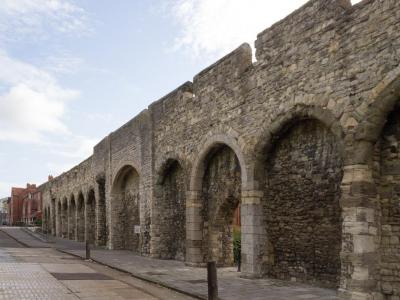
Work on the new wall began in the 1360s. Eventually, the wall was 1.25 miles long and wholly enclosed Southampton. The impressive wall housed 29 towers and eight gates. The towers were built to house cannons, which was a new technology in the 1300s.
The walls were used for defense throughout the 15th century. By the 18th century, the walls and gatehouses fell into disrepair. More recently, efforts have been made to preserve these historic walls.
Today, about half of the length of the original walls is still visible. Only 13 of the original 29 towers and six of the original gates still stand. God's House Tower still stands and is one of the first urban buildings to be purpose-built to hold gunpowder weapons. God's House Tower is three stories high and is next to God's House Gate.
Arundel tower still stands and is a popular attraction. The west walls are home to a unique feature called The Arcades. They are a series of arches built in the 14th century to reinforce the original 12th and 13th-century walls.
Work on the new wall began in the 1360s. Eventually, the wall was 1.25 miles long and wholly enclosed Southampton. The impressive wall housed 29 towers and eight gates. The towers were built to house cannons, which was a new technology in the 1300s.
The walls were used for defense throughout the 15th century. By the 18th century, the walls and gatehouses fell into disrepair. More recently, efforts have been made to preserve these historic walls.
Today, about half of the length of the original walls is still visible. Only 13 of the original 29 towers and six of the original gates still stand. God's House Tower still stands and is one of the first urban buildings to be purpose-built to hold gunpowder weapons. God's House Tower is three stories high and is next to God's House Gate.
Arundel tower still stands and is a popular attraction. The west walls are home to a unique feature called The Arcades. They are a series of arches built in the 14th century to reinforce the original 12th and 13th-century walls.
5) St. Mary's Church
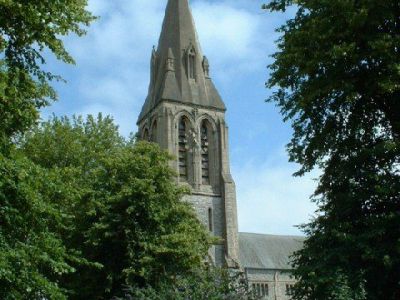
Saint Mary's Church in Southampton is the civic church and mother church of the city, with a history stretching back to circa 634. Originally founded as a small Saxon church in the ancient port town of Hamwic, it has been through multiple incarnations, with the current building being the sixth on the site. The present structure dates primarily from 1954 to 1956, rebuilt after its near-total destruction during the Southampton Blitz of World War II. However, its Grade II listed tower and spire, dating from 1912-1914, survived the bombings, remaining a dominant feature of the church.
As the tallest and largest church in Southampton, Saint Mary's is a local landmark, and its spire reaches 200 feet (61 meters), making it the tallest church in Hampshire. The church's connection to the city runs deep; Saint Mary's Stadium, home to Southampton F.C., takes its name from this historic site.
Notable features include its stained glass windows, the post-war architectural design, and a grand Willis organ, one of the largest of its kind on the South Coast. Saint Mary's bells have also left their mark on popular culture, inspiring the 1919 song "The Bells of Saint Mary's," which was later popularized by Bing Crosby in a film of the same name.
Architecturally, the church follows a traditional cruciform plan, with a Purbeck and Bathstone exterior. It combines designs from different eras and architects, culminating in a Neo-Cistercian style. The tower, designed by Arthur Edmund Street based on his father’s plans, is one of the finest examples of Victorian steeples in England, according to critic Nikolaus Pevsner.
The church’s long history reflects Southampton's own, from its Saxon roots to its resilience during the war, continuing to serve as a spiritual and civic cornerstone of the city.
As the tallest and largest church in Southampton, Saint Mary's is a local landmark, and its spire reaches 200 feet (61 meters), making it the tallest church in Hampshire. The church's connection to the city runs deep; Saint Mary's Stadium, home to Southampton F.C., takes its name from this historic site.
Notable features include its stained glass windows, the post-war architectural design, and a grand Willis organ, one of the largest of its kind on the South Coast. Saint Mary's bells have also left their mark on popular culture, inspiring the 1919 song "The Bells of Saint Mary's," which was later popularized by Bing Crosby in a film of the same name.
Architecturally, the church follows a traditional cruciform plan, with a Purbeck and Bathstone exterior. It combines designs from different eras and architects, culminating in a Neo-Cistercian style. The tower, designed by Arthur Edmund Street based on his father’s plans, is one of the finest examples of Victorian steeples in England, according to critic Nikolaus Pevsner.
The church’s long history reflects Southampton's own, from its Saxon roots to its resilience during the war, continuing to serve as a spiritual and civic cornerstone of the city.
6) God's House Tower
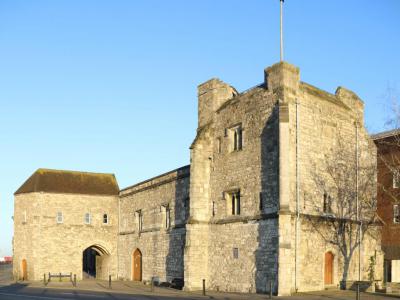
God's House Tower, located at the southeast corner of Southampton's town walls, is a historic 13th-century gatehouse that once provided access to the town from the Platform and Town Quay. Originally known as Saltmarsh Gate due to its proximity to marshlands, it later became known as God's House Gate because of its location near God's House Hospital, founded in 1168 to provide refuge for travelers.
Over the centuries, the tower evolved from a simple gatehouse to a significant fortification. Following a French raid in 1338, the town's defenses were strengthened, and in 1417, a two-story gallery and three-story tower were added, designed specifically to support cannon fire. This tower, equipped with eight gunports and rooftop firing points, helped the town gunner protect the sluices controlling seawater flow into a tidal moat that powered a nearby water mill.
In the following centuries, as Southampton's need for strong defenses diminished, God's House Tower transitioned into various roles, from a house of correction in the 1700s to the town jail by 1786. By 1855, a new prison was built elsewhere, and the tower fell into disuse until it was repurposed for storage in 1876. The building's exterior was cleaned and restored during this time, though part also served as a mortuary.
In 1961, God's House Tower became the Museum of Archaeology, showcasing Southampton's history, but closed in 2011 with exhibits moved to SeaCity Museum. Reopened in 2019 as an arts and heritage venue, it now features galleries, panoramic rooftop views, and a Hoxton Bakery branch. The Grade I listed building, known for its stone rubble construction, retains historical features like portcullis grooves, cinquefoil windows, and keyhole gunports, alongside traces of its tidal sluices and mural stairway.
Over the centuries, the tower evolved from a simple gatehouse to a significant fortification. Following a French raid in 1338, the town's defenses were strengthened, and in 1417, a two-story gallery and three-story tower were added, designed specifically to support cannon fire. This tower, equipped with eight gunports and rooftop firing points, helped the town gunner protect the sluices controlling seawater flow into a tidal moat that powered a nearby water mill.
In the following centuries, as Southampton's need for strong defenses diminished, God's House Tower transitioned into various roles, from a house of correction in the 1700s to the town jail by 1786. By 1855, a new prison was built elsewhere, and the tower fell into disuse until it was repurposed for storage in 1876. The building's exterior was cleaned and restored during this time, though part also served as a mortuary.
In 1961, God's House Tower became the Museum of Archaeology, showcasing Southampton's history, but closed in 2011 with exhibits moved to SeaCity Museum. Reopened in 2019 as an arts and heritage venue, it now features galleries, panoramic rooftop views, and a Hoxton Bakery branch. The Grade I listed building, known for its stone rubble construction, retains historical features like portcullis grooves, cinquefoil windows, and keyhole gunports, alongside traces of its tidal sluices and mural stairway.
7) Pilgrims Fathers Memorial
The Pilgrim Fathers Memorial in Southampton commemorates a pivotal moment in the journey of the Pilgrims who sought religious freedom. Built in 1913, this monument marks the departure of the "Mayflower" and "Speedwell" ships from Southampton Quay in 1620, carrying the Pilgrim Fathers to America. Fleeing persecution under the reign of King James I, the Pilgrims were driven by their desire to practice their Puritan faith freely.
The memorial, located on the north bank of The Haven, near the former site of Scotia Creek in Fishtoft, Lincolnshire, also recognizes earlier efforts by the Scrooby Congregation. These English Separatist Protestants first attempted to flee England in 1607, chartering a Dutch vessel to transport them to the Netherlands. However, their plan was thwarted when the captain betrayed them, leading to their arrest and imprisonment. A year later, they succeeded in their escape, first arriving in Amsterdam before settling in Leiden in 1609. By 1620, the congregation set sail for the New World, departing from Southampton and Plymouth.
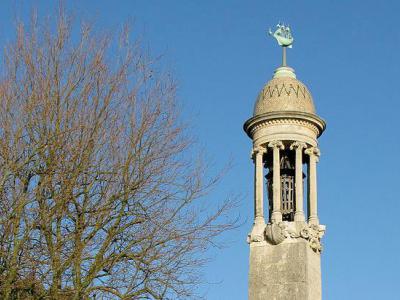
Erected by the former Boston Borough Council in 1957 on the 350th anniversary of the Scrooby Congregation's journey, the memorial is a small granite obelisk mounted on a granite block. Designed to symbolize the determination and faith of the Pilgrims, the monument was crafted by Leake's Masonry and attended by members of the General Society of Mayflower Descendants. The tapering shaft represents the steadfastness and resilience of the men and women who left their homeland in pursuit of religious liberty.
The memorial, located on the north bank of The Haven, near the former site of Scotia Creek in Fishtoft, Lincolnshire, also recognizes earlier efforts by the Scrooby Congregation. These English Separatist Protestants first attempted to flee England in 1607, chartering a Dutch vessel to transport them to the Netherlands. However, their plan was thwarted when the captain betrayed them, leading to their arrest and imprisonment. A year later, they succeeded in their escape, first arriving in Amsterdam before settling in Leiden in 1609. By 1620, the congregation set sail for the New World, departing from Southampton and Plymouth.
Erected by the former Boston Borough Council in 1957 on the 350th anniversary of the Scrooby Congregation's journey, the memorial is a small granite obelisk mounted on a granite block. Designed to symbolize the determination and faith of the Pilgrims, the monument was crafted by Leake's Masonry and attended by members of the General Society of Mayflower Descendants. The tapering shaft represents the steadfastness and resilience of the men and women who left their homeland in pursuit of religious liberty.
8) Mayflower Park
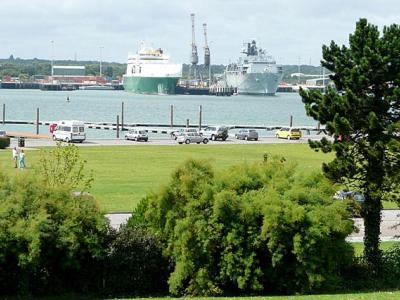
Mayflower Park in Southampton is a historically significant riverside park located on the banks of the River Test. Constructed in the 1930s by reclaiming surrounding mudflats, the park was initially known as the Royal Recreation Ground until 1955, when it was refurbished and renamed after the famous vessel, the Mayflower. This waterfront park remains a favorite location for the naming and christening of ships, as well as a popular venue for events like the Southampton Boat Show.
The park offers scenic views of the River Test and its maritime traffic, making it an essential recreational space for residents and visitors alike. As Southampton’s only city-centre waterside park, Mayflower Park provides a peaceful spot to watch ships-such as the Queen Mary II-departing from the adjacent port. Its central location makes it especially valuable for those living in nearby estates or staying in local hotels.
In addition to boat shows, the park hosts various events, including music concerts, circuses, and fireworks displays. Visitors can also enjoy the children’s playground, multi-use sports fields, and a café. Mayflower Park’s tranquil atmosphere, with benches overlooking the river, makes it a great spot for picnics, meditation, or simply watching the world go by.
Located near Southampton Port, the park is easily accessible on foot from Southampton Central Railway Station or by car, with parking available on-site. Visitors can also explore nearby attractions such as the Quilter’s Vault and the Medieval Merchant’s House, making it an ideal spot to unwind while soaking in the maritime heritage of the city.
The park offers scenic views of the River Test and its maritime traffic, making it an essential recreational space for residents and visitors alike. As Southampton’s only city-centre waterside park, Mayflower Park provides a peaceful spot to watch ships-such as the Queen Mary II-departing from the adjacent port. Its central location makes it especially valuable for those living in nearby estates or staying in local hotels.
In addition to boat shows, the park hosts various events, including music concerts, circuses, and fireworks displays. Visitors can also enjoy the children’s playground, multi-use sports fields, and a café. Mayflower Park’s tranquil atmosphere, with benches overlooking the river, makes it a great spot for picnics, meditation, or simply watching the world go by.
Located near Southampton Port, the park is easily accessible on foot from Southampton Central Railway Station or by car, with parking available on-site. Visitors can also explore nearby attractions such as the Quilter’s Vault and the Medieval Merchant’s House, making it an ideal spot to unwind while soaking in the maritime heritage of the city.
