Custom Walk in San Juan, Puerto Rico by kightlaura_5eb72 created on 2025-10-24
Guide Location: Puerto Rico » San Juan
Guide Type: Custom Walk
# of Sights: 7
Tour Duration: 2 Hour(s)
Travel Distance: 3.4 Km or 2.1 Miles
Share Key: SVPJC
Guide Type: Custom Walk
# of Sights: 7
Tour Duration: 2 Hour(s)
Travel Distance: 3.4 Km or 2.1 Miles
Share Key: SVPJC
How It Works
Please retrieve this walk in the GPSmyCity app. Once done, the app will guide you from one tour stop to the next as if you had a personal tour guide. If you created the walk on this website or come to the page via a link, please follow the instructions below to retrieve the walk in the app.
Retrieve This Walk in App
Step 1. Download the app "GPSmyCity: Walks in 1K+ Cities" on Apple App Store or Google Play Store.



Step 2. In the GPSmyCity app, download(or launch) the guide "San Juan Map and Walking Tours".
Step 3. Tap the menu button located at upper right corner of the "Walks" screen and select "Retrieve custom walk". Enter the share key: SVPJC
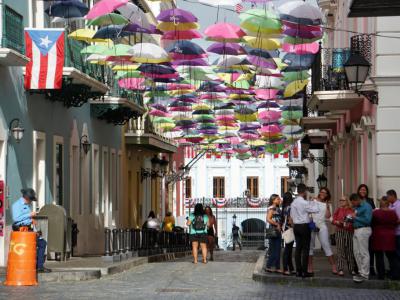
1) Calle de la Fortaleza (Fortaleza Street) (must see)
Proudly presiding over the bay of San Juan is the imposing La Fortaleza (Fortress), formally known as the Palace of Santa Catalina, the official residence of the Governor of Puerto Rico. The narrow road leading to the building, called Fortaleza Street, is the main artery of San Juan's historic quarter, cutting through most of it, and is also the oldest street in the area. It starts from Columbus Square and for the whole of its duration is lined with governmental buildings, hotels, perfumeries, craft shops, jewelry stores, and restaurants, gradually transforming into Avenue Juan Ponce de León in the east.
Just like many other colorful cobblestone streets in Old San Juan, each one more photogenic than the other, this thoroughfare is an important tourist attraction, in large part due to its historical and cultural significance. Visiting Fortaleza Street should be an integral part of every Old San Juan itinerary.
While the walled-in Old City has no shortage of vibrant photo spots, Fortaleza Street stands out above the rest due to the display of umbrellas – at the end of the street, near La Fortaleza itself – creating an overhead canopy that makes it particularly recognizable. These umbrellas tend to change colors during the year, from rainbow to all pink. Before the umbrellas, La Fortaleza Street was adorned with colorful kites.
Just like many other colorful cobblestone streets in Old San Juan, each one more photogenic than the other, this thoroughfare is an important tourist attraction, in large part due to its historical and cultural significance. Visiting Fortaleza Street should be an integral part of every Old San Juan itinerary.
While the walled-in Old City has no shortage of vibrant photo spots, Fortaleza Street stands out above the rest due to the display of umbrellas – at the end of the street, near La Fortaleza itself – creating an overhead canopy that makes it particularly recognizable. These umbrellas tend to change colors during the year, from rainbow to all pink. Before the umbrellas, La Fortaleza Street was adorned with colorful kites.
Sight description based on Wikipedia.
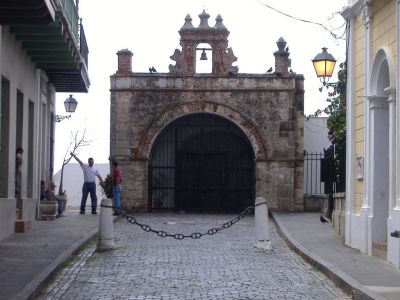
2) Capilla del Cristo (Chapel of Christ) (must see)
Capilla del Cristo (Chapel of Christ), is a small chapel located in the Old San Juan Historic District of Puerto Rico. Built in the 18th century, the structure has become a cultural icon of Puerto Rico and was saved from demolition in the 20th century. Most of the articles located at its altar are from 1753.
The chapel with its belfry is located in the Old San Juan Historic District in the western section of San Juan Islet, at the end of Cristo Street, now a pedestrian walkway. It sits on top of the old city walk. The chapel is a major tourist attraction in San Juan. Inside the chapel there is a famous painting called El Milagro ("The Miracle").
According to the legend, during a horse race that was taking place on the street where the chapel is located, a young rider and his horse took a bad fall and the rider went over the city wall but was miraculously saved. In a famous book about Puerto Rican legends, it says that the horse was killed but the rider lived. Afterwards, permission was granted to build the Catholic chapel and many festivals have been held, over the years, at the location to celebrate the miracle.
The chapel is open to publish on Saturday and Sunday from 12:00 to 18:00.
The chapel with its belfry is located in the Old San Juan Historic District in the western section of San Juan Islet, at the end of Cristo Street, now a pedestrian walkway. It sits on top of the old city walk. The chapel is a major tourist attraction in San Juan. Inside the chapel there is a famous painting called El Milagro ("The Miracle").
According to the legend, during a horse race that was taking place on the street where the chapel is located, a young rider and his horse took a bad fall and the rider went over the city wall but was miraculously saved. In a famous book about Puerto Rican legends, it says that the horse was killed but the rider lived. Afterwards, permission was granted to build the Catholic chapel and many festivals have been held, over the years, at the location to celebrate the miracle.
The chapel is open to publish on Saturday and Sunday from 12:00 to 18:00.
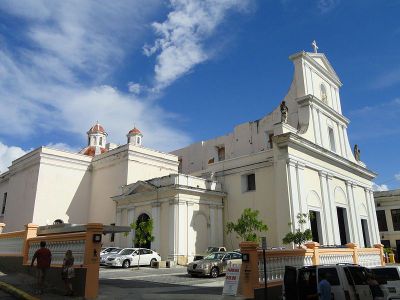
3) Cathedral of San Juan Bautista (must see)
The Cathedral of San Juan Bautista is the Roman Catholic temple and the seat of the Archdiocese of San Juan de Puerto Rico. This is one of the oldest buildings in San Juan and the second-oldest operational church in the Americas. Traditionally, travelers entering San Juan Gate would make this cathedral their first stop in the city to thank God for their safe journey.
It sits on the site of a grammar school, established in 1513 by Bishop Alonso Manso. This was the first school in Puerto Rico (and the oldest school in the United States after Puerto Rico became a US territory). Here, the Latin language, literature, history, science, art, philosophy, and theology were taught free of charge.
The very first, wooden, church on this spot was built in 1521. It was destroyed by a hurricane, and the current temple of stone was built in its place, in 1540. The church was remodeled several times over the course of centuries, most recently in 1917.
The cathedral contains the tomb of the Spanish explorer Juan Ponce de León. It also houses a shrine dedicated to the Blessed Carlos Manuel Rodríguez Santiago, the first Puerto Rican and the first Caribbean-born layperson (much as the first layperson in the history of the United States) to be beatified.
The Cathedral of San Juan Bautista is also unique as a rare example of medieval Spanish architecture in the New World.
It sits on the site of a grammar school, established in 1513 by Bishop Alonso Manso. This was the first school in Puerto Rico (and the oldest school in the United States after Puerto Rico became a US territory). Here, the Latin language, literature, history, science, art, philosophy, and theology were taught free of charge.
The very first, wooden, church on this spot was built in 1521. It was destroyed by a hurricane, and the current temple of stone was built in its place, in 1540. The church was remodeled several times over the course of centuries, most recently in 1917.
The cathedral contains the tomb of the Spanish explorer Juan Ponce de León. It also houses a shrine dedicated to the Blessed Carlos Manuel Rodríguez Santiago, the first Puerto Rican and the first Caribbean-born layperson (much as the first layperson in the history of the United States) to be beatified.
The Cathedral of San Juan Bautista is also unique as a rare example of medieval Spanish architecture in the New World.
Sight description based on Wikipedia.
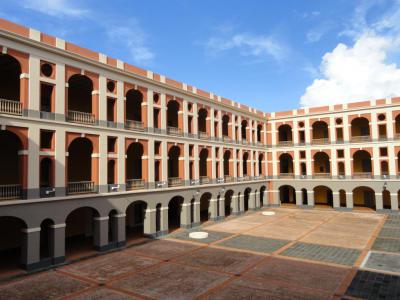
4) Cuartel de Ballajá (Ballaja Barracks)
Ballaja Barracks (or Cuartel de Ballajá in Spanish) is a military barracks located in San Juan. It was built from 1854 to 1864 for the Spanish troops established on the island and their families.
The three-story structure was completed in 1864, occupying an area of 7,700 square meters (83,000 sq ft). It could accommodate over 1,000 citizens, originally Spanish soldiers and their families. Its vast interior patio is one of the best examples of 19th-century Spanish architecture.
The barracks were heavily used during the Spanish–American War near the end of the 19th century. On May 12, 1898, during the American bombing of San Juan, the fleet led by Admiral William T. Sampson damaged the northeast side of the barracks. After the war ended, and with the change of sovereignty, the barracks became the quarters for the United States Army until 1939.
Today, the Ballaja Barracks houses several educational and cultural organizations including the Latin America Museum on its second floor. The museum offers three permanent collections: African Heritage, the Indian in America, and Popular Arts in America.
The three-story structure was completed in 1864, occupying an area of 7,700 square meters (83,000 sq ft). It could accommodate over 1,000 citizens, originally Spanish soldiers and their families. Its vast interior patio is one of the best examples of 19th-century Spanish architecture.
The barracks were heavily used during the Spanish–American War near the end of the 19th century. On May 12, 1898, during the American bombing of San Juan, the fleet led by Admiral William T. Sampson damaged the northeast side of the barracks. After the war ended, and with the change of sovereignty, the barracks became the quarters for the United States Army until 1939.
Today, the Ballaja Barracks houses several educational and cultural organizations including the Latin America Museum on its second floor. The museum offers three permanent collections: African Heritage, the Indian in America, and Popular Arts in America.
Sight description based on Wikipedia.
5) Paseo de la Princesa (Princess Promenade) (must see)
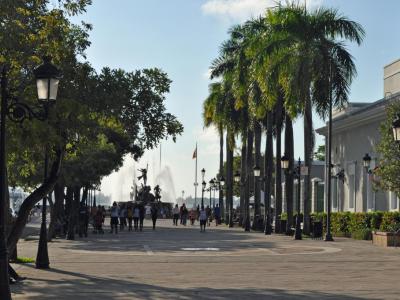
No trip to San Juan is complete without a stroll along the beautiful Princess Promenade, a carefully restored historic landmark, one of the most visited in the capital. Built in 1853, this esplanade skirts the curved city walls on the southern side of Old San Juan and is quite picture-perfect, with the San Juan Bay on the one side and the impressive fortification walls on the other.
The Promenade is equally suited for both walking and people-watching. It is also a great place to visit for families with children – easily accessible and traffic-free. The abundance of trees here provides plenty of shade, and there are lots of artisan stalls and street vendors selling local food. The area also often hosts festivals and fairs on weekends.
From here, you can make a slight detour to the narrow path, known as Paseo El Morro, leading to the historic El Morro Fort and the nearby San Juan Gate, which is the only city gate remaining from the colonial period.
Princess Promenade gets its name from an old 1837 building, located here, known as La Princesa. Originally, this building served as a municipal prison, although presently it houses the headquarters of the Puerto Rico Tourism Company and an art gallery.
The Promenade is equally suited for both walking and people-watching. It is also a great place to visit for families with children – easily accessible and traffic-free. The abundance of trees here provides plenty of shade, and there are lots of artisan stalls and street vendors selling local food. The area also often hosts festivals and fairs on weekends.
From here, you can make a slight detour to the narrow path, known as Paseo El Morro, leading to the historic El Morro Fort and the nearby San Juan Gate, which is the only city gate remaining from the colonial period.
Princess Promenade gets its name from an old 1837 building, located here, known as La Princesa. Originally, this building served as a municipal prison, although presently it houses the headquarters of the Puerto Rico Tourism Company and an art gallery.
6) El Arsenal (The Arsenal)
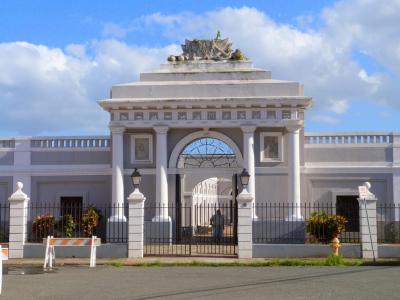
Located on La Puntilla Street, El Arsenal was built in 1791 as a Spanish naval station. Later the building became a citadel, which contained a storage room, offices, living sectors, workshops, a coast guard, kitchens and its own chapel. It features a combination of architectural styles and is now home to three exposition galleries.
The Arsenal played an interesting role in the American-Spanish War in the latest 19th century. After the United States invaded Puerto Rico in 1898 and defected the Spanish army, the island was ceded to the US as part of the Treaty of Paris. The US military allowed the remaining Spanish troops to remain in the Arsenal until they could be transported out of the Island, so Arsenal was the last place where the Spanish Empire in the Americas.
There are still some old canons on display at the Arsenal. The place offers an awesome view of the harbor - it is a fantastic spot for taking Instagram photos!
The Arsenal played an interesting role in the American-Spanish War in the latest 19th century. After the United States invaded Puerto Rico in 1898 and defected the Spanish army, the island was ceded to the US as part of the Treaty of Paris. The US military allowed the remaining Spanish troops to remain in the Arsenal until they could be transported out of the Island, so Arsenal was the last place where the Spanish Empire in the Americas.
There are still some old canons on display at the Arsenal. The place offers an awesome view of the harbor - it is a fantastic spot for taking Instagram photos!
7) Plaza Colon (Columbus Square)
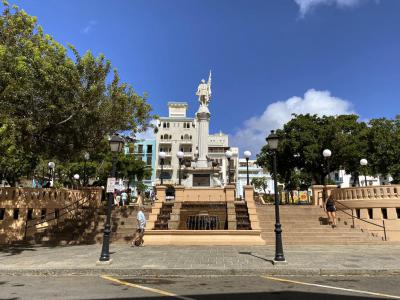
Columbus Square, originally known as Santiago Square, is one of the most important squares in San Juan, symbolizing progress and, at the same time, a testament to the old times. In the 17th century, the area marked the doorstep to the city, which was encircled by stone walls, from 1635-1641. The only way into the capital, back then, was through the five gates, the centermost of which was the Puerta de Santiago (or Land Gate), straddling the only highway linking the walled San Juan islet to the rest of Puerto Rico by land.
By 1772, the open space adjacent to Puerta de Santiago, while still unpaved, had taken the shape of Santiago Square. From 1862 to 1870, it was refurbished and the square finally started to take its current form. In 1893, the statue of Christopher Columbus was installed to commemorate the 400th anniversary of the discovery of Puerto Rico, following which the square itself was renamed Colón or Columbus Square.
To the south of it, today is the Tapia Theater, a true gem of Puerto Rican entertainment culture. Inaugurated in 1824, this lovely neoclassical structure was initially known as the San Juan Municipal Theater. Throughout the years, many notable performers have graced its stage. Outside the theater, along Fortaleza Street, there are a number of quaint restaurants and cute little cafes where one can sip some iced coffee outside whilst enjoying the sight of Columbus Square.
By 1772, the open space adjacent to Puerta de Santiago, while still unpaved, had taken the shape of Santiago Square. From 1862 to 1870, it was refurbished and the square finally started to take its current form. In 1893, the statue of Christopher Columbus was installed to commemorate the 400th anniversary of the discovery of Puerto Rico, following which the square itself was renamed Colón or Columbus Square.
To the south of it, today is the Tapia Theater, a true gem of Puerto Rican entertainment culture. Inaugurated in 1824, this lovely neoclassical structure was initially known as the San Juan Municipal Theater. Throughout the years, many notable performers have graced its stage. Outside the theater, along Fortaleza Street, there are a number of quaint restaurants and cute little cafes where one can sip some iced coffee outside whilst enjoying the sight of Columbus Square.
