Custom Walk in Geneva, Switzerland by marco_jensen_278c3 created on 2025-11-14
Guide Location: Switzerland » Geneva
Guide Type: Custom Walk
# of Sights: 9
Tour Duration: 2 Hour(s)
Travel Distance: 4.1 Km or 2.5 Miles
Share Key: 5TJTB
Guide Type: Custom Walk
# of Sights: 9
Tour Duration: 2 Hour(s)
Travel Distance: 4.1 Km or 2.5 Miles
Share Key: 5TJTB
How It Works
Please retrieve this walk in the GPSmyCity app. Once done, the app will guide you from one tour stop to the next as if you had a personal tour guide. If you created the walk on this website or come to the page via a link, please follow the instructions below to retrieve the walk in the app.
Retrieve This Walk in App
Step 1. Download the app "GPSmyCity: Walks in 1K+ Cities" on Apple App Store or Google Play Store.



Step 2. In the GPSmyCity app, download(or launch) the guide "Geneva Map and Walking Tours".
Step 3. Tap the menu button located at upper right corner of the "Walks" screen and select "Retrieve custom walk". Enter the share key: 5TJTB
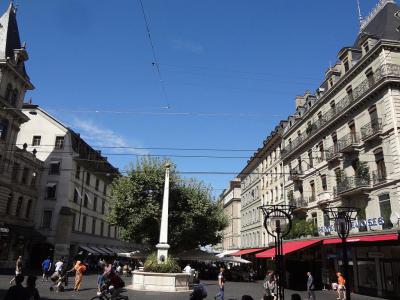
1) Place du Molard (Molard Square and Tower)
Molard Square—once grandly labelled Geneva’s “economic lung, urban matrix, and political arena”—has clearly never suffered from low self-esteem. And to be fair, it earned the title. This has been one of the city’s busiest commercial corners since at least the 16th century, though its résumé stretches back even further.
The place first appears in records in 1271 as a port, back when the lake came closer, and trade meant boats, not boutiques. The name “Molard” comes from Latin, meaning a raised embankment—essentially a sturdy bit of earth built to keep the water in check. By 1309, a proper market hall was up and running, turning the area into a lively customs and trading hub.
Roll ahead a few centuries, and Molard was the place where Geneva got things done. Warehouses, money changers, printers, notaries, inns—if it involved business, paperwork, or a handshake, it was happening here. Add in a fish and poultry market by 1690, and you’ve got the full sensory experience: commerce, conversation, and probably a strong hint of fresh produce...
Right at the centre stands the Molard Tower, also known as the Clock Tower—a leftover piece of the medieval defenses that once guarded this busy lakeside port. In 1906, it received a decorative upgrade: a painted frieze rescued from a demolished house in Rolle. Look closely, and you’ll spot coats of arms tied to the Reformation, along with a sculpture titled “Geneva, City of Refuge.” Now, here’s where things get curious—some swear the male figure on the sculpture looks suspiciously like Vladimir Lenin. Coincidence? Most likely. But it does give the tower a slightly unexpected cameo.
Today, Molard has traded sacks of grain for shopping bags. Small boutiques sit alongside global brands, with souvenir shops ready to ensure you don’t leave empty-handed. And twice a week, the square briefly returns to its market roots, transforming into an open-air flea market. So, whether you’re here to browse, bargain, or just people-watch, Molard Square continues doing what it has always done best—keeping Geneva in motion.
The place first appears in records in 1271 as a port, back when the lake came closer, and trade meant boats, not boutiques. The name “Molard” comes from Latin, meaning a raised embankment—essentially a sturdy bit of earth built to keep the water in check. By 1309, a proper market hall was up and running, turning the area into a lively customs and trading hub.
Roll ahead a few centuries, and Molard was the place where Geneva got things done. Warehouses, money changers, printers, notaries, inns—if it involved business, paperwork, or a handshake, it was happening here. Add in a fish and poultry market by 1690, and you’ve got the full sensory experience: commerce, conversation, and probably a strong hint of fresh produce...
Right at the centre stands the Molard Tower, also known as the Clock Tower—a leftover piece of the medieval defenses that once guarded this busy lakeside port. In 1906, it received a decorative upgrade: a painted frieze rescued from a demolished house in Rolle. Look closely, and you’ll spot coats of arms tied to the Reformation, along with a sculpture titled “Geneva, City of Refuge.” Now, here’s where things get curious—some swear the male figure on the sculpture looks suspiciously like Vladimir Lenin. Coincidence? Most likely. But it does give the tower a slightly unexpected cameo.
Today, Molard has traded sacks of grain for shopping bags. Small boutiques sit alongside global brands, with souvenir shops ready to ensure you don’t leave empty-handed. And twice a week, the square briefly returns to its market roots, transforming into an open-air flea market. So, whether you’re here to browse, bargain, or just people-watch, Molard Square continues doing what it has always done best—keeping Geneva in motion.
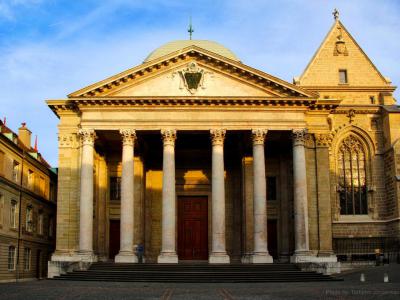
2) Cathédrale de St. Pierre (Saint Peter Cathedral) (must see)
If you’re standing in front of Saint Peter’s Cathedral in Geneva, you’re practically looking at over 1,600 years of “let’s rebuild it one more time.” Indeed, this hilltop has hosted a cathedral and a bishop since the 4th century. The current building emerged in 1160 under Prince-Bishop Arducius de Faucigny, first in full Gothic style and then enduring multiple changes ever since.
As a result, what you see today is a bit of an architectural mash-up: a strict, almost Roman temple-style portico bolted onto a soaring Gothic structure with pointed arches and a tall, elegant window. In 1535, came John Calvin, who, let’s say, wasn’t very much for the décor. The Reformation swept through, and anything that looked remotely decorative was removed. Statues, altars, paintings—all gone. Survived only the pulpit, a few artworks, and Calvin’s famously simple taste...
Once inside, you feel the immediate effect: wide, calm, and refreshingly uncluttered. Chandeliers hang above rows of benches, light spills across pale stone, and along the aisles, you’ll notice tombstones marking the resting places of church figures from the 15th and 16th centuries. It’s less “ornate spectacle” and more “quiet confidence.”
Now, if you’re feeling energetic, the north tower will challenge you with 157 steps. Make it to the top, and Geneva spreads out beneath you in a full panoramic payoff. Back down at ground level, the cathedral doubles as a concert venue, while below your feet, the archaeological site in the crypt reveals traces of a 4th-century basilica. And don’t skip the 14th-century Chapel of the Maccabees either—it’s one of the few places where decoration made a successful comeback...
Look up as you leave, and you’ll spot the grand pipe organ above the entrance, shaped like a red-and-gold crown and very much ready to make itself heard. There’s even a second, smaller organ up front, just in case... Near the pulpit, Calvin’s triangular stool still lingers—minimalist, of course.
Stepping outside to the north, you’ll find the International Museum of the Reformation, open Tuesday through Sunday, from 10 to 5, while a short walk brings you to the Museum of Art and History, housing treasures like the Saint Peter altarpiece. And just when you think the cathedral is done, the tower clock strikes the hour—followed by a cheerful glockenspiel tune, occasionally the Swiss National Anthem, as if to remind you: this place does know how to make an entrance...
As a result, what you see today is a bit of an architectural mash-up: a strict, almost Roman temple-style portico bolted onto a soaring Gothic structure with pointed arches and a tall, elegant window. In 1535, came John Calvin, who, let’s say, wasn’t very much for the décor. The Reformation swept through, and anything that looked remotely decorative was removed. Statues, altars, paintings—all gone. Survived only the pulpit, a few artworks, and Calvin’s famously simple taste...
Once inside, you feel the immediate effect: wide, calm, and refreshingly uncluttered. Chandeliers hang above rows of benches, light spills across pale stone, and along the aisles, you’ll notice tombstones marking the resting places of church figures from the 15th and 16th centuries. It’s less “ornate spectacle” and more “quiet confidence.”
Now, if you’re feeling energetic, the north tower will challenge you with 157 steps. Make it to the top, and Geneva spreads out beneath you in a full panoramic payoff. Back down at ground level, the cathedral doubles as a concert venue, while below your feet, the archaeological site in the crypt reveals traces of a 4th-century basilica. And don’t skip the 14th-century Chapel of the Maccabees either—it’s one of the few places where decoration made a successful comeback...
Look up as you leave, and you’ll spot the grand pipe organ above the entrance, shaped like a red-and-gold crown and very much ready to make itself heard. There’s even a second, smaller organ up front, just in case... Near the pulpit, Calvin’s triangular stool still lingers—minimalist, of course.
Stepping outside to the north, you’ll find the International Museum of the Reformation, open Tuesday through Sunday, from 10 to 5, while a short walk brings you to the Museum of Art and History, housing treasures like the Saint Peter altarpiece. And just when you think the cathedral is done, the tower clock strikes the hour—followed by a cheerful glockenspiel tune, occasionally the Swiss National Anthem, as if to remind you: this place does know how to make an entrance...
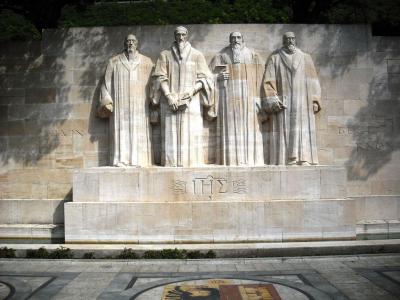
3) Mur des Réformateurs (Reformation Wall) (must see)
Inaugurated in 1909, the Reformation Wall celebrates the persons and events of the Protestant Reformation. Set within the grounds of the University of Geneva, this monument marks two milestones: 400 years since the birth of John Calvin and 350 years since he founded the university. Geneva clearly likes to celebrate with stone—and on a rather impressive scale...
The wall isn’t just placed here—it’s built straight into the old city fortifications, a subtle reminder that ideas once needed defending just as much as borders. The design came from a global competition—in total, 71 entries were submitted—before four Swiss architects teamed up to bring it to life. In a way, it was a kind of early-20th-century design showdown, only without reality-TV judges and more granite...
Because of its close connection to Protestantism, the individuals featured on the Wall most prominently are Calvinists, although key figures in other theologies are also included. Front and center, you’ll spot four towering figures—each over 16 feet tall— depicting William Farel, John Calvin, Theodore Beza, and John Knox. Robes on, small bibles in hand, expressions firmly set—they are not casual Sunday readers, indeed. Behind their calm poses lies a movement that reshaped half of Europe.
Flanking them on the left are three 10-foot figures, representing Frederick William of Brandenburg, William the Silent, and Gaspard de Coligny. On the one side, you'll find Roger Williams, Oliver Cromwell, and Stephen Bocskai. Different countries, different contexts—same big idea: reform, resistance, and a fair bit of controversy...
And running across the monument is the Latin motto that sums it all up: “After Darkness, Light.” Not exactly subtle, but then again, neither was the Reformation...
The wall isn’t just placed here—it’s built straight into the old city fortifications, a subtle reminder that ideas once needed defending just as much as borders. The design came from a global competition—in total, 71 entries were submitted—before four Swiss architects teamed up to bring it to life. In a way, it was a kind of early-20th-century design showdown, only without reality-TV judges and more granite...
Because of its close connection to Protestantism, the individuals featured on the Wall most prominently are Calvinists, although key figures in other theologies are also included. Front and center, you’ll spot four towering figures—each over 16 feet tall— depicting William Farel, John Calvin, Theodore Beza, and John Knox. Robes on, small bibles in hand, expressions firmly set—they are not casual Sunday readers, indeed. Behind their calm poses lies a movement that reshaped half of Europe.
Flanking them on the left are three 10-foot figures, representing Frederick William of Brandenburg, William the Silent, and Gaspard de Coligny. On the one side, you'll find Roger Williams, Oliver Cromwell, and Stephen Bocskai. Different countries, different contexts—same big idea: reform, resistance, and a fair bit of controversy...
And running across the monument is the Latin motto that sums it all up: “After Darkness, Light.” Not exactly subtle, but then again, neither was the Reformation...
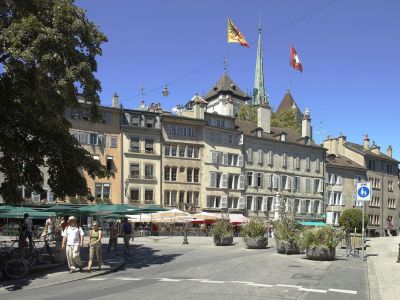
4) Place du Bourg-de-Four (Bourg-de-Four Square) (must see)
The name of this square—sounding official enough—is the French translation of the Latin term "Forum of the Burgundians.” This, in turn, is a nod to a long-gone royal presence—specifically the Castle of Gomdebaud, the Burgundian king, who died in 516. Back then, this was the place for markets and fairs. Livestock, trade, noise, negotiations... Today, it's still busy as a tourist magnet—with the cattle presently replaced by cappuccinos and camera phones...
Now, here’s where things get visually interesting. Unlike most classic European squares, having a wide-open space, the Burgundians' Forum refuses to play by the rules. It narrows in the middle like an hourglass, as if the city couldn’t quite decide how much space to afford it. On the north side, it is dominated by the rather serious-looking Palace of Justice, before the space splits into two streets—Fountain Street and Verdaine Street—with a Lutheran church quietly tucked in between, like it’s keeping an eye on both directions.
The south side looks more like a city square. The marble fountain at the center and surrounding buildings form a harmonious grouping, bordering a small, tree-lined promenade. Just beyond that, a tiny “placette” square—blink, and you might miss it—marks the start of Town Hall Street, and is part of the charm...
Standing by the fountain and turning east, you’ll spot the Palace of Justice again. Shift your gaze, and there’s Saint Peter’s Cathedral—Geneva’s largest church—watching over the square like it’s seen this whole transformation before. Around you, the edges are lined with gelaterias, cafés, bookshops, galleries, bars, and bistros. Quite a change for a place that once specialized in cattle...
Another point of interest is what's loosely translated as the “Chicken Coop Walkway,” which is already a clue. It’s a narrow staircase—67 steps—leading up toward Saint Peter's Cathedral. Just wide enough, as the saying goes, for two chickens to walk side by side. Humans manage, too, but it’s a close call...
Now, here’s where things get visually interesting. Unlike most classic European squares, having a wide-open space, the Burgundians' Forum refuses to play by the rules. It narrows in the middle like an hourglass, as if the city couldn’t quite decide how much space to afford it. On the north side, it is dominated by the rather serious-looking Palace of Justice, before the space splits into two streets—Fountain Street and Verdaine Street—with a Lutheran church quietly tucked in between, like it’s keeping an eye on both directions.
The south side looks more like a city square. The marble fountain at the center and surrounding buildings form a harmonious grouping, bordering a small, tree-lined promenade. Just beyond that, a tiny “placette” square—blink, and you might miss it—marks the start of Town Hall Street, and is part of the charm...
Standing by the fountain and turning east, you’ll spot the Palace of Justice again. Shift your gaze, and there’s Saint Peter’s Cathedral—Geneva’s largest church—watching over the square like it’s seen this whole transformation before. Around you, the edges are lined with gelaterias, cafés, bookshops, galleries, bars, and bistros. Quite a change for a place that once specialized in cattle...
Another point of interest is what's loosely translated as the “Chicken Coop Walkway,” which is already a clue. It’s a narrow staircase—67 steps—leading up toward Saint Peter's Cathedral. Just wide enough, as the saying goes, for two chickens to walk side by side. Humans manage, too, but it’s a close call...
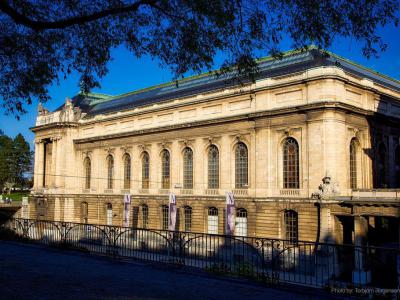
5) Musée d'Art et d'Histoire (Museum of Art and History) (must see)
The Museum of Art and History in Geneva, constructed in the early 20th century, houses a remarkable collection of fine art spanning from the Middle Ages to the 20th century. This collection features works from various schools of art, including Italian, Dutch, French, English, Genevan, and Swiss. Among its notable pieces is 'The Miraculous Draught of Fishes' (1444) by Konrad Witz, a part of Witz's Saint Peter Altarpiece.
The museum also boasts works by renowned artists such as Rembrandt, Cézanne, Modigliani, and the sculptor Rodin. Notable contributions can also be found from artists like Jean-Étienne Liotard, Ferdinand Hodler, Félix Vallotton, and Jean-Baptiste-Camille Corot. The collection of works by Genevan Neoclassical painter Jean-Pierre Saint-Ours (who passed away in 1809) is considered one of the museum's most exceptional offerings.
In addition to its fine art holdings, the museum houses an Applied Art section, which includes diverse collections of Byzantine art, icons, medieval and Renaissance weaponry, silverware, tinware, musical instruments, and textiles. The museum also showcases the complete interior furnishings and wood paneling from several rooms of the Lower Castle Zizers, dating back to the late 17th century.
The Archaeology section of the museum presents a wide array of artifacts, including findings from European prehistory, ancient Egypt (featuring a mummy from the 9th century BC), the Kerma culture of Sudan, the Near East, ancient Greece, as well as Roman and pre-Roman Italy. Additionally, there is a numismatic cabinet displaying a collection of coins and currency.
The museum also boasts works by renowned artists such as Rembrandt, Cézanne, Modigliani, and the sculptor Rodin. Notable contributions can also be found from artists like Jean-Étienne Liotard, Ferdinand Hodler, Félix Vallotton, and Jean-Baptiste-Camille Corot. The collection of works by Genevan Neoclassical painter Jean-Pierre Saint-Ours (who passed away in 1809) is considered one of the museum's most exceptional offerings.
In addition to its fine art holdings, the museum houses an Applied Art section, which includes diverse collections of Byzantine art, icons, medieval and Renaissance weaponry, silverware, tinware, musical instruments, and textiles. The museum also showcases the complete interior furnishings and wood paneling from several rooms of the Lower Castle Zizers, dating back to the late 17th century.
The Archaeology section of the museum presents a wide array of artifacts, including findings from European prehistory, ancient Egypt (featuring a mummy from the 9th century BC), the Kerma culture of Sudan, the Near East, ancient Greece, as well as Roman and pre-Roman Italy. Additionally, there is a numismatic cabinet displaying a collection of coins and currency.
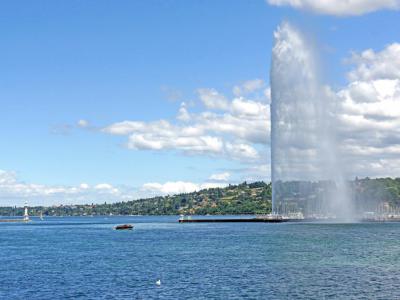
6) Jet d'Eau (Water-Jet) (must see)
Now, this fountain clearly never learned the meaning of restraint.
What you’re looking at started life in 1886, not as a postcard icon, but as a pressure valve for a hydraulic power network. In other words, this was Geneva’s very practical way of letting off steam—quite literally. And it proved so visually impressive that by 1891, the city decided to give it a promotion, relocating it to the lakefront to celebrate the Swiss Confederation’s 600th anniversary. The version you see today dates to 1951, powered by a discreet pumping station tucked just below the surface.
Now, the numbers. The Water-Jet fires 500 liters of water every second straight up to 140 meters, at speeds reaching 200 kilometers per hour. At any given moment, around 7,000 liters are suspended mid-air, briefly defying gravity before coming back down with a splash and purpose. This is one of the tallest fountains in the world—and yes, pilots can spot it from kilometers away, which tells you this isn’t your average decorative splash.
You can walk right up to it along a stone pier on the lake’s left bank, which sounds peaceful until the wind changes direction. Then suddenly, congratulations—you’re part of the attraction. Consider it Geneva’s way of keeping visitors alert...
Since 2003, the fountain runs daily, weather permitting, and in the warmer months, it stays on into the evening, illuminated by a series of lights that turn this engineered outburst into something almost theatrical. Not bad for what began as an industrial workaround...
What you’re looking at started life in 1886, not as a postcard icon, but as a pressure valve for a hydraulic power network. In other words, this was Geneva’s very practical way of letting off steam—quite literally. And it proved so visually impressive that by 1891, the city decided to give it a promotion, relocating it to the lakefront to celebrate the Swiss Confederation’s 600th anniversary. The version you see today dates to 1951, powered by a discreet pumping station tucked just below the surface.
Now, the numbers. The Water-Jet fires 500 liters of water every second straight up to 140 meters, at speeds reaching 200 kilometers per hour. At any given moment, around 7,000 liters are suspended mid-air, briefly defying gravity before coming back down with a splash and purpose. This is one of the tallest fountains in the world—and yes, pilots can spot it from kilometers away, which tells you this isn’t your average decorative splash.
You can walk right up to it along a stone pier on the lake’s left bank, which sounds peaceful until the wind changes direction. Then suddenly, congratulations—you’re part of the attraction. Consider it Geneva’s way of keeping visitors alert...
Since 2003, the fountain runs daily, weather permitting, and in the warmer months, it stays on into the evening, illuminated by a series of lights that turn this engineered outburst into something almost theatrical. Not bad for what began as an industrial workaround...
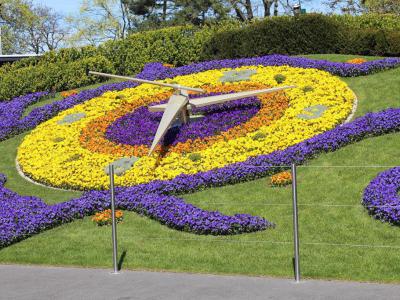
7) Horloge Fleurie (Flower Clock) (must see)
In a city where time isn’t just measured but practically worshiped, Geneva decided to take things one step further—and make time bloom. In 1955, right on the western edge of the English Garden, the now-famous Flower Clock was unveiled—a tribute not only to Swiss watchmaking, but also to a quiet appreciation for nature.
At first glance, it looks like a garden with commitment issues. Look again, and you’ll notice it’s a fully functioning clock—just one with better landscaping... The dial stretches about five meters across, and its second hand alone measures a confident 2.5 meters, sweeping across a face made of roughly 6,500 flowers and shrubs. For years, it proudly held the title of the world’s largest floral clock, until 2005, when a larger, 15-meter version appeared in Tehran and quietly stole the crown. Even so, Geneva’s version remains the original showstopper.
Indeed, this isn’t just a pretty face—it actually works... reliably and continuously so. For over half a century, the mechanism beneath the petals has kept ticking without interruption. No breaks, no days off, no “back in five minutes” sign. Just steady, Swiss-level precision.
And while the timing stays exact, the look never does. The clock is in constant transformation, as different flowers bloom and fade throughout the year. Each season brings a new arrangement, a fresh palette, a subtle redesign. It’s timekeeping, but with wardrobe changes.
And in keeping with Switzerland’s reputation for doing things properly, the entire display is maintained in an environmentally friendly way—no harsh chemicals, just careful cultivation.
So, as you stand here, watching the second hand glide over petals instead of numbers, take a moment. In Geneva, even time finds a way to slow down… just enough for you to notice it.
At first glance, it looks like a garden with commitment issues. Look again, and you’ll notice it’s a fully functioning clock—just one with better landscaping... The dial stretches about five meters across, and its second hand alone measures a confident 2.5 meters, sweeping across a face made of roughly 6,500 flowers and shrubs. For years, it proudly held the title of the world’s largest floral clock, until 2005, when a larger, 15-meter version appeared in Tehran and quietly stole the crown. Even so, Geneva’s version remains the original showstopper.
Indeed, this isn’t just a pretty face—it actually works... reliably and continuously so. For over half a century, the mechanism beneath the petals has kept ticking without interruption. No breaks, no days off, no “back in five minutes” sign. Just steady, Swiss-level precision.
And while the timing stays exact, the look never does. The clock is in constant transformation, as different flowers bloom and fade throughout the year. Each season brings a new arrangement, a fresh palette, a subtle redesign. It’s timekeeping, but with wardrobe changes.
And in keeping with Switzerland’s reputation for doing things properly, the entire display is maintained in an environmentally friendly way—no harsh chemicals, just careful cultivation.
So, as you stand here, watching the second hand glide over petals instead of numbers, take a moment. In Geneva, even time finds a way to slow down… just enough for you to notice it.
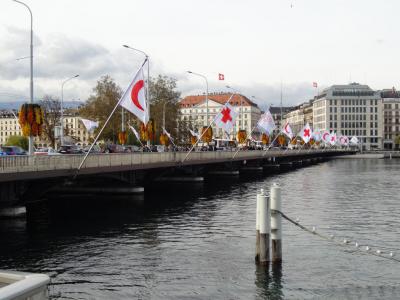
8) Pont du Mont Blanc (Mont Blanc Bridge)
The Mont-Blanc Bridge stands as the farthest upstream bridge along the Rhône River, positioned right at its exit point from Lake Geneva, essentially serving as the endpoint of the lake. This bridge connects two major thoroughfares within the city, namely rue du Mont-Blanc on the right bank and Quai Gustave-Ador on the left bank. It tends to experience heavy traffic congestion, especially during peak hours, but is typically less crowded at other times.
In December 2001, an underground pedestrian crossing was inaugurated beneath the first arch of the bridge on the right bank, allowing pedestrians to travel between quai des Bergues and quai du Mont-Blanc without navigating the road junction. This passage consists primarily of a unique steel floating pontoon.
The Mont Blanc Bridge features fixed flagpoles on both sides throughout its length, and on Swiss National Day, the flags representing the 26 cantons of Switzerland can be seen flying proudly.
This bridge holds special significance as a prime location for witnessing the fireworks displays during the Geneva festivals and serves as a route for the Lake Parade. It offers stunning panoramic vistas of Lake Geneva and the iconic Water Jet.
In December 2001, an underground pedestrian crossing was inaugurated beneath the first arch of the bridge on the right bank, allowing pedestrians to travel between quai des Bergues and quai du Mont-Blanc without navigating the road junction. This passage consists primarily of a unique steel floating pontoon.
The Mont Blanc Bridge features fixed flagpoles on both sides throughout its length, and on Swiss National Day, the flags representing the 26 cantons of Switzerland can be seen flying proudly.
This bridge holds special significance as a prime location for witnessing the fireworks displays during the Geneva festivals and serves as a route for the Lake Parade. It offers stunning panoramic vistas of Lake Geneva and the iconic Water Jet.

9) Le Scandale
Le Scandale, a renowned cocktail bar in Geneva, has been a local favorite and a popular destination for international guests since its inception in the 1990s. Known as the coolest hangout in downtown Geneva, this vibrant spot has carved out a unique identity, drawing in a diverse crowd with its captivating charm and an extensive cocktail menu.
The interior of Le Scandale is as memorable as its drinks. Dominated by bold shades of red, the decor creates an atmosphere that's both inviting and electric, perfectly encapsulating the bar's name. This color scheme sets a tone of excitement and allure, making it an ideal backdrop for both lively conversations and intimate moments.
At the heart of Le Scandale's appeal is its remarkable selection of cocktails. With more than eighty different concoctions available, it's a paradise for cocktail enthusiasts. Among these, the Margarita stands out as a crowd favorite, renowned for its perfect balance and exceptional taste. This variety ensures that every visit to Le Scandale offers a new flavor experience, catering to all palates, from the classic to the adventurous.
The interior of Le Scandale is as memorable as its drinks. Dominated by bold shades of red, the decor creates an atmosphere that's both inviting and electric, perfectly encapsulating the bar's name. This color scheme sets a tone of excitement and allure, making it an ideal backdrop for both lively conversations and intimate moments.
At the heart of Le Scandale's appeal is its remarkable selection of cocktails. With more than eighty different concoctions available, it's a paradise for cocktail enthusiasts. Among these, the Margarita stands out as a crowd favorite, renowned for its perfect balance and exceptional taste. This variety ensures that every visit to Le Scandale offers a new flavor experience, catering to all palates, from the classic to the adventurous.
