Custom Walk in Cartagena, Colombia by erinmichellecrocetti_a6fd3f created on 2026-01-09
Guide Location: Colombia » Cartagena
Guide Type: Custom Walk
# of Sights: 15
Tour Duration: 3 Hour(s)
Travel Distance: 4.3 Km or 2.7 Miles
Share Key: PW888
Guide Type: Custom Walk
# of Sights: 15
Tour Duration: 3 Hour(s)
Travel Distance: 4.3 Km or 2.7 Miles
Share Key: PW888
How It Works
Please retrieve this walk in the GPSmyCity app. Once done, the app will guide you from one tour stop to the next as if you had a personal tour guide. If you created the walk on this website or come to the page via a link, please follow the instructions below to retrieve the walk in the app.
Retrieve This Walk in App
Step 1. Download the app "GPSmyCity: Walks in 1K+ Cities" on Apple App Store or Google Play Store.



Step 2. In the GPSmyCity app, download(or launch) the guide "Cartagena Map and Walking Tours".
Step 3. Tap the menu button located at upper right corner of the "Walks" screen and select "Retrieve custom walk". Enter the share key: PW888
1) Las Bovedas (The Vaults)
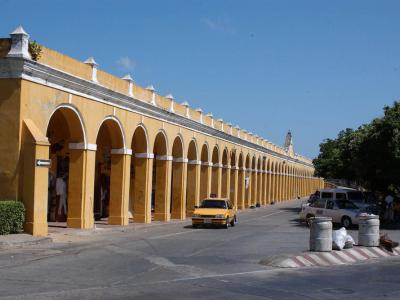
Exploring the Old City of Cartagena one cannot miss the immense arcade of columns and arches of bright golden color, located between the forts of Santa Clara and Santa Catalina. Known as Las Bóvedas (The Vaults), this building is indeed massive. Its walls – 15 meters thick(!) – were originally intended to protect a military storehouse.
The 23 bombproof arcades were built between 1789 and 1795 to a design by Antonio de Arebalo, a military engineer who worked on all fortifications in Cartagena. The 47 porticos were added in 1798. For a while, the vaults were used by the Spanish Crown as a garrison, the same purpose later used by republican forces. During the civil wars in the 19th century, the vaults were utilized as prison cells; at high tide, the unfortunate inmates had to stand up to their knees in seawater.
Nowadays, the building has become a lively marketplace, with the dungeon cells accommodating boutiques and other businesses. Inside the numbered vaults shops are selling a vast array of souvenirs: handcrafted items, paintings, colorful clothing, jewelry, and more. Together with the breathtaking view of the Caribbean Sea, this makes Las Bóvedas a popular tourist destination, appealing to those who love to stroll along the arcaded walkway whilst exploring traditional Colombian merchandise in this historic landmark.
The 23 bombproof arcades were built between 1789 and 1795 to a design by Antonio de Arebalo, a military engineer who worked on all fortifications in Cartagena. The 47 porticos were added in 1798. For a while, the vaults were used by the Spanish Crown as a garrison, the same purpose later used by republican forces. During the civil wars in the 19th century, the vaults were utilized as prison cells; at high tide, the unfortunate inmates had to stand up to their knees in seawater.
Nowadays, the building has become a lively marketplace, with the dungeon cells accommodating boutiques and other businesses. Inside the numbered vaults shops are selling a vast array of souvenirs: handcrafted items, paintings, colorful clothing, jewelry, and more. Together with the breathtaking view of the Caribbean Sea, this makes Las Bóvedas a popular tourist destination, appealing to those who love to stroll along the arcaded walkway whilst exploring traditional Colombian merchandise in this historic landmark.
2) Murallas de Cartagena (Cartagena City Walls) (must see)
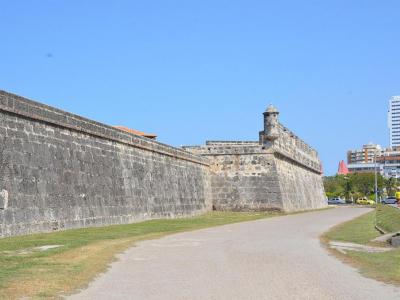
The walls around the Old City of Cartagena were built as protection against enemy attacks and pirate raids. The city walls reached completion in 1796 after nearly two centuries of construction. The wall is thick and well-constructed. Today, the walls represent one of the best-preserved fortifications in South America.
Walking along the Murallas de Cartagena (Cartagena City Walls) is a fun way to explore the walled site and offers fabulous views of the city and the glistening Caribbean Sea. The walls surround the historic Old Cartagena and stretch for 11 kilometers (just under seven miles). In spots along the wall, you'll find watch towers, old iron cannons, and lookout points.
A popular place to watch the sunset is from the Bastion of Santo Domingo, a fortification that marks the origin of the efforts to secure the city. Cafe del Mar is a restaurant with a central spot at the top of the bastion along the city walls. Relaxing on the walls and enjoying a drink is a great way to end a day exploring Cartagena.
Walking along the Murallas de Cartagena (Cartagena City Walls) is a fun way to explore the walled site and offers fabulous views of the city and the glistening Caribbean Sea. The walls surround the historic Old Cartagena and stretch for 11 kilometers (just under seven miles). In spots along the wall, you'll find watch towers, old iron cannons, and lookout points.
A popular place to watch the sunset is from the Bastion of Santo Domingo, a fortification that marks the origin of the efforts to secure the city. Cafe del Mar is a restaurant with a central spot at the top of the bastion along the city walls. Relaxing on the walls and enjoying a drink is a great way to end a day exploring Cartagena.
3) Baluarte de Santo Domingo (Bastion of Santo Domingo)
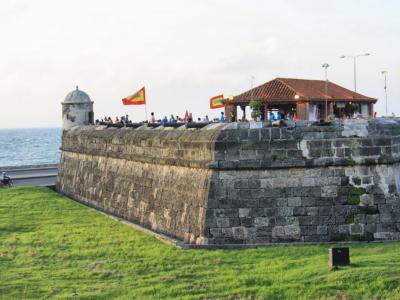
The Bastion of Santo Domingo (Baluarte de Santo Domingo) is a fortification, the origin of the Cartagena city walls constructed to protect the town against attacks. Soon after explorer Francis Drake pillaged Cartagena in 1586, plans were made to create a bastion to secure access to the city.
There are several things to see during your exploration of this large fortification. The stonework and masonry walls are well preserved. On the top of the bastion are rows of iron cannons resting along the parapet. At the front corner of the triangular-shaped structure is a small stone turret used as a watch tower.
This structure is located right next to the harbor and offers breathtaking panoramic views of the city skyline and the Caribbean Sea. Cafe del Mar, a lively restaurant and bar with plenty of outdoor tables, has a central location on top of the bastion. It's a fun spot to stop and take in the magnificent views, enjoy a drink, listen to music, and watch the sunset.
There are several things to see during your exploration of this large fortification. The stonework and masonry walls are well preserved. On the top of the bastion are rows of iron cannons resting along the parapet. At the front corner of the triangular-shaped structure is a small stone turret used as a watch tower.
This structure is located right next to the harbor and offers breathtaking panoramic views of the city skyline and the Caribbean Sea. Cafe del Mar, a lively restaurant and bar with plenty of outdoor tables, has a central location on top of the bastion. It's a fun spot to stop and take in the magnificent views, enjoy a drink, listen to music, and watch the sunset.
4) Catedral de Santa Catalina de Alejandria (Cartagena Cathedral)
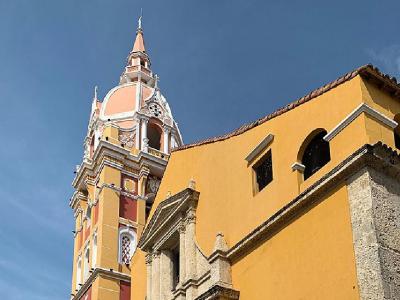
Sitting on the corner of the lively Bolivar Square in Cartagena is the magnificent church of Spanish Renaissance style, brightly painted in lemon-yellow with a white trim. The bell tower and dome rising over the rooftops of the Old City make it really hard to miss this architectural landmark.
The temple, officially known as the Metropolitan Cathedral Basilica of Santa Catalina of Alexandria, is the episcopal see of the Archbishop of Cartagena de Indias (one of the oldest episcopal sees in the Americas), and it is dedicated to the Christian martyr, Santa Catalina (aka Saint Catherine) of Alexandria.
The cathedral was built between 1577 and 1612, replacing a modest church of wood and reeds on this site. In 1586, while still under construction, the building suffered severe damage which seriously delayed its completion when Cartagena came under attack by the English privateer (pirate) Francis Drake. Armed with a fleet of up to 23 warships and more than 3,000 men, Drake captured the city and looted it for six weeks, threatening to destroy the cathedral, unless a juicy ransom was paid.
The first warning shot that he fired on the structure struck one of the columns, knocking it down and taking two more with it. The four arches supported by the columns and part of the roof also collapsed as a result. Finally, the Cartagenians agreed to pay “El Draque” 110,000 silver ducats to stop the destruction.
The original structure of the cathedral has been preserved to this day almost unchanged. Designed by master builder Simón González, it was modeled on basilicas in Andalusia, Spain and the Canary Islands. Later, in 1908, the tower and the dome of the cathedral were refurbished, but the balconies, the main portal, and the cornices are original from the colonial era.
The interior includes three naves divided by columned archways. The gilded high altar is large and exquisite, featuring small statuary and ornate gold decorations. High up on the side walls, there are nicely carved wooden reliefs depicting religious scenes. Also noteworthy is the gorgeous marble flooring of checkered tiles in shades of black and white.
Outside, in Plaza de la Proclamación (Proclamation Square), you can see a bronze statue of Pope John Paul II, a monument to the papal visit in 1986.
The temple, officially known as the Metropolitan Cathedral Basilica of Santa Catalina of Alexandria, is the episcopal see of the Archbishop of Cartagena de Indias (one of the oldest episcopal sees in the Americas), and it is dedicated to the Christian martyr, Santa Catalina (aka Saint Catherine) of Alexandria.
The cathedral was built between 1577 and 1612, replacing a modest church of wood and reeds on this site. In 1586, while still under construction, the building suffered severe damage which seriously delayed its completion when Cartagena came under attack by the English privateer (pirate) Francis Drake. Armed with a fleet of up to 23 warships and more than 3,000 men, Drake captured the city and looted it for six weeks, threatening to destroy the cathedral, unless a juicy ransom was paid.
The first warning shot that he fired on the structure struck one of the columns, knocking it down and taking two more with it. The four arches supported by the columns and part of the roof also collapsed as a result. Finally, the Cartagenians agreed to pay “El Draque” 110,000 silver ducats to stop the destruction.
The original structure of the cathedral has been preserved to this day almost unchanged. Designed by master builder Simón González, it was modeled on basilicas in Andalusia, Spain and the Canary Islands. Later, in 1908, the tower and the dome of the cathedral were refurbished, but the balconies, the main portal, and the cornices are original from the colonial era.
The interior includes three naves divided by columned archways. The gilded high altar is large and exquisite, featuring small statuary and ornate gold decorations. High up on the side walls, there are nicely carved wooden reliefs depicting religious scenes. Also noteworthy is the gorgeous marble flooring of checkered tiles in shades of black and white.
Outside, in Plaza de la Proclamación (Proclamation Square), you can see a bronze statue of Pope John Paul II, a monument to the papal visit in 1986.
5) Portal de Los Dulces (Sweets Portal)
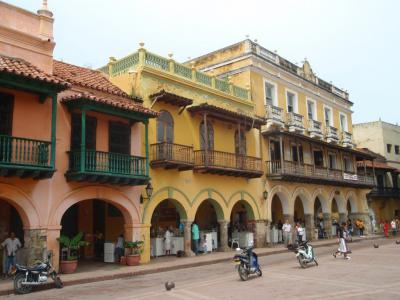
In the triangular-shaped Cars Square (Plaza de Los Coches), you'll find a candy market called Sweets Portal (Portal de Los Dulces). This site was named years ago for the sweet pastries sold there by street hagglers. You will find this lively market in the arcaded walkways of a row of old houses. The lovely Spanish colonial architecture of these brightly painted structures, with their charming balconies and tile roofs, is worth checking out.
At this outdoor market, you will find dozens of confectionary stands with vendors selling homemade candies and pastries. Jars filled with a variety of sweet treats are on display. You'll have fun shopping for delicious Caribbean delicacies with an emphasis on coconut sweets. Try the popular Cubanitos, rolled candy wrapped in colored paper.
Enjoy the colorful display of treats and the wonderful aroma of sweets in the air as you stroll through this inviting marketplace. There are also some interesting shops and restaurants around this colonial square. Don't miss Cartagena's landmark clock tower, directly across from the Sweets Portal.
At this outdoor market, you will find dozens of confectionary stands with vendors selling homemade candies and pastries. Jars filled with a variety of sweet treats are on display. You'll have fun shopping for delicious Caribbean delicacies with an emphasis on coconut sweets. Try the popular Cubanitos, rolled candy wrapped in colored paper.
Enjoy the colorful display of treats and the wonderful aroma of sweets in the air as you stroll through this inviting marketplace. There are also some interesting shops and restaurants around this colonial square. Don't miss Cartagena's landmark clock tower, directly across from the Sweets Portal.
6) Plaza de los Coches (Square of the Carriages)
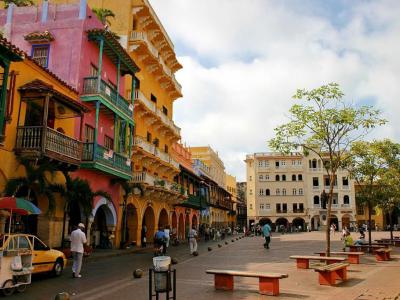
Square of the Carriages (Plaza de los Coches) is a historic square located in the heart of the walled city of Cartagena. This vibrant place is one of the city's most popular tourist destinations, known for its lively atmosphere, charming colonial architecture, and rich cultural history.
The square, originally known as Slave Square (Plaza del Esclavo), was where African slaves were bought and sold during the colonial period. In the early 19th century, the square was renamed Square of the Carriages as it became a popular spot for carriages to pick up and drop off passengers.
The square is bordered by several impressive colonial-era buildings, including the 18th-century Clock Tower and the Governor's Palace, which now houses the Museum of History of Cartagena. The architecture of these buildings reflects the city's rich cultural heritage and adds to the charm of the square.
Today, Square of the Carriages is a bustling hub of activity where visitors can find street vendors selling souvenirs, local food and drinks, and musicians playing traditional Colombian music. The area is also surrounded by shops, restaurants, and cafes.
The square was a hub of social and cultural activity during the colonial era. It hosted bullfights, theatrical performances, and religious processions, which attracted people from all over the city.
The statue located in the Square of the Carriages depicts Pedro de Heredia, the Spanish conquistador who founded the city of Cartagena in 1533. The statue was erected in 1937 to commemorate the 400th anniversary of the city's founding. It stands at the center of the square and is a popular spot for tourists to take photos.
The square, originally known as Slave Square (Plaza del Esclavo), was where African slaves were bought and sold during the colonial period. In the early 19th century, the square was renamed Square of the Carriages as it became a popular spot for carriages to pick up and drop off passengers.
The square is bordered by several impressive colonial-era buildings, including the 18th-century Clock Tower and the Governor's Palace, which now houses the Museum of History of Cartagena. The architecture of these buildings reflects the city's rich cultural heritage and adds to the charm of the square.
Today, Square of the Carriages is a bustling hub of activity where visitors can find street vendors selling souvenirs, local food and drinks, and musicians playing traditional Colombian music. The area is also surrounded by shops, restaurants, and cafes.
The square was a hub of social and cultural activity during the colonial era. It hosted bullfights, theatrical performances, and religious processions, which attracted people from all over the city.
The statue located in the Square of the Carriages depicts Pedro de Heredia, the Spanish conquistador who founded the city of Cartagena in 1533. The statue was erected in 1937 to commemorate the 400th anniversary of the city's founding. It stands at the center of the square and is a popular spot for tourists to take photos.
7) Torre del Reloj (Clock Tower) (must see)
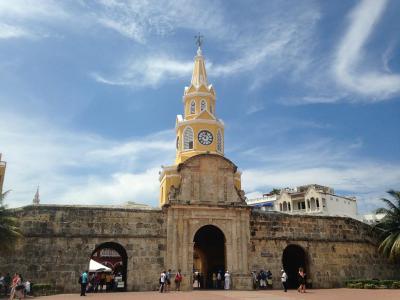
The main entrance to the historic walled city of Cartagena is famously known as the Clock Tower (Torre del Reloj). This significant landmark, built into the city wall, features a trio of open archways that offer a gateway into the Old City. A stunning clock tower crowns the central arch. With Baroque architecture, this beautiful eight-sided tower is painted golden-yellow with white trim.
Construction of this gateway took place between 1601 and 1631. Initially, only the central archway existed as a portal to the city. It was known as the Mouth of the Bridge (Boca del Puente). The other two housed an armory and a chapel. The clock tower was added later, during the early 18th century.
The Clock Tower is located next to Cars Square (Plaza de Los Coches) just inside the city walls. This triangular-shaped city square has a dark past as the place that once held Cartagena's slave market. This past also included public gallows in the center of the town square. On the plaza, directly across from the clock tower, you'll find the well-liked Cartagena sweets market known as Sweets Portal (Portal de Los Dulces).
The clock tower gate also serves as a connection from the city to the nearby Getsemani neighborhood just outside the walls. Getsemani is now a hip neighborhood filled with graffiti art and brightly painted buildings. Don't miss the two statues of Pegasus located on a nearby road that leads to the outside of the clock tower.
Construction of this gateway took place between 1601 and 1631. Initially, only the central archway existed as a portal to the city. It was known as the Mouth of the Bridge (Boca del Puente). The other two housed an armory and a chapel. The clock tower was added later, during the early 18th century.
The Clock Tower is located next to Cars Square (Plaza de Los Coches) just inside the city walls. This triangular-shaped city square has a dark past as the place that once held Cartagena's slave market. This past also included public gallows in the center of the town square. On the plaza, directly across from the clock tower, you'll find the well-liked Cartagena sweets market known as Sweets Portal (Portal de Los Dulces).
The clock tower gate also serves as a connection from the city to the nearby Getsemani neighborhood just outside the walls. Getsemani is now a hip neighborhood filled with graffiti art and brightly painted buildings. Don't miss the two statues of Pegasus located on a nearby road that leads to the outside of the clock tower.
8) Parque del Centenario (Centennial Park)
Centennial Park is a popular public park located in the historic center of Cartagena. Established in 1911 to commemorate the 100th anniversary of Catargena's independence from Spanish colonialism, the park is a beloved destination for locals and tourists, offering a tranquil oasis amid the bustling city.
The park's centerpiece is a large monument dedicated to the heroes of Colombia's independence. With pathways shaded by trees and dotted with statues and monuments, the park is a pleasant spot to hang out. Visitors will enjoy fountains, well-manicured gardens, palm trees, and shaded areas to relax.
In addition to its natural beauty, Centennial Park is a cultural hub, with regular events and activities throughout the year, such as concerts, art exhibitions, and traditional dance performances, providing visitors with a glimpse into the vibrant cultural heritage of Cartagena and Colombia.
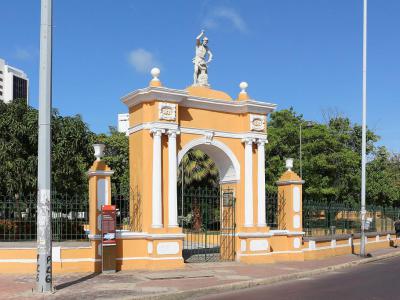
Centennial Park was designed by Pedro Malabet and built under the direction of Luis Felipe Jaspe Franco. Park's design was influenced by the neoclassical style of French gardens and incorporated elements such as symmetrical designs, axial perspectives, and fountains. Pedro Malabet designed several of the park's notable features, including the octagonal kiosk, the gatehouse, and the Clock Gate (Puerta del Reloj), one of the park's most recognizable landmarks.
The park's centerpiece is a large monument dedicated to the heroes of Colombia's independence. With pathways shaded by trees and dotted with statues and monuments, the park is a pleasant spot to hang out. Visitors will enjoy fountains, well-manicured gardens, palm trees, and shaded areas to relax.
In addition to its natural beauty, Centennial Park is a cultural hub, with regular events and activities throughout the year, such as concerts, art exhibitions, and traditional dance performances, providing visitors with a glimpse into the vibrant cultural heritage of Cartagena and Colombia.
Centennial Park was designed by Pedro Malabet and built under the direction of Luis Felipe Jaspe Franco. Park's design was influenced by the neoclassical style of French gardens and incorporated elements such as symmetrical designs, axial perspectives, and fountains. Pedro Malabet designed several of the park's notable features, including the octagonal kiosk, the gatehouse, and the Clock Gate (Puerta del Reloj), one of the park's most recognizable landmarks.
9) Calle de la Sierpe (Serpent Street)
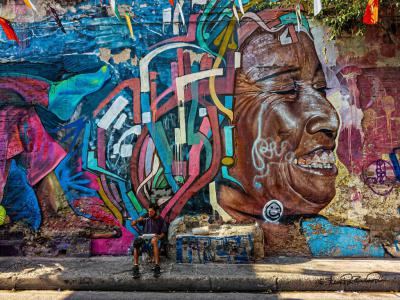
The first thing you notice on Calle de la Sierpe (Serpent Street) is the bright colors on the walls and the flags hanging over your head as you walk. Looping around from Calle Media Luna to the emblematic Plaza de la Trinidad (a place where important historical events once took place, determining the independence of Cartagena and consequently that of Colombia), this street – also known as Calle 29 – has a great deal of historical importance attached to it. However, it is the abundance of urban art illustrating the legends and mysteries surrounding Calle de la Sierpe's past that makes it one of the most popular destinations in the city.
Indeed, the ubiquitous graffiti here is the main attraction; found practically everywhere – on the walls, doors, and windows, and sometimes even on ruined buildings, – they effectively turn the area into one big photo op.
Standing out among them, in particular, are the two artworks: the Grinning Afro-Colombian Woman, and La Sierpe. The former – a large, striking mural by Dexs – is one of the most photographed pieces of street art in Cartagena. As for the latter (La Sierpe), this depiction of a half-woman, half-snake refers to a legend that gave the street its name.
Back in 1608, locals were often bothered by a hissing sound at night that came from what seemed like a big creature crawling on the ground, making a rattling noise. Gripped by fear, the people complained to the city mayor, Don Antonio de Viloria, who bravely ventured out several nights to find out the cause of it. One night, he finally managed to unveil the mystery – a giant rattlesnake! The serpent appeared out of nowhere, with its menacing phosphorescent eyes, wriggling and noisily shaking the large rattles on its tail.
The mayor, armed with courage and the magic technique he had learned on the island of Santa Domingo, drew some magical figures in the air, immediately after which the snake started to writhe and transformed into a woman, who happened to be a witch. The sorceress begged for forgiveness and implored clemency. According to the legend, she was imprisoned until 1614 when the Holy Inquisition Court sentenced her to 200 lashes and final banishment – for heresy.
As you venture further down the street, keep your eyes peeled for the depictions of indigenous people, as well as some other images, to get a sense of the fascinating ethnic diversity of the local population.
Indeed, the ubiquitous graffiti here is the main attraction; found practically everywhere – on the walls, doors, and windows, and sometimes even on ruined buildings, – they effectively turn the area into one big photo op.
Standing out among them, in particular, are the two artworks: the Grinning Afro-Colombian Woman, and La Sierpe. The former – a large, striking mural by Dexs – is one of the most photographed pieces of street art in Cartagena. As for the latter (La Sierpe), this depiction of a half-woman, half-snake refers to a legend that gave the street its name.
Back in 1608, locals were often bothered by a hissing sound at night that came from what seemed like a big creature crawling on the ground, making a rattling noise. Gripped by fear, the people complained to the city mayor, Don Antonio de Viloria, who bravely ventured out several nights to find out the cause of it. One night, he finally managed to unveil the mystery – a giant rattlesnake! The serpent appeared out of nowhere, with its menacing phosphorescent eyes, wriggling and noisily shaking the large rattles on its tail.
The mayor, armed with courage and the magic technique he had learned on the island of Santa Domingo, drew some magical figures in the air, immediately after which the snake started to writhe and transformed into a woman, who happened to be a witch. The sorceress begged for forgiveness and implored clemency. According to the legend, she was imprisoned until 1614 when the Holy Inquisition Court sentenced her to 200 lashes and final banishment – for heresy.
As you venture further down the street, keep your eyes peeled for the depictions of indigenous people, as well as some other images, to get a sense of the fascinating ethnic diversity of the local population.
10) Calle de San Juan (San Juan Street)
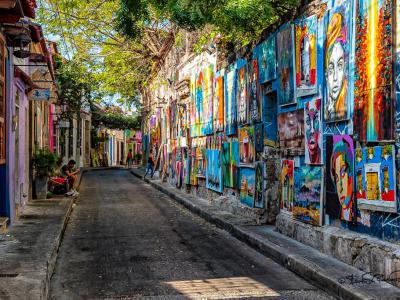
Stemming from Calle de la Sierpe to the south is a curved, narrow alley – Calle de San Juan (San Juan Street). Named after Saint John the Baptist, this is one of the few places in Cartagena to retain its original name from colonial times.
At 187 meters, this is also one of the longest “inner” streets in the Getsemaní neighborhood, and with a great deal of history packed inside these 187 meters, too. A century ago, this street was famed as the one inhabited by Admiral José Prudencio Padilla, the hero of the Expulsion of Mexico’s Spaniards in 1821-1836. More recently, it was the home of the notorious gangster, Samir Beetar, who made the name for himself among locals by helping needy neighbors and those with sick children pay for their medicine.
Still, what makes Calle de San Juan stand out today, at least in the eyes of numerous visitors, is the impressive collection of wall paintings coupled with an array of delightful cafes and restaurants lining the street. While the eateries and drinking establishments lure passers-by with their cozy atmosphere, the color palette of the surrounding artwork makes one feel as if drifting down the river of ink... Both pastimes are equally engaging!
At 187 meters, this is also one of the longest “inner” streets in the Getsemaní neighborhood, and with a great deal of history packed inside these 187 meters, too. A century ago, this street was famed as the one inhabited by Admiral José Prudencio Padilla, the hero of the Expulsion of Mexico’s Spaniards in 1821-1836. More recently, it was the home of the notorious gangster, Samir Beetar, who made the name for himself among locals by helping needy neighbors and those with sick children pay for their medicine.
Still, what makes Calle de San Juan stand out today, at least in the eyes of numerous visitors, is the impressive collection of wall paintings coupled with an array of delightful cafes and restaurants lining the street. While the eateries and drinking establishments lure passers-by with their cozy atmosphere, the color palette of the surrounding artwork makes one feel as if drifting down the river of ink... Both pastimes are equally engaging!
11) Plaza de La Trinidad (Trinity Square)
Plaza de la Trinidad in Cartagena's Getsemaní takes its name from the eponymous church, La Iglesia de la Santísima Trinidad, located right in front of it, completed in 1643.
The square is historically significant as the place of the country's first independence movement, the rebellion of Gethsemane lancers, in 1811, headed by blacksmith Pedro Romero. It ultimately led to the declaration of independence of what was then known as the city of Cartagena de Indias from the Spanish crown, some 11 years before the rest of the country became independent. Following the event, the square was renamed Plaza de la Libertad (Freedom Square).
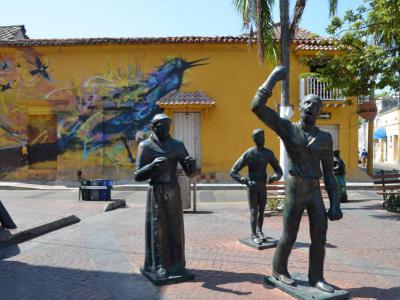
Today, there is a sculpture in the plaza paying tribute to Pedro Romero. Created by artist Nora Quintana, the sculptural group (made of fiberglass, resin and bronze patina) features Romero with his fist raised high in the air, accompanied by the Franciscan priest Father Umaña, and a Drummer.
Lately, the bohemian air of Getsemaní neighborhood found its way to this area in the form of graffiti. Alluding to the life and customs of the city, the graffiti create the image of a colonial-era plaza “disguised as a modern spot”, all the more beautiful in its own rustic way.
A piece of wall art to be noted in particular here is the picture-perfect mural of a black bird called Maria Mulata, which is the official bird of Cartagena. Painted by Colombian artist and graphic designer, Yurika MDC, at a glance, it seems just like an ordinary bird painted on yellow background, with some flashing lights of different colors added for decoration. However, locals know that, when the sun hits the bird from certain angles, these bright colors come to a full, meaningful display. Reportedly, the artist borrowed the idea for the mural from an old story told by a longtime Getsemaní resident.
Attractive by day, the square is also one of the coolest hangouts at night thanks to the street performers, food stands, and dine-in restaurants located nearby, largely stimulating the attendance by tourists and locals alike.
The square is historically significant as the place of the country's first independence movement, the rebellion of Gethsemane lancers, in 1811, headed by blacksmith Pedro Romero. It ultimately led to the declaration of independence of what was then known as the city of Cartagena de Indias from the Spanish crown, some 11 years before the rest of the country became independent. Following the event, the square was renamed Plaza de la Libertad (Freedom Square).
Today, there is a sculpture in the plaza paying tribute to Pedro Romero. Created by artist Nora Quintana, the sculptural group (made of fiberglass, resin and bronze patina) features Romero with his fist raised high in the air, accompanied by the Franciscan priest Father Umaña, and a Drummer.
Lately, the bohemian air of Getsemaní neighborhood found its way to this area in the form of graffiti. Alluding to the life and customs of the city, the graffiti create the image of a colonial-era plaza “disguised as a modern spot”, all the more beautiful in its own rustic way.
A piece of wall art to be noted in particular here is the picture-perfect mural of a black bird called Maria Mulata, which is the official bird of Cartagena. Painted by Colombian artist and graphic designer, Yurika MDC, at a glance, it seems just like an ordinary bird painted on yellow background, with some flashing lights of different colors added for decoration. However, locals know that, when the sun hits the bird from certain angles, these bright colors come to a full, meaningful display. Reportedly, the artist borrowed the idea for the mural from an old story told by a longtime Getsemaní resident.
Attractive by day, the square is also one of the coolest hangouts at night thanks to the street performers, food stands, and dine-in restaurants located nearby, largely stimulating the attendance by tourists and locals alike.
12) Barrio Getsemani (Getsemani Neighborhood)
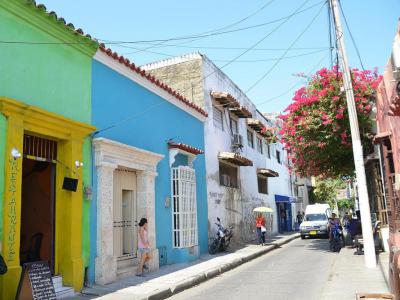
Getsemani neighborhood (Barrio Getsemani) is a trendy, artistic Cartagena district that centers around the picturesque Trinity Square (Plaza de la Trinidad). This once seedy area is now a thriving and beautiful place to explore. A rich array of brightly painted shops, street art, murals, vendors, and hip restaurants will greet you as you wander the streets of this colorful historical district.
The main thing to do in Getsemani is to explore the maze of streets and narrow alleyways as you experience the friendly, exhilarating atmosphere. Lovely Spanish Colonial architecture dominates the area. In the heart of Trinity Square is the Church of the Holy Trinity (Iglesia de la Trinidad), an impressive church dating back to 1600.
Head out from the Trinity Square down Serpent Street. You will see an impressive display of stunning murals on the walls of the buildings lining the street. Colorful international flags overhang the neighborhood alleyways as you wind around the corners. Other alleyways are strung with small colored banners and even umbrellas!
You won't want to miss exploring this vibrant neighborhood where everything around you is a rainbow of colors, art, tropical foliage, and lots of food. A walking tour is a perfect way to experience the area.
The main thing to do in Getsemani is to explore the maze of streets and narrow alleyways as you experience the friendly, exhilarating atmosphere. Lovely Spanish Colonial architecture dominates the area. In the heart of Trinity Square is the Church of the Holy Trinity (Iglesia de la Trinidad), an impressive church dating back to 1600.
Head out from the Trinity Square down Serpent Street. You will see an impressive display of stunning murals on the walls of the buildings lining the street. Colorful international flags overhang the neighborhood alleyways as you wind around the corners. Other alleyways are strung with small colored banners and even umbrellas!
You won't want to miss exploring this vibrant neighborhood where everything around you is a rainbow of colors, art, tropical foliage, and lots of food. A walking tour is a perfect way to experience the area.
13) Callejón Angosto (Narrow Alley)/Calle de las Sombrillas (Umbrella Street)
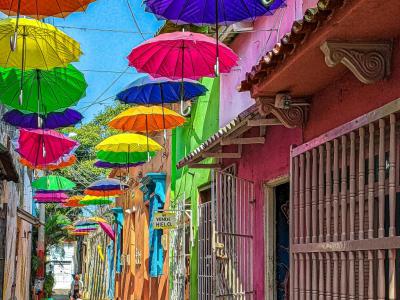
Formerly known as Callejón Angosto (Narrow Alley), this is indeed one of the narrowest streets in Getsemani. In recent years, in a bid to add color to its coral stone walls, the area – just like many other places around the world – embraced a new look with the help of an old accessory, the umbrella.
Being the first place in Colombia to put on such a look, the alleyway was subsequently renamed Calle de las Sombrillas (Umbrellas Street), becoming Cartagena's own Instagramable spot purposely designed for photo taking. A combination of overhanging umbrellas, colorful houses, and street art makes it undoubtedly one of the most picturesque locations in the city, especially when it's lit up at night.
The umbrellas proved a welcome addition from both artistic and practical standpoints, too, providing the much-needed shade from the scorching heat during midday, as well as protecting walkers from torrential rains when they come.
Having taken your must-have picture here, consider leaving a small tip in the box at the end of the street, as this is one of the few spots in Getsemaní that is still predominantly residential.
Being the first place in Colombia to put on such a look, the alleyway was subsequently renamed Calle de las Sombrillas (Umbrellas Street), becoming Cartagena's own Instagramable spot purposely designed for photo taking. A combination of overhanging umbrellas, colorful houses, and street art makes it undoubtedly one of the most picturesque locations in the city, especially when it's lit up at night.
The umbrellas proved a welcome addition from both artistic and practical standpoints, too, providing the much-needed shade from the scorching heat during midday, as well as protecting walkers from torrential rains when they come.
Having taken your must-have picture here, consider leaving a small tip in the box at the end of the street, as this is one of the few spots in Getsemaní that is still predominantly residential.
14) Calle de las Chancletas (Flip Flops Street)
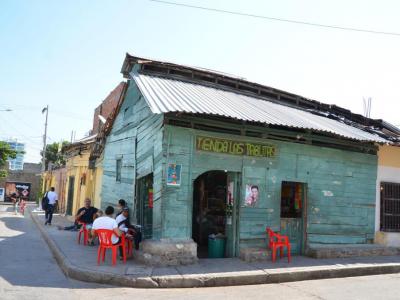
Curbed by Plazuela del Pozo, at one end, and the emblematic Tienda Las Tablitas shop at the other, lies yet another landmark of Gethsemane, Calle de las Chancletas or Flip Flops Street.
The origin of Tienda Las Tablitas – a liquor store, mini-market, bar, and even a casino, all wrapped into one (seemingly as old as the neighborhood itself, if only to believe that in the mid-1600s they already had this sort of establishments in Gethsemane) – is a mystery to many. Much like the Leaning Tower of Pisa, it seems miraculous that this iconic corner shop still stands. Aged definitely over 100 years, it was built from maritime timber packing material and is one of the top attractions in the area. As well as with locals it is very popular with photographers and is a must-see location for those visiting Cartagena's Gethsemane for the first time.
Back in colonial times, they say, boatmen from Barú and Tierrabomba used to come to the area to sell products, such as cassava and corn, on one of the nearby bridges. Their wives would come along and, with permission from locals, make them dinner, usually a sancocho (traditional soup/stew), in a designated spot on this street. The men, who had spent much time in the water, would leave their flip-flops drying in the sun on the sidewalk as they sat down to eat; this is how the street got its name.
And while the local residents are not strangers to flip flops either, it is the roses, creepers, and colonial architecture that are now the most prevalent illustration of this area. It is also safe to admit that, in terms of natural charm, Calle de las Chancletas is second to none in Gethsemane, always radiant and inviting to stop and contemplate the colorful facades, while snapping a few photos.
The origin of Tienda Las Tablitas – a liquor store, mini-market, bar, and even a casino, all wrapped into one (seemingly as old as the neighborhood itself, if only to believe that in the mid-1600s they already had this sort of establishments in Gethsemane) – is a mystery to many. Much like the Leaning Tower of Pisa, it seems miraculous that this iconic corner shop still stands. Aged definitely over 100 years, it was built from maritime timber packing material and is one of the top attractions in the area. As well as with locals it is very popular with photographers and is a must-see location for those visiting Cartagena's Gethsemane for the first time.
Back in colonial times, they say, boatmen from Barú and Tierrabomba used to come to the area to sell products, such as cassava and corn, on one of the nearby bridges. Their wives would come along and, with permission from locals, make them dinner, usually a sancocho (traditional soup/stew), in a designated spot on this street. The men, who had spent much time in the water, would leave their flip-flops drying in the sun on the sidewalk as they sat down to eat; this is how the street got its name.
And while the local residents are not strangers to flip flops either, it is the roses, creepers, and colonial architecture that are now the most prevalent illustration of this area. It is also safe to admit that, in terms of natural charm, Calle de las Chancletas is second to none in Gethsemane, always radiant and inviting to stop and contemplate the colorful facades, while snapping a few photos.
15) Castillo San Felipe de Barajas (San Felipe de Barajas Castle) (must see)
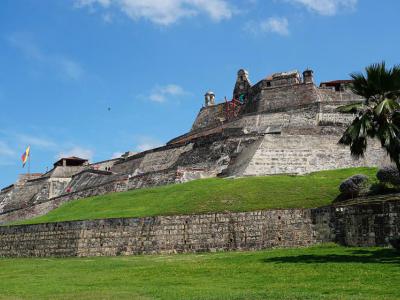
San Felipe de Barajas Castle (Castillo San Felipe de Barajas) is an old fortress located in Cartagena. It was built by the Spanish during the colonial period, to protect the city from attack by enemies and pirates.
The construction of the fortress began in 1536 under the direction of the Spanish engineer Antonio de Arévalo. However, the original structure was small and inadequate, so it was expanded and improved by subsequent Spanish engineers.
The most significant expansion of the fortress took place in the 17th century when the Spanish engineer Bautista Antonelli designed and built the present-day structure. Antonelli's design included a series of walls and bastions that made the fortress nearly impregnable.
The fortress played a crucial role in Cartagena's defense against various attacks by enemies and pirates, including the English, in 1741, during the War of Jenkins' Ear. The fortress held off the English for two months, and the battle ended with the Spanish victory.
During the 19th and 20th centuries, the fortress lost its military significance and was used for various purposes, including as a prison and a hospital. In 1984, UNESCO declared the historic center of Cartagena, including the fortress, a World Heritage Site.
Today, San Felipe de Barajas Castle is a popular tourist attraction in Cartagena. Visitors can explore the castle and learn about its history through exhibits and guided tours. The fortress also offers panoramic views of the city and the Caribbean Sea.
The construction of the fortress began in 1536 under the direction of the Spanish engineer Antonio de Arévalo. However, the original structure was small and inadequate, so it was expanded and improved by subsequent Spanish engineers.
The most significant expansion of the fortress took place in the 17th century when the Spanish engineer Bautista Antonelli designed and built the present-day structure. Antonelli's design included a series of walls and bastions that made the fortress nearly impregnable.
The fortress played a crucial role in Cartagena's defense against various attacks by enemies and pirates, including the English, in 1741, during the War of Jenkins' Ear. The fortress held off the English for two months, and the battle ended with the Spanish victory.
During the 19th and 20th centuries, the fortress lost its military significance and was used for various purposes, including as a prison and a hospital. In 1984, UNESCO declared the historic center of Cartagena, including the fortress, a World Heritage Site.
Today, San Felipe de Barajas Castle is a popular tourist attraction in Cartagena. Visitors can explore the castle and learn about its history through exhibits and guided tours. The fortress also offers panoramic views of the city and the Caribbean Sea.
