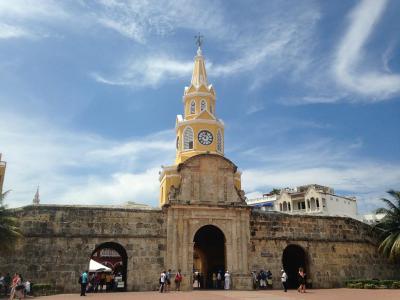


Torre del Reloj (Clock Tower), Cartagena (must see)
The Clock Tower is one of Cartagena’s most recognisable landmarks and the main gateway into its historic walled city. Built directly into the city walls, the entrance consists of three open archways crowned by an eight-sided tower painted golden yellow with white detailing.
Construction of the original gateway took place between 1601 and 1631. Initially, only the central arch served as an entrance to the city and was known as the Bridge Gate. It was reached by a drawbridge crossing Saint Anastasius Channel, which could be raised to protect the city from attack. The spaces on either side served other purposes, including as an armoury and a chapel.
The gateway was badly damaged during the French attack on Cartagena in 1697 and was subsequently rebuilt. Its familiar appearance developed much later. A public clock imported from the United States was installed in 1874, while in 1888, Cartagena-born architect Luis Felipe Jaspe designed the distinctive tower that rises above the gateway today. The original clock mechanism was later replaced by a Swiss one.
Before walking through the arches, step back to admire the Clock Tower rising above the warm yellow walls. The gateway historically connected the fortified city with the nearby Getsemani neighbourhood, today known for its colourful buildings and street art. Nearby, you can also look for two statues of Pegasus, the winged horse of Greek mythology. To find them, cross the busy intersection and head south-west from the Clock Tower. If you’re eager to take in the sea breeze, you’re in luck-the statues overlook the Bay of Souls.
Pass beneath the Clock Tower and you’ll emerge directly into Carriages Square, a triangular plaza with a darker history. During the colonial period, the square was associated with Cartagena’s slave market and once contained public gallows. Directly opposite the Clock Tower stands the popular Sweets Portal, where vendors sell traditional Colombian confectionery.
More than simply a picturesque entrance, the Clock Tower marks the transition into centuries-old Cartagena. Passing beneath its arches means following the same historic gateway through which generations of residents, merchants, soldiers and travellers entered the fortified city.
Construction of the original gateway took place between 1601 and 1631. Initially, only the central arch served as an entrance to the city and was known as the Bridge Gate. It was reached by a drawbridge crossing Saint Anastasius Channel, which could be raised to protect the city from attack. The spaces on either side served other purposes, including as an armoury and a chapel.
The gateway was badly damaged during the French attack on Cartagena in 1697 and was subsequently rebuilt. Its familiar appearance developed much later. A public clock imported from the United States was installed in 1874, while in 1888, Cartagena-born architect Luis Felipe Jaspe designed the distinctive tower that rises above the gateway today. The original clock mechanism was later replaced by a Swiss one.
Before walking through the arches, step back to admire the Clock Tower rising above the warm yellow walls. The gateway historically connected the fortified city with the nearby Getsemani neighbourhood, today known for its colourful buildings and street art. Nearby, you can also look for two statues of Pegasus, the winged horse of Greek mythology. To find them, cross the busy intersection and head south-west from the Clock Tower. If you’re eager to take in the sea breeze, you’re in luck-the statues overlook the Bay of Souls.
Pass beneath the Clock Tower and you’ll emerge directly into Carriages Square, a triangular plaza with a darker history. During the colonial period, the square was associated with Cartagena’s slave market and once contained public gallows. Directly opposite the Clock Tower stands the popular Sweets Portal, where vendors sell traditional Colombian confectionery.
More than simply a picturesque entrance, the Clock Tower marks the transition into centuries-old Cartagena. Passing beneath its arches means following the same historic gateway through which generations of residents, merchants, soldiers and travellers entered the fortified city.
Want to visit this sight? Check out these Self-Guided Walking Tours in Cartagena. Alternatively, you can download the mobile app "GPSmyCity: Walks in 1K+ Cities" from Apple App Store or Google Play Store. The app turns your mobile device to a personal tour guide and it works offline, so no data plan is needed when traveling abroad.
Download The GPSmyCity App



Torre del Reloj (Clock Tower) on Map
Sight Name: Torre del Reloj (Clock Tower)
Sight Location: Cartagena, Colombia (See walking tours in Cartagena)
Sight Type: Attraction/Landmark
Guide(s) Containing This Sight:
Sight Location: Cartagena, Colombia (See walking tours in Cartagena)
Sight Type: Attraction/Landmark
Guide(s) Containing This Sight:
Nearby Sights
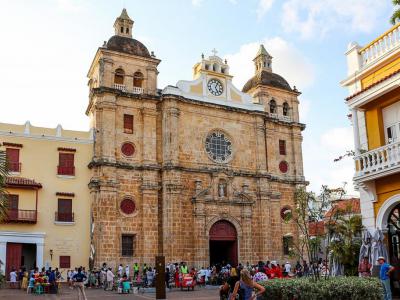
Walking Tours in Cartagena, Colombia
Create Your Own Walk in Cartagena
Creating your own self-guided walk in Cartagena is easy and fun. Choose the city attractions that you want to see and a walk route map will be created just for you. You can even set your hotel as the start point of the walk.
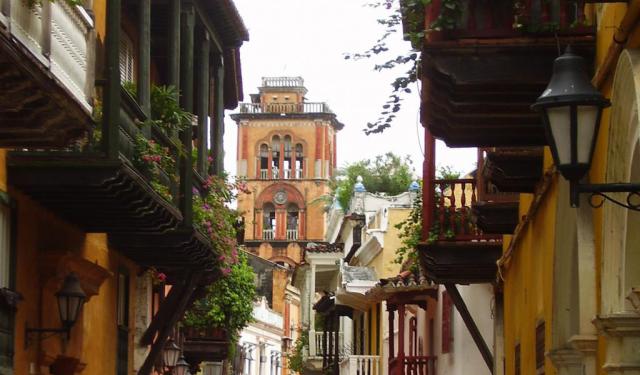
Cartagena Introduction Walking Tour
Nobel-prize winning Colombian writer Gabriel García Márquez moved to Cartagena as a young man in 1948. Upon entering the historic centre for the first time, he felt as if he had “been born again.”
Cartagena, a historic port city on Colombia’s Caribbean coast, has a history shaped by Indigenous cultures, Spanish colonisation, maritime trade, slavery, piracy and struggles for... view more
Tour Duration: 2 Hours
Travel Distance: 2.4 Km or 1.5 Miles
Cartagena, a historic port city on Colombia’s Caribbean coast, has a history shaped by Indigenous cultures, Spanish colonisation, maritime trade, slavery, piracy and struggles for... view more
Tour Duration: 2 Hours
Travel Distance: 2.4 Km or 1.5 Miles
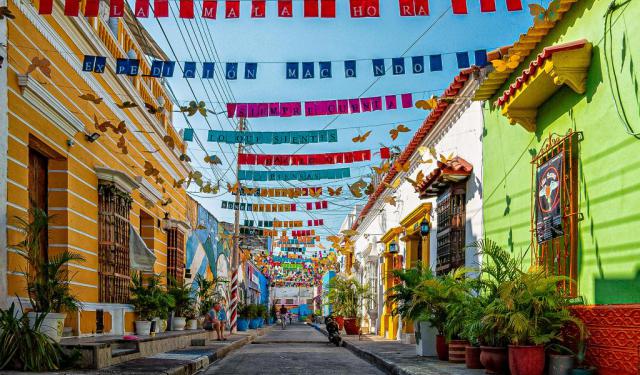
Getsemani Public Arts Walking Tour
Long known as the “neighbourhood of the poor” and notorious for criminal activity, the district of Getsemani has undergone considerable gentrification in recent years, becoming one of Cartagena’s hippest areas and an increasingly popular tourist destination. Local squares once associated with crime have been reclaimed, while many formerly neglected buildings have been transformed into... view more
Tour Duration: 1 Hour
Travel Distance: 0.8 Km or 0.5 Miles
Tour Duration: 1 Hour
Travel Distance: 0.8 Km or 0.5 Miles
Colonial Architecture Walk
Visiting Cartagena can be a remarkable experience, especially for those keen on architecture. The beautifully-preserved, mostly colonial-style, buildings in the historic center have long been one of the main attributes of this once burgeoning Colombian town.
Recognizing colonial Cartagena is easy, as it is surrounded by colossal stone walls tracing the outline of the old city. The downtown... view more
Tour Duration: 1 Hour
Travel Distance: 2 Km or 1.2 Miles
Recognizing colonial Cartagena is easy, as it is surrounded by colossal stone walls tracing the outline of the old city. The downtown... view more
Tour Duration: 1 Hour
Travel Distance: 2 Km or 1.2 Miles
Useful Travel Guides for Planning Your Trip

15 Tips to Have Fun in Cartagena De Indias, Colombia
Because of its troubled past, you will hear many nicknames to describe Cartagena de Indias. The magic city, The Heroic, The Rock Corral, The jewel of the Caribbean Coast. The mere mention of them allows you to travel through the history, from pirates and slavery to the revolutions for their...
City Walks Overview
