Custom Walk in Santa Fe, New Mexico by busbea_cba587 created on 2026-01-26
Guide Location: USA » Santa Fe
Guide Type: Custom Walk
# of Sights: 5
Tour Duration: 1 Hour(s)
Travel Distance: 0.7 Km or 0.4 Miles
Share Key: 6PP5F
Guide Type: Custom Walk
# of Sights: 5
Tour Duration: 1 Hour(s)
Travel Distance: 0.7 Km or 0.4 Miles
Share Key: 6PP5F
How It Works
Please retrieve this walk in the GPSmyCity app. Once done, the app will guide you from one tour stop to the next as if you had a personal tour guide. If you created the walk on this website or come to the page via a link, please follow the instructions below to retrieve the walk in the app.
Retrieve This Walk in App
Step 1. Download the app "GPSmyCity: Walks in 1K+ Cities" on Apple App Store or Google Play Store.



Step 2. In the GPSmyCity app, download(or launch) the guide "Santa Fe Map and Walking Tours".
Step 3. Tap the menu button located at upper right corner of the "Walks" screen and select "Retrieve custom walk". Enter the share key: 6PP5F
![San Miguel Mission [Oldest Church in the U.S.]](/img/gd_attr/35140.jpg)
1) San Miguel Mission [Oldest Church in the U.S.] (must see)
Back in 1610, some Franciscan friars got busy and put up what's now the oldest church in the States. This was Santa Fe's first church, and those Spanish missionaries were smart enough to plonk it down across the river where the native folks were hanging out. They were all about spreading the good word, so they whipped up this mission before even sorting out their own church closer to the Plaza.
Now, this place has seen its fair share of facelifts, so it's tough to say what's original and what's not. It's made of adobe with walls about five feet thick, and they threw in some stone buttresses in 1887 to keep everything from going sideways. The original church was likely a bit smaller, but it's been spruced up despite being set on fire during the Pueblo Revolt, and keeps standing on the same old foundations.
But enough about the exterior-let's dive into some juicy bits. The interior snug and whitewashed, with a restored late-18th-century altar screen that's seen its fair share of adventures. Covered in layers of house paint for years, it is the handiwork of an anonymous Mexican artist and acts like a giant picture frame, stuffed with oil paintings and bultos (fancy term for those painted wooden saint statues). And if you peek beneath your feet, you'll catch a glimpse of the church's original foundations-talk about history underfoot!
Tucked away at the back, San Miguel's old bell supposedly hails from Spain way back in 1356 – or so the engraving claims. Historians aren't buying it: They reckon it's more likely a sneaky defect that made an 8 look like a 3. Anyway, it made its way to the New World and landed here in the early 1800s, and it still hums like a charm, even with just a little tap.
Now, this place has seen its fair share of facelifts, so it's tough to say what's original and what's not. It's made of adobe with walls about five feet thick, and they threw in some stone buttresses in 1887 to keep everything from going sideways. The original church was likely a bit smaller, but it's been spruced up despite being set on fire during the Pueblo Revolt, and keeps standing on the same old foundations.
But enough about the exterior-let's dive into some juicy bits. The interior snug and whitewashed, with a restored late-18th-century altar screen that's seen its fair share of adventures. Covered in layers of house paint for years, it is the handiwork of an anonymous Mexican artist and acts like a giant picture frame, stuffed with oil paintings and bultos (fancy term for those painted wooden saint statues). And if you peek beneath your feet, you'll catch a glimpse of the church's original foundations-talk about history underfoot!
Tucked away at the back, San Miguel's old bell supposedly hails from Spain way back in 1356 – or so the engraving claims. Historians aren't buying it: They reckon it's more likely a sneaky defect that made an 8 look like a 3. Anyway, it made its way to the New World and landed here in the early 1800s, and it still hums like a charm, even with just a little tap.
2) Loretto Chapel (must see)
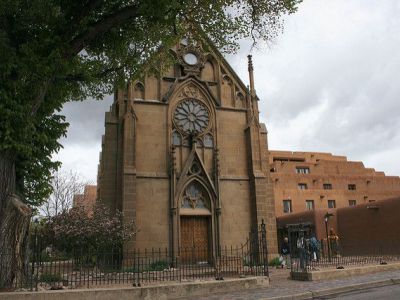
Loretto Chapel, the first Gothic-style building west of the Mississippi, was constructed alongside the Cathedral Basilica of Saint Francis of Assisi for the Sisters of Loretto, New Mexico's pioneering nuns. Originally named the Chapel of Our Lady of Light, this project kicked off in 1873 with the aim of mirroring the grandeur of Sainte-Chapelle in Paris, France. The Chapel's materials, including stones from quarries 200 miles south, and the expertise of French architects and Italian stonemasons were shared with the Cathedral Basilica. With its spires, buttresses, and imported harmonium and stained-glass windows from France, Loretto exudes architectural splendor.
But what truly draws the eye is the exquisite spiral staircase, dubbed the "Miraculous Stairs", leading to the choir loft. Crafted entirely from wood, this marvel winds gracefully without any central support pole, defying gravity like it's no big deal. Legend has it that in 1878, a mysterious carpenter, seemingly guided by the Sisters of Loretto's spiritual call, silently toiled for six months flat to create this masterpiece. And then, like a true mystery man, he vanished into thin air, leaving behind nothing but whispers of his craftiness. These fascinating tales, along with other historical nuggets, are shared on a looped recording inside the chapel.
But what truly draws the eye is the exquisite spiral staircase, dubbed the "Miraculous Stairs", leading to the choir loft. Crafted entirely from wood, this marvel winds gracefully without any central support pole, defying gravity like it's no big deal. Legend has it that in 1878, a mysterious carpenter, seemingly guided by the Sisters of Loretto's spiritual call, silently toiled for six months flat to create this masterpiece. And then, like a true mystery man, he vanished into thin air, leaving behind nothing but whispers of his craftiness. These fascinating tales, along with other historical nuggets, are shared on a looped recording inside the chapel.
3) Cathedral Basilica of St. Francis of Assisi (must see)
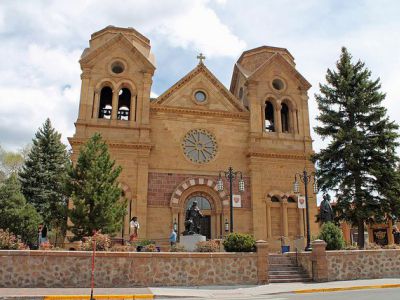
Santa Fe's majestic Cathedral Basilica of Saint Francis of Assisi, at the end of East San Francisco Street, is a testament to the vision of Bishop Jean-Baptiste Lamy, who oversaw its construction over a span of 15 years in the late 19th century. Known for his determination to "elevate" the city to European standards, Lamy's ambitious project resulted in this grandiose cathedral, towering over the landscape.
Lamy's disdain for the local religious customs, including the cult of the Virgin of Guadalupe and the Penitente brotherhood's practices, drove him to build a cathedral that surpassed the aesthetics and standards of the existing adobe structures. The original tiny adobe church dedicated to Saint Francis of Assisi, standing for 170 years, served as the framework for the new stone cathedral, constructed in Romanesque Revival style. However, due to financial constraints, Lamy's dream of domed towers atop the facade remained unfulfilled.
Inside, visitors are greeted by Gothic-inspired architecture, flooded with light from glowing stained-glass windows. A striking gilt altar screen, installed in 1987 for the building's centennial dedication, showcases primarily New World saints, including Kateri Tekakwitha, a 17th-century Mohawk woman canonized in 2012. Adjacent to the main altar stands the salvaged adobe chapel dedicated to La Conquistadora, a revered Native American statue with a storied history dating back to the 17th century.
As you make your grand exit, take a moment to appreciate the great cast-bronze doors, each panel telling a tale of New Mexico's Catholic history. These doors offer glimpses into the cathedral's past, including scenes of Italian stoneworkers constructing the edifice and families fleeing during the 1680 Pueblo Revolt-a rare depiction sympathetic to the Spanish perspective.
Lamy's disdain for the local religious customs, including the cult of the Virgin of Guadalupe and the Penitente brotherhood's practices, drove him to build a cathedral that surpassed the aesthetics and standards of the existing adobe structures. The original tiny adobe church dedicated to Saint Francis of Assisi, standing for 170 years, served as the framework for the new stone cathedral, constructed in Romanesque Revival style. However, due to financial constraints, Lamy's dream of domed towers atop the facade remained unfulfilled.
Inside, visitors are greeted by Gothic-inspired architecture, flooded with light from glowing stained-glass windows. A striking gilt altar screen, installed in 1987 for the building's centennial dedication, showcases primarily New World saints, including Kateri Tekakwitha, a 17th-century Mohawk woman canonized in 2012. Adjacent to the main altar stands the salvaged adobe chapel dedicated to La Conquistadora, a revered Native American statue with a storied history dating back to the 17th century.
As you make your grand exit, take a moment to appreciate the great cast-bronze doors, each panel telling a tale of New Mexico's Catholic history. These doors offer glimpses into the cathedral's past, including scenes of Italian stoneworkers constructing the edifice and families fleeing during the 1680 Pueblo Revolt-a rare depiction sympathetic to the Spanish perspective.
4) Palace of the Governors (New Mexico History Museum) (must see)
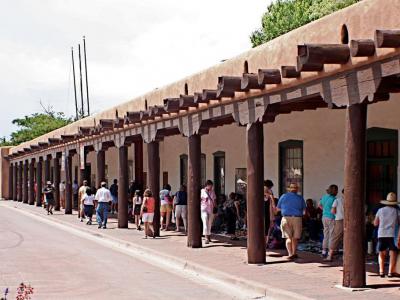
The Palace of the Governors, the former seat of Santa Fe's governance, is the oldest continuously occupied edifice in the United States erected by European settlers. This unassuming yet historically profound structure, constructed in 1610, has been the backdrop for several key events in the city's history. In 1693, Diego de Vargas valiantly battled Indian rebels within its walls when he reclaimed the city; ill-fated Mexican governor Albino Pérez met a grim fate, being beheaded in his office in 1837, and later, Governor Lew Wallace penned "Ben-Hur" (considered the most influential Christian book of the 19th century) here in the 1870s.
Inside, you'll find some of the most exquisite items in the state's collection, including trinkets and photographic prints from the 19th century alongside the stunning 18th-century Segesser hide paintings: two grand panels crafted from buffalo skin, depicting rare scenes of Spanish colonial battles. These works, along with the room they're in-decorated with 1909 murals-are truly worth the price of admission. In a couple of restored, furnished rooms, you can compare the living conditions of the Mexican leadership around 1845 to the relative comfort the U.S. governor enjoyed in 1893.
The Palace is part of the New Mexico History Museum complex, which also includes the newer building at the rear. There, you'll find more exhibits documenting the region's rich history.
Inside, you'll find some of the most exquisite items in the state's collection, including trinkets and photographic prints from the 19th century alongside the stunning 18th-century Segesser hide paintings: two grand panels crafted from buffalo skin, depicting rare scenes of Spanish colonial battles. These works, along with the room they're in-decorated with 1909 murals-are truly worth the price of admission. In a couple of restored, furnished rooms, you can compare the living conditions of the Mexican leadership around 1845 to the relative comfort the U.S. governor enjoyed in 1893.
The Palace is part of the New Mexico History Museum complex, which also includes the newer building at the rear. There, you'll find more exhibits documenting the region's rich history.
5) Santa Fe Plaza (must see)
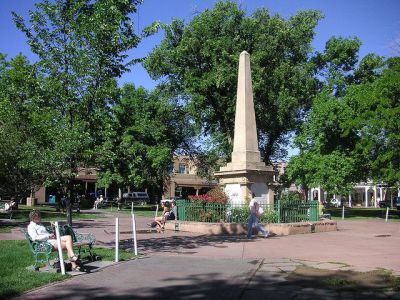
When Santa Fe was established around 1609, its layout followed Spanish laws for town planning in the colonies, resulting in a central plaza fronted by the Palace of the Governors ("Casas Reales") on its north side. This charming square, with its shady radial walkways, remains the city's social hub, surrounded by blocks rich with history. Throughout the year, it hosts many excellent arts, music, and cultural festivals, such as the Fiestas de Santa Fe, usually held during the second week of September.
One of the most iconic sights in Santa Fe is along the north side under the portal of the Palace of the Governors: Native American Indians from all over New Mexico selling their crafts, a tradition since the 1930s. Over 500 vendors, who must pass a strict application process that evaluates their technical skills, are licensed to sell here. Each morning, the 69 spots, each 12 bricks wide, are allocated by lottery. You'll find a variety of items, from silver bracelets to pottery to "heishi" (shell bead) necklaces to freshly harvested piñon nuts. It's a fantastic opportunity to buy directly from skilled artisans and learn about the work involved in each piece.
The controversial Soldiers' Monument, known locally as "the obelisk", had occupied the center of the plaza since 1867 and was dedicated to those who died in "battles with savage Indians in the territory of New Mexico". It was pulled down by demonstrators in 2020.
One of the most iconic sights in Santa Fe is along the north side under the portal of the Palace of the Governors: Native American Indians from all over New Mexico selling their crafts, a tradition since the 1930s. Over 500 vendors, who must pass a strict application process that evaluates their technical skills, are licensed to sell here. Each morning, the 69 spots, each 12 bricks wide, are allocated by lottery. You'll find a variety of items, from silver bracelets to pottery to "heishi" (shell bead) necklaces to freshly harvested piñon nuts. It's a fantastic opportunity to buy directly from skilled artisans and learn about the work involved in each piece.
The controversial Soldiers' Monument, known locally as "the obelisk", had occupied the center of the plaza since 1867 and was dedicated to those who died in "battles with savage Indians in the territory of New Mexico". It was pulled down by demonstrators in 2020.
