Custom Walk in Innsbruck, Austria by idwalsh_f5de57 created on 2026-02-13
Guide Location: Austria » Innsbruck
Guide Type: Custom Walk
# of Sights: 14
Tour Duration: 10 Hour(s)
Travel Distance: 26.2 Km or 16.3 Miles
Share Key: MDQB3
Guide Type: Custom Walk
# of Sights: 14
Tour Duration: 10 Hour(s)
Travel Distance: 26.2 Km or 16.3 Miles
Share Key: MDQB3
How It Works
Please retrieve this walk in the GPSmyCity app. Once done, the app will guide you from one tour stop to the next as if you had a personal tour guide. If you created the walk on this website or come to the page via a link, please follow the instructions below to retrieve the walk in the app.
Retrieve This Walk in App
Step 1. Download the app "GPSmyCity: Walks in 1K+ Cities" on Apple App Store or Google Play Store.



Step 2. In the GPSmyCity app, download(or launch) the guide "Innsbruck Map and Walking Tours".
Step 3. Tap the menu button located at upper right corner of the "Walks" screen and select "Retrieve custom walk". Enter the share key: MDQB3

1) Café Central
Nestled in the heart of Innsbruck, within the renowned Hotel Central, Café Central is a symbol of Viennese coffee house culture, brought to the Tyrolean landscape. This esteemed café, established in late 1875, embodies Vienna's rich coffee house heritage, making it a distinctive gem in the west of the Danube. Modeled in the traditional Viennese fashion, Café Central offers more than just a spot for coffee; it transports patrons to a bygone era, with its romantic and exquisitely adorned ambiance that enchants both locals and tourists alike.
The café serves as a venue where contrasts harmoniously coexist, welcoming a diverse array of patrons including locals, international travelers, students, families, and conference attendees. Café Central serves as a melting pot of cultures and a gathering place for various groups, embodying the vibrant diversity of the city in a cozy and inviting environment.
Since 1884, Café Central has been Austria's westernmost Viennese coffee house, exuding timeless charm. Offering modern comforts like free Wi-Fi, it's a top spot for quality and relaxation. With 22 coffee specialties and 67 newspapers and magazines, it's committed to excellence and customer satisfaction. Whether you're a regular patron or a first-time visitor, Café Central ensures a distinctive blend of history, culture, and hospitality, making each visit a memorable experience.
The café serves as a venue where contrasts harmoniously coexist, welcoming a diverse array of patrons including locals, international travelers, students, families, and conference attendees. Café Central serves as a melting pot of cultures and a gathering place for various groups, embodying the vibrant diversity of the city in a cozy and inviting environment.
Since 1884, Café Central has been Austria's westernmost Viennese coffee house, exuding timeless charm. Offering modern comforts like free Wi-Fi, it's a top spot for quality and relaxation. With 22 coffee specialties and 67 newspapers and magazines, it's committed to excellence and customer satisfaction. Whether you're a regular patron or a first-time visitor, Café Central ensures a distinctive blend of history, culture, and hospitality, making each visit a memorable experience.
2) Eduard-Wallnöfer-Platz (Eduard-Wallnöfer Square)
The Eduard-Wallnofer Square, or Landhausplatz, in Innsbruck, is not an ancient forum from the golden age of empire. Originally, the area held a mansion, villas and gardens.
The Gauhaus building was built in 1938-1939 by Walter and Ewald Guth. In front of the building it was planned to make a square memorializing Tyrolean National Socialists (Nazis) who had died resisting the former Republic. Other changes were planned but World War II intervened.
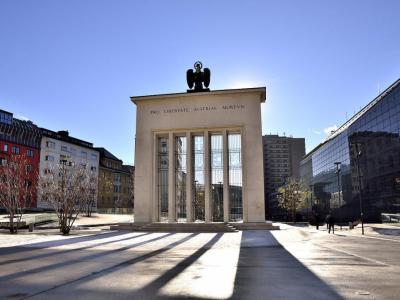
After the war, the French occupiers thought it would be a good place for a Liberation Monument, designed by French Major Jean Pascaud. The monument mimics the front facade of the Landhaus building. It has five open spaces between flat columns. The columns are held within a squared arch.
On the flat top of the monument is an Austrian bronze eagle. In 1994 the square was named for Eduard-Wallnofer. Eduard had served as governor of Tyrol from 1963 to 1987. He died in 1989.
The square is a landscape of sculpted concrete. The area in front of the Landhaus building is an inviting space for any event. There are large fountains in the square. Further south in the square, the polished concrete sheet takes on various shapes. Monuments are spaced out around the square, leaving a wide longitudinal area in the center.
Eduard Wallnofer was a farmer and a lifetime politician. He was popular. In 2005 it was revealed that he had been a member of the Nazi party. The square is named for him but Locals mainly call it Landhaus Square.
The Gauhaus building was built in 1938-1939 by Walter and Ewald Guth. In front of the building it was planned to make a square memorializing Tyrolean National Socialists (Nazis) who had died resisting the former Republic. Other changes were planned but World War II intervened.
After the war, the French occupiers thought it would be a good place for a Liberation Monument, designed by French Major Jean Pascaud. The monument mimics the front facade of the Landhaus building. It has five open spaces between flat columns. The columns are held within a squared arch.
On the flat top of the monument is an Austrian bronze eagle. In 1994 the square was named for Eduard-Wallnofer. Eduard had served as governor of Tyrol from 1963 to 1987. He died in 1989.
The square is a landscape of sculpted concrete. The area in front of the Landhaus building is an inviting space for any event. There are large fountains in the square. Further south in the square, the polished concrete sheet takes on various shapes. Monuments are spaced out around the square, leaving a wide longitudinal area in the center.
Eduard Wallnofer was a farmer and a lifetime politician. He was popular. In 2005 it was revealed that he had been a member of the Nazi party. The square is named for him but Locals mainly call it Landhaus Square.
3) Grassmayr Bell Museum
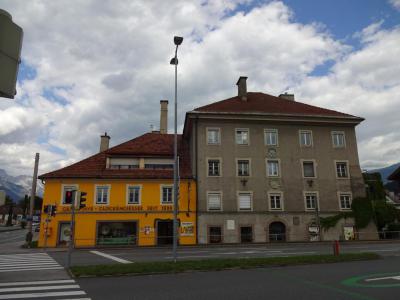
The Grassmayr Bell Museum in Innsbruck offers a unique insight into the ancient craft of bell-making, a tradition mastered by the Grassmayr family for over 400 years. Since Mortimer Grassmayr cast the first bell in 1599, fourteen generations have contributed to refining the art of bell foundry, blending science, passion, and meticulous craftsmanship. This longstanding family business is known for its secret technique called "ribbing," passed down from father to son, ensuring unparalleled bell quality.
More than just a museum, the Grassmayr Bell Museum provides an immersive journey into the traditional processes of bell casting, combining old methods with modern scientific advancements to create bells that resonate with exceptional clarity and durability. Visitors can witness firsthand the intricate process of crafting these magnificent instruments, renowned worldwide for their rich and distinctive tones, which adorn nearly 100 countries.
Innsbruck and its surroundings are enriched by the melodic sounds of Grassmayr bells, heard from the grandeur of Saint James' Cathedral to the tranquility of Telfs/Mösern, where a significant peace bell rings daily, its sound echoing for miles. These bells, an integral part of the region's soundscape, chime with a special resonance, particularly at midday, in the evenings, and on Friday afternoons, adding enchantment and historical significance to the surroundings. Through the Grassmayr Bell Museum, both visitors and locals are reminded of the profound impact and lasting legacy of bell sounds in community life, making it a must-visit destination for those interested in connecting with living history.
More than just a museum, the Grassmayr Bell Museum provides an immersive journey into the traditional processes of bell casting, combining old methods with modern scientific advancements to create bells that resonate with exceptional clarity and durability. Visitors can witness firsthand the intricate process of crafting these magnificent instruments, renowned worldwide for their rich and distinctive tones, which adorn nearly 100 countries.
Innsbruck and its surroundings are enriched by the melodic sounds of Grassmayr bells, heard from the grandeur of Saint James' Cathedral to the tranquility of Telfs/Mösern, where a significant peace bell rings daily, its sound echoing for miles. These bells, an integral part of the region's soundscape, chime with a special resonance, particularly at midday, in the evenings, and on Friday afternoons, adding enchantment and historical significance to the surroundings. Through the Grassmayr Bell Museum, both visitors and locals are reminded of the profound impact and lasting legacy of bell sounds in community life, making it a must-visit destination for those interested in connecting with living history.
4) Bergisel Ski Jump (must see)
The Bergisel Ski Jump is a renowned ski jumping hill situated on the historic Bergisel in Innsbruck. With a stadium accommodating up to 26,000 spectators, it holds a prominent position in the world of ski jumping, notably being a part of the FIS Ski Jumping World Cup circuit. This prestigious venue hosts the third competition of the Four Hills Tournament each year, emphasizing its importance in the international ski jumping calendar.
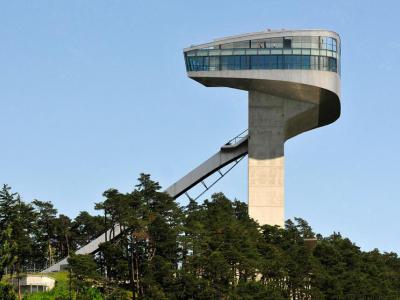
Ski jumping at Bergisel originated in the 1920s with basic wooden structures. A larger hill was built in 1930, renovated for the 1964 Winter Olympics. It hosted the event again in 1976, solidifying its historical importance. The current hill, designed by Zaha Hadid in 2003, features functional elements like the in-run bridge and tower, creating a striking landmark in Innsbruck.
Zaha Hadid, celebrated worldwide for her architectural brilliance, brought a unique blend of form and function to the Bergisel Ski Jump. At Bergisel, her design not only facilitates ski jumping but also serves as a multifunctional work of art housing a jump tower, café, and in-run, all converging into a remarkable presence.
Beyond its architectural and sporting significance, Bergisel Hill holds a rich historical legacy. Around 200 years ago, it was the battleground for a crucial battle for Tyrolean independence led by Andreas Hofer. The spirit of Tyrol's struggle for freedom is intertwined with the site's modern use for sports and recreation. Since its establishment as a ski jump venue in 1925, Bergisel has hosted two Olympic Games (1964 and 1976) along with other notable events, including a Mass celebrated by Pope John Paul II in 1988, attended by 60,000 people.
Ski jumping at Bergisel originated in the 1920s with basic wooden structures. A larger hill was built in 1930, renovated for the 1964 Winter Olympics. It hosted the event again in 1976, solidifying its historical importance. The current hill, designed by Zaha Hadid in 2003, features functional elements like the in-run bridge and tower, creating a striking landmark in Innsbruck.
Zaha Hadid, celebrated worldwide for her architectural brilliance, brought a unique blend of form and function to the Bergisel Ski Jump. At Bergisel, her design not only facilitates ski jumping but also serves as a multifunctional work of art housing a jump tower, café, and in-run, all converging into a remarkable presence.
Beyond its architectural and sporting significance, Bergisel Hill holds a rich historical legacy. Around 200 years ago, it was the battleground for a crucial battle for Tyrolean independence led by Andreas Hofer. The spirit of Tyrol's struggle for freedom is intertwined with the site's modern use for sports and recreation. Since its establishment as a ski jump venue in 1925, Bergisel has hosted two Olympic Games (1964 and 1976) along with other notable events, including a Mass celebrated by Pope John Paul II in 1988, attended by 60,000 people.
5) Patscherkofelbahn (Patscherkofel Cable Car)
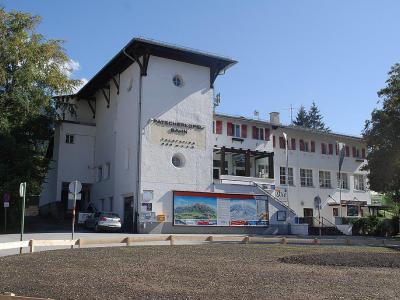
The Patscherkofel Cable Car (Patscherkofelbahn) is a famous cable car system located in Innsbruck, connecting the Igls district to the Patscherkofel mountain. It was first built in 1928 as an aerial tramway but was upgraded in 2017 to a modern monocable gondola system. This upgrade aimed to improve efficiency and capacity for visitors heading to the popular skiing and hiking destination.
The decision to upgrade the Patscherkofel Cable Car was made in October 2015, following a thorough evaluation of different improvement options. By March 2016, a comprehensive plan for the mountain area won an architectural competition, paving the way for the upgrade. Doppelmayr, a well-known cable car manufacturer, was contracted in April 2016 to carry out the project, with a tight deadline to finish by the 2017/18 winter season.
Construction began on April 26, 2017, with the aim of opening on December 15, 2017. However, due to delays, the opening was postponed to December 22, 2017. The opening ceremony was followed by normal ski operations the next day.
A notable feature of the upgraded system is the middle station, which serves as a technical hub and garage for the gondolas, aiding maintenance and operational readiness. This addition reflects the comprehensive approach taken in redesigning and reconstructing the Patscherkofel Cable Car, ensuring its importance for Innsbruck's tourism and local transportation.
The decision to upgrade the Patscherkofel Cable Car was made in October 2015, following a thorough evaluation of different improvement options. By March 2016, a comprehensive plan for the mountain area won an architectural competition, paving the way for the upgrade. Doppelmayr, a well-known cable car manufacturer, was contracted in April 2016 to carry out the project, with a tight deadline to finish by the 2017/18 winter season.
Construction began on April 26, 2017, with the aim of opening on December 15, 2017. However, due to delays, the opening was postponed to December 22, 2017. The opening ceremony was followed by normal ski operations the next day.
A notable feature of the upgraded system is the middle station, which serves as a technical hub and garage for the gondolas, aiding maintenance and operational readiness. This addition reflects the comprehensive approach taken in redesigning and reconstructing the Patscherkofel Cable Car, ensuring its importance for Innsbruck's tourism and local transportation.
6) Schloss Ambras (Ambras Castle) (must see)
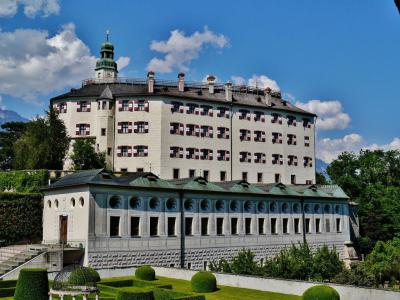
Schloss Ambras, or Ambras Castle, is one of the most popular tourist attractions in the region. The castle was built in the 16th century in the German Renaissance architectural style. It was converted into a museum in 1880.
The castle was built upon the grounds of a medieval fortress, which was constructed in the 10th century. During the 16th century, Archduke Ferdinand II ordered the castle be constructed around the medieval fortress as a gift for his wife, Philippine Welser. The archduke's family lived in Schloss Ambras from 1567 to 1595.
A prolific collector of art, Ferdinand ordered an area be designed specifically to display his collections. The museum is now considered one of the oldest in the world. The Lower Castle also features armouries from Holy Roman Emperors Maximilian I through Leopold I.
The Spanish Hall and the Upper Castle are also noted for art and architecture. The Spanish Hall contains 27 full-length portraits of the leaders of the Austrian state of Tyrol. The Upper Castle has many portraits of members of European royalty.
Along with works of art, the museum holds natural wonders, scientific items, toys and historic luxuries in its Chamber of Art and Curiosities collection. Items in this collection include goblets made from rhinoceros horn, bronze animals, measuring devices and clocks.
The castle grounds also hold a chapel, which is dedicated to Saint Nicholas. The chapel predates the castle by some 200 years. The chapel fell into ruin but was rebuilt and painted with an al fresco style in the late 1800s.
The castle was built upon the grounds of a medieval fortress, which was constructed in the 10th century. During the 16th century, Archduke Ferdinand II ordered the castle be constructed around the medieval fortress as a gift for his wife, Philippine Welser. The archduke's family lived in Schloss Ambras from 1567 to 1595.
A prolific collector of art, Ferdinand ordered an area be designed specifically to display his collections. The museum is now considered one of the oldest in the world. The Lower Castle also features armouries from Holy Roman Emperors Maximilian I through Leopold I.
The Spanish Hall and the Upper Castle are also noted for art and architecture. The Spanish Hall contains 27 full-length portraits of the leaders of the Austrian state of Tyrol. The Upper Castle has many portraits of members of European royalty.
Along with works of art, the museum holds natural wonders, scientific items, toys and historic luxuries in its Chamber of Art and Curiosities collection. Items in this collection include goblets made from rhinoceros horn, bronze animals, measuring devices and clocks.
The castle grounds also hold a chapel, which is dedicated to Saint Nicholas. The chapel predates the castle by some 200 years. The chapel fell into ruin but was rebuilt and painted with an al fresco style in the late 1800s.
7) Innsbrucker Nordkettenbahnen (Innsbruck Nordkette Cable Cars)
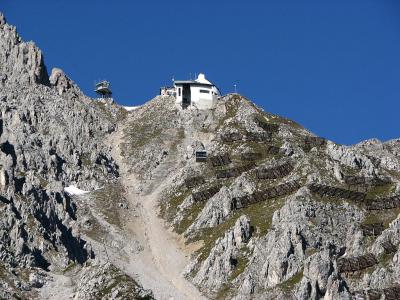
The Innsbruck Nordkette Cable Cars (Innsbrucker Nordkettenbahnen) in Tyrol provides access to the Nordkette, the southernmost part of the Karwendel mountain range. These cable cars operate in three sections, connecting downtown Innsbruck with the Seegrube station (1905 meters above sea level) and further to the Hafelekar mountain station (2269 meters above sea level).
The first section, from Innsbruck's old town to Hungerburg, is served by the "Hungerburgbahn" cable car, while the second and third sections to the Seegrube and Hafelekar stations are operated by two cable cars with a total of three cabins. The Seegrube and particularly the Hafelekarspitze offer panoramic views of Innsbruck city, the Inn Valley, and the Karwend.
In summer, the area serves as a starting point for hikes in the Nordkette and Karwendel mountains. Just west of the Hafelekar station, there's the entrance to the Innsbruck via Ferrata. Below the Hungerburg-Seegrube section of the Nordkettenbahn, you'll find the Nordkette single trail, a challenging route popular among freeride mountain bikers in Europe.
The Goetheweg trail extends from the Hafelekarhaus of the Nordkettenbahn to the Pfeishütte north of Rumer Spitze. In winter, the cable car, along with two chairlifts, forms a winter sports area. The Skylinepark snow park here is particularly loved by snowboarders and freeskiers.
Skiing enthusiasts are attracted to the famous ski routes from the summit of Hafelekar, offering thrilling and varied skiing experiences amidst the imposing rocks, especially in deep snow conditions. Towards the end of the winter season, many athletes head to Seegrube for snow gliding. After being briefly renamed Nordpark, the ski area has reverted to its original name, Innsbruck Nordkette Cable Cars, since 2009.
The first section, from Innsbruck's old town to Hungerburg, is served by the "Hungerburgbahn" cable car, while the second and third sections to the Seegrube and Hafelekar stations are operated by two cable cars with a total of three cabins. The Seegrube and particularly the Hafelekarspitze offer panoramic views of Innsbruck city, the Inn Valley, and the Karwend.
In summer, the area serves as a starting point for hikes in the Nordkette and Karwendel mountains. Just west of the Hafelekar station, there's the entrance to the Innsbruck via Ferrata. Below the Hungerburg-Seegrube section of the Nordkettenbahn, you'll find the Nordkette single trail, a challenging route popular among freeride mountain bikers in Europe.
The Goetheweg trail extends from the Hafelekarhaus of the Nordkettenbahn to the Pfeishütte north of Rumer Spitze. In winter, the cable car, along with two chairlifts, forms a winter sports area. The Skylinepark snow park here is particularly loved by snowboarders and freeskiers.
Skiing enthusiasts are attracted to the famous ski routes from the summit of Hafelekar, offering thrilling and varied skiing experiences amidst the imposing rocks, especially in deep snow conditions. Towards the end of the winter season, many athletes head to Seegrube for snow gliding. After being briefly renamed Nordpark, the ski area has reverted to its original name, Innsbruck Nordkette Cable Cars, since 2009.
8) Kaiserliche Hofburg (Imperial Palace) (must see)
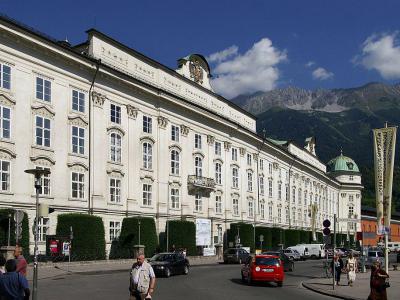
For a long time the Innsbruck Imperial Palace was the home of the ruling Habsburg dynasty in Austria. It rates among the Imperial Palace and the Schonbrumm Palace in Vienna as one of the three most important cultural edifices in the country.
It was formerly a residential compound of the Habsburgs. It still houses the Noblewomen's Collegiate Foundation, the Silver Chapel, the Court Church with the cenotaph of Maximilion, the Theological University, The Tyrolean Folk Art Museum, Innsbruck Cathedral, the Congress and the Court Garden.
The palace was initially constructed from bits of medieval fortifications by Archduke Sigismund in 1460. There were several major changes over the next 250 years. Empress Maria Theresia made Baroque alterations.
The main facade on the Street Rennweg was completed and the Giants' Hall received ceiling frescoes. The Imperial Chapel was built in the room where Francis I had died in 1765. In 1858 the last renovation of the Imperial apartments was completed. The renovations followed the Rococo style of the Schonbrumm Palace in Vienna.
The Imperial Palace contains, not only the extensive Imperial Apartments. It also holds the Gothic Hall. The hall was built in 1494. It is a five nave hall with a cross-groined vault. The area of the hall is 2,133 square feet.
The Palace Courtyard is paved with cobblestones. It has an area of 4,265 square feet. It has been called "the most beautiful inner courtyard in Innsbruck." Redone Baroque style, it features elements of pilaster, frames, cornices and cartouches. There are four portals accessing the courtyard.
The Imperial Palace has two chapels that can be used for services and events.
It was formerly a residential compound of the Habsburgs. It still houses the Noblewomen's Collegiate Foundation, the Silver Chapel, the Court Church with the cenotaph of Maximilion, the Theological University, The Tyrolean Folk Art Museum, Innsbruck Cathedral, the Congress and the Court Garden.
The palace was initially constructed from bits of medieval fortifications by Archduke Sigismund in 1460. There were several major changes over the next 250 years. Empress Maria Theresia made Baroque alterations.
The main facade on the Street Rennweg was completed and the Giants' Hall received ceiling frescoes. The Imperial Chapel was built in the room where Francis I had died in 1765. In 1858 the last renovation of the Imperial apartments was completed. The renovations followed the Rococo style of the Schonbrumm Palace in Vienna.
The Imperial Palace contains, not only the extensive Imperial Apartments. It also holds the Gothic Hall. The hall was built in 1494. It is a five nave hall with a cross-groined vault. The area of the hall is 2,133 square feet.
The Palace Courtyard is paved with cobblestones. It has an area of 4,265 square feet. It has been called "the most beautiful inner courtyard in Innsbruck." Redone Baroque style, it features elements of pilaster, frames, cornices and cartouches. There are four portals accessing the courtyard.
The Imperial Palace has two chapels that can be used for services and events.
9) Hofkirche (Court Church) (must see)
Holy Roman Emperor Maximilion I (1459-1519) had become obsessed with the reality of death. He carried his coffin with him in his travels. A ruler who had pursued fame and glory with gusto all his life now thought mostly of his tomb. He was buried in the Saint George castle chapel in Vienna. His son, Charles V, and his grandson, Ferdinand I, financed the tomb project.
There was a catch. There wasn't enough room in the Saint George castle chapel for Maximilion and the tomb. Something had to give. No problem. Ferdinand built a monastery and tomb in Innsbruck, over 300 miles away. Maximilion stayed in Vienna.
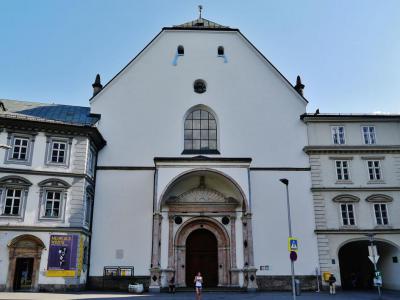
The Innsbruck building was named Court Church ("Hofkirche" in German). The Court Church is next to the Imperial Palace (Hofburg). The design of the church is by Andrea Crivelli of Trento. It follows the plan of a German "hall church."
It has three naves, both round and pointed arch windows, and a hip roof. There is a blend of Renaissance designs and German Gothic styles. The portal is Renaissance, carved by Hieronymus de Longhi and Anton de Bol.
Inside there are galleries and thin red marble colonettes with white capitals. The vault is in 17th-century Baroque style. The high altar, designed by court architect Nikolas Pacassi, dates from 1755. There are statues of Francis of Assisi and Teresa of Avila by Balthasar Moll and the world-famous Renaissance organ is by Jorg Ebert.
The Siver Chapel (a side chapel) has an altar to Mary made from silver, three elephant tusks, and 300 kilos of ebony. The chapel holds the tombs of Ferdinand II and his spouse, Philippine Welser.
In the center of the nave is the black marble Mannerist cenotaph of Emperor Maximilion. It was completed in 1572. The final touches of the kneeling Maximilion, the four virtues, and the iron grille were done by 1584.
Twenty-four bas-reliefs depict the events of Maximilion's life. There are 28 bronze statues of Habsburg emperors and ancestors. Andreas Hofer, the national hero of Tyrol, is also buried in the church.
There was a catch. There wasn't enough room in the Saint George castle chapel for Maximilion and the tomb. Something had to give. No problem. Ferdinand built a monastery and tomb in Innsbruck, over 300 miles away. Maximilion stayed in Vienna.
The Innsbruck building was named Court Church ("Hofkirche" in German). The Court Church is next to the Imperial Palace (Hofburg). The design of the church is by Andrea Crivelli of Trento. It follows the plan of a German "hall church."
It has three naves, both round and pointed arch windows, and a hip roof. There is a blend of Renaissance designs and German Gothic styles. The portal is Renaissance, carved by Hieronymus de Longhi and Anton de Bol.
Inside there are galleries and thin red marble colonettes with white capitals. The vault is in 17th-century Baroque style. The high altar, designed by court architect Nikolas Pacassi, dates from 1755. There are statues of Francis of Assisi and Teresa of Avila by Balthasar Moll and the world-famous Renaissance organ is by Jorg Ebert.
The Siver Chapel (a side chapel) has an altar to Mary made from silver, three elephant tusks, and 300 kilos of ebony. The chapel holds the tombs of Ferdinand II and his spouse, Philippine Welser.
In the center of the nave is the black marble Mannerist cenotaph of Emperor Maximilion. It was completed in 1572. The final touches of the kneeling Maximilion, the four virtues, and the iron grille were done by 1584.
Twenty-four bas-reliefs depict the events of Maximilion's life. There are 28 bronze statues of Habsburg emperors and ancestors. Andreas Hofer, the national hero of Tyrol, is also buried in the church.
10) Dom zu St. Jakob (St. Jakob Cathedral) (must see)
In 1180 a document mentioned a church attached to Wilten Abbey. It was repeatedly wracked by earthquakes and damaged by fires in the 13th and 14th centuries. In 1650 it was decided to demolish the church and build a new one.
In 1716 architect Johann Jacob Herkomer was selected for the job. The new church was inaugurated in 1724. Parishoners, nobility and the Empress donated generously toward its completion.
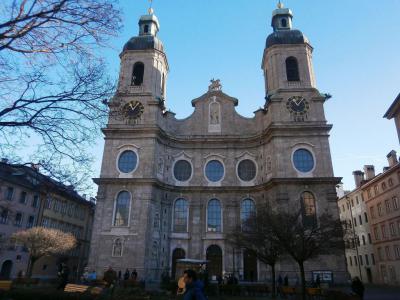
The Cathedral has two bell towers and a formidable onion shaped copper dome. The facade is made of limestone and marble. Niches with rounded arches in the concave facade hold limestone statues of Tyrolean saints. Hans Andre created the statues between 1941 and 1960. The Virgin in the facade gable and the mounted Saint James are also his.
The structure plan is cruciform. There are two towers, a double-bayed nave, a semicircular transept and a straight choir. The nave and the transept are covered by domes ornately decorated with frescoes. The over-all ambience is Renaissance.
Massive weighty columns support high rounded arches, creating a triumphal frame for the high altar. The altar and choir are illuminated by a high dome. The ceiling consists of false saucer domes of wood with concave moldings.
The marble high altar contains the Cathedral's treasure of treasures: the 1530 painting Maria Hilf (Mary of succor) by Lucas Cranach the Elder. The Cathedral also holds the canopied tomb of Archduke Maximilion III.
In 1716 architect Johann Jacob Herkomer was selected for the job. The new church was inaugurated in 1724. Parishoners, nobility and the Empress donated generously toward its completion.
The Cathedral has two bell towers and a formidable onion shaped copper dome. The facade is made of limestone and marble. Niches with rounded arches in the concave facade hold limestone statues of Tyrolean saints. Hans Andre created the statues between 1941 and 1960. The Virgin in the facade gable and the mounted Saint James are also his.
The structure plan is cruciform. There are two towers, a double-bayed nave, a semicircular transept and a straight choir. The nave and the transept are covered by domes ornately decorated with frescoes. The over-all ambience is Renaissance.
Massive weighty columns support high rounded arches, creating a triumphal frame for the high altar. The altar and choir are illuminated by a high dome. The ceiling consists of false saucer domes of wood with concave moldings.
The marble high altar contains the Cathedral's treasure of treasures: the 1530 painting Maria Hilf (Mary of succor) by Lucas Cranach the Elder. The Cathedral also holds the canopied tomb of Archduke Maximilion III.
11) Goldenes Dachl (The Golden Roof) (must see)
There were rumors around 1500 that Emperor Maximilion I was in financial difficulties. Ostensibly he had the Goldenes Roof built to commemorate his marriage to Bianca Maria Sforza of Milan. But perhaps he also wanted to quash the rumors he was broke.
His first wife, Mary of Burgundy died in 1482. His second marriage to Anne of Brittany was annulled in 1492. Bianca was the third to take the plunge with the Emperor. If a rumor started that she had money that wouldn't hurt anything.
The building of the Golden Roof was actually constructed by Archduke Friedrich IV in the early 1400s to be a residence for the rulers of Tyrol. When Maximilion moved in he commissioned the loggia on the facade from Nikolas Turing the Elder in 1493. Nikolas was the court builder. He designed the golden roof.
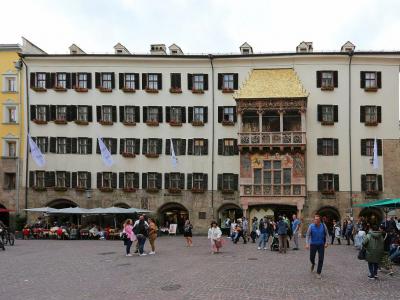
It wasn't gold, actually. It was made of 2,657 fire-gilded copper tiles. Near as good as gold for appearances. The front of the building became a double-decker oriel with two balustrades. The upper balcony served as a royal box. From there the emperor and his wife could enjoy festivals and tournaments in the square below.
The balustrade on the upper level has eight reliefs. Six face the square and two facing the sides. One of two reliefs in the center show Maximilion with wife number one and his current spouse, Bianca, who is on the left holding an apple. Maria of burgundy is on the right. The second relief shows the emperor with his jester and chancellor.
The flanking reliefs show Moorish dancers. Frescoes in the interior of the loggia were painted by Jorg Kolderer. They are of scenes of aristocratic life. Today all these decorations are copied. The originals are in the Tyrolean State Museum.
The Golden Roof is currently the home of the International Alpine Convention office and The Maximilianum, a museum showing the life of the emperor. There is a special exhibition called "What remains?" ("Was bliebt?" in German). There is a stair lift providing accessibility for everyone.
His first wife, Mary of Burgundy died in 1482. His second marriage to Anne of Brittany was annulled in 1492. Bianca was the third to take the plunge with the Emperor. If a rumor started that she had money that wouldn't hurt anything.
The building of the Golden Roof was actually constructed by Archduke Friedrich IV in the early 1400s to be a residence for the rulers of Tyrol. When Maximilion moved in he commissioned the loggia on the facade from Nikolas Turing the Elder in 1493. Nikolas was the court builder. He designed the golden roof.
It wasn't gold, actually. It was made of 2,657 fire-gilded copper tiles. Near as good as gold for appearances. The front of the building became a double-decker oriel with two balustrades. The upper balcony served as a royal box. From there the emperor and his wife could enjoy festivals and tournaments in the square below.
The balustrade on the upper level has eight reliefs. Six face the square and two facing the sides. One of two reliefs in the center show Maximilion with wife number one and his current spouse, Bianca, who is on the left holding an apple. Maria of burgundy is on the right. The second relief shows the emperor with his jester and chancellor.
The flanking reliefs show Moorish dancers. Frescoes in the interior of the loggia were painted by Jorg Kolderer. They are of scenes of aristocratic life. Today all these decorations are copied. The originals are in the Tyrolean State Museum.
The Golden Roof is currently the home of the International Alpine Convention office and The Maximilianum, a museum showing the life of the emperor. There is a special exhibition called "What remains?" ("Was bliebt?" in German). There is a stair lift providing accessibility for everyone.
12) Stadtturm (Town Tower) (must see)
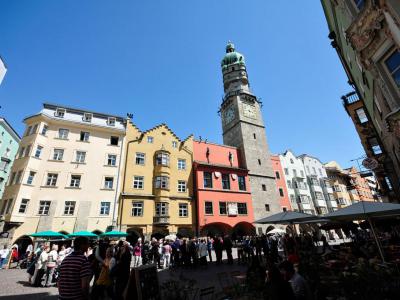
For nearly 450 years the Town Tower (Stadturm) has watched over the city of Innsbruck. It is 166 feet high. It affords an incomparable view of the town. The observation deck is lower (98 feet) but the view is still great. The Town Tower was meant to serve as a watch tower for the Old Town Hall. There were guards who were paid to sit and watch all day.
The earliest date available for the building is 1444. Master builder Caspar Schab rebuilt the roof using onion shaped domes in 1560. Four wrought iron gargoyles and the first tower clock built by Erasmus Melchior were installed in 1603. Guards were trained to warn of any danger to the town. The guards were called Turners.
The main challenge at the tower is to climb it. It is 131 steps to reach the 98 foot high observation deck. The stairs are narrow but they are made in the form of a DNA double helix. The result is there are separate one-way stairs to go up or down. The wooden walkway of the deck is narrow. It can support only a limited amount of people at a time.
On the way up, on the first floor, there is a statue of Archduke Sigismund des Munzreichen. He was a count of Tyrol and the predecessor to Maximilion. Also on the first floor is the clock of the tower manufactured by Johann Mannchardi of Munich in 1878.
The earliest date available for the building is 1444. Master builder Caspar Schab rebuilt the roof using onion shaped domes in 1560. Four wrought iron gargoyles and the first tower clock built by Erasmus Melchior were installed in 1603. Guards were trained to warn of any danger to the town. The guards were called Turners.
The main challenge at the tower is to climb it. It is 131 steps to reach the 98 foot high observation deck. The stairs are narrow but they are made in the form of a DNA double helix. The result is there are separate one-way stairs to go up or down. The wooden walkway of the deck is narrow. It can support only a limited amount of people at a time.
On the way up, on the first floor, there is a statue of Archduke Sigismund des Munzreichen. He was a count of Tyrol and the predecessor to Maximilion. Also on the first floor is the clock of the tower manufactured by Johann Mannchardi of Munich in 1878.
13) Maria-Theresien Strasse (Maria Theresia Street) (must see)
Austrians think of Maria-Theresien-Strasse as a shopping destination nonpareil. That's saying a lot for one shopping street in a country full of great places to shop.
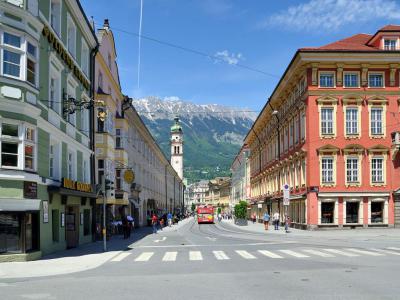
It is about 500 yards in length. The northern point is the intersection of Burggraben and Markgrabben. The south end is marked by the Truimphpforte, the Triumphal Arch of Maria Theresia. The street is a graceful curving promenade with inviting benches and ornate streetlamps of wood and brass.
The street is pedestrianized. The atmosphere is festive. If one walks north on the street there are dramatic mountain views looming over the town. In its early days, the street was a housing magnet for the wealthy and the nobility. They built homes and palaces; imposing Rococo, Baroque and Renaissance buildings.
Saint Anne's Column was erected in 1706 to commemorate the defeat of Bavarian invaders of 1703. The Virgin Mary stands on a crescent moon atop a tall, slender Corinthian column of red marble. Statues of saints Cassianus, Virgilius, George and Anne are at the base.
New age malls on the street area Kaufhaus Tyrol, voted Europe's best-looking shopping mall. The mall is home to nearly 50 shops. RathausGalerien is a modern glass-roofed building with 24 high profile brands and six restaurants.
The best time on Maria-Theresien Strasse is the annual Christmas Market from November to January. It is a festival of glass, crystals and light, creating a land of dreams.
It is about 500 yards in length. The northern point is the intersection of Burggraben and Markgrabben. The south end is marked by the Truimphpforte, the Triumphal Arch of Maria Theresia. The street is a graceful curving promenade with inviting benches and ornate streetlamps of wood and brass.
The street is pedestrianized. The atmosphere is festive. If one walks north on the street there are dramatic mountain views looming over the town. In its early days, the street was a housing magnet for the wealthy and the nobility. They built homes and palaces; imposing Rococo, Baroque and Renaissance buildings.
Saint Anne's Column was erected in 1706 to commemorate the defeat of Bavarian invaders of 1703. The Virgin Mary stands on a crescent moon atop a tall, slender Corinthian column of red marble. Statues of saints Cassianus, Virgilius, George and Anne are at the base.
New age malls on the street area Kaufhaus Tyrol, voted Europe's best-looking shopping mall. The mall is home to nearly 50 shops. RathausGalerien is a modern glass-roofed building with 24 high profile brands and six restaurants.
The best time on Maria-Theresien Strasse is the annual Christmas Market from November to January. It is a festival of glass, crystals and light, creating a land of dreams.
14) Tiroler Heimatwerk
Located in the heart of Innsbruck, Tiroler Heimatwerk is a tribute to the cultural legacy and age-old customs of the Tyrolean people. Established in 1934 under the name "Tiroler Hausindustrie," this revered institution has been instrumental in preserving and honoring the local traditions, crafts, and trades of Tyrol. Initially conceived by former students of the Imst Agricultural School, the Heimatwerk aimed to assist struggling mountain farmers by providing part-time work opportunities while safeguarding local craftsmanship.
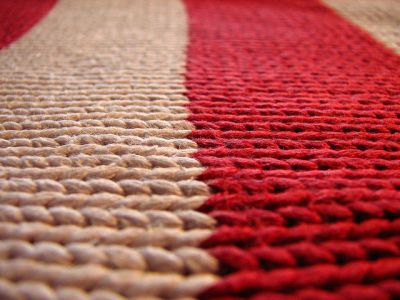
Despite facing disruptions during World War II, Tiroler Heimatwerk has consistently exhibited top-notch Tyrolean products, earning recognition at international expos. Its growth, including the acquisition of a wool spinning mill, has reinforced its dedication to tradition, quality, and supporting local artisans. Today, the Heimatwerk is celebrated for collaborating with knitters from the Paznaun Valley, producing highly coveted woolen goods that embody Tyrolean artistry.
Offering a wide range of folklore items such as accessories, traditional clothing, textiles, ceramics, furniture, and elaborately carved wooden chests, Tiroler Heimatwerk not only honors Tyrolean cultural values but also captivates both locals and tourists, seamlessly blending tradition with modernity.
Set in a beautifully adapted historic building, the modern and well-lit rooms of Tiroler Heimatwerk provide a clear display of merchandise, welcoming customers with an inviting ambiance. The Heimatwerk's dedication to quality and tradition is evident in its selection of goods from renowned regional and Alpine producers and craftsmen. This commitment extends to fostering sustainable relationships with customers and suppliers, reflecting a community-oriented approach that has defined Tiroler Heimatwerk for over 85 years.
Despite facing disruptions during World War II, Tiroler Heimatwerk has consistently exhibited top-notch Tyrolean products, earning recognition at international expos. Its growth, including the acquisition of a wool spinning mill, has reinforced its dedication to tradition, quality, and supporting local artisans. Today, the Heimatwerk is celebrated for collaborating with knitters from the Paznaun Valley, producing highly coveted woolen goods that embody Tyrolean artistry.
Offering a wide range of folklore items such as accessories, traditional clothing, textiles, ceramics, furniture, and elaborately carved wooden chests, Tiroler Heimatwerk not only honors Tyrolean cultural values but also captivates both locals and tourists, seamlessly blending tradition with modernity.
Set in a beautifully adapted historic building, the modern and well-lit rooms of Tiroler Heimatwerk provide a clear display of merchandise, welcoming customers with an inviting ambiance. The Heimatwerk's dedication to quality and tradition is evident in its selection of goods from renowned regional and Alpine producers and craftsmen. This commitment extends to fostering sustainable relationships with customers and suppliers, reflecting a community-oriented approach that has defined Tiroler Heimatwerk for over 85 years.
