Custom Walk in Genoa, Italy by ronaldfdewar6322 created on 2026-02-24
Guide Location: Italy » Genoa
Guide Type: Custom Walk
# of Sights: 11
Tour Duration: 2 Hour(s)
Travel Distance: 4.1 Km or 2.5 Miles
Share Key: EYH77
Guide Type: Custom Walk
# of Sights: 11
Tour Duration: 2 Hour(s)
Travel Distance: 4.1 Km or 2.5 Miles
Share Key: EYH77
How It Works
Please retrieve this walk in the GPSmyCity app. Once done, the app will guide you from one tour stop to the next as if you had a personal tour guide. If you created the walk on this website or come to the page via a link, please follow the instructions below to retrieve the walk in the app.
Retrieve This Walk in App
Step 1. Download the app "GPSmyCity: Walks in 1K+ Cities" on Apple App Store or Google Play Store.



Step 2. In the GPSmyCity app, download(or launch) the guide "Genoa Map and Walking Tours".
Step 3. Tap the menu button located at upper right corner of the "Walks" screen and select "Retrieve custom walk". Enter the share key: EYH77
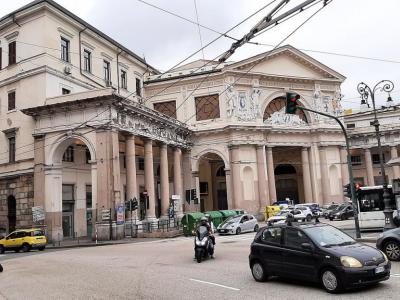
1) Genova Piazza Principe railway station
Genova Piazza Principe Railway Station, one of Genoa's busiest transport hubs, opened its doors in 1860, the year prior to Italy's. Although named after Piazza del Principe, the station's main entrance is located on the nearby Piazza Acquaverde. The station's neoclassical facade, adorned on the upper levels with statues and a large clock under an arch, lends it the distinction of an architectural landmark rather than merely a transit hub.
The station serves as a major gateway to both regional and high-speed train connections, facilitating travel to destinations across Italy and beyond, including the French Riviera and Eastern Europe. Inside, the ground level houses modern amenities, including ticket offices, waiting areas, shops, and dining options, while access to platforms is located underground and the upper floors are dedicated to office spaces. Piazza Acquaverde is just a short walk from Genoa's waterfront, perfect for those beginning or ending a cruise in the city.
The station serves as a major gateway to both regional and high-speed train connections, facilitating travel to destinations across Italy and beyond, including the French Riviera and Eastern Europe. Inside, the ground level houses modern amenities, including ticket offices, waiting areas, shops, and dining options, while access to platforms is located underground and the upper floors are dedicated to office spaces. Piazza Acquaverde is just a short walk from Genoa's waterfront, perfect for those beginning or ending a cruise in the city.
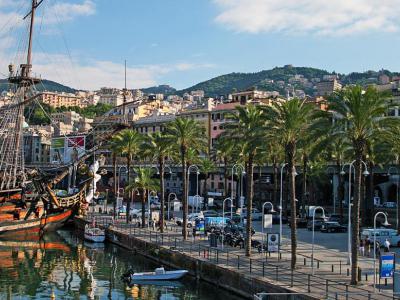
2) Porto Antico di Genova (Genoa Old Port) (must see)
Genoa’s Old Port is where the city casually reminds you that it once ruled the waves-and then invites you to hang around and enjoy the view. This is Genoa’s maritime past brought back to life with a distinctly modern attitude. In the harbor, old-style galleons share space with polished yachts and towering cruise ships, all floating together like different centuries decided to meet for an aperitivo.
There’s plenty to keep you busy without ever leaving the waterfront. You’ll find restaurants, museums, an aquarium, an auditorium, and even a botanical garden sealed inside a glass bubble. And yes, there’s also a giant octopus-shaped crane, which politely lifts visitors into the air for a better look-because in Genoa, even heavy machinery appears to enjoy a bit of showmanship. The Old Port works just as well for a slow sunset walk as it does for a late-evening stroll, when the lights reflect off the water, and the city feels momentarily hushed.
This transformation didn’t happen by accident. The redesign followed the vision of Renzo Piano, a world-renowned architect, who happens to be a Genoa native. He aimed to turn a neglected industrial harbor into a cultural and social hub-less rust and warehouses, more people, views, and public space. The result is a port that feels open and inviting, without pretending it ever stopped being a working harbor.
The official comeback moment came in 1992, during the International Exhibition known as Genoa ’92 – Colombo ’92. Held from May to August, the event marked 500 years since Christopher Columbus’s first voyage to the Americas and served as the grand debut of the restored Old Port. Its theme-“Christopher Columbus, the Ship, and the Sea”-could hardly have been more fitting. Since then, the Old Port has remained one of the clearest places to see how Genoa connects its past to the present, without losing its sea legs along the way.
There’s plenty to keep you busy without ever leaving the waterfront. You’ll find restaurants, museums, an aquarium, an auditorium, and even a botanical garden sealed inside a glass bubble. And yes, there’s also a giant octopus-shaped crane, which politely lifts visitors into the air for a better look-because in Genoa, even heavy machinery appears to enjoy a bit of showmanship. The Old Port works just as well for a slow sunset walk as it does for a late-evening stroll, when the lights reflect off the water, and the city feels momentarily hushed.
This transformation didn’t happen by accident. The redesign followed the vision of Renzo Piano, a world-renowned architect, who happens to be a Genoa native. He aimed to turn a neglected industrial harbor into a cultural and social hub-less rust and warehouses, more people, views, and public space. The result is a port that feels open and inviting, without pretending it ever stopped being a working harbor.
The official comeback moment came in 1992, during the International Exhibition known as Genoa ’92 – Colombo ’92. Held from May to August, the event marked 500 years since Christopher Columbus’s first voyage to the Americas and served as the grand debut of the restored Old Port. Its theme-“Christopher Columbus, the Ship, and the Sea”-could hardly have been more fitting. Since then, the Old Port has remained one of the clearest places to see how Genoa connects its past to the present, without losing its sea legs along the way.
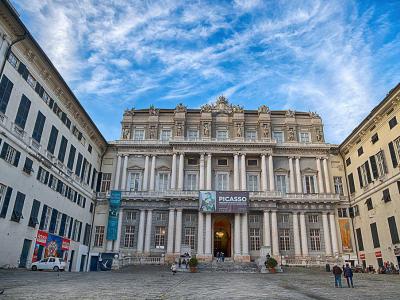
3) Genova Palazzo Ducale Fondazione per la Cultura (Doge's Palace Foundation for Culture)
The Doge's Palace is a majestic emblem of the city’s former maritime grandeur. Originally constructed at the close of the 13th century and officially serving as the residence of the Doges in 1339, its complex architecture blends Gothic foundations with Renaissance elegance and a Neoclassical façade designed by Simone Cantoni following a devastating fire in 1777. The building’s layered history is evident in its towers, loggias, internal courtyards, and the renowned “Grimaldina” prison tower.
Since its restoration in the early 1990s, revived for the 500th anniversary of Columbus, Doge's Palace has been reborn as Genoa’s premier cultural hub. Managed by the Palace Foundation for Culture since 2008, it tirelessly promotes local heritage through art exhibitions, concerts, theater, festivals, film, and debate series. The foundation’s mission extends beyond programming; it also fosters community growth and intercultural dialogue by collaborating with public institutions, educational bodies, and international partners.
Doge's Palace offers an ever-changing wealth of cultural experiences-from blockbuster art shows like “Five Minutes with Monet” to jazz nights, poetry readings, photography exhibitions, and even robotics showcases-making it the only Genoese venue where such diverse creative expressions coexist under one roof.
Since its restoration in the early 1990s, revived for the 500th anniversary of Columbus, Doge's Palace has been reborn as Genoa’s premier cultural hub. Managed by the Palace Foundation for Culture since 2008, it tirelessly promotes local heritage through art exhibitions, concerts, theater, festivals, film, and debate series. The foundation’s mission extends beyond programming; it also fosters community growth and intercultural dialogue by collaborating with public institutions, educational bodies, and international partners.
Doge's Palace offers an ever-changing wealth of cultural experiences-from blockbuster art shows like “Five Minutes with Monet” to jazz nights, poetry readings, photography exhibitions, and even robotics showcases-making it the only Genoese venue where such diverse creative expressions coexist under one roof.
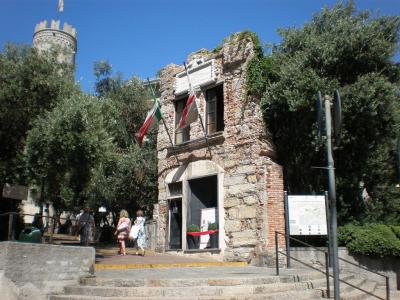
4) Casa della Famiglia Colombo (Columbus' House)
Just outside the old city walls near Porta Soprana and the cloister of Sant’Andrea, Columbus’ House stands on the site where the explorer is believed to have spent part of his childhood. The current two-story building is an 18th-century reconstruction, raised on the remains of a medieval home damaged in the 1684 bombardment of Genoa. Historical documents trace the Colombo family here between 1455 and 1470, with young Christopher living in the house from the age of four. The ground floor once housed a wool workshop run by his father, Domenico, featuring a kitchen space, a basin for water collection, and a basic latrine.
A wooden truss ceiling separates the lower level from the family quarters above, where two small rooms served for daily living. Though the house may have once risen to three stories, later additions were removed in the early 1900s during urban redevelopment, preserving the structure at its current height. A plaque on the front affirms the home’s significance as a place of origin. Since 1887, when the Municipality of Genoa acquired the site, Columbus’ House has functioned as a compact museum.
A wooden truss ceiling separates the lower level from the family quarters above, where two small rooms served for daily living. Though the house may have once risen to three stories, later additions were removed in the early 1900s during urban redevelopment, preserving the structure at its current height. A plaque on the front affirms the home’s significance as a place of origin. Since 1887, when the Municipality of Genoa acquired the site, Columbus’ House has functioned as a compact museum.

5) Piazza De Ferrari (Ferrari Square) (must see)
This place's story starts with the man whose name ended up on Genoa’s biggest calling card, Raffaele Luigi De Ferrari. He wasn’t just wealthy-he was spectacularly so. Prince of Lucedio, Duke of Galliera, senator of the Kingdom of Sardinia, Grand Officer of the Order of Italy… and that’s just the short list of his titles. In 1837, De Ferrari even managed to acquire properties once handed out by Napoleon I, via Prince Oscar of Sweden. Indeed, when your résumé reads like that, having the main square of Genoa named after you feels less like flattery and more like inevitability.
Ferrari Square itself is anything but modest. Spreading across roughly 120,000 square feet, it works as Genoa’s grand urban stage. At its center sits a massive bronze fountain completed in 1936, designed by Giuseppe Crosa di Vergagni-a piece that manages to be both monumental and unapologetically dramatic, very much in keeping with the square’s personality...
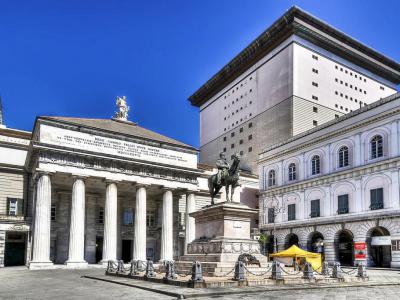
This space, however, didn’t always look the way it does now. In 1814, the Church of San Domenico was demolished to make room for the Carlo Felice Theater, designed by Carlo Barabino and completed in 1827. A few years later, in 1831, a two-story Linguistic Academy appeared nearby. The square officially became Ferrari Square in 1877-one year after De Ferrari’s death-because timing, apparently, matters even in commemoration. By 1893, Giuseppe Garibaldi, a hero of the Italian revolution, appeared here on horseback in bronze form in front of the theater.
As the late 19th and early 20th centuries rolled in, the square filled out with confident, eclectic architecture. The New Bourse Palace opened in 1912, followed by the Italian Credit Palace in 1914, and the Liguria Region Palace in 1923-each one keen to make its presence felt.
And then there are the veterans. The Doge's Palace, dating back to the 13th century and restored in 1992, now serves as a museum and cultural hub. Nearby stand the Giulio Pallavicini Palace from 1586 and the Agostino Spinola Palace, built in the 18th century and now home to a bank. Together, they turn Ferrari Square into a crash course in Genoa’s favorite subject: power, displayed loudly and over several centuries.
Ferrari Square itself is anything but modest. Spreading across roughly 120,000 square feet, it works as Genoa’s grand urban stage. At its center sits a massive bronze fountain completed in 1936, designed by Giuseppe Crosa di Vergagni-a piece that manages to be both monumental and unapologetically dramatic, very much in keeping with the square’s personality...
This space, however, didn’t always look the way it does now. In 1814, the Church of San Domenico was demolished to make room for the Carlo Felice Theater, designed by Carlo Barabino and completed in 1827. A few years later, in 1831, a two-story Linguistic Academy appeared nearby. The square officially became Ferrari Square in 1877-one year after De Ferrari’s death-because timing, apparently, matters even in commemoration. By 1893, Giuseppe Garibaldi, a hero of the Italian revolution, appeared here on horseback in bronze form in front of the theater.
As the late 19th and early 20th centuries rolled in, the square filled out with confident, eclectic architecture. The New Bourse Palace opened in 1912, followed by the Italian Credit Palace in 1914, and the Liguria Region Palace in 1923-each one keen to make its presence felt.
And then there are the veterans. The Doge's Palace, dating back to the 13th century and restored in 1992, now serves as a museum and cultural hub. Nearby stand the Giulio Pallavicini Palace from 1586 and the Agostino Spinola Palace, built in the 18th century and now home to a bank. Together, they turn Ferrari Square into a crash course in Genoa’s favorite subject: power, displayed loudly and over several centuries.
6) Teatro Carlo Felice (Carlo Felice Theatre)
The Carlo Felice Theatre is Genoa’s grand opera house, originally designed by Carlo Barabino and inaugurated in 1828 with Bellini’s Bianca and Fernando, it was named in honor of King Carlo Felice of Sardinia. Featuring a majestic neoclassical pronaos-the only part of the original building to survive World War II-the theater has been reborn as a symbol of cultural resilience.
Though the bombings of World War II devastated most of the structure, the façade remained intact and sparked an ambitious post-war reconstruction. Between 1987 and 1991, a team led by Pritzker-prize–winner Aldo Rossi, alongside Ignazio Gardella and others, rebuilt the interior with modern stage machinery and auditorium design, while preserving Barabino’s classic exterior.
Today, the Carlo Felice is the cultural heart of Genoa’s musical life, hosting opera, ballet, orchestral concerts, recitals, and special events. The theater boasts a main hall seating around 2,000 and a smaller auditorium for 200, both equipped with state-of-the-art staging systems and acoustics praised since the 19th century. Among the treasures in the foyer are modern frescoes by Aurelio Caminati and tapestries by Raimondo Sirotti, which sit alongside a historic statue of San Domenico-a testament to the theater’s layered aesthetic.
Though the bombings of World War II devastated most of the structure, the façade remained intact and sparked an ambitious post-war reconstruction. Between 1987 and 1991, a team led by Pritzker-prize–winner Aldo Rossi, alongside Ignazio Gardella and others, rebuilt the interior with modern stage machinery and auditorium design, while preserving Barabino’s classic exterior.
Today, the Carlo Felice is the cultural heart of Genoa’s musical life, hosting opera, ballet, orchestral concerts, recitals, and special events. The theater boasts a main hall seating around 2,000 and a smaller auditorium for 200, both equipped with state-of-the-art staging systems and acoustics praised since the 19th century. Among the treasures in the foyer are modern frescoes by Aurelio Caminati and tapestries by Raimondo Sirotti, which sit alongside a historic statue of San Domenico-a testament to the theater’s layered aesthetic.

7) Via Giuseppe Garibaldi (Giuseppe Garibaldi Street) (must see)
Giuseppe Garibaldi Street is where Genoa is showing off-and doing it with historical justification. This was one of the famous “New Streets,” laid out in 1583 when Genoese aristocrats decided their medieval lanes no longer matched their wealth.
At first, it went by practical names like Strada Maggiore (or Major Street) and Strada Nuova (New Street) before confidence kicked in, and it earned the nickname Strada Aurea, the Golden Street. Only in 1882 did it take on the name Giuseppe Garibaldi in honor of the general and revolutionary who greatly contributed to the Unification of Italy. The street's measurements were precise, but the ambition was anything but modest: just under a 1,000 feet long, relatively narrow, and packed edge to edge with palaces.
By the late 16th and 17th centuries, Genoa had enough money to burn and no interest in hiding it. The city’s oligarchs pushed north, reshaping the urban map and imagining a city of grand palaces and elegant villas beyond the old medieval core. This street became their architectural calling card-a place where wealth, taste, and rivalry all competed for attention, façade by façade.
Names changed as fortunes rose, but the message stayed the same. Today, Garibaldi Street anchors the New Streets Museum complex, linking three high-end properties: the Doria Tursi Palace, now Genoa’s City Hall; the White Palace, home to major art collections; and the former Podestà’s Palace. Together, they read like a résumé written in stone.
Back in the days of the Republic, these palaces served a very practical purpose. Genoa kept official Rolli lists-ranked registers of noble homes approved to host visiting kings, princes, diplomats, and church authorities. The higher the guest, the grander the palace. Hospitality here was a civic duty, but also a competitive sport.
Today, you can time your visit with Rolli Days, held each spring and autumn, when normally closed palaces open their doors to the public. And if you’re wondering whether all this repetition ever becomes too much, Charles Dickens had an answer. Writing in Pictures from Italy, he confessed he couldn’t forget these “streets of palaces,” where one grand building follows another, again and again. Genoa, it seems, has always liked to leave a strong impression-and then add one more...
At first, it went by practical names like Strada Maggiore (or Major Street) and Strada Nuova (New Street) before confidence kicked in, and it earned the nickname Strada Aurea, the Golden Street. Only in 1882 did it take on the name Giuseppe Garibaldi in honor of the general and revolutionary who greatly contributed to the Unification of Italy. The street's measurements were precise, but the ambition was anything but modest: just under a 1,000 feet long, relatively narrow, and packed edge to edge with palaces.
By the late 16th and 17th centuries, Genoa had enough money to burn and no interest in hiding it. The city’s oligarchs pushed north, reshaping the urban map and imagining a city of grand palaces and elegant villas beyond the old medieval core. This street became their architectural calling card-a place where wealth, taste, and rivalry all competed for attention, façade by façade.
Names changed as fortunes rose, but the message stayed the same. Today, Garibaldi Street anchors the New Streets Museum complex, linking three high-end properties: the Doria Tursi Palace, now Genoa’s City Hall; the White Palace, home to major art collections; and the former Podestà’s Palace. Together, they read like a résumé written in stone.
Back in the days of the Republic, these palaces served a very practical purpose. Genoa kept official Rolli lists-ranked registers of noble homes approved to host visiting kings, princes, diplomats, and church authorities. The higher the guest, the grander the palace. Hospitality here was a civic duty, but also a competitive sport.
Today, you can time your visit with Rolli Days, held each spring and autumn, when normally closed palaces open their doors to the public. And if you’re wondering whether all this repetition ever becomes too much, Charles Dickens had an answer. Writing in Pictures from Italy, he confessed he couldn’t forget these “streets of palaces,” where one grand building follows another, again and again. Genoa, it seems, has always liked to leave a strong impression-and then add one more...

8) Palazzo Bianco (White Palace)
Sitting on Giuseppe Garibaldi Street, right in the heart of the UNESCO-listed New Streets, the White Palace is refreshingly honest about its branding. It’s called “white” because the façade is, well… white. No metaphor, no symbolism-just good, pale stone.
The palace went up between 1530 and 1540 for Luca Grimaldi, a man who managed to be a troubadour, politician, and diplomat all at once-clearly someone who didn’t believe in choosing just one career path. The Grimaldis were one of Genoa’s prominent families, but the building didn’t stay put for long. By 1658, it had passed to the De Franchi Toso family, and in 1711, it changed hands again, this time as payment for a debt. In Genoa, even palaces sometimes settle accounts...
When the Durazzo family took over, they didn’t do things halfway. Between 1714 and 1716, they gave the palace a major makeover, and this is when the name “White Palace” truly stuck, reflecting the elegant, unified look we see today.
Fast-forward to the late 19th century, and the story takes a generous turn. Maria Brignole-Sale, the last of the Durazzos, handed the palace over to the city. Her idea was simple and forward-thinking: turn private luxury into a public art gallery. She even began expanding the collection herself, officially dedicating the gallery in 1884.
An easy walk from the historic center, this palace is, indeed, an even easier place to lose track of time once you’re inside it. Here, you get a crash course in elite taste.
Donna Maria had a clear soft spot for Spanish and Flemish painters, and it shows. Works by Van Dyck, Rubens, Filippino Lippi, Veronese, and Caravaggio line the walls, but the real standout here is Lucas Cranach the Elder’s Portrait of a Lady-a painting that tends to stop people mid-step. And just when you think you’ve seen it all, the upper floors switch gears with a surprisingly rich display of 19th- and 20th-century fashion.
So, prepare yourself to linger longer than you planned, quietly recalibrating what you thought you came to see.
The palace went up between 1530 and 1540 for Luca Grimaldi, a man who managed to be a troubadour, politician, and diplomat all at once-clearly someone who didn’t believe in choosing just one career path. The Grimaldis were one of Genoa’s prominent families, but the building didn’t stay put for long. By 1658, it had passed to the De Franchi Toso family, and in 1711, it changed hands again, this time as payment for a debt. In Genoa, even palaces sometimes settle accounts...
When the Durazzo family took over, they didn’t do things halfway. Between 1714 and 1716, they gave the palace a major makeover, and this is when the name “White Palace” truly stuck, reflecting the elegant, unified look we see today.
Fast-forward to the late 19th century, and the story takes a generous turn. Maria Brignole-Sale, the last of the Durazzos, handed the palace over to the city. Her idea was simple and forward-thinking: turn private luxury into a public art gallery. She even began expanding the collection herself, officially dedicating the gallery in 1884.
An easy walk from the historic center, this palace is, indeed, an even easier place to lose track of time once you’re inside it. Here, you get a crash course in elite taste.
Donna Maria had a clear soft spot for Spanish and Flemish painters, and it shows. Works by Van Dyck, Rubens, Filippino Lippi, Veronese, and Caravaggio line the walls, but the real standout here is Lucas Cranach the Elder’s Portrait of a Lady-a painting that tends to stop people mid-step. And just when you think you’ve seen it all, the upper floors switch gears with a surprisingly rich display of 19th- and 20th-century fashion.
So, prepare yourself to linger longer than you planned, quietly recalibrating what you thought you came to see.
9) Palazzo Gerolamo Grimaldi (Gerolamo Grimaldi Palace)
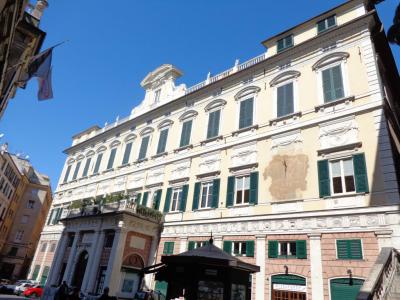
Gerolamo Grimaldi Palace, better known today as the Meridian Palace, is a Renaissance Genoa showing a bit of creative swagger. Constructed between 1536 and 1544 for the banker Gerolamo Grimaldi Oliva-who made his fortune managing tax collection in Spain and Portugal-this was never meant to be just another city palace.
Instead, it was designed as a clever cross between an urban residence and a suburban villa, taking full advantage of Genoa’s steep terrain. Architect Joseph Fürttenbach later admired its original layout, which featured gardens both above and below the building, with two façades playing off the dramatic slope.
Look to the north side, and you’ll spot one of the palace’s most eye-catching details: a bold fresco cycle of the Labours of Hercules, attributed to Aurelio Busso. These mythological heavy-lifting scenes still cling to the exterior, setting the tone before you even get inside.
Indoors, the decoration steps up another level. Between 1556 and 1566, Gerolamo’s son commissioned some of the most sought-after painters of the time-Luca Cambiaso, Giovanni Battista Castello, and Lazzaro Calvi-to cover the interiors with elaborate fresco cycles. The main salon steals the show, thanks to a dramatic perspective scene of Ulysses taking aim at the suitors, painted to impress and slightly intimidate.
The palace didn’t stay frozen in the 16th century. In the late 18th century, new urban development reshaped its southern façade along what was then the newly laid-out Newest Street, complete with a painted meridian sundial-the detail that eventually earned the palace its modern nickname. In the early 20th century, architect Gino Coppedè added further flair, redesigning the atrium with a stained-glass skylight and subtle Art Nouveau touches.
Today, as part of Genoa’s UNESCO-listed Rolli Palaces, the Meridian Palace offers richly frescoed rooms, theatrical staircases, and a slightly quieter atmosphere than the better-known stops on Via Garibaldi-a clear sign that some of Genoa’s best stories unfold just off the main stage.
Instead, it was designed as a clever cross between an urban residence and a suburban villa, taking full advantage of Genoa’s steep terrain. Architect Joseph Fürttenbach later admired its original layout, which featured gardens both above and below the building, with two façades playing off the dramatic slope.
Look to the north side, and you’ll spot one of the palace’s most eye-catching details: a bold fresco cycle of the Labours of Hercules, attributed to Aurelio Busso. These mythological heavy-lifting scenes still cling to the exterior, setting the tone before you even get inside.
Indoors, the decoration steps up another level. Between 1556 and 1566, Gerolamo’s son commissioned some of the most sought-after painters of the time-Luca Cambiaso, Giovanni Battista Castello, and Lazzaro Calvi-to cover the interiors with elaborate fresco cycles. The main salon steals the show, thanks to a dramatic perspective scene of Ulysses taking aim at the suitors, painted to impress and slightly intimidate.
The palace didn’t stay frozen in the 16th century. In the late 18th century, new urban development reshaped its southern façade along what was then the newly laid-out Newest Street, complete with a painted meridian sundial-the detail that eventually earned the palace its modern nickname. In the early 20th century, architect Gino Coppedè added further flair, redesigning the atrium with a stained-glass skylight and subtle Art Nouveau touches.
Today, as part of Genoa’s UNESCO-listed Rolli Palaces, the Meridian Palace offers richly frescoed rooms, theatrical staircases, and a slightly quieter atmosphere than the better-known stops on Via Garibaldi-a clear sign that some of Genoa’s best stories unfold just off the main stage.

10) Galleria Nazionale Di Palazzo Spinola (Palazzo Spinola National Gallery)
The Palazzo Spinola National Gallery occupies a magnificent late 16th-century palace originally commissioned by Francesco Grimaldi. Over the centuries, the palazzo passed through the hands of Genoa's elite families (Pallavicino, Doria, Spinola) and in 1958, it was donated to the Italian state, with the condition that its opulent interiors and collections remain preserved.
The museum spans two grand noble floors, showcasing frescoed ceilings, ornate furnishings, and rich decorative arts that highlight Genoa’s aristocratic lifestyle. The first floor emphasizes the earlier eras under Grimaldi and Pallavicino ownership, while the second floor displays lavish rococo enhancements from the 18th-century renovations by Maddalena Doria and the Spinola family. Visitors can walk through elegant salons-including the famed Hall of Mirrors-where marble floors, crystal chandeliers, and frescoed vaults create an immersive experience of Baroque grandeur.
The gallery’s art collection features works by major Italian, Flemish, and European masters. Highlights include Behold the Man by Antonello da Messina, Portrait of Ansaldo Pallavicino by Anthony van Dyck, as well as paintings by Peter Paul Rubens, Joos van Cleve, Luca Giordano, Guido Reni, and Bernard Strozzi. Complementing the paintings are precious silver items, oriental porcelain, and decorative furnishings that once belonged to the palace’s noble residents.
Beyond the palace ambiance, the third floor hosts the National Gallery of Liguria-a state-run museum displaying regional art from the Middle Ages through to the 20th century.
The museum spans two grand noble floors, showcasing frescoed ceilings, ornate furnishings, and rich decorative arts that highlight Genoa’s aristocratic lifestyle. The first floor emphasizes the earlier eras under Grimaldi and Pallavicino ownership, while the second floor displays lavish rococo enhancements from the 18th-century renovations by Maddalena Doria and the Spinola family. Visitors can walk through elegant salons-including the famed Hall of Mirrors-where marble floors, crystal chandeliers, and frescoed vaults create an immersive experience of Baroque grandeur.
The gallery’s art collection features works by major Italian, Flemish, and European masters. Highlights include Behold the Man by Antonello da Messina, Portrait of Ansaldo Pallavicino by Anthony van Dyck, as well as paintings by Peter Paul Rubens, Joos van Cleve, Luca Giordano, Guido Reni, and Bernard Strozzi. Complementing the paintings are precious silver items, oriental porcelain, and decorative furnishings that once belonged to the palace’s noble residents.
Beyond the palace ambiance, the third floor hosts the National Gallery of Liguria-a state-run museum displaying regional art from the Middle Ages through to the 20th century.
11) Basilica della Santissima Annunziata del Vastato (Basilica of the Most Holy Annunciation of Vastato)
The word "vastato” comes from the Latin vastinium, which sounds dramatic because it is. It meant a strip of land outside the city walls, deliberately cleared, so enemies had nowhere to hide. Not exactly prime real estate...
And yet, this is precisely where the Basilica of the Santissima Annunziata del Vastato decided to rise-outside the walls, on the former site of the Church of Santa Maria del Prato. The Franciscans got things started in 1520, then history did what it does best: interrupted everything. Work stalled in 1537 and only picked up again in 1591, when the wealthy Lomellini family took charge and hired architect Taddeo Carlone to move things along.
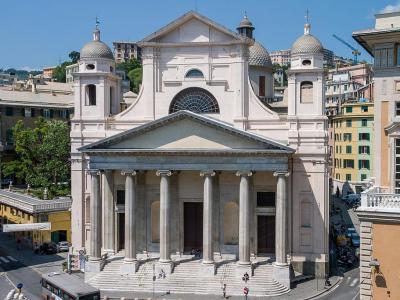
By the 17th century, restraint was firmly off the table. Painter Andrea Ansaldo oversaw a wave of full-blown Baroque decoration, turning the interior into something closer to a visual spectacle than a quiet church. Then, just to keep the timeline interesting, the 19th century added another layer. Between 1830 and 1840, architect Carlo Barabino designed the Neoclassical façade you see today-one more sign that this basilica never really stopped reinventing itself.
Now, take a look at the front. A classical portico stretches across the façade, topped with a triangular pediment and supported by six Ionic stone columns, plus two pilasters for good measure. Above the porch, two lunette windows stack neatly, the smaller perched above the larger, while twin bell towers frame the whole composition like architectural bookends.
Inside, the layout follows a Latin cross plan, with three naves lined by rows of lateral altars. Corinthian columns rise between the naves, linked by arches that guide your eye forward. And then the decoration hits.
Indeed, this is less a church interior and more a 17th-century art gallery in ecclesiastical form. Inlaid marble, gilded stucco, and frescoes cover nearly every surface, created by an impressive lineup of 23 local painters and 13 sculptors. Take your time here-this is one of those places where Genoa’s love of grandeur is not whispered, but confidently announced.
And yet, this is precisely where the Basilica of the Santissima Annunziata del Vastato decided to rise-outside the walls, on the former site of the Church of Santa Maria del Prato. The Franciscans got things started in 1520, then history did what it does best: interrupted everything. Work stalled in 1537 and only picked up again in 1591, when the wealthy Lomellini family took charge and hired architect Taddeo Carlone to move things along.
By the 17th century, restraint was firmly off the table. Painter Andrea Ansaldo oversaw a wave of full-blown Baroque decoration, turning the interior into something closer to a visual spectacle than a quiet church. Then, just to keep the timeline interesting, the 19th century added another layer. Between 1830 and 1840, architect Carlo Barabino designed the Neoclassical façade you see today-one more sign that this basilica never really stopped reinventing itself.
Now, take a look at the front. A classical portico stretches across the façade, topped with a triangular pediment and supported by six Ionic stone columns, plus two pilasters for good measure. Above the porch, two lunette windows stack neatly, the smaller perched above the larger, while twin bell towers frame the whole composition like architectural bookends.
Inside, the layout follows a Latin cross plan, with three naves lined by rows of lateral altars. Corinthian columns rise between the naves, linked by arches that guide your eye forward. And then the decoration hits.
Indeed, this is less a church interior and more a 17th-century art gallery in ecclesiastical form. Inlaid marble, gilded stucco, and frescoes cover nearly every surface, created by an impressive lineup of 23 local painters and 13 sculptors. Take your time here-this is one of those places where Genoa’s love of grandeur is not whispered, but confidently announced.
