Custom Walk in Florence, Italy by linda_orton79_e4972 created on 2026-03-17
Guide Location: Italy » Florence
Guide Type: Custom Walk
# of Sights: 10
Tour Duration: 2 Hour(s)
Travel Distance: 3.5 Km or 2.2 Miles
Share Key: DMRJ6
Guide Type: Custom Walk
# of Sights: 10
Tour Duration: 2 Hour(s)
Travel Distance: 3.5 Km or 2.2 Miles
Share Key: DMRJ6
How It Works
Please retrieve this walk in the GPSmyCity app. Once done, the app will guide you from one tour stop to the next as if you had a personal tour guide. If you created the walk on this website or come to the page via a link, please follow the instructions below to retrieve the walk in the app.
Retrieve This Walk in App
Step 1. Download the app "GPSmyCity: Walks in 1K+ Cities" on Apple App Store or Google Play Store.



Step 2. In the GPSmyCity app, download(or launch) the guide "Florence Map and Walking Tours".
Step 3. Tap the menu button located at upper right corner of the "Walks" screen and select "Retrieve custom walk". Enter the share key: DMRJ6
1) Mercato Centrale (Central Market) (must see)
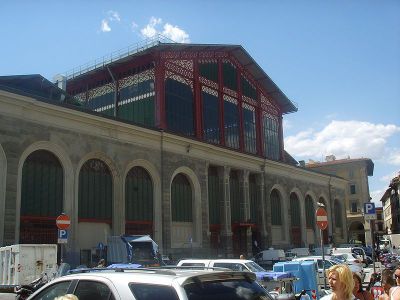
Florence's 19th-century Central Market, dating back to the 19th century, is divided into two distinct areas. The covered section is dedicated to all things food, while the outdoor area extends onto the surrounding streets, offering a variety of leather goods, clothing, and affordable souvenirs, including leather coats, jackets, and purses at great prices.
For those seeking Tuscan cuisine, the indoor area is the place to be. On the ground floor, you'll find a vibrant assortment of butchers, fishmongers, fruits, vegetables, and specialty shops. These specialty shops offer an array of local products such as olive oils, truffle honey, cured meats, cheeses, and sauces. Many of them even provide free samples, allowing visitors to taste before purchasing.
Upstairs, the food court awaits, featuring a host of delicious local culinary delights. Here, you not only have the opportunity to savor delicious food but also to observe the skilled artisans in action through glass windows. Watch as bread is freshly baked, bufala cheese is carefully crafted, and artisanal gelato is made from scratch. To fully enjoy your dining experience, it is recommended to visit outside of peak dining hours when the crowds are less overwhelming.
Some of the highlights include:
~ Il Pane e la Pasticceria: Witness the expertise of French baker and Bakery World Cup champion David Bedu as he creates a variety of bread, from baguettes to traditional loaves, and exquisite French pastries like choux and éclairs.
~ Martino Bellincampi's Shop: Indulge in buffalo mozzarella served in a classic Roman-style salad or enjoy the ultimate guilty pleasure of a Neapolitan "mozzarella in carrozza," a fried mozzarella sandwich.
~ ARÀ: Delight in Sicilian delicacies such as arancini (deep-fried rice balls with various fillings), cannoli, cassatini, and refreshing granita.
~ Il Tartufo: Experience the excellence of seasonal black & white truffles in dishes such as pasta, salads, sandwiches, spreads... even beer.
~ La Pizzeria: Savor Marco Fierro's perfectly crispy, fresh, wood oven-baked pizzas made with the finest Italian ingredients.
~ Pasta Fresca: Sample both classic and creative pasta dishes while attending cooking shows.
~ Il Vegeteriano e il Vegano: A haven for vegetarians and vegans, offering a wide selection of delectable options.
While the outdoor market closes in the afternoon, the food court stays open until midnight, offering an ideal spot for late-night cravings.
For those seeking Tuscan cuisine, the indoor area is the place to be. On the ground floor, you'll find a vibrant assortment of butchers, fishmongers, fruits, vegetables, and specialty shops. These specialty shops offer an array of local products such as olive oils, truffle honey, cured meats, cheeses, and sauces. Many of them even provide free samples, allowing visitors to taste before purchasing.
Upstairs, the food court awaits, featuring a host of delicious local culinary delights. Here, you not only have the opportunity to savor delicious food but also to observe the skilled artisans in action through glass windows. Watch as bread is freshly baked, bufala cheese is carefully crafted, and artisanal gelato is made from scratch. To fully enjoy your dining experience, it is recommended to visit outside of peak dining hours when the crowds are less overwhelming.
Some of the highlights include:
~ Il Pane e la Pasticceria: Witness the expertise of French baker and Bakery World Cup champion David Bedu as he creates a variety of bread, from baguettes to traditional loaves, and exquisite French pastries like choux and éclairs.
~ Martino Bellincampi's Shop: Indulge in buffalo mozzarella served in a classic Roman-style salad or enjoy the ultimate guilty pleasure of a Neapolitan "mozzarella in carrozza," a fried mozzarella sandwich.
~ ARÀ: Delight in Sicilian delicacies such as arancini (deep-fried rice balls with various fillings), cannoli, cassatini, and refreshing granita.
~ Il Tartufo: Experience the excellence of seasonal black & white truffles in dishes such as pasta, salads, sandwiches, spreads... even beer.
~ La Pizzeria: Savor Marco Fierro's perfectly crispy, fresh, wood oven-baked pizzas made with the finest Italian ingredients.
~ Pasta Fresca: Sample both classic and creative pasta dishes while attending cooking shows.
~ Il Vegeteriano e il Vegano: A haven for vegetarians and vegans, offering a wide selection of delectable options.
While the outdoor market closes in the afternoon, the food court stays open until midnight, offering an ideal spot for late-night cravings.
2) Battistero di San Giovanni (Baptistery of St. John)
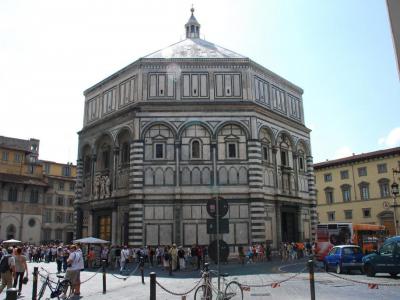
The beautiful Florence Baptistery, dedicated to Saint John the Baptist-patron saint of the city-stands prominently on Cathedral Square, opposite the Duomo. Raised in the 7th century over an ancient Roman structure thought to be a temple honoring Mars, the building features a distinctive octagonal shape. Early Christians frequently chose this eight-sided design for baptisteries, symbolizing renewal-the six days of creation, one day of rest, and the day of rebirth through baptism.
During its renovation in 1059, artisans covered the baptistery in alternating bands of white and dark green marble, giving the exterior its striking striped appearance. Yet, the baptistery is perhaps most famous for the three remarkable sets of bronze doors. The south doors depict moments from Saint John's life, combined with beautiful representations of the eight Christian virtues. The north doors, crafted by Lorenzo Ghiberti over 21 long years, illustrate scenes from the life of Christ. Ghiberti later devoted another 27 years to the spectacular east doors, famously described by Michelangelo as the “Gates of Paradise.” This extraordinary artwork features ten elaborate panels portraying the story of Joseph.
Inside, visitors can gaze upward at magnificent mosaics decorating the ceiling and view the baptismal font, in use since 1576. Francesco de’ Medici, Florence’s powerful ruler, had his son baptized here-just one among numerous notable figures who have shared this honor, including generations of the influential Medici family. Indeed, nearly every Catholic Florentine, up until the 19th century, received baptism within these very walls, making the Baptistery a core component of the city's religious heritage.
Florence's beloved poet Dante references this cherished building in his masterpiece, the “Divine Comedy.” Born in May 1265, the poet was originally named Durante, meaning “enduring,” after his maternal grandfather-though eventually, his family shortened the name to Dante.
Tip: Your standard ticket for the Duomo attractions includes access to the Baptistery, valid for 72 hours. Note that there's a strict dress code: shoulders and knees must be covered for both men and women, so please dress appropriately. To attend the daily mass, arrive around 10:30 AM at the door opposite the main entrance and mention “mass” or “messa” to the attendant.
During its renovation in 1059, artisans covered the baptistery in alternating bands of white and dark green marble, giving the exterior its striking striped appearance. Yet, the baptistery is perhaps most famous for the three remarkable sets of bronze doors. The south doors depict moments from Saint John's life, combined with beautiful representations of the eight Christian virtues. The north doors, crafted by Lorenzo Ghiberti over 21 long years, illustrate scenes from the life of Christ. Ghiberti later devoted another 27 years to the spectacular east doors, famously described by Michelangelo as the “Gates of Paradise.” This extraordinary artwork features ten elaborate panels portraying the story of Joseph.
Inside, visitors can gaze upward at magnificent mosaics decorating the ceiling and view the baptismal font, in use since 1576. Francesco de’ Medici, Florence’s powerful ruler, had his son baptized here-just one among numerous notable figures who have shared this honor, including generations of the influential Medici family. Indeed, nearly every Catholic Florentine, up until the 19th century, received baptism within these very walls, making the Baptistery a core component of the city's religious heritage.
Florence's beloved poet Dante references this cherished building in his masterpiece, the “Divine Comedy.” Born in May 1265, the poet was originally named Durante, meaning “enduring,” after his maternal grandfather-though eventually, his family shortened the name to Dante.
Tip: Your standard ticket for the Duomo attractions includes access to the Baptistery, valid for 72 hours. Note that there's a strict dress code: shoulders and knees must be covered for both men and women, so please dress appropriately. To attend the daily mass, arrive around 10:30 AM at the door opposite the main entrance and mention “mass” or “messa” to the attendant.
3) Piazza del Duomo (Cathedral Square)
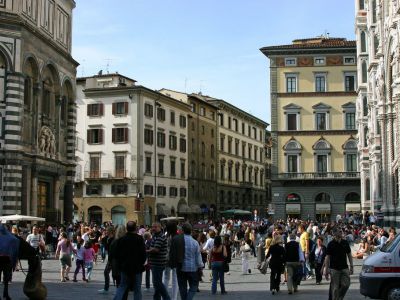
Piazza del Duomo, located in Florence, is one of the most popular destinations in Europe and the world; a place where history, art, and architectural magnificence converge. A UNESCO World Heritage site, this square is the bustling heart of the city and encompasses six of Florence's most renowned landmarks: the Florence Cathedral with its impressive Brunelleschi Dome, Giotto's splendid Bell Tower, adorned with intricate marble decorations and offering panoramic views of Florence; the Florence Baptistery, with its striking octagonal shape and magnificent bronze doors; the Crypt, and the Museum of the Works of the Cathedral ("Museo dell'Opera del Duomo"), which showcases an impressive collection of sculptures, artwork, and historical artifacts associated with the cathedral complex.
To conveniently explore all six attractions, you can obtain the Il Grande Museo del Duomo Card (which grants access to all of them), either online or from the ticket office at Piazza San Giovanni 7, located opposite the northern entrance of the Baptistery. If you decide to buy the Duomo Card from the ticket office, consider picking it up the day before your visit to save time.
Once you enter the first monument, you have a 24-hour window to explore the remaining attractions. However, keep in mind that you are not permitted to re-enter the same monument twice. Additionally, if you wish to visit the Dome ("Cupola"), it is necessary to reserve a 30-minute time slot. During peak months like July & August, it is advisable to book your slot in advance to ensure availability. The Duomo Card is a convenient choice if you do not plan to visit other museums or if you have limited time in the city.
Furthermore, there is a combined ticket option available for visiting the Uffizi Gallery, Pitti Palace, and Boboli Gardens. This ticket, valid for three days, can be purchased online or directly from the Uffizi ticket office. It offers faster entry, allowing you to make the most of your visit.
To conveniently explore all six attractions, you can obtain the Il Grande Museo del Duomo Card (which grants access to all of them), either online or from the ticket office at Piazza San Giovanni 7, located opposite the northern entrance of the Baptistery. If you decide to buy the Duomo Card from the ticket office, consider picking it up the day before your visit to save time.
Once you enter the first monument, you have a 24-hour window to explore the remaining attractions. However, keep in mind that you are not permitted to re-enter the same monument twice. Additionally, if you wish to visit the Dome ("Cupola"), it is necessary to reserve a 30-minute time slot. During peak months like July & August, it is advisable to book your slot in advance to ensure availability. The Duomo Card is a convenient choice if you do not plan to visit other museums or if you have limited time in the city.
Furthermore, there is a combined ticket option available for visiting the Uffizi Gallery, Pitti Palace, and Boboli Gardens. This ticket, valid for three days, can be purchased online or directly from the Uffizi ticket office. It offers faster entry, allowing you to make the most of your visit.
4) Sasso di Dante (Stone of Dante)
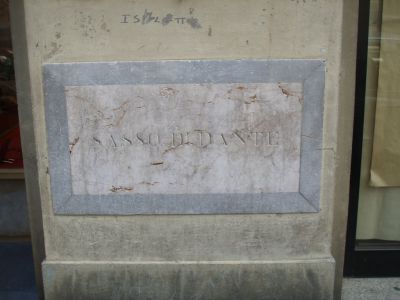
Sasso di Dante was the stone from where Dante would contemplate and write poems on summer evenings while watching the Florence Cathedral being built. Although the stone itself is no longer to be found, a plaque on the southern wall of Piazza del Duomo, affixed to the side of a store that sells religious items, claims to mark the location where the stone once stood.
The last time Dante could have sat on his rock was in 1302, the year he was exiled from Florence, never to return. This site is also associated with an anecdote that highlights the renowned poet's exceptional memory. While deeply immersed in his thoughts, an acquaintance passed by and approached him, asking, "Oh Dante, what is your favorite food?" To which Dante replied, "eggs." The following year, the same inquisitive person encountered Dante still seated in his cherished spot and inquired, "with what?" Dante promptly responded, "with salt!"
In close proximity, you will find an old trattoria aptly named Sasso di Dante, occupying a significant portion of the piazza. Its covered outdoor seating area provides an ideal setting for a leisurely lunch in pleasant weather – a perfect opportunity to reflect on your day so far or plan for the adventures that lie ahead in the afternoon.
The last time Dante could have sat on his rock was in 1302, the year he was exiled from Florence, never to return. This site is also associated with an anecdote that highlights the renowned poet's exceptional memory. While deeply immersed in his thoughts, an acquaintance passed by and approached him, asking, "Oh Dante, what is your favorite food?" To which Dante replied, "eggs." The following year, the same inquisitive person encountered Dante still seated in his cherished spot and inquired, "with what?" Dante promptly responded, "with salt!"
In close proximity, you will find an old trattoria aptly named Sasso di Dante, occupying a significant portion of the piazza. Its covered outdoor seating area provides an ideal setting for a leisurely lunch in pleasant weather – a perfect opportunity to reflect on your day so far or plan for the adventures that lie ahead in the afternoon.
5) Vivoli
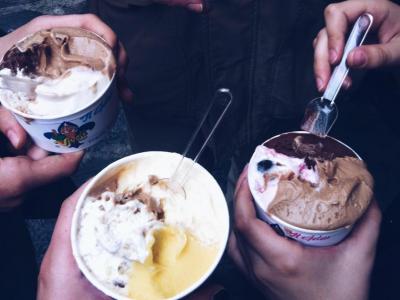
When it comes to gelato, Florence is often regarded as the place where this much-loved treat was first developed. One gelateria in particular is widely recognized as the city’s oldest, having opened in 1929. It offers a selection of more than twenty flavors, with small servings starting at around €3 and larger portions reaching €6, depending on size. What distinguishes this gelateria is its commitment to producing artisanal gelato entirely from scratch, made in small batches each morning.
The result is a gelato that is smooth, dense, and deeply flavored, clearly reflecting the use of fresh ingredients, especially fruit, without additives or artificial preservatives. Its most iconic flavor is Riso, meaning rice-a sweet, creamy gelato containing small pieces of cooked rice and dating back to the 1930s. In keeping with tradition, gelato here is served only in cups, never in cones. Another highlight is the affogato, made by pouring hot espresso over vanilla gelato in a pre-chilled cup, creating a balanced contrast of temperatures and flavors.
Inside the gelateria, a small seating area with tables and chairs at the back allows visitors to sit and enjoy their dessert at a relaxed pace. In the morning, the space also functions as a café, serving well-prepared cappuccinos alongside pastries and freshly baked cakes made on site. Even those who usually avoid coffee are often persuaded by the affogato, which works as much as a dessert as it does a drink.
The result is a gelato that is smooth, dense, and deeply flavored, clearly reflecting the use of fresh ingredients, especially fruit, without additives or artificial preservatives. Its most iconic flavor is Riso, meaning rice-a sweet, creamy gelato containing small pieces of cooked rice and dating back to the 1930s. In keeping with tradition, gelato here is served only in cups, never in cones. Another highlight is the affogato, made by pouring hot espresso over vanilla gelato in a pre-chilled cup, creating a balanced contrast of temperatures and flavors.
Inside the gelateria, a small seating area with tables and chairs at the back allows visitors to sit and enjoy their dessert at a relaxed pace. In the morning, the space also functions as a café, serving well-prepared cappuccinos alongside pastries and freshly baked cakes made on site. Even those who usually avoid coffee are often persuaded by the affogato, which works as much as a dessert as it does a drink.
6) Palazzo Vecchio (Old Palace) (must see)
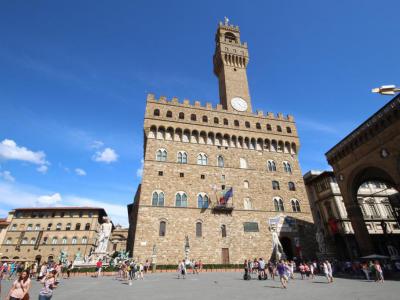
Just like the Cathedral complex and Florence’s world-class galleries, the Old Palace is essential for anyone wanting to grasp the city's history and cultural identity. This massive Romanesque fortress is one of the most striking town halls in all of Tuscany. Since 1872, it has served as the office of Florence’s mayor, but its legacy stretches much further back. Built in 1299, the edifice was the political heart of the Florentine Republic for centuries. When Cosimo de’ Medici moved in with his family in 1540 as Grand Duke, he had it expanded and transformed, blending its medieval bones with elegant Renaissance flair.
The rugged stone façade, lined with shields chronicling Florence’s political past, is also home to an impressive lineup of statues. These include Florence’s heraldic symbol- the Marzocco lion, along with Donatello’s powerful “Judith and Holofernes”, and “Hercules and Cacus”. The nearby Tower of Arnolfo, rising above the palace, offers a climbable vantage point-though access requires a separate ticket.
Meanwhile, inside, every room tells a chapter of the city’s history. You’ll walk through the spectacular Hall of the Five Hundred, designed to glorify Medici rule, and into the more private quarters where the family lived. Decorated under the artistic direction of Giorgio Vasari, these spaces are rich in symbolism and political narrative. Give yourself time to move slowly through the rooms-it’s an immersive dive into Florentine grandeur. And be warned: you may leave with a crick in your neck from gazing.
One standout work here is Michelangelo’s “Genius of Victory”. Originally meant for the tomb of Pope Julius II, the sculpture depicts a young, triumphant figure standing over a defeated older man. The contrast between the two is striking-the victor is smooth and polished, the vanquished figure unfinished and rough, still bearing the weight of the stone.
You’ll also come across something rather haunting-a death mask of Dante Alighieri, displayed between the Apartments of Eleanor and the Halls of the Priors. Though the poet was buried in Ravenna, this plaster cast has become a powerful reminder of his influence on Florence, both politically and culturally. Fans of Dan Brown’s “Inferno” will surely recognize it from the novel.
Tip: If you’re planning a guided visit, it’s best to book directly with the museum by email-include your preferred date and time, and wait for confirmation. Payment is made on the day of your tour, and afterward, you’re free to continue exploring on your own. Just keep in mind: because this is still a working municipal building, access may occasionally be restricted. It’s a good idea to check the official website before you go.
The rugged stone façade, lined with shields chronicling Florence’s political past, is also home to an impressive lineup of statues. These include Florence’s heraldic symbol- the Marzocco lion, along with Donatello’s powerful “Judith and Holofernes”, and “Hercules and Cacus”. The nearby Tower of Arnolfo, rising above the palace, offers a climbable vantage point-though access requires a separate ticket.
Meanwhile, inside, every room tells a chapter of the city’s history. You’ll walk through the spectacular Hall of the Five Hundred, designed to glorify Medici rule, and into the more private quarters where the family lived. Decorated under the artistic direction of Giorgio Vasari, these spaces are rich in symbolism and political narrative. Give yourself time to move slowly through the rooms-it’s an immersive dive into Florentine grandeur. And be warned: you may leave with a crick in your neck from gazing.
One standout work here is Michelangelo’s “Genius of Victory”. Originally meant for the tomb of Pope Julius II, the sculpture depicts a young, triumphant figure standing over a defeated older man. The contrast between the two is striking-the victor is smooth and polished, the vanquished figure unfinished and rough, still bearing the weight of the stone.
You’ll also come across something rather haunting-a death mask of Dante Alighieri, displayed between the Apartments of Eleanor and the Halls of the Priors. Though the poet was buried in Ravenna, this plaster cast has become a powerful reminder of his influence on Florence, both politically and culturally. Fans of Dan Brown’s “Inferno” will surely recognize it from the novel.
Tip: If you’re planning a guided visit, it’s best to book directly with the museum by email-include your preferred date and time, and wait for confirmation. Payment is made on the day of your tour, and afterward, you’re free to continue exploring on your own. Just keep in mind: because this is still a working municipal building, access may occasionally be restricted. It’s a good idea to check the official website before you go.
7) Piazzale degli Uffizi (Uffizi Courtyard)
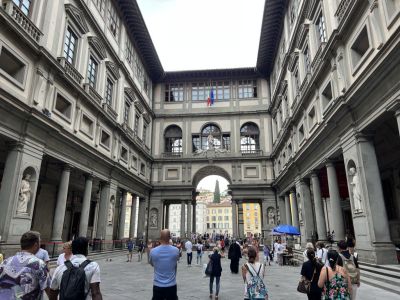
The Uffizi Courtyard is a grand and elegant space in the heart of Florence, framed by the historic Uffizi Gallery. Before its transformation, this area was far from refined-home to tanners, dyers, and widespread prostitution, earning it the Red-Light District nickname. Seeking to bring order and centralization to the city’s administration, Cosimo de’ Medici commissioned Giorgio Vasari in 1560 to design a new building that would house all major public offices near his residence at the Old Palace. Inspired by Venetian architecture, Vasari created a symmetrical row of buildings with graceful arches and columns, transforming the area into one of structured beauty and civic pride.
After Vasari’s death, construction continued, and by 1580, the Uffizi complex was connected to nearby buildings like the Mint and the Loggia dei Lanzi. The addition of the Vasari Corridor, an elevated walkway leading from the Uffizi to the Pitti Palace, allowed the Medici family to traverse the city in private. Today, the courtyard is a lively and symbolic space-bridging Florence’s gritty past with its Renaissance grandeur. It serves as both a cultural landmark and a busy walkway, often animated by artists, musicians, and the steady stream of visitors heading toward one of the world’s most important art museums.
Outside the Uffizi Gallery, twenty-eight marble statues of prominent Tuscans line the niches of the portico’s pillars, including four that overlook the Arno along Lungarno Anna Maria Luisa de' Medici; these sculptures, completed between 1842 and 1856 by some of the finest artists of the era, celebrate the region’s intellectual and artistic legacy. At the far end of the courtyard, just to the right of the archway leading to the Arno embankment, stands a full-length statue of Galileo Galilei, gazing thoughtfully skyward with a telescope in hand-a tribute sculpted by Aristodemus Costoli and gifted by Crown Prince Ferdinand, located on the square-facing side of the Verone Loggia.
After Vasari’s death, construction continued, and by 1580, the Uffizi complex was connected to nearby buildings like the Mint and the Loggia dei Lanzi. The addition of the Vasari Corridor, an elevated walkway leading from the Uffizi to the Pitti Palace, allowed the Medici family to traverse the city in private. Today, the courtyard is a lively and symbolic space-bridging Florence’s gritty past with its Renaissance grandeur. It serves as both a cultural landmark and a busy walkway, often animated by artists, musicians, and the steady stream of visitors heading toward one of the world’s most important art museums.
Outside the Uffizi Gallery, twenty-eight marble statues of prominent Tuscans line the niches of the portico’s pillars, including four that overlook the Arno along Lungarno Anna Maria Luisa de' Medici; these sculptures, completed between 1842 and 1856 by some of the finest artists of the era, celebrate the region’s intellectual and artistic legacy. At the far end of the courtyard, just to the right of the archway leading to the Arno embankment, stands a full-length statue of Galileo Galilei, gazing thoughtfully skyward with a telescope in hand-a tribute sculpted by Aristodemus Costoli and gifted by Crown Prince Ferdinand, located on the square-facing side of the Verone Loggia.
8) Ponte Vecchio (Old Bridge) (must see)
Ponte Vecchio, or The Old Bridge, first appeared in written records all the way back in 996. Of the six bridges that span the Arno River in Florence, it’s the only one that survived World War II intact-spared by retreating German forces. Today, this medieval stone arch structure stands as a powerful reminder of how a ruler’s vision can shape a city’s legacy.
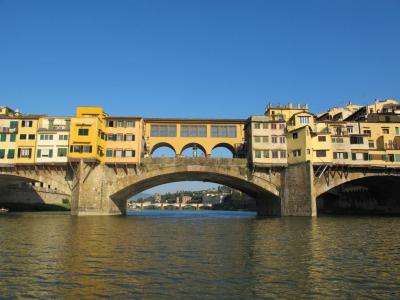
As in the Middle Ages, the bridge is still lined with shops-but what’s sold here has changed quite a bit over time. Originally, it was occupied by butchers, who were know for tossing animal waste directly into the river-hardly ideal for anyone strolling by. That all changed in the 16th century, when Grand Duke Ferdinando de’ Medici had the meat merchants removed and replaced with goldsmiths. Not only did this improve the smell, but it also turned the bridge into one of the most glittering, upscale corners of Florence.
Take a look from a distance, and you might spot something unusual-a raised corridor running above the shops. This hidden passage is part of the Vasari Corridor, a nearly kilometer-long tunnel that connects the Pitti Palace with the Old Palace. It was built so that the Grand Duke could move between his residence and government offices without mingling with the crowds. Although closed since 2016 for safety reasons, there are plans to reopen it for visitors.
There’s even a bit of financial folklore tied to this spot, which is said to be the birthplace of the term “bankruptcy.” When a moneylender couldn’t pay his debts, soldiers smashed his trading bench-called a banco-to pieces, a symbolic act that left him unable to operate. Hence the term “bancorotto”, or “broken bench”, was born.
These days, the Old Bridge is a lovely place for a walk-especially at sunset, when the light casts a golden glow over the Arno. Early mornings are just as magical, with soft reflections on the water and, if you’re lucky, the bridge nearly all to yourself.
As in the Middle Ages, the bridge is still lined with shops-but what’s sold here has changed quite a bit over time. Originally, it was occupied by butchers, who were know for tossing animal waste directly into the river-hardly ideal for anyone strolling by. That all changed in the 16th century, when Grand Duke Ferdinando de’ Medici had the meat merchants removed and replaced with goldsmiths. Not only did this improve the smell, but it also turned the bridge into one of the most glittering, upscale corners of Florence.
Take a look from a distance, and you might spot something unusual-a raised corridor running above the shops. This hidden passage is part of the Vasari Corridor, a nearly kilometer-long tunnel that connects the Pitti Palace with the Old Palace. It was built so that the Grand Duke could move between his residence and government offices without mingling with the crowds. Although closed since 2016 for safety reasons, there are plans to reopen it for visitors.
There’s even a bit of financial folklore tied to this spot, which is said to be the birthplace of the term “bankruptcy.” When a moneylender couldn’t pay his debts, soldiers smashed his trading bench-called a banco-to pieces, a symbolic act that left him unable to operate. Hence the term “bancorotto”, or “broken bench”, was born.
These days, the Old Bridge is a lovely place for a walk-especially at sunset, when the light casts a golden glow over the Arno. Early mornings are just as magical, with soft reflections on the water and, if you’re lucky, the bridge nearly all to yourself.
9) Basilica di Santa Maria Novella (Basilica of Santa Maria Novella)
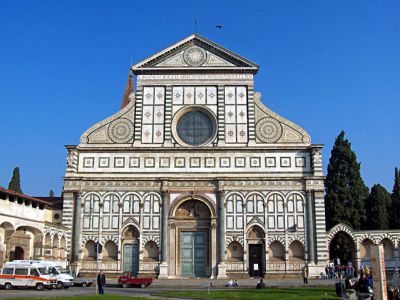
Built in the 13th century, Santa Maria Novella is, chronologically, the first grand basilica in Florence, and stands as the city's principal Dominican church. Within its walls, along with the adjacent cloister and chapter house, lie a multitude of art treasures and funerary monuments. Especially famous are frescoes crafted by Gothic and early Renaissance masters, generously funded by prominent Florentine families, securing for themselves funerary chapels on consecrated ground.
The exterior showcases architectural elements inspired by antiquity, including the pediment and frieze; however, the upper portion introduces a novel and unprecedented design feature: S-curved scrolls. These scrolls, or variations thereof, can be found in churches across Italy and owe their origins to the innovative design of Santa Maria Novella, which ingeniously addressed the challenge of transitioning from wide to narrow storeys.
Beyond its architectural splendor and captivating cloisters, the basilica houses an array of artistic treasures, including frescoes, statues, paintings, and wooden crosses. Notable among them is the world-famous fresco "The Holy Trinity" by Masaccio, which had a profound impact on Florentine painting, inspiring future generations with its groundbreaking use of perspective and mathematical proportions. Additionally, the pulpit designed by Brunelleschi himself is of historical significance, as it was from this very pulpit that the first verbal attack against Galileo Galilei was launched, ultimately leading to his indictment.
Be sure not to overlook the Cappella Strozzi di Mantova, situated at the end of the left transept. Adorned with frescoes inspired by Dante's "Divine Comedy", this chapel portrays the Last Judgment (on the back wall, featuring a portrait of Dante), Hell (on the right wall), and Paradise (on the left wall). Executed between 1350 and 1357, these remarkable artworks vividly bring to life the essence of Dante's renowned literary masterpiece.
The exterior showcases architectural elements inspired by antiquity, including the pediment and frieze; however, the upper portion introduces a novel and unprecedented design feature: S-curved scrolls. These scrolls, or variations thereof, can be found in churches across Italy and owe their origins to the innovative design of Santa Maria Novella, which ingeniously addressed the challenge of transitioning from wide to narrow storeys.
Beyond its architectural splendor and captivating cloisters, the basilica houses an array of artistic treasures, including frescoes, statues, paintings, and wooden crosses. Notable among them is the world-famous fresco "The Holy Trinity" by Masaccio, which had a profound impact on Florentine painting, inspiring future generations with its groundbreaking use of perspective and mathematical proportions. Additionally, the pulpit designed by Brunelleschi himself is of historical significance, as it was from this very pulpit that the first verbal attack against Galileo Galilei was launched, ultimately leading to his indictment.
Be sure not to overlook the Cappella Strozzi di Mantova, situated at the end of the left transept. Adorned with frescoes inspired by Dante's "Divine Comedy", this chapel portrays the Last Judgment (on the back wall, featuring a portrait of Dante), Hell (on the right wall), and Paradise (on the left wall). Executed between 1350 and 1357, these remarkable artworks vividly bring to life the essence of Dante's renowned literary masterpiece.
10) Farmacia di Santa Maria Novella
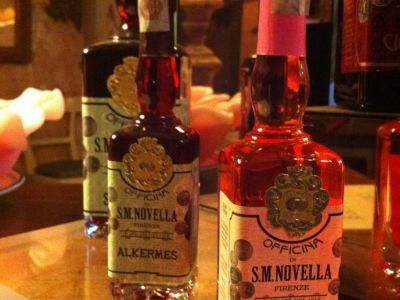
In Italy, we're used to think of a pharmacy as a place where you're supposed to buy medicines. Well, in Florence there's a special one, worth visiting especially when you aren't ill. It goes by the name of Farmacia di Santa Maria Novella and it holds the distinction of being the oldest continuously-running pharmacy in Europe. Not only does it offer a range of medicinal products, but it also produces exceptional perfumes, rare and delightful homemade liqueurs, beauty creams, soaps, potpourri sachets, and even a remedy for fainting, all packaged in Art-Deco style with gothic lettering.
Among the offerings are refined scents, including a fragrance called "Angels of Florence" designed for women. This perfume was created in 2006 to commemorate the 40th anniversary of the devastating Arno river flood that destroyed numerous cultural treasures in Florence, including nearly a million books in the Biblioteca Nazionale. Its name remains in English as a tribute to the "angels of mud", referring to the hundreds of young foreigners who came to Florence to aid in the rescue efforts and save the city's cultural heritage.
For those seeking exquisite liqueurs, the pharmacy offers "Elisir di rose", known for its delicate flavor derived from roses, and "Alkermes", a highly alcoholic Florentine liqueur with a vibrant red color. It is said to be a secret recipe of the Medici family and is now specifically used to make the traditional Italian dessert, "zuppa inglese". Prices for these liqueurs start at 17.50 euros for the smallest bottle (100 ml).
If soap bars are what you're after, you'll find a wide selection to choose from, with numerous scents and packaging options available. Single bars of pomegranate or milk soap, weighing 200 grams each, are priced at 12 euros.
The products from Farmacia di Santa Maria Novella are highly sought-after and make for exceptional and original gifts when visiting Florence.
Among the offerings are refined scents, including a fragrance called "Angels of Florence" designed for women. This perfume was created in 2006 to commemorate the 40th anniversary of the devastating Arno river flood that destroyed numerous cultural treasures in Florence, including nearly a million books in the Biblioteca Nazionale. Its name remains in English as a tribute to the "angels of mud", referring to the hundreds of young foreigners who came to Florence to aid in the rescue efforts and save the city's cultural heritage.
For those seeking exquisite liqueurs, the pharmacy offers "Elisir di rose", known for its delicate flavor derived from roses, and "Alkermes", a highly alcoholic Florentine liqueur with a vibrant red color. It is said to be a secret recipe of the Medici family and is now specifically used to make the traditional Italian dessert, "zuppa inglese". Prices for these liqueurs start at 17.50 euros for the smallest bottle (100 ml).
If soap bars are what you're after, you'll find a wide selection to choose from, with numerous scents and packaging options available. Single bars of pomegranate or milk soap, weighing 200 grams each, are priced at 12 euros.
The products from Farmacia di Santa Maria Novella are highly sought-after and make for exceptional and original gifts when visiting Florence.
