Custom Walk in Rome, Italy by rustiafj_6cb35 created on 2026-03-18
Guide Location: Italy » Rome
Guide Type: Custom Walk
# of Sights: 14
Tour Duration: 2 Hour(s)
Travel Distance: 3.2 Km or 2 Miles
Share Key: Q8M7V
Guide Type: Custom Walk
# of Sights: 14
Tour Duration: 2 Hour(s)
Travel Distance: 3.2 Km or 2 Miles
Share Key: Q8M7V
How It Works
Please retrieve this walk in the GPSmyCity app. Once done, the app will guide you from one tour stop to the next as if you had a personal tour guide. If you created the walk on this website or come to the page via a link, please follow the instructions below to retrieve the walk in the app.
Retrieve This Walk in App
Step 1. Download the app "GPSmyCity: Walks in 1K+ Cities" on Apple App Store or Google Play Store.



Step 2. In the GPSmyCity app, download(or launch) the guide "Rome Map and Walking Tours".
Step 3. Tap the menu button located at upper right corner of the "Walks" screen and select "Retrieve custom walk". Enter the share key: Q8M7V
1) Colosseo (Colosseum) (must see)
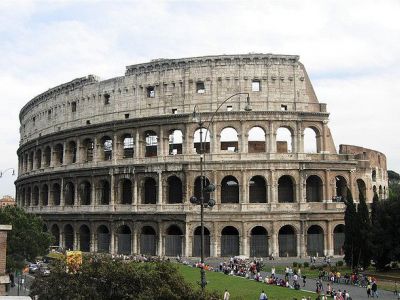
The Colosseum, Rome’s iconic elliptical amphitheater, is the largest ancient amphitheater ever built, covering 24,000 square meters. Constructed between 69 and 80 AD by the Flavian dynasty, it was initially called the Flavian Amphitheater. Its modern name stems from the Colossus of Nero statue that once stood nearby, with the term "Colosseum" emerging during the medieval period.
Built on the land reclaimed from Emperor Nero’s landscaped Domus Aurea complex after the Great Fire of 64 AD, the Colosseum represented a gift to the Roman people under Emperor Vespasian. It was constructed using travertine, tuff, and concrete and was funded by spoils from the Jewish War. The latter, fought in 70 AD, led to the Siege of Jerusalem and brought back numerous prisoners who largely contributed to the massive workforce needed for the construction. The amphitheater comprised four tiers that could hold between 50,000 and 80,000 spectators at a time. Its free-standing structure features three architectural orders – Doric, Ionic, and Corinthian.
The lowest tier was for the emperor and the royal family, the two middle ones were for the noble Romans and members of government, while the highest tier was for the ordinary citizens. The elaborate system included 80 entrances, passageways for crowd control, and numbered pottery tickets for seating. Admission was free and the main sponsor was the emperor himself.
The Colosseum hosted gladiatorial contests, animal hunts, and mythological reenactments. Events often featured exotic animals imported from Africa and the Middle East. Emperor Trajan's games, for example, involved over 11,000 animals and 10,000 gladiators over 123 days! The below-ground passages were used to bring men and animals into the arena, which was separated from the audience by a ditch. Occasionally, it was reportedly even flooded for naval battles. Executions were common during intervals, with the condemned facing wild beasts or acting out tragic myths.
During the medieval period, the Colosseum served as a fortress and even a stone quarry. Passers-by habitually chipped off pieces of it for souvenirs which, together with some natural causes like earthquakes, led to its partial destruction.
Despite popular belief that the early Christians were martyred here in numbers, evidence suggests that most executions occurred elsewhere. By the 17th century, the Colosseum became recognized as a sacred site. Today, it hosts the Pope’s Good Friday “Way of the Cross” procession.
Only the north side of the building, as well as the underground passages, have survived intact. The arena floor is totally gone. Inside the Colosseum, there's a historical exhibition with both permanent and changing displays.
Tips:
Visit early in the morning or late in the evening to avoid long queues and heat. The ground and first floors are open to visitors without a special ticket, while the subterranean part and the third floor are accessed on pre-booked tours only. Opt for a guided tour to skip lines and access the Forum area. Alternatively, buy tickets in advance or at the Roman Forum. Enhance your experience with an audio guide for detailed historical insights.
Built on the land reclaimed from Emperor Nero’s landscaped Domus Aurea complex after the Great Fire of 64 AD, the Colosseum represented a gift to the Roman people under Emperor Vespasian. It was constructed using travertine, tuff, and concrete and was funded by spoils from the Jewish War. The latter, fought in 70 AD, led to the Siege of Jerusalem and brought back numerous prisoners who largely contributed to the massive workforce needed for the construction. The amphitheater comprised four tiers that could hold between 50,000 and 80,000 spectators at a time. Its free-standing structure features three architectural orders – Doric, Ionic, and Corinthian.
The lowest tier was for the emperor and the royal family, the two middle ones were for the noble Romans and members of government, while the highest tier was for the ordinary citizens. The elaborate system included 80 entrances, passageways for crowd control, and numbered pottery tickets for seating. Admission was free and the main sponsor was the emperor himself.
The Colosseum hosted gladiatorial contests, animal hunts, and mythological reenactments. Events often featured exotic animals imported from Africa and the Middle East. Emperor Trajan's games, for example, involved over 11,000 animals and 10,000 gladiators over 123 days! The below-ground passages were used to bring men and animals into the arena, which was separated from the audience by a ditch. Occasionally, it was reportedly even flooded for naval battles. Executions were common during intervals, with the condemned facing wild beasts or acting out tragic myths.
During the medieval period, the Colosseum served as a fortress and even a stone quarry. Passers-by habitually chipped off pieces of it for souvenirs which, together with some natural causes like earthquakes, led to its partial destruction.
Despite popular belief that the early Christians were martyred here in numbers, evidence suggests that most executions occurred elsewhere. By the 17th century, the Colosseum became recognized as a sacred site. Today, it hosts the Pope’s Good Friday “Way of the Cross” procession.
Only the north side of the building, as well as the underground passages, have survived intact. The arena floor is totally gone. Inside the Colosseum, there's a historical exhibition with both permanent and changing displays.
Tips:
Visit early in the morning or late in the evening to avoid long queues and heat. The ground and first floors are open to visitors without a special ticket, while the subterranean part and the third floor are accessed on pre-booked tours only. Opt for a guided tour to skip lines and access the Forum area. Alternatively, buy tickets in advance or at the Roman Forum. Enhance your experience with an audio guide for detailed historical insights.
2) Foro di Augusto (Forum of Augustus)
Augustus was the first Roman emperor, the one who transformed the Roman Republic into the Roman Empire. After the assassination of his great-uncle, Julius Caesar, Augustus navigated a series of civil wars, eventually defeating Mark Antony and Cleopatra to secure power. His reign, from 27 BC until his death in 14 AD, marked a period of relative peace and stability known as the Roman Peace. During that time, he oversaw significant reforms in government, infrastructure, and the military.
Augustus is also recognized for his ambitious building projects, including the construction of the Pantheon and the Altar of Peace, as well as for fostering a flourishing Roman culture and arts. His leadership solidified the imperial system, making the Roman Empire a dominant force for centuries.
The Forum of Augustus was built in 42 BC after his victory at the Battle of Philippi to fulfill a promise to honor Mars Ultor, the Roman God of War. The central feature of the forum was the Temple of Mars Ultor, which was adorned with numerous statues. At its center stood a statue of Augustus in military attire, accompanied by statues of Mars and Venus.
In total, there were 108 portrait statues in the temple, each with inscriptions detailing their respective person's achievements. Along the left side were the statues of famous Republican leaders honoring Rome's military and political history, while the right side was reserved for figures from the Caesar family, tracing Augustus's lineage back to the founder of Rome, Romulus.
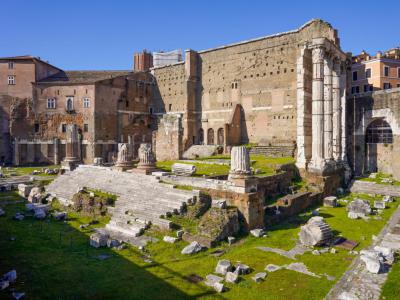
Today, the Forum of Augustus is partially preserved. While much of it lies in ruins, several key elements, such as some of its large marble foundations, columns, and parts of the inner sanctuary of the Temple of Mars Ultor, can still be seen. Although most statues and reliefs no longer exist in their original form, there are depictions and descriptions of the forum's artwork that can be found in historical sources.
Although much of the forum is now underground or obscured by later constructions, the remaining spaces allow visitors to get an idea of its general layout as a place for public business and display of Augustus's power and military achievements.
Augustus is also recognized for his ambitious building projects, including the construction of the Pantheon and the Altar of Peace, as well as for fostering a flourishing Roman culture and arts. His leadership solidified the imperial system, making the Roman Empire a dominant force for centuries.
The Forum of Augustus was built in 42 BC after his victory at the Battle of Philippi to fulfill a promise to honor Mars Ultor, the Roman God of War. The central feature of the forum was the Temple of Mars Ultor, which was adorned with numerous statues. At its center stood a statue of Augustus in military attire, accompanied by statues of Mars and Venus.
In total, there were 108 portrait statues in the temple, each with inscriptions detailing their respective person's achievements. Along the left side were the statues of famous Republican leaders honoring Rome's military and political history, while the right side was reserved for figures from the Caesar family, tracing Augustus's lineage back to the founder of Rome, Romulus.
Today, the Forum of Augustus is partially preserved. While much of it lies in ruins, several key elements, such as some of its large marble foundations, columns, and parts of the inner sanctuary of the Temple of Mars Ultor, can still be seen. Although most statues and reliefs no longer exist in their original form, there are depictions and descriptions of the forum's artwork that can be found in historical sources.
Although much of the forum is now underground or obscured by later constructions, the remaining spaces allow visitors to get an idea of its general layout as a place for public business and display of Augustus's power and military achievements.
3) Foro di Traiano (Trajan's Forum)
Emperor Trajan, who reigned from 98 to 117 AD, is best known for his military conquests. Prime among them were the Dacian Wars, resulting in the annexation of Dacia (which is modern-day Romania) and expanding the Roman Empire to its greatest territorial extent. Trajan's successful campaigns brought immense wealth to Rome, notably in the form of Dacian gold, which funded various public works.
Beyond military achievements, Trajan was admired for his relatively fair and just governance, implementing social programs such as the Alimenta, a welfare program for orphaned children and poor families. His reign is often seen as a high point in Roman history, marked by prosperity, effective leadership, and the expansion of the empire.
Trajan is also celebrated for his significant contributions to Roman architecture, including the construction of Trajan's Forum in 113 AD. Set to commemorate Trajan's military victories, particularly the conquest of Dacia, the forum was part of a larger complex that featured a vast, portico-lined square measuring 300 by 185 meters, enclosed by tall tuff walls clad in marble. The main entrance at the south end had a triumphal arch celebrating the Dacian Wars. The arch was adorned with friezes and statues depicting Dacian prisoners.
The forum's open space was paved in Carrara marble and connected to the Forum of Augustus. Key structures therein included Trajan's Market, the Basilica Ulpia, one Latin library and one Greek library, and Trajan’s Column.
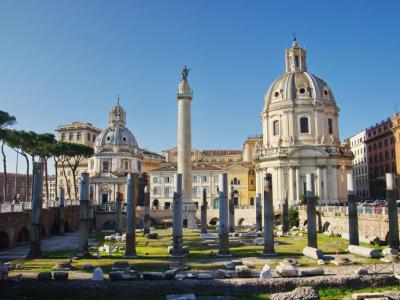
Today, the forum is one of the most impressive and well-preserved ancient Roman sites. Although mostly in ruins, visitors can still see the iconic Trajan’s Column standing 30 meters tall, covered in a continuous frieze depicting scenes from the Dacian Wars. Also, don't miss the ruins of Trajan's Market. This structure – a series of multi-level buildings that once housed administrative offices and retail spaces – is often referred to as the world’s oldest shopping mall.
Beyond military achievements, Trajan was admired for his relatively fair and just governance, implementing social programs such as the Alimenta, a welfare program for orphaned children and poor families. His reign is often seen as a high point in Roman history, marked by prosperity, effective leadership, and the expansion of the empire.
Trajan is also celebrated for his significant contributions to Roman architecture, including the construction of Trajan's Forum in 113 AD. Set to commemorate Trajan's military victories, particularly the conquest of Dacia, the forum was part of a larger complex that featured a vast, portico-lined square measuring 300 by 185 meters, enclosed by tall tuff walls clad in marble. The main entrance at the south end had a triumphal arch celebrating the Dacian Wars. The arch was adorned with friezes and statues depicting Dacian prisoners.
The forum's open space was paved in Carrara marble and connected to the Forum of Augustus. Key structures therein included Trajan's Market, the Basilica Ulpia, one Latin library and one Greek library, and Trajan’s Column.
Today, the forum is one of the most impressive and well-preserved ancient Roman sites. Although mostly in ruins, visitors can still see the iconic Trajan’s Column standing 30 meters tall, covered in a continuous frieze depicting scenes from the Dacian Wars. Also, don't miss the ruins of Trajan's Market. This structure – a series of multi-level buildings that once housed administrative offices and retail spaces – is often referred to as the world’s oldest shopping mall.
4) Mercati di Traiano (Trajan's Market)
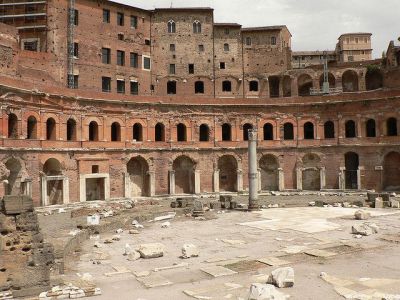
Trajan's Market is a complex of ruins, once part of Trajan's Forum in Rome. The remaining buildings (or rather fragments thereof) that offer a glimpse into the daily social and business activities of the ancient Roman capital, are now carefully restored.
The arcades in the market are believed to have served as administrative offices for Emperor Trajan himself. Spread across multiple levels, some of which are accessible to visitors today, the market encompassed shops and apartments. The world's oldest shopping mall, if you like, this venue comprised both a marketplace and a cultural center. Remarkable elements that attest to its significance include delicate marble floors, remnants of a library, and the towering triumphal column, the second-largest standing ancient structure in Rome, following the Colosseum.
Constructed circa 100 AD, Trajan's Market was designed by Apollodorus of Damascus, the esteemed architect who consistently accompanied Trajan on his expeditions. While the core structure dates back to this period, subsequent additions were made during the Middle Ages, including visible floor levels within the market and fortified elements like the notable "militia tower."
At a later point in time, a convent emerged in the vicinity, but it was ultimately demolished in the early 20th century as part of the comprehensive restoration project aimed at returning Trajan's Market to its authentic and original state.
The arcades in the market are believed to have served as administrative offices for Emperor Trajan himself. Spread across multiple levels, some of which are accessible to visitors today, the market encompassed shops and apartments. The world's oldest shopping mall, if you like, this venue comprised both a marketplace and a cultural center. Remarkable elements that attest to its significance include delicate marble floors, remnants of a library, and the towering triumphal column, the second-largest standing ancient structure in Rome, following the Colosseum.
Constructed circa 100 AD, Trajan's Market was designed by Apollodorus of Damascus, the esteemed architect who consistently accompanied Trajan on his expeditions. While the core structure dates back to this period, subsequent additions were made during the Middle Ages, including visible floor levels within the market and fortified elements like the notable "militia tower."
At a later point in time, a convent emerged in the vicinity, but it was ultimately demolished in the early 20th century as part of the comprehensive restoration project aimed at returning Trajan's Market to its authentic and original state.
5) Fori Imperiali (Imperial Forums)
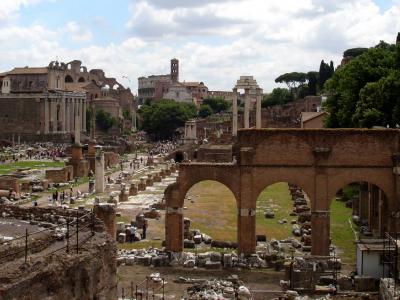
The Imperial Forums are a series of monumental public squares in Rome that once served as centers of politics, religion, and economy during the Roman Republic and Empire. Located near the Roman Forum, these squares were built over about 150 years, between the mid-1st century BC and the early 2nd century AD. It began with Julius Caesar, who restructured the area to establish the Forum of Caesar. This forum, inaugurated in 46 BC, celebrated his power and included a temple to Venus Genetrix, symbolizing his divine lineage.
Emperor Augustus followed with the Forum of Augustus, inaugurated in 2 BC after decades of construction. It featured the Temple of Mars Ultor, honoring his victory at Philippi and his connection to Rome's mythological founding through Mars. The forum's layout included semicircular exedrae, long porticos, and a fire-resistant wall separating it from the Suburra district.
Emperor Vespasian, in turn, constructed the Temple of Peace, otherwise known as the Forum of Vespasian, in 75 AD, to commemorate the conquest of Jerusalem. Unlike other forums, it served as a garden and open-air museum, featuring pools, statues, and the Forma Urbis Romae, a marble map of ancient Rome.
The Forum of Nerva, initiated by Domitian and completed by his successor, was a smaller transitional forum connecting the earlier complexes. It included a monumental entrance and a temple dedicated to Minerva, symbolizing protection for the emperor.
The Forum of Trajan, completed in 113 AD, was the largest and most elaborate. Built to commemorate Trajan’s victory in Dacia, its design required significant reshaping of the Quirinal Hill. It featured the Basilica Ulpia, Trajan's Column, and a massive equestrian statue of the emperor.
During the 1930s, Mussolini restored the Imperial Forums in an effort to evoke and emulate the past glories of Ancient Rome. He also built a road crossing through the site, supposedly in a bid to make the Colosseum visible from his office window.
A museum at Trajan’s Market, opened in 2007, showcases the history and significance of these forums through artifacts, models, and exhibits, preserving the legacy of Rome's monumental past. Although only a fraction of the original structures remain, the ruins of the Imperial Forums still convey the scale and grandeur of the ancient city. In recent years, the Imperial Forums avenue has been made traffic-free, so walking on it, with just a little imagination, will give you a pretty good sense of Ancient Rome's magnitude.
Emperor Augustus followed with the Forum of Augustus, inaugurated in 2 BC after decades of construction. It featured the Temple of Mars Ultor, honoring his victory at Philippi and his connection to Rome's mythological founding through Mars. The forum's layout included semicircular exedrae, long porticos, and a fire-resistant wall separating it from the Suburra district.
Emperor Vespasian, in turn, constructed the Temple of Peace, otherwise known as the Forum of Vespasian, in 75 AD, to commemorate the conquest of Jerusalem. Unlike other forums, it served as a garden and open-air museum, featuring pools, statues, and the Forma Urbis Romae, a marble map of ancient Rome.
The Forum of Nerva, initiated by Domitian and completed by his successor, was a smaller transitional forum connecting the earlier complexes. It included a monumental entrance and a temple dedicated to Minerva, symbolizing protection for the emperor.
The Forum of Trajan, completed in 113 AD, was the largest and most elaborate. Built to commemorate Trajan’s victory in Dacia, its design required significant reshaping of the Quirinal Hill. It featured the Basilica Ulpia, Trajan's Column, and a massive equestrian statue of the emperor.
During the 1930s, Mussolini restored the Imperial Forums in an effort to evoke and emulate the past glories of Ancient Rome. He also built a road crossing through the site, supposedly in a bid to make the Colosseum visible from his office window.
A museum at Trajan’s Market, opened in 2007, showcases the history and significance of these forums through artifacts, models, and exhibits, preserving the legacy of Rome's monumental past. Although only a fraction of the original structures remain, the ruins of the Imperial Forums still convey the scale and grandeur of the ancient city. In recent years, the Imperial Forums avenue has been made traffic-free, so walking on it, with just a little imagination, will give you a pretty good sense of Ancient Rome's magnitude.
6) Vittoriano (Victor Emmanuel II National Monument) (must see)
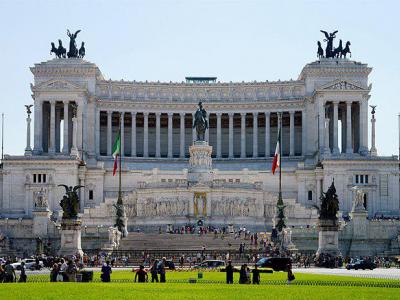
The Victor Emmanuel II National Monument, also known as the Altar of the Fatherland, honors Italy’s first king and symbolizes the nation’s unification. Constructed from 1885 to 1935, its design was inspired by the Roman Forum. The neoclassical monument blends Hellenistic influences with modern urban design, featuring grand staircases, Corinthian columns, fountains, and statues, including a striking equestrian statue of Victor Emmanuel II.
Its dimensions are imposing, with a width of 135 meters and a height of 81 meters, including statues of the goddess Victoria atop quadrigas. Also adding to its grandeur are the two colossal Italian tricolors at the sides.
The monument's key features include the Tomb of the Unknown Soldier, inaugurated in 1921. Its eternal flames perpetually guarded by soldiers reflect classical traditions of remembrance. Sculptures like The Thought and The Action are complemented by allegorical decorations and mosaics highlighting Italian virtues, sciences, and intellectual achievements. The site also honors Italy's pre-unification legacy through sculptures of 14 historic capitals and other artistic elements.
Ascending the central staircase rewards visitors with a view of the monument itself but also a panoramic vista over the city. This elevated spot offers an ideal opportunity for capturing memorable photos. For added convenience, a lift was installed in 2007, enabling visitors to reach the rooftop and enjoy a bird's-eye panorama of Rome (please note that there is a small fee for the ride).
Flanking Venice Square, the Fountains of the Two Seas symbolize Italy's geographical unity, representing the Adriatic and Tyrrhenian Seas. Beneath the monument lies a crypt built with materials from World War I battlefields, creating a sacred space for reflection.
At the base of the complex, visitors can explore the Central Museum of Italian Unification, which chronicles the country’s history from the late 18th century to World War I, and the Shrine of the Flags, showcasing military flags and artifacts. The admission is free.
The monument is a centerpiece for national celebrations like Republic Day and Liberation Day. Although initially met with controversy and subjected to derogatory nicknames like the "wedding cake," it has become one of the city's most popular attractions after the Vatican and the Roman Ruins. Despite some locals considering it tacky, there is an undeniable allure in witnessing triumphal architecture that aspires to rival the grandeur of ancient structures.
Tip:
Visit the monument at night when it is beautifully illuminated.
Its dimensions are imposing, with a width of 135 meters and a height of 81 meters, including statues of the goddess Victoria atop quadrigas. Also adding to its grandeur are the two colossal Italian tricolors at the sides.
The monument's key features include the Tomb of the Unknown Soldier, inaugurated in 1921. Its eternal flames perpetually guarded by soldiers reflect classical traditions of remembrance. Sculptures like The Thought and The Action are complemented by allegorical decorations and mosaics highlighting Italian virtues, sciences, and intellectual achievements. The site also honors Italy's pre-unification legacy through sculptures of 14 historic capitals and other artistic elements.
Ascending the central staircase rewards visitors with a view of the monument itself but also a panoramic vista over the city. This elevated spot offers an ideal opportunity for capturing memorable photos. For added convenience, a lift was installed in 2007, enabling visitors to reach the rooftop and enjoy a bird's-eye panorama of Rome (please note that there is a small fee for the ride).
Flanking Venice Square, the Fountains of the Two Seas symbolize Italy's geographical unity, representing the Adriatic and Tyrrhenian Seas. Beneath the monument lies a crypt built with materials from World War I battlefields, creating a sacred space for reflection.
At the base of the complex, visitors can explore the Central Museum of Italian Unification, which chronicles the country’s history from the late 18th century to World War I, and the Shrine of the Flags, showcasing military flags and artifacts. The admission is free.
The monument is a centerpiece for national celebrations like Republic Day and Liberation Day. Although initially met with controversy and subjected to derogatory nicknames like the "wedding cake," it has become one of the city's most popular attractions after the Vatican and the Roman Ruins. Despite some locals considering it tacky, there is an undeniable allure in witnessing triumphal architecture that aspires to rival the grandeur of ancient structures.
Tip:
Visit the monument at night when it is beautifully illuminated.
7) Musei Capitolini (Capitoline Museums) (must see)
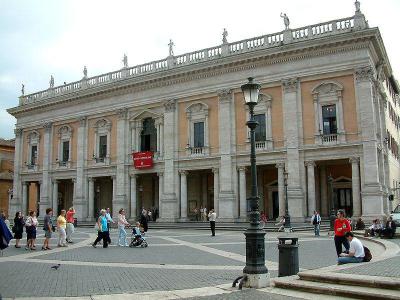
The Capitoline Museums in Rome are among the city's most prestigious art and archaeology institutions, second in prominence only to the Vatican Museums. Established in 1471 by Pope Sixtus IV, who donated significant bronze sculptures to the city, it is recognized as the world's oldest public museum. Designed by Michelangelo in 1536, the museum spans two main buildings: the Conservators' Palace and the New Palace, housing artifacts from ancient, medieval, and Renaissance periods.
Significant expansions occurred in 1734 under Pope Clement XII, who added Cardinal Albani’s antiquities to prevent their export. Rodolfo Lanciani’s 19th-century reorganization emphasized the archaeological context. The collection now covers nearly 13,000 square meters and includes modern additions such as the Central Montemartini branch and the Exedra of Marcus Aurelius.
Local highlights include the Equestrian Statue of Marcus Aurelius, moved indoors in 1990 (its place in the square is now taken by a replica), and the iconic Capitoline Wolf, a bronze sculpture potentially dating to the 5th century BC or the medieval period. The Colossus of Constantine, the Hercules of the Forum Boarium, and the Boy with Thorn are among other bronze masterpieces found here. Also noteworthy are The Dying Gaul and Arnolfo di Cambio’s Portrait of Charles I of Anjou made in the 13th century, Europe’s earliest lifelike portrait of a living figure.
Historical artifacts include the Protomoteca, busts relocated from the Pantheon, and the Conaccordo Gallery, which connects the palaces and leads to the Tabularium and the Temple of Veiovis. The Conservators' Palace features the Hall of the Horatii and Curiatii with 16th-century frescoes, and the Pinacoteca Capitolina which displays Renaissance works by Caravaggio, Titian, and Tintoretto. Its corridor showcases an Epigraphic Collection, while a staircase leading to the Tabularium gallery affords breathtaking views of the Roman Forum.
With a full-day ticket, visitors can leisurely explore both palaces, culminating in a panoramic view of ancient Rome.
The Capitoline Museums also hold historical significance as the venue where the 1957 Treaties of Rome, a cornerstone of the European Union, were signed.
Tip:
The Terrazza Caffarelli café atop the Capitoline Museums offers stunning panoramic views of Rome's rooftops and ancient ruins, especially at sunset. Enjoy excellent coffee, cakes, or an aperitivo with snacks. Accessible via Piazzale Caffarelli, the café welcomes all, even those without museum admission, for a memorable culinary and scenic experience.
Significant expansions occurred in 1734 under Pope Clement XII, who added Cardinal Albani’s antiquities to prevent their export. Rodolfo Lanciani’s 19th-century reorganization emphasized the archaeological context. The collection now covers nearly 13,000 square meters and includes modern additions such as the Central Montemartini branch and the Exedra of Marcus Aurelius.
Local highlights include the Equestrian Statue of Marcus Aurelius, moved indoors in 1990 (its place in the square is now taken by a replica), and the iconic Capitoline Wolf, a bronze sculpture potentially dating to the 5th century BC or the medieval period. The Colossus of Constantine, the Hercules of the Forum Boarium, and the Boy with Thorn are among other bronze masterpieces found here. Also noteworthy are The Dying Gaul and Arnolfo di Cambio’s Portrait of Charles I of Anjou made in the 13th century, Europe’s earliest lifelike portrait of a living figure.
Historical artifacts include the Protomoteca, busts relocated from the Pantheon, and the Conaccordo Gallery, which connects the palaces and leads to the Tabularium and the Temple of Veiovis. The Conservators' Palace features the Hall of the Horatii and Curiatii with 16th-century frescoes, and the Pinacoteca Capitolina which displays Renaissance works by Caravaggio, Titian, and Tintoretto. Its corridor showcases an Epigraphic Collection, while a staircase leading to the Tabularium gallery affords breathtaking views of the Roman Forum.
With a full-day ticket, visitors can leisurely explore both palaces, culminating in a panoramic view of ancient Rome.
The Capitoline Museums also hold historical significance as the venue where the 1957 Treaties of Rome, a cornerstone of the European Union, were signed.
Tip:
The Terrazza Caffarelli café atop the Capitoline Museums offers stunning panoramic views of Rome's rooftops and ancient ruins, especially at sunset. Enjoy excellent coffee, cakes, or an aperitivo with snacks. Accessible via Piazzale Caffarelli, the café welcomes all, even those without museum admission, for a memorable culinary and scenic experience.
8) Foro Romano (Roman Forum) (must see)
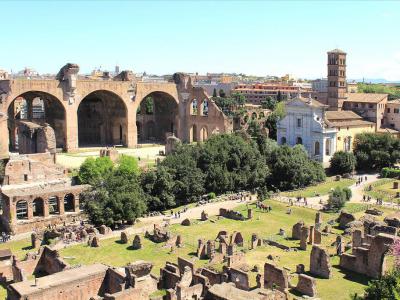
The Roman Forum, once the pulsating heart of ancient Rome's public life, evolved from a simple marketplace around 500 BC into the epicenter of Roman political, social, and religious activity. Known as the Forum Magnum, it became a hub for triumphal processions, public speeches, elections, criminal trials, gladiatorial matches, and commerce. Statues and monuments celebrating Roman leaders solidified its status as one of history’s most significant meeting places.
Initially featuring early structures like the Regia (a royal residence) and the Temple of Vesta, the Forum developed into a formal assembly area called the Comitium, where the Senate and government convened. Over centuries, temples, tribunals, and public buildings, such as the Senate House and the Temple of Saturn, transformed the Forum into a multifunctional hub. The Basilica Aemilia, built in 179 BC, expanded judicial activities, while Julius Caesar’s enhancements, including the Basilica Julia and Curia Julia, underscored its role as a center for politics, commerce, and religion.
Despite its prominence, the Forum’s importance began to decline with the emergence of grander structures, such as Trajan's Forum and the Basilica Ulpia, to the north. Unlike the more planned Imperial Forums, the Roman Forum grew organically, reflecting a mix of architectural styles across periods. Constantine the Great’s construction of the Maxentius Basilica in 312 AD marked its final significant addition, temporarily restoring its political centrality. However, the fall of the Western Roman Empire in the 5th century AD led to the Forum's destruction and decline.
Today, the Roman Forum is a sprawling ruin but remains a priceless historical treasure. Though reduced to crumbling remains, it continues to captivate visitors, drawing nearly five million annually. Highlights of the site include the Sacred Street, the Arch of Titus, and remnants of iconic buildings like the Temple of Castor and Pollux.
Initially featuring early structures like the Regia (a royal residence) and the Temple of Vesta, the Forum developed into a formal assembly area called the Comitium, where the Senate and government convened. Over centuries, temples, tribunals, and public buildings, such as the Senate House and the Temple of Saturn, transformed the Forum into a multifunctional hub. The Basilica Aemilia, built in 179 BC, expanded judicial activities, while Julius Caesar’s enhancements, including the Basilica Julia and Curia Julia, underscored its role as a center for politics, commerce, and religion.
Despite its prominence, the Forum’s importance began to decline with the emergence of grander structures, such as Trajan's Forum and the Basilica Ulpia, to the north. Unlike the more planned Imperial Forums, the Roman Forum grew organically, reflecting a mix of architectural styles across periods. Constantine the Great’s construction of the Maxentius Basilica in 312 AD marked its final significant addition, temporarily restoring its political centrality. However, the fall of the Western Roman Empire in the 5th century AD led to the Forum's destruction and decline.
Today, the Roman Forum is a sprawling ruin but remains a priceless historical treasure. Though reduced to crumbling remains, it continues to captivate visitors, drawing nearly five million annually. Highlights of the site include the Sacred Street, the Arch of Titus, and remnants of iconic buildings like the Temple of Castor and Pollux.
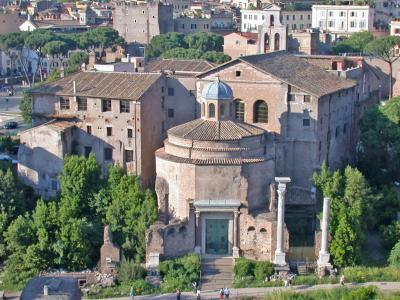
9) Tempio di Romolo (Temple of Romulus)
The Temple of Romulus, wedged between the Temple of Antoninus and Faustina and the Basilica of Maxentius along the Sacred Street, is traditionally linked to Valerius Romulus, the son of Emperor Maxentius. However, its true origins remain debated.
Some historians suggest that it originally served as a vestibule for the Temple of Peace, later repurposed by Maxentius, in the 4th century AD, as a temple honoring his son, who died in the year 309 at the tender age of four. Medieval sources and coins inscribed with “in eternal memory” phrase support this theory, though some argue the inscription may refer to a mausoleum on the Appian Way. Others claim the temple was dedicated to Constantine I.
A 19th-century theory proposes that the structure was once linked to the Temple of the Penates, which stood on the Velia Hill and, according to legend, was founded by Romulus, the mythical founder of Rome. Regardless of its origins, the temple was later incorporated into a Christian complex when Pope Felix IV converted part of it into the Basilica of Saints Cosmas and Damian in 527 AD. Over time, the structure underwent several modifications.
Architecturally, the circular temple is notable for its brick construction, concrete dome, and a façade that originally featured four statues. Its most striking feature still in place is the grand entrance, framed by two red porphyry columns, a material considered as valuable as gold in antiquity. Among its most remarkable elements is the original bronze doors, a rare surviving example from ancient Rome, still functioning with their original locking mechanism. Inside, a central circular hall is flanked by two symmetrical apsidal halls, maintaining a harmonious layout.
Despite centuries of change, the Temple of Divine Romulus remains one of the best-preserved structures in the Roman Forum.
Some historians suggest that it originally served as a vestibule for the Temple of Peace, later repurposed by Maxentius, in the 4th century AD, as a temple honoring his son, who died in the year 309 at the tender age of four. Medieval sources and coins inscribed with “in eternal memory” phrase support this theory, though some argue the inscription may refer to a mausoleum on the Appian Way. Others claim the temple was dedicated to Constantine I.
A 19th-century theory proposes that the structure was once linked to the Temple of the Penates, which stood on the Velia Hill and, according to legend, was founded by Romulus, the mythical founder of Rome. Regardless of its origins, the temple was later incorporated into a Christian complex when Pope Felix IV converted part of it into the Basilica of Saints Cosmas and Damian in 527 AD. Over time, the structure underwent several modifications.
Architecturally, the circular temple is notable for its brick construction, concrete dome, and a façade that originally featured four statues. Its most striking feature still in place is the grand entrance, framed by two red porphyry columns, a material considered as valuable as gold in antiquity. Among its most remarkable elements is the original bronze doors, a rare surviving example from ancient Rome, still functioning with their original locking mechanism. Inside, a central circular hall is flanked by two symmetrical apsidal halls, maintaining a harmonious layout.
Despite centuries of change, the Temple of Divine Romulus remains one of the best-preserved structures in the Roman Forum.
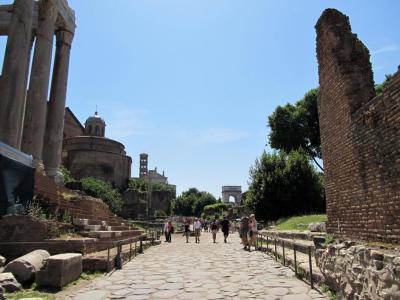
10) Via Sacra (Sacred Street)
The Sacred Street, once the main ceremonial and religious road in ancient Rome, dates back to the city's regal age. It used to link key settlements, such as Velia, to major landmarks like the Roman Forum and Capitoline Hill. As Rome grew, the street became central to both political and religious activities, passing through significant sites such as the Regia, one of the oldest buildings in the Forum, and the Comitium, the city's political hub.
The name “Sacred” derives from its association with sacred events, including the peace treaty which united the Romans and Sabines under a dual kingship of Romulus and Titus Tatius. Over time, the road was paved and modified, becoming the primary route for triumphal processions celebrating military victories. These parades, which frequently followed Roman conquests, moved through the Arch of Titus and concluded at the Arch of Septimius Severus.
As the street’s importance grew, it underwent improvements, including the addition of colonnades and other architectural enhancements. The Arch of Titus was among these significant upgrades. Over the centuries, the Sacred Street evolved from a residential area, where noble families once lived, into a monumental corridor lined with structures like the Basilica of Maxentius, the Temple of Venus and Roma, and the Temple of Peace. Its proximity to early Christian churches underscored its continued religious significance even as Rome transitioned into the imperial era.
Following the Great Fire of Rome in 64 AD, Nero redirected and straightened the eastern stretch of the street, adding colonnades and commercial spaces, effectively transforming it into a grand boulevard. In this capacity, the road was a stage for everyday Roman life, hosting solemn festivals, public gatherings, business dealings, and even prostitution.
Since the reign of Augustus, the first Roman emperor, it became part of the apotheosis ceremonies for deceased rulers; their bodies were carried along the street to the Forum for public tributes.
Visitors can still see wear and tear from Roman times on the Sacred Street's pavers, including smooth surfaces and wagon-wheel crevices. As such, it's a must-see highlight of the Roman Forum, offering a tangible connection to Rome’s ancient grandeur.
The name “Sacred” derives from its association with sacred events, including the peace treaty which united the Romans and Sabines under a dual kingship of Romulus and Titus Tatius. Over time, the road was paved and modified, becoming the primary route for triumphal processions celebrating military victories. These parades, which frequently followed Roman conquests, moved through the Arch of Titus and concluded at the Arch of Septimius Severus.
As the street’s importance grew, it underwent improvements, including the addition of colonnades and other architectural enhancements. The Arch of Titus was among these significant upgrades. Over the centuries, the Sacred Street evolved from a residential area, where noble families once lived, into a monumental corridor lined with structures like the Basilica of Maxentius, the Temple of Venus and Roma, and the Temple of Peace. Its proximity to early Christian churches underscored its continued religious significance even as Rome transitioned into the imperial era.
Following the Great Fire of Rome in 64 AD, Nero redirected and straightened the eastern stretch of the street, adding colonnades and commercial spaces, effectively transforming it into a grand boulevard. In this capacity, the road was a stage for everyday Roman life, hosting solemn festivals, public gatherings, business dealings, and even prostitution.
Since the reign of Augustus, the first Roman emperor, it became part of the apotheosis ceremonies for deceased rulers; their bodies were carried along the street to the Forum for public tributes.
Visitors can still see wear and tear from Roman times on the Sacred Street's pavers, including smooth surfaces and wagon-wheel crevices. As such, it's a must-see highlight of the Roman Forum, offering a tangible connection to Rome’s ancient grandeur.
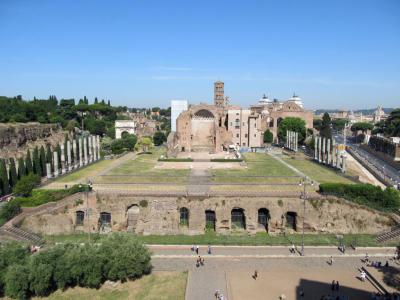
11) Templum Veneris et Romae (Temple of Venus and Roma)
The Temple of Venus and Roma is said to be the largest temple of Ancient Rome. Constructed by Emperor Hadrian on the Velian Hill, between the eastern edge of the Roman Forum and the Colosseum, it was dedicated to two goddesses: Venus, the goddess of love and bringer of good fortune, and Roma, the personification of eternal Rome.
The construction began in 121 AD and was completed 20 years later, with the official inauguration taking place another six years after that. The temple suffered damage from a fire in 307 AD, and eventually underwent modifications.
Raised on a platform measuring 145 by 100 meters, the temple's main structure, sized 110 by 53 meters, reached a height of 31 meters (complete with the statues on top). It consisted of two main chambers, each housing a cult statue of a deity. There, Venus and Roma were depicted seated on thrones. The chambers were arranged symmetrically, with the chamber of Roma facing west to the Roman Forum, and that of Venus facing east toward the Colosseum.
The entrance to each chamber was adorned with a row of four columns. Surrounding the temple, colonnaded entrances terminated in staircases leading down to the Colosseum. This arrangement provided a grand and impressive approach to the building.
One fascinating aspect of it, devised by Emperor Hadrian, was the symbolic connection between the two goddesses. By placing the divinities of Venus and Rome back-to-back in a single temple, a subtle symmetry was achieved in a sense that the Latin word "AMOR" (meaning love) can also be read as "ROMA" (which means Rome), if spelled backward.
Within Venus's chamber, there was an additional altar where newlywed couples could make sacrifices.
While the Temple of Venus and Roma no longer stands in its complete form, its remnants and historical accounts provide valuable insights into the colossality and ingenuity of Roman imperial architecture.
The construction began in 121 AD and was completed 20 years later, with the official inauguration taking place another six years after that. The temple suffered damage from a fire in 307 AD, and eventually underwent modifications.
Raised on a platform measuring 145 by 100 meters, the temple's main structure, sized 110 by 53 meters, reached a height of 31 meters (complete with the statues on top). It consisted of two main chambers, each housing a cult statue of a deity. There, Venus and Roma were depicted seated on thrones. The chambers were arranged symmetrically, with the chamber of Roma facing west to the Roman Forum, and that of Venus facing east toward the Colosseum.
The entrance to each chamber was adorned with a row of four columns. Surrounding the temple, colonnaded entrances terminated in staircases leading down to the Colosseum. This arrangement provided a grand and impressive approach to the building.
One fascinating aspect of it, devised by Emperor Hadrian, was the symbolic connection between the two goddesses. By placing the divinities of Venus and Rome back-to-back in a single temple, a subtle symmetry was achieved in a sense that the Latin word "AMOR" (meaning love) can also be read as "ROMA" (which means Rome), if spelled backward.
Within Venus's chamber, there was an additional altar where newlywed couples could make sacrifices.
While the Temple of Venus and Roma no longer stands in its complete form, its remnants and historical accounts provide valuable insights into the colossality and ingenuity of Roman imperial architecture.
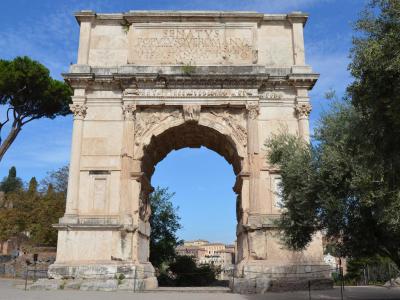
12) Arco di Tito (Arch of Titus)
The Arch of Titus, an honorific arch on the Sacred Street, was built by Emperor Domitian around 81 AD. Its purpose was to commemorate Domitian's brother Titus’ victory in Judaea (which is modern-day Israel and Palestine) and his subsequent deification. The arch celebrates the Roman triumph over the Jewish revolt (also known as the Great Revolt), which resulted in the fall of Jerusalem in 70 AD. This victory brought over 60,000 Jewish slaves and immense wealth back to Rome, funding the construction of the Colosseum.
One of the only three surviving arches out of Rome’s original 36, the Arch of Titus provides a rare visual representation of the Roman triumphal procession of 71 AD. It also portrays Titus on horseback, symbolizing Rome’s dominance, and the Eagle, a representation of Roman power.
The Roman treatment of conquered people varied. Those who surrendered quickly were often incorporated into Roman society, while those who resisted fiercely-as in Judaea-faced brutal consequences such as mass slaughter, enslavement, and destruction of homes and livelihoods. The Jewish rebellion was crushed after the Romans breached three walls of Jerusalem over seven months, leading to one of the most devastating sackings of antiquity.
The arch's panels vividly depict scenes from this momentous event, offering one of the few contemporary representations of artifacts from Herod's Temple including the menorah, a multi-branched candelabra, used in the religious rituals of Judaism. While not explicitly mentioned, the panels closely mirror the narrative of the Roman procession described a decade earlier in the book titled "The Jewish War" written by Josephus, a first-century Roman-Jewish historian.
Beyond its historical importance, the Arch of Titus showcases a significant evolution in Roman art. The reliefs inside demonstrate early illusionistic techniques, giving a sense of depth and motion, a precursor to Baroque aesthetics nearly 1,500 years later. These artistic innovations highlight the stark contrast between the flourishing Roman Empire and the struggling tribes of northern Europe, who at the time still lived in primitive conditions.
As such, the arch had a long-lasting architectural influence, serving as a model for later triumphal arches, including the Arch of Triumph in Paris. Although the identity of its architect is uncertain, Rabirius, a favored designer of Emperor Domitian, is often suggested.
For Jewish communities, the arch remains a symbol of the diaspora. The menorah relief, a significant Jewish artifact depicted on the arch, later inspired the official emblem of the State of Israel. Today, the Arch of Titus is a must-see monument in Rome, linking the ancient past to modern history and symbolizing both Roman power and Jewish resilience.
One of the only three surviving arches out of Rome’s original 36, the Arch of Titus provides a rare visual representation of the Roman triumphal procession of 71 AD. It also portrays Titus on horseback, symbolizing Rome’s dominance, and the Eagle, a representation of Roman power.
The Roman treatment of conquered people varied. Those who surrendered quickly were often incorporated into Roman society, while those who resisted fiercely-as in Judaea-faced brutal consequences such as mass slaughter, enslavement, and destruction of homes and livelihoods. The Jewish rebellion was crushed after the Romans breached three walls of Jerusalem over seven months, leading to one of the most devastating sackings of antiquity.
The arch's panels vividly depict scenes from this momentous event, offering one of the few contemporary representations of artifacts from Herod's Temple including the menorah, a multi-branched candelabra, used in the religious rituals of Judaism. While not explicitly mentioned, the panels closely mirror the narrative of the Roman procession described a decade earlier in the book titled "The Jewish War" written by Josephus, a first-century Roman-Jewish historian.
Beyond its historical importance, the Arch of Titus showcases a significant evolution in Roman art. The reliefs inside demonstrate early illusionistic techniques, giving a sense of depth and motion, a precursor to Baroque aesthetics nearly 1,500 years later. These artistic innovations highlight the stark contrast between the flourishing Roman Empire and the struggling tribes of northern Europe, who at the time still lived in primitive conditions.
As such, the arch had a long-lasting architectural influence, serving as a model for later triumphal arches, including the Arch of Triumph in Paris. Although the identity of its architect is uncertain, Rabirius, a favored designer of Emperor Domitian, is often suggested.
For Jewish communities, the arch remains a symbol of the diaspora. The menorah relief, a significant Jewish artifact depicted on the arch, later inspired the official emblem of the State of Israel. Today, the Arch of Titus is a must-see monument in Rome, linking the ancient past to modern history and symbolizing both Roman power and Jewish resilience.
13) Palatino (Palatine Hill) (must see)
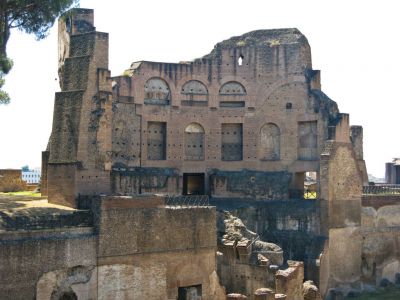
The Palatine Hill, centrally located among Rome’s seven hills, is one of the city’s oldest and most historically significant areas. Often referred to as "the first nucleus of the Roman Empire," it is now a vast open-air museum.
Overlooking the Roman Forum and Circus Maximus, Palatine Hill became the desirable location for the homes of Rome's wealthiest citizens during the Republican era. During the Imperial era, starting from the reign of Augustus, it was an exclusive domain of emperors, featuring luxurious palaces like those of Augustus, Tiberius, and Domitian. Before imperial development, the hill had two summits, Palatium and Germalus, separated by a depression. Over time, the Palatine played a central role in Rome’s evolution, with continuous habitation traced back to the 10th century BC. Excavations reveal funerary huts from the 9th–7th centuries BC, aligning with the city’s mythological founding period.
The modern-day word “palace” is derived from the word “Palatine”.
Roman mythology enriches its legacy, as the hill was believed to be the site where Rome was reportedly founded. According to legend, it was on this hill that the twins Romulus and Remus, the legendary founders of Rome, were discovered by a she-wolf who raised them. When they grew up, the twins set out to build a city of their own. While Remus wanted to build it on Aventine Hill, Romulus had his mind set firmly on Palatine Hill. The brothers argued fiercely, and during the fight, Romulus killed Remus. He went on to build the city in 753 BC, calling it Rome, and reigned as its first king.
Monumental structures dominate the site, including the Palace of Domitian and the House of Livia, the latter renowned for its well-preserved frescoes. The House of Tiberius partially survives within the Farnese Gardens.
Extensive archaeological excavations, dating back to Augustus’ time, have uncovered significant finds, including Bronze Age artifacts and the Palatine House, thought to be the birthplace of Emperor Augustus. Modern investigations have revealed frescoed walls and mosaics, along with the Lupercal, the cave at the southwest foot of the Palatine Hill, where Romulus and Remus were suckled by the she-wolf.
Tip:
"Super" tickets provide access to the key attractions on the Hill, including the Roman Forum and Colosseum. Prepare with water, snacks, sunscreen, a hat, and sturdy shoes, as the steep paths and lack of vending machines can be challenging.
Overlooking the Roman Forum and Circus Maximus, Palatine Hill became the desirable location for the homes of Rome's wealthiest citizens during the Republican era. During the Imperial era, starting from the reign of Augustus, it was an exclusive domain of emperors, featuring luxurious palaces like those of Augustus, Tiberius, and Domitian. Before imperial development, the hill had two summits, Palatium and Germalus, separated by a depression. Over time, the Palatine played a central role in Rome’s evolution, with continuous habitation traced back to the 10th century BC. Excavations reveal funerary huts from the 9th–7th centuries BC, aligning with the city’s mythological founding period.
The modern-day word “palace” is derived from the word “Palatine”.
Roman mythology enriches its legacy, as the hill was believed to be the site where Rome was reportedly founded. According to legend, it was on this hill that the twins Romulus and Remus, the legendary founders of Rome, were discovered by a she-wolf who raised them. When they grew up, the twins set out to build a city of their own. While Remus wanted to build it on Aventine Hill, Romulus had his mind set firmly on Palatine Hill. The brothers argued fiercely, and during the fight, Romulus killed Remus. He went on to build the city in 753 BC, calling it Rome, and reigned as its first king.
Monumental structures dominate the site, including the Palace of Domitian and the House of Livia, the latter renowned for its well-preserved frescoes. The House of Tiberius partially survives within the Farnese Gardens.
Extensive archaeological excavations, dating back to Augustus’ time, have uncovered significant finds, including Bronze Age artifacts and the Palatine House, thought to be the birthplace of Emperor Augustus. Modern investigations have revealed frescoed walls and mosaics, along with the Lupercal, the cave at the southwest foot of the Palatine Hill, where Romulus and Remus were suckled by the she-wolf.
Tip:
"Super" tickets provide access to the key attractions on the Hill, including the Roman Forum and Colosseum. Prepare with water, snacks, sunscreen, a hat, and sturdy shoes, as the steep paths and lack of vending machines can be challenging.
14) Arco di Costantino (Arch of Constantine)
On October 28, 312 AD, Roman emperor Constantine had an epic battle with his rival, co-emperor Maxentius. It went down in history as the Battle of the Milvian Bridge. Victorious Constantine became the sole ruler of the Roman Empire, thus ending the system of Tetrarchy. He is generally regarded as the last great emperor of Rome.
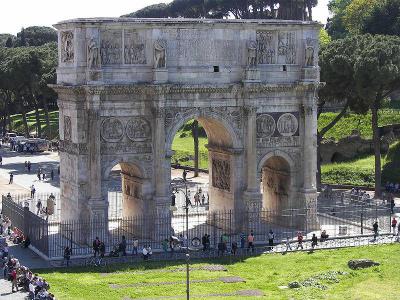
The Arch of Constantine, Rome’s largest triumphal arch, was dedicated in 315 AD to commemorate Constantine’s victory. Located between the Colosseum and Palatine Hill, it spans the Road of Triumph, marking the route of Roman military parades. The arch stands 21 meters high, featuring three bays and incorporating elements from earlier monuments, including reliefs and statues from the reigns of Trajan, Hadrian, and Marcus Aurelius, reworked to celebrate Constantine.
Scholars have debated the arch's origins, suggesting it may predate Constantine and even have ties to Hadrian’s or Maxentius’s reigns. The arch exemplifies Late Antique artistic styles, with a blend of reused classical Greek-inspired elements and newly-created simpler, symbolic works. Reliefs from earlier monuments display classical proportions and dynamic movement, while the 4th-century additions feature rigid and geometric forms, reflecting changes in artistic priorities or economic constraints at that time. This stylistic contrast highlights the transition from Rome’s classical tradition to the evolving aesthetics of Late Antiquity.
Decorative elements on the arch include reliefs of Dacians from Trajan’s reign, panels depicting Marcus Aurelius’s military campaigns, and roundels from Hadrian’s era reworked to depict Constantine. A Constantinian frieze narrates his campaign against Maxentius, while inscriptions celebrate him as a pious and victorious leader.
One such inscription credits Constantine with saving the Roman people by divine inspiration. It refers to his vision before the Battle of Milvian Bridge in 312 AD, where he claimed to have seen a cross in the sky and heard the words: "In this sign, you will conquer." This event is often linked to Constantine's promotion of Christianity within the Roman Empire. The arch also balances pagan and Christian themes, symbolizing Constantine’s shifting religious stance during this period.
The Arch of Constantine's global influence as a monument includes the likes of the Arch of Triumph in Paris, the Marble Arch in London, Washington Union Station in Washington DC, and the American Museum of Natural History in New York City.
The Arch of Constantine, Rome’s largest triumphal arch, was dedicated in 315 AD to commemorate Constantine’s victory. Located between the Colosseum and Palatine Hill, it spans the Road of Triumph, marking the route of Roman military parades. The arch stands 21 meters high, featuring three bays and incorporating elements from earlier monuments, including reliefs and statues from the reigns of Trajan, Hadrian, and Marcus Aurelius, reworked to celebrate Constantine.
Scholars have debated the arch's origins, suggesting it may predate Constantine and even have ties to Hadrian’s or Maxentius’s reigns. The arch exemplifies Late Antique artistic styles, with a blend of reused classical Greek-inspired elements and newly-created simpler, symbolic works. Reliefs from earlier monuments display classical proportions and dynamic movement, while the 4th-century additions feature rigid and geometric forms, reflecting changes in artistic priorities or economic constraints at that time. This stylistic contrast highlights the transition from Rome’s classical tradition to the evolving aesthetics of Late Antiquity.
Decorative elements on the arch include reliefs of Dacians from Trajan’s reign, panels depicting Marcus Aurelius’s military campaigns, and roundels from Hadrian’s era reworked to depict Constantine. A Constantinian frieze narrates his campaign against Maxentius, while inscriptions celebrate him as a pious and victorious leader.
One such inscription credits Constantine with saving the Roman people by divine inspiration. It refers to his vision before the Battle of Milvian Bridge in 312 AD, where he claimed to have seen a cross in the sky and heard the words: "In this sign, you will conquer." This event is often linked to Constantine's promotion of Christianity within the Roman Empire. The arch also balances pagan and Christian themes, symbolizing Constantine’s shifting religious stance during this period.
The Arch of Constantine's global influence as a monument includes the likes of the Arch of Triumph in Paris, the Marble Arch in London, Washington Union Station in Washington DC, and the American Museum of Natural History in New York City.
