Custom Walk in Tours, France by jessicaowens31_82489e created on 2026-03-25
Guide Location: France » Tours
Guide Type: Custom Walk
# of Sights: 7
Tour Duration: 3 Hour(s)
Travel Distance: 5.9 Km or 3.7 Miles
Share Key: X94J4
Guide Type: Custom Walk
# of Sights: 7
Tour Duration: 3 Hour(s)
Travel Distance: 5.9 Km or 3.7 Miles
Share Key: X94J4
How It Works
Please retrieve this walk in the GPSmyCity app. Once done, the app will guide you from one tour stop to the next as if you had a personal tour guide. If you created the walk on this website or come to the page via a link, please follow the instructions below to retrieve the walk in the app.
Retrieve This Walk in App
Step 1. Download the app "GPSmyCity: Walks in 1K+ Cities" on Apple App Store or Google Play Store.



Step 2. In the GPSmyCity app, download(or launch) the guide "Tours Map and Walking Tours".
Step 3. Tap the menu button located at upper right corner of the "Walks" screen and select "Retrieve custom walk". Enter the share key: X94J4
1) Basilica of St. Martin (must see)
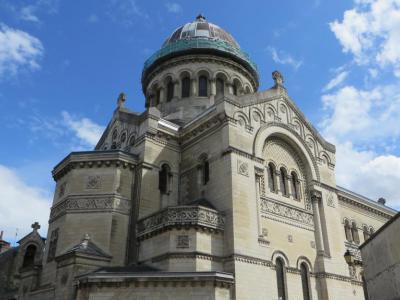
The beginning of the story of the Basilica of Saint Martin goes all the way back to the 4th Century, when a small chapel was established here. The chapel was dedicated to Saint Martin, who was the bishop of Tours at that time. Destroyed and rebuilt many times since, it was architect Victor Laloux that designed the Roman-Byzantine basilica on the site today.
The first basilica was built in the fifth century over the ruins of an earlier chapel. The basilica was dedicated to Saint Martin of Tours and it was erected over his tomb. Alcuin, an adviser of Charlemagne, was appointed Abbot of the monastic establishment of Saint-Martin's, developed as a collegiate church and governed by a community of canons.
The medieval chapel was destroyed in the French Revolution. Only two old towers connected to the medieval chapel are still standing today. Between the years of 1896 and 1924 the present church was built by Victor Laloux in a neo-Byzantine style on the site of the original basilica. The church was dedicated in 1925.
It has been said the exterior design is reminiscent of an old European synagogue. The interior has white stone walls and stained glass windows showing scenes in the life of the Saint. The new, modern crypt of the church holds the remains of Saint Martin.
The Basilica is located in the Tours Old Town. Saint Martin was third bishop of Tours. He is one of the most familiar and recognizable Christian saints in France. Because of his military experience and his leadership of French Christians, Saint Martin is seen as a protector of France.
The first basilica was built in the fifth century over the ruins of an earlier chapel. The basilica was dedicated to Saint Martin of Tours and it was erected over his tomb. Alcuin, an adviser of Charlemagne, was appointed Abbot of the monastic establishment of Saint-Martin's, developed as a collegiate church and governed by a community of canons.
The medieval chapel was destroyed in the French Revolution. Only two old towers connected to the medieval chapel are still standing today. Between the years of 1896 and 1924 the present church was built by Victor Laloux in a neo-Byzantine style on the site of the original basilica. The church was dedicated in 1925.
It has been said the exterior design is reminiscent of an old European synagogue. The interior has white stone walls and stained glass windows showing scenes in the life of the Saint. The new, modern crypt of the church holds the remains of Saint Martin.
The Basilica is located in the Tours Old Town. Saint Martin was third bishop of Tours. He is one of the most familiar and recognizable Christian saints in France. Because of his military experience and his leadership of French Christians, Saint Martin is seen as a protector of France.
2) Place Plumereau (Plum Square) (must see)
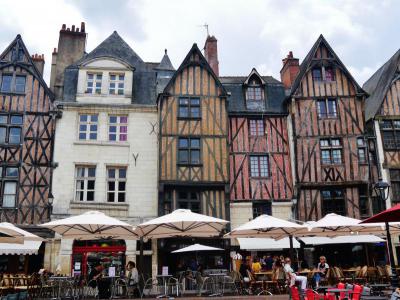
The most touristy place in Tours is the Place Plumereau, or as the locals call it "PlumSquare." Not only popular for visitors, it is also a favorite watering hole for students and the locals. It is in the center of the Saint-Martin district of the city, a very historic area of Tours old town.
The place was not always named Place Plumereau. It was known as Carroi aux Chapeaux in the 13th century, Fruits Square in 1816, and Carroi des Quenouilles. Finally, on 18 November 1888, it became Place Plumereau.
The square is named Plumereau in honor of M. Charles Plumereau (1818-1885). M. Plumereau had no family or heirs. He was a city councilor and when he died he bequeathed 3,000 francs to the city.
The square is lined with half-timbered houses and mansions with Renaissance and Romanesque facades from the 15th century. The square is close to the local university. This makes it a popular spot for students. With the students, locals, and tourists, things can be quite crowded at times.
Seating is no problem. Most of the restaurants and cafes set out chairs on the streets and terraces even in winter.
The place was not always named Place Plumereau. It was known as Carroi aux Chapeaux in the 13th century, Fruits Square in 1816, and Carroi des Quenouilles. Finally, on 18 November 1888, it became Place Plumereau.
The square is named Plumereau in honor of M. Charles Plumereau (1818-1885). M. Plumereau had no family or heirs. He was a city councilor and when he died he bequeathed 3,000 francs to the city.
The square is lined with half-timbered houses and mansions with Renaissance and Romanesque facades from the 15th century. The square is close to the local university. This makes it a popular spot for students. With the students, locals, and tourists, things can be quite crowded at times.
Seating is no problem. Most of the restaurants and cafes set out chairs on the streets and terraces even in winter.
3) Château de Tours (Tours Castle)
Clearly the Chateau is not what it used to be. Ah, the snows of yesteryear! On the 13th of May 1429, Joan of Arc was received here by Charles VII, shortly after she had saved Orleans. The chateau at the time was a traditional royal residence. There is a plaque across the road from the castle to mark the event. All gone now!
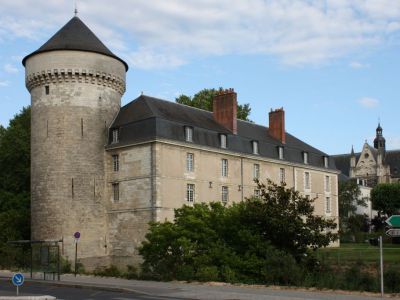
The chateau was built in the 11th century for the Lords of France. Somehow, until the year 2000, it saw service as an aquarium. It held around 1,500 fish of 200 different species. The Grevin Museum also founded a branch here. The castle is classified as a Historical Monument since 1913.
At the present time the chateau shows contemporary exhibitions of paintings and photographs. The exhibits, managed by Le Jeu de Paume, Include art by Joan Miro, Daniel Buren, Nadar, and Robert Capa.
The Chateau is located in the center of the city, surrounded by gardens. It has been through a lot. Two towers remain. The inside is not breathtaking. But, once upon a time...
The chateau was built in the 11th century for the Lords of France. Somehow, until the year 2000, it saw service as an aquarium. It held around 1,500 fish of 200 different species. The Grevin Museum also founded a branch here. The castle is classified as a Historical Monument since 1913.
At the present time the chateau shows contemporary exhibitions of paintings and photographs. The exhibits, managed by Le Jeu de Paume, Include art by Joan Miro, Daniel Buren, Nadar, and Robert Capa.
The Chateau is located in the center of the city, surrounded by gardens. It has been through a lot. Two towers remain. The inside is not breathtaking. But, once upon a time...
4) Saint Gatien's Cathedral (must see)
"...not until the cathedral is finished" is an old saying around the city of Tours. It refers to the cathedral of Saint Gatien. The cathedral was dedicated to Saint Gatianus in 1356 but it was the reincarnation of several other churches on the site. The first was dedicated to Saint Maurice and built by Bishop Lidorius in 371.
Lidorius' church burned in 558 and was rebuilt by Gregory of Tours in 590. In 1160 a new structure was erected in the Angevin style. This one burned before it was finished. Work resumed in 1220. Many renovations in different styles were made. The choir and transept used the lower Romanesque structure. Parts were Gothic or Rayonnant.
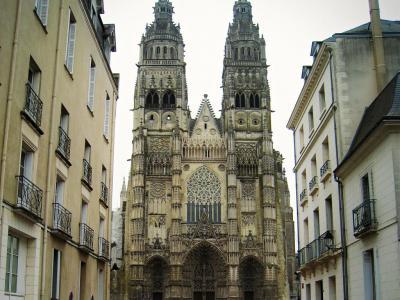
Further work was interrupted by the Hundred Years War, a long time to wait for the cathedral to be finished. But not to worry, The nave was finished in the 15th century. The two Renaissance towers were erected outside the ancient city walls. The first tower was finished in 1534. The second was put up in 1547.
During the French Revolution, the church was magically changed into a Temple of Reason. Napoleon made up with the Pope, however, and reason was restored and the church became a church again. Major restoration commenced in 1993. The organ and the upper windows were restored. The rose window was completed and a new altar was dedicated in 2018.
The sides of the cathedral are supported with enormous flying buttresses and spires. The north transept has two extra buttresses and a rose window. The window has a bar across its face to provide extra strength.
The nave holds a monumental tomb for the children of King Charles VII and Ann of Brittany. Made in 1506, the Italian-style tomb is of Carrara marble.
Three enormous rose windows of stained glass adorn the west, north, and south ends of the cathedral. The windows were made in the style of the glass artisans of Tours. They admit more natural light and sharpen the images. This permitted more expressiveness in the subjects depicted, creating a three-dimensional effect.
At last, the cathedral is finished. The "wait" is over.
Why You Should Visit:
To be overwhelmed by the craftsmanship of the Middle Ages, especially with the great rose windows. The building arts in this church have been lost, but some things remain.
Lidorius' church burned in 558 and was rebuilt by Gregory of Tours in 590. In 1160 a new structure was erected in the Angevin style. This one burned before it was finished. Work resumed in 1220. Many renovations in different styles were made. The choir and transept used the lower Romanesque structure. Parts were Gothic or Rayonnant.
Further work was interrupted by the Hundred Years War, a long time to wait for the cathedral to be finished. But not to worry, The nave was finished in the 15th century. The two Renaissance towers were erected outside the ancient city walls. The first tower was finished in 1534. The second was put up in 1547.
During the French Revolution, the church was magically changed into a Temple of Reason. Napoleon made up with the Pope, however, and reason was restored and the church became a church again. Major restoration commenced in 1993. The organ and the upper windows were restored. The rose window was completed and a new altar was dedicated in 2018.
The sides of the cathedral are supported with enormous flying buttresses and spires. The north transept has two extra buttresses and a rose window. The window has a bar across its face to provide extra strength.
The nave holds a monumental tomb for the children of King Charles VII and Ann of Brittany. Made in 1506, the Italian-style tomb is of Carrara marble.
Three enormous rose windows of stained glass adorn the west, north, and south ends of the cathedral. The windows were made in the style of the glass artisans of Tours. They admit more natural light and sharpen the images. This permitted more expressiveness in the subjects depicted, creating a three-dimensional effect.
At last, the cathedral is finished. The "wait" is over.
Why You Should Visit:
To be overwhelmed by the craftsmanship of the Middle Ages, especially with the great rose windows. The building arts in this church have been lost, but some things remain.
5) Rue Nationale (National Street) (must see)
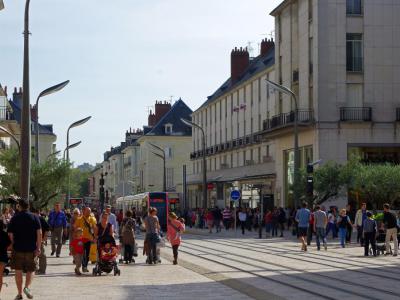
National Street (Rue Nationale) in Tours is one of the city's oldest and busiest shopping streets, reflecting centuries of history, architecture, and urban planning. Spanning 700 meters through the city center, this north-south street connects the Place Anatole France and Pont Wilson to Avenue de Grammont, forming part of a straight seven-kilometer road that includes Avenue de la Tranchée and Avenue de Grammont.
Originally known as Royal Street (Rue Royale), the street was restructured in 1777 based on designs by Jean Cabet de Limeray. This marked a pivotal shift in the city's urban layout, changing from an east-west to a north-south axis, centered around the Saint-Julien church. The street underwent significant changes in 1840 under Mayor Walvein, who imposed strict architectural guidelines to ensure symmetry in the facades, creating a mirrored effect across the street at Place Anatole France.
In 1884, under Mayor Jules Charpentier, Royal Street was renamed National Street. The street faced devastation during World War II when Nazi bombings in June 1940 led to a major fire, destroying parts of the street including the old City Hall. Post-war reconstruction led by architect Pierre Patout significantly altered the northern part of National Street, expanding it by ten meters.
The completion of the A10 highway in 1981 shifted major traffic away from National Street, which previously served as a critical route from Paris to Spain. Today, the street is characterized by a vibrant commercial scene, with the northern part accommodating car and bus traffic, and the southern part pedestrianized and reserved for public transport.
National Street starts at the central library and the ancient Saint-Julien church. It houses notable historical sites like the Hôtel du Faisan at No. 17 and the birthplace of French literary giant Honoré de Balzac at No. 39. The street also features statues of renowned intellectuals René Descartes and François Rabelais, and hosts two museums: the Wine Museum and the Companion Museum, located at No. 16 and No. 8, respectively.
The evolution of Rue Nationale from a royal avenue to a modern shopping street encapsulates the rich history and cultural heritage of Tours, making it a pivotal element in the city’s identity and daily life.
Originally known as Royal Street (Rue Royale), the street was restructured in 1777 based on designs by Jean Cabet de Limeray. This marked a pivotal shift in the city's urban layout, changing from an east-west to a north-south axis, centered around the Saint-Julien church. The street underwent significant changes in 1840 under Mayor Walvein, who imposed strict architectural guidelines to ensure symmetry in the facades, creating a mirrored effect across the street at Place Anatole France.
In 1884, under Mayor Jules Charpentier, Royal Street was renamed National Street. The street faced devastation during World War II when Nazi bombings in June 1940 led to a major fire, destroying parts of the street including the old City Hall. Post-war reconstruction led by architect Pierre Patout significantly altered the northern part of National Street, expanding it by ten meters.
The completion of the A10 highway in 1981 shifted major traffic away from National Street, which previously served as a critical route from Paris to Spain. Today, the street is characterized by a vibrant commercial scene, with the northern part accommodating car and bus traffic, and the southern part pedestrianized and reserved for public transport.
National Street starts at the central library and the ancient Saint-Julien church. It houses notable historical sites like the Hôtel du Faisan at No. 17 and the birthplace of French literary giant Honoré de Balzac at No. 39. The street also features statues of renowned intellectuals René Descartes and François Rabelais, and hosts two museums: the Wine Museum and the Companion Museum, located at No. 16 and No. 8, respectively.
The evolution of Rue Nationale from a royal avenue to a modern shopping street encapsulates the rich history and cultural heritage of Tours, making it a pivotal element in the city’s identity and daily life.
6) Hotel de Ville (City Hall) (must see)
Joan of Arc is remembered and celebrated in the City Hall of Tours. A triptych of her life by Jean-Paul Laurens decorates the hall. It is appropriate. Wars are recalled in a staircase. The aspirations of the revolution are not overlooked.
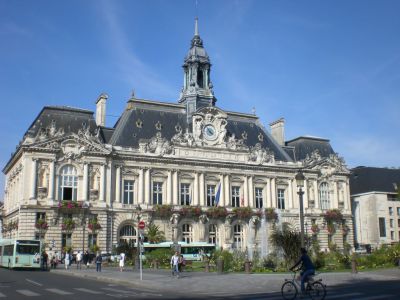
On the ground floor there is a stone peristyle serving as an exhibition space. The building is rather huge compared to the Place Jean-Jaeres or the Palace of Justice. More than any other civic building, it is meant to declare the virtues and authority of the Republic. The hall has a distinct Parisian ambience.
Various artists have contributed to this Hall on the Loire. There are four Atlantean sculptures by Francois Sicard on the facade. There is the clock, flanked by two caryatids, "Day and Night" by Emile Joseph Nestor Carlier. The rivers Loire and Cher are represented by two lengthy figures created by Jean-Antoine Injalbert.
The east and west wings of the Hall are decorated with works of art. "Courage" and "Strength" of Jean-Baptiste Hugues in the west wing. In the east wing we have "Education" and Vigilance" by Alphonse Cordonnier. The roof served as a model for the Hotel de Ville in Montreal Canada in 1922 when its roof was destroyed by fire.
The hall was built in 1904 by Victor Laloux. Inside the Hall as one enters, there is a golden square-shaped dome with the letters "RF", "Republique Francais." Saint Joan would approve.
On the ground floor there is a stone peristyle serving as an exhibition space. The building is rather huge compared to the Place Jean-Jaeres or the Palace of Justice. More than any other civic building, it is meant to declare the virtues and authority of the Republic. The hall has a distinct Parisian ambience.
Various artists have contributed to this Hall on the Loire. There are four Atlantean sculptures by Francois Sicard on the facade. There is the clock, flanked by two caryatids, "Day and Night" by Emile Joseph Nestor Carlier. The rivers Loire and Cher are represented by two lengthy figures created by Jean-Antoine Injalbert.
The east and west wings of the Hall are decorated with works of art. "Courage" and "Strength" of Jean-Baptiste Hugues in the west wing. In the east wing we have "Education" and Vigilance" by Alphonse Cordonnier. The roof served as a model for the Hotel de Ville in Montreal Canada in 1922 when its roof was destroyed by fire.
The hall was built in 1904 by Victor Laloux. Inside the Hall as one enters, there is a golden square-shaped dome with the letters "RF", "Republique Francais." Saint Joan would approve.
7) Jardin Botanique (Botanical Gardens) (must see)
Botanical Garden of Tours, located on Boulevard Tonnellé, is a cherished 5-hectare municipal botanical garden and arboretum with a rich history dating back to 1843. Established through public subscription and spearheaded by pharmacist Jean-Anthyme Margueron, it stands as Tours' oldest public garden. Originally designed to support the newly created General Hospice and the Preparatory School of Pharmacy in 1841, the garden began with a diverse collection of approximately 2,000 medicinal and exotic plants. This collection was housed within greenhouses, an orchard, and the garden proper.
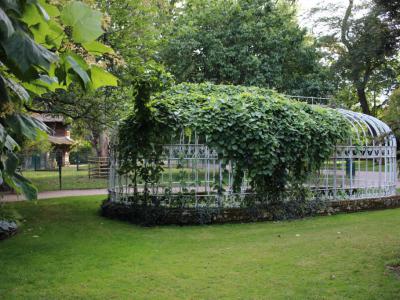
Tragically, the garden suffered severe flooding from the Loire River twice, once in 1848 and again in 1856, reaching depths of up to 2 meters. These events necessitated extensive rebuilding efforts, including the replacement of many trees. The garden continued to evolve, adding an orangery and an animal park in 1863, followed by the construction of new greenhouses in 1890 under Louis Madelin's direction. These greenhouses, which included cold, temperate, and hot environments, marked a significant development, and the garden's first seed catalog was published in 1901. However, the greenhouses sustained damage during World War II due to bombardments.
Today, the Botanical Garden of Tours boasts around 2,000 taxa, meticulously organized across various themed sections. The north part of the garden features regular parterres along a magnolia-lined avenue, complete with a pool adorned with water lilies and lotus. This area was renovated in 1980 to include themed gardens and a phylogenetic garden. The eastern section is dedicated to bulbs, rhizomes, and perennials and includes a garden illustrating plant evolution. The southern portion of the garden showcases an impressive English-style arboretum, a pond, and a "garden of simples," reminiscent of medieval botanical collections. To the west, visitors can explore a heath, bog, Mediterranean garden, and an alpine garden.
Additional facilities in the Botanical Garden include an orangery, exhibition greenhouses, and a small animal area, making it a comprehensive and educational destination for botany enthusiasts and the general public alike.
Tragically, the garden suffered severe flooding from the Loire River twice, once in 1848 and again in 1856, reaching depths of up to 2 meters. These events necessitated extensive rebuilding efforts, including the replacement of many trees. The garden continued to evolve, adding an orangery and an animal park in 1863, followed by the construction of new greenhouses in 1890 under Louis Madelin's direction. These greenhouses, which included cold, temperate, and hot environments, marked a significant development, and the garden's first seed catalog was published in 1901. However, the greenhouses sustained damage during World War II due to bombardments.
Today, the Botanical Garden of Tours boasts around 2,000 taxa, meticulously organized across various themed sections. The north part of the garden features regular parterres along a magnolia-lined avenue, complete with a pool adorned with water lilies and lotus. This area was renovated in 1980 to include themed gardens and a phylogenetic garden. The eastern section is dedicated to bulbs, rhizomes, and perennials and includes a garden illustrating plant evolution. The southern portion of the garden showcases an impressive English-style arboretum, a pond, and a "garden of simples," reminiscent of medieval botanical collections. To the west, visitors can explore a heath, bog, Mediterranean garden, and an alpine garden.
Additional facilities in the Botanical Garden include an orangery, exhibition greenhouses, and a small animal area, making it a comprehensive and educational destination for botany enthusiasts and the general public alike.
