Custom Walk in Rhodes, Greece by srijitac_77ead6 created on 2026-04-04
Guide Location: Greece » Rhodes
Guide Type: Custom Walk
# of Sights: 6
Tour Duration: 1 Hour(s)
Travel Distance: 2.8 Km or 1.7 Miles
Share Key: LFYET
Guide Type: Custom Walk
# of Sights: 6
Tour Duration: 1 Hour(s)
Travel Distance: 2.8 Km or 1.7 Miles
Share Key: LFYET
How It Works
Please retrieve this walk in the GPSmyCity app. Once done, the app will guide you from one tour stop to the next as if you had a personal tour guide. If you created the walk on this website or come to the page via a link, please follow the instructions below to retrieve the walk in the app.
Retrieve This Walk in App
Step 1. Download the app "GPSmyCity: Walks in 1K+ Cities" on Apple App Store or Google Play Store.



Step 2. In the GPSmyCity app, download(or launch) the guide "Rhodes Map and Walking Tours".
Step 3. Tap the menu button located at upper right corner of the "Walks" screen and select "Retrieve custom walk". Enter the share key: LFYET
1) Stoa Building
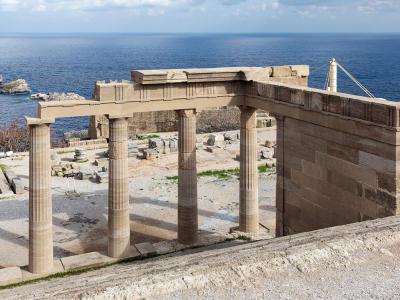
The Stoa Building is another historical site within the Acropolis of Rhodes that has been preserved for visitors today. Constructed towards the end of the 3rd century BC, this building would have been an impressive sight in classical times, large enough to be clearly visible from the lower town and harbor of Rhodes. A "stoa" in ancient Greece typically featured two long rows of columns supporting a roof, with walls at each end to hold the structure together.
Although the Stoa in Rhodes hasn't survived intact, many of its columns and the original floor plan are still visible. The structure spans 87 meters in length and originally included fourty-two columns, while the middle of the supporting wall was designed to accommodate a grand staircase. This large building served as a hub for visitors coming from the lower town, likely housing market stalls and providing space for public events or simply offering a shady respite from the intense Mediterranean sun. The Stoa of Rhodes is located lower down, likely forming part of the approach or surrounding structures.
Over time, the ancient Rhodians expanded the building and cleverly integrated two large, underground cisterns to collect rainwater from the roof and the propylaia staircase, showcasing their ingenuity in water management.
Although the Stoa in Rhodes hasn't survived intact, many of its columns and the original floor plan are still visible. The structure spans 87 meters in length and originally included fourty-two columns, while the middle of the supporting wall was designed to accommodate a grand staircase. This large building served as a hub for visitors coming from the lower town, likely housing market stalls and providing space for public events or simply offering a shady respite from the intense Mediterranean sun. The Stoa of Rhodes is located lower down, likely forming part of the approach or surrounding structures.
Over time, the ancient Rhodians expanded the building and cleverly integrated two large, underground cisterns to collect rainwater from the roof and the propylaia staircase, showcasing their ingenuity in water management.
2) Nymphaea Cave Sanctuary
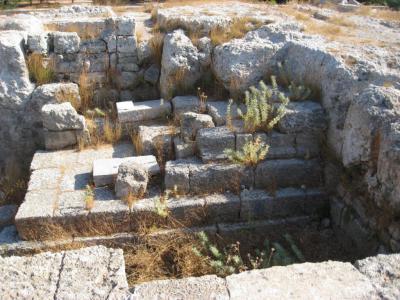
At the northern edge of the Acropolis of Rhodes, you'll find the Nymphaea, a fascinating site featuring four caverns carved directly into the earth, linked by interconnecting underground passages. Inside these caves, there are small grottoes where statuettes were once placed, along with water cisterns that connected to ancient underground aqueducts. The green spaces at the entrance served as tranquil areas for reflection and worship during the Hellenistic period.
In ancient Greek religion, nymphs-supernatural female entities associated with water-were highly revered. Although it’s unclear which specific nymph or deity was venerated here, such sites were typically built within natural grottoes and often featured water elements.
Today, the Nymphaea, along with the rest of the Acropolis, is an open-air site open to the public at all times. Exploring these cool caves offers a refreshing respite from the Mediterranean heat and a serene spot to contemplate the ancient lifestyle of Rhodes.
In ancient Greek religion, nymphs-supernatural female entities associated with water-were highly revered. Although it’s unclear which specific nymph or deity was venerated here, such sites were typically built within natural grottoes and often featured water elements.
Today, the Nymphaea, along with the rest of the Acropolis, is an open-air site open to the public at all times. Exploring these cool caves offers a refreshing respite from the Mediterranean heat and a serene spot to contemplate the ancient lifestyle of Rhodes.
3) Temple of Athena Polias and Zeus Polieus
The Temple of Athena Polias and Zeus Polieus, located at the northern edge of the Acropolis, was more than just a place of worship; it also doubled as a key place for storing important treaties and documents during the Hellenistic period of Rhodes.
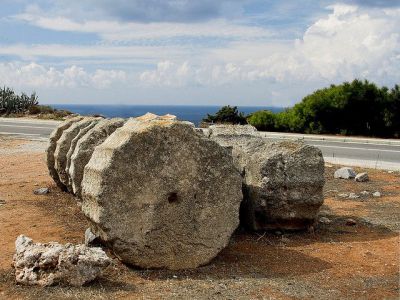
Surrounded by columns on all sides, this temple was quite the sight back in the day. Even the remains we see today are impressive and give us a hint of its past glory. You can still see parts of its structure, like the column drums-some are as big as 1.20 meters in diameter and others are a bit smaller at 1 meter across.
From inscriptions found on-site, we know that people came here to worship both Athena and Zeus, with several statues of Athena also discovered here. Researchers think this temple was built before the nearby Stoa Building, around the 4th century B.C. Later on, in the 5th and 6th centuries A.D., a Christian church was raised right over the original temple, and in medieval times, they even added a monastery.
Surrounded by columns on all sides, this temple was quite the sight back in the day. Even the remains we see today are impressive and give us a hint of its past glory. You can still see parts of its structure, like the column drums-some are as big as 1.20 meters in diameter and others are a bit smaller at 1 meter across.
From inscriptions found on-site, we know that people came here to worship both Athena and Zeus, with several statues of Athena also discovered here. Researchers think this temple was built before the nearby Stoa Building, around the 4th century B.C. Later on, in the 5th and 6th centuries A.D., a Christian church was raised right over the original temple, and in medieval times, they even added a monastery.
4) Ancient Stadium of Rhodes (must see)
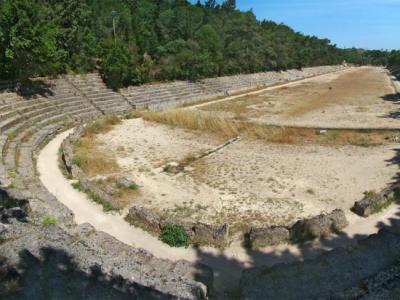
At the ancient Acropolis of Rhodes, visitors have the opportunity to explore the remains of a stadium that dates back to the 2nd century BC. Remarkably, parts of it are still standing today, including the "Sphendone" (the curved end with a turning post), the "Proedries" (the seating area for officials), and some of the lower seats in the auditorium. Built primarily from locally-sourced limestone, this robust site not only withstands the test of time but also showcases the craftsmanship of ancient builders who constructed it by hand.
The stadium was a significant venue for games similar to those of the Olympics, focusing on events connected to the Cult of Apollo; moreover, it played an integral role in the civic and religious activities of the ancient city. Influenced by Hellenistic culture, the people of Rhodes embraced the Greek gods, and remains of the temples dedicated to Zeus, Athena, Apollo, and Helios can be found nearby.
As you wander through the site, you can almost picture the ancient Rhodians gathering in this very setting. Additionally, the view of Rhodes Town from the stadium is impressive, offering a perspective on the area's landscape and cultural heritage.
The stadium was a significant venue for games similar to those of the Olympics, focusing on events connected to the Cult of Apollo; moreover, it played an integral role in the civic and religious activities of the ancient city. Influenced by Hellenistic culture, the people of Rhodes embraced the Greek gods, and remains of the temples dedicated to Zeus, Athena, Apollo, and Helios can be found nearby.
As you wander through the site, you can almost picture the ancient Rhodians gathering in this very setting. Additionally, the view of Rhodes Town from the stadium is impressive, offering a perspective on the area's landscape and cultural heritage.
5) Odeon of Rhodes
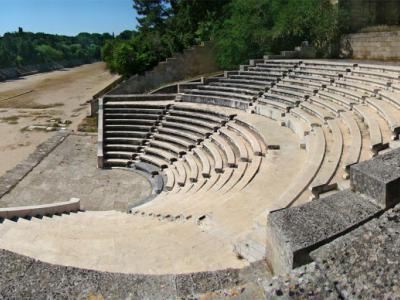
Just north of the ancient stadium, the Italian School of Archaeology uncovered the Odeon, with both monuments having been restructured during the period of Italian rule-only the orchestra and a few front-row seats here are original. Dating from the Classical Greek and Hellenistic periods, between the 3rd and 2nd centuries BC, the marble Odeon is an elegant theatrical structure nestled on the east slope of the Acropolis hill, configured within a rectangular layout. It had a seating capacity of about 800 people and was a key part of the Gymnasium complex, which was dedicated to the education of young people and apparently included a significant library.
The ancient Greeks likely attended singing events, musical performances, and poetry recitals at this venue. As you explore the site, set against a backdrop of lush greenery and naturally integrated into its surroundings, you'll feel as though you've stepped back in time, enveloped in an atmosphere that captures the essence of ancient Greek culture.
The ancient Greeks likely attended singing events, musical performances, and poetry recitals at this venue. As you explore the site, set against a backdrop of lush greenery and naturally integrated into its surroundings, you'll feel as though you've stepped back in time, enveloped in an atmosphere that captures the essence of ancient Greek culture.
6) Temple of Pythian Apollo
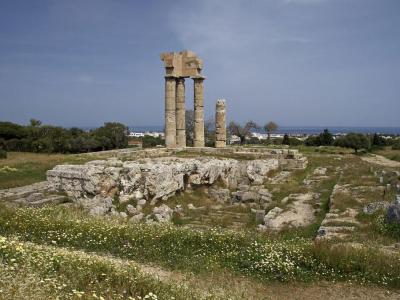
Located on the western part of the ancient Acropolis of Rhodes, this temple, though smaller than the one dedicated to Athena Polias and Zeus Polieus, shares a similar east-west orientation and stands near a large rectangular terrace. Constructed in the 2nd century BC in the Doric style, it was part of an enclosed precinct and served as a landmark for ships sailing to Rhodes. Even today, the re-erected columns are visible from the harbor, continuing to mark the landscape.
Pythia, the renowned priestess of Apollo, played an important role in ancient Greek society due to her oracles and divination skills. She was consulted before all major decisions, guiding the ancients on matters ranging from personal choices to significant political and military strategies. Her presence and function at the temple highlight its significant standing in both religious and civic life.
The site saw extensive archaeological activity during the Italian occupation of the island from 1912 to 1945, with the temple itself being reconstructed in the late 1930s. Unfortunately, it sustained severe damage from bombings during the Second World War, and from 1946 onward, the Greek Archaeological Service took on the challenging task of preserving what remained.
Pythia, the renowned priestess of Apollo, played an important role in ancient Greek society due to her oracles and divination skills. She was consulted before all major decisions, guiding the ancients on matters ranging from personal choices to significant political and military strategies. Her presence and function at the temple highlight its significant standing in both religious and civic life.
The site saw extensive archaeological activity during the Italian occupation of the island from 1912 to 1945, with the temple itself being reconstructed in the late 1930s. Unfortunately, it sustained severe damage from bombings during the Second World War, and from 1946 onward, the Greek Archaeological Service took on the challenging task of preserving what remained.
