Custom Walk in Kuala Lumpur, Malaysia by jwoodcock_5d877e created on 2026-04-05
Guide Location: Malaysia » Kuala Lumpur
Guide Type: Custom Walk
# of Sights: 10
Tour Duration: 2 Hour(s)
Travel Distance: 3.9 Km or 2.4 Miles
Share Key: VE3UR
Guide Type: Custom Walk
# of Sights: 10
Tour Duration: 2 Hour(s)
Travel Distance: 3.9 Km or 2.4 Miles
Share Key: VE3UR
How It Works
Please retrieve this walk in the GPSmyCity app. Once done, the app will guide you from one tour stop to the next as if you had a personal tour guide. If you created the walk on this website or come to the page via a link, please follow the instructions below to retrieve the walk in the app.
Retrieve This Walk in App
Step 1. Download the app "GPSmyCity: Walks in 1K+ Cities" on Apple App Store or Google Play Store.



Step 2. In the GPSmyCity app, download(or launch) the guide "Kuala Lumpur Map and Walking Tours".
Step 3. Tap the menu button located at upper right corner of the "Walks" screen and select "Retrieve custom walk". Enter the share key: VE3UR
1) Dataran Merdeka (Independence Square)
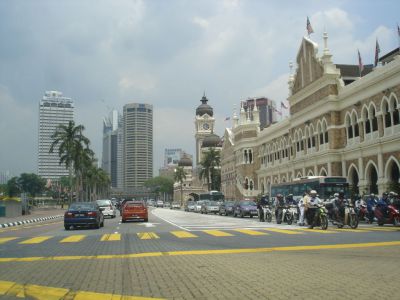
Independence Square forms the symbolic and historical center of Kuala Lumpur. Begin by standing at the edge of the broad green field and take in the open space. It was here, at midnight on August 31, 1957, that the Union Jack was lowered and the Malayan flag raised for the first time, marking the country’s independence. The lawn beneath you was once used as a cricket ground during the British colonial period.
Direct your attention to the eastern edge of the square, where the Sultan Abdul Samad Building stretches along the street. Notice its Moorish-style arches, copper domes, and the prominent clock tower rising above the façade. Then look across the field to the Royal Selangor Club, whose Tudor-style design reflects its role as a former gathering place for British officials. Next, turn slightly toward the northern edge, across the road, where Saint Mary's Cathedral introduces a quieter architectural note.
Now face the southern end of the square. On your right stands the Kuala Lumpur Library, while to your left you will see the Former Chartered Bank Building. Between them, look toward the open area where one of the tallest flagpoles in Malaysia marks the exact spot where the national flag was first raised. Nearby, the Victoria Fountain adds a smaller but notable historic feature.
Today, Independence Square functions as both a ceremonial ground and a public gathering space. It hosts annual Independence Day celebrations, while on quieter days, visitors and locals use the open lawn for relaxation and photography, with the surrounding architecture offering a clear sense of the city’s layered past.
Direct your attention to the eastern edge of the square, where the Sultan Abdul Samad Building stretches along the street. Notice its Moorish-style arches, copper domes, and the prominent clock tower rising above the façade. Then look across the field to the Royal Selangor Club, whose Tudor-style design reflects its role as a former gathering place for British officials. Next, turn slightly toward the northern edge, across the road, where Saint Mary's Cathedral introduces a quieter architectural note.
Now face the southern end of the square. On your right stands the Kuala Lumpur Library, while to your left you will see the Former Chartered Bank Building. Between them, look toward the open area where one of the tallest flagpoles in Malaysia marks the exact spot where the national flag was first raised. Nearby, the Victoria Fountain adds a smaller but notable historic feature.
Today, Independence Square functions as both a ceremonial ground and a public gathering space. It hosts annual Independence Day celebrations, while on quieter days, visitors and locals use the open lawn for relaxation and photography, with the surrounding architecture offering a clear sense of the city’s layered past.
2) Sultan Abdul Samad Building
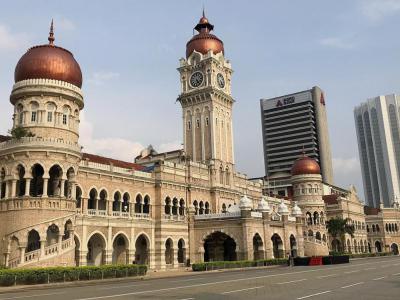
Sultan Abdul Samad Building was completed in 1897 during British colonial rule. It originally housed key government offices, including the colonial secretariat. Named after the fourth Sultan of Selangor, the building reflects the administrative importance of the area and continues to anchor the historic center of the city.
As you approach, take time to observe its distinctive architectural style, often described as Indo-Saracenic or Moorish Revival, with elements of Neo-Gothic influence. The façade is defined by a sequence of pointed arches and colonnades, while copper domes crown the towers. At the center, a clock tower rising to about 40 meters draws the eye. Walk along the length of the building to notice how its details repeat and shift. The shaded arcades at ground level form a continuous passage, offering relief from the heat, while the upper levels introduce balconies and decorative features typical of late 19th-century design.
If you move toward the rear of the building, you will find a quieter area facing the river, where a small garden with tiled fountains and benches provides a place to pause. Today, although its functions have evolved, the building continues to house government offices and serves as a backdrop for national celebrations. In the evening, it is often illuminated, emphasizing its architectural details and reinforcing its role as a central landmark in Kuala Lumpur.
As you approach, take time to observe its distinctive architectural style, often described as Indo-Saracenic or Moorish Revival, with elements of Neo-Gothic influence. The façade is defined by a sequence of pointed arches and colonnades, while copper domes crown the towers. At the center, a clock tower rising to about 40 meters draws the eye. Walk along the length of the building to notice how its details repeat and shift. The shaded arcades at ground level form a continuous passage, offering relief from the heat, while the upper levels introduce balconies and decorative features typical of late 19th-century design.
If you move toward the rear of the building, you will find a quieter area facing the river, where a small garden with tiled fountains and benches provides a place to pause. Today, although its functions have evolved, the building continues to house government offices and serves as a backdrop for national celebrations. In the evening, it is often illuminated, emphasizing its architectural details and reinforcing its role as a central landmark in Kuala Lumpur.
3) Central Market (must see)
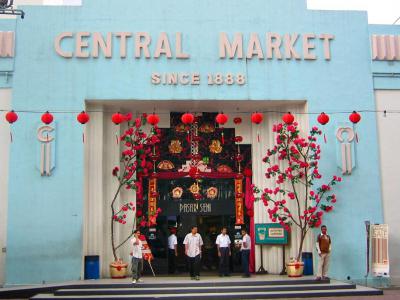
Central Market has grown from a practical marketplace into one of the city’s main cultural attractions. Founded in 1888 during the British period, it originally operated as a wet market serving miners and local residents. The present building, completed in 1937 in an Art Deco style, reflects a shift toward a more permanent and organized structure. Today, it is recognized as a heritage site and a key landmark of Malaysian culture.
Begin your visit at the entrance and step inside to explore the structured layout of the market. The interior is lined with stalls offering handicrafts, textiles, souvenirs, and locally made goods. As you walk through, notice how the ground floor is organized into themed “streets,” such as Lorong Melayu, Lorong Cina, and Lorong India. Items such as batik fabrics, wood carvings, jewelry, and traditional clothing highlight both individual traditions and a shared, distinctly Malaysian character.
Compared to its early days, when it was known as a “wet market” with constantly damp floors, the space is now clean, well-lit, and adapted for visitors. The variety of goods extends beyond crafts to include bags, clothing, sweets, and small gifts, making it a practical stop for souvenirs.
Before leaving, step out toward Kasturi Walk, the covered pedestrian lane at the front of the building. Here, additional vendors and street food stalls create a more casual atmosphere. You may also choose to pause at the food court or nearby cafés to sample local dishes. Together, these spaces present Central Market as both a shopping destination and a compact introduction to Kuala Lumpur’s multicultural character.
Begin your visit at the entrance and step inside to explore the structured layout of the market. The interior is lined with stalls offering handicrafts, textiles, souvenirs, and locally made goods. As you walk through, notice how the ground floor is organized into themed “streets,” such as Lorong Melayu, Lorong Cina, and Lorong India. Items such as batik fabrics, wood carvings, jewelry, and traditional clothing highlight both individual traditions and a shared, distinctly Malaysian character.
Compared to its early days, when it was known as a “wet market” with constantly damp floors, the space is now clean, well-lit, and adapted for visitors. The variety of goods extends beyond crafts to include bags, clothing, sweets, and small gifts, making it a practical stop for souvenirs.
Before leaving, step out toward Kasturi Walk, the covered pedestrian lane at the front of the building. Here, additional vendors and street food stalls create a more casual atmosphere. You may also choose to pause at the food court or nearby cafés to sample local dishes. Together, these spaces present Central Market as both a shopping destination and a compact introduction to Kuala Lumpur’s multicultural character.
4) Sze Ya Temple
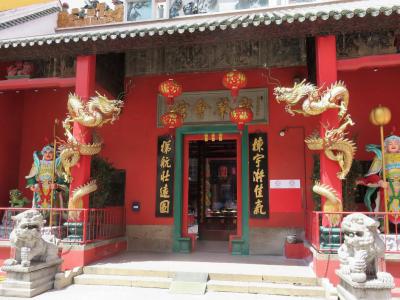
One of the most fascinating temples in Kuala Lumpur is the Sze Ya Temple. Located in China Town, this Taoist Temple is one of the city’s heritage sites. Cramped in the narrowest streets, the positioning and design of the Temple is in accordance to Feng Shui.
The Sze Ya Temple is one of the few structures that commemorate one of the founding fathers of Kuala Lumpur. Built by Kapitan Yap Ah Loy in 1864, the building hasn’t changed much from the day it was constructed. With elaborate roof ridges, and ornate interiors, the temple is a reflection of the old Chinese style of architecture. The Temple pays tribute to the deity Sin Sze Ya and Si Sze Ya, who are considered as the guardians of the immigrant Chinese miners.
It is believed that the entire burden of constructing this beautiful temple was taken over by Loy and to honor that, a statue of the Kapitan still stands to the left of the main altar.
The Sze Ya Temple is one of the oldest Taoist Temples in Kuala Lumpur and has witnessed most of the city's history.
The Sze Ya Temple is one of the few structures that commemorate one of the founding fathers of Kuala Lumpur. Built by Kapitan Yap Ah Loy in 1864, the building hasn’t changed much from the day it was constructed. With elaborate roof ridges, and ornate interiors, the temple is a reflection of the old Chinese style of architecture. The Temple pays tribute to the deity Sin Sze Ya and Si Sze Ya, who are considered as the guardians of the immigrant Chinese miners.
It is believed that the entire burden of constructing this beautiful temple was taken over by Loy and to honor that, a statue of the Kapitan still stands to the left of the main altar.
The Sze Ya Temple is one of the oldest Taoist Temples in Kuala Lumpur and has witnessed most of the city's history.
5) Petaling Street (Chinatown)
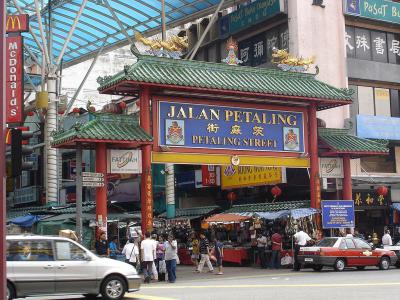
Petaling Street lies at the center of Kuala Lumpur’s Chinatown and reflects the city’s long-standing trading tradition. The area developed in the late 19th century as Chinese miners and merchants settled nearby, creating a network of shops and markets. Over time, Petaling Street grew into one of the city’s busiest commercial areas and remains closely connected to Kuala Lumpur’s early history.
Enter through the main archway and walk into the covered street, where rows of stalls line both sides. As you move forward, you will encounter vendors selling clothing, bags, accessories, electronics, and souvenirs. Bargaining is part of the experience, and the dense layout gives the street a constant sense of movement. The market operates throughout the day, but it becomes more active as evening approaches, when lights and crowds intensify the atmosphere.
Take a moment to look beyond the stalls and notice the surrounding shophouses, many dating from the early 20th century. Their narrow façades and layered signage create a distinct visual rhythm. As you continue, pause at one of the food stalls or small eateries to sample local dishes and snacks. Today, it remains one of Kuala Lumpur’s most recognizable market streets, combining commerce, heritage, and street-level activity in a compact and continuously changing setting.
Enter through the main archway and walk into the covered street, where rows of stalls line both sides. As you move forward, you will encounter vendors selling clothing, bags, accessories, electronics, and souvenirs. Bargaining is part of the experience, and the dense layout gives the street a constant sense of movement. The market operates throughout the day, but it becomes more active as evening approaches, when lights and crowds intensify the atmosphere.
Take a moment to look beyond the stalls and notice the surrounding shophouses, many dating from the early 20th century. Their narrow façades and layered signage create a distinct visual rhythm. As you continue, pause at one of the food stalls or small eateries to sample local dishes and snacks. Today, it remains one of Kuala Lumpur’s most recognizable market streets, combining commerce, heritage, and street-level activity in a compact and continuously changing setting.
6) Chinatown
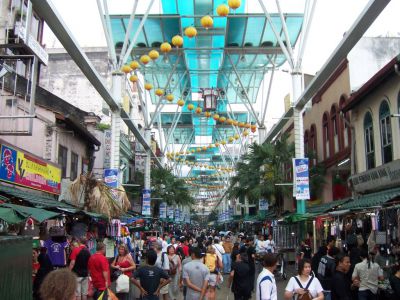
Kuala Lumpur's Chinatown is a dynamic, colorful area that perfectly illustrates the blend of old traditions and modern life. It's a great spot for anyone wanting to experience Chinese-Malaysian culture, packed with various activities and sights.
Petaling Street is at the core of Chinatown. It's known for its fashion stores and a big covered market selling a wide range of items like produce, clothing, and accessories. At night, Petaling Street turns into an evening market with red Chinese lanterns, offering a beautiful view. The street vendors sell all sorts of things, from fake designer clothes and bags to electronics, fresh produce, spices, and different souvenirs. This change from a busy day market to a lively night market gives a special feel, really showing what this place is about.
The food scene in Chinatown is a key feature, with everything from street food like nasi lemak and pisang goreng to high-end Chinese restaurants. Teh tarik, a popular local tea, is a must-try, combining taste and tradition.
Chinatown also has important religious sites like the Taoist Guan Di Temple and the 19th-century Sri Mahamariamman Temple, famous for its detailed facade with Hindu gods. These temples are not just spiritual places but also architectural wonders that show the rich history of the area. The Chan See Shu Yuen Temple is another highlight, offering insight into Chinatown's historical background amid modern tourist spots.
Petaling Street is at the core of Chinatown. It's known for its fashion stores and a big covered market selling a wide range of items like produce, clothing, and accessories. At night, Petaling Street turns into an evening market with red Chinese lanterns, offering a beautiful view. The street vendors sell all sorts of things, from fake designer clothes and bags to electronics, fresh produce, spices, and different souvenirs. This change from a busy day market to a lively night market gives a special feel, really showing what this place is about.
The food scene in Chinatown is a key feature, with everything from street food like nasi lemak and pisang goreng to high-end Chinese restaurants. Teh tarik, a popular local tea, is a must-try, combining taste and tradition.
Chinatown also has important religious sites like the Taoist Guan Di Temple and the 19th-century Sri Mahamariamman Temple, famous for its detailed facade with Hindu gods. These temples are not just spiritual places but also architectural wonders that show the rich history of the area. The Chan See Shu Yuen Temple is another highlight, offering insight into Chinatown's historical background amid modern tourist spots.
7) Sri Mahamariamman Temple
Kuala Lumpur in itself is a culmination of brewing together different cultures and people. The resultant of this rich blend of ideas, philosophies and heritage coming from different cultures and parts of the world is what makes it a fascinating place to visit and a tourist’s paradise. One such architectural example is the Sri Mahamariamman Temple.
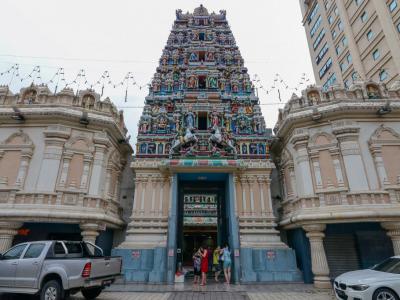
Built in 1873, this enchanting temple is the oldest functioning Hindu Temple in Malaysia. Founded by K. Thamboosamy Pillai, a pre-independence Tamil settler and one of the most prominent figures in the Tamil community in the country, the Temple was initially used exclusively by the Pillai family. It was not until 1920s that they opened the doors so that it could become a place of worship for the immigrants from India.
One of the most striking features of the Sri Mahamariamman is its dramatic tower filled with intricate sculptures of the various Hindu deities – a whopping 228 idols. Known as the ‘gopuram’, the tower is dedicated to the deity Mariamman, protector of all those in distant lands to preserve them from the evils of the world. This temple is especially relevant because the procession at Thaipusam (Hindu festival) during the month of February starts from here.
Tip:
Entry is free, but ladies need to cover properly and shoes must be removed and stored on the side for a small fee (bring wet wipes for your feet to avoid getting socks dirty). Friday afternoon prayer time is an exciting experience; watching the ritual, and all the music to go with it.
Built in 1873, this enchanting temple is the oldest functioning Hindu Temple in Malaysia. Founded by K. Thamboosamy Pillai, a pre-independence Tamil settler and one of the most prominent figures in the Tamil community in the country, the Temple was initially used exclusively by the Pillai family. It was not until 1920s that they opened the doors so that it could become a place of worship for the immigrants from India.
One of the most striking features of the Sri Mahamariamman is its dramatic tower filled with intricate sculptures of the various Hindu deities – a whopping 228 idols. Known as the ‘gopuram’, the tower is dedicated to the deity Mariamman, protector of all those in distant lands to preserve them from the evils of the world. This temple is especially relevant because the procession at Thaipusam (Hindu festival) during the month of February starts from here.
Tip:
Entry is free, but ladies need to cover properly and shoes must be removed and stored on the side for a small fee (bring wet wipes for your feet to avoid getting socks dirty). Friday afternoon prayer time is an exciting experience; watching the ritual, and all the music to go with it.
8) Railway Station
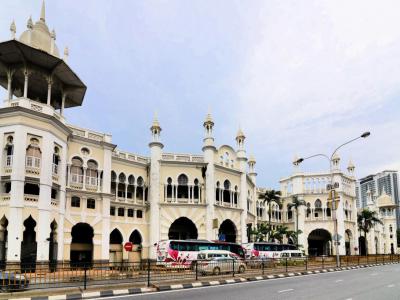
There's hardly any other railway station in the world as grand and spectacular as the one on Jalan Sultan Hishamuddin Road in Kuala Lumpur. With an immaculate exterior and bold Indo-Mughal pillars and arches, the railway station can be easily mistaken for a palace in the city. A must visit on your architectural tour of the Malaysian capital; this railway station is one of those structures that make architectural landscape of Kuala Lumpur not only unique but also unforgettable.
Built in 1910, the present structure took place of the preceding railway station, known as the Resident Station, which stood on the same site. Designed by Arthur Benison Hubback, the architect who has many renowned buildings to his credit, the design of this magnificent structure came into being only courtesy of inspiration from the Anglo-Asian architecture. Having spent many years in India, Hubback architected many buildings throughout the country after which he moved to Malaysia.
A total sum of around RM 23,000 was expended on construction of this masterpiece of a terminus. The Indo-Saracenic connection is evidently seen in many structural monuments in the city and the railway station is one of them. Although the exterior of the station has remained unchanged, the interiors have been redone several times.
Built in 1910, the present structure took place of the preceding railway station, known as the Resident Station, which stood on the same site. Designed by Arthur Benison Hubback, the architect who has many renowned buildings to his credit, the design of this magnificent structure came into being only courtesy of inspiration from the Anglo-Asian architecture. Having spent many years in India, Hubback architected many buildings throughout the country after which he moved to Malaysia.
A total sum of around RM 23,000 was expended on construction of this masterpiece of a terminus. The Indo-Saracenic connection is evidently seen in many structural monuments in the city and the railway station is one of them. Although the exterior of the station has remained unchanged, the interiors have been redone several times.
9) Chan She Shu Yuen Temple
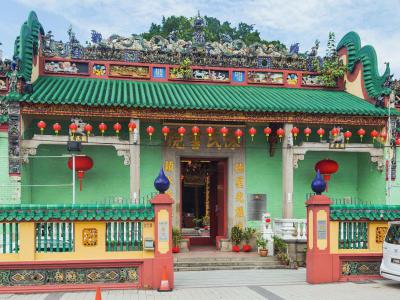
The Chan She Shu Yuen Temple started off as the Chan She Shu Yuen Clan Association over a hundred years ago and has strong historical ties with Kuala Lumpur. It is one of the few surviving clan houses in the city of Kuala Lumpur, the house of the Yuen family. When people migrated from China to Kuala Lumpur, the Chan She Shu Yuen Clan Association was the home for those who had Chan, Chen and Tan surnames since they had ancestral ties with the Yuen. The Clan House gave the migrants initial refuge and helped them establish themselves in the city.
In the late 1890s, the Clan House began construction of a new building that was completed in 1906. Built in Chinese Baroque style on Petaling Street in the Chinatown, the construction went through many hardships which were documented. All men and materials required for the construction came from China. The result of this painstaking endeavor are beautiful carvings in wood, limestone and stone, curved ceramic glazed tiles and the Chinese motifs on the tiles of the Chan She Shu Yuen Clan Temple, as you see it today.
The worship hall, called the De Xing Hall in Chinese, honors the ancestors of the Yuen family. This beautiful temple is open from 8 am to 5 pm seven days a week and has no admission fees. So, when you plan to visit the Chinatown in Kuala Lumpur, put the Chan She Shu Yuen Temple on the must-visit list.
In the late 1890s, the Clan House began construction of a new building that was completed in 1906. Built in Chinese Baroque style on Petaling Street in the Chinatown, the construction went through many hardships which were documented. All men and materials required for the construction came from China. The result of this painstaking endeavor are beautiful carvings in wood, limestone and stone, curved ceramic glazed tiles and the Chinese motifs on the tiles of the Chan She Shu Yuen Clan Temple, as you see it today.
The worship hall, called the De Xing Hall in Chinese, honors the ancestors of the Yuen family. This beautiful temple is open from 8 am to 5 pm seven days a week and has no admission fees. So, when you plan to visit the Chinatown in Kuala Lumpur, put the Chan She Shu Yuen Temple on the must-visit list.
10) Victoria Institution Clock Tower
The Victoria Institution, located in Kuala Lumpur, holds the distinction of being the city's oldest secondary school. Its establishment is closely tied to the desire to create a lasting tribute to Queen Victoria's Golden Jubilee in 1887. To realize this goal, the school received financial support from various sources, including public contributions, the Sultan and government of Selangor, influential residents of Kuala Lumpur, and the general public.
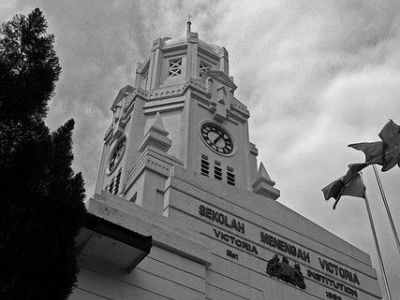
The school features a distinctive clock tower and two sports pavilions at its front, as well as a spacious field surrounded by colonial-era trees, including yellow flame trees and palms. Notably, the institution boasts a 25-meter swimming pool and a 100-meter synthetic track, making it the sole school in the region with access to such facilities at that time.
In February 2009, the school reclaimed its original name, following official recognition of its status as a part of Malaysia's national heritage. The Victoria Institution primarily serves male students from Form 1 to 5, with female students being admitted for Form 6 (Lower and Upper). It is commonly referred to as VI, and its students are known as Victorians.
Renowned for its academic and sports achievements, the school is regarded as one of Malaysia's top non-residential institutions. In 2007, it received the distinction of being named a Cluster School of Excellence by the then-Minister of Education in Malaysia, Hishamuddin Hussein.
The school features a distinctive clock tower and two sports pavilions at its front, as well as a spacious field surrounded by colonial-era trees, including yellow flame trees and palms. Notably, the institution boasts a 25-meter swimming pool and a 100-meter synthetic track, making it the sole school in the region with access to such facilities at that time.
In February 2009, the school reclaimed its original name, following official recognition of its status as a part of Malaysia's national heritage. The Victoria Institution primarily serves male students from Form 1 to 5, with female students being admitted for Form 6 (Lower and Upper). It is commonly referred to as VI, and its students are known as Victorians.
Renowned for its academic and sports achievements, the school is regarded as one of Malaysia's top non-residential institutions. In 2007, it received the distinction of being named a Cluster School of Excellence by the then-Minister of Education in Malaysia, Hishamuddin Hussein.
