Custom Walk in Tunis, Tunisia by jo_vansteenbergen_9c67ff created on 2026-04-09
Guide Location: Tunisia » Tunis
Guide Type: Custom Walk
# of Sights: 10
Tour Duration: 3 Hour(s)
Travel Distance: 6.1 Km or 3.8 Miles
Share Key: UZ8VJ
Guide Type: Custom Walk
# of Sights: 10
Tour Duration: 3 Hour(s)
Travel Distance: 6.1 Km or 3.8 Miles
Share Key: UZ8VJ
How It Works
Please retrieve this walk in the GPSmyCity app. Once done, the app will guide you from one tour stop to the next as if you had a personal tour guide. If you created the walk on this website or come to the page via a link, please follow the instructions below to retrieve the walk in the app.
Retrieve This Walk in App
Step 1. Download the app "GPSmyCity: Walks in 1K+ Cities" on Apple App Store or Google Play Store.



Step 2. In the GPSmyCity app, download(or launch) the guide "Tunis Map and Walking Tours".
Step 3. Tap the menu button located at upper right corner of the "Walks" screen and select "Retrieve custom walk". Enter the share key: UZ8VJ
1) Mosquée Zitouna (Mosque of Olive) (must see)
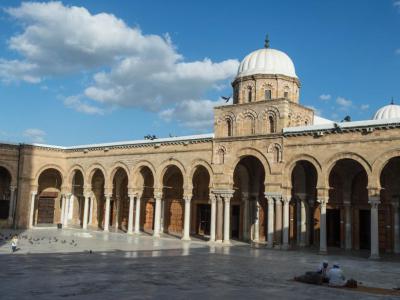
The Mosque of Olive is the oldest mosque in Tunis. Its origins date to the early 8th century, traditionally linked to Hassan ibn al-Nuʿman, an Arab general and governor, though most historians agree the mosque was largely completed around 732 CE under the Umayyad governor Ubayd Allah ibn al-Habhab. The mosque then underwent a decisive transformation in 864 CE, when the Aghlabid dynasty carried out a major reconstruction that gave the complex much of the form seen today.
Architecturally, the mosque follows the principles of early North African Islamic design. Covering approximately 5,000 square meters, it includes a large rectangular courtyard and a hypostyle prayer hall supported by more than 150 columns, many reused from ancient Carthage. The square minaret was rebuilt in 1894 during the French protectorate. Designed in a deliberate Almohad revival style, it echoes earlier Islamic landmarks such as the Great Mosque of Algiers and the Giralda in Seville.
The name “Olive” is tied to strong local tradition. One legend associates it with Saint Olivia of Palermo, whose memory is linked to an earlier Christian presence on or near the site. Historically, however, the name is officially attributed to a single olive tree said to have stood where Ubayd Allah ibn al-Habhab first prayed. Beyond worship, the mosque was also home to the University of Ez-Zitouna, one of the most influential centers of learning in the Islamic world.
For visitors today, non-Muslims are often not permitted inside the courtyard, depending on current regulations. Instead, the most familiar views of the mosque are from the rooftop terraces of surrounding carpet shops, particularly in nearby souks.
Architecturally, the mosque follows the principles of early North African Islamic design. Covering approximately 5,000 square meters, it includes a large rectangular courtyard and a hypostyle prayer hall supported by more than 150 columns, many reused from ancient Carthage. The square minaret was rebuilt in 1894 during the French protectorate. Designed in a deliberate Almohad revival style, it echoes earlier Islamic landmarks such as the Great Mosque of Algiers and the Giralda in Seville.
The name “Olive” is tied to strong local tradition. One legend associates it with Saint Olivia of Palermo, whose memory is linked to an earlier Christian presence on or near the site. Historically, however, the name is officially attributed to a single olive tree said to have stood where Ubayd Allah ibn al-Habhab first prayed. Beyond worship, the mosque was also home to the University of Ez-Zitouna, one of the most influential centers of learning in the Islamic world.
For visitors today, non-Muslims are often not permitted inside the courtyard, depending on current regulations. Instead, the most familiar views of the mosque are from the rooftop terraces of surrounding carpet shops, particularly in nearby souks.
2) Souks of Tunis (must see)
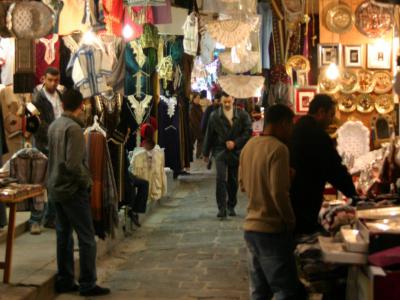
The Souks of Tunis form the commercial center of the old town and have shaped daily life in the city for centuries. This dense network of covered markets developed largely in the 13th century, organizing trade by craft and profession. Each souk traditionally specialized in a specific activity, creating a structured marketplace that closely linked commerce, religion, and urban life.
Walking through the souks reveals a sequence of narrow passages, vaulted ceilings, and shafts of filtered light, with shops opening directly onto the lanes. Many of the historic specializations remain visible today. The Perfumers' Market continues its long association with perfumes and fragrances, alongside henna and beauty products, while Souk El Bay is known for precious metals and jewelry. Textile traditions survive in Souk El Kmach and Souk El Kebabgia, while Souk Ech-Chaouachine, established in 1692, is still closely associated with the production of chachias, the traditional Tunisian skullcap made using Andalusian techniques.
Some souks reflect more complex layers of history. Souk El Berka, built in 1612, was once the city’s slave market, where auctions took place on a central platform. After slavery was abolished in Tunisia in 1846, the souk transitioned into a center for jewelry trading, giving the space a very different role while preserving its architectural form. Souk Es Sabbaghine, historically devoted to dyeing textiles, an activity considered unsuitable near the mosque, was deliberately located farther away.
Merchants call out from shaded doorways, craftsmen work in open view, and everyday exchanges unfold among centuries-old buildings. Moving through this living network offers a direct encounter with the scale, sound, and pace of the old town, revealing how tradition, trade, and daily necessity continue to shape one of North Africa’s most enduring urban marketplaces.
Walking through the souks reveals a sequence of narrow passages, vaulted ceilings, and shafts of filtered light, with shops opening directly onto the lanes. Many of the historic specializations remain visible today. The Perfumers' Market continues its long association with perfumes and fragrances, alongside henna and beauty products, while Souk El Bay is known for precious metals and jewelry. Textile traditions survive in Souk El Kmach and Souk El Kebabgia, while Souk Ech-Chaouachine, established in 1692, is still closely associated with the production of chachias, the traditional Tunisian skullcap made using Andalusian techniques.
Some souks reflect more complex layers of history. Souk El Berka, built in 1612, was once the city’s slave market, where auctions took place on a central platform. After slavery was abolished in Tunisia in 1846, the souk transitioned into a center for jewelry trading, giving the space a very different role while preserving its architectural form. Souk Es Sabbaghine, historically devoted to dyeing textiles, an activity considered unsuitable near the mosque, was deliberately located farther away.
Merchants call out from shaded doorways, craftsmen work in open view, and everyday exchanges unfold among centuries-old buildings. Moving through this living network offers a direct encounter with the scale, sound, and pace of the old town, revealing how tradition, trade, and daily necessity continue to shape one of North Africa’s most enduring urban marketplaces.
3) Kasbah Mosque
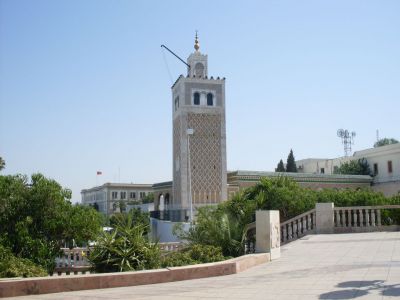
The Kasbah Mosque, located in the historic district of Kasbah in Tunis, is a notable religious and architectural landmark. This mosque, listed as a Historical Monument, was commissioned by sultan Abu Zakariya Yahya in the early 13th century. Abu Zakariya Yahya founded the Hafsid dynasty, which ruled present-day Tunisia until the 16th century. The mosque's architect was Ali ibn Muhammad ibn Qasim.
Initially, the mosque was only used as a place of prayer for the rulers residing in the Kasbah area. However, it later became a public mosque for the Friday prayer, open to the whole city. The mosque's wooden minbar was replaced with a stone minbar during the Ottoman period in 1584. The prayer hall of the mosque has a rectangular shape, an unusual feature for Almohad-style mosques of the time.
The prayer hall is divided into seven "naves" separated by horseshoe arches, with nine arch spans for each nave. Marble columns with Hafsid-period capitals support the arches. The hall is roofed by a series of groin vaults, and the mihrab in the southeast wall is decorated with marble paneling and flanked by decorative colonettes.
The mosque's architectural style reflects the ancient local traditions of stone cutting, and its intricate decorative elements, such as the muqarnas (ornamental molding) dome above the mihrab, make it a significant example of Islamic art and architecture. Today, the Kasbah Mosque is a popular destination for tourists and a cultural hub for locals, providing a glimpse into the rich history and heritage of Tunisia.
Tip:
As with other mosques in Tunis, you cannot visit inside being a non-Muslim.
Initially, the mosque was only used as a place of prayer for the rulers residing in the Kasbah area. However, it later became a public mosque for the Friday prayer, open to the whole city. The mosque's wooden minbar was replaced with a stone minbar during the Ottoman period in 1584. The prayer hall of the mosque has a rectangular shape, an unusual feature for Almohad-style mosques of the time.
The prayer hall is divided into seven "naves" separated by horseshoe arches, with nine arch spans for each nave. Marble columns with Hafsid-period capitals support the arches. The hall is roofed by a series of groin vaults, and the mihrab in the southeast wall is decorated with marble paneling and flanked by decorative colonettes.
The mosque's architectural style reflects the ancient local traditions of stone cutting, and its intricate decorative elements, such as the muqarnas (ornamental molding) dome above the mihrab, make it a significant example of Islamic art and architecture. Today, the Kasbah Mosque is a popular destination for tourists and a cultural hub for locals, providing a glimpse into the rich history and heritage of Tunisia.
Tip:
As with other mosques in Tunis, you cannot visit inside being a non-Muslim.
4) Dar Hussein
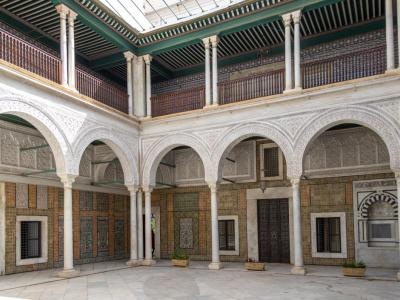
Dar Hussein is a stunning historical palace in the old city of Tunis. The oldest history of the mansion dates from the 11th century AD, and it was the house of many rulers and princes. The palace was renovated and expanded in the 18th and 19th centuries during the reign of the Husainid Dynasty and is considered one of the most important architectural landmarks in the country.
The Dar Hussein has undergone several renovations and restorations, preserving its authentic Islamic and Andalusian architectural styles that dominated North Africa during the 18th century. The palace presents several architectural elements, including stucco decoration, marble floors, carved cedarwood ceilings, and Moroccan mosaic tilework with intricate geometric designs and floral motifs.
The courtyard is surrounded by arched galleries, known as "liwans." The liwans lead to several rooms, each with its unique architectural features and decorations. The palace also boasts a beautiful rooftop terrace with panoramic views of the Medina of Tunis.
Dar Hussein's architecture is a testament to the skill and creativity of North African artisans and craftsmen during the 18th century. Today, the palace houses the National Heritage Institute. Dar Hussein was inscribed as a UNESCO World Heritage Site in 1979 as part of Medina of Tunis.
The Dar Hussein has undergone several renovations and restorations, preserving its authentic Islamic and Andalusian architectural styles that dominated North Africa during the 18th century. The palace presents several architectural elements, including stucco decoration, marble floors, carved cedarwood ceilings, and Moroccan mosaic tilework with intricate geometric designs and floral motifs.
The courtyard is surrounded by arched galleries, known as "liwans." The liwans lead to several rooms, each with its unique architectural features and decorations. The palace also boasts a beautiful rooftop terrace with panoramic views of the Medina of Tunis.
Dar Hussein's architecture is a testament to the skill and creativity of North African artisans and craftsmen during the 18th century. Today, the palace houses the National Heritage Institute. Dar Hussein was inscribed as a UNESCO World Heritage Site in 1979 as part of Medina of Tunis.
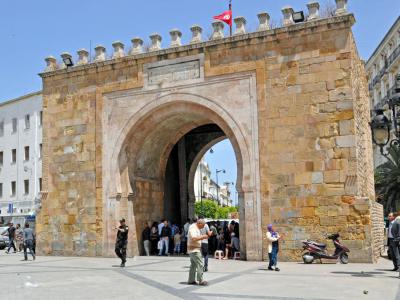
5) Bab el Bhar (Gate of France) (must see)
The Gate of the Sea or Gate of France stands at the meeting point between the historic city and the modern city beyond. The original gate was built in the 10th century during the Aghlabid period, when Tunis was protected by defensive walls enclosing the old town. Demolished in 1848 and rebuilt in 1860 under French rule, the gate took on its current form at a moment when the city was opening outward toward newly planned European quarters.
The name Gate of the Sea reflects its original orientation toward the coastline and the route leading to the port. During the French protectorate, it became known as the Gate of France, a name that emphasized its role as the entrance to the European district. After Tunisia gained independence, the gate officially returned to its original Arabic name. Architecturally modest, the structure consists of a single arched passage topped by a parapet and inscription, with a marked elevation of seven meters above sea level.
Passing through the gate is a clear physical and visual transition. On the old town side, narrow streets, souks, and traditional buildings close in immediately around the gate. On the modern side, France Avenue opens onto wider streets lined with cafés, shops, and administrative buildings. Often the first point of entry for visitors approaching the old city, the Gate of the Sea compresses centuries of urban history into just a few steps. Recognized as part of the UNESCO World Heritage, it remains one of the most meaningful places to experience the city’s layered past and evolving identity.
The name Gate of the Sea reflects its original orientation toward the coastline and the route leading to the port. During the French protectorate, it became known as the Gate of France, a name that emphasized its role as the entrance to the European district. After Tunisia gained independence, the gate officially returned to its original Arabic name. Architecturally modest, the structure consists of a single arched passage topped by a parapet and inscription, with a marked elevation of seven meters above sea level.
Passing through the gate is a clear physical and visual transition. On the old town side, narrow streets, souks, and traditional buildings close in immediately around the gate. On the modern side, France Avenue opens onto wider streets lined with cafés, shops, and administrative buildings. Often the first point of entry for visitors approaching the old city, the Gate of the Sea compresses centuries of urban history into just a few steps. Recognized as part of the UNESCO World Heritage, it remains one of the most meaningful places to experience the city’s layered past and evolving identity.
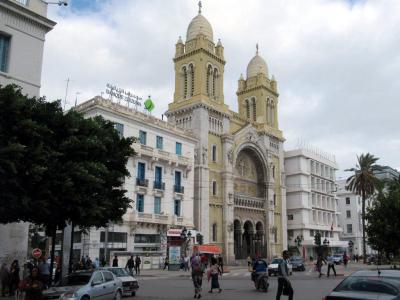
6) Cathédrale Saint-Vincent-de-Paul (St. Vincent de Paul Cathedral) (must see)
The Saint Vincent de Paul Cathedral was completed in 1897 during the French protectorate as part of the city’s late-19th-century transformation. Dedicated to Saint Vincent de Paul, the patron saint of charity, the cathedral reflects a period when new religious, civic, and administrative institutions were reshaping the capital’s urban identity. The cathedral continues to function as the episcopal seat of the Archdiocese of Tunis and remains open to visitors.
As you approach the building, its eclectic architecture becomes immediately noticeable. Designed by architect L. Bonnet-Labrance, the cathedral combines Moorish, Gothic, and Neo-Byzantine influences. The façade features arched openings, domed elements, and twin bell towers, added in 1910 using the then-innovative Hennebique reinforced-concrete technique. Yellow-and-white decorative tiles, a wrought-iron gate, and marble columns guide visitors toward the covered entrance.
Visitor access is from Algiers Street, which runs along the right side when viewed from the main facade. As you enter, the first thing you see is a large statue of Christ with outstretched arms. Moving into the nave, the view opens upward toward high vaults and softly colored stained glass. On your right, the space draws you toward the altar area, framed by rounded arches and stone columns. Above it rises the decorated dome, richly painted with biblical scenes and figures arranged in circular bands.
Just beyond the altar area is the Chapel of the Blessed Sacrament. Along the side walls, a small portrait gallery depicting saints is arranged. On the right-hand side of the nave, opposite the altar, stands a statue of the Virgin Mary, beside the Chapel of the Relics, also referred to as the treasury, where sacred liturgical objects are displayed.
As you approach the building, its eclectic architecture becomes immediately noticeable. Designed by architect L. Bonnet-Labrance, the cathedral combines Moorish, Gothic, and Neo-Byzantine influences. The façade features arched openings, domed elements, and twin bell towers, added in 1910 using the then-innovative Hennebique reinforced-concrete technique. Yellow-and-white decorative tiles, a wrought-iron gate, and marble columns guide visitors toward the covered entrance.
Visitor access is from Algiers Street, which runs along the right side when viewed from the main facade. As you enter, the first thing you see is a large statue of Christ with outstretched arms. Moving into the nave, the view opens upward toward high vaults and softly colored stained glass. On your right, the space draws you toward the altar area, framed by rounded arches and stone columns. Above it rises the decorated dome, richly painted with biblical scenes and figures arranged in circular bands.
Just beyond the altar area is the Chapel of the Blessed Sacrament. Along the side walls, a small portrait gallery depicting saints is arranged. On the right-hand side of the nave, opposite the altar, stands a statue of the Virgin Mary, beside the Chapel of the Relics, also referred to as the treasury, where sacred liturgical objects are displayed.
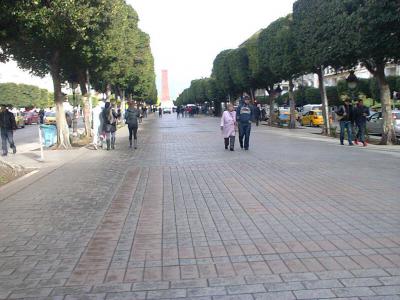
7) Avenue Habib Bourguiba
Avenue Habib Bourguiba is the main civic thoroughfare of Tunis. Named after Tunisia’s first president, the boulevard was laid out during the French colonial period as a formal urban axis, designed with broad proportions and symmetrical planning. At the center of the avenue runs a wide central promenade lined with ficus trees and benches. Along its edges are cafés, restaurants, shops, hotels, and government buildings, many dating from the late 19th and early 20th centuries.
Originally known as the Marine Promenade, the avenue became a focal point of colonial administration and later of national identity. Nearby landmarks include the Romanesque-Byzantine Saint Vincent de Paul Cathedral, completed in 1897, and the Art Nouveau Municipal Theater, built in 1902. The avenue is most active in the evening, when cafés and sidewalks fill with locals and visitors.
More than a traffic corridor, Avenue Habib Bourguiba has long hosted demonstrations, celebrations, and everyday routines, most notably during the 2011 revolution, when thousands of protesters gathered in front of the Ministry of the Interior to demand the departure of President Zine El Abidine Ben Ali. Since the revolution, the avenue has been marked by permanent security measures.
Originally known as the Marine Promenade, the avenue became a focal point of colonial administration and later of national identity. Nearby landmarks include the Romanesque-Byzantine Saint Vincent de Paul Cathedral, completed in 1897, and the Art Nouveau Municipal Theater, built in 1902. The avenue is most active in the evening, when cafés and sidewalks fill with locals and visitors.
More than a traffic corridor, Avenue Habib Bourguiba has long hosted demonstrations, celebrations, and everyday routines, most notably during the 2011 revolution, when thousands of protesters gathered in front of the Ministry of the Interior to demand the departure of President Zine El Abidine Ben Ali. Since the revolution, the avenue has been marked by permanent security measures.
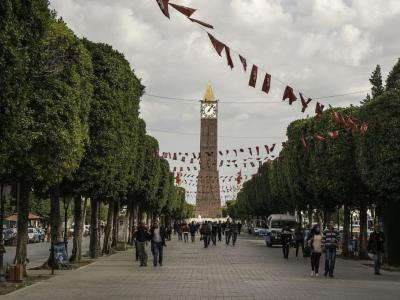
8) Clock Tower
The Clock Tower, situated in "14 January 2011 Square," is the first landmark tourists see when visiting Tunis. It is often referred to as the "Tunisian Big Ben" due to its resemblance to the famous clock tower in London. The clock tower stands 37 meters (121 feet) high and is covered in bronze paint.
The square has a fascinating history, as it was previously named Africa Square and featured a statue of Habib Bourguiba, the first president of independent Tunisia. After Bourguiba stepped down as president in 1987, the new leader of the country, Zine El Abidine Ben Ali, renamed the square '7 November 1987 Square' in honor of his inauguration day.
The clock in the center of the square, also known as the "Alarm Clock," had a unique feature where the number 6 was replaced with the number 7 to signify Ben Ali's inauguration day. In 2001, the square underwent a major renovation which involved removing the "Alarm Clock" and replacing it with the current Clock Tower, a tall obelisk with a clock on top, which now serves as the main attraction for tourists. After the Jasmine Revolution in 2011, the square was renamed 14 January 2011 Square (Place du 14-Janvier 2011) to commemorate the day of Ben Ali's overthrow.
The Clock Tower's unique features and significance in Tunisian history make it an essential destination for anyone visiting the city.
The square has a fascinating history, as it was previously named Africa Square and featured a statue of Habib Bourguiba, the first president of independent Tunisia. After Bourguiba stepped down as president in 1987, the new leader of the country, Zine El Abidine Ben Ali, renamed the square '7 November 1987 Square' in honor of his inauguration day.
The clock in the center of the square, also known as the "Alarm Clock," had a unique feature where the number 6 was replaced with the number 7 to signify Ben Ali's inauguration day. In 2001, the square underwent a major renovation which involved removing the "Alarm Clock" and replacing it with the current Clock Tower, a tall obelisk with a clock on top, which now serves as the main attraction for tourists. After the Jasmine Revolution in 2011, the square was renamed 14 January 2011 Square (Place du 14-Janvier 2011) to commemorate the day of Ben Ali's overthrow.
The Clock Tower's unique features and significance in Tunisian history make it an essential destination for anyone visiting the city.
9) Bab El Khadra
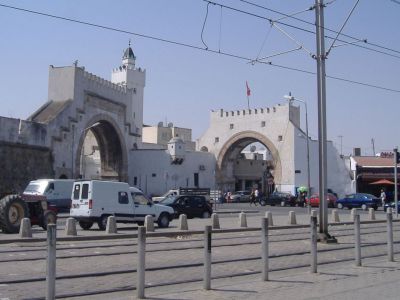
Bab El Khadra is one of the gates that lead to the medina of Tunis, located in the second enclosure of the northern suburbs. The original structure was built in 1320 as a simple arch, but was later destroyed and rebuilt by the French colonizers in 1881 to facilitate trade. The new gate, based on the original model, was designed by the French architect Raphaël Guy, and it has a distinctly European style that resembles the gates of a European castle.
The gate was named "Green Gate" or "Gate of Greenery" due to the market gardening and orchards towards Ariana and Carthage cities. During the 16th and 17th centuries, a festival was organized every year, in spring, in a public square near Bab El Khadra called "Rose Square." The Tunisian chronicler, Ibn Dinar, describes the festival as " a meeting point of people of debauchery and idleness. Their motto was infamous recreation; one meets singers, dancers, and charlatans there; one sells dried fruits and sweets there."
Bab El Khadra is known for its impressive size, towering walls, and ornate decoration. Originally designed to be a defensive structure with arrow slits and other defensive features, it also served as a symbol of power and wealth for the rulers of Tunis. Despite its controversial past, Bab El Khadra remains an important historical landmark in Tunis, representing the city's complex blend of French and Arab influences.
The gate was named "Green Gate" or "Gate of Greenery" due to the market gardening and orchards towards Ariana and Carthage cities. During the 16th and 17th centuries, a festival was organized every year, in spring, in a public square near Bab El Khadra called "Rose Square." The Tunisian chronicler, Ibn Dinar, describes the festival as " a meeting point of people of debauchery and idleness. Their motto was infamous recreation; one meets singers, dancers, and charlatans there; one sells dried fruits and sweets there."
Bab El Khadra is known for its impressive size, towering walls, and ornate decoration. Originally designed to be a defensive structure with arrow slits and other defensive features, it also served as a symbol of power and wealth for the rulers of Tunis. Despite its controversial past, Bab El Khadra remains an important historical landmark in Tunis, representing the city's complex blend of French and Arab influences.
10) Medina of Tunis (Tunis Old CIty)
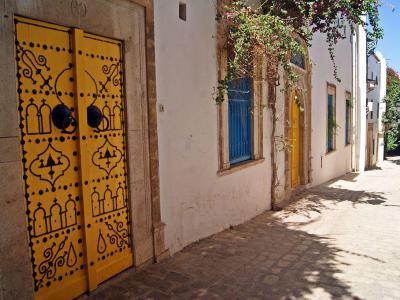
The Medina of Tunis is located in the very heart of the city. It is a UNESCO World Heritage Site and a great attraction to tourists. The narrow streets of Medina are full of colorful shops with various goods ranging from leather to plastic, from souvenirs to the works of tiny crafts shops. The shop owners are much less pushy than say in Marrakesh, and normally they start with a price which of course is inflated, but not extremely so. You don't need a guide, as you can manage the tour by yourself; it is simple to get around – one major path, Kasbah Street (Rue de la Kasbah), going across the Medina from the Victory Square (Place de la Victoire) up to the Grand Mosque. If you go off the beaten track, you can find some wonderful treasures (particularly beautiful rugs and ceramics), but you will have to bargain hard!
Tip:
Make sure you get a proper map from the tourist information bureau so you know where to go; otherwise it isn't very clear (even with online apps). Walk the small roads and discover the small laboratories where they make handbags, shoes, perfumes and many other things... Very interesting!
Tip:
Make sure you get a proper map from the tourist information bureau so you know where to go; otherwise it isn't very clear (even with online apps). Walk the small roads and discover the small laboratories where they make handbags, shoes, perfumes and many other things... Very interesting!
