Custom Walk in Palma de Mallorca, Spain by itswildhorses_b5c5d2 created on 2026-04-09
Guide Location: Spain » Palma de Mallorca
Guide Type: Custom Walk
# of Sights: 7
Tour Duration: 3 Hour(s)
Travel Distance: 8.3 Km or 5.2 Miles
Share Key: FR7E8
Guide Type: Custom Walk
# of Sights: 7
Tour Duration: 3 Hour(s)
Travel Distance: 8.3 Km or 5.2 Miles
Share Key: FR7E8
How It Works
Please retrieve this walk in the GPSmyCity app. Once done, the app will guide you from one tour stop to the next as if you had a personal tour guide. If you created the walk on this website or come to the page via a link, please follow the instructions below to retrieve the walk in the app.
Retrieve This Walk in App
Step 1. Download the app "GPSmyCity: Walks in 1K+ Cities" on Apple App Store or Google Play Store.



Step 2. In the GPSmyCity app, download(or launch) the guide "Palma de Mallorca Map and Walking Tours".
Step 3. Tap the menu button located at upper right corner of the "Walks" screen and select "Retrieve custom walk". Enter the share key: FR7E8

1) Castell de Bellver (Bellver Castle) (must see)
Bellver Castle (Castell de Bellver), perched atop the lush Puig de Sa Mesquida just 3 kilometers west of Palma’s historic core, offers visitors both architectural intrigue and breathtaking vistas. Built between 1300 and 1310 by order of King Jaume II of Mallorca and designed by Pere Salvà (who also worked on the Royal Palace of La Almudaina), this castle is one of the few truly circular fortresses in Europe-its round outer curtain wall, central courtyard, and three surrounding towers seamlessly define its rare form.
Originally conceived as a royal residence, Bellver Castle served the kings of Mallorca only briefly-Jaume II, Sanç I, and Jaume III all stayed for short periods. As political tides shifted, the fortress was repurposed: by the 18th century, it had become a military prison, holding notable figures such as Gaspar Melchor de Jovellanos, and continued in this function through Spain’s wars and civil conflicts until the early 20th century.
Today, the castle is a welcoming cultural icon under the care of Palma’s city government. Inside lies the City History Museum (Museu d’Història de la Ciutat), tracing Palma’s evolution from Roman and Moorish times through to the modern era, with displays of ceramics, maps, sculpture, and city artefacts. Visitors can stroll among the Gothic arches of the two‑level courtyard, climb to the rooftop terrace, and explore the structure’s hidden recesses-from former dungeons to a cistern within the courtyard well.
For tourists, Bellver Castle rewards both curiosity and wonder: artfully blending medieval Gothic elegance with formidable military design, it also offers panoramic views across the Bay of Palma, the Sierra de Tramuntana, and the city rooftops. Surrounded by pine‑clad forest and linked to the city via a scenic uphill walk or local bus route, it’s a must-see landmark whose name, meaning “beautiful view,” lives up to every bit of expectation.
Originally conceived as a royal residence, Bellver Castle served the kings of Mallorca only briefly-Jaume II, Sanç I, and Jaume III all stayed for short periods. As political tides shifted, the fortress was repurposed: by the 18th century, it had become a military prison, holding notable figures such as Gaspar Melchor de Jovellanos, and continued in this function through Spain’s wars and civil conflicts until the early 20th century.
Today, the castle is a welcoming cultural icon under the care of Palma’s city government. Inside lies the City History Museum (Museu d’Història de la Ciutat), tracing Palma’s evolution from Roman and Moorish times through to the modern era, with displays of ceramics, maps, sculpture, and city artefacts. Visitors can stroll among the Gothic arches of the two‑level courtyard, climb to the rooftop terrace, and explore the structure’s hidden recesses-from former dungeons to a cistern within the courtyard well.
For tourists, Bellver Castle rewards both curiosity and wonder: artfully blending medieval Gothic elegance with formidable military design, it also offers panoramic views across the Bay of Palma, the Sierra de Tramuntana, and the city rooftops. Surrounded by pine‑clad forest and linked to the city via a scenic uphill walk or local bus route, it’s a must-see landmark whose name, meaning “beautiful view,” lives up to every bit of expectation.
2) Plaza de España (Spain Square)
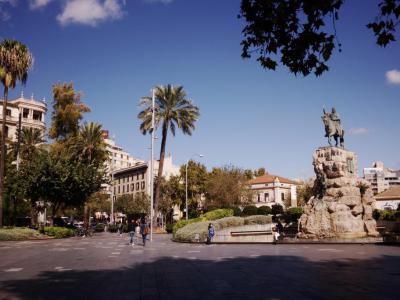
Spain Square is one of Palma de Mallorca’s main transport and civic hubs, marking the transition between the historic Old Town and the newer parts of the city. Although it lacks the medieval origins of many nearby squares, its importance grew in the late 19th and early 20th centuries, when Palma expanded beyond its former city walls.
Riding high above the square is a bronze statue of James I of Aragon, known as The Conqueror. From this vantage point, he overlooks a space as busy as his own life once was. James captured Mallorca from Abu Yahya, the Moorish governor, on September 5, 1229, a decisive moment in the island’s history. Today, beneath his watchful gaze, cafés and benches offer places to pause, while buses, cars, and electric scooters weave through the square, and people constantly meet and part.
Spain Square functions as a true nerve center of Mallorca. Beneath it lies the city’s main transport terminal, serving most buses and trains on the island. Buses connect Palma with towns across Mallorca, while trains run to Inca, Sa Pobla, Manacor, and Marratxí.
Directly behind the station terminal is Station Park, a landscaped green space that provides a welcome refuge from the bustle of the square. With shaded paths and a children’s play area, it offers a quieter counterpoint to the constant movement across the road in Spain Square itself.
Riding high above the square is a bronze statue of James I of Aragon, known as The Conqueror. From this vantage point, he overlooks a space as busy as his own life once was. James captured Mallorca from Abu Yahya, the Moorish governor, on September 5, 1229, a decisive moment in the island’s history. Today, beneath his watchful gaze, cafés and benches offer places to pause, while buses, cars, and electric scooters weave through the square, and people constantly meet and part.
Spain Square functions as a true nerve center of Mallorca. Beneath it lies the city’s main transport terminal, serving most buses and trains on the island. Buses connect Palma with towns across Mallorca, while trains run to Inca, Sa Pobla, Manacor, and Marratxí.
Directly behind the station terminal is Station Park, a landscaped green space that provides a welcome refuge from the bustle of the square. With shaded paths and a children’s play area, it offers a quieter counterpoint to the constant movement across the road in Spain Square itself.
3) Olivar Market (must see)
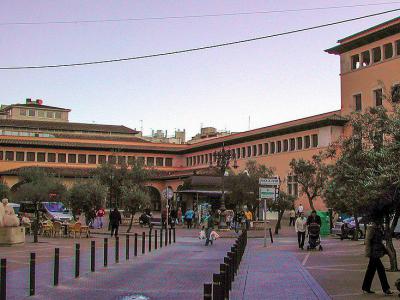
Olivar Market sits in the heart of Palma de Mallorca and is the city’s largest and most important public market. Opened in 1951, it takes its name from the former Convent of the Olivar, which once occupied the area. Built as part of Palma’s postwar modernization, the market brought together food vendors who had previously operated in smaller open-air settings, creating a central hub for everyday shopping and social life.
If you enjoy food in all its forms, Olivar Market is the place to be. The easiest way to understand its importance is to watch the locals. See where they go for snacks, take-away meals, fresh ingredients, and casual lunches. Follow their lead. Even with a fairly dense network of supermarkets in the city, the market remains the go-to destination for residents as well as visitors.
Inside, the range is impressive. Seafood displays highlight Mallorca’s close relationship with the Mediterranean, while nearby stalls offer meats, cured sausages such as sobrassada, cheeses, fresh fruit, vegetables, dairy products, and gourmet specialties. Sushi counters sit alongside traditional fishmongers, reflecting both local tastes and modern influences. Bars, cafés, and small restaurants throughout the market make it easy to stop for tapas, coffee, or a meal on the spot.
On the ground floor (the first floor in the United States), visitors will find most of the produce, meat, seafood, and gourmet food stalls. Escalators and elevators lead to the upper level, which expands the experience beyond food shopping. Here, you’ll find a small shopping arcade, restaurants and bars, boutiques, a supermarket, a cooking school, a hairdressing salon, a children’s area, and even a library, along with access to the parking area.
Beyond its offerings, Olivar Market provides a vivid snapshot of daily Palma life. Conversations flow across counters, routines unfold naturally, and the pace shifts from busy mornings to a calmer midday rhythm. It’s not just a market, but one of the best places to understand how Palma eats, shops, and lives.
If you enjoy food in all its forms, Olivar Market is the place to be. The easiest way to understand its importance is to watch the locals. See where they go for snacks, take-away meals, fresh ingredients, and casual lunches. Follow their lead. Even with a fairly dense network of supermarkets in the city, the market remains the go-to destination for residents as well as visitors.
Inside, the range is impressive. Seafood displays highlight Mallorca’s close relationship with the Mediterranean, while nearby stalls offer meats, cured sausages such as sobrassada, cheeses, fresh fruit, vegetables, dairy products, and gourmet specialties. Sushi counters sit alongside traditional fishmongers, reflecting both local tastes and modern influences. Bars, cafés, and small restaurants throughout the market make it easy to stop for tapas, coffee, or a meal on the spot.
On the ground floor (the first floor in the United States), visitors will find most of the produce, meat, seafood, and gourmet food stalls. Escalators and elevators lead to the upper level, which expands the experience beyond food shopping. Here, you’ll find a small shopping arcade, restaurants and bars, boutiques, a supermarket, a cooking school, a hairdressing salon, a children’s area, and even a library, along with access to the parking area.
Beyond its offerings, Olivar Market provides a vivid snapshot of daily Palma life. Conversations flow across counters, routines unfold naturally, and the pace shifts from busy mornings to a calmer midday rhythm. It’s not just a market, but one of the best places to understand how Palma eats, shops, and lives.
4) Plaza Mayor (Main Square)
Main Square is one of Palma de Mallorca’s most lively and historically layered public spaces, located at the heart of the Old Town. Despite its relaxed atmosphere today, the site has a far darker past. Until 1823, it was occupied by the Convent of Saint Philip Neri, which had effectively served as the headquarters of the Spanish Inquisition in Mallorca. Few mourned its demolition, and about a decade later, work began on creating the square that now occupies the site.
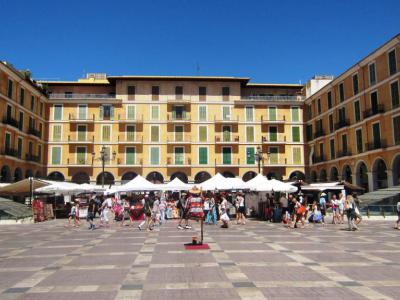
The resulting plaza is a large, rectangular space, fully tiled and closed to motor traffic. Three- and four-storey porticoed buildings line its edges, creating a sense of enclosure while offering shaded walkways at street level.
Main Square sits close to several important landmarks, including the Churches of Saint Michael and Saint Eulalia, as well as the Town Hall and the Main Theatre, making it a natural crossroads within the historic centre. Streets leading out of the square are packed with shops, cafés, and galleries, keeping the area busy throughout the day.
Today, Main Square is animated by restaurants, cafés, art galleries, and frequent street performers. An artisan market is held here every week, adding to the square’s lively character. Once a place of fear and judgment, Main Square has become one of Palma’s most social spaces—a fitting transformation at the heart of the city.
The resulting plaza is a large, rectangular space, fully tiled and closed to motor traffic. Three- and four-storey porticoed buildings line its edges, creating a sense of enclosure while offering shaded walkways at street level.
Main Square sits close to several important landmarks, including the Churches of Saint Michael and Saint Eulalia, as well as the Town Hall and the Main Theatre, making it a natural crossroads within the historic centre. Streets leading out of the square are packed with shops, cafés, and galleries, keeping the area busy throughout the day.
Today, Main Square is animated by restaurants, cafés, art galleries, and frequent street performers. An artisan market is held here every week, adding to the square’s lively character. Once a place of fear and judgment, Main Square has become one of Palma’s most social spaces—a fitting transformation at the heart of the city.
5) Arab Baths (must see)
Romans, Byzantines and Arabs had settled one after the other in Mallorca before the Catalans arrived. In the Arab days it was called Medina Mayurqa and they really liked to bath. They built their baths, called hammams, using materials left behind by the Romans and Byzantines. They used old bits of columns and capitals and voila! A bath!
The Arabs built well. The baths in Mallorca are over a thousand years old. One may not vouch for the plumbing, but the building materials are still good. Maybe shabby, but ok. The hot room and warm room of the Arab Baths are still extant but the cold room is no more.
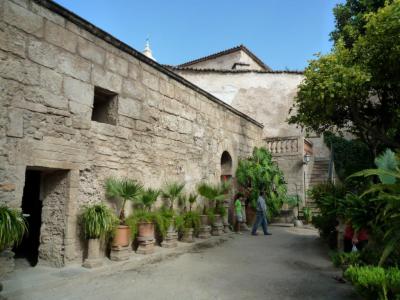
The hot room is a square room. It has 12 columns and a domed ceiling. It is a gallery with a barrel vault. The room has 24 holes for ventilation. The dome has five holes to let in light and fresh air. There is a small well-tended garden attached to the baths. The garden has a jasmine archway, subtropical trees and plants. An afternoon enjoyment.
The baths are only a walk of a minute or so from the Palma Cathedral. They open at 9am to 6pm in the evening in winter and until 7:30pm from April to November.
The Arabs built well. The baths in Mallorca are over a thousand years old. One may not vouch for the plumbing, but the building materials are still good. Maybe shabby, but ok. The hot room and warm room of the Arab Baths are still extant but the cold room is no more.
The hot room is a square room. It has 12 columns and a domed ceiling. It is a gallery with a barrel vault. The room has 24 holes for ventilation. The dome has five holes to let in light and fresh air. There is a small well-tended garden attached to the baths. The garden has a jasmine archway, subtropical trees and plants. An afternoon enjoyment.
The baths are only a walk of a minute or so from the Palma Cathedral. They open at 9am to 6pm in the evening in winter and until 7:30pm from April to November.
6) Palma Cathedral (must see)
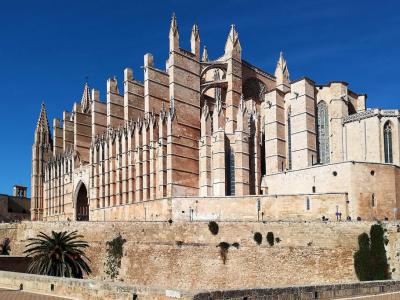
Palma Cathedral, commonly known as La Seu, is the most iconic landmark of Palma de Mallorca and one of the great Gothic cathedrals of the Mediterranean. Rising directly above the Bay of Palma, its vast sandstone structure dominates the city skyline. According to tradition, its construction was born of a vow. In December 1229, King James I of Aragon was caught in a violent storm while sailing to conquer the Balearic Islands. Facing disaster, the young king swore that if he survived and succeeded, he would build a great cathedral in Mallorca. He survived, conquered the island, and in 1230 construction began on La Seu, on the site of the former main mosque.
Building continued intermittently for around 350 years, making the cathedral a record of evolving architectural styles. The seaward-facing portal reflects early Gothic influences from the 13th century, while the opposite portal dates to the late Gothic period of the 16th century. Elsewhere, Gothic gives way to Renaissance elements, Baroque chapels, and touches of Classicism, particularly in the baptistry. The nave, completed last, ranks among the largest in Europe.
Light is central to the cathedral’s identity. The immense Gothic rose window on the eastern façade measures about 41 feet in diameter and is composed of roughly 1,200 pieces of stained glass. Each morning, sunlight floods the interior with shifting colours. Twice a year, on February 2 and November 11, this effect becomes especially dramatic during the “Light Game of the Eight,” when the rising sun projects the rose window’s image directly beneath the western rose, forming a luminous figure eight. For about twenty days on either side of the winter solstice, sunrise can be seen through both rosettes. The rose window on the eastern façade is positioned directly above the High Altar.
Another highlight to admire is famed modernist architect Antoni Gaudí’s early 20th-century intervention: a massive chandelier suspended above the central altar area. To see it best, stand at the front of the pews in the central nave and look up. You will see a large, illuminated, hexagonal baldachin hanging from chains. Made of wrought iron and cardboard, it features 35 brass lamps.
A natural follow-up after viewing Gaudí’s chandelier is another major intervention, completed in 2007. The Chapel of the Blessed Sacrament was renovated by renowned Mallorcan artist Miquel Barceló, who covered its walls with large, cracked ceramic sculptures representing the miracle of the loaves and fishes. Look for the submerged textures of fish and sea plants, as well as the tall, eerie, monochromatic windows that make the space feel underwater. The chapel is located at the front end of the south aisle, near the main altar.
The Trinity Chapel, which is not open to the public, contains the tombs of Kings James II and James III.
Building continued intermittently for around 350 years, making the cathedral a record of evolving architectural styles. The seaward-facing portal reflects early Gothic influences from the 13th century, while the opposite portal dates to the late Gothic period of the 16th century. Elsewhere, Gothic gives way to Renaissance elements, Baroque chapels, and touches of Classicism, particularly in the baptistry. The nave, completed last, ranks among the largest in Europe.
Light is central to the cathedral’s identity. The immense Gothic rose window on the eastern façade measures about 41 feet in diameter and is composed of roughly 1,200 pieces of stained glass. Each morning, sunlight floods the interior with shifting colours. Twice a year, on February 2 and November 11, this effect becomes especially dramatic during the “Light Game of the Eight,” when the rising sun projects the rose window’s image directly beneath the western rose, forming a luminous figure eight. For about twenty days on either side of the winter solstice, sunrise can be seen through both rosettes. The rose window on the eastern façade is positioned directly above the High Altar.
Another highlight to admire is famed modernist architect Antoni Gaudí’s early 20th-century intervention: a massive chandelier suspended above the central altar area. To see it best, stand at the front of the pews in the central nave and look up. You will see a large, illuminated, hexagonal baldachin hanging from chains. Made of wrought iron and cardboard, it features 35 brass lamps.
A natural follow-up after viewing Gaudí’s chandelier is another major intervention, completed in 2007. The Chapel of the Blessed Sacrament was renovated by renowned Mallorcan artist Miquel Barceló, who covered its walls with large, cracked ceramic sculptures representing the miracle of the loaves and fishes. Look for the submerged textures of fish and sea plants, as well as the tall, eerie, monochromatic windows that make the space feel underwater. The chapel is located at the front end of the south aisle, near the main altar.
The Trinity Chapel, which is not open to the public, contains the tombs of Kings James II and James III.
7) La Llotja (The Market) (must see)
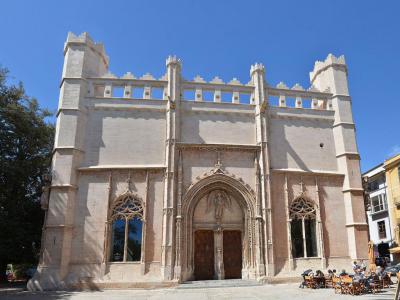
La Llotja, the old Maritime Trade Exchange, is a masterpiece of bourgeois Gothic architecture. It may be found next to La Seu, or Palma Cathedral, on the Avenue Gabriel Roca. The Trade Exchange was founded in Barcelona by a privilege granted by King Marti I in 1403. The exchange moved to Mallorca in 1452 to be housed in La Llotja.
The Exchange regulated trade and maintained the port of Palma. Business transactions could be conducted in the la Llotja building. As maritime trade fell off, la Llotja became merely a goods depot. It was an arms factory and arsenal in the Napoleonic wars and after the factory, it was a courthouse. From 1886 to 1962 it was a museum.
Architect Guillem Sanear began construction in 1426. It was completed in 1447 by Guillermo Vilasolar. In 1452 the Maritime Trade Exchange moved in. During this time the building formed a part of the city's defense walls. Four towers were set up on the four corners of the cube-shaped building. The building was almost touched by the sea.
Inside is a single space. Two rows of twisted columns support a vaulted ceiling. Above the main entrance is a sculpture of The Angel of Merchants in the tympanum.
In the last thirty years the Llotja has been a center for art shows, events and political meetings. It has been recently restored and the roof is now a terraced flat roof. Groups may ascend to the roof with permission. It is open daily except Monday.
The Exchange regulated trade and maintained the port of Palma. Business transactions could be conducted in the la Llotja building. As maritime trade fell off, la Llotja became merely a goods depot. It was an arms factory and arsenal in the Napoleonic wars and after the factory, it was a courthouse. From 1886 to 1962 it was a museum.
Architect Guillem Sanear began construction in 1426. It was completed in 1447 by Guillermo Vilasolar. In 1452 the Maritime Trade Exchange moved in. During this time the building formed a part of the city's defense walls. Four towers were set up on the four corners of the cube-shaped building. The building was almost touched by the sea.
Inside is a single space. Two rows of twisted columns support a vaulted ceiling. Above the main entrance is a sculpture of The Angel of Merchants in the tympanum.
In the last thirty years the Llotja has been a center for art shows, events and political meetings. It has been recently restored and the roof is now a terraced flat roof. Groups may ascend to the roof with permission. It is open daily except Monday.
