Custom Walk in Tunis, Tunisia by gmarkasyan_ab43d created on 2026-04-12
Guide Location: Tunisia » Tunis
Guide Type: Custom Walk
# of Sights: 11
Tour Duration: 2 Hour(s)
Travel Distance: 3.6 Km or 2.2 Miles
Share Key: R4YA9
Guide Type: Custom Walk
# of Sights: 11
Tour Duration: 2 Hour(s)
Travel Distance: 3.6 Km or 2.2 Miles
Share Key: R4YA9
How It Works
Please retrieve this walk in the GPSmyCity app. Once done, the app will guide you from one tour stop to the next as if you had a personal tour guide. If you created the walk on this website or come to the page via a link, please follow the instructions below to retrieve the walk in the app.
Retrieve This Walk in App
Step 1. Download the app "GPSmyCity: Walks in 1K+ Cities" on Apple App Store or Google Play Store.



Step 2. In the GPSmyCity app, download(or launch) the guide "Tunis Map and Walking Tours".
Step 3. Tap the menu button located at upper right corner of the "Walks" screen and select "Retrieve custom walk". Enter the share key: R4YA9
1) Cathédrale Saint-Vincent-de-Paul (St. Vincent de Paul Cathedral) (must see)
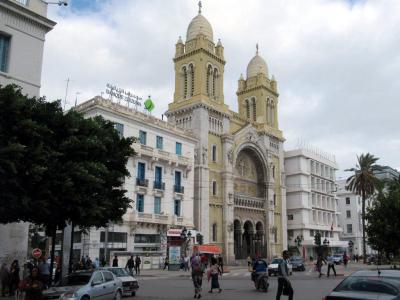
The Saint Vincent de Paul Cathedral was completed in 1897 during the French protectorate as part of the city’s late-19th-century transformation. Dedicated to Saint Vincent de Paul, the patron saint of charity, the cathedral reflects a period when new religious, civic, and administrative institutions were reshaping the capital’s urban identity. The cathedral continues to function as the episcopal seat of the Archdiocese of Tunis and remains open to visitors.
As you approach the building, its eclectic architecture becomes immediately noticeable. Designed by architect L. Bonnet-Labrance, the cathedral combines Moorish, Gothic, and Neo-Byzantine influences. The façade features arched openings, domed elements, and twin bell towers, added in 1910 using the then-innovative Hennebique reinforced-concrete technique. Yellow-and-white decorative tiles, a wrought-iron gate, and marble columns guide visitors toward the covered entrance.
Visitor access is from Algiers Street, which runs along the right side when viewed from the main facade. As you enter, the first thing you see is a large statue of Christ with outstretched arms. Moving into the nave, the view opens upward toward high vaults and softly colored stained glass. On your right, the space draws you toward the altar area, framed by rounded arches and stone columns. Above it rises the decorated dome, richly painted with biblical scenes and figures arranged in circular bands.
Just beyond the altar area is the Chapel of the Blessed Sacrament. Along the side walls, a small portrait gallery depicting saints is arranged. On the right-hand side of the nave, opposite the altar, stands a statue of the Virgin Mary, beside the Chapel of the Relics, also referred to as the treasury, where sacred liturgical objects are displayed.
As you approach the building, its eclectic architecture becomes immediately noticeable. Designed by architect L. Bonnet-Labrance, the cathedral combines Moorish, Gothic, and Neo-Byzantine influences. The façade features arched openings, domed elements, and twin bell towers, added in 1910 using the then-innovative Hennebique reinforced-concrete technique. Yellow-and-white decorative tiles, a wrought-iron gate, and marble columns guide visitors toward the covered entrance.
Visitor access is from Algiers Street, which runs along the right side when viewed from the main facade. As you enter, the first thing you see is a large statue of Christ with outstretched arms. Moving into the nave, the view opens upward toward high vaults and softly colored stained glass. On your right, the space draws you toward the altar area, framed by rounded arches and stone columns. Above it rises the decorated dome, richly painted with biblical scenes and figures arranged in circular bands.
Just beyond the altar area is the Chapel of the Blessed Sacrament. Along the side walls, a small portrait gallery depicting saints is arranged. On the right-hand side of the nave, opposite the altar, stands a statue of the Virgin Mary, beside the Chapel of the Relics, also referred to as the treasury, where sacred liturgical objects are displayed.
2) Avenue de France
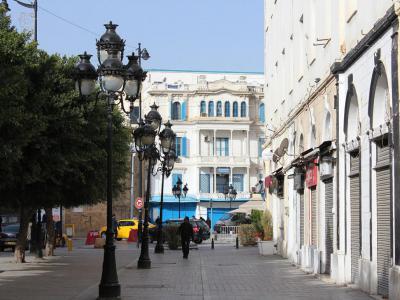
Avenue de France in Tunis is a major thoroughfare that runs between Victory Square (Place de la Victoire) to the west and Independence Square (Place de l'Indépendance) to the east, and serves as an extension of the city's main artery, Avenue Habib-Bourguiba. It was initially built as a route linking Tunis to its port, making it one of the oldest streets outside the city walls. The avenue is characterized by its arcades, modeled after those of Rivoli Street (rue de Rivoli) in Paris, while its extension, Avenue Habib-Bourguiba, is inspired by the Champs-Elysees Avenue.
In the early 2000s, a proposal to pedestrianize the avenue, was suggested to reduce heavy traffic and enhance the city center's appeal. Today, Avenue de France remains one of the busiest and most important streets attracting locals and tourists with its art-deco facades from the early 20th century, clothing and shoe stores, restaurants, elegant cafés, patisseries, and terraces. The landmarks on the Avenue de France offer visitors a glimpse into Tunis' rich history and vibrant present, showcasing the city's unique blend of French and Arab influences.
In the early 2000s, a proposal to pedestrianize the avenue, was suggested to reduce heavy traffic and enhance the city center's appeal. Today, Avenue de France remains one of the busiest and most important streets attracting locals and tourists with its art-deco facades from the early 20th century, clothing and shoe stores, restaurants, elegant cafés, patisseries, and terraces. The landmarks on the Avenue de France offer visitors a glimpse into Tunis' rich history and vibrant present, showcasing the city's unique blend of French and Arab influences.
3) Medina of Tunis (Tunis Old CIty)
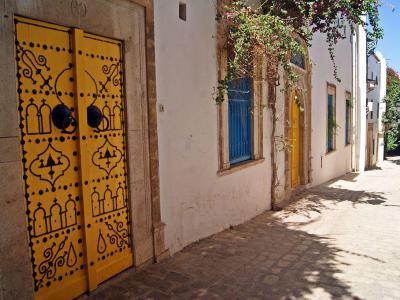
The Medina of Tunis is located in the very heart of the city. It is a UNESCO World Heritage Site and a great attraction to tourists. The narrow streets of Medina are full of colorful shops with various goods ranging from leather to plastic, from souvenirs to the works of tiny crafts shops. The shop owners are much less pushy than say in Marrakesh, and normally they start with a price which of course is inflated, but not extremely so. You don't need a guide, as you can manage the tour by yourself; it is simple to get around – one major path, Kasbah Street (Rue de la Kasbah), going across the Medina from the Victory Square (Place de la Victoire) up to the Grand Mosque. If you go off the beaten track, you can find some wonderful treasures (particularly beautiful rugs and ceramics), but you will have to bargain hard!
Tip:
Make sure you get a proper map from the tourist information bureau so you know where to go; otherwise it isn't very clear (even with online apps). Walk the small roads and discover the small laboratories where they make handbags, shoes, perfumes and many other things... Very interesting!
Tip:
Make sure you get a proper map from the tourist information bureau so you know where to go; otherwise it isn't very clear (even with online apps). Walk the small roads and discover the small laboratories where they make handbags, shoes, perfumes and many other things... Very interesting!
4) Mosquée Zitouna (Mosque of Olive) (must see)
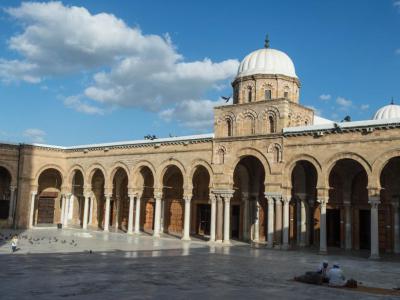
The Mosque of Olive is the oldest mosque in Tunis. Its origins date to the early 8th century, traditionally linked to Hassan ibn al-Nuʿman, an Arab general and governor, though most historians agree the mosque was largely completed around 732 CE under the Umayyad governor Ubayd Allah ibn al-Habhab. The mosque then underwent a decisive transformation in 864 CE, when the Aghlabid dynasty carried out a major reconstruction that gave the complex much of the form seen today.
Architecturally, the mosque follows the principles of early North African Islamic design. Covering approximately 5,000 square meters, it includes a large rectangular courtyard and a hypostyle prayer hall supported by more than 150 columns, many reused from ancient Carthage. The square minaret was rebuilt in 1894 during the French protectorate. Designed in a deliberate Almohad revival style, it echoes earlier Islamic landmarks such as the Great Mosque of Algiers and the Giralda in Seville.
The name “Olive” is tied to strong local tradition. One legend associates it with Saint Olivia of Palermo, whose memory is linked to an earlier Christian presence on or near the site. Historically, however, the name is officially attributed to a single olive tree said to have stood where Ubayd Allah ibn al-Habhab first prayed. Beyond worship, the mosque was also home to the University of Ez-Zitouna, one of the most influential centers of learning in the Islamic world.
For visitors today, non-Muslims are often not permitted inside the courtyard, depending on current regulations. Instead, the most familiar views of the mosque are from the rooftop terraces of surrounding carpet shops, particularly in nearby souks.
Architecturally, the mosque follows the principles of early North African Islamic design. Covering approximately 5,000 square meters, it includes a large rectangular courtyard and a hypostyle prayer hall supported by more than 150 columns, many reused from ancient Carthage. The square minaret was rebuilt in 1894 during the French protectorate. Designed in a deliberate Almohad revival style, it echoes earlier Islamic landmarks such as the Great Mosque of Algiers and the Giralda in Seville.
The name “Olive” is tied to strong local tradition. One legend associates it with Saint Olivia of Palermo, whose memory is linked to an earlier Christian presence on or near the site. Historically, however, the name is officially attributed to a single olive tree said to have stood where Ubayd Allah ibn al-Habhab first prayed. Beyond worship, the mosque was also home to the University of Ez-Zitouna, one of the most influential centers of learning in the Islamic world.
For visitors today, non-Muslims are often not permitted inside the courtyard, depending on current regulations. Instead, the most familiar views of the mosque are from the rooftop terraces of surrounding carpet shops, particularly in nearby souks.
5) Souks of Tunis (must see)
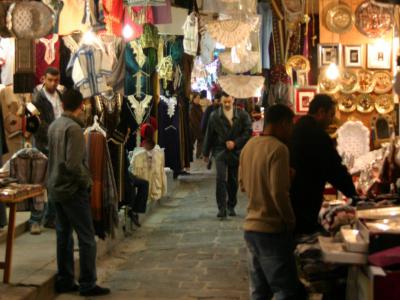
The Souks of Tunis form the commercial center of the old town and have shaped daily life in the city for centuries. This dense network of covered markets developed largely in the 13th century, organizing trade by craft and profession. Each souk traditionally specialized in a specific activity, creating a structured marketplace that closely linked commerce, religion, and urban life.
Walking through the souks reveals a sequence of narrow passages, vaulted ceilings, and shafts of filtered light, with shops opening directly onto the lanes. Many of the historic specializations remain visible today. The Perfumers' Market continues its long association with perfumes and fragrances, alongside henna and beauty products, while Souk El Bay is known for precious metals and jewelry. Textile traditions survive in Souk El Kmach and Souk El Kebabgia, while Souk Ech-Chaouachine, established in 1692, is still closely associated with the production of chachias, the traditional Tunisian skullcap made using Andalusian techniques.
Some souks reflect more complex layers of history. Souk El Berka, built in 1612, was once the city’s slave market, where auctions took place on a central platform. After slavery was abolished in Tunisia in 1846, the souk transitioned into a center for jewelry trading, giving the space a very different role while preserving its architectural form. Souk Es Sabbaghine, historically devoted to dyeing textiles, an activity considered unsuitable near the mosque, was deliberately located farther away.
Merchants call out from shaded doorways, craftsmen work in open view, and everyday exchanges unfold among centuries-old buildings. Moving through this living network offers a direct encounter with the scale, sound, and pace of the old town, revealing how tradition, trade, and daily necessity continue to shape one of North Africa’s most enduring urban marketplaces.
Walking through the souks reveals a sequence of narrow passages, vaulted ceilings, and shafts of filtered light, with shops opening directly onto the lanes. Many of the historic specializations remain visible today. The Perfumers' Market continues its long association with perfumes and fragrances, alongside henna and beauty products, while Souk El Bay is known for precious metals and jewelry. Textile traditions survive in Souk El Kmach and Souk El Kebabgia, while Souk Ech-Chaouachine, established in 1692, is still closely associated with the production of chachias, the traditional Tunisian skullcap made using Andalusian techniques.
Some souks reflect more complex layers of history. Souk El Berka, built in 1612, was once the city’s slave market, where auctions took place on a central platform. After slavery was abolished in Tunisia in 1846, the souk transitioned into a center for jewelry trading, giving the space a very different role while preserving its architectural form. Souk Es Sabbaghine, historically devoted to dyeing textiles, an activity considered unsuitable near the mosque, was deliberately located farther away.
Merchants call out from shaded doorways, craftsmen work in open view, and everyday exchanges unfold among centuries-old buildings. Moving through this living network offers a direct encounter with the scale, sound, and pace of the old town, revealing how tradition, trade, and daily necessity continue to shape one of North Africa’s most enduring urban marketplaces.
6) Kasbah Square (must see)
The Kasbah Square (Place de la Kasbah) is a lively and active public square located in the heart of the historic Kasbah district in Tunis. It was established in the late 1950s following the demolition of the citadel of Tunis ramparts and adjacent buildings, becoming the center of a new urban and political complex that hosts public institutions and administrative offices.
Since the 2011 revolution, the square has been a site for various political demonstrations, including two significant sit-ins calling for government resignation and the election of a constituent assembly.
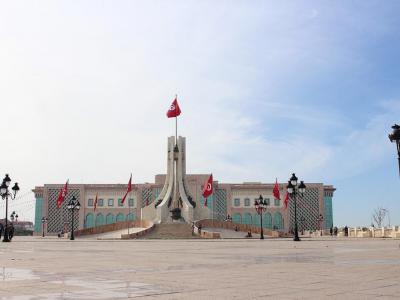
The square's centerpiece is the National Monument of the Kasbah, designed and executed by Tunisian sculptor Abdelfattah Boussetta in 1989, which serves as a memorial monument and symbol of several events in Tunisia.
Kasbah Square is located opposite the well-known Mosquée El-Kasbah and houses the City Hall of Tunis, representing the intersection of tradition and modernity. It is an attractive square with graceful black lanterns and many red Tunisian flags, close to downtown Tunis and within walking distance of other places like the old Medina.
Since the 2011 revolution, the square has been a site for various political demonstrations, including two significant sit-ins calling for government resignation and the election of a constituent assembly.
The square's centerpiece is the National Monument of the Kasbah, designed and executed by Tunisian sculptor Abdelfattah Boussetta in 1989, which serves as a memorial monument and symbol of several events in Tunisia.
Kasbah Square is located opposite the well-known Mosquée El-Kasbah and houses the City Hall of Tunis, representing the intersection of tradition and modernity. It is an attractive square with graceful black lanterns and many red Tunisian flags, close to downtown Tunis and within walking distance of other places like the old Medina.
7) Place du Gouvernement (Government Square)
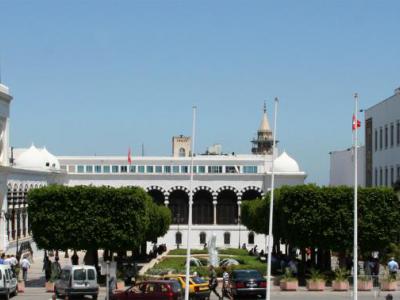
Government Square (Place du Gouvernement) is a rectangular square located at the entrance to the Kasbah district, which is also known as the "Ministry District" due to the presence of various public institutions. The square was named after the Government Palace, the headquarters for the head of government.
The square was once called Kasbah Square (Place de la Kasbah) until the opening of the current homonymous place to the west after Tunisia gained independence. The square is surrounded by public buildings, fountains, palm trees, and flowers, and it serves as a good starting point for exploring the medina.
The Government Square houses the City Hall, the Secretary of State, and the Ministry of Finance. The Dar el Bey Palace, which hosts the Prime Minister's office, can be found at the southern end of the square, along with the Ottmana Aziza Hospital. The Kasbah mosque, with the city's highest minaret, still stands just north of the square and dates back to the 13th century. The mosque was restored in the 1960s.
The administrative buildings in the square were constructed in an Arabist and European architectural style in the late 19th century and represent the affirmation of the Tunisian State after the French protectorate.
The square was once called Kasbah Square (Place de la Kasbah) until the opening of the current homonymous place to the west after Tunisia gained independence. The square is surrounded by public buildings, fountains, palm trees, and flowers, and it serves as a good starting point for exploring the medina.
The Government Square houses the City Hall, the Secretary of State, and the Ministry of Finance. The Dar el Bey Palace, which hosts the Prime Minister's office, can be found at the southern end of the square, along with the Ottmana Aziza Hospital. The Kasbah mosque, with the city's highest minaret, still stands just north of the square and dates back to the 13th century. The mosque was restored in the 1960s.
The administrative buildings in the square were constructed in an Arabist and European architectural style in the late 19th century and represent the affirmation of the Tunisian State after the French protectorate.
8) Place de l'Independance (Independence Square)
Independence Square marks the point where modern Tunis began to take shape in the late 19th century. Laid out during the French protectorate, the square introduced a new urban language of broad streets, open sightlines, and monumental architecture. Before 1956, the space was known as Residence Square, named for its proximity to the French Embassy and surrounding residential buildings. Following Tunisia’s independence from France, it was renamed Independence Square.
The square is framed by some of Tunis’s most recognizable landmarks. The Cathedral of Saint Vincent de Paul rises prominently on the north side of the square, while the French Embassy occupies the southern side, recalling the area’s former role as a colonial administrative center. On the western side, the long façade of The Arcades forms a continuous row of covered walkways and ground-floor cafés, a classic feature of late-19th-century European urban design adapted to the Tunisian climate.
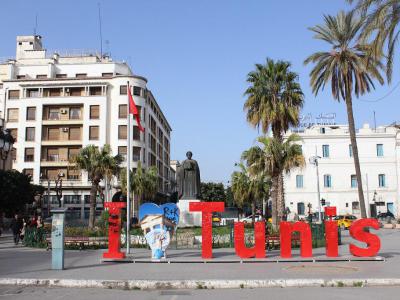
At the center of the space, stands the statue of Ibn Khaldun, the renowned Tunisian historian and philosopher, sculpted by Zubair al-Turki. Just beside the statue’s base, a marble plaque displays selected quotations associated with his thought, inviting visitors to pause and read. Behind the statue, facing the boulevard, the popular “I Love Tunis” sign adds a contemporary note and is frequently used as a photo backdrop.
The square is framed by some of Tunis’s most recognizable landmarks. The Cathedral of Saint Vincent de Paul rises prominently on the north side of the square, while the French Embassy occupies the southern side, recalling the area’s former role as a colonial administrative center. On the western side, the long façade of The Arcades forms a continuous row of covered walkways and ground-floor cafés, a classic feature of late-19th-century European urban design adapted to the Tunisian climate.
At the center of the space, stands the statue of Ibn Khaldun, the renowned Tunisian historian and philosopher, sculpted by Zubair al-Turki. Just beside the statue’s base, a marble plaque displays selected quotations associated with his thought, inviting visitors to pause and read. Behind the statue, facing the boulevard, the popular “I Love Tunis” sign adds a contemporary note and is frequently used as a photo backdrop.
9) Théâtre Municipal (Municipal Theatre)
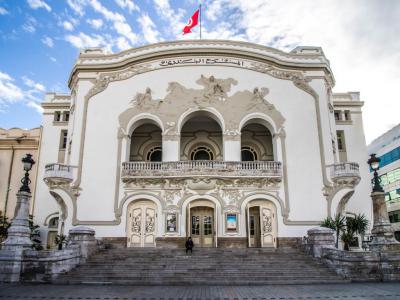
The Municipal Theater is one of the city’s most distinctive cultural landmarks, completed in 1902 with funding from the city of Tunis. Designed by French architect Jean-Émile Resplandy, the building originally opened as the Municipal Casino, a private–public hybrid intended primarily as a social and cultural clubhouse for the French elite. Its placement along Avenue Habib Bourguiba formed part of a broader plan to shape the boulevard into a formal civic and cultural axis within the expanding colonial city.
Architecturally, the theater is best known for its elegant Art Nouveau façade, a rare sight in North Africa. The façade features flowing curves, sculpted ornamentation, and theatrical motifs that give the exterior a light, expressive character, clearly setting it apart from the more restrained buildings nearby. While the original structure seated 856 patrons, the interior hall was later demolished and enlarged to meet growing demands. The historic façade was preserved, and the rebuilt theater reopened in January 1911 with an expanded capacity of around 1,100 seats.
Over time, the Municipal Theater evolved from an elite social venue into a fully public cultural institution. Today, it remains an active performance venue, hosting opera, ballet, symphonic concerts, and drama. It is home to the Tunisian Symphony Orchestra and regularly stages major national and international events, including the Carthage Theater Days, typically held in late autumn.
Architecturally, the theater is best known for its elegant Art Nouveau façade, a rare sight in North Africa. The façade features flowing curves, sculpted ornamentation, and theatrical motifs that give the exterior a light, expressive character, clearly setting it apart from the more restrained buildings nearby. While the original structure seated 856 patrons, the interior hall was later demolished and enlarged to meet growing demands. The historic façade was preserved, and the rebuilt theater reopened in January 1911 with an expanded capacity of around 1,100 seats.
Over time, the Municipal Theater evolved from an elite social venue into a fully public cultural institution. Today, it remains an active performance venue, hosting opera, ballet, symphonic concerts, and drama. It is home to the Tunisian Symphony Orchestra and regularly stages major national and international events, including the Carthage Theater Days, typically held in late autumn.
10) Place du 14 Janvier (14th January Square)
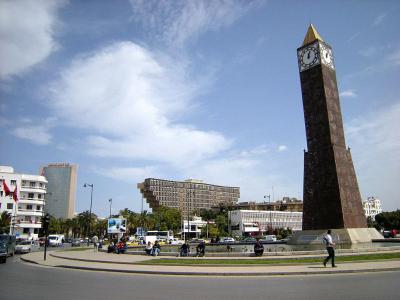
The 14th January Square occupies a pivotal position in modern Tunis, where political history, public life, and urban space converge. Renamed to mark the Tunisian Revolution that erupted on January 14, 2011, the square commemorates the moment that triggered political change in Tunisia and ignited the wider Arab Spring. The square functions primarily as a crossroads.
Anchoring this section of Avenue Habib Bourguiba, the square sits directly on the boulevard’s wide central promenade, a tree-lined pedestrian spine that extends east and west, structuring traffic, movement, and public space. On the eastern end of Avenue Habib Bourguiba, the square is framed by government buildings, hotels, and administrative landmarks linked to the city’s late 19th- and early 20th-century expansion. Among them are the Ministry of Tourism and Handicrafts, reflecting Tunis’s role as a national gateway for culture and travel.
Once called Africa Square, it originally featured a statue of French statesman Jules Ferry, later replaced in 1956 by an equestrian statue of country's first President Habib Bourguiba following independence. After Bourguiba’s removal from power in 1987, the statue disappeared, and a clock tower, with a reflecting pool and dancing fountain, took its place, standing right in the center of the square. In 2016, Bourguiba’s statue returned to the western edge of the square.
Anchoring this section of Avenue Habib Bourguiba, the square sits directly on the boulevard’s wide central promenade, a tree-lined pedestrian spine that extends east and west, structuring traffic, movement, and public space. On the eastern end of Avenue Habib Bourguiba, the square is framed by government buildings, hotels, and administrative landmarks linked to the city’s late 19th- and early 20th-century expansion. Among them are the Ministry of Tourism and Handicrafts, reflecting Tunis’s role as a national gateway for culture and travel.
Once called Africa Square, it originally featured a statue of French statesman Jules Ferry, later replaced in 1956 by an equestrian statue of country's first President Habib Bourguiba following independence. After Bourguiba’s removal from power in 1987, the statue disappeared, and a clock tower, with a reflecting pool and dancing fountain, took its place, standing right in the center of the square. In 2016, Bourguiba’s statue returned to the western edge of the square.
11) Clock Tower
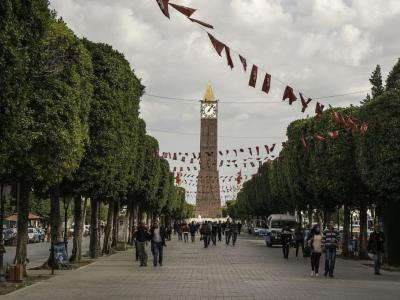
The Clock Tower, situated in "14 January 2011 Square," is the first landmark tourists see when visiting Tunis. It is often referred to as the "Tunisian Big Ben" due to its resemblance to the famous clock tower in London. The clock tower stands 37 meters (121 feet) high and is covered in bronze paint.
The square has a fascinating history, as it was previously named Africa Square and featured a statue of Habib Bourguiba, the first president of independent Tunisia. After Bourguiba stepped down as president in 1987, the new leader of the country, Zine El Abidine Ben Ali, renamed the square '7 November 1987 Square' in honor of his inauguration day.
The clock in the center of the square, also known as the "Alarm Clock," had a unique feature where the number 6 was replaced with the number 7 to signify Ben Ali's inauguration day. In 2001, the square underwent a major renovation which involved removing the "Alarm Clock" and replacing it with the current Clock Tower, a tall obelisk with a clock on top, which now serves as the main attraction for tourists. After the Jasmine Revolution in 2011, the square was renamed 14 January 2011 Square (Place du 14-Janvier 2011) to commemorate the day of Ben Ali's overthrow.
The Clock Tower's unique features and significance in Tunisian history make it an essential destination for anyone visiting the city.
The square has a fascinating history, as it was previously named Africa Square and featured a statue of Habib Bourguiba, the first president of independent Tunisia. After Bourguiba stepped down as president in 1987, the new leader of the country, Zine El Abidine Ben Ali, renamed the square '7 November 1987 Square' in honor of his inauguration day.
The clock in the center of the square, also known as the "Alarm Clock," had a unique feature where the number 6 was replaced with the number 7 to signify Ben Ali's inauguration day. In 2001, the square underwent a major renovation which involved removing the "Alarm Clock" and replacing it with the current Clock Tower, a tall obelisk with a clock on top, which now serves as the main attraction for tourists. After the Jasmine Revolution in 2011, the square was renamed 14 January 2011 Square (Place du 14-Janvier 2011) to commemorate the day of Ben Ali's overthrow.
The Clock Tower's unique features and significance in Tunisian history make it an essential destination for anyone visiting the city.
