Custom Walk in Honolulu, Hawaii by millerzbirdfarm_5f44a7 created on 2026-04-21
Guide Location: USA » Honolulu
Guide Type: Custom Walk
# of Sights: 7
Tour Duration: 1 Hour(s)
Travel Distance: 0.9 Km or 0.6 Miles
Share Key: AHEAW
Guide Type: Custom Walk
# of Sights: 7
Tour Duration: 1 Hour(s)
Travel Distance: 0.9 Km or 0.6 Miles
Share Key: AHEAW
How It Works
Please retrieve this walk in the GPSmyCity app. Once done, the app will guide you from one tour stop to the next as if you had a personal tour guide. If you created the walk on this website or come to the page via a link, please follow the instructions below to retrieve the walk in the app.
Retrieve This Walk in App
Step 1. Download the app "GPSmyCity: Walks in 1K+ Cities" on Apple App Store or Google Play Store.



Step 2. In the GPSmyCity app, download(or launch) the guide "Honolulu Map and Walking Tours".
Step 3. Tap the menu button located at upper right corner of the "Walks" screen and select "Retrieve custom walk". Enter the share key: AHEAW
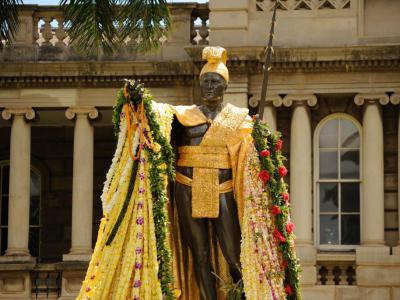
1) Kamehameha Statue
The Kamehameha I statue in Honolulu, created by Thomas Ridgeway Gould, an American sculptor, was set up in 1883. This particular version is the second in a series. The first one is in North Kohala on Hawaiʻi Island, while this second one is placed in front of the Aliʻiōlani Hale, a government building in Honolulu, on Oahu Island. This brass statue depicts Kamehameha I, who unified the Hawaiian Islands and established the Kingdom of Hawaiʻi in 1810. It's large and has a two-tone finish, with a dark brown patina and gold highlights on the clothing.
This statue was made as a backup for the original Kamehameha the Great statue. That one was intended to mark 100 years since Captain James Cook arrived in Hawaii. The Honolulu statue has stood in front of the Aliʻiōlani Hale since 1883, a spot originally meant for the first statue.
The second cast of the Kamehameha I statue is not just an artwork; it's become a symbol of Hawaiian politics and culture. It's part of the Hawaiian state seal and the logo of the Kamehameha Schools, which are scattered across the Islands. In 1959, with Hawaii becoming the 50th U.S. state, a third version of this statue was made. This one, modeled after the second, is in the U.S. Capitol in Washington, D.C.
Businesses, particularly in tourism, have used the statue's image widely. It appears on things like brochures, postcards, T-shirts, and various crafts, and miniature replicas are common Hawaiian souvenirs.
Additionally, the statue plays a significant role in Kamehameha Day celebrations. This annual holiday honors Hawaiʻi's first king. During these festivities, the statue is traditionally adorned with long lei as a tribute to Kamehameha I and his legacy.
This statue was made as a backup for the original Kamehameha the Great statue. That one was intended to mark 100 years since Captain James Cook arrived in Hawaii. The Honolulu statue has stood in front of the Aliʻiōlani Hale since 1883, a spot originally meant for the first statue.
The second cast of the Kamehameha I statue is not just an artwork; it's become a symbol of Hawaiian politics and culture. It's part of the Hawaiian state seal and the logo of the Kamehameha Schools, which are scattered across the Islands. In 1959, with Hawaii becoming the 50th U.S. state, a third version of this statue was made. This one, modeled after the second, is in the U.S. Capitol in Washington, D.C.
Businesses, particularly in tourism, have used the statue's image widely. It appears on things like brochures, postcards, T-shirts, and various crafts, and miniature replicas are common Hawaiian souvenirs.
Additionally, the statue plays a significant role in Kamehameha Day celebrations. This annual holiday honors Hawaiʻi's first king. During these festivities, the statue is traditionally adorned with long lei as a tribute to Kamehameha I and his legacy.
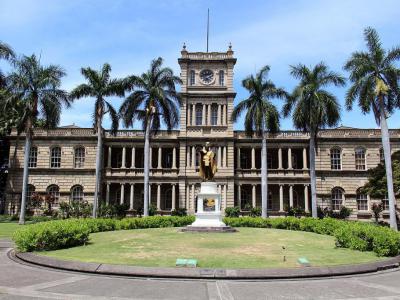
2) Aliiolani Hale (House of Heavenly Kings)
Aliiolani Hale stands as a prominent structure nestled in downtown Honolulu, currently serving as the official residence of the Hawaii State Supreme Court. It holds historical significance as the former administrative headquarters of the Kingdom of Hawaii.
This architectural marvel, Aliiolani Hale, was conceived by the Australian architect Thomas Rowe in an Italian Renaissance Revival style, originally intended to serve as the royal palace for King Kamehameha V. In the Hawaiian language, the name "Aliiolani Hale" translates to "House of Heavenly Kings," a term that also doubled as one of King Kamehameha V's given names.
However, a practical shift in plans occurred during Kamehameha V's reign. Recognizing the pressing need for a suitable government facility in Honolulu, as the existing structures were notably undersized for the growing Hawaiian government, he redirected the purpose of Aliiolani Hale from a palace to a government office building.
On February 19, 1872, Kamehameha V laid the cornerstone for this structure. Unfortunately, he passed away before its completion, and it was subsequently dedicated in 1874 by his successor, King David Kalakaua. Interestingly, the extravagant design of the building drew criticism from Hawaiian media at the time, prompting suggestions to revert it to its original palace purpose.
In 1893, Aliiolani Hale played a pivotal role in Hawaiian history as the site of Queen Liliuokalani's overthrow. The Committee of Safety, led by Lorrin Thurston and backed by US Marines, ousted the queen from power. Today, Aliiolani Hale enjoys a place on the National Register of Historic Places and houses the King Kamehameha V Judiciary History Center.
Within the building's courtyard, you can find the renowned gold-leaf statue of Kamehameha the Great, adding to its cultural and historical significance.
This architectural marvel, Aliiolani Hale, was conceived by the Australian architect Thomas Rowe in an Italian Renaissance Revival style, originally intended to serve as the royal palace for King Kamehameha V. In the Hawaiian language, the name "Aliiolani Hale" translates to "House of Heavenly Kings," a term that also doubled as one of King Kamehameha V's given names.
However, a practical shift in plans occurred during Kamehameha V's reign. Recognizing the pressing need for a suitable government facility in Honolulu, as the existing structures were notably undersized for the growing Hawaiian government, he redirected the purpose of Aliiolani Hale from a palace to a government office building.
On February 19, 1872, Kamehameha V laid the cornerstone for this structure. Unfortunately, he passed away before its completion, and it was subsequently dedicated in 1874 by his successor, King David Kalakaua. Interestingly, the extravagant design of the building drew criticism from Hawaiian media at the time, prompting suggestions to revert it to its original palace purpose.
In 1893, Aliiolani Hale played a pivotal role in Hawaiian history as the site of Queen Liliuokalani's overthrow. The Committee of Safety, led by Lorrin Thurston and backed by US Marines, ousted the queen from power. Today, Aliiolani Hale enjoys a place on the National Register of Historic Places and houses the King Kamehameha V Judiciary History Center.
Within the building's courtyard, you can find the renowned gold-leaf statue of Kamehameha the Great, adding to its cultural and historical significance.
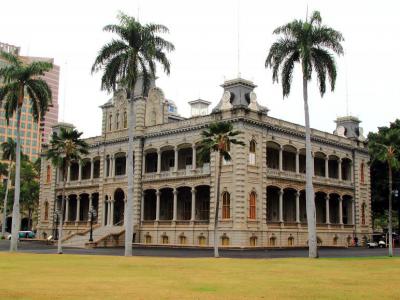
3) Iolani Palace (must see)
When Hawaii was ruled by King Kamehameha III, he resided in the Iolani Palace. The palace was in use by the royalty of the Kingdom of Hawaii through 1893 when the Kalakaua Dynasty was overthrown.
The building was in use as the seat of government in Hawaii until 1969. Soon thereafter it was turned into a museum. It is now on the National Register of Historic Places.
Construction on Iolani Palace began in 1879 in the American Florentine Style. It was designed by architects Thomas J. Baker, Chris J. Wall and Isaac Moore. The palace was completed in 1882. Unlike many homes at the time, even those built for royalty, the palace included electric lights, plumbing and a telephone.
Those who visit the palace today will find historic photos, military memorabilia and many items that once belonged to the palace. The Iolani Palace continues to add to its collection as missing items are recovered. A large number of furnishings were sold in public auction, but identifying royal marks have allowed furniture, tableware, silver and art to be returned to its rightful home.
Visitors can take part in regular lectures and talks that are held at the palace. They can also enjoy classes, like traditional Hawaiian quilting. Royal Hawaiian Band concerts regularly take place at the palace as well.
The palace is open Monday through Saturday. Children under the age of five must remain strapped into a stroller or holding hands with an adult at all times.
Why You Should Visit:
Iolani Palace is the only royal palace in the United States. It is a great place to learn more about the history and culture of Hawaii.
Tips:
Iolani Palace is considered to be a sacred place. Appropriate attire is required for touring the premises. Visitors aren't permitted if they are wearing beachwear or clothing displaying profanity.
The building was in use as the seat of government in Hawaii until 1969. Soon thereafter it was turned into a museum. It is now on the National Register of Historic Places.
Construction on Iolani Palace began in 1879 in the American Florentine Style. It was designed by architects Thomas J. Baker, Chris J. Wall and Isaac Moore. The palace was completed in 1882. Unlike many homes at the time, even those built for royalty, the palace included electric lights, plumbing and a telephone.
Those who visit the palace today will find historic photos, military memorabilia and many items that once belonged to the palace. The Iolani Palace continues to add to its collection as missing items are recovered. A large number of furnishings were sold in public auction, but identifying royal marks have allowed furniture, tableware, silver and art to be returned to its rightful home.
Visitors can take part in regular lectures and talks that are held at the palace. They can also enjoy classes, like traditional Hawaiian quilting. Royal Hawaiian Band concerts regularly take place at the palace as well.
The palace is open Monday through Saturday. Children under the age of five must remain strapped into a stroller or holding hands with an adult at all times.
Why You Should Visit:
Iolani Palace is the only royal palace in the United States. It is a great place to learn more about the history and culture of Hawaii.
Tips:
Iolani Palace is considered to be a sacred place. Appropriate attire is required for touring the premises. Visitors aren't permitted if they are wearing beachwear or clothing displaying profanity.
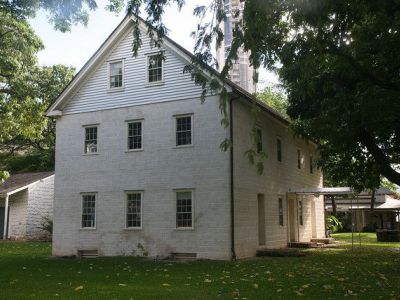
4) Hawaiian Mission Houses
The Mission Houses Museum collects and exhibits documents and artifacts relating to Hawaiian history between 1820 and 1863 – the “missionary” period. Today, the museum has over 3,000 Hawaiian, Western, and Pacific artifacts, and more than 12,000 books, manuscripts, original letters, diaries, journals, illustrations and Hawaiian church records.
The Houses themselves are interesting for the way they demonstrate how New England missionaries progressively adapted to the environment. The Oldest Frame House was built from materials shipped down from Boston around 1821. They were precut and premeasured, so they pretty much just needed to be assembled. The funny thing about the Oldest Frame House is the style – it was made with small windows and short eaves, to help it survive Boston winters, which made it odd to use in Hawaii.
The Chamberlain House was built in 1831 from local Hawaiian materials, including coral blocks and salvaged lumber from ships. This house has larger windows, and shutters to provide shade, which the Oldest Frame House did not. The Print House was an addition to the Oldest Frame House. Originally a bedroom, the coral block addition later served as the missionaries' print house. Today, the Print House serves as an exhibit to show how the native Hawaiians and New England missionaries developed the first materials printed in native Hawaiian language.
Why You Should Visit:
To take a look at life back when the missions were still in service during the plantation days and to learn about the impact of these missionaries on the native Hawaiian culture.
Lots of great events for kids and adults throughout the year, including certain days with free admission, and a well-appointed gift shop.
The Houses themselves are interesting for the way they demonstrate how New England missionaries progressively adapted to the environment. The Oldest Frame House was built from materials shipped down from Boston around 1821. They were precut and premeasured, so they pretty much just needed to be assembled. The funny thing about the Oldest Frame House is the style – it was made with small windows and short eaves, to help it survive Boston winters, which made it odd to use in Hawaii.
The Chamberlain House was built in 1831 from local Hawaiian materials, including coral blocks and salvaged lumber from ships. This house has larger windows, and shutters to provide shade, which the Oldest Frame House did not. The Print House was an addition to the Oldest Frame House. Originally a bedroom, the coral block addition later served as the missionaries' print house. Today, the Print House serves as an exhibit to show how the native Hawaiians and New England missionaries developed the first materials printed in native Hawaiian language.
Why You Should Visit:
To take a look at life back when the missions were still in service during the plantation days and to learn about the impact of these missionaries on the native Hawaiian culture.
Lots of great events for kids and adults throughout the year, including certain days with free admission, and a well-appointed gift shop.
5) Honolulu Hale (City Hall)
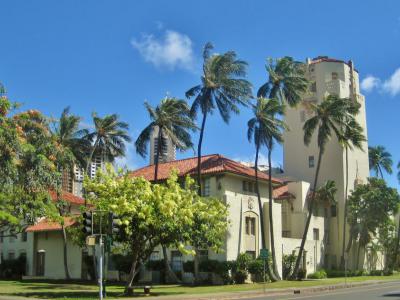
Honolulu Hale is the official seat of government of the city and county, site of the chambers of the Mayor of Honolulu and the Honolulu City Council. In the Hawaiian language, "hale" (pronounced HAH-leh) means house or building.
Honolulu Hale was an idea started by Joseph J. Fern. Originally, Honolulu was overseen by a Board of Supervisors. During the existence of the County of Oahu, the Board met in city halls all around Honolulu. When the County of Oahu and the Board of Supervisors dissolved in 1907 and established the City & County of Honolulu, Fern became its first mayor and began making preliminary plans for the construction of a city hall. Unfortunately, Fern died in 1920 of diabetes before he could persuade residents of the need for a permanent city hall. Mayor John Wilson, who was also the Honolulu Chapter President of the American Association of Engineers, carried on Fern's dream.
Honolulu Hale was built in an Italianate Spanish Colonial Revival style that was popular on the islands at the time. Its interior courtyard, staircase, and open ceiling were modeled after the Bargello in Florence. Einar Peterson was commissioned to paint frescoes in the interior while Mario Valdastri was commissioned to install intricate stonework. In 1951, two three-story wings were added to the original structure.
Surrounding Honolulu Hale are other prominent historic and artistic landmarks: Aliiolani Hale, Hawaii State Capitol, Iolani Palace, Kawaiahao Church, Sky Gate, and the Territorial Building. Within walking distance are Cathedral of Our Lady of Peace, Cathedral Church of Saint Andrew and Washington Place.
Tip:
A great time to visit the city hall is during the holiday season when they decorate it with a display of illumination nicknamed the Honolulu City Lights. Make sure you look up!
Honolulu Hale was an idea started by Joseph J. Fern. Originally, Honolulu was overseen by a Board of Supervisors. During the existence of the County of Oahu, the Board met in city halls all around Honolulu. When the County of Oahu and the Board of Supervisors dissolved in 1907 and established the City & County of Honolulu, Fern became its first mayor and began making preliminary plans for the construction of a city hall. Unfortunately, Fern died in 1920 of diabetes before he could persuade residents of the need for a permanent city hall. Mayor John Wilson, who was also the Honolulu Chapter President of the American Association of Engineers, carried on Fern's dream.
Honolulu Hale was built in an Italianate Spanish Colonial Revival style that was popular on the islands at the time. Its interior courtyard, staircase, and open ceiling were modeled after the Bargello in Florence. Einar Peterson was commissioned to paint frescoes in the interior while Mario Valdastri was commissioned to install intricate stonework. In 1951, two three-story wings were added to the original structure.
Surrounding Honolulu Hale are other prominent historic and artistic landmarks: Aliiolani Hale, Hawaii State Capitol, Iolani Palace, Kawaiahao Church, Sky Gate, and the Territorial Building. Within walking distance are Cathedral of Our Lady of Peace, Cathedral Church of Saint Andrew and Washington Place.
Tip:
A great time to visit the city hall is during the holiday season when they decorate it with a display of illumination nicknamed the Honolulu City Lights. Make sure you look up!
6) Hawaii State Library
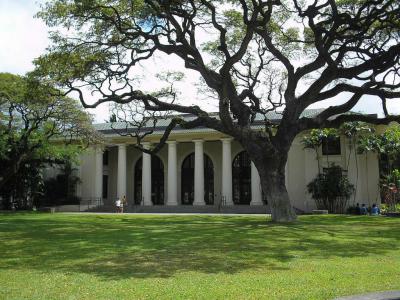
The Hawaii State Library is located adjacent to Iolani Palace in downtown Honolulu. This serves as the base for the Hawaii State Public Library System, which is the only statewide library system in the entire United States.
The building that houses the Hawaii State Library was designed by Henry D. Whitfield, Andrew Carnegie's brother-in-law, and funded by Carnegie himself. Construction began in 1911, and the building was finished in 1913. Before the library was built, the Honolulu Library and Reading Room Association provided library services to the community. Prior to 1959, library services were established separately for each island, with minimal oversight by the Library of Hawaii. In 1959, when Hawaii formally became a state, the Hawaii State Public Library System was developed. In 1978, the Hawaii State Library was added to the National Register of Historic Places.
Today, the Hawaii State Library holds more than 525,000 books, while the entire library system has over 3 million. The courtyard is decorated with an ocean mosaic by Japanese American Hiroki Morinoue, the Edna Allyn Children's Room contains murals of Hawaiian legends by painter Juliette May Fraser, and the front lawn sports cast bronze sculptures named "Parent I" and "Young Girl" by British sculptor Barbara Hepworth.
The building that houses the Hawaii State Library was designed by Henry D. Whitfield, Andrew Carnegie's brother-in-law, and funded by Carnegie himself. Construction began in 1911, and the building was finished in 1913. Before the library was built, the Honolulu Library and Reading Room Association provided library services to the community. Prior to 1959, library services were established separately for each island, with minimal oversight by the Library of Hawaii. In 1959, when Hawaii formally became a state, the Hawaii State Public Library System was developed. In 1978, the Hawaii State Library was added to the National Register of Historic Places.
Today, the Hawaii State Library holds more than 525,000 books, while the entire library system has over 3 million. The courtyard is decorated with an ocean mosaic by Japanese American Hiroki Morinoue, the Edna Allyn Children's Room contains murals of Hawaiian legends by painter Juliette May Fraser, and the front lawn sports cast bronze sculptures named "Parent I" and "Young Girl" by British sculptor Barbara Hepworth.
7) Kawaiahao Church
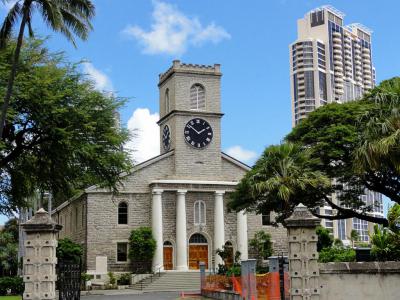
Kawaiahao Church, often referred to as Hawaii's equivalent of Westminster Abbey, holds a significant historical and cultural status. In the past, it served as the national church of the Kingdom of Hawaii and served as the private chapel for the Hawaiian royal family. Despite not being the original structure, it stands as Hawaii's oldest existing Christian place of worship. The present Kawaiahao Church was constructed on the grounds where four smaller thatched churches once stood, and it was meticulously built using coral rock.
The name "Kawaiahao" originates from the Hawaiian phrase meaning "the water of Hao," which alludes to the site's origins as a spring and a small freshwater pool that was managed by High Chiefess Hao.
The commissioning of Kawaiahao Church took place during the reigns of Kings Kamehameha II and III. It was designed by Reverend Hiram Bingham, with a deliberate intention to emulate the architectural style of Hawaiian missionaries. The construction process involved the laborious task of quarrying coral rock by hand. This demanding process required highly skilled divers who had to descend to depths of up to 18 feet below sea level to cut out stone slabs. Subsequently, these slabs were transported from beneath the sea to the shore and then to the church construction site.
It was within the walls of Kawaiahao Church that King Kamehameha III famously uttered the phrase, "The life of the land is perpetuated in righteousness," which eventually became the official motto of Hawaii.
The name "Kawaiahao" originates from the Hawaiian phrase meaning "the water of Hao," which alludes to the site's origins as a spring and a small freshwater pool that was managed by High Chiefess Hao.
The commissioning of Kawaiahao Church took place during the reigns of Kings Kamehameha II and III. It was designed by Reverend Hiram Bingham, with a deliberate intention to emulate the architectural style of Hawaiian missionaries. The construction process involved the laborious task of quarrying coral rock by hand. This demanding process required highly skilled divers who had to descend to depths of up to 18 feet below sea level to cut out stone slabs. Subsequently, these slabs were transported from beneath the sea to the shore and then to the church construction site.
It was within the walls of Kawaiahao Church that King Kamehameha III famously uttered the phrase, "The life of the land is perpetuated in righteousness," which eventually became the official motto of Hawaii.
