Custom Walk in Kyoto, Japan by emurphy_74f69 created on 2026-04-30
Guide Location: Japan » Kyoto
Guide Type: Custom Walk
# of Sights: 5
Tour Duration: 2 Hour(s)
Travel Distance: 5.3 Km or 3.3 Miles
Share Key: 7PKJM
Guide Type: Custom Walk
# of Sights: 5
Tour Duration: 2 Hour(s)
Travel Distance: 5.3 Km or 3.3 Miles
Share Key: 7PKJM
How It Works
Please retrieve this walk in the GPSmyCity app. Once done, the app will guide you from one tour stop to the next as if you had a personal tour guide. If you created the walk on this website or come to the page via a link, please follow the instructions below to retrieve the walk in the app.
Retrieve This Walk in App
Step 1. Download the app "GPSmyCity: Walks in 1K+ Cities" on Apple App Store or Google Play Store.



Step 2. In the GPSmyCity app, download(or launch) the guide "Kyoto Map and Walking Tours".
Step 3. Tap the menu button located at upper right corner of the "Walks" screen and select "Retrieve custom walk". Enter the share key: 7PKJM
1) Fushimi Inari Taisha Shrine (must see)
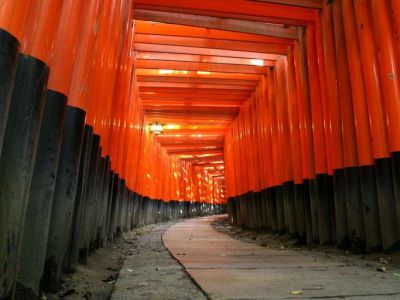
If you can only squeeze in one Shinto shrine visit during your Kyoto stay, Fushimi Inari-Taisha should be your top choice. As the primary shrine for 40,000 Inari dedications nationwide, it holds sway as the divine abode of fertility, rice, sake, and prosperity.
A sight to behold, this captivating complex sprawls across a mountain, boasting over 10,000 vermillion torii gates that weave through dense woodlands along a 4-kilometer trail. Stone foxes, guardians with granary keys, dot the landscape, alongside five shrines, mausoleums, and sake-laden altars. In Shinto belief, foxes serve as messengers to 'kami' (gods), bridging our world and the next.
While wandering through the crimson tunnel may feel surreal, the shrine's focus remains firmly rooted in worldly affairs. Originally honoring rice and sake gods since AD 711, its emphasis later shifted to commerce, evidenced by black kanji inscriptions on torii gates, each donated by businesses hoping for prosperity.
Venture to the hilltop, where countless altars await, erected by devotees after individual visions of Inari. Traditional stores peddle noodles and religious items, while a viewing point offers a stunning panorama of southern Kyoto. With its playful yet sacred ambiance, embellished by myriad fox statues, the hill exudes an enchanting allure, making Fushimi Inari the city's crown jewel.
Why You Should Visit:
Apart from ample photo ops along the winding mountain trails, it offers a mystical journey through sacred terrain, rejuvenated by crisp mountain air.
Tips:
While amenities are sparse, stores and eateries dot the path, but consider carrying water. The trek to the summit is rewarding, especially in solitude, so aim for an early start to avoid crowds and relish the serene charm.
A sight to behold, this captivating complex sprawls across a mountain, boasting over 10,000 vermillion torii gates that weave through dense woodlands along a 4-kilometer trail. Stone foxes, guardians with granary keys, dot the landscape, alongside five shrines, mausoleums, and sake-laden altars. In Shinto belief, foxes serve as messengers to 'kami' (gods), bridging our world and the next.
While wandering through the crimson tunnel may feel surreal, the shrine's focus remains firmly rooted in worldly affairs. Originally honoring rice and sake gods since AD 711, its emphasis later shifted to commerce, evidenced by black kanji inscriptions on torii gates, each donated by businesses hoping for prosperity.
Venture to the hilltop, where countless altars await, erected by devotees after individual visions of Inari. Traditional stores peddle noodles and religious items, while a viewing point offers a stunning panorama of southern Kyoto. With its playful yet sacred ambiance, embellished by myriad fox statues, the hill exudes an enchanting allure, making Fushimi Inari the city's crown jewel.
Why You Should Visit:
Apart from ample photo ops along the winding mountain trails, it offers a mystical journey through sacred terrain, rejuvenated by crisp mountain air.
Tips:
While amenities are sparse, stores and eateries dot the path, but consider carrying water. The trek to the summit is rewarding, especially in solitude, so aim for an early start to avoid crowds and relish the serene charm.
2) Tofuku-ji Temple (must see)
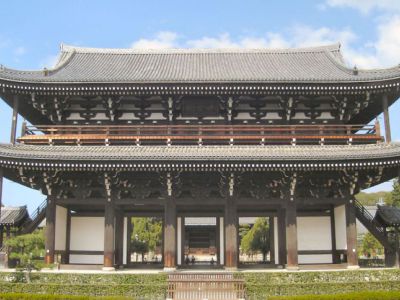
Established in 1236, Tofuku-ji stands as one of Kyoto's oldest and grandest Zen monasteries, nestled amidst the picturesque Eastern Hills. Stepping into its grounds feels like a journey back in time, as remnants of medieval charm still linger, inviting exploration of its renowned attractions: a lush gorge adorned with two thousand maples and a modern masterpiece of a garden.
True to Zen principles, the temple's layout follows a simple yet elegant design, with key structures aligned along a central axis. While most buildings are modern reconstructions, a testament to resilience after a devastating fire in 1881, the Sanmon ceremonial gate remains an imposing symbol of the temple's grandeur. Adjacent to it lies the intriguingly named "100 man toilet", featuring meticulously aligned circular openings in padded earth, alongside washrooms that once served hundreds of monks using an innovative sauna system.
Venturing further, the journey across a roofed bridge spanning a ravine leads to the revered Founder’s Hall, a site that requires a fee for entry. During autumn, the gorge teems with visitors drawn by the mesmerizing hues of its maple foliage; however, for aficionados of gardens, the spotlight falls on the Abbot's Quarters, encircled by the renowned Hasso Garden by Shigemori Mirei, credited with revolutionizing Zen garden design.
Each section of the garden tells a unique story, blending tradition with innovation. The Southern Garden features rocks symbolizing the Isles of the Immortals, juxtaposed with mossy mounds representing the top five Gozan Zen temples. Meanwhile, the Western Garden introduces a departure from convention with its raked gravel squares, and the Northern Garden captivates with a fading checkered pattern stretching into the distance. Lastly, the Eastern Garden ingeniously repurposes old pillars to depict the revered Big Dipper of Daoism, seamlessly intertwining myth and modernity to transcend traditional design constraints.
Tip:
Be sure to carry cash, as entrance fees are required for each of the garden areas. Prior research can help you decide which garden best suits your preferences.
True to Zen principles, the temple's layout follows a simple yet elegant design, with key structures aligned along a central axis. While most buildings are modern reconstructions, a testament to resilience after a devastating fire in 1881, the Sanmon ceremonial gate remains an imposing symbol of the temple's grandeur. Adjacent to it lies the intriguingly named "100 man toilet", featuring meticulously aligned circular openings in padded earth, alongside washrooms that once served hundreds of monks using an innovative sauna system.
Venturing further, the journey across a roofed bridge spanning a ravine leads to the revered Founder’s Hall, a site that requires a fee for entry. During autumn, the gorge teems with visitors drawn by the mesmerizing hues of its maple foliage; however, for aficionados of gardens, the spotlight falls on the Abbot's Quarters, encircled by the renowned Hasso Garden by Shigemori Mirei, credited with revolutionizing Zen garden design.
Each section of the garden tells a unique story, blending tradition with innovation. The Southern Garden features rocks symbolizing the Isles of the Immortals, juxtaposed with mossy mounds representing the top five Gozan Zen temples. Meanwhile, the Western Garden introduces a departure from convention with its raked gravel squares, and the Northern Garden captivates with a fading checkered pattern stretching into the distance. Lastly, the Eastern Garden ingeniously repurposes old pillars to depict the revered Big Dipper of Daoism, seamlessly intertwining myth and modernity to transcend traditional design constraints.
Tip:
Be sure to carry cash, as entrance fees are required for each of the garden areas. Prior research can help you decide which garden best suits your preferences.
3) Sanjusangen-do Temple (must see)
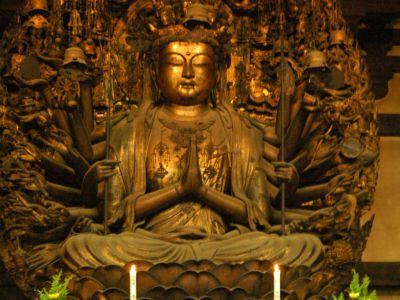
Sanjūsangen-dō is truly remarkable in every aspect. Stretching a staggering 387 feet (118 meters), it holds the title of the longest wooden building worldwide. Within its walls stand 1,000 life-sized Buddha figures, arranged on each side of an immense sitting statue. Constructed in the 1160s, this hall served as the private sanctuary of Go-Shirakawa, a former emperor, within his vast estate.
Motivated by his faith in Amida, the ex-emperor sought to honor the deity who vowed to welcome all who invoked his name into his Pure Land paradise. The statues portray Kannon, a messenger of Amida and bodhisattva bridging the gap between worlds. Here, Kannon takes the form of the so-called Senjū Kannon, with eleven faces and a thousand arms!
Walking amidst these rows of statues can evoke a sense of awe akin to standing before a celestial choir. Despite their uniform appearance at first glance, each statue is subtly unique in body shape, eye width, and robe design. Legend has it that with enough contemplation, one may even recognize a familiar face among them.
Unfortunately, the original brightly colored building, representing the Pure Land, fell victim to fire in 1249; as a result, 875 of the statues had to be replaced. Facing west towards Amida's Pure Land, worshippers would have been greeted by the dazzling spectacle of the statues bathed in the morning sun's first rays when the central doors swung open. In a city renowned for its enchanting moments, this sight undoubtedly stood out as the most magical.
Tips:
Photography inside the hall is strictly prohibited, so consider purchasing the inexpensive guidebook with lovely pictures and informative text as a keepsake. And before departing, take a leisurely 10-15 minute stroll through the small garden surrounding the hall, a tranquil oasis deserving of appreciation.
Motivated by his faith in Amida, the ex-emperor sought to honor the deity who vowed to welcome all who invoked his name into his Pure Land paradise. The statues portray Kannon, a messenger of Amida and bodhisattva bridging the gap between worlds. Here, Kannon takes the form of the so-called Senjū Kannon, with eleven faces and a thousand arms!
Walking amidst these rows of statues can evoke a sense of awe akin to standing before a celestial choir. Despite their uniform appearance at first glance, each statue is subtly unique in body shape, eye width, and robe design. Legend has it that with enough contemplation, one may even recognize a familiar face among them.
Unfortunately, the original brightly colored building, representing the Pure Land, fell victim to fire in 1249; as a result, 875 of the statues had to be replaced. Facing west towards Amida's Pure Land, worshippers would have been greeted by the dazzling spectacle of the statues bathed in the morning sun's first rays when the central doors swung open. In a city renowned for its enchanting moments, this sight undoubtedly stood out as the most magical.
Tips:
Photography inside the hall is strictly prohibited, so consider purchasing the inexpensive guidebook with lovely pictures and informative text as a keepsake. And before departing, take a leisurely 10-15 minute stroll through the small garden surrounding the hall, a tranquil oasis deserving of appreciation.
4) Ninen-zaka & Sannen-zakaa Streets (must see)
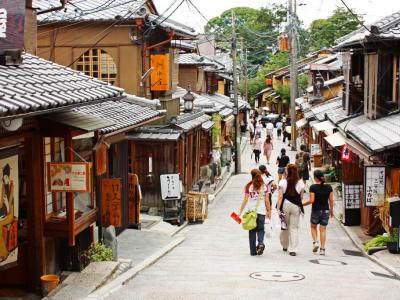
If you ever thought that time-travel on foot is not possible, welcome to Ninen-zaka and Sannen-zaka, Kyoto’s prettiest pair of gently sloping stone-paved streets. Just south of the famous Kiyomizu-dera Temple, these twin time capsules have been charming pilgrims, poets, and now Instagrammers since the Heian period (as far back as the 8th century AD). Their names-translating to “Two-Year Hill” and “Three-Year Hill,” respectively-aren’t just quaint poetry; legend has it that if you trip here, you’ll be cursed with two or three years of bad luck. So watch your step, but do it stylishly...
Lined with wooden machiya townhouses straight out of an Edo-era painting, these streets now brim with modern temptations in historical disguise-such as matcha lattes in teahouses, delicate sweets that look too pretty to eat, and souvenir shops where even the magnets feel refined. Early mornings bring soft golden light and far fewer tourists-ideal for catching that postcard-perfect shot of Yasaka Pagoda or wandering down a lantern-lit alley like a wandering extra in a samurai drama.
No cars, no chaos-just the click-clack of wooden geta sandals on stone and the scent of roasted tea in the air. It’s like Kyoto whispered, “Slow down,” and these hills listened. For a walk that’s part history lesson, part sensory feast, and 100% Kyoto, Ninen-zaka and Sannen-zaka are more than just pathways-they’re an experience with a side of superstition...
Lined with wooden machiya townhouses straight out of an Edo-era painting, these streets now brim with modern temptations in historical disguise-such as matcha lattes in teahouses, delicate sweets that look too pretty to eat, and souvenir shops where even the magnets feel refined. Early mornings bring soft golden light and far fewer tourists-ideal for catching that postcard-perfect shot of Yasaka Pagoda or wandering down a lantern-lit alley like a wandering extra in a samurai drama.
No cars, no chaos-just the click-clack of wooden geta sandals on stone and the scent of roasted tea in the air. It’s like Kyoto whispered, “Slow down,” and these hills listened. For a walk that’s part history lesson, part sensory feast, and 100% Kyoto, Ninen-zaka and Sannen-zaka are more than just pathways-they’re an experience with a side of superstition...
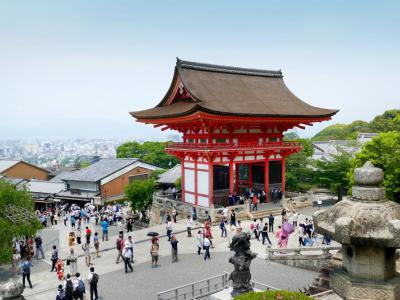
5) Kiyomizu-dera Temple (must see)
Towering above the treasure-packed sprawl of Southern Higashiyama, Kiyomizu-dera temple is both a place of worship and Kyoto’s dramatic headliner. Equal parts spiritual retreat and bucket-list selfie spot, it offers sweeping views of the city below (if you can peel your eyes away from the throngs of visitors doing the same). And should you be bold enough (or just patient) to visit during cherry blossom season, the nighttime glow of illuminated petals will be your reward for enduring the human traffic jam.
The temple’s story starts with a splash-quite literally. In 778, a monk named Enchin Shonin, nudged by a divine vision, stumbled upon the Otowa Spring. The water was so pure that it gave the temple its name: Kiyomizu, meaning “clear water.” A noble patron, moved by the miracle (or just in the mood for grand gestures), commissioned a hall built not in typical temple fashion but in the style of an aristocrat’s dream home-complete with a swooping shingled roof. At its heart is a rarely-seen 1,000-armed Kannon (a bodhisattva of compassion, widely revered in East Asian Buddhism, especially in Japan), which is unveiled to mere mortals once every 33 years. Blink and you’ll miss it... for another three decades.
Then there’s the famous stage-no nails, just massive wooden pillars holding up a 13-meter (or 43-foot) drop. Originally used for sacred dance performances, it later gained ill fame as a tragic endpoint for desperate folks hoping to leap their way into a better afterlife. Nowadays, you’re more likely to leap into a photo op with Kyoto’s hills in the background.
Wander a bit more and you'll find Jishu Shrine, matchmaking central, and the pagoda where expectant mothers whisper hopes for safe births. And don’t skip the Otowa Spring, of course: its three trickling streams promise health, longevity, or academic success. Just pick one-greedy sipping is frowned upon. After 1,200 years, the lines are still long and the stakes still high. So, choose wisely...
The temple’s story starts with a splash-quite literally. In 778, a monk named Enchin Shonin, nudged by a divine vision, stumbled upon the Otowa Spring. The water was so pure that it gave the temple its name: Kiyomizu, meaning “clear water.” A noble patron, moved by the miracle (or just in the mood for grand gestures), commissioned a hall built not in typical temple fashion but in the style of an aristocrat’s dream home-complete with a swooping shingled roof. At its heart is a rarely-seen 1,000-armed Kannon (a bodhisattva of compassion, widely revered in East Asian Buddhism, especially in Japan), which is unveiled to mere mortals once every 33 years. Blink and you’ll miss it... for another three decades.
Then there’s the famous stage-no nails, just massive wooden pillars holding up a 13-meter (or 43-foot) drop. Originally used for sacred dance performances, it later gained ill fame as a tragic endpoint for desperate folks hoping to leap their way into a better afterlife. Nowadays, you’re more likely to leap into a photo op with Kyoto’s hills in the background.
Wander a bit more and you'll find Jishu Shrine, matchmaking central, and the pagoda where expectant mothers whisper hopes for safe births. And don’t skip the Otowa Spring, of course: its three trickling streams promise health, longevity, or academic success. Just pick one-greedy sipping is frowned upon. After 1,200 years, the lines are still long and the stakes still high. So, choose wisely...
