Custom Walk in Taipei, Taiwan by drape97_9e8932 created on 2026-05-03
Guide Location: Taiwan » Taipei
Guide Type: Custom Walk
# of Sights: 7
Tour Duration: 15 Hour(s)
Travel Distance: 42.5 Km or 26.4 Miles
Share Key: PYH9M
Guide Type: Custom Walk
# of Sights: 7
Tour Duration: 15 Hour(s)
Travel Distance: 42.5 Km or 26.4 Miles
Share Key: PYH9M
How It Works
Please retrieve this walk in the GPSmyCity app. Once done, the app will guide you from one tour stop to the next as if you had a personal tour guide. If you created the walk on this website or come to the page via a link, please follow the instructions below to retrieve the walk in the app.
Retrieve This Walk in App
Step 1. Download the app "GPSmyCity: Walks in 1K+ Cities" on Apple App Store or Google Play Store.



Step 2. In the GPSmyCity app, download(or launch) the guide "Taipei Map and Walking Tours".
Step 3. Tap the menu button located at upper right corner of the "Walks" screen and select "Retrieve custom walk". Enter the share key: PYH9M
1) Longshan Temple (must see)
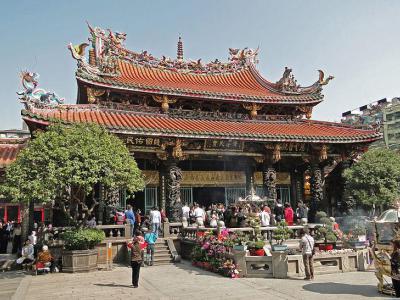
Longshan Temple is one of Taipei’s oldest and most important religious landmarks, deeply rooted in the city’s early history and everyday spiritual life. Originally constructed in 1738 by settlers from Fujian Province during the Qing dynasty, the temple was built as a place of worship for Chinese immigrants who had settled in the Bangka area, today’s Wanhua District.
As soon as you pass through the gate facing the street, you will be met by a broad courtyard. It leads you straight ahead to the Front Hall. Step onto its porch, and you'll notice it is flanked by two bronze pillars. They are intricately cast with spiralling dragons and characters from the Ming Dynasty novel Investiture of the Gods. Most temples in Taiwan feature stone pillars; Longshan is the only temple in the country with pillars cast in bronze. If you look ten metres to your right and left, you will see one gate on each side. They might look similar, but according to Taiwanese etiquette, you should always enter through the gate on the right (called the Dragon Gate) and exit through the gate on the left (called the Tiger Gate). Entering through the mouth of the dragon and leaving through the mouth of the tiger symbolises turning bad luck into good fortune.
The temple's architecture follows traditional southern Chinese temple design, with ornate roofs, carved stone pillars, and richly decorated courtyards. The temple’s vivid colours and decorative details immediately stand out, with dragons appearing throughout the complex-an apt motif, as the temple’s name translates to “Dragon Mountain.”
However, the soul of the temple is the miraculous Guanyin statue. To find it, walk into the main courtyard and look toward the central hall. During a World War II Allied air raid on May 31, 1945, a bomb hit this hall, and the entire structure burned to the ground. Miraculously, the wooden Guanyin statue sitting at the centre was found completely unscorched among the ash. To see the statue at its best, wait for a gap in the crowds of chanting worshippers and look through the central doorway.
Decoration plays an important role in the temple’s atmosphere, especially during festivals. During Lunar New Year, lanterns fill the courtyards, and flowers are abundant throughout the grounds. Among the many altars, one of the most popular is dedicated to Yue Lao, the god revered as a matchmaker. Walk past the Main Hall to the very back row of altars. Follow the corridor to the westernmost altar. Single residents of Taipei often visit this altar to pray for lasting love, taking a symbolic red string meant to be tied around their future partner’s wrist.
Outside the temple, food stalls and a nearby underground mall selling Buddhist merchandise add to the experience.
As soon as you pass through the gate facing the street, you will be met by a broad courtyard. It leads you straight ahead to the Front Hall. Step onto its porch, and you'll notice it is flanked by two bronze pillars. They are intricately cast with spiralling dragons and characters from the Ming Dynasty novel Investiture of the Gods. Most temples in Taiwan feature stone pillars; Longshan is the only temple in the country with pillars cast in bronze. If you look ten metres to your right and left, you will see one gate on each side. They might look similar, but according to Taiwanese etiquette, you should always enter through the gate on the right (called the Dragon Gate) and exit through the gate on the left (called the Tiger Gate). Entering through the mouth of the dragon and leaving through the mouth of the tiger symbolises turning bad luck into good fortune.
The temple's architecture follows traditional southern Chinese temple design, with ornate roofs, carved stone pillars, and richly decorated courtyards. The temple’s vivid colours and decorative details immediately stand out, with dragons appearing throughout the complex-an apt motif, as the temple’s name translates to “Dragon Mountain.”
However, the soul of the temple is the miraculous Guanyin statue. To find it, walk into the main courtyard and look toward the central hall. During a World War II Allied air raid on May 31, 1945, a bomb hit this hall, and the entire structure burned to the ground. Miraculously, the wooden Guanyin statue sitting at the centre was found completely unscorched among the ash. To see the statue at its best, wait for a gap in the crowds of chanting worshippers and look through the central doorway.
Decoration plays an important role in the temple’s atmosphere, especially during festivals. During Lunar New Year, lanterns fill the courtyards, and flowers are abundant throughout the grounds. Among the many altars, one of the most popular is dedicated to Yue Lao, the god revered as a matchmaker. Walk past the Main Hall to the very back row of altars. Follow the corridor to the westernmost altar. Single residents of Taipei often visit this altar to pray for lasting love, taking a symbolic red string meant to be tied around their future partner’s wrist.
Outside the temple, food stalls and a nearby underground mall selling Buddhist merchandise add to the experience.
2) Ximending District and Red House Theater (must see)
Ximending is one of Taipei’s most dynamic districts and a place where the city’s past and present intersect most visibly. Developed during the Japanese colonial period shortly after 1895, the area was planned as Taiwan’s first pedestrian zone and as a modern commercial and entertainment quarter. Inspired in part by Tokyo’s Asakusa district, Ximending quickly established itself as a centre for theatres, cafés, shops, and nightlife. Today, it remains one of Taipei’s busiest areas, attracting up to three million shoppers each month, drawn by its concentration of retail, food, and street culture.
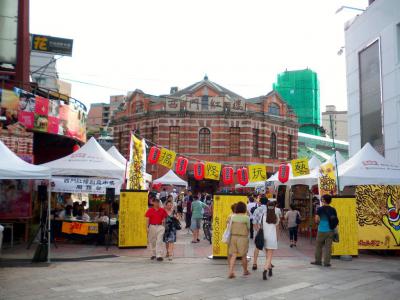
At the heart of Ximending stands the Red House Theater. Dating back to 1908, when Taipei was under Japanese rule, the building was designed by Japanese architect Kondō Jūrō and originally served as a public market. Its octagonal brick structure and red-brick façade made it a recognisable landmark from the outset. Inside the Red House, you will encounter the history museum and the “100 Treasures” exhibit. Then, walk straight northwest through to the Cruciform Building (basically the back section) to explore the 16 Creative Boutiques, where you can find unique handmade goods from local designers. On the south-side plaza outside, look for the concentration of open-air bars that form the heart of Taipei’s nightlife.
The open square in front of the Red House has long played an important role in the district’s public life. It has previously served as a venue for events such as the Lantern Festival, and on occasion, visitors may even encounter unannounced performances or pop-up concerts by well-known artists. Today, the Red House hosts cultural performances, exhibitions, and creative markets featuring local designers and craftspeople.
At the heart of Ximending stands the Red House Theater. Dating back to 1908, when Taipei was under Japanese rule, the building was designed by Japanese architect Kondō Jūrō and originally served as a public market. Its octagonal brick structure and red-brick façade made it a recognisable landmark from the outset. Inside the Red House, you will encounter the history museum and the “100 Treasures” exhibit. Then, walk straight northwest through to the Cruciform Building (basically the back section) to explore the 16 Creative Boutiques, where you can find unique handmade goods from local designers. On the south-side plaza outside, look for the concentration of open-air bars that form the heart of Taipei’s nightlife.
The open square in front of the Red House has long played an important role in the district’s public life. It has previously served as a venue for events such as the Lantern Festival, and on occasion, visitors may even encounter unannounced performances or pop-up concerts by well-known artists. Today, the Red House hosts cultural performances, exhibitions, and creative markets featuring local designers and craftspeople.
3) Chiang Kai-shek Memorial Hall (must see)
Chiang Kai-shek Memorial Hall is one of Taipei’s most prominent landmarks and a key symbol of Taiwan’s modern political history. Completed in 1980, five years after Chiang Kai-shek’s death, the memorial was built to honour the former leader of the Republic of China, who ruled Taiwan after retreating from mainland China in 1949.
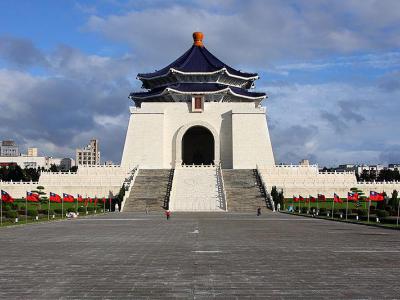
The memorial hall is characterised by its striking white colour and four-sided structure, crowned by a blue octagonal roof. The number eight holds symbolic meaning in Asian culture, traditionally associated with abundance and good fortune, and this symbolism is echoed throughout the design. To reach the main entrance, you can choose between two sets of white staircases, each comprising 89 steps, a reference to Chiang Kai-shek’s age at the time of his passing. Halfway up, pause to look at the central marble ramp, which is carved with the national emblem and traditional cloud motifs.
The upper level contains the main hall, where a large bronze statue of Chiang Kai-shek sits in a formal pose. Beyond the 6.3-metre-tall statue, look up at the caisson ceiling. It features the 12-pointed sun from the Republic of China’s national emblem.
For a different experience, the ground level houses a library and a museum dedicated to documenting Chiang Kai-shek’s life and career, alongside exhibits that explore Taiwan’s political history and postwar development. Reaching the library does not require climbing the staircase. The idea is to stay at plaza level and go around the corner of the complex until you reach one of its lateral sides. There, a staircase is flanked by two arched gateways, which lead to the library.
The ground-floor plaza in front of the complex is best known for the ceremonial changing of the guard. The Military Honor Guard changes every hour, on the hour, from 9 a.m. to 5 p.m., and the ceremony often attracts large crowds, so arriving 10–15 minutes early is recommended.
After all the stair climbing and military discipline, you might want to unwind by enjoying the surrounding gardens, reflecting pools, and open squares, where locals gather daily for tai chi, strolls, and quiet breaks from the city.
The memorial hall is characterised by its striking white colour and four-sided structure, crowned by a blue octagonal roof. The number eight holds symbolic meaning in Asian culture, traditionally associated with abundance and good fortune, and this symbolism is echoed throughout the design. To reach the main entrance, you can choose between two sets of white staircases, each comprising 89 steps, a reference to Chiang Kai-shek’s age at the time of his passing. Halfway up, pause to look at the central marble ramp, which is carved with the national emblem and traditional cloud motifs.
The upper level contains the main hall, where a large bronze statue of Chiang Kai-shek sits in a formal pose. Beyond the 6.3-metre-tall statue, look up at the caisson ceiling. It features the 12-pointed sun from the Republic of China’s national emblem.
For a different experience, the ground level houses a library and a museum dedicated to documenting Chiang Kai-shek’s life and career, alongside exhibits that explore Taiwan’s political history and postwar development. Reaching the library does not require climbing the staircase. The idea is to stay at plaza level and go around the corner of the complex until you reach one of its lateral sides. There, a staircase is flanked by two arched gateways, which lead to the library.
The ground-floor plaza in front of the complex is best known for the ceremonial changing of the guard. The Military Honor Guard changes every hour, on the hour, from 9 a.m. to 5 p.m., and the ceremony often attracts large crowds, so arriving 10–15 minutes early is recommended.
After all the stair climbing and military discipline, you might want to unwind by enjoying the surrounding gardens, reflecting pools, and open squares, where locals gather daily for tai chi, strolls, and quiet breaks from the city.
4) Xingtian Temple (must see)
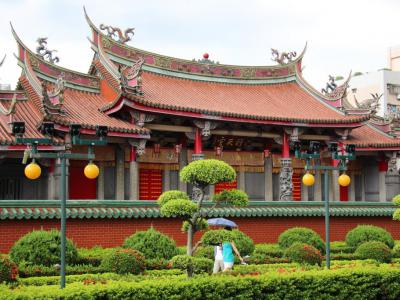
The Xingtian Temple is a new building dating back to 1967. This temple is dedicated to Guan Yu, who is considered a patron god of business people, and was a second-century general who was deified. Some of the most popular sights in and around the temple include figures of dragons.
This temple's design is simple yet has a dignified feel very fitting for its place in worship. The main hall has a censer with a unique dragon-centered design. Most of the worshipers at this temple gather in the courtyard to pray, either kneeling or bowing their heads.
There are free candles available for visitors to take if they wish. Although this temple is not as old as some in Taipei, it is an excellent place to gain an appreciation for the local religious life.
This temple's design is simple yet has a dignified feel very fitting for its place in worship. The main hall has a censer with a unique dragon-centered design. Most of the worshipers at this temple gather in the courtyard to pray, either kneeling or bowing their heads.
There are free candles available for visitors to take if they wish. Although this temple is not as old as some in Taipei, it is an excellent place to gain an appreciation for the local religious life.
5) National Palace Museum (must see)
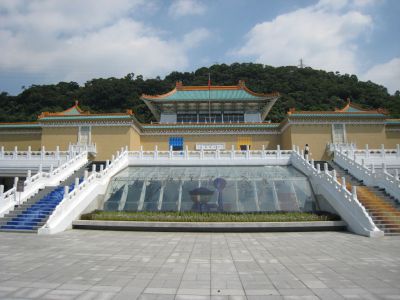
The primary building of the National Palace Museum in Taipei was designed by Huang Baoyu and was constructed from March 1964 to August 1965. Because there wasn't enough space to display over 600,000 artifacts, the museum underwent expansions in 1967, 1970, 1984, 1996, and 2002.
The museum's collection includes antiquities that span thousands of years and encompass various genres. The museum's permanent exhibitions of painting and calligraphy change every three months. At any given time, about 3,000 pieces from the museum's collection are on display, with the remainder safely stored in temperature-controlled vaults. Despite their brevity, these exhibitions are highly popular among visitors.
The National Palace Museum's compound also includes the Zhishan Garden, a classical Chinese garden in the style of the Song and Ming dynasties, covering an area of 1.88 hectares. This garden incorporates principles from various fields such as feng shui, Chinese architecture, water management, landscape design, and Chinese folklore and metaphor. It features numerous ponds, water features, and wooden Chinese pavilions. Additionally, there is another Chinese-style garden nearby called the Shuangxi Park and Chinese Garden.
Why You Should Visit:
Very educational museum – everything is in three languages and the way it walks through history is fascinating.
The premier items are the Jadeite Cabbage and the Meat-Shaped Jasper, which are both beautiful pieces.
Tip:
Try arriving early and on weekdays to avoid the large tour groups. Go and see the main attractions first!
Definitely use the audio guide if you have plenty of time and are keen to learn more about the key exhibited pieces.
There is also a 75-min guided tour in English (pre-book online on NPM website) that gives a splendid overview of the bronze, ceramics, calligraphy & special items.
Visit the Zhishan Garden beside if you are in the mood to chill (museum ticket gives admission). If not, move on to the next place which is Yangmingshan National Park.
The museum's collection includes antiquities that span thousands of years and encompass various genres. The museum's permanent exhibitions of painting and calligraphy change every three months. At any given time, about 3,000 pieces from the museum's collection are on display, with the remainder safely stored in temperature-controlled vaults. Despite their brevity, these exhibitions are highly popular among visitors.
The National Palace Museum's compound also includes the Zhishan Garden, a classical Chinese garden in the style of the Song and Ming dynasties, covering an area of 1.88 hectares. This garden incorporates principles from various fields such as feng shui, Chinese architecture, water management, landscape design, and Chinese folklore and metaphor. It features numerous ponds, water features, and wooden Chinese pavilions. Additionally, there is another Chinese-style garden nearby called the Shuangxi Park and Chinese Garden.
Why You Should Visit:
Very educational museum – everything is in three languages and the way it walks through history is fascinating.
The premier items are the Jadeite Cabbage and the Meat-Shaped Jasper, which are both beautiful pieces.
Tip:
Try arriving early and on weekdays to avoid the large tour groups. Go and see the main attractions first!
Definitely use the audio guide if you have plenty of time and are keen to learn more about the key exhibited pieces.
There is also a 75-min guided tour in English (pre-book online on NPM website) that gives a splendid overview of the bronze, ceramics, calligraphy & special items.
Visit the Zhishan Garden beside if you are in the mood to chill (museum ticket gives admission). If not, move on to the next place which is Yangmingshan National Park.
6) Taipei 101 (must see)
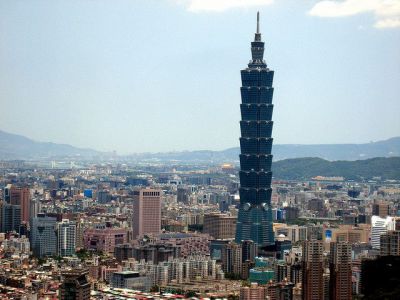
Taipei 101 is the tallest skyscraper in Taiwan. At 1,667-feet tall, it held the distinction of the world's tallest building from 2004 through 2010. It was surpassed by the Burj Khalifa in Dubai, though a number of taller buildings have been constructed since that time leaving Taipei 101 the world's 10th tallest skyscraper.
Construction of the building began in 1999 and was completed in 2004. The Taipei Financial Center Corporation was a conglomerate of several banks that joined to build the skyscraper. It was designed by architects C.Y. Lee and C.P. Wang in a Postmodern architectural style.
The 101 stories of Taipei 101 are primarily offices, though floors one through five are a popular shopping mall. There is also a gymnasium and a restaurant.
Visitors can utilize the indoor observation decks on floors 88 and 89 or the outdoor observation decks on 91 and 101. Both are open from 9 AM through 10 PM daily.
Tip:
If you're looking to take a picture of the exterior, try to hike the Elephant Mountain (Xiangshan) to get a better shot. The hike is free and you get some great city views. Tickets may be purchased on site in the shopping mall (5th floor) or in advance through the Observatory's website. If you choose the former and are not a Taiwanese citizen, show your passport to get a 10% discount off the ticket price.
Construction of the building began in 1999 and was completed in 2004. The Taipei Financial Center Corporation was a conglomerate of several banks that joined to build the skyscraper. It was designed by architects C.Y. Lee and C.P. Wang in a Postmodern architectural style.
The 101 stories of Taipei 101 are primarily offices, though floors one through five are a popular shopping mall. There is also a gymnasium and a restaurant.
Visitors can utilize the indoor observation decks on floors 88 and 89 or the outdoor observation decks on 91 and 101. Both are open from 9 AM through 10 PM daily.
Tip:
If you're looking to take a picture of the exterior, try to hike the Elephant Mountain (Xiangshan) to get a better shot. The hike is free and you get some great city views. Tickets may be purchased on site in the shopping mall (5th floor) or in advance through the Observatory's website. If you choose the former and are not a Taiwanese citizen, show your passport to get a 10% discount off the ticket price.
7) Maokong Gondola (must see)
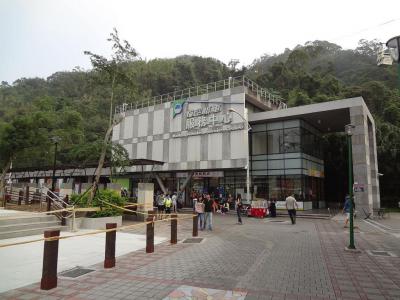
The Maokong Gondola, measuring a total length of 4.03 kilometers, proudly stands as Taipei City's inaugural gondola system. The duration of a one-way ride on this gondola typically ranges from 20 to 30 minutes. The journey encompasses four distinct stops: Taipei Zoo Station, Taipei Zoo South Station, Zhinan Temple Station, and Maokong Station. Navigating the Maokong Gondola is a straightforward process; you simply disembark from the last stop on the Metro's Wenhu Line, Taipei Zoo Station, and make your way to the Taipei Zoo Station of the Maokong Gondola to commence your ride.
Three particularly enchanting times to embark on this gondola adventure are immediately following rain showers, during the mesmerizing sunset, and when the city lights illuminate the night. While aboard the gondola, as it gracefully traverses the undulating landscape, you'll catch glimpses of passing Metro trains, the serene park along the Jingmei River, and even the distinctive "giraffe" incinerator. Upon reaching the second stop, the gondola executes a sweeping turn, offering a breathtaking panoramic vista that includes the flow of traffic on the freeway below. After departing from Zhinan Temple Station, you'll venture into a steep, V-shaped gorge-a pivotal highlight of the gondola journey, promising an indelible experience.
The ultimate destination is Maokong, home to numerous tea plantations and charming tea shops. Many visitors embark on this journey expressly to indulge in tea and conversation. Do ensure to visit one of the tea shops and savor the renowned "Muzha Tieguanyin" or "Wenshan Pouchong tea" when you arrive at Maokong. Your trip will undoubtedly be rewarded with the delightful combination of specialty tea and a delicious meal, all while basking in the splendid scenery of Taipei Basin.
Three particularly enchanting times to embark on this gondola adventure are immediately following rain showers, during the mesmerizing sunset, and when the city lights illuminate the night. While aboard the gondola, as it gracefully traverses the undulating landscape, you'll catch glimpses of passing Metro trains, the serene park along the Jingmei River, and even the distinctive "giraffe" incinerator. Upon reaching the second stop, the gondola executes a sweeping turn, offering a breathtaking panoramic vista that includes the flow of traffic on the freeway below. After departing from Zhinan Temple Station, you'll venture into a steep, V-shaped gorge-a pivotal highlight of the gondola journey, promising an indelible experience.
The ultimate destination is Maokong, home to numerous tea plantations and charming tea shops. Many visitors embark on this journey expressly to indulge in tea and conversation. Do ensure to visit one of the tea shops and savor the renowned "Muzha Tieguanyin" or "Wenshan Pouchong tea" when you arrive at Maokong. Your trip will undoubtedly be rewarded with the delightful combination of specialty tea and a delicious meal, all while basking in the splendid scenery of Taipei Basin.
