Custom Walk in Calgary, Alberta by lyndahughes34_2fa43f created on 2026-05-06
Guide Location: Canada » Calgary
Guide Type: Custom Walk
# of Sights: 15
Tour Duration: 4 Hour(s)
Travel Distance: 9.1 Km or 5.7 Miles
Share Key: DSK75
Guide Type: Custom Walk
# of Sights: 15
Tour Duration: 4 Hour(s)
Travel Distance: 9.1 Km or 5.7 Miles
Share Key: DSK75
How It Works
Please retrieve this walk in the GPSmyCity app. Once done, the app will guide you from one tour stop to the next as if you had a personal tour guide. If you created the walk on this website or come to the page via a link, please follow the instructions below to retrieve the walk in the app.
Retrieve This Walk in App
Step 1. Download the app "GPSmyCity: Walks in 1K+ Cities" on Apple App Store or Google Play Store.



Step 2. In the GPSmyCity app, download(or launch) the guide "Calgary Map and Walking Tours".
Step 3. Tap the menu button located at upper right corner of the "Walks" screen and select "Retrieve custom walk". Enter the share key: DSK75
1) Calgary Tower (must see)
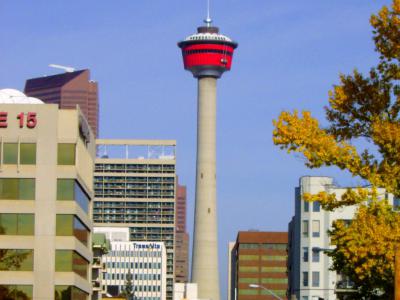
Rising above downtown like a confident exclamation point, Calgary Tower reaches 191 metres into the prairie sky. It first appeared in 1967 under the name Husky Tower, built as part of a downtown renewal push and timed neatly with Canada’s centennial celebrations. The project was a joint effort between Husky Oil and Realty Company Limited, and a few years later, in 1971, the tower was officially renamed-simple, direct, and very Calgary. It also earned early bragging rights as a founding member of the World Federation of Great Towers, which is exactly what it sounds like.
The tower was designed by W. G. Milne & A. Dale and Associates and took just fifteen months to complete, a quick turnaround for something this tall. Structurally, it’s no lightweight: the tower can handle winds of up to 161 kilometres per hour and is engineered to withstand earthquakes. One of its quiet engineering feats is the central column, poured continuously over 24 straight days without stopping-a detail easy to miss, but impressive once you know it.
Up top, the views do most of the talking. The observation level gives you a full sweep of the city grid, the rivers, and, on clear days, the distant outline of the Rocky Mountains. If you prefer your skyline with a side of dinner, there’s the revolving Sky 360 restaurant, where the city slowly turns beneath your table while you stay comfortably seated. It’s multitasking at its finest: eat, relax, and sightsee all at once.
At ground level, the tower plugs straight into Calgary’s +15 Skyway network, an elevated indoor walkway system that keeps downtown connected year-round. From here, you can walk indoors to places like the Fairmont Palliser Hotel, One Palliser Square, and EnCana Place. Whether you head up, dine around, or drift off through the skywalks, the Calgary Tower is less a stop-and-go landmark and more a smooth transition between the city’s past ambitions and its modern rhythm.
The tower was designed by W. G. Milne & A. Dale and Associates and took just fifteen months to complete, a quick turnaround for something this tall. Structurally, it’s no lightweight: the tower can handle winds of up to 161 kilometres per hour and is engineered to withstand earthquakes. One of its quiet engineering feats is the central column, poured continuously over 24 straight days without stopping-a detail easy to miss, but impressive once you know it.
Up top, the views do most of the talking. The observation level gives you a full sweep of the city grid, the rivers, and, on clear days, the distant outline of the Rocky Mountains. If you prefer your skyline with a side of dinner, there’s the revolving Sky 360 restaurant, where the city slowly turns beneath your table while you stay comfortably seated. It’s multitasking at its finest: eat, relax, and sightsee all at once.
At ground level, the tower plugs straight into Calgary’s +15 Skyway network, an elevated indoor walkway system that keeps downtown connected year-round. From here, you can walk indoors to places like the Fairmont Palliser Hotel, One Palliser Square, and EnCana Place. Whether you head up, dine around, or drift off through the skywalks, the Calgary Tower is less a stop-and-go landmark and more a smooth transition between the city’s past ambitions and its modern rhythm.
2) Mechanical Horse
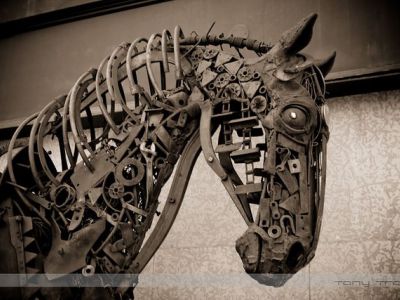
The Mechanical Horse is a striking example of urban steampunk artistry. Crafted from discarded gears, chains, and other metallic components, this life-size sculpture mimics the form of a stallion, its intricate framework revealing every repurposed relic. The sculpture has earned its place as a favoured photo backdrop for both tourists and locals alike.
The work, attributed variously to artists such as Russell Zeid or Dixie Jernett (sometimes known as “Powder the Plow Horse” or “Steam‑Punk Clydesdale”), evokes Alberta’s equine heritage with a modern twist. As a testament to upcycling, the sculpture transforms what was once scrap into a symbol of resilience and creative reuse. Its rusted patina and mechanical details invite viewers to explore the relationship between nature, industry, and artistry.
What sets the Mechanical Horse apart is its eclectic composition. Scraps of farm equipment, automotive parts, and industrial machinery interlace to form its skeleton, while reflective chrome hooves and spines of welded rods give life to its steely visage. This blend of raw materials crafts a narrative of transformation, where abandoned metal gains new purpose, mirroring Calgary’s evolution from frontier town to modern metropolis.
For visitors, encountering the Mechanical Horse offers more than a photo opportunity. It sparks curiosity, prompting questions about its origins, the artistic process behind it, and the stories hidden in its welded seams. Positioned in the heart of a city known for celebrating its Western roots-especially during the Stampede-this sculpture serves as a bridge between past and present, tradition and innovation.
The work, attributed variously to artists such as Russell Zeid or Dixie Jernett (sometimes known as “Powder the Plow Horse” or “Steam‑Punk Clydesdale”), evokes Alberta’s equine heritage with a modern twist. As a testament to upcycling, the sculpture transforms what was once scrap into a symbol of resilience and creative reuse. Its rusted patina and mechanical details invite viewers to explore the relationship between nature, industry, and artistry.
What sets the Mechanical Horse apart is its eclectic composition. Scraps of farm equipment, automotive parts, and industrial machinery interlace to form its skeleton, while reflective chrome hooves and spines of welded rods give life to its steely visage. This blend of raw materials crafts a narrative of transformation, where abandoned metal gains new purpose, mirroring Calgary’s evolution from frontier town to modern metropolis.
For visitors, encountering the Mechanical Horse offers more than a photo opportunity. It sparks curiosity, prompting questions about its origins, the artistic process behind it, and the stories hidden in its welded seams. Positioned in the heart of a city known for celebrating its Western roots-especially during the Stampede-this sculpture serves as a bridge between past and present, tradition and innovation.
3) Stephen Avenue (must see)
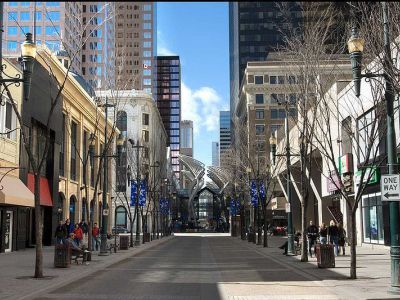
Downtown Calgary is where the city turns up the volume, and Stephen Avenue is right at the centre of it. This pedestrian-only stretch is the main stage for shopping, people-watching, and everyday city life. Cafés spill onto the sidewalks, bars and pubs keep things lively well into the evening, and restaurants cover everything from quick bites to polished dining. If you enjoy browsing-or seriously shopping-this is the place where Calgary shows off its retail confidence, with a mix of high-end stores and small boutiques tempting you at every turn.
Lined along the avenue are major shopping complexes such as The Bay Department Store, Bankers Hall, Scotia Centre, Fashion Central, and the Core Shopping Centre, making it easy to move from one indoor space to the next without losing momentum. You’ll also pass major hotels like the Calgary Marriott and the Hyatt Regency, along with the Telus Convention Centre, which adds a steady flow of visitors to the street. It’s busy, but not chaotic-more like a steady urban rhythm that pulls you along.
Stephen Avenue isn’t just about modern commerce, though. In 1992, it was officially designated a National Historic Site of Canada, and the reason becomes clear when you start looking up. Many of the buildings here date back to the late 19th century and are built from local sandstone. After a devastating fire in 1886 damaged much of the city, these structures were designed to resist future disasters, giving the street its distinctive, solid look.
The avenue takes its name from George Stephen, the first president of the Canadian Pacific Railway and later the first Baron Mount Stephen, linking the street directly to the forces that shaped Calgary’s growth.
As you walk this stretch, take your time. Let the mix of history, architecture, shopping, and street life set the pace. Stephen Avenue isn’t something to rush-it’s one of those places where Calgary explains itself best, one block at a time.
Lined along the avenue are major shopping complexes such as The Bay Department Store, Bankers Hall, Scotia Centre, Fashion Central, and the Core Shopping Centre, making it easy to move from one indoor space to the next without losing momentum. You’ll also pass major hotels like the Calgary Marriott and the Hyatt Regency, along with the Telus Convention Centre, which adds a steady flow of visitors to the street. It’s busy, but not chaotic-more like a steady urban rhythm that pulls you along.
Stephen Avenue isn’t just about modern commerce, though. In 1992, it was officially designated a National Historic Site of Canada, and the reason becomes clear when you start looking up. Many of the buildings here date back to the late 19th century and are built from local sandstone. After a devastating fire in 1886 damaged much of the city, these structures were designed to resist future disasters, giving the street its distinctive, solid look.
The avenue takes its name from George Stephen, the first president of the Canadian Pacific Railway and later the first Baron Mount Stephen, linking the street directly to the forces that shaped Calgary’s growth.
As you walk this stretch, take your time. Let the mix of history, architecture, shopping, and street life set the pace. Stephen Avenue isn’t something to rush-it’s one of those places where Calgary explains itself best, one block at a time.
4) The Conversation
Calgary is indeed a city of surprises as any tourist to this city will tell you. There are numerous attractive and interesting tourist attractions that include many unique sculptures that speak volumes about the city and the country.
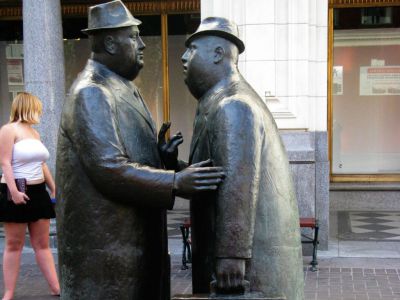
One of the popular sculptures that tourists never miss is called The Conversation. This is a sculpture that depicts two businessmen who have just met on one of the downtown streets. The sculpture is so realistic that you feel like shaking their hands and joining in the conversation. This sculpture was created by William Hodd McElcheran and was placed in Stephen Avenue in 1981.
It is made of bronze and is kept right on the Pedestrian Mall in Stephen Avenue. Visit this mall and you just cannot miss this Calgary’s most famous sculpture. You will find the businessmen wearing small felt hats and bulky topcoats talking business. They are definitely wheeling and dealing as you can see from their expressions. This artwork belonged to Norcen Energy Resources who in 1981 donated it to the City of Calgary.
On your trip to Calgary, do not miss a visit to the Pedestrian Mall in Stephen Avenue to view this wonderful statue that is certainly the pride of the city.
One of the popular sculptures that tourists never miss is called The Conversation. This is a sculpture that depicts two businessmen who have just met on one of the downtown streets. The sculpture is so realistic that you feel like shaking their hands and joining in the conversation. This sculpture was created by William Hodd McElcheran and was placed in Stephen Avenue in 1981.
It is made of bronze and is kept right on the Pedestrian Mall in Stephen Avenue. Visit this mall and you just cannot miss this Calgary’s most famous sculpture. You will find the businessmen wearing small felt hats and bulky topcoats talking business. They are definitely wheeling and dealing as you can see from their expressions. This artwork belonged to Norcen Energy Resources who in 1981 donated it to the City of Calgary.
On your trip to Calgary, do not miss a visit to the Pedestrian Mall in Stephen Avenue to view this wonderful statue that is certainly the pride of the city.
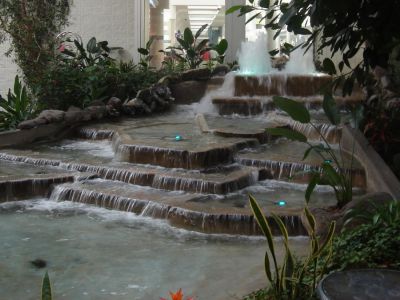
5) Devonian Gardens in Core Shopping Center
You might come to the Core Shopping Centre for errands, fashion, or a last-minute souvenir-but here’s the twist: one of its best features has nothing to do with shopping at all.
Head upstairs and you’ll find the Devonian Gardens, an indoor botanical garden quietly thriving above the retail buzz. More than 500 trees grow here, joined by a living wall, gentle fountains, and winding paths that feel worlds away from escalators and checkout lines. It’s all cared for by the city’s parks department, which explains why it feels more like a greenhouse escape than a mall add-on.
This is a place made for slowing down. You can wander through the greenery, settle into a chair with a book, or claim a table for lunch that somehow feels outdoors, even though you’re still indoors. There’s a public piano waiting for anyone brave-or talented-enough to sit down and play, adding a bit of surprise soundtrack to the space. Families will notice a dedicated children’s play area, giving younger visitors room to burn off energy while adults take a breather.
Best of all, there’s no ticket, no time limit, and no pressure to buy anything. You can drop in for five minutes or stay for an hour, treat it as a shortcut or a destination. In a city known for big skies and open parks, Devonian Gardens proves that even above a shopping centre, Calgary still makes room for calm, green pauses-sometimes exactly where you least expect them.
Head upstairs and you’ll find the Devonian Gardens, an indoor botanical garden quietly thriving above the retail buzz. More than 500 trees grow here, joined by a living wall, gentle fountains, and winding paths that feel worlds away from escalators and checkout lines. It’s all cared for by the city’s parks department, which explains why it feels more like a greenhouse escape than a mall add-on.
This is a place made for slowing down. You can wander through the greenery, settle into a chair with a book, or claim a table for lunch that somehow feels outdoors, even though you’re still indoors. There’s a public piano waiting for anyone brave-or talented-enough to sit down and play, adding a bit of surprise soundtrack to the space. Families will notice a dedicated children’s play area, giving younger visitors room to burn off energy while adults take a breather.
Best of all, there’s no ticket, no time limit, and no pressure to buy anything. You can drop in for five minutes or stay for an hour, treat it as a shortcut or a destination. In a city known for big skies and open parks, Devonian Gardens proves that even above a shopping centre, Calgary still makes room for calm, green pauses-sometimes exactly where you least expect them.
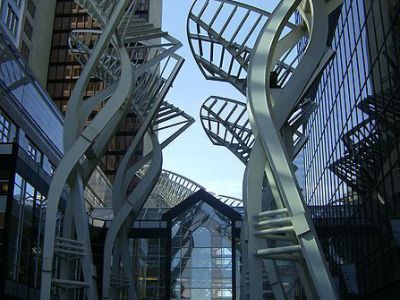
6) Trees Sculptures
The Trees Sculpture is located on Stephen Avenue between Bankers Hall and the Core Shopping Centre. The sculpture was designed by the architect of the Bankers Hall building, The Cohos Evamy Partners, because trees are difficult to grow in Calgary. They also provide an excellent wind break in this busy walking area.
This sculpture goes by many different names. Some call it the Galleria Trees. Other call it the Ten Trees. Everyone who sees them agrees that they are stunning works of art no matter what they are named.
The metal structures are interesting during the daytime, but they should also be viewed at night when they are lit with vibrant, seasonally-themed LED lights. They are also outfitted with a sound system so that music can be played along with the light show.
This sculpture goes by many different names. Some call it the Galleria Trees. Other call it the Ten Trees. Everyone who sees them agrees that they are stunning works of art no matter what they are named.
The metal structures are interesting during the daytime, but they should also be viewed at night when they are lit with vibrant, seasonally-themed LED lights. They are also outfitted with a sound system so that music can be played along with the light show.
7) Counting Crows
Calgary is a city in Alberta, Canada that has a lot to offer tourists in terms of sightseeing. There are many sculptures, museums and parks here that attract thousands of tourists from around the world.
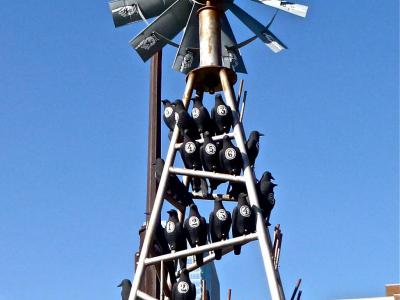
If you are artistically inclined, then you must not miss the Counting Crows sculpture located at Fourth Street and 13th Avenue SW. This sculpture was created by artist Evelyn Grant who handed it over to the City of Calgary in 2001.
Counting Crows is a piece inspired by and based on a traditional English rhyme. People used this rhyme to predict their fortunes. Evelyn Grant is a University of Calgary. She also completed the fine arts program at ACAD.
Counting Crows sculpture resembles an ornamental wind mill. You must visit Fourth Street to view this wonderful sculpture created to perfection by the artist. This is one of the attractions you may miss out with your busy itinerary. So, before you visit Calgary, be sure you include a visit to Counting Crows which reflects Calgary’s artistic talent and passion for sculptures.
Check out all the crows sitting on the windmill. They look so realistic and one look at them and you feel they are ready to fly away.
If you are artistically inclined, then you must not miss the Counting Crows sculpture located at Fourth Street and 13th Avenue SW. This sculpture was created by artist Evelyn Grant who handed it over to the City of Calgary in 2001.
Counting Crows is a piece inspired by and based on a traditional English rhyme. People used this rhyme to predict their fortunes. Evelyn Grant is a University of Calgary. She also completed the fine arts program at ACAD.
Counting Crows sculpture resembles an ornamental wind mill. You must visit Fourth Street to view this wonderful sculpture created to perfection by the artist. This is one of the attractions you may miss out with your busy itinerary. So, before you visit Calgary, be sure you include a visit to Counting Crows which reflects Calgary’s artistic talent and passion for sculptures.
Check out all the crows sitting on the windmill. They look so realistic and one look at them and you feel they are ready to fly away.
8) Brick Couch
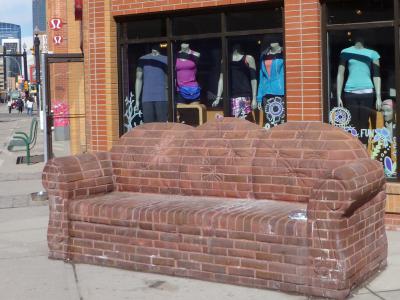
Calgary sculptures not only look realistic, they also create that perfect illusion. Brick Couch is a standing example of an amusing and clever illusion of an inviting, soft couch. This couch is an exciting addition to the street where it is located. It invites people walking around to come and sit on it and enjoy the ambience of the 4th Street.
Created by artists Brian and Dawn, the Brick Couch is made of at least 1100 bricks that are hand-fired. It clearly reflects the way bricks were used historically. Brick Couch is indeed an architectural marvel that must not be missed by any tourist visiting the city.
Brian and Dawn the artists donated this inviting couch to the City of Calgary in 2004. They co-own the Voyager Art & Tile located in Red Deer. This company in Calgary specializes in mosaic, tiles and public art.
One look at the Brick Couch and you know that this is the work of a well qualified ceramic art degree holder. Sure enough, both Brian and Dawn have done their masters in ceramics at the Ohio State University.
This pair of dedicated artists and businessmen has received many awards. They have been commissioned many times for public art. Make sure you see this unique and interesting piece of artwork in Calgary on your trip to the city.
Created by artists Brian and Dawn, the Brick Couch is made of at least 1100 bricks that are hand-fired. It clearly reflects the way bricks were used historically. Brick Couch is indeed an architectural marvel that must not be missed by any tourist visiting the city.
Brian and Dawn the artists donated this inviting couch to the City of Calgary in 2004. They co-own the Voyager Art & Tile located in Red Deer. This company in Calgary specializes in mosaic, tiles and public art.
One look at the Brick Couch and you know that this is the work of a well qualified ceramic art degree holder. Sure enough, both Brian and Dawn have done their masters in ceramics at the Ohio State University.
This pair of dedicated artists and businessmen has received many awards. They have been commissioned many times for public art. Make sure you see this unique and interesting piece of artwork in Calgary on your trip to the city.
9) Peace Bridge (must see)
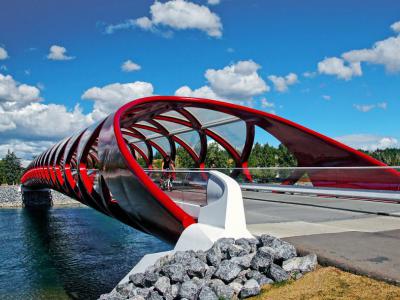
The Peace Bridge is a pedestrian and cyclist crossing over the Bow River, spanning about 130.6 meters in length and 8 meters across, with a tubular double-helix truss design that stands roughly 5.85 meters tall. Conceived by Spanish architect Santiago Calatrava and completed in March 2012, this signature red-and-white structure - echoing both national and civic colours - bridges the southern Eau Claire/Downtown pathway with the northern Sunnyside community.
As a sculptural marvel, the bridge’s helical steel frame-comprising around 850 tonnes of steel-withstands without piers in the water, preserving the river’s natural flow and minimizing ecological impact. Covered with curved glass panels and well-lit at night, it offers a sheltered, barrier-free experience for walkers and riders alike. The interior width is split into a 3.7-meter pedestrian walkway and a 2.5-meter cycling lane, helping manage up to 9,000 users daily.
Beyond functionality, the Peace Bridge has quickly become one of Calgary’s most photographed landmarks. Its striking form-likened by many to a giant finger-trap puzzle-provides dynamic sightlines toward the downtown skyline and the serene Bow River, especially during sunrise or twilight. Despite initial controversy over cost and design, it earned accolades as a top architectural project and public space of 2012.
For visitors, the bridge offers more than just a crossing-it’s a walking art installation. The seamless glide between neighborhoods invites exploration of surrounding gems like Eau Claire Market, Prince’s Island Park, and the pathways that line the riverbanks. Whether you’re on foot or bike, crossing during evening illuminations or sunshine-dappled days, the Peace Bridge is a vibrant invitation to connect with Calgary’s urban pulse and riverside beauty.
As a sculptural marvel, the bridge’s helical steel frame-comprising around 850 tonnes of steel-withstands without piers in the water, preserving the river’s natural flow and minimizing ecological impact. Covered with curved glass panels and well-lit at night, it offers a sheltered, barrier-free experience for walkers and riders alike. The interior width is split into a 3.7-meter pedestrian walkway and a 2.5-meter cycling lane, helping manage up to 9,000 users daily.
Beyond functionality, the Peace Bridge has quickly become one of Calgary’s most photographed landmarks. Its striking form-likened by many to a giant finger-trap puzzle-provides dynamic sightlines toward the downtown skyline and the serene Bow River, especially during sunrise or twilight. Despite initial controversy over cost and design, it earned accolades as a top architectural project and public space of 2012.
For visitors, the bridge offers more than just a crossing-it’s a walking art installation. The seamless glide between neighborhoods invites exploration of surrounding gems like Eau Claire Market, Prince’s Island Park, and the pathways that line the riverbanks. Whether you’re on foot or bike, crossing during evening illuminations or sunshine-dappled days, the Peace Bridge is a vibrant invitation to connect with Calgary’s urban pulse and riverside beauty.
10) Chinatown
Calgary’s Chinatown sits just north of downtown, pressed up against the Bow River, and it’s compact enough to explore without ever feeling rushed. The streets here are lined with restaurants, small shops, and cultural spaces, creating a neighbourhood that feels busy but approachable. You can cross it in minutes-or stretch the visit out with a meal, a browse, or a pause by the river.
This is one of those areas where time is flexible. A focused walk of about half an hour is enough to see the main sights, but Chinatown has a habit of slowing people down. A menu catches your eye, a shop window pulls you in, or a festival sound drifts across the street, and suddenly your short visit turns into a longer stay.
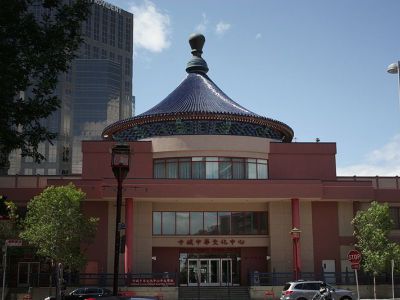
Along the riverfront, Sien Lok Park runs parallel to the water, quietly honoring the first Chinese settlers who helped shape the city. It’s a good place to step off the street and let the river set the tempo. Just across the road stands the Calgary Chinese Cultural Centre, a striking building that houses exhibitions, a museum, and community spaces. Throughout the year, it also becomes a focal point for events, especially during celebrations like the Chinese Lunar New Year, when the area comes alive with color, music, and movement.
Chinatown doesn’t ask for a strict plan. Wander, stop when something interests you, and let the neighbourhood guide the rhythm. It’s a small district, but it leaves a strong impression-and it fits easily into a walk along the river or a longer exploration of the city.
This is one of those areas where time is flexible. A focused walk of about half an hour is enough to see the main sights, but Chinatown has a habit of slowing people down. A menu catches your eye, a shop window pulls you in, or a festival sound drifts across the street, and suddenly your short visit turns into a longer stay.
Along the riverfront, Sien Lok Park runs parallel to the water, quietly honoring the first Chinese settlers who helped shape the city. It’s a good place to step off the street and let the river set the tempo. Just across the road stands the Calgary Chinese Cultural Centre, a striking building that houses exhibitions, a museum, and community spaces. Throughout the year, it also becomes a focal point for events, especially during celebrations like the Chinese Lunar New Year, when the area comes alive with color, music, and movement.
Chinatown doesn’t ask for a strict plan. Wander, stop when something interests you, and let the neighbourhood guide the rhythm. It’s a small district, but it leaves a strong impression-and it fits easily into a walk along the river or a longer exploration of the city.
11) Family of Man
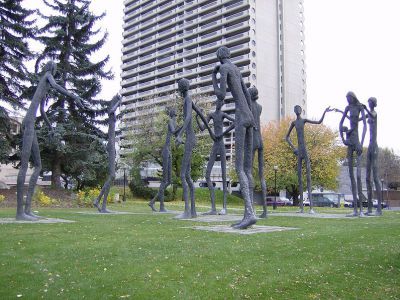
Family of Man is a 21 feet tall set of sculptures that were created exclusively to be displayed at the British Pavilions at Expo 67. These sculptures were designed by Mario Armengol to portray they way Britain handles international responsibilities specifically challenges in the form of world problems.
Mario Armengol expertly depicts two different moods through these sculptures namely the dominating nature of man and a feeling of dependence and insignificance, a completely contradictory mood.
In spite of being 21 feet tall, these sculptures reflect raceless, naked and expressionless human women and men. All sculptures are combined in groups and each one of them extend their hands in gesture of goodwill and fellowship.
After the Expo 67 concluded, the sculptures were bought on behalf of Maxwell Cummings and Sons by Robert Cummings. It was donated to Calgary by this company later. The City of Calgary appointed a special committee to review and identify the best site for these statues. A suitable location was then identified. Today the Family of Man statues stand in front of the Calgary Education Center.
Many tourists come to see these unique and interesting sculptures. Do not miss a visit to this education center and see these sculptures on your trip to Calgary.
Mario Armengol expertly depicts two different moods through these sculptures namely the dominating nature of man and a feeling of dependence and insignificance, a completely contradictory mood.
In spite of being 21 feet tall, these sculptures reflect raceless, naked and expressionless human women and men. All sculptures are combined in groups and each one of them extend their hands in gesture of goodwill and fellowship.
After the Expo 67 concluded, the sculptures were bought on behalf of Maxwell Cummings and Sons by Robert Cummings. It was donated to Calgary by this company later. The City of Calgary appointed a special committee to review and identify the best site for these statues. A suitable location was then identified. Today the Family of Man statues stand in front of the Calgary Education Center.
Many tourists come to see these unique and interesting sculptures. Do not miss a visit to this education center and see these sculptures on your trip to Calgary.
12) Cathedral Church of the Redeemer
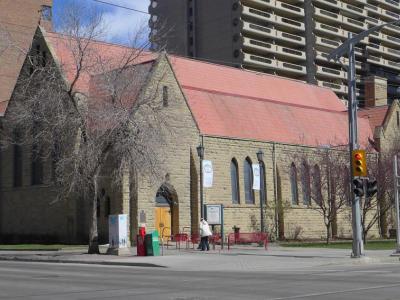
Constructed in early twentieth century, Cathedral Church of the Redeemer is one of the major tourist attractions in Calgary. This building is built with rusticated sandstone and is located in downtown Calgary close to the Olympic Plaza.
The church has one and a half stories and has attractive features such as stained glass windows, red metal roof and stone walls. Many interesting landscape elements surround this charming church.
Cathedral Church of the Redeemer holds the distinction of being a standing example of Gothic Revival architecture skillfully integrated with other styles and influences. In Alberta, this church is also associated with early Anglican Church presence.
Some of the most significant elements that define the character of this church include its massing, form and size, buttresses that are non-load-bearing, usage of rusticated Paskapoo sandstone from the famed Oliver quarry, separate articulating gable roofs, gallery on the West end, lower side aisles, first metal roofing in the city, fish-scale roof cladding, heavy timber cross bracing and roof rafters and much more.
At the cathedral, you will also find the 1906 original Casavant Freres organ with refurbishments. You will certainly be impressed with the elaborate and intricate woodwork. Do not miss out the stunning oak reredos in the sanctuary.
The church has one and a half stories and has attractive features such as stained glass windows, red metal roof and stone walls. Many interesting landscape elements surround this charming church.
Cathedral Church of the Redeemer holds the distinction of being a standing example of Gothic Revival architecture skillfully integrated with other styles and influences. In Alberta, this church is also associated with early Anglican Church presence.
Some of the most significant elements that define the character of this church include its massing, form and size, buttresses that are non-load-bearing, usage of rusticated Paskapoo sandstone from the famed Oliver quarry, separate articulating gable roofs, gallery on the West end, lower side aisles, first metal roofing in the city, fish-scale roof cladding, heavy timber cross bracing and roof rafters and much more.
At the cathedral, you will also find the 1906 original Casavant Freres organ with refurbishments. You will certainly be impressed with the elaborate and intricate woodwork. Do not miss out the stunning oak reredos in the sanctuary.
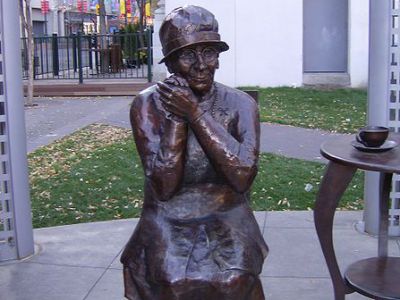
13) Women are Persons
When you visit the Olympic Park in Calgary, you cannot miss the Women are Persons! Monument. This statue specifically recognizes the role played by Canadian women in the growth of the country. It was also built to honor the Famous Five, five women who fought for their rights on behalf of all Canadian women.
Adrienne Clarkson, the Governor General unveiled this monument on 18th October 1999 at a special event. On 18th October 2000, another monument resembling Women are Persons was unveiled in Ottawa.
The right of Canadian women to fight for the senate came about due to diligent efforts of four women from Alberta. They fought to be recognized as “persons” constitutionally. The battle was led by Emily Murphy who was supported in her effort by four others.
Their plea was rejected in 1928 by the court. It was in October 18th 1929 that a decision was taken in their favour by the British Privy Council’s Judicial Committee. These ladies were popularly referred to as the Famous Five.
In Canada, October 18th is celebrated as the Persons Day. Be sure to visit the Olympic Park and view these famous sculptures that talk about the steely determination and consistent efforts of Canadian women to bring about change and progress in the country.
Adrienne Clarkson, the Governor General unveiled this monument on 18th October 1999 at a special event. On 18th October 2000, another monument resembling Women are Persons was unveiled in Ottawa.
The right of Canadian women to fight for the senate came about due to diligent efforts of four women from Alberta. They fought to be recognized as “persons” constitutionally. The battle was led by Emily Murphy who was supported in her effort by four others.
Their plea was rejected in 1928 by the court. It was in October 18th 1929 that a decision was taken in their favour by the British Privy Council’s Judicial Committee. These ladies were popularly referred to as the Famous Five.
In Canada, October 18th is celebrated as the Persons Day. Be sure to visit the Olympic Park and view these famous sculptures that talk about the steely determination and consistent efforts of Canadian women to bring about change and progress in the country.
14) Family of Horses
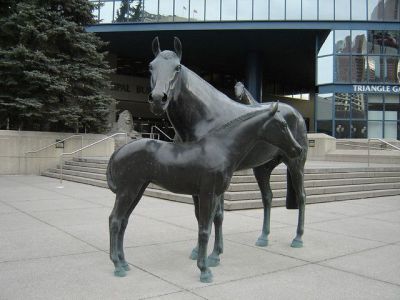
Family of Horses is a statue donated to the City of Calgary by Spruce Meadows owned by the Southern Family. Spruce Meadows came into existence for the exclusive purpose of spreading goodwill, good friendship and good commerce.
The culmination of Southern family’s dream, Spruce Meadows today is managed by corporations, athletes’, volunteers, fans, staff and officials. This unique and memorable place is a dream shared by these stakeholders.
This venue sees many international level sporting events being held. It also organizes show jumping tournaments for different age groups. In a clean and green environment, the horse is celebrated and encouraged to breed and train.
As a contribution to the City of Calgary, Spruce Meadows donated the Family of Horses statues which today stand in front of the City Hall. Spruce Meadow’s contribution to the city reflects Calgary’s deep passion and love for horses.
Tourists to the city enjoy a visit to Spruce Meadows as well as the City Hall to view these statues. You will find the stallion positioned in such a manner that it overlooks the foal and mare. This signifies the strength and kinship among the families here and the special bond they share. Do not miss a visit to the City Hall and see the interesting Family of Man statues on your trip to Calgary.
The culmination of Southern family’s dream, Spruce Meadows today is managed by corporations, athletes’, volunteers, fans, staff and officials. This unique and memorable place is a dream shared by these stakeholders.
This venue sees many international level sporting events being held. It also organizes show jumping tournaments for different age groups. In a clean and green environment, the horse is celebrated and encouraged to breed and train.
As a contribution to the City of Calgary, Spruce Meadows donated the Family of Horses statues which today stand in front of the City Hall. Spruce Meadow’s contribution to the city reflects Calgary’s deep passion and love for horses.
Tourists to the city enjoy a visit to Spruce Meadows as well as the City Hall to view these statues. You will find the stallion positioned in such a manner that it overlooks the foal and mare. This signifies the strength and kinship among the families here and the special bond they share. Do not miss a visit to the City Hall and see the interesting Family of Man statues on your trip to Calgary.
15) Fort Calgary (must see)
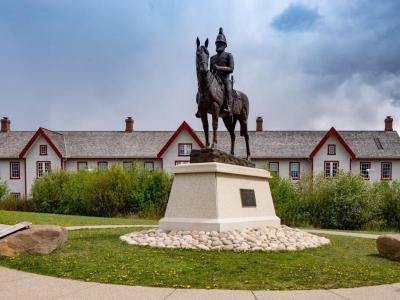
Fort Calgary came into being in 1875, thanks to a federal order with a very specific goal: put an end to the whiskey trade that had taken root at the meeting point of the Bow and Elbow rivers. Law, order, and fewer questionable drinks-that was the plan.
Choosing the exact location fell to the F Troop of the North-West Mounted Police, led by Ephrem A. Brisebois, who arrived from Fort Macleod with determination and limited equipment. To cross the Bow River, they improvised with a tarpaulin stretched over a wagon box. The first man to step onto the riverbank was Corporal George Clift King, a detail that earned him the informal title of Calgary’s first citizen. No plaque at the time, just cold water and good timing...
Construction followed using spruce logs floated down from upstream and locally sourced pine. The fort included the basics: men’s quarters, storage buildings, stables, and a guard room. Early on, it went by practical names like “Bow Fort” or “The Elbow.” An attempt to name it after Brisebois failed-popularity matters, even in the 1870s.
Ultimately, in 1876, the fort officially became Fort Calgary-courtesy of Colonel James Macleod, Commissioner of the North-West Mounted Police, who had spent time in Scotland and proposed this name after a small hamlet on the Isle of Mull.
As the settlement grew, so did the fort. Parts were dismantled to make way for new barracks in 1882, and by 1888, a two-storey building stood here, large enough to house 100 men.
Today, Fort Calgary remains one of the clearest places to trace the city’s beginnings-a stop where Calgary’s story starts to sound less like legend and more like real life, boots, logs, rivers, and all...
Choosing the exact location fell to the F Troop of the North-West Mounted Police, led by Ephrem A. Brisebois, who arrived from Fort Macleod with determination and limited equipment. To cross the Bow River, they improvised with a tarpaulin stretched over a wagon box. The first man to step onto the riverbank was Corporal George Clift King, a detail that earned him the informal title of Calgary’s first citizen. No plaque at the time, just cold water and good timing...
Construction followed using spruce logs floated down from upstream and locally sourced pine. The fort included the basics: men’s quarters, storage buildings, stables, and a guard room. Early on, it went by practical names like “Bow Fort” or “The Elbow.” An attempt to name it after Brisebois failed-popularity matters, even in the 1870s.
Ultimately, in 1876, the fort officially became Fort Calgary-courtesy of Colonel James Macleod, Commissioner of the North-West Mounted Police, who had spent time in Scotland and proposed this name after a small hamlet on the Isle of Mull.
As the settlement grew, so did the fort. Parts were dismantled to make way for new barracks in 1882, and by 1888, a two-storey building stood here, large enough to house 100 men.
Today, Fort Calgary remains one of the clearest places to trace the city’s beginnings-a stop where Calgary’s story starts to sound less like legend and more like real life, boots, logs, rivers, and all...
