Custom Walk in Edinburgh, Scotland by cjcsailor7468 created on 2026-05-07
Guide Location: Scotland » Edinburgh
Guide Type: Custom Walk
# of Sights: 6
Tour Duration: 2 Hour(s)
Travel Distance: 4 Km or 2.5 Miles
Share Key: JCV5R
Guide Type: Custom Walk
# of Sights: 6
Tour Duration: 2 Hour(s)
Travel Distance: 4 Km or 2.5 Miles
Share Key: JCV5R
How It Works
Please retrieve this walk in the GPSmyCity app. Once done, the app will guide you from one tour stop to the next as if you had a personal tour guide. If you created the walk on this website or come to the page via a link, please follow the instructions below to retrieve the walk in the app.
Retrieve This Walk in App
Step 1. Download the app "GPSmyCity: Walks in 1K+ Cities" on Apple App Store or Google Play Store.



Step 2. In the GPSmyCity app, download(or launch) the guide "Edinburgh Map and Walking Tours".
Step 3. Tap the menu button located at upper right corner of the "Walks" screen and select "Retrieve custom walk". Enter the share key: JCV5R
1) Telfer Wall
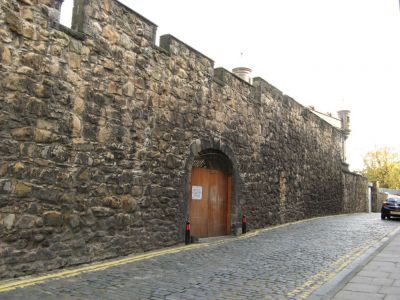
If you would like to see a real part of ancient Edinburgh, head over to Heriot Place where you will find one of the few remaining stretches of the Telfer Wall-a genuine piece of the city’s old fortification system.
Back in the day, Edinburgh’s Old Town had not just one or two, but three defensive walls. The first was a bit half-hearted-more like a polite suggestion than real protection, securing the area just around the High Street. After the Battle of Flodden, the locals realized that other than this part of their town, nothing else was protected, and so, in 1513, they built the Flodden Wall. Unfortunately, as the 1600s rolled around, that wall started showing the signs of ageing, shoddy workmanship, and proved a bit undersized for the rapidly growing town. Thus, in 1630, the Telfer Wall was added, as the last line of defense, running south of the Flodden Wall.
Sadly, not much of those once-mighty walls remain today-either demolished or politely erased by time. The gateways-otherwise called “ports,” (because Edinburgh likes to keep things slightly confusing)-are long gone. But thanks to the Heriot Society, you can still admire a preserved corner tower from the Flodden Wall and a nice long stretch of the Telfer Wall still standing on Heriot Place.
During excavations at the base of the wall in 1850, archaeologists hit the jackpot-a well-preserved Roman bronze coin, dating back to the time of Constantine the Great. Further excavations revealed two coffins fashioned out of oak trunks; the exterior of the coffins was rough wood, but the interiors contained the head and the arms of a man and a woman.
Between the coffins, the skull and antlers of an enormous deer were discovered, along with a spearhead made of horn. The burial site is thought to date back to the 3rd century AD. The remains of the humans disintegrated when they attempted to retrieve them, but the deer’s skull was intact and today is proudly displayed in the Royal Scottish Museum (because, indeed, in Edinburgh, the deer enjoy rather good survival rates...).
Back in the day, Edinburgh’s Old Town had not just one or two, but three defensive walls. The first was a bit half-hearted-more like a polite suggestion than real protection, securing the area just around the High Street. After the Battle of Flodden, the locals realized that other than this part of their town, nothing else was protected, and so, in 1513, they built the Flodden Wall. Unfortunately, as the 1600s rolled around, that wall started showing the signs of ageing, shoddy workmanship, and proved a bit undersized for the rapidly growing town. Thus, in 1630, the Telfer Wall was added, as the last line of defense, running south of the Flodden Wall.
Sadly, not much of those once-mighty walls remain today-either demolished or politely erased by time. The gateways-otherwise called “ports,” (because Edinburgh likes to keep things slightly confusing)-are long gone. But thanks to the Heriot Society, you can still admire a preserved corner tower from the Flodden Wall and a nice long stretch of the Telfer Wall still standing on Heriot Place.
During excavations at the base of the wall in 1850, archaeologists hit the jackpot-a well-preserved Roman bronze coin, dating back to the time of Constantine the Great. Further excavations revealed two coffins fashioned out of oak trunks; the exterior of the coffins was rough wood, but the interiors contained the head and the arms of a man and a woman.
Between the coffins, the skull and antlers of an enormous deer were discovered, along with a spearhead made of horn. The burial site is thought to date back to the 3rd century AD. The remains of the humans disintegrated when they attempted to retrieve them, but the deer’s skull was intact and today is proudly displayed in the Royal Scottish Museum (because, indeed, in Edinburgh, the deer enjoy rather good survival rates...).
2) Parish Church of St. Andrew's and St. George's
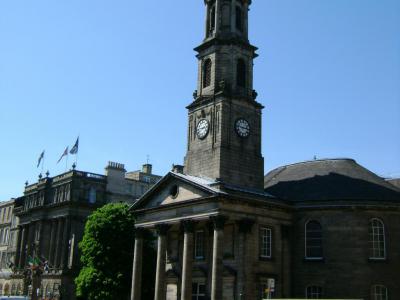
While in Edinburgh, you may want to visit the Parish Church of Saint Andrew’s and Saint George’s, the first church that was built in the city’s New Town.
When James Craig designed the New Town, he set aside two parcels of land for two churches: one at the west end to be dedicated to Saint George, and the other, at the east end – to Saint Andrew.
Unfortunately, Sir Lawrence Dundus, who wanted the plot on the east end for his new house, quickly bought it, leaving a plot in the middle of the street. The planners decided that two churches couldn’t be built so close to one another, so the plans for Saint George’s church were set aside and Saint Andrew’s was built in 1780, dedicated to both saints altogether.
The building has an elliptical plan and was the first church of this architectural style in the land. In the 18th century, classical Roman architecture was in fashion, so the church has a temple-like portico and ceiling rosettes, based on Robert Wood’s 1753 examples found in a temple in Syria.
The steeple, built in 1787, houses eight peal bells that were cast by William and Thomas Mears in 1788. These are the last peal bells and the only surviving Georgian bells in Scotland.
The original 18th century windows were replaced by stained glass windows by Alfred Webster and Douglas Strachan in 1912 and 1934 respectively.
When James Craig designed the New Town, he set aside two parcels of land for two churches: one at the west end to be dedicated to Saint George, and the other, at the east end – to Saint Andrew.
Unfortunately, Sir Lawrence Dundus, who wanted the plot on the east end for his new house, quickly bought it, leaving a plot in the middle of the street. The planners decided that two churches couldn’t be built so close to one another, so the plans for Saint George’s church were set aside and Saint Andrew’s was built in 1780, dedicated to both saints altogether.
The building has an elliptical plan and was the first church of this architectural style in the land. In the 18th century, classical Roman architecture was in fashion, so the church has a temple-like portico and ceiling rosettes, based on Robert Wood’s 1753 examples found in a temple in Syria.
The steeple, built in 1787, houses eight peal bells that were cast by William and Thomas Mears in 1788. These are the last peal bells and the only surviving Georgian bells in Scotland.
The original 18th century windows were replaced by stained glass windows by Alfred Webster and Douglas Strachan in 1912 and 1934 respectively.
3) Princes Street
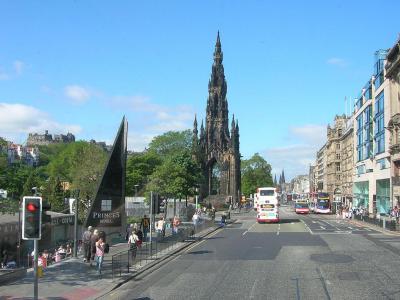
Stretching from Leith Street to Lothian Road like Edinburgh’s own stylish catwalk, Princes Street is an over-a-mile-long stretch of shopping temptation-the city’s main artery, buzzing with cafés, pubs, department stores, and selfie opportunities galore.
The street was named after two of King George III’s sons-Prince George (who later became King George IV) and Prince Frederick. While the early 18th-century buildings once stood prim and proper, the 19th century and later the 1960s had other plans. Cue the “Princes Street Plan,” a bold makeover that saw some old façades pulled down in favor of boxy modern storefronts, all in the name of progress and window-shopping efficiency.
The resulting new layout appears as follows: shops and commercial buzz line the north side, while the south side takes the scenic route, offering unbeatable views of the Old Town and the ever-dramatic Edinburgh Castle. Between them lies what was once a murky loch-or Nor Loch to be exact-drained in 1820 and transformed into the much more appealing Princes Street Gardens.
The gardens span 38 acres of greenery, split neatly by the Mound and sprinkled with statues like an outdoor sculpture gallery. One especially moving highlight is the War Memorial to Scottish-American soldiers, a spot for reflection amid the buskers and picnic blankets.
In the summer, the Ross Bandstand kicks into gear with concerts and open-air theatre. And don’t miss the city’s prettiest timekeeper-a floral clock that blooms right on cue.
The street was named after two of King George III’s sons-Prince George (who later became King George IV) and Prince Frederick. While the early 18th-century buildings once stood prim and proper, the 19th century and later the 1960s had other plans. Cue the “Princes Street Plan,” a bold makeover that saw some old façades pulled down in favor of boxy modern storefronts, all in the name of progress and window-shopping efficiency.
The resulting new layout appears as follows: shops and commercial buzz line the north side, while the south side takes the scenic route, offering unbeatable views of the Old Town and the ever-dramatic Edinburgh Castle. Between them lies what was once a murky loch-or Nor Loch to be exact-drained in 1820 and transformed into the much more appealing Princes Street Gardens.
The gardens span 38 acres of greenery, split neatly by the Mound and sprinkled with statues like an outdoor sculpture gallery. One especially moving highlight is the War Memorial to Scottish-American soldiers, a spot for reflection amid the buskers and picnic blankets.
In the summer, the Ross Bandstand kicks into gear with concerts and open-air theatre. And don’t miss the city’s prettiest timekeeper-a floral clock that blooms right on cue.
4) St. Cuthbert's Church
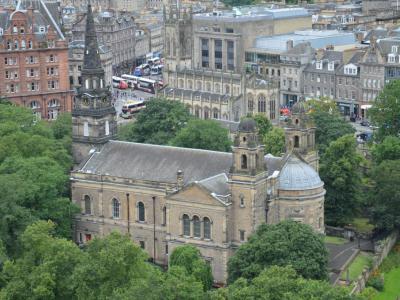
The Parish Church of Saint Cuthbert, which is associated with the Church of Scotland, is a part of the Presbytery of Edinburgh. It's located to the east of Lothian Road in the central area of Edinburgh, right at the base of the Castle Rock's western side, near the western end of Princes Street. Unlike the newer Saint John's Church, Saint Cuthbert's is situated below street level, making it less visible from the north. The church is surrounded by a churchyard, which serves as a green space in the city center and visually connects with Princes Street Gardens on its eastern side.
The churchyard is quite impressive and contains numerous noteworthy monuments, including one dedicated to John Grant of Kilgraston (located near Perth) and a three-bay Gothic mausoleum for the Gordons of Cluny, designed by David Bryce.
One peculiar feature of the churchyard is its western side, where Lothian Road was expanded over it in 1930 by the City Architect, Ebenezer James MacRae. This expansion was done on pillars due to the significant difference in height, allowing the graves to remain beneath the road surface. As a result, the eastern sidewalk now passes over these graves.
The founding date of the first Saint Cuthbert's church is uncertain. Some sources suggest it was established in the late 17th century, possibly during Saint Cuthbert's lifetime or shortly after. Others link it to Queen Margaret's arrival in Scotland in 1069. The parish may have originally covered all of Edinburgh before Saint Giles' parish split from it in the 12th century. The church is first mentioned in a 1128 charter when David I granted it to Holyrood Abbey.
The churchyard is quite impressive and contains numerous noteworthy monuments, including one dedicated to John Grant of Kilgraston (located near Perth) and a three-bay Gothic mausoleum for the Gordons of Cluny, designed by David Bryce.
One peculiar feature of the churchyard is its western side, where Lothian Road was expanded over it in 1930 by the City Architect, Ebenezer James MacRae. This expansion was done on pillars due to the significant difference in height, allowing the graves to remain beneath the road surface. As a result, the eastern sidewalk now passes over these graves.
The founding date of the first Saint Cuthbert's church is uncertain. Some sources suggest it was established in the late 17th century, possibly during Saint Cuthbert's lifetime or shortly after. Others link it to Queen Margaret's arrival in Scotland in 1069. The parish may have originally covered all of Edinburgh before Saint Giles' parish split from it in the 12th century. The church is first mentioned in a 1128 charter when David I granted it to Holyrood Abbey.
5) Dean Village
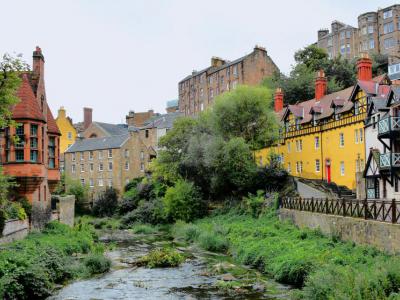
Dean Village, once a deep valley near Edinburgh's city center, thrived for over 800 years as a grain milling hub. It boasted up to eleven mills powered by the Water of Leith. This area was initially mentioned in a 1145 charter by King David I of Scotland, who granted a mill here to Holyrood Abbey.
Remaining distinct until the 1800s, Dean Village changed hands in 1826 when John Learmonth, future Edinburgh Lord Provost, bought it. The Dean Bridge, crucial for crossing the valley, was built in 1831-33 without a toll, as insisted by the Cramond Road Trustees and designed by Thomas Telford. This four-arch bridge, over 400 feet wide and 106 feet above the water, significantly improved access from the city.
In 1847, Dean House was demolished to create Dean Cemetery. This mansion, central to the Dean Estate since 1609, left its mark through sculptured stones in the cemetery's southern wall and ceiling panels in Scotland's National Museum. The cemetery is notable for housing prominent figures like Sir Thomas Bouch.
With the emergence of larger mills in Leith, Dean Village's prosperity declined, leading to decay and poverty until the 1960s. However, since the mid-1970s, it has been revitalized into a peaceful area near the city center, with renovated residential spaces and the Water of Leith Walkway established in 1983.
Dean Bridge also appears in Ian Rankin's "Strip Jack" and Peter May's "The Lewis Man," highlighting its cultural significance.
Remaining distinct until the 1800s, Dean Village changed hands in 1826 when John Learmonth, future Edinburgh Lord Provost, bought it. The Dean Bridge, crucial for crossing the valley, was built in 1831-33 without a toll, as insisted by the Cramond Road Trustees and designed by Thomas Telford. This four-arch bridge, over 400 feet wide and 106 feet above the water, significantly improved access from the city.
In 1847, Dean House was demolished to create Dean Cemetery. This mansion, central to the Dean Estate since 1609, left its mark through sculptured stones in the cemetery's southern wall and ceiling panels in Scotland's National Museum. The cemetery is notable for housing prominent figures like Sir Thomas Bouch.
With the emergence of larger mills in Leith, Dean Village's prosperity declined, leading to decay and poverty until the 1960s. However, since the mid-1970s, it has been revitalized into a peaceful area near the city center, with renovated residential spaces and the Water of Leith Walkway established in 1983.
Dean Bridge also appears in Ian Rankin's "Strip Jack" and Peter May's "The Lewis Man," highlighting its cultural significance.
6) St. Mary's Cathedral
Saint Mary’s Cathedral is located in Edinburgh’s New Town district and you shouldn't miss the opportunity to visit this fine church.
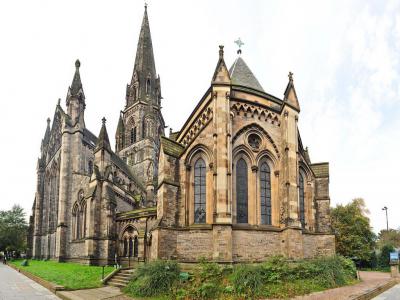
The building was designed by Sir George Gilbert Scott in 1874 and is a wonderful example of Victorian Gothic architecture. The foundation stone was hollowed out and it contains a copy of the Trust Deed, Oliver and Boyd’s Almanac, coins, newspapers and an edition of the Post Office directory. The nave was opened in 1879 and the twin spires on the west end were added by Sir George’s grandson Charles in 1913.
The church complex comprises the Song School with its lovely murals of the Beneficiate by Phoebe Anna Traquair and the Chapter House which is open as a crèche on Sundays.
Inside the cathedral, you will find Sir Walter Scott’s pew, which was brought here in 2006 and memorials to the Soldiers of the Royal Scots Infantry killed overseas between 1857 and 1870. Other memorials are dedicated to important Scottish Generals.
The Lorimer Rood Cross over the nave altar was placed there in 1922; the reredos behind the High Altar represent Christ with the Saints Mary, Margaret, Columba and John.
You can also admire the Paolozzi window – one of the first stained-glass windows in Scotland. It caused a bit of a stir at the time, but as it represented scenes from the Ascension, it was allowed to remain in place. The most notable item in the church is Borthwick’s powerful painting “The Presence”.
Why You Should Visit:
This Cathedral is very much a working one and you can be treated to fantastic choral/organ music on most days.
Otherwise, of course, the architecture is a treat to watch – a must for anyone interested in the splendor of 19th-century houses of worship.
The building was designed by Sir George Gilbert Scott in 1874 and is a wonderful example of Victorian Gothic architecture. The foundation stone was hollowed out and it contains a copy of the Trust Deed, Oliver and Boyd’s Almanac, coins, newspapers and an edition of the Post Office directory. The nave was opened in 1879 and the twin spires on the west end were added by Sir George’s grandson Charles in 1913.
The church complex comprises the Song School with its lovely murals of the Beneficiate by Phoebe Anna Traquair and the Chapter House which is open as a crèche on Sundays.
Inside the cathedral, you will find Sir Walter Scott’s pew, which was brought here in 2006 and memorials to the Soldiers of the Royal Scots Infantry killed overseas between 1857 and 1870. Other memorials are dedicated to important Scottish Generals.
The Lorimer Rood Cross over the nave altar was placed there in 1922; the reredos behind the High Altar represent Christ with the Saints Mary, Margaret, Columba and John.
You can also admire the Paolozzi window – one of the first stained-glass windows in Scotland. It caused a bit of a stir at the time, but as it represented scenes from the Ascension, it was allowed to remain in place. The most notable item in the church is Borthwick’s powerful painting “The Presence”.
Why You Should Visit:
This Cathedral is very much a working one and you can be treated to fantastic choral/organ music on most days.
Otherwise, of course, the architecture is a treat to watch – a must for anyone interested in the splendor of 19th-century houses of worship.
