Custom Walk in Helsinki, Finland by lmw5005_62c794 created on 2026-05-10
Guide Location: Finland » Helsinki
Guide Type: Custom Walk
# of Sights: 6
Tour Duration: 1 Hour(s)
Travel Distance: 1.3 Km or 0.8 Miles
Share Key: DFPUY
Guide Type: Custom Walk
# of Sights: 6
Tour Duration: 1 Hour(s)
Travel Distance: 1.3 Km or 0.8 Miles
Share Key: DFPUY
How It Works
Please retrieve this walk in the GPSmyCity app. Once done, the app will guide you from one tour stop to the next as if you had a personal tour guide. If you created the walk on this website or come to the page via a link, please follow the instructions below to retrieve the walk in the app.
Retrieve This Walk in App
Step 1. Download the app "GPSmyCity: Walks in 1K+ Cities" on Apple App Store or Google Play Store.



Step 2. In the GPSmyCity app, download(or launch) the guide "Helsinki Map and Walking Tours".
Step 3. Tap the menu button located at upper right corner of the "Walks" screen and select "Retrieve custom walk". Enter the share key: DFPUY
1) Academic Bookshop
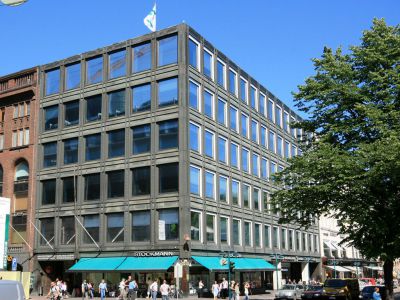
The Academic Bookshop in Helsinki is renowned for its high quality and modern approach among retail bookstores. It was established to offer a varied and thoughtfully curated collection of books, and magazines, as well as office and stationery supplies. Over time, it has solidified its reputation as a top choice for readers, writers, and those seeking the perfect gift, boasting knowledgeable staff dedicated to assisting customers.
A key aspect of the Academic Bookshop's identity is its architectural significance, crafted by the celebrated Finnish architect Alvar Aalto. Built between 1962 and 1969, the building showcases a distinctive copper facade adorned with large windows, welcoming natural light inside. Notably, the windows are adorned with strips of white marble, lending an air of sophistication to the exterior. However, it's the interior that truly captivates, characterized by spaciousness and brightness in contrast to the darker exterior. Aalto's design incorporates geometric shapes and cuts, accentuated by natural light streaming through expansive glass skylights, creating an inviting and inspiring atmosphere for visitors.
Moreover, the premises include a Starbucks café on the ground floor and Cafe Aalto on the second floor, offering visitors spaces to unwind, enjoy a cup of coffee, and delve into their latest literary discovery. With its diverse product range, architectural splendor, and accompanying amenities, the Academic Bookshop stands as a must-visit destination in Helsinki for anyone who values literature and architectural marvels.
A key aspect of the Academic Bookshop's identity is its architectural significance, crafted by the celebrated Finnish architect Alvar Aalto. Built between 1962 and 1969, the building showcases a distinctive copper facade adorned with large windows, welcoming natural light inside. Notably, the windows are adorned with strips of white marble, lending an air of sophistication to the exterior. However, it's the interior that truly captivates, characterized by spaciousness and brightness in contrast to the darker exterior. Aalto's design incorporates geometric shapes and cuts, accentuated by natural light streaming through expansive glass skylights, creating an inviting and inspiring atmosphere for visitors.
Moreover, the premises include a Starbucks café on the ground floor and Cafe Aalto on the second floor, offering visitors spaces to unwind, enjoy a cup of coffee, and delve into their latest literary discovery. With its diverse product range, architectural splendor, and accompanying amenities, the Academic Bookshop stands as a must-visit destination in Helsinki for anyone who values literature and architectural marvels.
2) Esplanadi Park (must see)
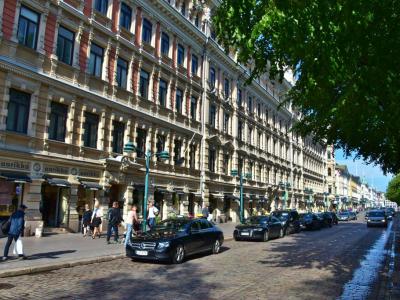
Between Erottaja Square and Market Square, you will find Esplanadi Park. Known simply as ‘Espa’ by the locals, this long promenade is a popular walking area. The park opened in 1818 and was designed by Carl Ludwig Engel. In 1827, Engels Teater was the first theater built in Helsinki.
Espa is a popular spot with locals to enjoy a picnic or see live performances. The central section of the park features roses bushes, crab apple trees, and aspen trees. You'll see many monuments and statues, including one of national poet Johan Ludvig Runeberg. He wrote the Finnish national anthem, and his was the first monument erected in Helsinki in 1885.
The Kappeli Restaurant opened in 1867, and it’s still known for great food in a beautiful setting. Espa Stage hosts live music throughout the year, including the longest music festival in Finland. It's held from May until the end of August and features 200 or more artists hosted by the Cultural Office of the City of Helsinki.
Why You Should Visit:
Beautiful open space in the middle of the city, great for sitting on the bench and people watching, or bringing food and having a picnic.
Tip:
Be sure to take in the architecture on both sides – the old buildings are splendid.
Espa is a popular spot with locals to enjoy a picnic or see live performances. The central section of the park features roses bushes, crab apple trees, and aspen trees. You'll see many monuments and statues, including one of national poet Johan Ludvig Runeberg. He wrote the Finnish national anthem, and his was the first monument erected in Helsinki in 1885.
The Kappeli Restaurant opened in 1867, and it’s still known for great food in a beautiful setting. Espa Stage hosts live music throughout the year, including the longest music festival in Finland. It's held from May until the end of August and features 200 or more artists hosted by the Cultural Office of the City of Helsinki.
Why You Should Visit:
Beautiful open space in the middle of the city, great for sitting on the bench and people watching, or bringing food and having a picnic.
Tip:
Be sure to take in the architecture on both sides – the old buildings are splendid.
3) National Library of Finland
The National Library of Finland stands as the primary research library within the country. It operates under the administrative umbrella of the University of Helsinki, formerly known as the Helsinki University Library until August 1, 2006.
Tasked with preserving Finland's cultural heritage, the National Library operates as a legal deposit library, mandated by Finnish law to receive copies of all printed materials and most audiovisual content originating from or intended for distribution within Finland. These materials are then distributed to the library's national collection and to reserve collections of five other university libraries. Additionally, the National Library is responsible for archiving and safeguarding internet-published materials.
Residents of Finland are eligible to register as users of the National Library, granting them borrowing privileges for library materials. However, publications within the national collection are not available for loan beyond the library premises. Notably, the library boasts one of the world's most extensive collections of books published during the Russian Empire era.
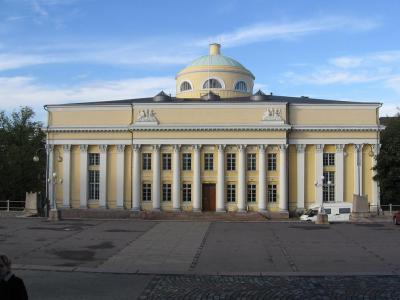
Situated near Senaatintori Square in Helsinki, the National Library comprises both historic and modern architectural elements. The original section of the library, designed by Carl Ludvig Engel, dates back to 1844, while the newer Rotunda extension, crafted by architect Gustaf Nyström, was completed in 1906. The majority of the library's holdings are housed in the Kirjaluola, an underground bunker carved into solid rock, located 18 meters below the library, with a volume of 57,600 cubic meters (2,030,000 cubic feet).
Tasked with preserving Finland's cultural heritage, the National Library operates as a legal deposit library, mandated by Finnish law to receive copies of all printed materials and most audiovisual content originating from or intended for distribution within Finland. These materials are then distributed to the library's national collection and to reserve collections of five other university libraries. Additionally, the National Library is responsible for archiving and safeguarding internet-published materials.
Residents of Finland are eligible to register as users of the National Library, granting them borrowing privileges for library materials. However, publications within the national collection are not available for loan beyond the library premises. Notably, the library boasts one of the world's most extensive collections of books published during the Russian Empire era.
Situated near Senaatintori Square in Helsinki, the National Library comprises both historic and modern architectural elements. The original section of the library, designed by Carl Ludvig Engel, dates back to 1844, while the newer Rotunda extension, crafted by architect Gustaf Nyström, was completed in 1906. The majority of the library's holdings are housed in the Kirjaluola, an underground bunker carved into solid rock, located 18 meters below the library, with a volume of 57,600 cubic meters (2,030,000 cubic feet).
4) Senaatintori (Senate Square) (must see)
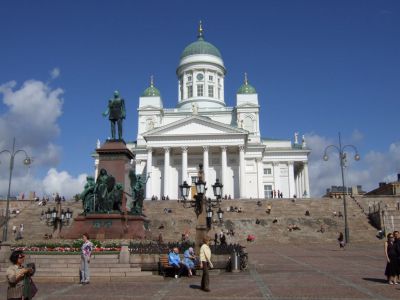
Senate Square, or Senaatintori, is a city square surrounded by beautiful Neo-Classical buildings. The square and its buildings are the oldest part of Helsinki. The structures on the square include the Cathedral, the main building of the University of Helsinki, the Government Palace, and the Sederholm House dating from 1757.
The square is built on the site of a 17th and 18th-century graveyard. The city plan, designed by Johan Albrecht Ehrenström, designated the square in 1812. By 1822, the Government Palace was completed. The Senate of Finland met there until the Council of State replaced it in 1918. Today, the building is used by the Prime Minister and Cabinet officials.
The University Building was constructed in 1832. But the most dominant building in the square is by far the Helsinki Cathedral. It was designed by Carl Ludvig Engel but was not completed until 12 years after his death. It was initially called the Church of Saint Nicholas.
Walter Runeberg carved the central statue of Emperor Alexander II in 1894. During the Russian years, the Alexander statue was a symbol of resistance. People would leave flowers under the statue as a gesture of protest against Alexander's grandson, tsar Nicolas II. Alexander was known locally as "the good tsar."
Why You Should Visit:
Today, Senate Square is a popular destination. There's often a festival, art exhibition, or concert going on.
The square is the site of the oldest buildings in Helsinki. The Cathedral is especially worth seeing as it is one of the most iconic buildings in the city. From the stairs to the Cathedral, be sure to take in the view of the city all around.
Tips:
Every day a digital carillon plays at 17:49. The acoustically best spot to hear the piece is at the central statue of Alexander II.
If visiting in the wintertime, the Helsinki Christmas Market is held every December in Senate Square.
The square has appeared in many movies, including many scenes that were supposedly set in Russia. By omitting the distinctive Cathedral from his shots, Warren Beatty convincingly used Senate Square as a substitute for Soviet Saint Petersburg in the 1981 film Reds.
The square is built on the site of a 17th and 18th-century graveyard. The city plan, designed by Johan Albrecht Ehrenström, designated the square in 1812. By 1822, the Government Palace was completed. The Senate of Finland met there until the Council of State replaced it in 1918. Today, the building is used by the Prime Minister and Cabinet officials.
The University Building was constructed in 1832. But the most dominant building in the square is by far the Helsinki Cathedral. It was designed by Carl Ludvig Engel but was not completed until 12 years after his death. It was initially called the Church of Saint Nicholas.
Walter Runeberg carved the central statue of Emperor Alexander II in 1894. During the Russian years, the Alexander statue was a symbol of resistance. People would leave flowers under the statue as a gesture of protest against Alexander's grandson, tsar Nicolas II. Alexander was known locally as "the good tsar."
Why You Should Visit:
Today, Senate Square is a popular destination. There's often a festival, art exhibition, or concert going on.
The square is the site of the oldest buildings in Helsinki. The Cathedral is especially worth seeing as it is one of the most iconic buildings in the city. From the stairs to the Cathedral, be sure to take in the view of the city all around.
Tips:
Every day a digital carillon plays at 17:49. The acoustically best spot to hear the piece is at the central statue of Alexander II.
If visiting in the wintertime, the Helsinki Christmas Market is held every December in Senate Square.
The square has appeared in many movies, including many scenes that were supposedly set in Russia. By omitting the distinctive Cathedral from his shots, Warren Beatty convincingly used Senate Square as a substitute for Soviet Saint Petersburg in the 1981 film Reds.
5) Helsinki Cathedral (must see)
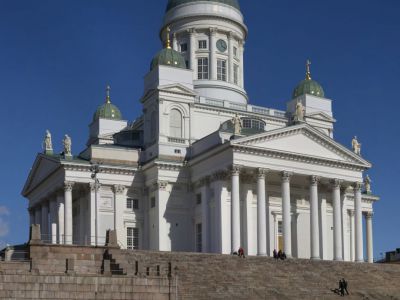
Helsinki Cathedral is an important symbol of Finnish culture and architecture, situated in the heart of Helsinki's Kruununhaka neighborhood on Senate Square. This impressive building serves as the main Lutheran cathedral for the Diocese of Helsinki and has a rich history dating back to the early 19th century. Initially built between 1830 and 1852, the cathedral was dedicated to the Grand Duke of Finland, Tsar Nicholas I, and was known as Saint Nicholas's Church until Finland gained independence in 1917. Today, it is renowned worldwide as one of Finland's most significant historical landmarks.
Designed by Carl Ludvig Engel in the Neoclassical style, Helsinki Cathedral features a distinctive green dome surrounded by four smaller domes, creating a striking silhouette against the city skyline. Engel intended the cathedral to be the focal point of his design for Senate Square, with other structures complementing its grandeur. The cathedral's architectural plan, based on a Greek cross, emphasizes symmetry with colonnades and pediments adorning each arm, though Engel's original vision for additional columns at the entrance was never realized.
Built on the site of the earlier Ulrika Eleonora Church from the 18th century, Helsinki Cathedral's foundation has historical significance. Construction was funded by a decree from Alexander I, tying its origins to Helsinki's designation as the nation's capital in 1812. While Engel passed away before its completion, Ernst Lohrmann, his successor, made further contributions to the design, including the addition of four small domes and a bell tower. Notable zinc statues of the Twelve Apostles, crafted by renowned artists of the time, adorn the roofline.
Throughout its existence, Helsinki Cathedral has undergone renovations and restorations, including the conversion of its crypt into a functional space for exhibitions and events beyond religious ceremonies. It remains an important center for worship, hosting regular services and special occasions like weddings. With half a million visitors in 2018 alone, it is a popular tourist destination, embodying Finnish culture and spirituality through its historical significance, architectural grandeur, and active community involvement.
Tips:
Plenty of steps to get to the cathedral's main entrance (no handrails, so be prepared). There are some wheelchair ramps if needed.
Also worth a visit is an atypical café right under the cathedral (Cafe Krypta). The entrance is at the back of Kirkkokatu Street or via elevator from the cathedral. Friendly staff, delicious pastries, and inexpensive coffee.
Designed by Carl Ludvig Engel in the Neoclassical style, Helsinki Cathedral features a distinctive green dome surrounded by four smaller domes, creating a striking silhouette against the city skyline. Engel intended the cathedral to be the focal point of his design for Senate Square, with other structures complementing its grandeur. The cathedral's architectural plan, based on a Greek cross, emphasizes symmetry with colonnades and pediments adorning each arm, though Engel's original vision for additional columns at the entrance was never realized.
Built on the site of the earlier Ulrika Eleonora Church from the 18th century, Helsinki Cathedral's foundation has historical significance. Construction was funded by a decree from Alexander I, tying its origins to Helsinki's designation as the nation's capital in 1812. While Engel passed away before its completion, Ernst Lohrmann, his successor, made further contributions to the design, including the addition of four small domes and a bell tower. Notable zinc statues of the Twelve Apostles, crafted by renowned artists of the time, adorn the roofline.
Throughout its existence, Helsinki Cathedral has undergone renovations and restorations, including the conversion of its crypt into a functional space for exhibitions and events beyond religious ceremonies. It remains an important center for worship, hosting regular services and special occasions like weddings. With half a million visitors in 2018 alone, it is a popular tourist destination, embodying Finnish culture and spirituality through its historical significance, architectural grandeur, and active community involvement.
Tips:
Plenty of steps to get to the cathedral's main entrance (no handrails, so be prepared). There are some wheelchair ramps if needed.
Also worth a visit is an atypical café right under the cathedral (Cafe Krypta). The entrance is at the back of Kirkkokatu Street or via elevator from the cathedral. Friendly staff, delicious pastries, and inexpensive coffee.
6) Uspenski Cathedral (must see)
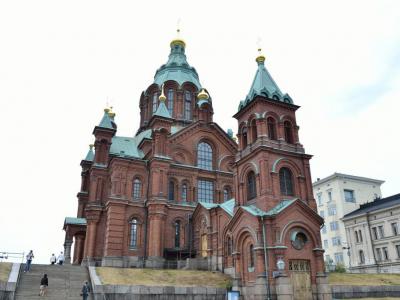
Part of the Eastern Orthodox Church, the Upenski Cathedral is the official seat of the bishop of Helsinki for that faith tradition. It is dedicated to the Dormition of Theotokos (The Bearer of God, or Mary). In fact, the name of the church itself is derived from the old Slavic word for Dormition.
The building was finished in 1868 and took a total of six years to complete. The well known Russian architect Alexey Gomostaev designed the structure. Sadly, it was not completed in his lifetime.
There is a crypt chapel that is built into the building complex. It was named after one of the old Vicars of the church, Alexander Hotovitzky. He served the local parish in the early 1900s.
There are several very beautiful icons on display in this cathedral. They also happen to be quite valuable as art antiquities. In fact, two of them had been stolen from the church in the last several years, with only one having been (remarkably) recovered. Consequently, glass protection covers had to be added, but this will not ruin your chance to appreciate the icons.
Tips:
- The climb up involves quite a number of stairs. Go up there at sunset. You'll get stunning photos of the cityscape with the sun setting just behind the Lutheran Cathedral.
- The rocks right in front of the church are popular place to sit on together with friends enjoying the view. Just watch out – they are steep!
The building was finished in 1868 and took a total of six years to complete. The well known Russian architect Alexey Gomostaev designed the structure. Sadly, it was not completed in his lifetime.
There is a crypt chapel that is built into the building complex. It was named after one of the old Vicars of the church, Alexander Hotovitzky. He served the local parish in the early 1900s.
There are several very beautiful icons on display in this cathedral. They also happen to be quite valuable as art antiquities. In fact, two of them had been stolen from the church in the last several years, with only one having been (remarkably) recovered. Consequently, glass protection covers had to be added, but this will not ruin your chance to appreciate the icons.
Tips:
- The climb up involves quite a number of stairs. Go up there at sunset. You'll get stunning photos of the cityscape with the sun setting just behind the Lutheran Cathedral.
- The rocks right in front of the church are popular place to sit on together with friends enjoying the view. Just watch out – they are steep!
