Custom Walk in Basel, Switzerland by robert_sharrer_a855a2 created on 2026-05-13
Guide Location: Switzerland » Basel
Guide Type: Custom Walk
# of Sights: 6
Tour Duration: 1 Hour(s)
Travel Distance: 1.8 Km or 1.1 Miles
Share Key: J4NMW
Guide Type: Custom Walk
# of Sights: 6
Tour Duration: 1 Hour(s)
Travel Distance: 1.8 Km or 1.1 Miles
Share Key: J4NMW
How It Works
Please retrieve this walk in the GPSmyCity app. Once done, the app will guide you from one tour stop to the next as if you had a personal tour guide. If you created the walk on this website or come to the page via a link, please follow the instructions below to retrieve the walk in the app.
Retrieve This Walk in App
Step 1. Download the app "GPSmyCity: Walks in 1K+ Cities" on Apple App Store or Google Play Store.



Step 2. In the GPSmyCity app, download(or launch) the guide "Basel Map and Walking Tours".
Step 3. Tap the menu button located at upper right corner of the "Walks" screen and select "Retrieve custom walk". Enter the share key: J4NMW
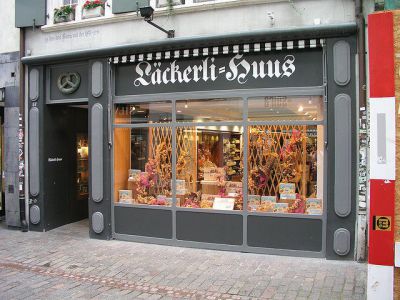
1) Läckerli Huus
Lackerli Huus is a celebrated Swiss confectionery and baked goods manufacturer with over a century of tradition. Famous for its Original Basler Lackerli, this iconic establishment has been delighting locals and visitors alike with Basel’s finest delicacies since its founding in 1903.
The Basler Lackerli, a quintessential Basel specialty, is baked using a closely guarded recipe featuring honey, hazelnuts, almonds, candied orange and lemon peel, and a medley of aromatic spices. Beyond the Lackerli, the Lackerli Huus offers an array of mouthwatering treats, including Rahmtafeli, Gelee Russe, Flutes de Bale, high-quality chocolates, and artisan biscuits, all crafted with care and passion.
Originally established to cater to local cravings, the company began shipping its delights nationwide before opening its first store in 1950. By 1954, Lackerli Huus had gained recognition at the Mustermesse Basel fair. In the 1970s, the company moved into its flagship location on Gerbergasse, becoming a landmark for sweet seekers in Basel. Today, the Frenkendorf facility, designed to reflect the company’s tradition of biscuit tins and golden packaging, houses production, storage, and offices.
For anyone exploring Basel, a visit to the Lackerli Huus is essential. The Gerbergasse store offers the largest selection of their exquisite creations, presented in elegantly designed tins and packages that make perfect gifts. With its blend of tradition, craftsmanship, and innovation, Lackerli Huus is more than a shop-it's a true Basel institution.
The Basler Lackerli, a quintessential Basel specialty, is baked using a closely guarded recipe featuring honey, hazelnuts, almonds, candied orange and lemon peel, and a medley of aromatic spices. Beyond the Lackerli, the Lackerli Huus offers an array of mouthwatering treats, including Rahmtafeli, Gelee Russe, Flutes de Bale, high-quality chocolates, and artisan biscuits, all crafted with care and passion.
Originally established to cater to local cravings, the company began shipping its delights nationwide before opening its first store in 1950. By 1954, Lackerli Huus had gained recognition at the Mustermesse Basel fair. In the 1970s, the company moved into its flagship location on Gerbergasse, becoming a landmark for sweet seekers in Basel. Today, the Frenkendorf facility, designed to reflect the company’s tradition of biscuit tins and golden packaging, houses production, storage, and offices.
For anyone exploring Basel, a visit to the Lackerli Huus is essential. The Gerbergasse store offers the largest selection of their exquisite creations, presented in elegantly designed tins and packages that make perfect gifts. With its blend of tradition, craftsmanship, and innovation, Lackerli Huus is more than a shop-it's a true Basel institution.
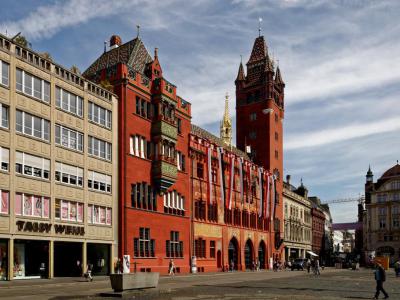
2) Marktplatz (Market Square)
The vibrant red town hall dominates Market Square. Market Square hosts a daily market that features local produce and regional and Swiss specialties. In addition, visitors can stock up on flowers, coffee, honey, crafts, and wine.
The square dates back to at least the year 1091. Back then, the square was bisected by Birsig Creek. There was a grain market where the citizens met and handled business. In 1290, the first town hall was built and that became the center of the town's political life.
In addition to the town hall, the square was home to the court. In front of the courthouse was a flat stone used for executions and public announcements. The accused often were brought here to face the ridicule of the population.
In the early days, the square was surrounded by wooden shops and houses with fold-down shutters. Through the open windows, owners would sell their goods that included meats, sausages, tripe, herring, birds, and gingerbread.
The houses were destroyed in 1891 to expand Market Square. Over the years, large commercial buildings have taken over. The square was further modified in 1908 when it was leveled out. Today, it is one of the most important tram junctions in the city, with seven lines passing through this one spot.
Market Square is delightful over the Christmas holidays. Visitors can do holiday shopping while enjoying hot chocolate and festive holiday lights. But any time of year is a great time to visit, thanks to the many charming cafes, restaurants, shops, and boutiques.
The square dates back to at least the year 1091. Back then, the square was bisected by Birsig Creek. There was a grain market where the citizens met and handled business. In 1290, the first town hall was built and that became the center of the town's political life.
In addition to the town hall, the square was home to the court. In front of the courthouse was a flat stone used for executions and public announcements. The accused often were brought here to face the ridicule of the population.
In the early days, the square was surrounded by wooden shops and houses with fold-down shutters. Through the open windows, owners would sell their goods that included meats, sausages, tripe, herring, birds, and gingerbread.
The houses were destroyed in 1891 to expand Market Square. Over the years, large commercial buildings have taken over. The square was further modified in 1908 when it was leveled out. Today, it is one of the most important tram junctions in the city, with seven lines passing through this one spot.
Market Square is delightful over the Christmas holidays. Visitors can do holiday shopping while enjoying hot chocolate and festive holiday lights. But any time of year is a great time to visit, thanks to the many charming cafes, restaurants, shops, and boutiques.
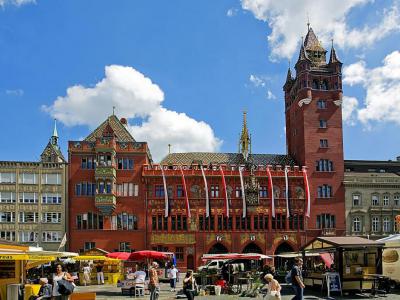
3) Rathaus (Town Hall) (must see)
Town Hall is home to the Basel government and parliament. This dramatic red brick building with its imposing tower is one of Basel's most attractive landmarks.
The current Town Hall was built between 1504 and 1513 to celebrate Basel's joining the Swiss Confederation. It replaced an older, less grand structure. While the building has undergone many renovations over the centuries, the three iconic arched entrances are from the initial construction.
Artist Hans Holbein decorated the Town Hall's Assembly Hall in 1521. Hans Holbein would later rise to fame as King Henry VIII's court painter.
The Gothic-style Front Chambers were added in the 1600s. The tower was added in the 1800s. At the time, its imposing height was controversial, and a public vote was called before construction was approved.
The exterior facade features depictions of historical and legendary figures. On the balcony, an inscription reminds visitors Here begins Swiss land. The crenellations are decorated with Basel's coats of arms.
The interior is richly decorated. The courtyard features a Roman statue representing Julius Caesar's contemporary Lucius Munatuis Plancus. Plancus founded Augusta Raurica, the nearby Roman city.
Many paintings depict a law and order theme. For example, the Roman goddess of Justice, Justitia, is depicted in a scene over the Front Chambers.
The Cantonal Parliament debates twice a month in the assembly hall. The Cantonal Government meets in Town Hall every Tuesday. The Chancellery and the Department of Presidental Affairs are also located in the Town Hall.
Guided tours in English are available every Saturday at 4:30 p.m.
The current Town Hall was built between 1504 and 1513 to celebrate Basel's joining the Swiss Confederation. It replaced an older, less grand structure. While the building has undergone many renovations over the centuries, the three iconic arched entrances are from the initial construction.
Artist Hans Holbein decorated the Town Hall's Assembly Hall in 1521. Hans Holbein would later rise to fame as King Henry VIII's court painter.
The Gothic-style Front Chambers were added in the 1600s. The tower was added in the 1800s. At the time, its imposing height was controversial, and a public vote was called before construction was approved.
The exterior facade features depictions of historical and legendary figures. On the balcony, an inscription reminds visitors Here begins Swiss land. The crenellations are decorated with Basel's coats of arms.
The interior is richly decorated. The courtyard features a Roman statue representing Julius Caesar's contemporary Lucius Munatuis Plancus. Plancus founded Augusta Raurica, the nearby Roman city.
Many paintings depict a law and order theme. For example, the Roman goddess of Justice, Justitia, is depicted in a scene over the Front Chambers.
The Cantonal Parliament debates twice a month in the assembly hall. The Cantonal Government meets in Town Hall every Tuesday. The Chancellery and the Department of Presidental Affairs are also located in the Town Hall.
Guided tours in English are available every Saturday at 4:30 p.m.
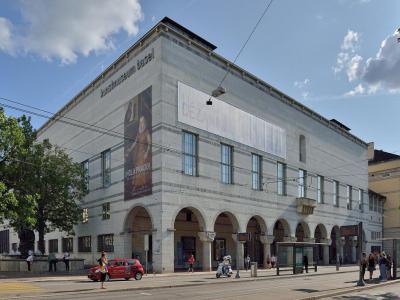
4) Kunstmuseum Basel (Fine Arts Museum) (must see)
Basel's Fine Arts Museum is home to the world's oldest public museum. It began when Basel and the University of Basel purchased a collection of Hans Holbein's works in 1661. The collection has been available to the public since 1671.
The collection features artworks from the 15th century to the present. The Fine Arts Museum features the world's most extensive collection of art by the illustrious Holbein family.
Renaissance works include art by Mathias Grunewald, Martn Schonguer, and Hans Baldung. Notable art from the 17th and 18th centuries includes work by Rembrandt and Peter Paul Rubens. Works from the 19th century include valuable paintings by Edouard Manet, Claude Monet, Paul Cezanne, and Paul Gaugin. The museum also houses works by Vincent van Gogh.
20th-century artists include Pablo Picasso, Paul Klee, and Marc Chagall. More contemporary art on display represents Andy Warhol, Francesco Clemente, and Rosemarie Trockel.
In 1939, the Fine Arts Museum acquired numerous artworks created by German-Jewish artists. The Nazi regime considered these works to be degenerate and had planned to destroy them. These artworks are on display in the museum today.
The collection features artworks from the 15th century to the present. The Fine Arts Museum features the world's most extensive collection of art by the illustrious Holbein family.
Renaissance works include art by Mathias Grunewald, Martn Schonguer, and Hans Baldung. Notable art from the 17th and 18th centuries includes work by Rembrandt and Peter Paul Rubens. Works from the 19th century include valuable paintings by Edouard Manet, Claude Monet, Paul Cezanne, and Paul Gaugin. The museum also houses works by Vincent van Gogh.
20th-century artists include Pablo Picasso, Paul Klee, and Marc Chagall. More contemporary art on display represents Andy Warhol, Francesco Clemente, and Rosemarie Trockel.
In 1939, the Fine Arts Museum acquired numerous artworks created by German-Jewish artists. The Nazi regime considered these works to be degenerate and had planned to destroy them. These artworks are on display in the museum today.
5) Basel Museum of Ancient Art and Ludwig Collection
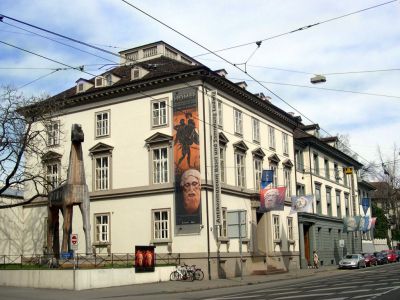
The Basel Museum of Ancient Art and Ludwig Collection is a remarkable institution in Basel, recognized as a heritage site of national significance. Founded in 1961 to unify the city’s scattered antiquities, the museum showcases a vast range of artifacts from ancient civilizations, spanning from 4000 BC to 400 AD. It resides within two architecturally significant buildings, both designed by Melchior Berri in the early 19th century. Originally, only the building constructed for merchant Isaac Iselin-Roulet was used, while the second building, designed for Johann Jakob Bachofen-Merian, was integrated into the museum in 1986, culminating in a total exhibition space of 3000 square meters by 1992.
The museum’s extensive collection is the only one of its kind in Switzerland, focusing on Mediterranean cultures, particularly those of ancient Egypt, Greece, and Italy, along with artifacts from the Near East and Cyprus. The Greek vases, Egyptian relics, and other artifacts offer a fascinating glimpse into the art and life of early civilizations. The Sculpture Hall, located near Basel University, complements the museum with its impressive array of over 2,200 plaster casts of ancient sculptures, ranging from the Archaic to the Late Roman period, making it one of the most distinguished collections of its type globally.
In addition to its permanent exhibitions, the museum organizes special programs designed to connect past and present, fostering cultural dialogue with its visitors.
The museum’s extensive collection is the only one of its kind in Switzerland, focusing on Mediterranean cultures, particularly those of ancient Egypt, Greece, and Italy, along with artifacts from the Near East and Cyprus. The Greek vases, Egyptian relics, and other artifacts offer a fascinating glimpse into the art and life of early civilizations. The Sculpture Hall, located near Basel University, complements the museum with its impressive array of over 2,200 plaster casts of ancient sculptures, ranging from the Archaic to the Late Roman period, making it one of the most distinguished collections of its type globally.
In addition to its permanent exhibitions, the museum organizes special programs designed to connect past and present, fostering cultural dialogue with its visitors.
6) Tinguely Brunnen Fountain (must see)
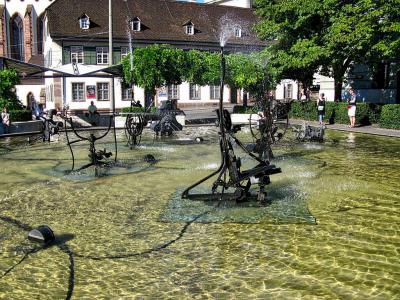
Swiss artist Jean Tinguely created this magnificent fountain in 1977. The fountain stands where the city theatre company's stage once stood.
Tinguely created mechanical iron figures. The figures were crafted with scraps of metal and plastic from the dismantled theater.
Tinguely placed the figures in a shallow basin and added the water feature. The ten figures are powered by a low-voltage current and seem to be constantly talking and interacting with each other. The water jets splash back and forth between the figures. This motion and interaction represents the actors, dancers, and mime artists who performed on the theater's stage.
The fountain is lit at night and offers a different perspective on this fascinating fountain. In the winter, the water freezes in motion for yet another artistic display.
The Tinguely Brunnen Fountain is one of Tinguely's most well-known works. Tingley referred to the fountain as Composition of the Six Elements.
Tinguely created mechanical iron figures. The figures were crafted with scraps of metal and plastic from the dismantled theater.
Tinguely placed the figures in a shallow basin and added the water feature. The ten figures are powered by a low-voltage current and seem to be constantly talking and interacting with each other. The water jets splash back and forth between the figures. This motion and interaction represents the actors, dancers, and mime artists who performed on the theater's stage.
The fountain is lit at night and offers a different perspective on this fascinating fountain. In the winter, the water freezes in motion for yet another artistic display.
The Tinguely Brunnen Fountain is one of Tinguely's most well-known works. Tingley referred to the fountain as Composition of the Six Elements.
