Custom Walk in Tours, France by timohthy_d3fa3 created on 2026-05-24
Guide Location: France » Tours
Guide Type: Custom Walk
# of Sights: 12
Tour Duration: 3 Hour(s)
Travel Distance: 4.6 Km or 2.9 Miles
Share Key: 76Y49
Guide Type: Custom Walk
# of Sights: 12
Tour Duration: 3 Hour(s)
Travel Distance: 4.6 Km or 2.9 Miles
Share Key: 76Y49
How It Works
Please retrieve this walk in the GPSmyCity app. Once done, the app will guide you from one tour stop to the next as if you had a personal tour guide. If you created the walk on this website or come to the page via a link, please follow the instructions below to retrieve the walk in the app.
Retrieve This Walk in App
Step 1. Download the app "GPSmyCity: Walks in 1K+ Cities" on Apple App Store or Google Play Store.



Step 2. In the GPSmyCity app, download(or launch) the guide "Tours Map and Walking Tours".
Step 3. Tap the menu button located at upper right corner of the "Walks" screen and select "Retrieve custom walk". Enter the share key: 76Y49
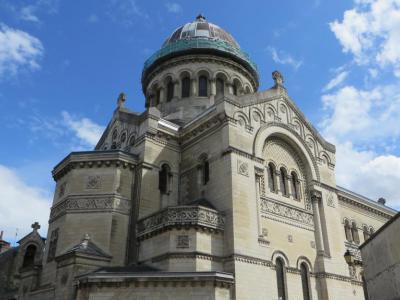
1) Basilica of St. Martin (must see)
The beginning of the story of the Basilica of Saint Martin goes all the way back to the 4th Century, when a small chapel was established here. The chapel was dedicated to Saint Martin, who was the bishop of Tours at that time. Destroyed and rebuilt many times since, it was architect Victor Laloux that designed the Roman-Byzantine basilica on the site today.
The first basilica was built in the fifth century over the ruins of an earlier chapel. The basilica was dedicated to Saint Martin of Tours and it was erected over his tomb. Alcuin, an adviser of Charlemagne, was appointed Abbot of the monastic establishment of Saint-Martin's, developed as a collegiate church and governed by a community of canons.
The medieval chapel was destroyed in the French Revolution. Only two old towers connected to the medieval chapel are still standing today. Between the years of 1896 and 1924 the present church was built by Victor Laloux in a neo-Byzantine style on the site of the original basilica. The church was dedicated in 1925.
It has been said the exterior design is reminiscent of an old European synagogue. The interior has white stone walls and stained glass windows showing scenes in the life of the Saint. The new, modern crypt of the church holds the remains of Saint Martin.
The Basilica is located in the Tours Old Town. Saint Martin was third bishop of Tours. He is one of the most familiar and recognizable Christian saints in France. Because of his military experience and his leadership of French Christians, Saint Martin is seen as a protector of France.
The first basilica was built in the fifth century over the ruins of an earlier chapel. The basilica was dedicated to Saint Martin of Tours and it was erected over his tomb. Alcuin, an adviser of Charlemagne, was appointed Abbot of the monastic establishment of Saint-Martin's, developed as a collegiate church and governed by a community of canons.
The medieval chapel was destroyed in the French Revolution. Only two old towers connected to the medieval chapel are still standing today. Between the years of 1896 and 1924 the present church was built by Victor Laloux in a neo-Byzantine style on the site of the original basilica. The church was dedicated in 1925.
It has been said the exterior design is reminiscent of an old European synagogue. The interior has white stone walls and stained glass windows showing scenes in the life of the Saint. The new, modern crypt of the church holds the remains of Saint Martin.
The Basilica is located in the Tours Old Town. Saint Martin was third bishop of Tours. He is one of the most familiar and recognizable Christian saints in France. Because of his military experience and his leadership of French Christians, Saint Martin is seen as a protector of France.
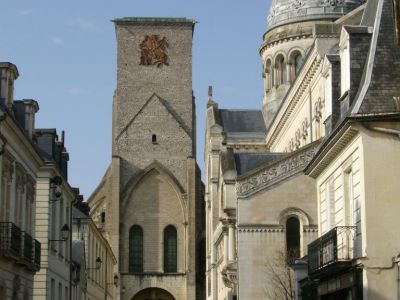
2) Tour Charlemagne (Tower of Charles the Great)
On June 4, 800 AD, the wife of Emperor Charles the Great (Charlemagne), died. Her name was Luitgarde d'Alemanie. Tradition has it that the Emperor buried his wife in or near the Basilica of Saint Martin of Tours. The tower of Charlemagne is a remnant of the ancient building. The actual tomb of the Empress has never been officially certified.
The basilica in place in 800 AD was replaced in 1014, when Herve de Buzancais, treasure of Saint-Martin, built a Romanesque basilica over the site. Originally this building had three towers, two in front and one at the transept. Two other towers were added, The Charlemagne Tower to the north and the Cadran Tower to the south.
The Charlemagne tower was set on firm foundations. The southern tower was placed over the vaults of the transept. In time this latter move proved to be a bad idea. Only the Tower of Charlemagne has stood the test of time.
The tower was restored in 1962 along with the rehabilitation efforts of the Tours old town district. The tower is Romanesque on the lower floors and Gothic above. Two lower floors can be accessed by a spiral staircase in a turret. The top floor can be reached through an internal spiral staircase.
The basilica in place in 800 AD was replaced in 1014, when Herve de Buzancais, treasure of Saint-Martin, built a Romanesque basilica over the site. Originally this building had three towers, two in front and one at the transept. Two other towers were added, The Charlemagne Tower to the north and the Cadran Tower to the south.
The Charlemagne tower was set on firm foundations. The southern tower was placed over the vaults of the transept. In time this latter move proved to be a bad idea. Only the Tower of Charlemagne has stood the test of time.
The tower was restored in 1962 along with the rehabilitation efforts of the Tours old town district. The tower is Romanesque on the lower floors and Gothic above. Two lower floors can be accessed by a spiral staircase in a turret. The top floor can be reached through an internal spiral staircase.
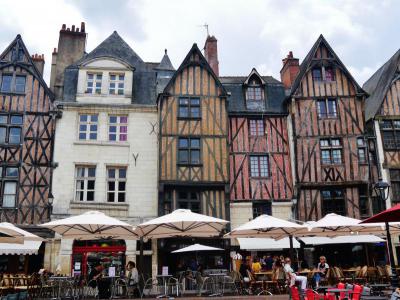
3) Place Plumereau (Plum Square) (must see)
The most touristy place in Tours is the Place Plumereau, or as the locals call it "PlumSquare." Not only popular for visitors, it is also a favorite watering hole for students and the locals. It is in the center of the Saint-Martin district of the city, a very historic area of Tours old town.
The place was not always named Place Plumereau. It was known as Carroi aux Chapeaux in the 13th century, Fruits Square in 1816, and Carroi des Quenouilles. Finally, on 18 November 1888, it became Place Plumereau.
The square is named Plumereau in honor of M. Charles Plumereau (1818-1885). M. Plumereau had no family or heirs. He was a city councilor and when he died he bequeathed 3,000 francs to the city.
The square is lined with half-timbered houses and mansions with Renaissance and Romanesque facades from the 15th century. The square is close to the local university. This makes it a popular spot for students. With the students, locals, and tourists, things can be quite crowded at times.
Seating is no problem. Most of the restaurants and cafes set out chairs on the streets and terraces even in winter.
The place was not always named Place Plumereau. It was known as Carroi aux Chapeaux in the 13th century, Fruits Square in 1816, and Carroi des Quenouilles. Finally, on 18 November 1888, it became Place Plumereau.
The square is named Plumereau in honor of M. Charles Plumereau (1818-1885). M. Plumereau had no family or heirs. He was a city councilor and when he died he bequeathed 3,000 francs to the city.
The square is lined with half-timbered houses and mansions with Renaissance and Romanesque facades from the 15th century. The square is close to the local university. This makes it a popular spot for students. With the students, locals, and tourists, things can be quite crowded at times.
Seating is no problem. Most of the restaurants and cafes set out chairs on the streets and terraces even in winter.
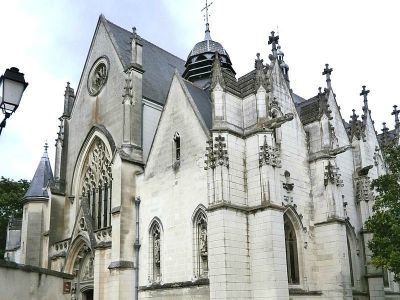
4) Eglise Notre Dame de la Riche (Church of Notre Dame de la Riche)
The Church of Notre Dame de la Riche (Eglise Notre Dame de la Riche) is a historic church in Old Tours. Its origins can be traced back to the 4th century when Saint Lidoire constructed a church on the grounds of a Christian cemetery. This site later hosted the 10th-century Notre-Dame-la-Pauvre church, built over the tomb of Bishop Saint Gatien, with records of its existence dating from 920. Over centuries, the church underwent multiple reconstructions and was renamed Notre-Dame-la-Riche in 1141.
The church visible today was predominantly rebuilt in the 15th century, although on a smaller scale compared to its predecessors. It suffered significant damage during a Protestant sacking in 1562, leading to extensive restoration efforts before 1570. More changes followed; in 1746, a wooden rood screen was replaced by an iron grille, and in 1775, the La Riche pillar, a remnant of the Romanesque structure, was demolished.
Throughout the French Revolution, the church was repurposed for saltpeter production, only to be returned to religious use in 1798. Subsequent restorations occurred from 1818 to 1820 and more comprehensively between 1860 and 1866 under architect Gustave Guérin. These restorations involved significant structural enhancements including the addition of brick vaults and the reuse of the original timber framework for the new roof. The west and south aisles, along with the portals, were also rebuilt during this period.
The church was registered as a historic monument on March 30, 1926. It houses an impressive collection of art and relics, including a set of five 17th-century statues depicting the Marriage of the Holy Virgin, crafted by Touraine sculptor Antoine Charpentier. The church also contains several 16th-century stained glass windows and relics of Saint Francis de Paule, displayed on the north side wall.
The Church of Notre Dame de la Riche stands as a testament to the rich historical and cultural tapestry of Tours, embodying centuries of architectural evolution and religious significance.
The church visible today was predominantly rebuilt in the 15th century, although on a smaller scale compared to its predecessors. It suffered significant damage during a Protestant sacking in 1562, leading to extensive restoration efforts before 1570. More changes followed; in 1746, a wooden rood screen was replaced by an iron grille, and in 1775, the La Riche pillar, a remnant of the Romanesque structure, was demolished.
Throughout the French Revolution, the church was repurposed for saltpeter production, only to be returned to religious use in 1798. Subsequent restorations occurred from 1818 to 1820 and more comprehensively between 1860 and 1866 under architect Gustave Guérin. These restorations involved significant structural enhancements including the addition of brick vaults and the reuse of the original timber framework for the new roof. The west and south aisles, along with the portals, were also rebuilt during this period.
The church was registered as a historic monument on March 30, 1926. It houses an impressive collection of art and relics, including a set of five 17th-century statues depicting the Marriage of the Holy Virgin, crafted by Touraine sculptor Antoine Charpentier. The church also contains several 16th-century stained glass windows and relics of Saint Francis de Paule, displayed on the north side wall.
The Church of Notre Dame de la Riche stands as a testament to the rich historical and cultural tapestry of Tours, embodying centuries of architectural evolution and religious significance.
5) Le Café Chaud
Nestled on Briçonnet Street, in the heart of Tours, Le Café Chaud stands out as a cherished institution, celebrating over four decades of vibrant nightlife and conviviality. Known for its eclectic mix of offerings and atmospheric charm, this bar club is a staple in the local scene, attracting a diverse clientele spanning multiple generations.
Upon entering Le Café Chaud, guests are welcomed into a space where jazz music softly fills the air, setting the tone for an evening of relaxation and enjoyment. The ground floor invites patrons to indulge in various café-cocktails under subdued lighting, creating a warm and inviting ambiance. The décor, modest yet elegant, complements the overall vibe of a classic café with a twist.
A distinctive feature of Le Café Chaud is its club bar located in the basement, thematically designed to mimic a disused Parisian Metro. This quirky, subterranean space serves as the perfect backdrop for themed and dance nights, where the small dance floor buzzes with energy, accommodating the rhythmic sway of salsa steps or the lively movements of a DJ-led dance party.
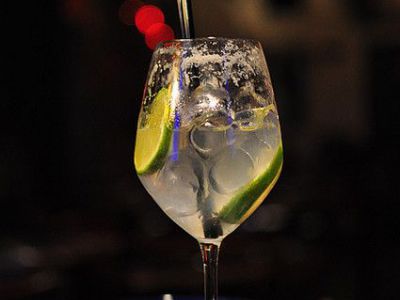
Le Café Chaud excels in its beverage offerings, with an extensive menu of colorful drinks, both alcoholic and non-alcoholic. Guests can savor everything from regional wines to signature cocktails like the Montparnasse or a classic mojito. Additionally, delicious aperitif platters provide the perfect accompaniment to any drink choice, making for a satisfying start or end to the evening.
Whether you're looking to enjoy a jazzy night out, dance away on the small yet vibrant dance floor, or simply relax with a cocktail in hand, this establishment promises a memorable experience. It's not just a café or a club, but a place where every visit feels like coming home to a lively and heartfelt celebration.
Upon entering Le Café Chaud, guests are welcomed into a space where jazz music softly fills the air, setting the tone for an evening of relaxation and enjoyment. The ground floor invites patrons to indulge in various café-cocktails under subdued lighting, creating a warm and inviting ambiance. The décor, modest yet elegant, complements the overall vibe of a classic café with a twist.
A distinctive feature of Le Café Chaud is its club bar located in the basement, thematically designed to mimic a disused Parisian Metro. This quirky, subterranean space serves as the perfect backdrop for themed and dance nights, where the small dance floor buzzes with energy, accommodating the rhythmic sway of salsa steps or the lively movements of a DJ-led dance party.
Le Café Chaud excels in its beverage offerings, with an extensive menu of colorful drinks, both alcoholic and non-alcoholic. Guests can savor everything from regional wines to signature cocktails like the Montparnasse or a classic mojito. Additionally, delicious aperitif platters provide the perfect accompaniment to any drink choice, making for a satisfying start or end to the evening.
Whether you're looking to enjoy a jazzy night out, dance away on the small yet vibrant dance floor, or simply relax with a cocktail in hand, this establishment promises a memorable experience. It's not just a café or a club, but a place where every visit feels like coming home to a lively and heartfelt celebration.
6) Eglise Saint Saturnin (Saint-Saturnin Church)
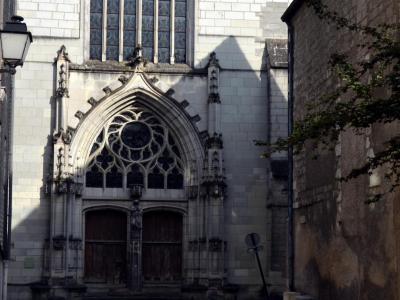
The Eglise Saint-Saturnin, nestled on the picturesque bank of the Loire River in Tours, and formerly known as the Carmelite Church (Eglise des Carmes), boasts a rich historical tapestry dating back to its founding in 1473. Its construction was notably supported by King Louis XI. The church stands out for its striking façade, which faces Rue Littré, inviting visitors and worshippers alike into its historically and architecturally rich interior.
The origins of the church trace back to its establishment adjacent to the former Carmelite priory, replacing the original parish church of Saint-Saturnin which was demolished during the Revolution. While no visible remains of the first convent church exist, the current structure reflects the architectural style and religious fervor of the 15th century, particularly evident in the south aisle characterized by ribbed arches and pointed formations. In contrast, the north aisle showcases modifications from the 19th century with its basket-handle vaults, highlighting the architectural evolution over the centuries.
Inside the church, the décor was largely redone in 1864, coinciding with the construction of the north aisle. One of the interior’s most noteworthy features is the choir stalls, originally from Cormery Abbey, symbolizing a significant historical and religious heritage. These stalls not only add to the church's aesthetic but also serve as a physical connection to its monastic past.
Further enhancing the historical ambiance are the stained glass windows installed in 1890, preserving fragments from the Chenonceaux Castle (Château de Chenonceaux), and adding layers of artistic and historical significance. Additionally, the pilasters of the north pillars of the nave, serving as buttresses, are remnants from the church’s initial construction, bridging past and present.
Today, the Eglise Saint-Saturnin not only serves as a place of worship but also as a beacon of local heritage, reflecting centuries of architectural adaptations and religious devotion. Its blend of historical elements from various eras makes it a fascinating site for visitors exploring Tours.
The origins of the church trace back to its establishment adjacent to the former Carmelite priory, replacing the original parish church of Saint-Saturnin which was demolished during the Revolution. While no visible remains of the first convent church exist, the current structure reflects the architectural style and religious fervor of the 15th century, particularly evident in the south aisle characterized by ribbed arches and pointed formations. In contrast, the north aisle showcases modifications from the 19th century with its basket-handle vaults, highlighting the architectural evolution over the centuries.
Inside the church, the décor was largely redone in 1864, coinciding with the construction of the north aisle. One of the interior’s most noteworthy features is the choir stalls, originally from Cormery Abbey, symbolizing a significant historical and religious heritage. These stalls not only add to the church's aesthetic but also serve as a physical connection to its monastic past.
Further enhancing the historical ambiance are the stained glass windows installed in 1890, preserving fragments from the Chenonceaux Castle (Château de Chenonceaux), and adding layers of artistic and historical significance. Additionally, the pilasters of the north pillars of the nave, serving as buttresses, are remnants from the church’s initial construction, bridging past and present.
Today, the Eglise Saint-Saturnin not only serves as a place of worship but also as a beacon of local heritage, reflecting centuries of architectural adaptations and religious devotion. Its blend of historical elements from various eras makes it a fascinating site for visitors exploring Tours.
7) Eglise Saint Julien (Saint-Julien Church)
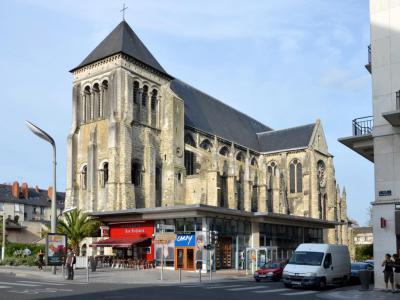
Saint-Julien Church in Tours is a remarkable historic site with origins tracing back to the 6th century. Initially part of a Benedictine abbey, the church is located in Vieux-Tours and is bordered by National Street (Rue Nationale), Anatole-France Place, and Prosper-Mérimée Square. The structure predominantly dates from the 13th century and has been classified as a historic monument since 1840.
The abbey began at the end of the 6th century and evolved significantly until the 9th century, featuring structures like a square tower that remains visible today. It included a cloister, cellars for storing harvests, and a library. Over the centuries, the abbey faced numerous adversities, including destruction by the Normans in 853 and conflicts such as the bitter dispute between the feudal house of Blésoise and the house of Anjou in 1044, which resulted in damage to the church.
The church underwent multiple reconstructions; notably, after a hurricane in 1224 demolished the nave. The rebuilding efforts in the subsequent years gave the church its present form. The French Revolution brought further challenges as the church was repurposed as a stable and a coach house.
Saint-Julien Church showcases a blend of architectural styles resulting from various construction phases. The bell tower, 25 meters tall, likely dates from the 11th-century Romanesque-style reconstruction under Abbot Gerbert. The ground floor of the bell tower may have been modified from its original design, as current observations suggest changes might have been made post-construction.
The abbey's new nave was reconstructed from 1243 to 1259, during a period when Gothic architecture was predominant. Several of the stained glass windows that beautify both the nave and the choir were crafted by Max Ingrand. Additional stained glass in the choir was created by Jacques Le Chevallier. These windows serve as replacements for the original ones made in the 19th century by the Lobin workshop, which were destroyed in the Second World War.
Saint-Julien Church remains an active site of historical and cultural significance in Tours, reflecting a rich history of resilience and adaptation. Its architecture tells a story of centuries of development, destruction, and restoration, making it a profound testament to the heritage of the region.
The abbey began at the end of the 6th century and evolved significantly until the 9th century, featuring structures like a square tower that remains visible today. It included a cloister, cellars for storing harvests, and a library. Over the centuries, the abbey faced numerous adversities, including destruction by the Normans in 853 and conflicts such as the bitter dispute between the feudal house of Blésoise and the house of Anjou in 1044, which resulted in damage to the church.
The church underwent multiple reconstructions; notably, after a hurricane in 1224 demolished the nave. The rebuilding efforts in the subsequent years gave the church its present form. The French Revolution brought further challenges as the church was repurposed as a stable and a coach house.
Saint-Julien Church showcases a blend of architectural styles resulting from various construction phases. The bell tower, 25 meters tall, likely dates from the 11th-century Romanesque-style reconstruction under Abbot Gerbert. The ground floor of the bell tower may have been modified from its original design, as current observations suggest changes might have been made post-construction.
The abbey's new nave was reconstructed from 1243 to 1259, during a period when Gothic architecture was predominant. Several of the stained glass windows that beautify both the nave and the choir were crafted by Max Ingrand. Additional stained glass in the choir was created by Jacques Le Chevallier. These windows serve as replacements for the original ones made in the 19th century by the Lobin workshop, which were destroyed in the Second World War.
Saint-Julien Church remains an active site of historical and cultural significance in Tours, reflecting a rich history of resilience and adaptation. Its architecture tells a story of centuries of development, destruction, and restoration, making it a profound testament to the heritage of the region.
8) Le Musée du Compagnonnage (Crafts Museum) (must see)
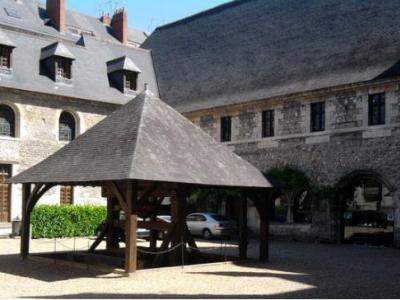
Crafts Museum (Le Musée du Compagnonnage), nestled in the historic Saint-Julien de Tours abbey, stands as a vibrant testament to the traditional French craft guilds, known as the Compagnons du Tour de France. Recognized as a "Museum of France," this cultural gem showcases the rich legacy of skilled tradesmen from their medieval origins to the contemporary era, making it an essential visit for those interested in artisanal history and craftsmanship.
Originally founded in 1911, the museum was housed within the Museum of Fine Arts before the guild associations took over the collections in the 1950s. The establishment saw a significant transformation when it relocated to its current location in the former abbey in 1968. Since then, the museum has undergone further expansions and renovations, notably in 1975, adding modern facilities including a reception, a shop, educational workshops, and a conference and exhibition room.
Today, the museum boasts around 3,000 items spread across 700 square meters of exhibition space, including two main exhibition rooms formerly used as hospitality and monks’ dormitory areas. The collections comprise a diverse array of artifacts such as masterpieces crafted by guild members, ritualistic items like canes and gourds, and intricate models and tools that demonstrate the high level of skill and creativity inherent in the guild trades. Notable pieces include a lock with traps and secrets, miniature park gates, and the sugar pagoda, all displayed under the arches resembling an overturned ship’s hull from the 13th-century abbey.
The museum does not only serve as a repository of physical artifacts but also as a lively cultural venue. It hosts periodic events, thematic exhibitions, and activities tailored for children, enriching visitors' understanding of the companions' history, traditions, and craftsmanship. This dynamic programming, along with the visually and historically rich displays, underscores the museum's role in celebrating and preserving the unique cultural heritage of the Compagnons du Tour de France.
Originally founded in 1911, the museum was housed within the Museum of Fine Arts before the guild associations took over the collections in the 1950s. The establishment saw a significant transformation when it relocated to its current location in the former abbey in 1968. Since then, the museum has undergone further expansions and renovations, notably in 1975, adding modern facilities including a reception, a shop, educational workshops, and a conference and exhibition room.
Today, the museum boasts around 3,000 items spread across 700 square meters of exhibition space, including two main exhibition rooms formerly used as hospitality and monks’ dormitory areas. The collections comprise a diverse array of artifacts such as masterpieces crafted by guild members, ritualistic items like canes and gourds, and intricate models and tools that demonstrate the high level of skill and creativity inherent in the guild trades. Notable pieces include a lock with traps and secrets, miniature park gates, and the sugar pagoda, all displayed under the arches resembling an overturned ship’s hull from the 13th-century abbey.
The museum does not only serve as a repository of physical artifacts but also as a lively cultural venue. It hosts periodic events, thematic exhibitions, and activities tailored for children, enriching visitors' understanding of the companions' history, traditions, and craftsmanship. This dynamic programming, along with the visually and historically rich displays, underscores the museum's role in celebrating and preserving the unique cultural heritage of the Compagnons du Tour de France.
9) Château de Tours (Tours Castle)
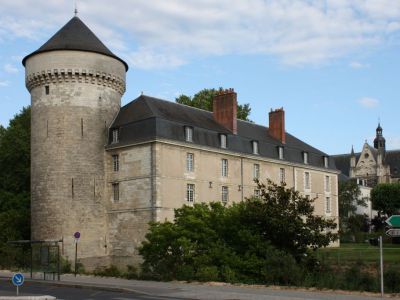
Clearly the Chateau is not what it used to be. Ah, the snows of yesteryear! On the 13th of May 1429, Joan of Arc was received here by Charles VII, shortly after she had saved Orleans. The chateau at the time was a traditional royal residence. There is a plaque across the road from the castle to mark the event. All gone now!
The chateau was built in the 11th century for the Lords of France. Somehow, until the year 2000, it saw service as an aquarium. It held around 1,500 fish of 200 different species. The Grevin Museum also founded a branch here. The castle is classified as a Historical Monument since 1913.
At the present time the chateau shows contemporary exhibitions of paintings and photographs. The exhibits, managed by Le Jeu de Paume, Include art by Joan Miro, Daniel Buren, Nadar, and Robert Capa.
The Chateau is located in the center of the city, surrounded by gardens. It has been through a lot. Two towers remain. The inside is not breathtaking. But, once upon a time...
The chateau was built in the 11th century for the Lords of France. Somehow, until the year 2000, it saw service as an aquarium. It held around 1,500 fish of 200 different species. The Grevin Museum also founded a branch here. The castle is classified as a Historical Monument since 1913.
At the present time the chateau shows contemporary exhibitions of paintings and photographs. The exhibits, managed by Le Jeu de Paume, Include art by Joan Miro, Daniel Buren, Nadar, and Robert Capa.
The Chateau is located in the center of the city, surrounded by gardens. It has been through a lot. Two towers remain. The inside is not breathtaking. But, once upon a time...
10) Saint Gatien's Cathedral (must see)
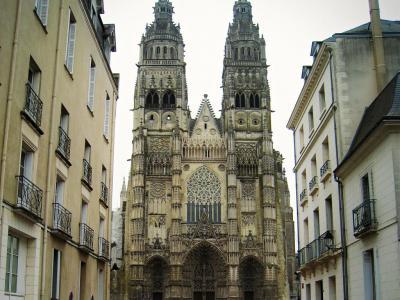
"...not until the cathedral is finished" is an old saying around the city of Tours. It refers to the cathedral of Saint Gatien. The cathedral was dedicated to Saint Gatianus in 1356 but it was the reincarnation of several other churches on the site. The first was dedicated to Saint Maurice and built by Bishop Lidorius in 371.
Lidorius' church burned in 558 and was rebuilt by Gregory of Tours in 590. In 1160 a new structure was erected in the Angevin style. This one burned before it was finished. Work resumed in 1220. Many renovations in different styles were made. The choir and transept used the lower Romanesque structure. Parts were Gothic or Rayonnant.
Further work was interrupted by the Hundred Years War, a long time to wait for the cathedral to be finished. But not to worry, The nave was finished in the 15th century. The two Renaissance towers were erected outside the ancient city walls. The first tower was finished in 1534. The second was put up in 1547.
During the French Revolution, the church was magically changed into a Temple of Reason. Napoleon made up with the Pope, however, and reason was restored and the church became a church again. Major restoration commenced in 1993. The organ and the upper windows were restored. The rose window was completed and a new altar was dedicated in 2018.
The sides of the cathedral are supported with enormous flying buttresses and spires. The north transept has two extra buttresses and a rose window. The window has a bar across its face to provide extra strength.
The nave holds a monumental tomb for the children of King Charles VII and Ann of Brittany. Made in 1506, the Italian-style tomb is of Carrara marble.
Three enormous rose windows of stained glass adorn the west, north, and south ends of the cathedral. The windows were made in the style of the glass artisans of Tours. They admit more natural light and sharpen the images. This permitted more expressiveness in the subjects depicted, creating a three-dimensional effect.
At last, the cathedral is finished. The "wait" is over.
Why You Should Visit:
To be overwhelmed by the craftsmanship of the Middle Ages, especially with the great rose windows. The building arts in this church have been lost, but some things remain.
Lidorius' church burned in 558 and was rebuilt by Gregory of Tours in 590. In 1160 a new structure was erected in the Angevin style. This one burned before it was finished. Work resumed in 1220. Many renovations in different styles were made. The choir and transept used the lower Romanesque structure. Parts were Gothic or Rayonnant.
Further work was interrupted by the Hundred Years War, a long time to wait for the cathedral to be finished. But not to worry, The nave was finished in the 15th century. The two Renaissance towers were erected outside the ancient city walls. The first tower was finished in 1534. The second was put up in 1547.
During the French Revolution, the church was magically changed into a Temple of Reason. Napoleon made up with the Pope, however, and reason was restored and the church became a church again. Major restoration commenced in 1993. The organ and the upper windows were restored. The rose window was completed and a new altar was dedicated in 2018.
The sides of the cathedral are supported with enormous flying buttresses and spires. The north transept has two extra buttresses and a rose window. The window has a bar across its face to provide extra strength.
The nave holds a monumental tomb for the children of King Charles VII and Ann of Brittany. Made in 1506, the Italian-style tomb is of Carrara marble.
Three enormous rose windows of stained glass adorn the west, north, and south ends of the cathedral. The windows were made in the style of the glass artisans of Tours. They admit more natural light and sharpen the images. This permitted more expressiveness in the subjects depicted, creating a three-dimensional effect.
At last, the cathedral is finished. The "wait" is over.
Why You Should Visit:
To be overwhelmed by the craftsmanship of the Middle Ages, especially with the great rose windows. The building arts in this church have been lost, but some things remain.
11) Hotel de Ville (City Hall) (must see)
Joan of Arc is remembered and celebrated in the City Hall of Tours. A triptych of her life by Jean-Paul Laurens decorates the hall. It is appropriate. Wars are recalled in a staircase. The aspirations of the revolution are not overlooked.
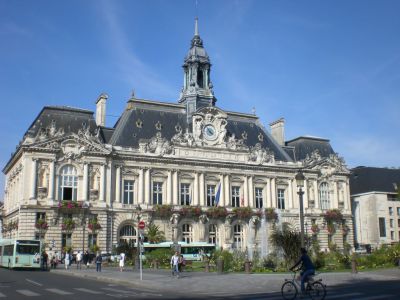
On the ground floor there is a stone peristyle serving as an exhibition space. The building is rather huge compared to the Place Jean-Jaeres or the Palace of Justice. More than any other civic building, it is meant to declare the virtues and authority of the Republic. The hall has a distinct Parisian ambience.
Various artists have contributed to this Hall on the Loire. There are four Atlantean sculptures by Francois Sicard on the facade. There is the clock, flanked by two caryatids, "Day and Night" by Emile Joseph Nestor Carlier. The rivers Loire and Cher are represented by two lengthy figures created by Jean-Antoine Injalbert.
The east and west wings of the Hall are decorated with works of art. "Courage" and "Strength" of Jean-Baptiste Hugues in the west wing. In the east wing we have "Education" and Vigilance" by Alphonse Cordonnier. The roof served as a model for the Hotel de Ville in Montreal Canada in 1922 when its roof was destroyed by fire.
The hall was built in 1904 by Victor Laloux. Inside the Hall as one enters, there is a golden square-shaped dome with the letters "RF", "Republique Francais." Saint Joan would approve.
On the ground floor there is a stone peristyle serving as an exhibition space. The building is rather huge compared to the Place Jean-Jaeres or the Palace of Justice. More than any other civic building, it is meant to declare the virtues and authority of the Republic. The hall has a distinct Parisian ambience.
Various artists have contributed to this Hall on the Loire. There are four Atlantean sculptures by Francois Sicard on the facade. There is the clock, flanked by two caryatids, "Day and Night" by Emile Joseph Nestor Carlier. The rivers Loire and Cher are represented by two lengthy figures created by Jean-Antoine Injalbert.
The east and west wings of the Hall are decorated with works of art. "Courage" and "Strength" of Jean-Baptiste Hugues in the west wing. In the east wing we have "Education" and Vigilance" by Alphonse Cordonnier. The roof served as a model for the Hotel de Ville in Montreal Canada in 1922 when its roof was destroyed by fire.
The hall was built in 1904 by Victor Laloux. Inside the Hall as one enters, there is a golden square-shaped dome with the letters "RF", "Republique Francais." Saint Joan would approve.
12) Rue Nationale (National Street) (must see)
National Street (Rue Nationale) in Tours is one of the city's oldest and busiest shopping streets, reflecting centuries of history, architecture, and urban planning. Spanning 700 meters through the city center, this north-south street connects the Place Anatole France and Pont Wilson to Avenue de Grammont, forming part of a straight seven-kilometer road that includes Avenue de la Tranchée and Avenue de Grammont.
Originally known as Royal Street (Rue Royale), the street was restructured in 1777 based on designs by Jean Cabet de Limeray. This marked a pivotal shift in the city's urban layout, changing from an east-west to a north-south axis, centered around the Saint-Julien church. The street underwent significant changes in 1840 under Mayor Walvein, who imposed strict architectural guidelines to ensure symmetry in the facades, creating a mirrored effect across the street at Place Anatole France.
In 1884, under Mayor Jules Charpentier, Royal Street was renamed National Street. The street faced devastation during World War II when Nazi bombings in June 1940 led to a major fire, destroying parts of the street including the old City Hall. Post-war reconstruction led by architect Pierre Patout significantly altered the northern part of National Street, expanding it by ten meters.
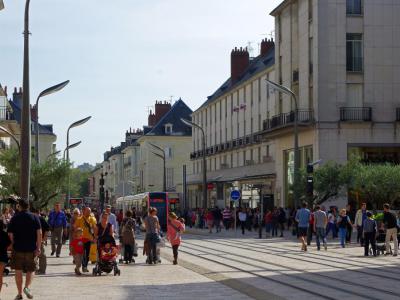
The completion of the A10 highway in 1981 shifted major traffic away from National Street, which previously served as a critical route from Paris to Spain. Today, the street is characterized by a vibrant commercial scene, with the northern part accommodating car and bus traffic, and the southern part pedestrianized and reserved for public transport.
National Street starts at the central library and the ancient Saint-Julien church. It houses notable historical sites like the Hôtel du Faisan at No. 17 and the birthplace of French literary giant Honoré de Balzac at No. 39. The street also features statues of renowned intellectuals René Descartes and François Rabelais, and hosts two museums: the Wine Museum and the Companion Museum, located at No. 16 and No. 8, respectively.
The evolution of Rue Nationale from a royal avenue to a modern shopping street encapsulates the rich history and cultural heritage of Tours, making it a pivotal element in the city’s identity and daily life.
Originally known as Royal Street (Rue Royale), the street was restructured in 1777 based on designs by Jean Cabet de Limeray. This marked a pivotal shift in the city's urban layout, changing from an east-west to a north-south axis, centered around the Saint-Julien church. The street underwent significant changes in 1840 under Mayor Walvein, who imposed strict architectural guidelines to ensure symmetry in the facades, creating a mirrored effect across the street at Place Anatole France.
In 1884, under Mayor Jules Charpentier, Royal Street was renamed National Street. The street faced devastation during World War II when Nazi bombings in June 1940 led to a major fire, destroying parts of the street including the old City Hall. Post-war reconstruction led by architect Pierre Patout significantly altered the northern part of National Street, expanding it by ten meters.
The completion of the A10 highway in 1981 shifted major traffic away from National Street, which previously served as a critical route from Paris to Spain. Today, the street is characterized by a vibrant commercial scene, with the northern part accommodating car and bus traffic, and the southern part pedestrianized and reserved for public transport.
National Street starts at the central library and the ancient Saint-Julien church. It houses notable historical sites like the Hôtel du Faisan at No. 17 and the birthplace of French literary giant Honoré de Balzac at No. 39. The street also features statues of renowned intellectuals René Descartes and François Rabelais, and hosts two museums: the Wine Museum and the Companion Museum, located at No. 16 and No. 8, respectively.
The evolution of Rue Nationale from a royal avenue to a modern shopping street encapsulates the rich history and cultural heritage of Tours, making it a pivotal element in the city’s identity and daily life.
