Custom Walk in Arles, France by rwroberts_557b23 created on 2026-05-25
Guide Location: France » Arles
Guide Type: Custom Walk
# of Sights: 14
Tour Duration: 2 Hour(s)
Travel Distance: 1.9 Km or 1.2 Miles
Share Key: 3TJZ8
Guide Type: Custom Walk
# of Sights: 14
Tour Duration: 2 Hour(s)
Travel Distance: 1.9 Km or 1.2 Miles
Share Key: 3TJZ8
How It Works
Please retrieve this walk in the GPSmyCity app. Once done, the app will guide you from one tour stop to the next as if you had a personal tour guide. If you created the walk on this website or come to the page via a link, please follow the instructions below to retrieve the walk in the app.
Retrieve This Walk in App
Step 1. Download the app "GPSmyCity: Walks in 1K+ Cities" on Apple App Store or Google Play Store.



Step 2. In the GPSmyCity app, download(or launch) the guide "Arles Map and Walking Tours".
Step 3. Tap the menu button located at upper right corner of the "Walks" screen and select "Retrieve custom walk". Enter the share key: 3TJZ8
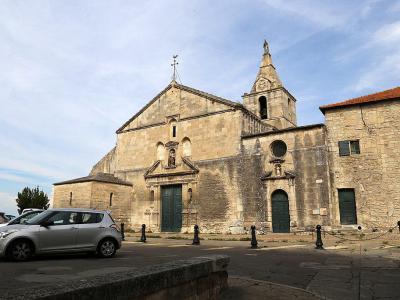
1) Eglise de la Major d'Arles (Church of the Major of Arles)
Church of the Major of Arles commands both a physical and historical prominence in the cityscape. Originally built on the ruins of a Roman temple and consecrated in 452 during the third council of Arles, this timeless sanctuary established itself early on as a spiritual and communal landmark. The church, named for Our Lady the Major, later began construction in its Romanesque form in 1152, retaining the three original nave bays to this day.
Over the centuries, the church evolved , blending Romanesque architecture with Gothic and later additions. The nave’s robust double-arched barrel vault and sturdy pillars reflect its Romanesque roots, while a later Gothic chancel features ribbed vaults and a five-sided apse. In the 16th and 17th centuries, renovations introduced the current square bell tower topped with a pyramidal spire-added in 1579-later adorned by a statue of the Virgin and Child in 1867.
Step inside, and you’ll discover a richly appointed interior filled with historical treasures. Its chapels and altars house centuries-old works: the polychrome marble altars, paintings depicting miracles of saints, intricately sculpted pulpit and choir stalls, and numerous statues-for example, Saint‑Martin, Saint‑George, and Saint‑Véran-each protected as historic objects. The organ, fashioned in 1698 and rebuilt in subsequent years, showcases craftsmanship from Lyon and Marseille.
Beyond its architectural and artistic heritage, the church remains deeply woven into Arles’s living traditions. Amid its classical role as a collegiate church-elevated by Pope Julius III in 1551-it served as the seat of the widest parish in the city until the Revolution. Today, it continues to host the brotherhood of the Gardiens de Saint‑Georges-the traditional Camargue horsemen-who annually return on May 1 for a ceremony blessing their horses, preserving a centuries-old ritual.
Over the centuries, the church evolved , blending Romanesque architecture with Gothic and later additions. The nave’s robust double-arched barrel vault and sturdy pillars reflect its Romanesque roots, while a later Gothic chancel features ribbed vaults and a five-sided apse. In the 16th and 17th centuries, renovations introduced the current square bell tower topped with a pyramidal spire-added in 1579-later adorned by a statue of the Virgin and Child in 1867.
Step inside, and you’ll discover a richly appointed interior filled with historical treasures. Its chapels and altars house centuries-old works: the polychrome marble altars, paintings depicting miracles of saints, intricately sculpted pulpit and choir stalls, and numerous statues-for example, Saint‑Martin, Saint‑George, and Saint‑Véran-each protected as historic objects. The organ, fashioned in 1698 and rebuilt in subsequent years, showcases craftsmanship from Lyon and Marseille.
Beyond its architectural and artistic heritage, the church remains deeply woven into Arles’s living traditions. Amid its classical role as a collegiate church-elevated by Pope Julius III in 1551-it served as the seat of the widest parish in the city until the Revolution. Today, it continues to host the brotherhood of the Gardiens de Saint‑Georges-the traditional Camargue horsemen-who annually return on May 1 for a ceremony blessing their horses, preserving a centuries-old ritual.
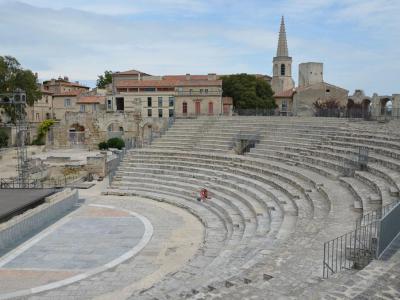
2) Theatre Antique d'Arles (Ancient Theater of Arles) (must see)
The Ancient Theater of Arles stands as one of the earliest monumental structures built in the city following its Roman colonization, around the late 1st century BC under Emperor Augustus. Designed to showcase drama, poetry, and public entertainment, the theatre could once welcome more than 8,000 spectators who gathered to enjoy performances celebrating Roman culture and civic unity. Although much of its original grandeur has faded over the centuries, the structure remains an essential reminder of Arles’s role as a thriving provincial center in the Roman Empire.
Like many ancient sites, the theatre suffered significant dismantling during the Middle Ages, when its stones were reused to construct churches and fortifications. Even so, several remarkable features endure, including the remnants of the seating area and the circular orchestra in front of the stage. The latter still bears traces of an altar dedicated to Apollo - adorned with swans, the emblem of Emperor Augustus - which once occupied its center.
However, the most alluring of elements is a pair of elegant marble columns still standing behind the stage - a stunning fragment of what was once a richly decorated stage backdrop. These columns became known as the “Two Widows,” much like two wives awaiting their lost husbands.
Today, the Ancient Theater blends heritage with living culture. From the end of June to the end of August, it hosts the Arles and Costume Festivals, the International Photography Meetings and the Peplum Film Festival. You are more than welcome to enjoy them just like the Romans once did - under the open Provençal sky.
Like many ancient sites, the theatre suffered significant dismantling during the Middle Ages, when its stones were reused to construct churches and fortifications. Even so, several remarkable features endure, including the remnants of the seating area and the circular orchestra in front of the stage. The latter still bears traces of an altar dedicated to Apollo - adorned with swans, the emblem of Emperor Augustus - which once occupied its center.
However, the most alluring of elements is a pair of elegant marble columns still standing behind the stage - a stunning fragment of what was once a richly decorated stage backdrop. These columns became known as the “Two Widows,” much like two wives awaiting their lost husbands.
Today, the Ancient Theater blends heritage with living culture. From the end of June to the end of August, it hosts the Arles and Costume Festivals, the International Photography Meetings and the Peplum Film Festival. You are more than welcome to enjoy them just like the Romans once did - under the open Provençal sky.

3) Marche d’Arles (Arles Market)
The Arles Market, or Marche d'Arles, is not only renowned as one of the most beautiful markets in Provence but also stands out as one of the largest in the region. Spanning an impressive length of over 2.5 kilometers, this vibrant market offers a wide variety of goods and delights to visitors.
The market takes place on both Wednesdays and Saturdays, each with its own designated location. On Wednesdays, the market stretches along Boulevard Émile-Combes, extending from Place Lamartine to the crossroads of La Croisière. On Saturdays, the bustling market can be found along Boulevards des Lices, Georges-Clemenceau, and Émile-Combes.
With approximately 450 stallholders on Saturdays and 300 on Wednesdays, the Arles Market presents an extensive selection of products to explore. From fresh fruits and vegetables to an assortment of cheeses, flowers, spices, meat, and fish, visitors can find an abundance of fresh produce and regional specialties. Olive oil, Arles sausage, Camargue rice, and tellines are just a few examples of the local delicacies available. Additionally, the market caters to a variety of needs beyond food, offering clothing, shoes, fabrics, crafts, and more.
The significance of the Arles Market can be traced back in history. In a letter dating back to 1584, Henri III confirmed the existence of the two weekly markets in Arles, specifically those held on Wednesdays and Saturdays. Even earlier, a 5th-century author described the market in Arles as a treasure trove of exotic goods. The market has since continued to thrive and evolve, showcasing a rich tradition and providing a vibrant atmosphere for locals and visitors alike.
The market takes place on both Wednesdays and Saturdays, each with its own designated location. On Wednesdays, the market stretches along Boulevard Émile-Combes, extending from Place Lamartine to the crossroads of La Croisière. On Saturdays, the bustling market can be found along Boulevards des Lices, Georges-Clemenceau, and Émile-Combes.
With approximately 450 stallholders on Saturdays and 300 on Wednesdays, the Arles Market presents an extensive selection of products to explore. From fresh fruits and vegetables to an assortment of cheeses, flowers, spices, meat, and fish, visitors can find an abundance of fresh produce and regional specialties. Olive oil, Arles sausage, Camargue rice, and tellines are just a few examples of the local delicacies available. Additionally, the market caters to a variety of needs beyond food, offering clothing, shoes, fabrics, crafts, and more.
The significance of the Arles Market can be traced back in history. In a letter dating back to 1584, Henri III confirmed the existence of the two weekly markets in Arles, specifically those held on Wednesdays and Saturdays. Even earlier, a 5th-century author described the market in Arles as a treasure trove of exotic goods. The market has since continued to thrive and evolve, showcasing a rich tradition and providing a vibrant atmosphere for locals and visitors alike.

4) Cloitre Saint-Trophime (St. Trophime Cloister) (must see)
The Cloister of Saint Trophime in Arles is one of the finest examples of Romanesque and early Gothic architecture in southern France, offering visitors a peaceful retreat steeped in art and spirituality. Built between the 12th and 14th centuries, it adjoins the Church of Saint Trophime, which was once the cathedral of Arles. The cloister served as the residence and contemplative space for the cathedral’s canons, providing a serene environment for prayer, study, and reflection.
What makes the Saint Trophime Cloister particularly exceptional is its remarkable sculptural decoration. Each gallery is adorned with intricately carved capitals and reliefs depicting biblical narratives, saints, and symbolic motifs that illustrate the transition from Romanesque to Gothic art. Visitors can observe this evolution firsthand: the older northern and eastern galleries feature rounded Romanesque arches, while the later southern and western galleries display the pointed arches characteristic of the Gothic style.
Unusually, the cloister connects to the church’s choir by a staircase of twenty-five steps - a rare arrangement, as cloisters are typically accessed from the nave or transept. Despite this distinctive layout, the cloister’s significance has long been recognized: it was designated a historic monument in 1846 and, like the Arles Obelisk, was inscribed on the UNESCO World Heritage list in 1981.
Beyond its artistic beauty, the cloister holds deep historical resonance. It was here that ecclesiastical councils were held and important decisions shaping the city’s spiritual life were made. Today, the site exudes an atmosphere of timeless calm, perfect for its meditative purposes. Go ahead and feel the silence yourself, but everyone has to work for it. Those steps will not climb themselves.
What makes the Saint Trophime Cloister particularly exceptional is its remarkable sculptural decoration. Each gallery is adorned with intricately carved capitals and reliefs depicting biblical narratives, saints, and symbolic motifs that illustrate the transition from Romanesque to Gothic art. Visitors can observe this evolution firsthand: the older northern and eastern galleries feature rounded Romanesque arches, while the later southern and western galleries display the pointed arches characteristic of the Gothic style.
Unusually, the cloister connects to the church’s choir by a staircase of twenty-five steps - a rare arrangement, as cloisters are typically accessed from the nave or transept. Despite this distinctive layout, the cloister’s significance has long been recognized: it was designated a historic monument in 1846 and, like the Arles Obelisk, was inscribed on the UNESCO World Heritage list in 1981.
Beyond its artistic beauty, the cloister holds deep historical resonance. It was here that ecclesiastical councils were held and important decisions shaping the city’s spiritual life were made. Today, the site exudes an atmosphere of timeless calm, perfect for its meditative purposes. Go ahead and feel the silence yourself, but everyone has to work for it. Those steps will not climb themselves.
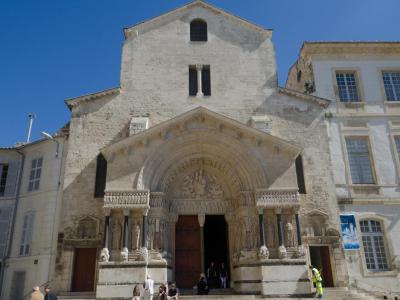
5) Cathedrale Saint-Trophime d'Arles (St. Trophime Cathedral) (must see)
The Cathedral of Saint Trophime in Arles is one of the greatest masterpieces of Romanesque architecture in Provence and a highlight for any visitor to the city. Dedicated to Saint Trophimus, the first bishop of Arles and a key figure in the Christianization of the Gauls, the cathedral was built between the 12th and 15th centuries on the site of an earlier church. For centuries, it served as the seat of the archbishops of Arles and as an important stop along the pilgrimage route to Santiago de Compostela, contributing significantly to its artistic and religious prominence.
The main historical event connected to the Cathedral is the coronation of Holy Roman Emperor Frederick Barbarossa as king of Burgundy in 1178. Back then, it was a strategical move, as the newly crowned king was looking to consolidate his position following a series of defeats to the Lombard League.
The most celebrated feature of Saint Trophime is its magnificent Romanesque portal, sculpted around 1180. The façade depicts the Last Judgment, with Christ in Majesty surrounded by apostles, angels, and symbolic creatures - a stunning display of medieval craftsmanship. The detailed carvings make the portal one of the finest in France.
Inside, the cathedral’s austere Romanesque nave gives way to Gothic additions made in later centuries, creating a harmonious blend of styles. The church also holds a rich history of ecclesiastical councils, royal visits, and religious ceremonies that reflect Arles’s influence as a spiritual center during the Middle Ages.
For visitors today, Saint Trophime offers more than architectural beauty - it provides a window into the medieval soul of Arles. Customary to Arles's monuments, the Cathedral was listed as a UNESCO World Heritage Site in 1981.
The main historical event connected to the Cathedral is the coronation of Holy Roman Emperor Frederick Barbarossa as king of Burgundy in 1178. Back then, it was a strategical move, as the newly crowned king was looking to consolidate his position following a series of defeats to the Lombard League.
The most celebrated feature of Saint Trophime is its magnificent Romanesque portal, sculpted around 1180. The façade depicts the Last Judgment, with Christ in Majesty surrounded by apostles, angels, and symbolic creatures - a stunning display of medieval craftsmanship. The detailed carvings make the portal one of the finest in France.
Inside, the cathedral’s austere Romanesque nave gives way to Gothic additions made in later centuries, creating a harmonious blend of styles. The church also holds a rich history of ecclesiastical councils, royal visits, and religious ceremonies that reflect Arles’s influence as a spiritual center during the Middle Ages.
For visitors today, Saint Trophime offers more than architectural beauty - it provides a window into the medieval soul of Arles. Customary to Arles's monuments, the Cathedral was listed as a UNESCO World Heritage Site in 1981.
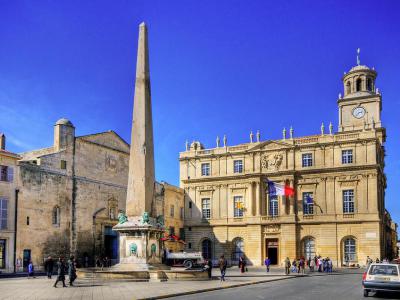
6) Town Hall and Cryptoportics of Arles
The Town Hall was completed in 1676, during a period when Arles sought to reaffirm its civic prestige. Designed in an elegant Provençal classical style, its harmonious façade and well-proportioned clock tower stand proudly on Republic Square, symbolizing the authority of the city’s magistrates.
Inside, its grand staircase is crafted using stones recovered from ancient Roman buildings. As a stylish bonus, the staircase also features a replica of Venus of Arles. The original ancient Greco-Roman sculpture was deemed to be a great gift for King Louis XIV, hence it was moved to the Versailles Palace itself.
Directly beneath Republic Square and the Town Hall lies the Cryptoporticus of Arles. Constructed around 30 BC during the Roman colony’s early development, this network of semi-subterranean vaulted galleries once supported the ancient forum above. The structure likely served multiple roles, including storage, administrative functions, and stabilization of the civic center built on uneven terrain. Remarkably well preserved, its long corridors, robust stone arches, and cool, shadowed atmosphere offer visitors a rare opportunity to explore the hidden infrastructure of a Roman city.
The contrast between the Town Hall’s sunlight-washed façade and the shadowed maze below it captures the pleasing dichotomy of Arles. Together, they reveal how the city’s history lives both above and beneath the surface - and whichever one you choose to discover first, both are ready to impress.
Inside, its grand staircase is crafted using stones recovered from ancient Roman buildings. As a stylish bonus, the staircase also features a replica of Venus of Arles. The original ancient Greco-Roman sculpture was deemed to be a great gift for King Louis XIV, hence it was moved to the Versailles Palace itself.
Directly beneath Republic Square and the Town Hall lies the Cryptoporticus of Arles. Constructed around 30 BC during the Roman colony’s early development, this network of semi-subterranean vaulted galleries once supported the ancient forum above. The structure likely served multiple roles, including storage, administrative functions, and stabilization of the civic center built on uneven terrain. Remarkably well preserved, its long corridors, robust stone arches, and cool, shadowed atmosphere offer visitors a rare opportunity to explore the hidden infrastructure of a Roman city.
The contrast between the Town Hall’s sunlight-washed façade and the shadowed maze below it captures the pleasing dichotomy of Arles. Together, they reveal how the city’s history lives both above and beneath the surface - and whichever one you choose to discover first, both are ready to impress.
7) Eglise Sainte-Anne d'Arles (Arles St. Anne Church)
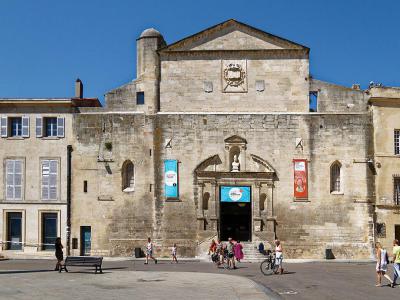
Originally constructed in the 12th century as the Church of Notre-Dame-la-Principale, The Church of Saint Anne once served as a parish church closely linked to the neighbouring cathedral. Over time, its role shifted dramatically. In the 17th century, the building was repurposed as a seminary, later becoming a burial site for prominent canons of Saint Trophime.
It was also during the 17th century that the church received its current name. Consecrated on the feast day of Saint Anne, the dedication was far from coincidental: the church once safeguarded revered relics of Saint Anne, including a vermeil bust.
Although no longer functioning as a church, Saint Anne retains its solemn Romanesque character. The simplicity of its façade and the solid lines of its architecture bring back ideas of medieval craftsmanship.
Nowadays, Saint Anne is best known as a temporary exhibition space, hosting rotating displays of art and archaeology that complement Arles’s cultural scene. Even though the church retired from its original purpose, the value it provides to local history and culture cannot be understated. After all, it has not been granted the status of historical monument in 1875 for nothing.
It was also during the 17th century that the church received its current name. Consecrated on the feast day of Saint Anne, the dedication was far from coincidental: the church once safeguarded revered relics of Saint Anne, including a vermeil bust.
Although no longer functioning as a church, Saint Anne retains its solemn Romanesque character. The simplicity of its façade and the solid lines of its architecture bring back ideas of medieval craftsmanship.
Nowadays, Saint Anne is best known as a temporary exhibition space, hosting rotating displays of art and archaeology that complement Arles’s cultural scene. Even though the church retired from its original purpose, the value it provides to local history and culture cannot be understated. After all, it has not been granted the status of historical monument in 1875 for nothing.

8) Obelisque d'Arles (Arles Obelisk)
The Arles Obelisk stands proudly at the center of Republic Square, serving as one of the city’s most iconic landmarks and a testament to its Roman heritage. Carved from a single block of granite, the monument dates to the 4th century AD, when it originally adorned the Roman circus of Arles, a grand arena once used for chariot races. After the fall of the Roman Empire, the obelisk was lost to time, later rediscovered in fragments during the 17th century and re-erected in 1676.
The monument’s reinstallation marked a civic celebration of Arles’s ancient past, at a time when the city sought to reconnect with its classical roots. A gilded sun once crowned the obelisk, reflecting the light of Provence, though it has since been replaced by a bronze globe and later a weather vane. Standing over 20 meters tall, it commands attention amid the harmonious surroundings of Republic Square, flanked by the City Hall and Saint Trophime Church. Interestingly, unlike other Roman monuments, the obelisk lacks inscriptions.
Given it has been recognized as a historic monument since 1840, the obelisk has seen countless dawns and dusks. Yet, watching it shine in the center of the Republic Square remains an experience to be enjoyed. Cherry on top, it is on the UNESCO World Heritage list of Roman and Romanesque monuments since 1981.
The monument’s reinstallation marked a civic celebration of Arles’s ancient past, at a time when the city sought to reconnect with its classical roots. A gilded sun once crowned the obelisk, reflecting the light of Provence, though it has since been replaced by a bronze globe and later a weather vane. Standing over 20 meters tall, it commands attention amid the harmonious surroundings of Republic Square, flanked by the City Hall and Saint Trophime Church. Interestingly, unlike other Roman monuments, the obelisk lacks inscriptions.
Given it has been recognized as a historic monument since 1840, the obelisk has seen countless dawns and dusks. Yet, watching it shine in the center of the Republic Square remains an experience to be enjoyed. Cherry on top, it is on the UNESCO World Heritage list of Roman and Romanesque monuments since 1981.

9) Place de la Republique (Republic Square)
Republic Square serves as the city’s elegant and historic centerpiece. Paved with cobblestones and framed by impressive architecture, the square beautifully reflects Arles’s layered past.
At its center rises the Arles Obelisk, a 4th-century Roman obelisk that once adorned the ancient circus, rediscovered in the 17th century and erected here in 1676 to celebrate the city’s classical heritage. Around it stand several of Arles’s most remarkable landmarks: the Town Hall, built in the 17th century with a harmonious façade exemplifying Provençal classicism, and the Church of Saint Trophime, a Romanesque masterpiece famed for its sculpted portal depicting the Last Judgment and for being a key stop along the pilgrimage route to Santiago de Compostela.
Republic Square is not only a historic setting but also a vibrant part of daily life in Arles - a gathering place for residents, a venue for open-air markets, and a stage for local festivals beneath the Provençal sun. Visitors can enjoy the lively atmosphere from the surrounding cafés or admire the square as it glows in warm, golden tones. The golden hues of the architecture framing the square contribute to the election of the „Queen of Arles”. Every few years, a young woman is chosen to represent the traditions and customs of the region, all under the applause of crowds gathered in the Republic Square.
At its center rises the Arles Obelisk, a 4th-century Roman obelisk that once adorned the ancient circus, rediscovered in the 17th century and erected here in 1676 to celebrate the city’s classical heritage. Around it stand several of Arles’s most remarkable landmarks: the Town Hall, built in the 17th century with a harmonious façade exemplifying Provençal classicism, and the Church of Saint Trophime, a Romanesque masterpiece famed for its sculpted portal depicting the Last Judgment and for being a key stop along the pilgrimage route to Santiago de Compostela.
Republic Square is not only a historic setting but also a vibrant part of daily life in Arles - a gathering place for residents, a venue for open-air markets, and a stage for local festivals beneath the Provençal sun. Visitors can enjoy the lively atmosphere from the surrounding cafés or admire the square as it glows in warm, golden tones. The golden hues of the architecture framing the square contribute to the election of the „Queen of Arles”. Every few years, a young woman is chosen to represent the traditions and customs of the region, all under the applause of crowds gathered in the Republic Square.

10) Rue de la Republique (Republic Street)
Republic Street is one of the principal thoroughfares in Arles and a natural route for anyone exploring the heart of the city. Its origins align with 19th-century urban modernization, when Arles redesigned parts of its medieval street network to create a grander, more functional promenade leading directly to Republic Square. The wide, straight layout contrasts with the surrounding maze of narrow historic alleys.
Today, Republic Street plays an important role as a commercial and cultural artery. Lined with shops, cafés, bookshops, and boutiques, it offers a pleasant environment for a leisurely stroll or a shopping break between visits to nearby landmarks such as the Town Hall, Saint Trophime, and the Reattu Museum. The street also features handsome 19th-century façades and subtle architectural details that highlight Arles’s evolution from an ancient Roman colony into a modern Provençal city.
As visitors walk along this lively avenue, they experience a constant blend of everyday local life and the artistic atmosphere that Arles is known for. Get guided by the wafting aromas of fresh bread and pastries and you will surely love the main artery of Arles.
Today, Republic Street plays an important role as a commercial and cultural artery. Lined with shops, cafés, bookshops, and boutiques, it offers a pleasant environment for a leisurely stroll or a shopping break between visits to nearby landmarks such as the Town Hall, Saint Trophime, and the Reattu Museum. The street also features handsome 19th-century façades and subtle architectural details that highlight Arles’s evolution from an ancient Roman colony into a modern Provençal city.
As visitors walk along this lively avenue, they experience a constant blend of everyday local life and the artistic atmosphere that Arles is known for. Get guided by the wafting aromas of fresh bread and pastries and you will surely love the main artery of Arles.

11) Place du Forum (Forum Square)
Forum Square stands on the site of what was once the vibrant political and commercial heart of the Roman city of Arelate. Established in the 1st century BC during the urban expansion under Emperor Augustus, the Roman forum served as a grand public space lined with temples, administrative buildings, and arcades where citizens gathered to debate politics, conduct business, and participate in public life. Although the ancient structures have mostly disappeared beneath centuries of urban development, the square remains an important reference point for understanding the early formation of Arles.
Today, Forum Square preserves only a small but striking architectural fragment from its Roman past: the “Two Columns.” These Corinthian shafts, built into the corner of a later building, provide a reminder of a former temple dedicated to the Roman Emperor Augustus. Their weathered surfaces contrast with the lively cafés and restaurants that now animate the square, particularly in summer, when terraces spill out beneath the Provençal sun.
Nearby, charming narrow streets lead visitors deeper into the Old Town, emulating the compact street plan established during the Roman period. The square also carries cultural significance through its association with artists such as Vincent van Gogh, who painted scenes of the neighborhood during his time in Arles.
Forum Square continues to serve as a social hub - a place where locals meet, visitors pause, and the history of Arles quietly supports the life unfolding above it. Put on your Provence glasses and you might witness the hayday of this lively square.
Today, Forum Square preserves only a small but striking architectural fragment from its Roman past: the “Two Columns.” These Corinthian shafts, built into the corner of a later building, provide a reminder of a former temple dedicated to the Roman Emperor Augustus. Their weathered surfaces contrast with the lively cafés and restaurants that now animate the square, particularly in summer, when terraces spill out beneath the Provençal sun.
Nearby, charming narrow streets lead visitors deeper into the Old Town, emulating the compact street plan established during the Roman period. The square also carries cultural significance through its association with artists such as Vincent van Gogh, who painted scenes of the neighborhood during his time in Arles.
Forum Square continues to serve as a social hub - a place where locals meet, visitors pause, and the history of Arles quietly supports the life unfolding above it. Put on your Provence glasses and you might witness the hayday of this lively square.
12) Cafe Van Gogh
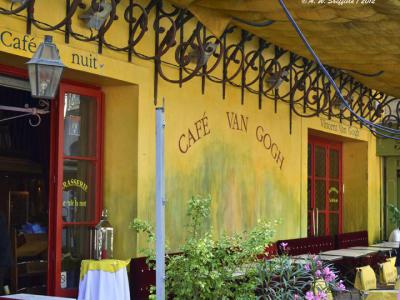
Café Le Soir, holds a special place in art history, particularly due to its association with Vincent van Gogh. The café, currently named "Van Gogh," is situated in the Place du Forum, which has a rich historical significance dating back to the Middle Ages.
The Place du Forum has a dark past, having been the site of capital executions during medieval times. However, it gained artistic renown through van Gogh's iconic 1888 painting, "Café Terrace at Night." The painting depicts the nocturnal terrace of the café, which closely resembles Café Le Soir as it appears today. Interestingly, the café underwent renovations in the 1990s, during which it was repainted yellow to accentuate its resemblance to van Gogh's artwork. This choice aimed to recreate the same ambiance depicted in the painting, as it is likely that the café had a yellow appearance at night due to the lighting conditions of the time.
For those who appreciate art and history, Café Le Soir in Arles offers a unique opportunity to step into van Gogh's world by immersing oneself in the same setting that inspired the artist.
The Place du Forum has a dark past, having been the site of capital executions during medieval times. However, it gained artistic renown through van Gogh's iconic 1888 painting, "Café Terrace at Night." The painting depicts the nocturnal terrace of the café, which closely resembles Café Le Soir as it appears today. Interestingly, the café underwent renovations in the 1990s, during which it was repainted yellow to accentuate its resemblance to van Gogh's artwork. This choice aimed to recreate the same ambiance depicted in the painting, as it is likely that the café had a yellow appearance at night due to the lighting conditions of the time.
For those who appreciate art and history, Café Le Soir in Arles offers a unique opportunity to step into van Gogh's world by immersing oneself in the same setting that inspired the artist.

13) Thermes de Constantin (Baths of Constantine)
The Baths of Constantine are a remarkable testament to Roman engineering and everyday life in the ancient city. Built in the early 4th century AD during the reign of Emperor Constantine the Great, they formed part of a larger palatial complex overlooking the Rhône and served as a place where citizens could enjoy bathing, relaxation, and social interaction - a staple of Roman urban culture. Although only a portion of the baths survives today, what remains offers a vivid impression of their original scale and function.
The best-preserved section includes the caldarium, or hot room, recognizable by its thick walls and semi-domed architecture that once supported an elaborate heating system known as the hypocaust, which circulated warm air beneath the floors. Fragments representing the frigidarium and tepidarium - the cold and warm rooms - recall the ritual progression of Roman bathing. The brick arches, vaulted ceilings, and traces of marble decoration highlight the sophistication of Arles as a Roman colony and the comfort and luxury that bathers could enjoy nearly 1,700 years ago.
Over time, the structure endured damage and alterations, particularly in the Middle Ages when the surrounding area was fortified. Yet its core remained intact, earning recognition as a historic monument as early as the 19th century. Thanks to this resilience, the Baths of Constantine are among the best-preserved Roman baths in France, alongside the renowned Baths of Cluny in Paris.
The best-preserved section includes the caldarium, or hot room, recognizable by its thick walls and semi-domed architecture that once supported an elaborate heating system known as the hypocaust, which circulated warm air beneath the floors. Fragments representing the frigidarium and tepidarium - the cold and warm rooms - recall the ritual progression of Roman bathing. The brick arches, vaulted ceilings, and traces of marble decoration highlight the sophistication of Arles as a Roman colony and the comfort and luxury that bathers could enjoy nearly 1,700 years ago.
Over time, the structure endured damage and alterations, particularly in the Middle Ages when the surrounding area was fortified. Yet its core remained intact, earning recognition as a historic monument as early as the 19th century. Thanks to this resilience, the Baths of Constantine are among the best-preserved Roman baths in France, alongside the renowned Baths of Cluny in Paris.

14) Arenes d'Arles (Arles Amphitheatre) (must see)
The Arles Amphitheatre is one of the most impressive Roman monuments in southern France and a powerful symbol of the city’s ancient past. Built around 90 AD during the reign of Emperor Domitian, it was designed as a grand arena for gladiatorial games and public spectacles that entertained the population of Roman Arles, then known as Arelate. With an elliptical shape stretching over 130 meters in length and seating for more than 20,000 spectators, the amphitheatre reflected the city’s status and prosperity within the Roman Empire.
Over the centuries, its role changed significantly. Following the fall of Rome, the amphitheatre was fortified and transformed into a small defensive town complete with homes, shops, and even two chapels built within its walls. By the Middle Ages, more than 200 houses filled the interior, creating a bustling community protected by the original Roman towers. It was only in the 19th century, thanks to the efforts of preservationists including the writer Prosper Mérimée, that the houses were removed and restoration began to reclaim the monument’s ancient form.
Those restauration efforts were not in vain, as the arena still enthralls audiences with bullfighting events, plays and concerts to this day. Moreover, its stairways and upper tiers double as panoramic platforms which allow for prefect views of the city’s rooftops, the Rhône River, and the distant Alpilles hills. Fair enough - its inscription on the UNESCO World Heritage List in 1981 is more than deserved.
Over the centuries, its role changed significantly. Following the fall of Rome, the amphitheatre was fortified and transformed into a small defensive town complete with homes, shops, and even two chapels built within its walls. By the Middle Ages, more than 200 houses filled the interior, creating a bustling community protected by the original Roman towers. It was only in the 19th century, thanks to the efforts of preservationists including the writer Prosper Mérimée, that the houses were removed and restoration began to reclaim the monument’s ancient form.
Those restauration efforts were not in vain, as the arena still enthralls audiences with bullfighting events, plays and concerts to this day. Moreover, its stairways and upper tiers double as panoramic platforms which allow for prefect views of the city’s rooftops, the Rhône River, and the distant Alpilles hills. Fair enough - its inscription on the UNESCO World Heritage List in 1981 is more than deserved.
