Custom Walk in Split, Croatia by sherry_qinli_3aef3 created on 2026-05-25
Guide Location: Croatia » Split
Guide Type: Custom Walk
# of Sights: 6
Tour Duration: 1 Hour(s)
Travel Distance: 1 Km or 0.6 Miles
Share Key: 5K3FR
Guide Type: Custom Walk
# of Sights: 6
Tour Duration: 1 Hour(s)
Travel Distance: 1 Km or 0.6 Miles
Share Key: 5K3FR
How It Works
Please retrieve this walk in the GPSmyCity app. Once done, the app will guide you from one tour stop to the next as if you had a personal tour guide. If you created the walk on this website or come to the page via a link, please follow the instructions below to retrieve the walk in the app.
Retrieve This Walk in App
Step 1. Download the app "GPSmyCity: Walks in 1K+ Cities" on Apple App Store or Google Play Store.



Step 2. In the GPSmyCity app, download(or launch) the guide "Split Map and Walking Tours".
Step 3. Tap the menu button located at upper right corner of the "Walks" screen and select "Retrieve custom walk". Enter the share key: 5K3FR
1) Riva Harbor (must see)
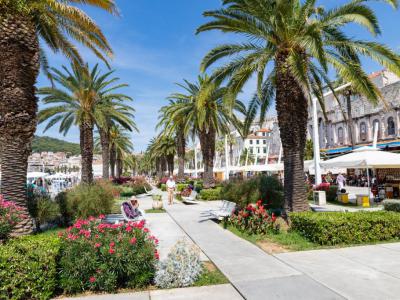
Strolling down Split’s iconic Riva Harbor feels less like sightseeing and more like slipping straight into the city’s daily rhythm. Imagine a wide, palm-lined promenade hugging the Adriatic, where every breeze seems to carry the scent of salt and roasted coffee beans. Locals call it simply “Riva,” but what it really is—Split’s living room: open-air, sunlit, and always buzzing.
Originally shaped by Marshal Marmont’s French-era urban redesign in the early 1800s, the Riva replaced defensive walls with a graceful promenade. Over a century later, it was pedestrianized in the 1990s, transforming it into one of Split’s most popular waterfront promenades.
Once upon a time, Emperor Diocletian himself had ships docked right at his palace walls, bringing exotic goods, fresh fish, and perhaps the occasional amphora of fine wine. Today, cruise ships glide into the Port of Split, which ranks as the largest passenger port in Croatia and the third busiest in the Mediterranean, handling around 5 million passengers annually. Visitors and locals alike sip espresso and watch the world drift by. The Riva is a living testament to Split’s soul as a port city shaped by centuries of trade, sea stories, and salty winds.
The first thing you might want to do here is claim a spot on one of the many benches. Watch as sunlight dances across the Adriatic’s deep blue surface, then wander past cheerful cafés and gelato stands. Feeling peckish? Fresh seafood, local pastries, or a quick espresso are always just steps away. And yes, you’ll be sharing your view with the city’s famously fearless pigeons.
Turn around, and you’ll see the ancient south wall of Diocletian’s Palace rising behind the promenade, a striking blend of Roman stone and lively modern façades. It is this collision of past and present that gives the Riva its vibrant energy.
As evening falls, don’t rush off. The sunset here is a nightly ritual. The sky shifts from rose-gold to deep indigo, street musicians begin to play, and the harbor seems to glow.
In Split, you don’t just pass through the Riva. You slow down, look around, and truly feel the heartbeat of the city.
Originally shaped by Marshal Marmont’s French-era urban redesign in the early 1800s, the Riva replaced defensive walls with a graceful promenade. Over a century later, it was pedestrianized in the 1990s, transforming it into one of Split’s most popular waterfront promenades.
Once upon a time, Emperor Diocletian himself had ships docked right at his palace walls, bringing exotic goods, fresh fish, and perhaps the occasional amphora of fine wine. Today, cruise ships glide into the Port of Split, which ranks as the largest passenger port in Croatia and the third busiest in the Mediterranean, handling around 5 million passengers annually. Visitors and locals alike sip espresso and watch the world drift by. The Riva is a living testament to Split’s soul as a port city shaped by centuries of trade, sea stories, and salty winds.
The first thing you might want to do here is claim a spot on one of the many benches. Watch as sunlight dances across the Adriatic’s deep blue surface, then wander past cheerful cafés and gelato stands. Feeling peckish? Fresh seafood, local pastries, or a quick espresso are always just steps away. And yes, you’ll be sharing your view with the city’s famously fearless pigeons.
Turn around, and you’ll see the ancient south wall of Diocletian’s Palace rising behind the promenade, a striking blend of Roman stone and lively modern façades. It is this collision of past and present that gives the Riva its vibrant energy.
As evening falls, don’t rush off. The sunset here is a nightly ritual. The sky shifts from rose-gold to deep indigo, street musicians begin to play, and the harbor seems to glow.
In Split, you don’t just pass through the Riva. You slow down, look around, and truly feel the heartbeat of the city.
2) Diocletian's Palace (must see)
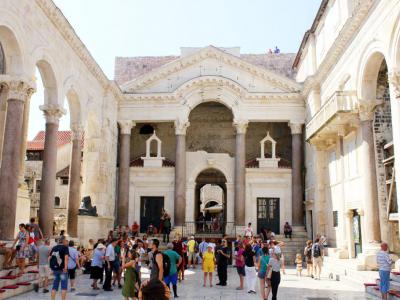
Call it a palace if you like, but Diocletian’s masterpiece is really part imperial retirement villa, part military fortress, and part living city. Built at the end of the third century AD for the Roman emperor who gave up power in favor of peace (and yes, cabbages), it’s a place where stone walls once sheltered soldiers, emperors, monks—and today, generations of Split’s residents.
Perched on a peninsula near Salona—then Dalmatia’s Roman capital and Diocletian’s birthplace—the palace originally served as a seaside sanctuary for the emperor’s final years. When he died in 312, the complex remained under Roman control and occasionally offered refuge to members of the imperial family who needed to lay low.
In the 7th century, when Slavic and Avar invaders destroyed Salona, survivors escaped behind these formidable walls, founding a new settlement right inside the palace. And here’s the surprise—they never left. Today, Split’s Old Town literally lives within those ancient foundations: temples transformed into churches, courtyards became vibrant squares, and homes sprang up between columns.
Later transformations added layers of history. The emperor’s mausoleum was converted into what is now recognized as the world’s oldest Catholic cathedral still in use in its original structure—the Cathedral of Domnius. In the 18th century, Scottish architect Robert Adam studied the palace ruins and helped inspire the elegance of Neoclassical architecture across Europe.
The palace’s layout originally formed an irregular rectangle, once fortified by 16 defensive towers. Its southern façade opened directly to the sea, with ships docking at what is still known as the Sea Gate. Three other gates connected the city walls to external routes: the Golden Gate to the north, leading toward Salona; the Silver Gate to the east, facing Stobreč; and the Iron Gate on the west, reserved for military access.
Indeed, there are few places like this, where centuries layer so vividly in stone—Roman ambition, medieval resilience, and Venetian finesse all mingle beneath your footsteps...
Perched on a peninsula near Salona—then Dalmatia’s Roman capital and Diocletian’s birthplace—the palace originally served as a seaside sanctuary for the emperor’s final years. When he died in 312, the complex remained under Roman control and occasionally offered refuge to members of the imperial family who needed to lay low.
In the 7th century, when Slavic and Avar invaders destroyed Salona, survivors escaped behind these formidable walls, founding a new settlement right inside the palace. And here’s the surprise—they never left. Today, Split’s Old Town literally lives within those ancient foundations: temples transformed into churches, courtyards became vibrant squares, and homes sprang up between columns.
Later transformations added layers of history. The emperor’s mausoleum was converted into what is now recognized as the world’s oldest Catholic cathedral still in use in its original structure—the Cathedral of Domnius. In the 18th century, Scottish architect Robert Adam studied the palace ruins and helped inspire the elegance of Neoclassical architecture across Europe.
The palace’s layout originally formed an irregular rectangle, once fortified by 16 defensive towers. Its southern façade opened directly to the sea, with ships docking at what is still known as the Sea Gate. Three other gates connected the city walls to external routes: the Golden Gate to the north, leading toward Salona; the Silver Gate to the east, facing Stobreč; and the Iron Gate on the west, reserved for military access.
Indeed, there are few places like this, where centuries layer so vividly in stone—Roman ambition, medieval resilience, and Venetian finesse all mingle beneath your footsteps...
3) Cathedral of St. Domnius (must see)
In 305 AD, Emperor Diocletian, known for his brutal persecution of Christians, retired to sunny Dalmatia to cultivate cabbages and built himself a magnificent mausoleum at the heart of his new palace. A few centuries later, that same mausoleum was transformed into a cathedral dedicated to one of the very martyrs he had executed. What a dramatic irony of history...
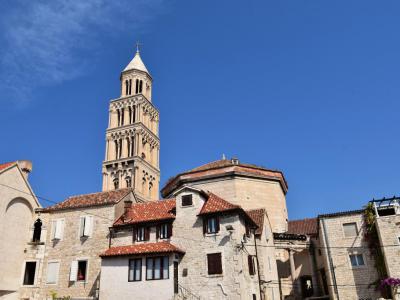
The structure we see today was expertly crafted from white marble, limestone, and brick around the late third century. By the seventh century, refugees from destroyed Salona, who settled in the palace walls, consecrated it as a Christian church dedicated to the Virgin Mary. A choir was later added, and by the 12th century, the elegant bell tower honoring Bishop Domnius rose above the ancient stone.
Saint Domnius himself was the Bishop of Salona, born in Antioch and beheaded in 304 alongside other Christians, ironically dying just a year before Diocletian abdicated. Today, this cathedral is still in use within its original structure, making it the oldest Catholic cathedral in the world still used in its primary form.
As you approach the cathedral, you’ll walk along the same main north-south and east-west streets that guided pilgrims through the palace centuries ago. At their crossing lies the Peristyle, a grand courtyard that serves as the main entrance to the cathedral.
Cross the threshold, and you’re stepping into over 1,700 years of layered history: from an emperor’s resting place to a medieval choir loft, through the Romanesque tower, and into a treasury. The latter is filled with numerous masterpieces such as the 13th-century Madonna and Child panel, intricately crafted reliquaries, ceremonial chalices, and manuscripts spanning from the 6th to the 19th centuries.
It is fair to say that nowhere else do imperial power, medieval devotion, and contemporary faith converge so elegantly, especially when viewed through the lens of fate’s own historical twist...
The structure we see today was expertly crafted from white marble, limestone, and brick around the late third century. By the seventh century, refugees from destroyed Salona, who settled in the palace walls, consecrated it as a Christian church dedicated to the Virgin Mary. A choir was later added, and by the 12th century, the elegant bell tower honoring Bishop Domnius rose above the ancient stone.
Saint Domnius himself was the Bishop of Salona, born in Antioch and beheaded in 304 alongside other Christians, ironically dying just a year before Diocletian abdicated. Today, this cathedral is still in use within its original structure, making it the oldest Catholic cathedral in the world still used in its primary form.
As you approach the cathedral, you’ll walk along the same main north-south and east-west streets that guided pilgrims through the palace centuries ago. At their crossing lies the Peristyle, a grand courtyard that serves as the main entrance to the cathedral.
Cross the threshold, and you’re stepping into over 1,700 years of layered history: from an emperor’s resting place to a medieval choir loft, through the Romanesque tower, and into a treasury. The latter is filled with numerous masterpieces such as the 13th-century Madonna and Child panel, intricately crafted reliquaries, ceremonial chalices, and manuscripts spanning from the 6th to the 19th centuries.
It is fair to say that nowhere else do imperial power, medieval devotion, and contemporary faith converge so elegantly, especially when viewed through the lens of fate’s own historical twist...

4) People's Square (Pjaca) (must see)
Though everyone calls it People’s Square, its original name was Saint Lawrence’s Square, dating all the way back to the 13th century. What makes this place special is that it was the very first part of Split where folks dared to live outside the safety of Diocletian’s Palace walls, marking the city’s slow but steady expansion beyond the emperor’s ancient fortress.
Life here never stops. The city clock overlooking the square has 24 numerals instead of the usual 12, reminding everyone that in People’s Square, time flows on its own unique rhythm. This is where locals and visitors alike gather to rest, eat, drink, meet friends, and simply soak up the city’s lively atmosphere. Connected directly to the Peristyle of the old palace, the square blends the ancient with the everyday.
Surrounding the square, architecture tells its own story—Renaissance grace, Venetian elegance, and Gothic charm all line the streets. Dominating the north side is the Old Town Hall, a 15th-century building that today hosts art and history exhibitions. Legend has it that every building in Split holds a secret or a tale, and here those stories feel alive.
Among the gems you’ll discover in the square are the ornate palaces of former nobility, the Church of Our Lady of the Bell Tower, the Old Town Clock, the charming Old Town Café, and the historic Morpurgo Bookstore, welcoming readers since 1860.
At the base of the square’s flagpole, a quote from local poet Tonći Petrasov reads:
"One doesn’t need to travel anywhere,
nor does one have to search elsewhere,
what you are looking for is precisely here."
In People’s Square, those words ring true. This is where Split’s past and present meet, where stories are shared, and where the city’s spirit pulses strongest.
Life here never stops. The city clock overlooking the square has 24 numerals instead of the usual 12, reminding everyone that in People’s Square, time flows on its own unique rhythm. This is where locals and visitors alike gather to rest, eat, drink, meet friends, and simply soak up the city’s lively atmosphere. Connected directly to the Peristyle of the old palace, the square blends the ancient with the everyday.
Surrounding the square, architecture tells its own story—Renaissance grace, Venetian elegance, and Gothic charm all line the streets. Dominating the north side is the Old Town Hall, a 15th-century building that today hosts art and history exhibitions. Legend has it that every building in Split holds a secret or a tale, and here those stories feel alive.
Among the gems you’ll discover in the square are the ornate palaces of former nobility, the Church of Our Lady of the Bell Tower, the Old Town Clock, the charming Old Town Café, and the historic Morpurgo Bookstore, welcoming readers since 1860.
At the base of the square’s flagpole, a quote from local poet Tonći Petrasov reads:
"One doesn’t need to travel anywhere,
nor does one have to search elsewhere,
what you are looking for is precisely here."
In People’s Square, those words ring true. This is where Split’s past and present meet, where stories are shared, and where the city’s spirit pulses strongest.
5) Prokurative (Republic Square)
Strolling into Republic Square, better known to locals as Prokurative, you might feel as if you’ve wandered into Venice by mistake. Thank Antonio Bajamonti, the 19th-century mayor of the city, remembered as one of its most successful, who dreamed of turning Split from a sleepy port into a vibrant cultural center. In 1859, he even funded with his own money the grand Teatro Bajamonti.
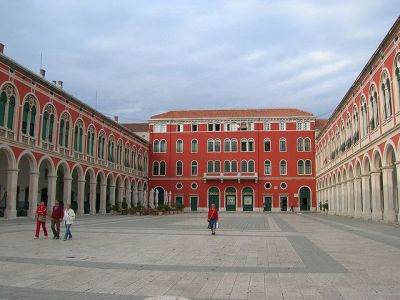
Framed on three sides by stately red neo-Renaissance buildings, the square opens proudly toward the sea, letting the Adriatic breeze sweep through its elegant arches. Look closely: on the left wing, you’ll see graceful Venetian colonnades and bas-reliefs below the windows. But on the right—just smooth, unadorned walls.
Did you know? Legend has it that the Venetian architect, who designed the square, grew so homesick that he abandoned the project midway, sailing back to Venice and leaving one side unfinished.
Today, Prokurative is more than an architectural showpiece. It’s Split’s favorite open-air living room. Cafés spill out onto sunlit terraces, musicians tune their instruments, and festival banners flutter in the breeze. Most famously, it hosts the Split Music Festival, when voices echo off stone façades and the square itself becomes a stage.
Blending Italian charm, local history, and a few unfinished dreams, Prokurative remains a beloved gathering place—proof that in Split, even what’s left undone can become part of the story...
Framed on three sides by stately red neo-Renaissance buildings, the square opens proudly toward the sea, letting the Adriatic breeze sweep through its elegant arches. Look closely: on the left wing, you’ll see graceful Venetian colonnades and bas-reliefs below the windows. But on the right—just smooth, unadorned walls.
Did you know? Legend has it that the Venetian architect, who designed the square, grew so homesick that he abandoned the project midway, sailing back to Venice and leaving one side unfinished.
Today, Prokurative is more than an architectural showpiece. It’s Split’s favorite open-air living room. Cafés spill out onto sunlit terraces, musicians tune their instruments, and festival banners flutter in the breeze. Most famously, it hosts the Split Music Festival, when voices echo off stone façades and the square itself becomes a stage.
Blending Italian charm, local history, and a few unfinished dreams, Prokurative remains a beloved gathering place—proof that in Split, even what’s left undone can become part of the story...
6) Golden Gate
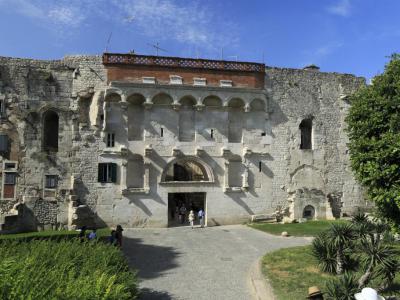
Now, imagine Emperor Diocletian, who has officially clocked out of ruling the Roman Empire—so, no more edicts, no rebellions—sailing home to his seaside villa. The word “villa”, however, might be an understatement for a fortress with a sea view...
He steps ashore, dusts off his toga, and walks straight through one of the four entrances to what is now the Old Town of Split, though in Diocletian’s day it was simply his palace. The Romans, being Romans, built it as the so-called "propugnaculum"—the double doors for defensive purposes.
Today, we call it the Golden Gate. Back then, it was known as Porta Septemtrionalis, or the Northern Gate. In the Middle Ages, it became the Roman Gate. The name “Golden Gate” didn’t appear until 1553. Same structure, different branding. History loves to rebrand...
Take a closer look at the façade, and you’ll spot niches designed for statues of the ruling power squad: the four Tetrarchs. That’s Diocletian himself, alongside his imperial colleagues, namely Maximian, Galerius, and Constantius Chlorus—the men who split the empire into manageable pieces and hoped it would behave. Above the outer section of the gate, the small 6th-century Church of Saint Martin quietly perches, as if keeping watch over centuries of comings and goings.
Ironically, most modern visitors enter from the sea, through the southern or eastern gates. The Golden Gate—the grand, ceremonial main entrance—doesn’t always get the spotlight it was built for. But step outside, and you can’t miss the towering 28-foot statue of Saint Gregory of Nin, standing guard just beyond the gate. Bronze, bold, and impossible to ignore.
So, whenever you pass through, just imagine the emperor himself doing the same—retired, powerful, and very pleased with his new address...
He steps ashore, dusts off his toga, and walks straight through one of the four entrances to what is now the Old Town of Split, though in Diocletian’s day it was simply his palace. The Romans, being Romans, built it as the so-called "propugnaculum"—the double doors for defensive purposes.
Today, we call it the Golden Gate. Back then, it was known as Porta Septemtrionalis, or the Northern Gate. In the Middle Ages, it became the Roman Gate. The name “Golden Gate” didn’t appear until 1553. Same structure, different branding. History loves to rebrand...
Take a closer look at the façade, and you’ll spot niches designed for statues of the ruling power squad: the four Tetrarchs. That’s Diocletian himself, alongside his imperial colleagues, namely Maximian, Galerius, and Constantius Chlorus—the men who split the empire into manageable pieces and hoped it would behave. Above the outer section of the gate, the small 6th-century Church of Saint Martin quietly perches, as if keeping watch over centuries of comings and goings.
Ironically, most modern visitors enter from the sea, through the southern or eastern gates. The Golden Gate—the grand, ceremonial main entrance—doesn’t always get the spotlight it was built for. But step outside, and you can’t miss the towering 28-foot statue of Saint Gregory of Nin, standing guard just beyond the gate. Bronze, bold, and impossible to ignore.
So, whenever you pass through, just imagine the emperor himself doing the same—retired, powerful, and very pleased with his new address...
