Custom Walk in Gdansk, Poland by maxinewhittaker34_5d9ec5 created on 2026-05-27
Guide Location: Poland » Gdansk
Guide Type: Custom Walk
# of Sights: 16
Tour Duration: 5 Hour(s)
Travel Distance: 12.4 Km or 7.7 Miles
Share Key: EJ6X3
Guide Type: Custom Walk
# of Sights: 16
Tour Duration: 5 Hour(s)
Travel Distance: 12.4 Km or 7.7 Miles
Share Key: EJ6X3
How It Works
Please retrieve this walk in the GPSmyCity app. Once done, the app will guide you from one tour stop to the next as if you had a personal tour guide. If you created the walk on this website or come to the page via a link, please follow the instructions below to retrieve the walk in the app.
Retrieve This Walk in App
Step 1. Download the app "GPSmyCity: Walks in 1K+ Cities" on Apple App Store or Google Play Store.



Step 2. In the GPSmyCity app, download(or launch) the guide "Gdansk Map and Walking Tours".
Step 3. Tap the menu button located at upper right corner of the "Walks" screen and select "Retrieve custom walk". Enter the share key: EJ6X3

1) Stare Miasto (Old Town)
The Old Town (Stare Miasto) of Gdansk stands as a monumental testament to Europe's rich history. Renowned as one of the continent's largest historical centers, this medieval heart of Gdansk is notably twice the size of its counterpart in Krakow. The Old Town has a unique ability to transport visitors back to the Middle Ages, thanks to its remarkable layout and architecture. Despite the significant reconstructions undertaken after World War II, the area retains a substantial number of authentic, centuries-old buildings.
The layout of the streets in the Old Town has remained largely unchanged since medieval times, adding to the area's historical authenticity. Impressively, more than 30% of these streets have retained their original names for over half a millennium, reinforcing the sense of timelessness and historical continuity.
Gdansk’s legacy as a prominent Hanseatic town is palpable throughout the Old Town. This rich mercantile past is reflected in the numerous handicraft shops scattered across the area, where visitors can purchase locally made crafts. A particularly noteworthy aspect of Gdansk's local craftsmanship is its exquisite amber jewelry. Known as the "gold of the Baltic," this golden-hued gem is a significant part of the region's cultural heritage. Artisans skillfully incorporate amber into various forms of jewelry and artwork, including necklaces, rings, bracelets, and other decorative items, making them unique souvenirs or gifts that capture the essence of Gdansk's Old Town.
The layout of the streets in the Old Town has remained largely unchanged since medieval times, adding to the area's historical authenticity. Impressively, more than 30% of these streets have retained their original names for over half a millennium, reinforcing the sense of timelessness and historical continuity.
Gdansk’s legacy as a prominent Hanseatic town is palpable throughout the Old Town. This rich mercantile past is reflected in the numerous handicraft shops scattered across the area, where visitors can purchase locally made crafts. A particularly noteworthy aspect of Gdansk's local craftsmanship is its exquisite amber jewelry. Known as the "gold of the Baltic," this golden-hued gem is a significant part of the region's cultural heritage. Artisans skillfully incorporate amber into various forms of jewelry and artwork, including necklaces, rings, bracelets, and other decorative items, making them unique souvenirs or gifts that capture the essence of Gdansk's Old Town.

2) Artus Court
Facing the Neptune Fountain, the Artus Court was once one of the city’s most prestigious meeting places. Established by the mid-14th century, it served as a gathering hall for wealthy merchants, city officials, and visiting dignitaries. Its name comes from the legend of King Arthur, whose court symbolized honor, loyalty, and chivalry. Across northern Europe, similar halls adopted the Arthurian name, though in Gdansk these spaces became closely associated with the city’s prosperous merchant class rather than nobility.
The original building was destroyed by fire in 1476, and the structure seen today reflects later rebuilding and renovations, particularly a major redesign completed in 1617 under architect Abraham van den Blocke. The façade is an example of Dutch Mannerism, a style that influenced much of Gdansk’s historic architecture. Statues of classical and historical figures, including the Roman general Scipio Africanus, the Athenian statesman Themistocles, the Roman commander Marcus Furius Camillus, and the Jewish military leader Judas Maccabeus, line the exterior, while allegorical figures representing strength, justice, and fortune decorate the gable above.
Inside, Artus Court opens into an impressive Gothic hall once used for banquets, ceremonies, and commercial negotiations. The interior is richly decorated with carved wood, heraldic emblems, paintings, tapestries, armor, and model ships. One of the most remarkable features is the monumental tiled stove built in 1546, located along the wall of the main ceremonial hall. Rising roughly 11 meters high, it dominates the room with hundreds of ceramic tiles portraying European rulers, coats of arms, and symbolic figures. Today, Artus Court operates as part of the Museum of Gdansk and remains open to visitors exploring the old town.
The original building was destroyed by fire in 1476, and the structure seen today reflects later rebuilding and renovations, particularly a major redesign completed in 1617 under architect Abraham van den Blocke. The façade is an example of Dutch Mannerism, a style that influenced much of Gdansk’s historic architecture. Statues of classical and historical figures, including the Roman general Scipio Africanus, the Athenian statesman Themistocles, the Roman commander Marcus Furius Camillus, and the Jewish military leader Judas Maccabeus, line the exterior, while allegorical figures representing strength, justice, and fortune decorate the gable above.
Inside, Artus Court opens into an impressive Gothic hall once used for banquets, ceremonies, and commercial negotiations. The interior is richly decorated with carved wood, heraldic emblems, paintings, tapestries, armor, and model ships. One of the most remarkable features is the monumental tiled stove built in 1546, located along the wall of the main ceremonial hall. Rising roughly 11 meters high, it dominates the room with hundreds of ceramic tiles portraying European rulers, coats of arms, and symbolic figures. Today, Artus Court operates as part of the Museum of Gdansk and remains open to visitors exploring the old town.
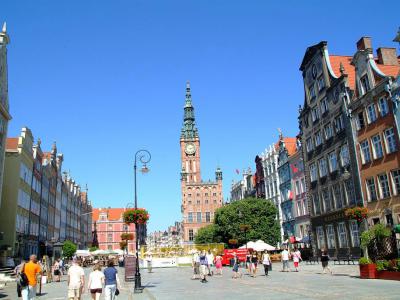
3) Gdańsk Town Hall
The Gdansk Town Hall, also known as Main Town Hall, has served as the administrative heart of Gdansk for centuries. The origins of the Town Hall date to the 14th century, when Gdansk adopted Kulm Law in 1346, reorganizing city government into separate administrative and judicial bodies. This shift required expanded civic space, leading to the development of a growing complex rather than a single structure. Over the centuries, the building underwent repeated reconstructions and enlargements following fires and changing architectural tastes.
The tower atop the town hall became a symbol of civic authority and prosperity, crowned with a gilded statue of King Sigismund II Augustus. A carillon installed within the tower added music to the rhythm of city life, while the clock overlooked the busy market square below. Inside, the Town Hall contains richly decorated chambers once used for council meetings and formal ceremonies. The most impressive space is the Great Council Chamber located on the upper level of the historic building, often called the Red Hall, where elaborate ceiling paintings, carved details, and symbolic decoration celebrate justice, civic pride, and the city’s independence.
Today, the Town Hall operates as part of the Museum of Gdansk, preserving both its interiors and the history of the city it governed. Visitors can explore exhibitions focused on Gdansk’s political and cultural development, while seasonal access to the tower observation gallery offers panoramic views across rooftops, church spires, and the Motława River.
The tower atop the town hall became a symbol of civic authority and prosperity, crowned with a gilded statue of King Sigismund II Augustus. A carillon installed within the tower added music to the rhythm of city life, while the clock overlooked the busy market square below. Inside, the Town Hall contains richly decorated chambers once used for council meetings and formal ceremonies. The most impressive space is the Great Council Chamber located on the upper level of the historic building, often called the Red Hall, where elaborate ceiling paintings, carved details, and symbolic decoration celebrate justice, civic pride, and the city’s independence.
Today, the Town Hall operates as part of the Museum of Gdansk, preserving both its interiors and the history of the city it governed. Visitors can explore exhibitions focused on Gdansk’s political and cultural development, while seasonal access to the tower observation gallery offers panoramic views across rooftops, church spires, and the Motława River.
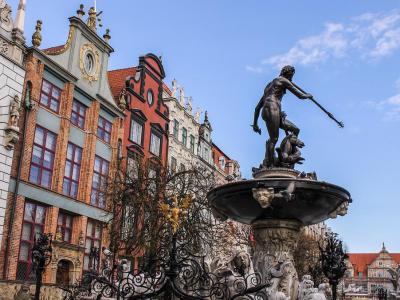
4) Neptune's Fountain
The Neptune Fountain reflects Gdansk’s long connection to the sea. Neptune, the Roman god of the oceans, was chosen as a symbol of maritime prosperity in a city whose identity was shaped by Baltic trade and its role as a major port. The fountain was commissioned in 1606 by Mayor Bartholomäus Schachmann, who envisioned a grand monument near an older public well. Construction began that same year, though progress slowed due to wars, building renovations, and the death of architect Abraham van den Blocke.
The fountain was finally completed and unveiled in 1633. The statue stands on a pedestal made of dark volcanic tuff, surrounded by an ornate iron fence added in 1634. The monument combines Renaissance and Flemish Mannerist influences, visible in its decorative detailing and formal composition. Neptune faces toward the former royal residences along the Royal Route, posed in a slight bow while holding his trident.
The surrounding fence originally featured gilded Polish eagles, symbols removed during World War II and later restored. During the war, the fountain itself was dismantled and hidden for protection before being reconstructed after the conflict. It returned to operation in 1957 and underwent additional restoration work in 2012 to preserve its structure and detailing.
Local legend adds a playful dimension to the fountain’s history. According to tradition, Neptune struck the water with his trident after merchants tossed coins into the basin, breaking the gold into tiny flakes that inspired the famous Goldwasser liqueur associated with Gdansk.
The fountain was finally completed and unveiled in 1633. The statue stands on a pedestal made of dark volcanic tuff, surrounded by an ornate iron fence added in 1634. The monument combines Renaissance and Flemish Mannerist influences, visible in its decorative detailing and formal composition. Neptune faces toward the former royal residences along the Royal Route, posed in a slight bow while holding his trident.
The surrounding fence originally featured gilded Polish eagles, symbols removed during World War II and later restored. During the war, the fountain itself was dismantled and hidden for protection before being reconstructed after the conflict. It returned to operation in 1957 and underwent additional restoration work in 2012 to preserve its structure and detailing.
Local legend adds a playful dimension to the fountain’s history. According to tradition, Neptune struck the water with his trident after merchants tossed coins into the basin, breaking the gold into tiny flakes that inspired the famous Goldwasser liqueur associated with Gdansk.
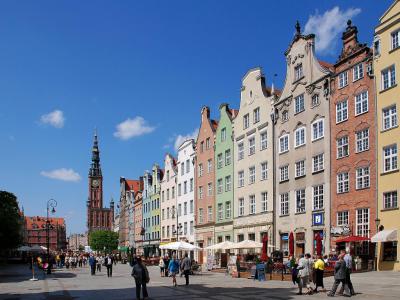
5) Long Market Square (must see)
The Long Market functions less as a square and more as a broad historic street lined with elaborate façades. Passing through the arches of the Green Gate, visitors enter a space that once served as the final stage of the Royal Route, where Polish monarchs made ceremonial entrances into the city beginning in the 16th century. Today, cafés, amber shops, restaurants, and seasonal markets fill the area with activity.
Many of the buildings seen today were carefully reconstructed after World War II, following their original Renaissance and Dutch-Flemish Mannerist designs. Wealthy merchants once combined business and residence here. The market was also a stage for public life in all its forms. Royal banquets, processions, and civic ceremonies took place here, while public punishments and executions were also carried out in earlier centuries.
Walking from the Green Gate into Long Market, not far beyond the entrance, the English House appears on the right-hand side. It is easy to recognize by its tall, narrow proportions and richly layered façade, which rises higher than many neighboring buildings. On the left-hand side near numbers 14–16, visitors may notice the Fahrenheit Thermometer marker near the Abegg House, a small reference to physicist Daniel Gabriel Fahrenheit, who was born in Gdańsk in 1686.
The former Town Pharmacy sits at the intersection with Kuśnierska Street, on the same side as the English House. Continue toward the Long Street, near the approach to the Town Hall. Here, the richly decorated Golden House stands out clearly from surrounding façades. Built in the early 17th century, it is distinguished by sculpted figures, decorative reliefs, and gilded details across the front elevation. Its ornamentation makes it one of the easiest buildings to identify along the square, especially when sunlight highlights the pale stone carvings.
Many of the buildings seen today were carefully reconstructed after World War II, following their original Renaissance and Dutch-Flemish Mannerist designs. Wealthy merchants once combined business and residence here. The market was also a stage for public life in all its forms. Royal banquets, processions, and civic ceremonies took place here, while public punishments and executions were also carried out in earlier centuries.
Walking from the Green Gate into Long Market, not far beyond the entrance, the English House appears on the right-hand side. It is easy to recognize by its tall, narrow proportions and richly layered façade, which rises higher than many neighboring buildings. On the left-hand side near numbers 14–16, visitors may notice the Fahrenheit Thermometer marker near the Abegg House, a small reference to physicist Daniel Gabriel Fahrenheit, who was born in Gdańsk in 1686.
The former Town Pharmacy sits at the intersection with Kuśnierska Street, on the same side as the English House. Continue toward the Long Street, near the approach to the Town Hall. Here, the richly decorated Golden House stands out clearly from surrounding façades. Built in the early 17th century, it is distinguished by sculpted figures, decorative reliefs, and gilded details across the front elevation. Its ornamentation makes it one of the easiest buildings to identify along the square, especially when sunlight highlights the pale stone carvings.
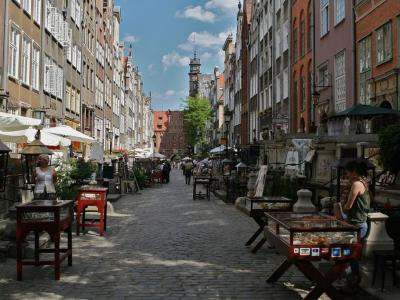
6) Mariacka Street (must see)
Mariacka Street is one of the most atmospheric streets in the historic center. Narrow, cobbled, and lined with old burgher houses, it offers a quieter and more intimate experience. The street takes its name from Saint Mary’s Church, whose tower rises above the rooftops at one end, creating a strong visual connection between the two landmarks.
Mariacka Street developed during the Middle Ages as a residential and commercial lane linked to the nearby church district and river trade. Wealthy merchants and craftsmen once lived here, and many of the houses retain raised stone terraces reached by short stairways. Decorative iron railings, carved portals, and sculpted gargoyles give the façades a distinctive appearance. These gargoyles were designed not only as decoration but also as waterspouts, carrying rainwater away from the walls while symbolically protecting homes from evil. Biblical scenes and ornamental carvings can still be found on some façades.
At the river end of the street stands the 15th-century Saint Mary's Gate, one of the historic water gates that once connected the city to the harbor. The gate displays coats of arms linked to Gdansk, Prussia, and Poland, marking the street’s long relationship with trade and civic identity. Beside the gate is the Archaeological Museum in Gdansk, whose tower offers elevated views over the surrounding rooftops and riverfront.
Mariacka Street is also closely associated with amber craftsmanship, a tradition deeply tied to the Baltic coast. Workshops, galleries, and jewelry stores line the ground floors, displaying polished amber in shades ranging from pale honey to deep cognac. Cafés and wine bars add to the atmosphere. During the annual Saint Dominic's Fair in August, the lane becomes lively with performers, vendors, and visitors, though at quieter times it retains a calm, almost contemplative character.
Mariacka Street developed during the Middle Ages as a residential and commercial lane linked to the nearby church district and river trade. Wealthy merchants and craftsmen once lived here, and many of the houses retain raised stone terraces reached by short stairways. Decorative iron railings, carved portals, and sculpted gargoyles give the façades a distinctive appearance. These gargoyles were designed not only as decoration but also as waterspouts, carrying rainwater away from the walls while symbolically protecting homes from evil. Biblical scenes and ornamental carvings can still be found on some façades.
At the river end of the street stands the 15th-century Saint Mary's Gate, one of the historic water gates that once connected the city to the harbor. The gate displays coats of arms linked to Gdansk, Prussia, and Poland, marking the street’s long relationship with trade and civic identity. Beside the gate is the Archaeological Museum in Gdansk, whose tower offers elevated views over the surrounding rooftops and riverfront.
Mariacka Street is also closely associated with amber craftsmanship, a tradition deeply tied to the Baltic coast. Workshops, galleries, and jewelry stores line the ground floors, displaying polished amber in shades ranging from pale honey to deep cognac. Cafés and wine bars add to the atmosphere. During the annual Saint Dominic's Fair in August, the lane becomes lively with performers, vendors, and visitors, though at quieter times it retains a calm, almost contemplative character.
7) Dlugie Pobrzeze (Long Embankment Street) (must see)
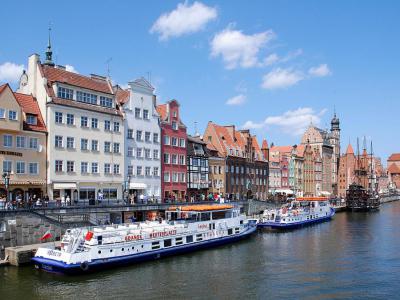
Running along the western bank of the Motława River, Long Embankment Street forms one of the most scenic promenades in the historic center. Today, it offers wide views across the river toward former granaries and waterfront buildings, creating one of the most recognizable riverfront scenes in Gdansk.
During the medieval and early modern periods, the embankment served as the working port of the city. Wooden piers, loading platforms, and quays lined the waterfront, allowing ships to unload grain, timber, salt, and imported goods directly into nearby warehouses. The sheltered waters of the Motława provided easy access to the Baltic Sea, helping Gdansk grow into one of the richest trading centers in northern Europe. Water gates built into the city walls connected the harbor to the streets behind, allowing goods to move efficiently between ships and merchant houses.
The promenade itself originated in the 14th century, though the earliest structures were largely wooden. In the 17th century, the waterfront was reorganized into a more unified walkway, replacing many of the earlier goods platforms. The famous Crane Gate, standing toward the northern end of the embankment, and several water gates were rebuilt in medieval style, while new quay walls and lower riverfront sections were added to support passenger vessels and public access.
Today, Long Embankment Street is one of the liveliest walking areas in Gdansk. Reconstructed Hanseatic-style townhouses line the promenade, housing cafés, restaurants, and shops beneath their narrow façades. Visitors walking north from the Green Gate toward the Crane pass riverside terraces, moored boats, and occasional cruise departures.
During the medieval and early modern periods, the embankment served as the working port of the city. Wooden piers, loading platforms, and quays lined the waterfront, allowing ships to unload grain, timber, salt, and imported goods directly into nearby warehouses. The sheltered waters of the Motława provided easy access to the Baltic Sea, helping Gdansk grow into one of the richest trading centers in northern Europe. Water gates built into the city walls connected the harbor to the streets behind, allowing goods to move efficiently between ships and merchant houses.
The promenade itself originated in the 14th century, though the earliest structures were largely wooden. In the 17th century, the waterfront was reorganized into a more unified walkway, replacing many of the earlier goods platforms. The famous Crane Gate, standing toward the northern end of the embankment, and several water gates were rebuilt in medieval style, while new quay walls and lower riverfront sections were added to support passenger vessels and public access.
Today, Long Embankment Street is one of the liveliest walking areas in Gdansk. Reconstructed Hanseatic-style townhouses line the promenade, housing cafés, restaurants, and shops beneath their narrow façades. Visitors walking north from the Green Gate toward the Crane pass riverside terraces, moored boats, and occasional cruise departures.
8) Brama Żuraw (Crane Gate) (must see)
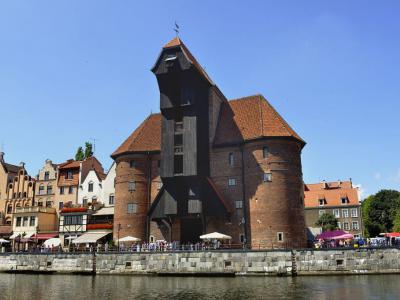
The Crane Gate has become one of the city’s best-known symbols. It once formed a crucial link between the harbor and the streets of the old town. The first wooden crane on this site dates to at least 1367, though it was destroyed by fire in the 15th century. The present brick structure was erected in 1444, with its western façade completed by 1483, creating the distinctive silhouette that still defines the waterfront today.
The Crane Gate combined two important functions: it served as both a port crane and a fortified city gate. Massive brick towers flank the central timber lifting structure, while defensive features such as cannon openings and firing embrasures reveal its military role. As the largest water gate in Gdansk, it controlled access between the river and the city while helping protect the harbor.
Inside the crane, a system of large wooden treadwheels powered the lifting mechanism. Two pairs of wheels mounted on a shared shaft were operated by workers walking inside them, much like oversized hamster wheels. Four people powered each wheel, generating enough force to lift cargo weighing up to two tons to heights approaching 36 meters. The crane was used to unload goods, move heavy cargo, and raise ship masts for repairs. Although its practical role declined over time, the mechanism remained in use in limited form until the mid-20th century.
The Crane suffered serious damage during the final months of World War II when much of Gdańsk’s historic center was destroyed. Reconstruction was completed by 1965. Today, it forms part of the National Maritime Museum in Gdansk, housing exhibitions focused on port life between the 16th and 18th centuries. Visitors can see the enormous drive wheels up close and learn how the crane operated within the harbor economy.
The Crane Gate combined two important functions: it served as both a port crane and a fortified city gate. Massive brick towers flank the central timber lifting structure, while defensive features such as cannon openings and firing embrasures reveal its military role. As the largest water gate in Gdansk, it controlled access between the river and the city while helping protect the harbor.
Inside the crane, a system of large wooden treadwheels powered the lifting mechanism. Two pairs of wheels mounted on a shared shaft were operated by workers walking inside them, much like oversized hamster wheels. Four people powered each wheel, generating enough force to lift cargo weighing up to two tons to heights approaching 36 meters. The crane was used to unload goods, move heavy cargo, and raise ship masts for repairs. Although its practical role declined over time, the mechanism remained in use in limited form until the mid-20th century.
The Crane suffered serious damage during the final months of World War II when much of Gdańsk’s historic center was destroyed. Reconstruction was completed by 1965. Today, it forms part of the National Maritime Museum in Gdansk, housing exhibitions focused on port life between the 16th and 18th centuries. Visitors can see the enormous drive wheels up close and learn how the crane operated within the harbor economy.
9) St. Mary's Church (must see)
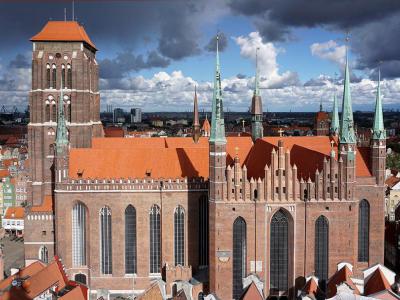
Saint Mary's Church is one of the largest brick churches in the world. Construction began in 1343 and continued for more than 150 years. It is often called the “Crown of Gdansk” because of its commanding presence over the old town. Built primarily from red brick in the Northern Gothic style, the church is an immense hall church with aisles and a transept, measuring roughly 105 meters in length. The current structure began taking shape in 1379 under architect Heinrich Ungeradin, while the tower and major structural elements were completed by the late 15th century. Its exterior is marked by stepped gables, pointed windows, and a massive square tower.
Between 1536 and 1572, it was shared by Catholics and Lutherans, and from the late 16th century until 1945 it became one of the largest Lutheran churches in the world. Since the end of World War II, it has returned to Catholic use. The building suffered heavy wartime damage, but restoration began in 1946 and gradually returned the church to its historic form.
Inside, visitors encounter a vast and light-filled interior supported by vaulted ceilings and slender columns. To orient yourself, enter through the main western doors. One of the most remarkable features, the astronomical clock created in 1467 by Hans Düringer, stands along the northern wall of the nave, slightly forward of the midpoint. Continuing forward along the central aisle toward the eastern end of the church brings you to the main altar. Around this area and along the side aisles, you will also find chapels and memorials linked to merchant families, each marked by distinct decorative elements and inscriptions.
Another important highlight is the stone Pietà dating from around 1410, one of the church’s notable medieval sculptures. To find it, move toward the southern side aisle, where it is placed within one of the chapels near the wall. Nearby chapels and altars contain additional medieval artwork. For the tower climb, look for the entrance near the northern side of the church, close to one of the side aisles. A staircase leads upward to the observation platform. At the top, visitors are rewarded with wide views over Gdansk.
Between 1536 and 1572, it was shared by Catholics and Lutherans, and from the late 16th century until 1945 it became one of the largest Lutheran churches in the world. Since the end of World War II, it has returned to Catholic use. The building suffered heavy wartime damage, but restoration began in 1946 and gradually returned the church to its historic form.
Inside, visitors encounter a vast and light-filled interior supported by vaulted ceilings and slender columns. To orient yourself, enter through the main western doors. One of the most remarkable features, the astronomical clock created in 1467 by Hans Düringer, stands along the northern wall of the nave, slightly forward of the midpoint. Continuing forward along the central aisle toward the eastern end of the church brings you to the main altar. Around this area and along the side aisles, you will also find chapels and memorials linked to merchant families, each marked by distinct decorative elements and inscriptions.
Another important highlight is the stone Pietà dating from around 1410, one of the church’s notable medieval sculptures. To find it, move toward the southern side aisle, where it is placed within one of the chapels near the wall. Nearby chapels and altars contain additional medieval artwork. For the tower climb, look for the entrance near the northern side of the church, close to one of the side aisles. A staircase leads upward to the observation platform. At the top, visitors are rewarded with wide views over Gdansk.
10) Ulica Długa (Long Street) (must see)
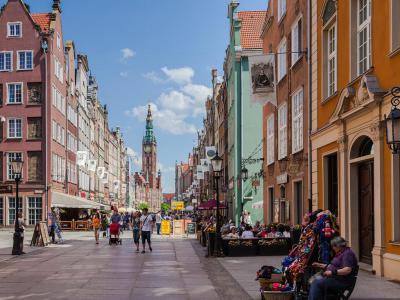
Long Street forms one of the city’s oldest and most important thoroughfares. Together with Long Market, it makes up the central section of the Royal Route, the ceremonial path once followed by Polish monarchs entering Gdansk. Stretching from the impressive Golden Gate to the towering Main Town Hall, the street has long served as a center of trade, civic life, and architectural display. The street reveals a continuous line of historic façades that create one of the most recognizable streetscapes in Poland.
Long Street developed during the Middle Ages as a prestigious residential district for wealthy merchants and influential families. The narrow street became lined with richly ornamented burgher houses, many featuring decorative portals, terraces, and carved stone details inspired by Gothic, Renaissance, and later Baroque styles. Though heavily damaged during World War II, much of the street was reconstructed using historic plans, photographs, and archival records.
Walking along the street toward the western side, architectural variety from one building to the next is revealed. House numbering follows an older system, with numbers running in opposite directions on either side of the street. Several notable residences stand out. On the left-hand side, number 35 is known as the Lion Castle, recognizable by its decorative frontage and historical association with royal receptions once held for King Władysław IV.
Farther along, look for Ferber House at number 28, dating from 1560, identified by sculptural decoration and carved coats of arms. Near the western end of the street, the historic Uphagen House at number 12 stands out as a preserved merchant residence, where visitors can step inside to see furnished interiors that recreate upper-class life in the 18th century.
Today, Long Street functions as a pedestrian promenade lined with cafés, amber shops, restaurants, and seasonal market stalls. Street performers and outdoor terraces add movement to the historic setting, while cobbled paving and restored façades reinforce the atmosphere of a traditional European old town.
Long Street developed during the Middle Ages as a prestigious residential district for wealthy merchants and influential families. The narrow street became lined with richly ornamented burgher houses, many featuring decorative portals, terraces, and carved stone details inspired by Gothic, Renaissance, and later Baroque styles. Though heavily damaged during World War II, much of the street was reconstructed using historic plans, photographs, and archival records.
Walking along the street toward the western side, architectural variety from one building to the next is revealed. House numbering follows an older system, with numbers running in opposite directions on either side of the street. Several notable residences stand out. On the left-hand side, number 35 is known as the Lion Castle, recognizable by its decorative frontage and historical association with royal receptions once held for King Władysław IV.
Farther along, look for Ferber House at number 28, dating from 1560, identified by sculptural decoration and carved coats of arms. Near the western end of the street, the historic Uphagen House at number 12 stands out as a preserved merchant residence, where visitors can step inside to see furnished interiors that recreate upper-class life in the 18th century.
Today, Long Street functions as a pedestrian promenade lined with cafés, amber shops, restaurants, and seasonal market stalls. Street performers and outdoor terraces add movement to the historic setting, while cobbled paving and restored façades reinforce the atmosphere of a traditional European old town.
11) Golden Gate
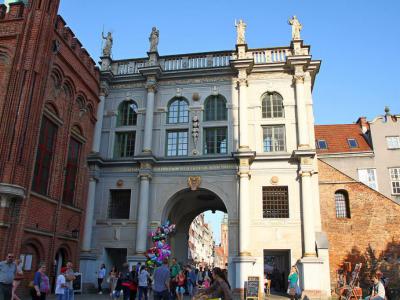
The Golden Gate marks the inland beginning of the Royal Route, the ceremonial path once used by Polish monarchs entering the city. Built in 1614, it replaced the earlier 13th-century Long Street Gate. Designed by Dutch architect Abraham van den Blocke, the structure reflects the Dutch Mannerist style that influenced much of Gdańsk’s architecture during its trading peak.
Although part of the old city fortifications, the gate was intended as a decorative civic monument rather than a defensive barrier. Its pale stone façade, ornamental columns, and balanced proportions give it the appearance of a ceremonial arch, welcoming visitors into the old town. The upper sections of the gate are decorated with statues representing civic virtues important to the identity of Gdańsk, including Peace, Freedom, Fortune, Fame, Concord, Justice, Piety, and Wisdom. Latin inscriptions reinforce these ideals, including a phrase expressing that small republics prosper through harmony and decline through discord.
Beyond its symbolic role, the Golden Gate formed part of a broader defensive complex, which controlled access to the city from the west. The Golden Gate suffered heavy damage during World War II but was carefully restored by 1957. Today, the area around the gate is lively, with small stalls and nearby shops offering souvenirs, amber jewellery, prints, and handcrafted items inspired by the city’s history.
Although part of the old city fortifications, the gate was intended as a decorative civic monument rather than a defensive barrier. Its pale stone façade, ornamental columns, and balanced proportions give it the appearance of a ceremonial arch, welcoming visitors into the old town. The upper sections of the gate are decorated with statues representing civic virtues important to the identity of Gdańsk, including Peace, Freedom, Fortune, Fame, Concord, Justice, Piety, and Wisdom. Latin inscriptions reinforce these ideals, including a phrase expressing that small republics prosper through harmony and decline through discord.
Beyond its symbolic role, the Golden Gate formed part of a broader defensive complex, which controlled access to the city from the west. The Golden Gate suffered heavy damage during World War II but was carefully restored by 1957. Today, the area around the gate is lively, with small stalls and nearby shops offering souvenirs, amber jewellery, prints, and handcrafted items inspired by the city’s history.
12) Hala Targowa (Market Hall)
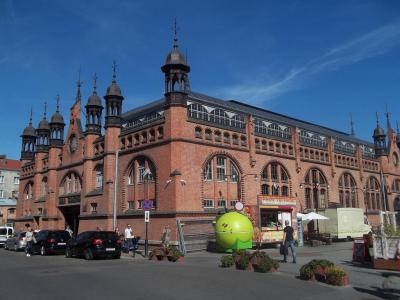
The Market Hall was built in 1896 and designed by architect Kurt Fehlhaber. The hall was created to modernize trade by bringing vendors together in a structured indoor space. It stands on the former site of a Dominican monastery demolished in the 19th century.
The building reflects an eclectic architectural style typical of late 19th-century market halls, combining brick construction with a metal roof framework. Its elongated layout is divided into three interior bays by rows of cast-iron pillars, while large semicircular windows and clerestory openings allow natural light to fill the space. Small turret-like features punctuate the roofline, and decorative elements such as buttresses, polygonal forms, and the coat of arms of Gdansk add detail to the exterior.
Originally, the interior accommodated nearly 200 stalls, along with administrative offices and even a police station. Today, the hall continues to operate as a working market, with vendors offering fresh produce, meats, cheeses, baked goods, and regional specialties. A major restoration program begun in 2000 revealed an unexpected feature beneath the hall: the foundations of a Romanesque church associated with the early history of the site. These remains led to the creation of an underground archaeological museum, where visitors can view fragments of the medieval structure, including parts of the nave and chancel.
The building reflects an eclectic architectural style typical of late 19th-century market halls, combining brick construction with a metal roof framework. Its elongated layout is divided into three interior bays by rows of cast-iron pillars, while large semicircular windows and clerestory openings allow natural light to fill the space. Small turret-like features punctuate the roofline, and decorative elements such as buttresses, polygonal forms, and the coat of arms of Gdansk add detail to the exterior.
Originally, the interior accommodated nearly 200 stalls, along with administrative offices and even a police station. Today, the hall continues to operate as a working market, with vendors offering fresh produce, meats, cheeses, baked goods, and regional specialties. A major restoration program begun in 2000 revealed an unexpected feature beneath the hall: the foundations of a Romanesque church associated with the early history of the site. These remains led to the creation of an underground archaeological museum, where visitors can view fragments of the medieval structure, including parts of the nave and chancel.
13) St. Bridget's Church
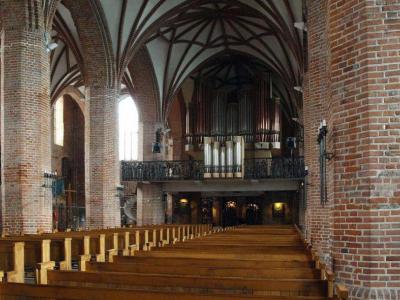
Saint Bridget's Church in Gdansk is an important historical and cultural site deeply connected to Polish history and the Catholic religion. First built in the late 14th century for Saint Bridget's Order followers, the church has a significant past. It was almost entirely destroyed during World War II and was reconstructed in 1973 using its original 1394-1420 designs. This rebuild maintains the church's original architectural style and its historical importance.
The church's standout feature is the 'Amber Altar', a continuing project that honors Divine Providence, celebrates Pope John Paul II's papacy, and acknowledges Poland's regained independence. This altar is a religious symbol and an artistic masterpiece, displaying the Blessed Virgin Mary, painted by Father Franciszek Znaniecki, influenced by the December 1970 workers' massacre. It includes figures like Saint Bridget of Sweden, Saint Elizabeth Hesselblad, Pope Saint John Paul II, and Cardinal Stefan Wyszynski, showing the blend of Polish patriotism and Catholic faith. The altar also has an amber monstrance with relics of Pope Saint John Paul II and Blessed Jerzy Popieluszko, adding to its historical and religious value.
The church also features memorials to various historical events, like the Katyń massacre and tributes to Solidarity (Solidarność), a broad anti-authoritarian social movement, showing the strong link between the Catholic Church and Polish nationalism. One memorial is for Father Jerzy Popieluszko, a Solidarity chaplain killed by secret police in 1984.
In 2010, renovation works uncovered a hidden crypt with human remains, believed to be from the early 17th century. Now open to the public, this crypt contains Saint Bridget of Sweden's relics and some of the found skulls, adding more to the church's rich history.
Finally, the church's recognition as a Lesser Basilica in 1991 by Pope John Paul II and his statue outside highlight its religious significance and its ties to the broader Catholic community. Saint Bridget's Church is more than a place of worship; it's a symbol of Polish history, faith, and endurance.
The church's standout feature is the 'Amber Altar', a continuing project that honors Divine Providence, celebrates Pope John Paul II's papacy, and acknowledges Poland's regained independence. This altar is a religious symbol and an artistic masterpiece, displaying the Blessed Virgin Mary, painted by Father Franciszek Znaniecki, influenced by the December 1970 workers' massacre. It includes figures like Saint Bridget of Sweden, Saint Elizabeth Hesselblad, Pope Saint John Paul II, and Cardinal Stefan Wyszynski, showing the blend of Polish patriotism and Catholic faith. The altar also has an amber monstrance with relics of Pope Saint John Paul II and Blessed Jerzy Popieluszko, adding to its historical and religious value.
The church also features memorials to various historical events, like the Katyń massacre and tributes to Solidarity (Solidarność), a broad anti-authoritarian social movement, showing the strong link between the Catholic Church and Polish nationalism. One memorial is for Father Jerzy Popieluszko, a Solidarity chaplain killed by secret police in 1984.
In 2010, renovation works uncovered a hidden crypt with human remains, believed to be from the early 17th century. Now open to the public, this crypt contains Saint Bridget of Sweden's relics and some of the found skulls, adding more to the church's rich history.
Finally, the church's recognition as a Lesser Basilica in 1991 by Pope John Paul II and his statue outside highlight its religious significance and its ties to the broader Catholic community. Saint Bridget's Church is more than a place of worship; it's a symbol of Polish history, faith, and endurance.

14) Museum of the Second World War (must see)
Opened in 2016, the Museum of the Second World War in Gdańsk, is an impressive example of contemporary architecture located at the northern edge of the city's waterfront. This museum has gained significant recognition for its comprehensive and moving portrayal of Poland's experience during the Second World War, making it a must-visit attraction. It underscores the immense human suffering caused by the conflict, which leaves a lasting impression on those who visit.
Covering an area of 5000 square meters, the museum is divided into 18 carefully curated sections, arranged chronologically to provide an immersive and educational journey through the war's history. Visitors receive complimentary maps with their tickets to help navigate the extensive exhibits. These exhibits commence with the causes of the war, showcasing Nazi propaganda posters, and culminate with the beginning of the Cold War, which is highlighted by Communist propaganda.
Among the captivating displays are notable highlights such as a large-scale reconstruction of a pre-war Warsaw street, a profoundly moving Holocaust section featuring images of Jewish individuals reaching heights of up to 7 meters, a Sherman tank, and a dramatic recreation of a bombed Warsaw courtyard, complete with a Russian tank. The museum also features an insightful section on the crucial wartime meetings between the allies in Tehran, Casablanca, Moscow, and Yalta.
The exhibits are rich in historical artifacts, including uniforms, weapons, maps, documents, and compelling footage, all accompanied by concise explanations in English. Additionally, strategically placed throughout the museum are small yet impactful items, such as Nazi Christmas decorations with swastikas, the Oscar-nominated film "Siege," personal belongings from the Siege of Leningrad, artifacts from the Katyń massacre, and radios from Czechoslovakia warning against listening to the BBC. There is also a dedicated section on the Polish resistance, although it contains comparatively less content about Gdańsk itself.
The building's design, characterized by exposed concrete painted in somber black and grey, complements the museum's emotionally charged atmosphere. The impact of the museum is so profound that many visitors leave visibly moved by the powerful narrative it conveys.
Covering an area of 5000 square meters, the museum is divided into 18 carefully curated sections, arranged chronologically to provide an immersive and educational journey through the war's history. Visitors receive complimentary maps with their tickets to help navigate the extensive exhibits. These exhibits commence with the causes of the war, showcasing Nazi propaganda posters, and culminate with the beginning of the Cold War, which is highlighted by Communist propaganda.
Among the captivating displays are notable highlights such as a large-scale reconstruction of a pre-war Warsaw street, a profoundly moving Holocaust section featuring images of Jewish individuals reaching heights of up to 7 meters, a Sherman tank, and a dramatic recreation of a bombed Warsaw courtyard, complete with a Russian tank. The museum also features an insightful section on the crucial wartime meetings between the allies in Tehran, Casablanca, Moscow, and Yalta.
The exhibits are rich in historical artifacts, including uniforms, weapons, maps, documents, and compelling footage, all accompanied by concise explanations in English. Additionally, strategically placed throughout the museum are small yet impactful items, such as Nazi Christmas decorations with swastikas, the Oscar-nominated film "Siege," personal belongings from the Siege of Leningrad, artifacts from the Katyń massacre, and radios from Czechoslovakia warning against listening to the BBC. There is also a dedicated section on the Polish resistance, although it contains comparatively less content about Gdańsk itself.
The building's design, characterized by exposed concrete painted in somber black and grey, complements the museum's emotionally charged atmosphere. The impact of the museum is so profound that many visitors leave visibly moved by the powerful narrative it conveys.
15) Oliwa Park
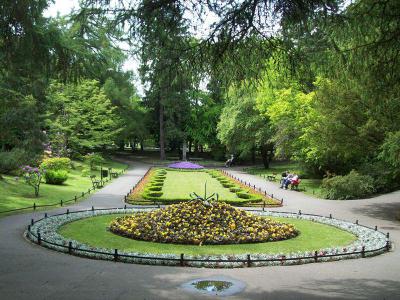
Oliwa Park, located in Gdańsk, is a 25-acre (10 hectares) verdant oasis known for its breathtaking landscaping and architectural marvels. Designed by the renowned Polish gardener Kazimierz Dębiński, this picturesque public park is a popular destination for tourists, nature lovers, families, and couples seeking a tranquil retreat from the city's hustle and bustle.
At the core of Oliwa Park are its manicured gardens, where visitors can enjoy serene walks, scenic picnics, and relaxed afternoons. The park features tree-lined pathways that meander around lush lawns, perfect for picnicking, exercising, or unwinding. A highlight of the park is the stream and waterfall, with stepping-stone-like boulders that are especially popular among children.
The park's southern section boasts an elegant French Rococo garden, complete with a narrow pond and encircled by towering trees. The Botanical Garden here displays a variety of flora including magnolias, rhododendrons, and spruces, while the Palm House is home to an exotic collection of palms. Another notable feature is the Alpinarium, a rockery designed to emulate a mountain environment.
Wildlife enthusiasts will appreciate the park's diverse fauna, including carp, squirrels, and swans. Art lovers are drawn to the decorative sculptures scattered throughout the park, such as the bust of Poland's national poet, Adam Mickiewicz. A unique attraction is the Whispering Caves, where visitors can communicate through two shells set on opposite sides of a path.
A significant landmark within the park is the 18th-century Abbot’s Palace, formerly the residence of the Cistercian monks' abbot. Today, it houses the modern art department of the National Museum in Gdańsk, featuring an array of Polish art, ceramics, and sculptures dating from the 1800s to early 1900s. In front of the palace lies an immaculately maintained Baroque-style garden.
At the core of Oliwa Park are its manicured gardens, where visitors can enjoy serene walks, scenic picnics, and relaxed afternoons. The park features tree-lined pathways that meander around lush lawns, perfect for picnicking, exercising, or unwinding. A highlight of the park is the stream and waterfall, with stepping-stone-like boulders that are especially popular among children.
The park's southern section boasts an elegant French Rococo garden, complete with a narrow pond and encircled by towering trees. The Botanical Garden here displays a variety of flora including magnolias, rhododendrons, and spruces, while the Palm House is home to an exotic collection of palms. Another notable feature is the Alpinarium, a rockery designed to emulate a mountain environment.
Wildlife enthusiasts will appreciate the park's diverse fauna, including carp, squirrels, and swans. Art lovers are drawn to the decorative sculptures scattered throughout the park, such as the bust of Poland's national poet, Adam Mickiewicz. A unique attraction is the Whispering Caves, where visitors can communicate through two shells set on opposite sides of a path.
A significant landmark within the park is the 18th-century Abbot’s Palace, formerly the residence of the Cistercian monks' abbot. Today, it houses the modern art department of the National Museum in Gdańsk, featuring an array of Polish art, ceramics, and sculptures dating from the 1800s to early 1900s. In front of the palace lies an immaculately maintained Baroque-style garden.
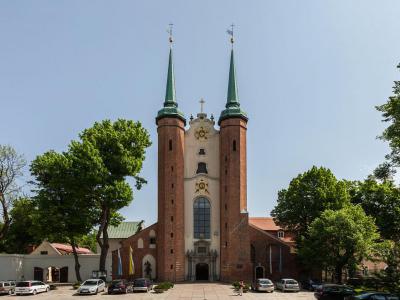
16) Oliwa Cathedral
Oliwa Cathedral, formally known as the Archcathedral Basilica of the Holy Trinity, is a prominent church in Gdańsk. This magnificent edifice stands out as a three-nave basilica featuring a transept and a multisided closed presbytery, complete with an ambulatory. The cathedral's striking façade is adorned with two slender 46-meter-tall towers with sharply-edged helmets, a Baroque portal from 1688, varied-sized windows, and three cartouches. A notable feature of the cathedral is its bell tower, a characteristic element of Cistercian architecture.
Remarkably, the cathedral is 17.7 meters high, 19 meters wide, and 107 meters long, with the interior spanning 97.6 meters, making it the longest Cistercian church in the world. The cathedral's interior is a treasure trove of art from the Renaissance, Baroque, Rococo, and Classical periods, reflecting immense artistic value.
There are 23 altars within the cathedral, each of historical significance and mainly crafted in the Baroque and Rococo styles, with some made of marble. Their iconography reflects the principles of the post-Trent church. The most significant altar is the High Altar from 1688, celebrated as the finest Baroque artwork in Pomerania. Additionally, there is a noteworthy Netherland Renaissance style altar which served as the main altar until 1688. The cathedral's paintings, created by renowned 17th-century artists add to its grandeur.
The interior also houses Rococo chapels dedicated to the Holy Cross and Saint John of Nepomuk, an ambo, tombstones, epitaphs, and the tombs of the Pomeranian Dukes and the Kos family. Additionally, it contains a bishop's crypt, antique chandeliers, canopies, and numerous other antiquities. Of particular note is a feretory depicting Our Lady of Oliwa with the Infant Jesus, a revered object carried during the annual pilgrimage to the Calvary of Wejherowo.
Remarkably, the cathedral is 17.7 meters high, 19 meters wide, and 107 meters long, with the interior spanning 97.6 meters, making it the longest Cistercian church in the world. The cathedral's interior is a treasure trove of art from the Renaissance, Baroque, Rococo, and Classical periods, reflecting immense artistic value.
There are 23 altars within the cathedral, each of historical significance and mainly crafted in the Baroque and Rococo styles, with some made of marble. Their iconography reflects the principles of the post-Trent church. The most significant altar is the High Altar from 1688, celebrated as the finest Baroque artwork in Pomerania. Additionally, there is a noteworthy Netherland Renaissance style altar which served as the main altar until 1688. The cathedral's paintings, created by renowned 17th-century artists add to its grandeur.
The interior also houses Rococo chapels dedicated to the Holy Cross and Saint John of Nepomuk, an ambo, tombstones, epitaphs, and the tombs of the Pomeranian Dukes and the Kos family. Additionally, it contains a bishop's crypt, antique chandeliers, canopies, and numerous other antiquities. Of particular note is a feretory depicting Our Lady of Oliwa with the Infant Jesus, a revered object carried during the annual pilgrimage to the Calvary of Wejherowo.
