Custom Walk in San Francisco, California by tonyt_9a38e8 created on 2026-06-09
Guide Location: USA » San Francisco
Guide Type: Custom Walk
# of Sights: 7
Tour Duration: 4 Hour(s)
Travel Distance: 10.9 Km or 6.8 Miles
Share Key: FBYSQ
Guide Type: Custom Walk
# of Sights: 7
Tour Duration: 4 Hour(s)
Travel Distance: 10.9 Km or 6.8 Miles
Share Key: FBYSQ
How It Works
Please retrieve this walk in the GPSmyCity app. Once done, the app will guide you from one tour stop to the next as if you had a personal tour guide. If you created the walk on this website or come to the page via a link, please follow the instructions below to retrieve the walk in the app.
Retrieve This Walk in App
Step 1. Download the app "GPSmyCity: Walks in 1K+ Cities" on Apple App Store or Google Play Store.



Step 2. In the GPSmyCity app, download(or launch) the guide "San Francisco Map and Walking Tours".
Step 3. Tap the menu button located at upper right corner of the "Walks" screen and select "Retrieve custom walk". Enter the share key: FBYSQ
1) Pier 39 (must see)
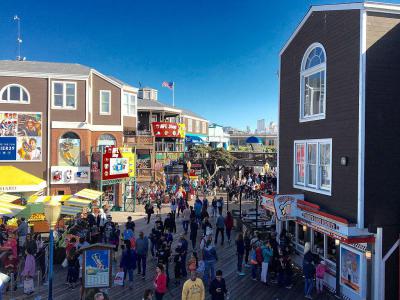
Pier 39-the beating, barking heart of Fisherman’s Wharf-isn’t much of a fisherman’s pier anymore. The old fleet has long since sailed off into history, but in its place rose something entirely different: a carnival by the sea. Imagine a boardwalk that decided to go full extrovert-complete with a glittering carousel (hidden toward the end of the pier like a shy performer), neon amusements, and the constant hum of tourists chasing their next photo op. Revamped in the 1970s to resemble a quaint wooden fishing village, it now welcomes thousands daily-none of whom are catching fish, though, but plenty of those catching Instagram stories...
It’s essentially an open-air shopping mall in a sailor’s disguise. Between the street performers, the Aquarium of the Bay, and enough snack stands to feed a small ship’s crew, there’s no shortage of things to distract you from the ocean view. If you need a recharge, the visitor center has you covered-literally-with phone-charging stations and a place to stash your bags while you explore.
Then there’s the food-because let’s be honest, half the crowd here comes for the chowder. Fourteen restaurants dish out everything from cioppino (which is the Italian-American shellfish and tomato stew) to locally-sourced oysters, with Fog Harbor Fish House leading the pack in both flavor and sustainability. If you’re feeling adventurous, there’s even a floating restaurant-Forbes Island-where the catch of the day comes with a side of gentle rocking.
But the true stars of Pier 39 aren’t human at all. The sea lions, self-appointed landlords since 1989, lounge across the docks like sunbathing celebrities-loud, lazy, and utterly unbothered by their audience. Slightly stinky, yes, but undeniably charming...
From the pier, you’ll spot Angel Island, Alcatraz, and both the Golden Gate and Bay Bridges stretching across the horizon. Boat tickets and ferry rides await those itching to head out on the water. Just remember: San Francisco’s sea breeze doesn’t care about your vacation outfit-so bring a jacket, or risk looking windswept in every photo...
It’s essentially an open-air shopping mall in a sailor’s disguise. Between the street performers, the Aquarium of the Bay, and enough snack stands to feed a small ship’s crew, there’s no shortage of things to distract you from the ocean view. If you need a recharge, the visitor center has you covered-literally-with phone-charging stations and a place to stash your bags while you explore.
Then there’s the food-because let’s be honest, half the crowd here comes for the chowder. Fourteen restaurants dish out everything from cioppino (which is the Italian-American shellfish and tomato stew) to locally-sourced oysters, with Fog Harbor Fish House leading the pack in both flavor and sustainability. If you’re feeling adventurous, there’s even a floating restaurant-Forbes Island-where the catch of the day comes with a side of gentle rocking.
But the true stars of Pier 39 aren’t human at all. The sea lions, self-appointed landlords since 1989, lounge across the docks like sunbathing celebrities-loud, lazy, and utterly unbothered by their audience. Slightly stinky, yes, but undeniably charming...
From the pier, you’ll spot Angel Island, Alcatraz, and both the Golden Gate and Bay Bridges stretching across the horizon. Boat tickets and ferry rides await those itching to head out on the water. Just remember: San Francisco’s sea breeze doesn’t care about your vacation outfit-so bring a jacket, or risk looking windswept in every photo...
2) Sea Lion Center
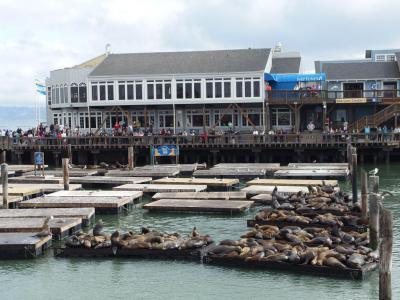
You’ve probably heard them before you’ve seen them-the deep, throaty “arf-arf-arf” echoing across San Francisco Bay. That’s your cue: you’ve reached the Sea Lion Center at Pier 39, where the city’s most famous sunbathers have taken over the floating K-Dock. These California sea lions showed up uninvited after the 1989 Loma Prieta earthquake, decided the marina was prime real estate, and have been flopping, barking, and generally ignoring eviction notices ever since.
What started as a few curious visitors quickly became a full-blown colony-hundreds of whiskered residents lounging on the docks as if they’d booked an all-inclusive spa package. The reason? Perfect conditions: no sharks, plenty of fish, and just enough space to argue over who gets the best sunspot. They’ve turned this once-ordinary pier into one of San Francisco’s most beloved (and noisiest) attractions.
Hovering just above the commotion, the Sea Lion Center turns the spectacle into something smarter. Run by the nonprofit Bay Ecotarium (the same folks behind the Aquarium of the Bay), it’s a compact but clever space filled with interactive displays, videos, and a life-size sea lion skeleton that gives you an X-ray look at these flippered comedians. The staff are part biologist, part storyteller, and fully ready to answer any sea-lion-related question your inner child-or actual child-can come up with.
It’s free to visit (though tossing a donation into the jar earns you good eco-karma), and open daily from roughly 10 a.m. to 4 p.m. (or a bit later on weekends). By the end, you’ll walk away grinning, smelling faintly of sea air, and maybe feeling a little more protective of the planet’s wilder tenants. Because here at Pier 39, conservation isn’t just a lesson-it’s loud, proud, and covered in whiskers...
What started as a few curious visitors quickly became a full-blown colony-hundreds of whiskered residents lounging on the docks as if they’d booked an all-inclusive spa package. The reason? Perfect conditions: no sharks, plenty of fish, and just enough space to argue over who gets the best sunspot. They’ve turned this once-ordinary pier into one of San Francisco’s most beloved (and noisiest) attractions.
Hovering just above the commotion, the Sea Lion Center turns the spectacle into something smarter. Run by the nonprofit Bay Ecotarium (the same folks behind the Aquarium of the Bay), it’s a compact but clever space filled with interactive displays, videos, and a life-size sea lion skeleton that gives you an X-ray look at these flippered comedians. The staff are part biologist, part storyteller, and fully ready to answer any sea-lion-related question your inner child-or actual child-can come up with.
It’s free to visit (though tossing a donation into the jar earns you good eco-karma), and open daily from roughly 10 a.m. to 4 p.m. (or a bit later on weekends). By the end, you’ll walk away grinning, smelling faintly of sea air, and maybe feeling a little more protective of the planet’s wilder tenants. Because here at Pier 39, conservation isn’t just a lesson-it’s loud, proud, and covered in whiskers...
3) Ross Alley
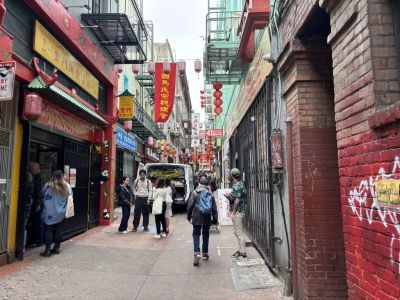
Slipping off the main thoroughfares of Chinatown, the alleyways tell their stories, too. One such is Ross Alley, running a single block between Jackson and Washington Streets. Back in the day (at the turn of the 20th century), this narrow lane had a reputation for its gambling parlors and brothels, drawing a colorful, and sometimes notorious, crowd. Those days have long since passed, but the area’s historic character (albeit now considerably more softened as a quieter pedestrian passage) remains intact.
Among its few but memorable landmarks, the Golden Gate Fortune Cookie Factory stands out. Founded in 1962, it is still hand-folding fortune cookies-a rare survival of a craft that has almost vanished in the age of mass production-in a small workshop scented with sugar and vanilla. Guests can watch the warm wafers being shaped one by one, and, as a playful souvenir, even slip a personal handwritten message inside before they’re folded-a treat that feels both delicious and a little magical.
Film buffs may also recognize parts of the alley from the silver screen. Its close-set buildings, dusky light, and authentic atmosphere have made it a backdrop for cult classics such as “Indiana Jones and the Temple of Doom,” “Big Trouble in Little China,” and “The Karate Kid Part II.” Apparently, the timeworn red-brick façades and overhanging balconies lend it a cinematic quality that directors can’t resist.
Still, despite its Hollywood fame, Ross Alley refuses to become a spectacle. Its charm lies in its authenticity – laundry still flutters overhead, shopkeepers chat at their doorways, and the rhythm of everyday life continues in the centuries-old setting.
The alley invites visitors to a slower pace. Walking here is like opening a window onto another time: murals and art installations bring bursts of color to the weathered walls, while the architecture itself offers a living link to the past. One narrow passage with a wealth of stories (of merchants, laborers, and everyday families) stitched into its fabric serves as a reminder that history often hides in the smallest of streets...
Among its few but memorable landmarks, the Golden Gate Fortune Cookie Factory stands out. Founded in 1962, it is still hand-folding fortune cookies-a rare survival of a craft that has almost vanished in the age of mass production-in a small workshop scented with sugar and vanilla. Guests can watch the warm wafers being shaped one by one, and, as a playful souvenir, even slip a personal handwritten message inside before they’re folded-a treat that feels both delicious and a little magical.
Film buffs may also recognize parts of the alley from the silver screen. Its close-set buildings, dusky light, and authentic atmosphere have made it a backdrop for cult classics such as “Indiana Jones and the Temple of Doom,” “Big Trouble in Little China,” and “The Karate Kid Part II.” Apparently, the timeworn red-brick façades and overhanging balconies lend it a cinematic quality that directors can’t resist.
Still, despite its Hollywood fame, Ross Alley refuses to become a spectacle. Its charm lies in its authenticity – laundry still flutters overhead, shopkeepers chat at their doorways, and the rhythm of everyday life continues in the centuries-old setting.
The alley invites visitors to a slower pace. Walking here is like opening a window onto another time: murals and art installations bring bursts of color to the weathered walls, while the architecture itself offers a living link to the past. One narrow passage with a wealth of stories (of merchants, laborers, and everyday families) stitched into its fabric serves as a reminder that history often hides in the smallest of streets...
4) Chinatown Gate (Dragon's Gate)
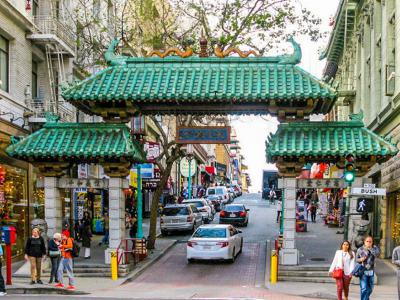
In keeping with Feng Shui principles, the southern edge of San Francisco’s Chinatown is marked by a towering gateway that straddles the bustle of Grant Avenue. This is the Dragon Gate, a flamboyant arch dressed in curling green dragons and traditional tiles. It might look timeless, but it’s actually a relative newcomer-unveiled only in 1970. Its materials were a gift from Taiwan, while the elegant design came from Chinese-American architect Clayton Lee, who modeled it after the ceremonial village gates of old China. Across the top, four carved Chinese characters proclaim a message of welcome: “All under heaven is for the good of the people.”
Guarding the arch are a pair of stone lions, known as fu dogs. On the west side, the male lion steadies a ball beneath his paw, symbolizing protection of the outside world. On the east, the lioness rests her paw on a playful cub, representing the nurturing of family. Together, they embody the balance of strength and care, ensuring that any evil spirits think twice before crossing the threshold.
Pass beneath the gate, and the character of the neighborhood unfolds in full color. In the 1920s, local merchants reinvented Chinatown’s appearance by adding pagoda-roofed façades and bright ornamental details-a pioneering initiative which created an identity that has drawn visitors ever since. The once-notorious red-light district gave way to lantern-strung streets. As evening sets in, the dragon-shaped streetlights flicker on, casting a warm glow across the lively thoroughfare, bustling with herbal shops, bakeries, tea houses, and jewelry stores.
Guarding the arch are a pair of stone lions, known as fu dogs. On the west side, the male lion steadies a ball beneath his paw, symbolizing protection of the outside world. On the east, the lioness rests her paw on a playful cub, representing the nurturing of family. Together, they embody the balance of strength and care, ensuring that any evil spirits think twice before crossing the threshold.
Pass beneath the gate, and the character of the neighborhood unfolds in full color. In the 1920s, local merchants reinvented Chinatown’s appearance by adding pagoda-roofed façades and bright ornamental details-a pioneering initiative which created an identity that has drawn visitors ever since. The once-notorious red-light district gave way to lantern-strung streets. As evening sets in, the dragon-shaped streetlights flicker on, casting a warm glow across the lively thoroughfare, bustling with herbal shops, bakeries, tea houses, and jewelry stores.
5) Cable Car Museum (must see)
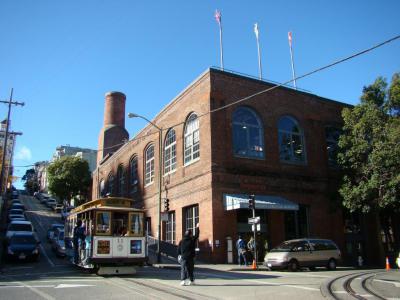
When it comes to public transportation in the City by the Bay, cable cars steal the show! Invented in the late 19th century, they were introduced on an experimental basis for the uneven and steep terrain of San Francisco. After nearly two centuries, these cars have not only proven vital for everyday commute, whirring through the streets from 6 am to 1 am, but also become its identity card.
It is, therefore, only natural to expect them to be celebrated with a designated museum. Such a place does exist and is more than just a museum but is also a showcase of the inner workings of San Francisco's cable car network. The hub of four main cable systems, all the existing cable lines are routed from this building, allowing visitors to view them from the top floor.
You can spend a good one hour in the museum, looking around the well-spaced exhibits accompanied with quite a bit of information. Another incentive to visit is the free admission!
They have a donation box for those who care to contribute. Cable cars are expensive to maintain, and supporting the museum financially, much as taking a ride in one of the cars can help keep the system running.
There is also a cute gift shop with souvenirs, plus a great café across the road, for afterward.
Tip:
If you visit the museum on one of your first days, you will look at the cars in the street with more knowledge for the rest of your vacation.
The museum is open daily: from 10am to 6pm (April through September); and from 10am to 5pm (November through March).
It is, therefore, only natural to expect them to be celebrated with a designated museum. Such a place does exist and is more than just a museum but is also a showcase of the inner workings of San Francisco's cable car network. The hub of four main cable systems, all the existing cable lines are routed from this building, allowing visitors to view them from the top floor.
You can spend a good one hour in the museum, looking around the well-spaced exhibits accompanied with quite a bit of information. Another incentive to visit is the free admission!
They have a donation box for those who care to contribute. Cable cars are expensive to maintain, and supporting the museum financially, much as taking a ride in one of the cars can help keep the system running.
There is also a cute gift shop with souvenirs, plus a great café across the road, for afterward.
Tip:
If you visit the museum on one of your first days, you will look at the cars in the street with more knowledge for the rest of your vacation.
The museum is open daily: from 10am to 6pm (April through September); and from 10am to 5pm (November through March).
6) Lombard Street (must see)
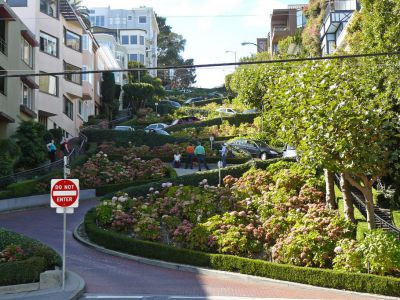
As a tourist magnet, Lombard Street is recognized as the most crooked street in the world. It takes eight turns on a 24-degree slope to make one feel that it is also, indeed, one of the steepest.
Even though walking or cycling this one-way (downhill) street may instill a sense of immediate vertigo, which can be risky at times, the reason for Lombard's crooked form, surprisingly, is safety. Given the natural grading of the land, the zig-zag pattern reduces the effect of the slope's steepness, making it easier to play on. As far back as 1920, it was suggested that scenic switchbacks to be added to bring a certain appeal to the surroundings, and apparently, it worked.
Year after year, Lombard Street manages to get more than its share of visitors who marvel at its scenic beauty and strangeness. Although zig-zag patterns may be enough to visit, a lesser-known fact about this street is that it houses some of San Francisco's most magnificent mansions. One of them – the Montandon House – is also reputed for being haunted.
For many, if not all, guests of San Francisco, a visit to Lombard Street is a must, if only to check it off their bucket list!
Tip:
Around 10 am is the best time to visit due to less crowd and sunshine. It is nice to start at the top and look down, then walk down and look up. Not only is it a lot easier, but if you carry on down the road, it will lead you to Coit Tower, another attraction in its own right, offering panoramic views over the city and the bay.
Even though walking or cycling this one-way (downhill) street may instill a sense of immediate vertigo, which can be risky at times, the reason for Lombard's crooked form, surprisingly, is safety. Given the natural grading of the land, the zig-zag pattern reduces the effect of the slope's steepness, making it easier to play on. As far back as 1920, it was suggested that scenic switchbacks to be added to bring a certain appeal to the surroundings, and apparently, it worked.
Year after year, Lombard Street manages to get more than its share of visitors who marvel at its scenic beauty and strangeness. Although zig-zag patterns may be enough to visit, a lesser-known fact about this street is that it houses some of San Francisco's most magnificent mansions. One of them – the Montandon House – is also reputed for being haunted.
For many, if not all, guests of San Francisco, a visit to Lombard Street is a must, if only to check it off their bucket list!
Tip:
Around 10 am is the best time to visit due to less crowd and sunshine. It is nice to start at the top and look down, then walk down and look up. Not only is it a lot easier, but if you carry on down the road, it will lead you to Coit Tower, another attraction in its own right, offering panoramic views over the city and the bay.
7) Golden Gate Bridge (must see)
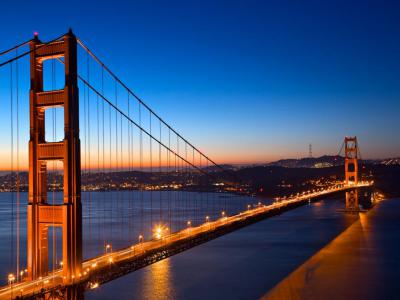
The Golden Gate Bridge stands proudly as a suspension bridge that spans the Golden Gate, a one-mile-wide (1.6 kilometers) strait connecting the majestic San Francisco Bay to the vast Pacific Ocean. This iconic structure serves as a vital link, connecting the bustling city of San Francisco, situated at the northern tip of the San Francisco Peninsula, to Marin County. It bears the weight of both U.S. Route 101 and California State Route 1, facilitating smooth transportation across the strait for vehicles and serves as a pathway for pedestrians and cyclists, also designated as a part of U.S. Bicycle Route 95. Notably, the American Society of Civil Engineers recognizes it as one of the Wonders of the Modern World, contributing to its international fame and making it a symbol synonymous with San Francisco and California.
The concept of establishing a fixed link between San Francisco and Marin had been gaining popularity since the late 19th century. However, it was not until the early 20th century that the idea became a feasible reality. Spearheading the endeavor, Joseph Strauss took on the role of chief engineer, while Leon Moisseiff, Irving Morrow, and Charles Ellis made significant design contributions. In 1937, the Golden Gate Bridge opened its doors to the public, marking a monumental achievement in engineering. Over the years, it has undergone various retrofits and improvement projects, ensuring its continued functionality and safety.
With its captivating beauty and iconic allure, the Golden Gate Bridge has been aptly described in Frommer's travel guide as "possibly the most beautiful, certainly the most photographed, bridge in the world." A testament to its grandeur, at the time of its inauguration in 1937, it held the titles of the longest and tallest suspension bridge globally, relinquishing them only in 1964 and 1998, respectively. The bridge's main span measures an impressive 4,200 feet (1,280 meters), while its total height soars to 746 feet (227 meters).
Why You Should Visit:
The highlight of any San Francisco trip.
Tip:
Some suggested viewpoints are from: Baker Beach on the southern end of the bridge as well as from Fort Point National Historic Site. These two will give you very nice scenic views of the bridge as a landscape. There is also the parking and visitor center on the northern end. It can be crowded, but this is one spot to begin your walking journey across the bridge.
The best photos can be taken on a ferry boat ride which will take you under the bridge and back again.
The concept of establishing a fixed link between San Francisco and Marin had been gaining popularity since the late 19th century. However, it was not until the early 20th century that the idea became a feasible reality. Spearheading the endeavor, Joseph Strauss took on the role of chief engineer, while Leon Moisseiff, Irving Morrow, and Charles Ellis made significant design contributions. In 1937, the Golden Gate Bridge opened its doors to the public, marking a monumental achievement in engineering. Over the years, it has undergone various retrofits and improvement projects, ensuring its continued functionality and safety.
With its captivating beauty and iconic allure, the Golden Gate Bridge has been aptly described in Frommer's travel guide as "possibly the most beautiful, certainly the most photographed, bridge in the world." A testament to its grandeur, at the time of its inauguration in 1937, it held the titles of the longest and tallest suspension bridge globally, relinquishing them only in 1964 and 1998, respectively. The bridge's main span measures an impressive 4,200 feet (1,280 meters), while its total height soars to 746 feet (227 meters).
Why You Should Visit:
The highlight of any San Francisco trip.
Tip:
Some suggested viewpoints are from: Baker Beach on the southern end of the bridge as well as from Fort Point National Historic Site. These two will give you very nice scenic views of the bridge as a landscape. There is also the parking and visitor center on the northern end. It can be crowded, but this is one spot to begin your walking journey across the bridge.
The best photos can be taken on a ferry boat ride which will take you under the bridge and back again.
