Custom Walk in Santorini, Greece by milraisa_8b6897 created on 2026-06-17
Guide Location: Greece » Santorini
Guide Type: Custom Walk
# of Sights: 7
Tour Duration: 22 Hour(s)
Travel Distance: 64.4 Km or 40 Miles
Share Key: HBP7T
Guide Type: Custom Walk
# of Sights: 7
Tour Duration: 22 Hour(s)
Travel Distance: 64.4 Km or 40 Miles
Share Key: HBP7T
How It Works
Please retrieve this walk in the GPSmyCity app. Once done, the app will guide you from one tour stop to the next as if you had a personal tour guide. If you created the walk on this website or come to the page via a link, please follow the instructions below to retrieve the walk in the app.
Retrieve This Walk in App
Step 1. Download the app "GPSmyCity: Walks in 1K+ Cities" on Apple App Store or Google Play Store.



Step 2. In the GPSmyCity app, download(or launch) the guide "Santorini Map and Walking Tours".
Step 3. Tap the menu button located at upper right corner of the "Walks" screen and select "Retrieve custom walk". Enter the share key: HBP7T
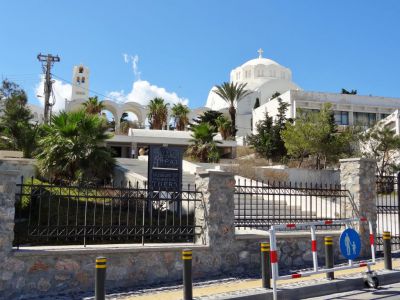
1) Museum of Prehistoric Thera (must see)
The Museum of Prehistoric Thera offers a focused introduction to Santorini’s prehistoric past, centered on the Bronze Age settlement of Akrotiri. The first displays you encounter provide broad context, introducing the island’s geology, volcanic landscape, and early settlement history. These sections frame the story of Thera before the catastrophic eruption of the 17th century BCE, setting the stage for the archaeological material that follows.
The exhibition then turns to finds drawn primarily from Akrotiri, with additional material from other sites on the island. Here, the focus shifts to the Late Cycladic I period, the final phase of life at Akrotiri. Pottery vessels, jewelry, and bronze tools illustrate everyday activities and technical skill, while more specialized ceramic forms, such as “bird jugs” decorated with swallow motifs, reflect both function and decoration.
Nearby, plaster casts of wooden furniture, including beds and storage units, offer one of the museum’s most tangible connections to daily life. Created from voids left in the volcanic ash after the original wood decayed, these casts preserve forms that are rarely visible in prehistoric archaeology and give a sense of how interior spaces were organized.
The museum’s highlight is presented on the second floor, where a major permanent exhibition opened in 2021 under the title “Thera Wall Paintings: The Masterpieces of Aegean Prehistory”. The frescoes are arranged according to their original iconographic programs, allowing visitors to see how painted scenes once functioned within specific rooms rather than as isolated images.
Among the most celebrated works are the saffron gatherers, the spring fresco with swallows, and compositions known as the Ladies, Papyri, and Blue Monkeys. Their vivid colors, rhythmic movement, and close observation of the natural world form the visual center of the museum. Smaller fragments surrounding them show how decoration extended throughout the interiors of Akrotiri’s houses.
One of the museum’s most exceptional small finds is the Gold Ibex figurine, discovered in 1999. Cast from solid gold, it is unique within Aegean prehistoric art and offers a glimpse into the wealth, craftsmanship, and symbolic culture of Akrotiri shortly before its burial. Together, the galleries present a coherent journey from geological forces to a fully developed Bronze Age settlement, preserved at a precise moment beneath volcanic ash.
The exhibition then turns to finds drawn primarily from Akrotiri, with additional material from other sites on the island. Here, the focus shifts to the Late Cycladic I period, the final phase of life at Akrotiri. Pottery vessels, jewelry, and bronze tools illustrate everyday activities and technical skill, while more specialized ceramic forms, such as “bird jugs” decorated with swallow motifs, reflect both function and decoration.
Nearby, plaster casts of wooden furniture, including beds and storage units, offer one of the museum’s most tangible connections to daily life. Created from voids left in the volcanic ash after the original wood decayed, these casts preserve forms that are rarely visible in prehistoric archaeology and give a sense of how interior spaces were organized.
The museum’s highlight is presented on the second floor, where a major permanent exhibition opened in 2021 under the title “Thera Wall Paintings: The Masterpieces of Aegean Prehistory”. The frescoes are arranged according to their original iconographic programs, allowing visitors to see how painted scenes once functioned within specific rooms rather than as isolated images.
Among the most celebrated works are the saffron gatherers, the spring fresco with swallows, and compositions known as the Ladies, Papyri, and Blue Monkeys. Their vivid colors, rhythmic movement, and close observation of the natural world form the visual center of the museum. Smaller fragments surrounding them show how decoration extended throughout the interiors of Akrotiri’s houses.
One of the museum’s most exceptional small finds is the Gold Ibex figurine, discovered in 1999. Cast from solid gold, it is unique within Aegean prehistoric art and offers a glimpse into the wealth, craftsmanship, and symbolic culture of Akrotiri shortly before its burial. Together, the galleries present a coherent journey from geological forces to a fully developed Bronze Age settlement, preserved at a precise moment beneath volcanic ash.
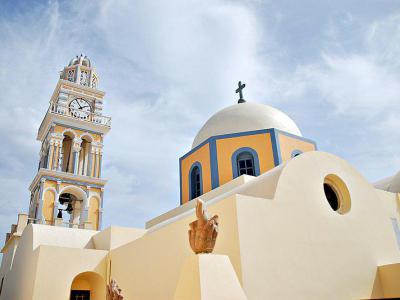
2) St. John the Baptist Cathedral (must see)
The Catholic Cathedral of Saint John the Baptist stands out as the principal Roman Catholic church on the island. Originally established in the 17th century during the period of Venetian influence, it reflects the Catholic presence fostered by Western religious orders, including the Jesuits. Like many buildings on Santorini, it was repeatedly affected by seismic activity. The structure seen today dates from a reconstruction completed in 1975, carried out in a restrained, Baroque-inspired style.
Approaching the cathedral, notice the peach-colored facade, which immediately distinguishes it from the island’s predominantly whitewashed Orthodox churches. The clock tower and bell tower, rising just to one side, serve as an easy visual marker from nearby streets.
As you step inside, pause near the entrance. To one side, you’ll find the confessional, a feature typical of Catholic churches but rarely encountered elsewhere on the island. Moving forward into the nave, your eye is naturally drawn toward the main altar, positioned beneath the dome and arranged according to Western liturgical tradition rather than behind an iconostasis.
Lift your gaze upward to the central chandelier, suspended below the dome. Its placement reinforces the height of the space and acts as the visual center of the interior. Above the altar, a large religious painting forms the focal point of the sanctuary, framed by soft blue, cream, and warm-toned surfaces that emphasize light and balance over heavy ornamentation. Along the side walls, look for a series of framed devotional paintings and portraits of saints, arranged in a clear, orderly sequence.
The cathedral remains an active place of worship, serving both local parishioners and visitors. Sunday Mass is regularly held, often attended by an international congregation, with parts of the service occasionally offered in multiple languages depending on those present. Visitors are expected to dress modestly and maintain a respectful atmosphere, especially during services.
Outside, the surrounding streets form part of Fira’s compact commercial center, with small shops, cafes, and casual eateries unfolding just beyond the church-an everyday setting that contrasts with the quiet, ordered interior you have just explored.
Approaching the cathedral, notice the peach-colored facade, which immediately distinguishes it from the island’s predominantly whitewashed Orthodox churches. The clock tower and bell tower, rising just to one side, serve as an easy visual marker from nearby streets.
As you step inside, pause near the entrance. To one side, you’ll find the confessional, a feature typical of Catholic churches but rarely encountered elsewhere on the island. Moving forward into the nave, your eye is naturally drawn toward the main altar, positioned beneath the dome and arranged according to Western liturgical tradition rather than behind an iconostasis.
Lift your gaze upward to the central chandelier, suspended below the dome. Its placement reinforces the height of the space and acts as the visual center of the interior. Above the altar, a large religious painting forms the focal point of the sanctuary, framed by soft blue, cream, and warm-toned surfaces that emphasize light and balance over heavy ornamentation. Along the side walls, look for a series of framed devotional paintings and portraits of saints, arranged in a clear, orderly sequence.
The cathedral remains an active place of worship, serving both local parishioners and visitors. Sunday Mass is regularly held, often attended by an international congregation, with parts of the service occasionally offered in multiple languages depending on those present. Visitors are expected to dress modestly and maintain a respectful atmosphere, especially during services.
Outside, the surrounding streets form part of Fira’s compact commercial center, with small shops, cafes, and casual eateries unfolding just beyond the church-an everyday setting that contrasts with the quiet, ordered interior you have just explored.
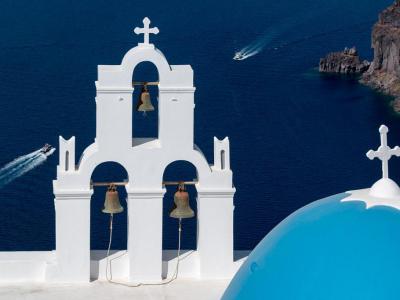
3) Three Bells of Fira (must see)
The Three Bells of Fira, officially known as the Catholic Church of the Dormition, belongs to the Greek Catholic Church and falls under the jurisdiction of the Catholic Diocese of Santorini, following the Byzantine liturgical tradition while remaining in communion with Rome.
The site has a long and layered history. In the 17th century, two small cave churches were carved into the cliff face here. As the settlement expanded and the terrain shifted, these early structures were lost. An infirmary was later built on the site and subsequently occupied by Jesuits, before the property was transferred to the Catholic authorities. The present-day church was constructed in 1757, forming the core of the structure seen today.
The church suffered serious damage during the 1956 Amorgos earthquake. Extensive restoration followed, giving the building its current appearance. Architecturally modest in scale, its visual impact comes from its setting and composition: whitewashed walls, a vivid blue dome, and a freestanding bell tower crowned with three bells. The bell tower, positioned slightly apart from the church itself, overlooks the caldera and the Nea Kameni volcanic islet.
The church is dedicated to the Dormition of the Virgin Mary, celebrated on 15 August, which remains its principal feast day. On this occasion, religious services and observances are held in keeping with Byzantine Catholic tradition.
Today, the Three Bells of Fira functions both as an active place of worship and as one of the island’s most photographed viewpoints. Its best-known view is from the clifftop viewpoint and parking area above the church, from where the dome and bell tower are seen framed against the sea and sky.
The site has a long and layered history. In the 17th century, two small cave churches were carved into the cliff face here. As the settlement expanded and the terrain shifted, these early structures were lost. An infirmary was later built on the site and subsequently occupied by Jesuits, before the property was transferred to the Catholic authorities. The present-day church was constructed in 1757, forming the core of the structure seen today.
The church suffered serious damage during the 1956 Amorgos earthquake. Extensive restoration followed, giving the building its current appearance. Architecturally modest in scale, its visual impact comes from its setting and composition: whitewashed walls, a vivid blue dome, and a freestanding bell tower crowned with three bells. The bell tower, positioned slightly apart from the church itself, overlooks the caldera and the Nea Kameni volcanic islet.
The church is dedicated to the Dormition of the Virgin Mary, celebrated on 15 August, which remains its principal feast day. On this occasion, religious services and observances are held in keeping with Byzantine Catholic tradition.
Today, the Three Bells of Fira functions both as an active place of worship and as one of the island’s most photographed viewpoints. Its best-known view is from the clifftop viewpoint and parking area above the church, from where the dome and bell tower are seen framed against the sea and sky.
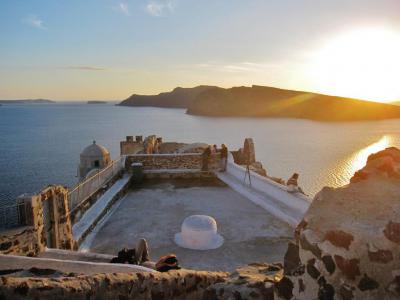
4) Oia Castle (must see)
Oia Castle, often identified as the Castle of Saint Nicholas, is a late-15th-century fortified site and one of the best-known historical landmarks in Oia today. Its ruins remain a major gathering point, especially in the evening, because the exposed cliffside position offers wide caldera views.
The castle was developed during the period of Venetian domination as part of Santorini’s network of fortified settlements, created to guard against pirate raids in the Aegean. Raids could involve theft and the taking of captives, which helps explain why local settlement patterns favored compact building and rapid retreat to defensible points. Some accounts also describe residents hiding valuables in pits beneath buildings within the fortified area; this is often repeated in local narratives about the site.
Within the castle complex, there were residences associated with the Venetian rulers, and the high position functioned as a lookout over sea routes. The stronghold is often said to have been taken by Ottoman forces in 1577, while wider histories place the Ottoman conquest of Santorini within the broader annexation of the Cyclades in 1579, so it’s best understood as a late-16th-century transition from Venetian to Ottoman control.
The site was severely damaged in the 1956 earthquake, when large sections of the fortifications and parts of the surrounding settlement collapsed down the cliffs. What remains today are fragments of walls and the base of defensive elements, but the viewpoint is still exceptional. From the ruins, visitors can clearly see the volcanic islets of Nea Kameni and Palea Kameni in the center of the caldera, as well as the nearby island of Thirasia to the northwest.
The castle was developed during the period of Venetian domination as part of Santorini’s network of fortified settlements, created to guard against pirate raids in the Aegean. Raids could involve theft and the taking of captives, which helps explain why local settlement patterns favored compact building and rapid retreat to defensible points. Some accounts also describe residents hiding valuables in pits beneath buildings within the fortified area; this is often repeated in local narratives about the site.
Within the castle complex, there were residences associated with the Venetian rulers, and the high position functioned as a lookout over sea routes. The stronghold is often said to have been taken by Ottoman forces in 1577, while wider histories place the Ottoman conquest of Santorini within the broader annexation of the Cyclades in 1579, so it’s best understood as a late-16th-century transition from Venetian to Ottoman control.
The site was severely damaged in the 1956 earthquake, when large sections of the fortifications and parts of the surrounding settlement collapsed down the cliffs. What remains today are fragments of walls and the base of defensive elements, but the viewpoint is still exceptional. From the ruins, visitors can clearly see the volcanic islets of Nea Kameni and Palea Kameni in the center of the caldera, as well as the nearby island of Thirasia to the northwest.
5) Ancient Thera (must see)
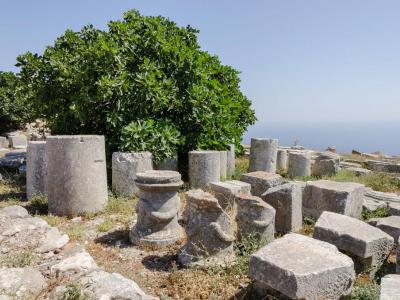
Ancient Thera was once a great civilization. Today, visitors can explore Ancient Thera's ruins. Ancient Thera was built on Mesa Vouno Mountain. This 365 meter (1197 feet) tall site provided the Lacedaemonian colonists with a strategic position for their town. The colonists originally arrived in the eighth century BC with King Theras and named the island after their king.
Later, the Ptolemaic dynasty inhabited the island, and Thera was Egpyt's military base in the fourth century BC.
The site was excavated from 1896 to 1961. Archeologists discovered a settlement that included extensive buildings and streets. The settlement dates to as early as the 9th century BC. Most of the settlement dates to the Hellenistic period. Archeologists unearthed cemeteries, temples, churches, markets, and a theatre.
The site features the Terrace of the Festivals, where men would dance to honor Apollo. Visitors can also see a spring inside a cave. This spring was vital to the settlement as it provided vital drinking water.
Visitors can tour the archeological site and enjoy the fabulous mountain-top views.
Why You Should Visit:
The views from Thera are just amazing and almost worth the time and price to get in to see. From Kamari and its beach to the Aegean Sea and Perissa to the south with its beaches and domed churches, there's much to see and appreciate.
Tip:
Depending on your fitness level, the walk up could easily take 30 mins to an hour. It's very windy at the top and throughout Thera, so be prepared – the wind gusts can be strong at times.
Later, the Ptolemaic dynasty inhabited the island, and Thera was Egpyt's military base in the fourth century BC.
The site was excavated from 1896 to 1961. Archeologists discovered a settlement that included extensive buildings and streets. The settlement dates to as early as the 9th century BC. Most of the settlement dates to the Hellenistic period. Archeologists unearthed cemeteries, temples, churches, markets, and a theatre.
The site features the Terrace of the Festivals, where men would dance to honor Apollo. Visitors can also see a spring inside a cave. This spring was vital to the settlement as it provided vital drinking water.
Visitors can tour the archeological site and enjoy the fabulous mountain-top views.
Why You Should Visit:
The views from Thera are just amazing and almost worth the time and price to get in to see. From Kamari and its beach to the Aegean Sea and Perissa to the south with its beaches and domed churches, there's much to see and appreciate.
Tip:
Depending on your fitness level, the walk up could easily take 30 mins to an hour. It's very windy at the top and throughout Thera, so be prepared – the wind gusts can be strong at times.
6) Perissa Black Sand Beach (must see)
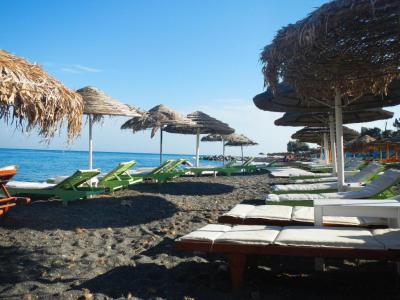
Perissa Beach is famous for its black volcanic sand and crystal clear water. Thousands of years ago, the volcano erupted and covered the island in black volcanic ash, pumice, and lava. As a result, Perissa Black Sand Beach has a high level of volcanic mix, making the sand appear black.
Visitors can stroll along the shore or relax on a sun lounger. Many restaurants provide beach umbrellas for patrons. Persissa Beach is cosmopolitan and offers a variety of shore-side and water activities. Visitors can also enjoy watersports such as swimming, canoeing, windsurfing, diving, or jet skiing.
Popular beach bars and restaurants line the beach. DJs play lively music while visitors try beachside cocktails. At night, check out the exciting nightlife and enjoy the beach clubs.
In addition, Perissa Beach has a waterpark with waterslides and pools. The waterpark is a great place for kids and adults to have fun.
Perissa Beach is a Blue Flag beach. This designation indicates that the beach is clean and sustainable.
Visitors can stroll along the shore or relax on a sun lounger. Many restaurants provide beach umbrellas for patrons. Persissa Beach is cosmopolitan and offers a variety of shore-side and water activities. Visitors can also enjoy watersports such as swimming, canoeing, windsurfing, diving, or jet skiing.
Popular beach bars and restaurants line the beach. DJs play lively music while visitors try beachside cocktails. At night, check out the exciting nightlife and enjoy the beach clubs.
In addition, Perissa Beach has a waterpark with waterslides and pools. The waterpark is a great place for kids and adults to have fun.
Perissa Beach is a Blue Flag beach. This designation indicates that the beach is clean and sustainable.
7) Akrotiri Excavation Site (must see)
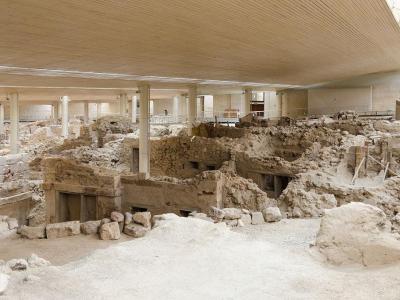
The Akrotiri Excavation Site in Santorini is a significant archaeological site that unveils a well-preserved Cycladic Bronze Age settlement. Named after the nearby village of Akrotiri, this site offers a unique glimpse into ancient life due to its exceptional preservation in volcanic ash from the Theran eruption in the 16th century BCE.
The earliest signs of human activity at Akrotiri date back to the fifth millennium BCE, starting as a modest fishing and farming village. By the end of the third millennium BCE, Akrotiri had developed into a thriving community, likely bolstered by trade with other Aegean cultures, as evidenced by foreign pottery fragments found at the site. Its strategic location on the main sailing route between Cyprus and Minoan Crete further facilitated its growth, particularly in the copper trade. This prosperity is reflected in the settlement’s sophisticated infrastructure, which included paved streets, an extensive drainage system, and advanced craft production.
Excavations on Santorini started in the 19th century, but it was Spyridon Marinatos's comprehensive excavations in 1967 that unveiled the significance of Akrotiri. Marinatos's efforts led to the discovery of the buried city, revealing buildings preserved to heights of more than one story, which posed distinctive challenges for the excavation process.
Excavated artifacts are now housed in the Museum of Prehistoric Thera, showcasing a wide array of objects and artworks, including pottery, which is abundant due to the sudden evacuation of the town. The variety of pottery found, from storage jars to cooking vessels, provides insight into the daily life and activities of the settlement’s inhabitants.
One noteworthy aspect of the excavation is the preservation of furniture. Volcanic ash created molds of disintegrated wooden objects, allowing archaeologists to use plaster to create casts of furniture, such as beds and tables. Offering tables, often found at the site, were made of clay or plaster and decorated similarly to wall paintings.
Why You Should Visit:
Very carefully prepared space showing a whole village's old buildings and life. Excellent guides and lots of information.
The whole area is covered with a hi-tech roof, so you can walk without being grilled by the sun.
The earliest signs of human activity at Akrotiri date back to the fifth millennium BCE, starting as a modest fishing and farming village. By the end of the third millennium BCE, Akrotiri had developed into a thriving community, likely bolstered by trade with other Aegean cultures, as evidenced by foreign pottery fragments found at the site. Its strategic location on the main sailing route between Cyprus and Minoan Crete further facilitated its growth, particularly in the copper trade. This prosperity is reflected in the settlement’s sophisticated infrastructure, which included paved streets, an extensive drainage system, and advanced craft production.
Excavations on Santorini started in the 19th century, but it was Spyridon Marinatos's comprehensive excavations in 1967 that unveiled the significance of Akrotiri. Marinatos's efforts led to the discovery of the buried city, revealing buildings preserved to heights of more than one story, which posed distinctive challenges for the excavation process.
Excavated artifacts are now housed in the Museum of Prehistoric Thera, showcasing a wide array of objects and artworks, including pottery, which is abundant due to the sudden evacuation of the town. The variety of pottery found, from storage jars to cooking vessels, provides insight into the daily life and activities of the settlement’s inhabitants.
One noteworthy aspect of the excavation is the preservation of furniture. Volcanic ash created molds of disintegrated wooden objects, allowing archaeologists to use plaster to create casts of furniture, such as beds and tables. Offering tables, often found at the site, were made of clay or plaster and decorated similarly to wall paintings.
Why You Should Visit:
Very carefully prepared space showing a whole village's old buildings and life. Excellent guides and lots of information.
The whole area is covered with a hi-tech roof, so you can walk without being grilled by the sun.
