Custom Walk in Hanoi, Vietnam by alek_das90_47784a created on 2026-06-20
Guide Location: Vietnam » Hanoi
Guide Type: Custom Walk
# of Sights: 6
Tour Duration: 2 Hour(s)
Travel Distance: 3.1 Km or 1.9 Miles
Share Key: YNZTU
Guide Type: Custom Walk
# of Sights: 6
Tour Duration: 2 Hour(s)
Travel Distance: 3.1 Km or 1.9 Miles
Share Key: YNZTU
How It Works
Please retrieve this walk in the GPSmyCity app. Once done, the app will guide you from one tour stop to the next as if you had a personal tour guide. If you created the walk on this website or come to the page via a link, please follow the instructions below to retrieve the walk in the app.
Retrieve This Walk in App
Step 1. Download the app "GPSmyCity: Walks in 1K+ Cities" on Apple App Store or Google Play Store.



Step 2. In the GPSmyCity app, download(or launch) the guide "Hanoi Map and Walking Tours".
Step 3. Tap the menu button located at upper right corner of the "Walks" screen and select "Retrieve custom walk". Enter the share key: YNZTU
1) Ngoc Son Temple
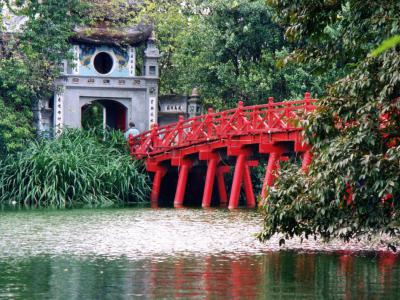
The Ncog Son temple stands on an island of the Hoan Kiem Lake. There was a temple at the location from the 14th century. The present structure was built in the 18th century. A three passage gate called the Tam Quan stands at one end of a red wooden bridge called The Huc (Rising Sun bridge). The Huc connects the Island with the mainland.
The Ncog Son temple is dedicated to many heroes. The main altar is dedicated to the hero Tran Hung Dao, who defeated and army of 300,000 invaders from the Chinese Yuan dynasty. Other altars are dedicated to La To, the patron saint of physicians, the scholar Van Xuong and Nguyen Van Sieu, a Confucian scholar who voluntarily restored the temple and its surroundings in 1864.
Nguyen Van Sieu added the Thap But, a 30 foot stone obelisk with a tip that resembles a paintbrush found to the left of the gates and Dai Nghien, a hollowed rock in the shape of a peach called the writing pad to the temple complex.
The temple has a pavilion in front of the altars and many souvenir shops for tourists. Elderly Vietnamese gather at the courtyard of the temple to play danh co tuong or Chinese Chess.
The Ncog Son temple is dedicated to many heroes. The main altar is dedicated to the hero Tran Hung Dao, who defeated and army of 300,000 invaders from the Chinese Yuan dynasty. Other altars are dedicated to La To, the patron saint of physicians, the scholar Van Xuong and Nguyen Van Sieu, a Confucian scholar who voluntarily restored the temple and its surroundings in 1864.
Nguyen Van Sieu added the Thap But, a 30 foot stone obelisk with a tip that resembles a paintbrush found to the left of the gates and Dai Nghien, a hollowed rock in the shape of a peach called the writing pad to the temple complex.
The temple has a pavilion in front of the altars and many souvenir shops for tourists. Elderly Vietnamese gather at the courtyard of the temple to play danh co tuong or Chinese Chess.
2) St. Joseph Cathedral
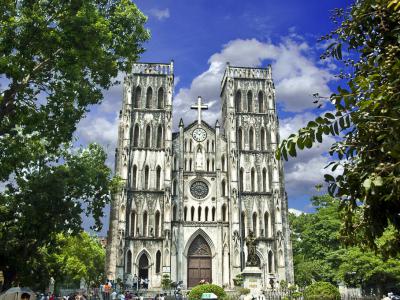
Saint Joseph's Cathedral in Hanoi serves as the seat of the Roman Catholic Archdiocese of Hanoi. Constructed in 1886 during French colonial rule, it is the oldest church in the city. Locally known as the "Big Church," it is situated on Nha Chung Street, close to the Ho Hoan Kiem, also known as the Lake of the Returned Sword.
The cathedral's location has a significant historical backdrop, as it was built on the site of the demolished Bao Thien Pagoda, a 12th-century temple constructed by the Ly Dynasty and formerly a vital place of worship for the local populace. This decision by the French to replace the pagoda highlighted their influence and architectural ambitions in Hanoi during their colonial tenure.
Saint Joseph's Cathedral was consecrated on Christmas Day, 1886, and features a neo-Gothic architectural style, mirroring the iconic Notre Dame Cathedral in Paris. This style is evident in its facade, characterized by twin towers flanked by impressive stained glass windows. These windows allow light to filter through in a myriad of colors, creating a visually captivating effect.
In front of the cathedral stands the Regina Pacis (Queen of Peace) statue of the Virgin Mary, adding to its spiritual and architectural significance. Inside, the cathedral is renowned for its beautiful interiors, which visitors can admire through a side door entry.
Mass is conducted twice daily at Saint Joseph's Cathedral, with increased attendance on Sundays and holidays, reflecting its central role in the religious life of the community. The cathedral remains a popular destination for both worshippers and tourists, offering a glimpse into the spiritual and colonial history of Hanoi.
The cathedral's location has a significant historical backdrop, as it was built on the site of the demolished Bao Thien Pagoda, a 12th-century temple constructed by the Ly Dynasty and formerly a vital place of worship for the local populace. This decision by the French to replace the pagoda highlighted their influence and architectural ambitions in Hanoi during their colonial tenure.
Saint Joseph's Cathedral was consecrated on Christmas Day, 1886, and features a neo-Gothic architectural style, mirroring the iconic Notre Dame Cathedral in Paris. This style is evident in its facade, characterized by twin towers flanked by impressive stained glass windows. These windows allow light to filter through in a myriad of colors, creating a visually captivating effect.
In front of the cathedral stands the Regina Pacis (Queen of Peace) statue of the Virgin Mary, adding to its spiritual and architectural significance. Inside, the cathedral is renowned for its beautiful interiors, which visitors can admire through a side door entry.
Mass is conducted twice daily at Saint Joseph's Cathedral, with increased attendance on Sundays and holidays, reflecting its central role in the religious life of the community. The cathedral remains a popular destination for both worshippers and tourists, offering a glimpse into the spiritual and colonial history of Hanoi.
3) Hang Bong Street (must see)
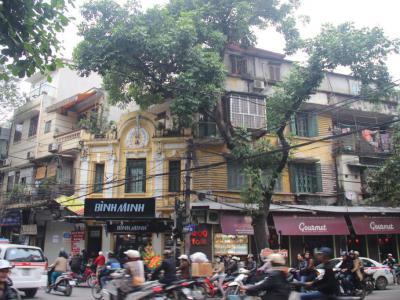
Hàng Bông (French: Rue du Coton) is an ancient street running for about 932 meters from the crossroad Hàng Bông - Hàng Gai - Hàng Trong - Hàng Hom to the former city gate Cửa Nam (South Gate). Once populated by cotton dealers and makers of clothes and winter blankets (hence the name), today's Hàng Bông is one of the busiest shopping streets in Hanoi, lined with art galleries, silk and clothing shops.
Formerly this street consisted of various sections, each with its own name, such as Hang Hai (aka Hang Bong Hai), Hang Manh (packed with shops selling comedy shoes, hats, and paper worship items), Hang Bong Dem (inhabited by sellers of cotton balls, cotton- and other blankets), Hang Bong Banyan Tree Cua Quyen (home to a small temple worshiping Co Quyen, with a banyan tree nearby), Hang Bong Lo (where all kinds of fish were sold), Hang Bong Tho Nhuom (back in the early 20th century this was home to the dyers of silk fabrics), and Hang Bong Alley (known during the French colonial era as Rue Lhonde).
Also, during the French period, Old Hang Bong Street was a home to many print houses, bookstores, and journalists. Notorious for many traffic accidents involving trams (prior to 1991), Hang Bong Street, since the turn of the 21st century, has been gradually associated with luxurious fashion, largely surpassing the rival destinations of Hang Dao, Luong Van Can and Tran Nhan Tong streets. Today, this street also accommodates the fancy Silk Path hotel where once used to be the music tea rooms, popular haunt for artists and other creative folk.
At night, Hang Bong Street is a popular gathering spot for youngsters and students, in large part due to the cheap fried and grilled spring rolls sold on the corner of Hang Bong junction and Tam Thuong alley. At the end of the street, on the right-hand (even-numbered) side is a pastry shop very famous with backpackers. On festive occasions, this street is also teeming with sellers of flags and T-shirts.
Formerly this street consisted of various sections, each with its own name, such as Hang Hai (aka Hang Bong Hai), Hang Manh (packed with shops selling comedy shoes, hats, and paper worship items), Hang Bong Dem (inhabited by sellers of cotton balls, cotton- and other blankets), Hang Bong Banyan Tree Cua Quyen (home to a small temple worshiping Co Quyen, with a banyan tree nearby), Hang Bong Lo (where all kinds of fish were sold), Hang Bong Tho Nhuom (back in the early 20th century this was home to the dyers of silk fabrics), and Hang Bong Alley (known during the French colonial era as Rue Lhonde).
Also, during the French period, Old Hang Bong Street was a home to many print houses, bookstores, and journalists. Notorious for many traffic accidents involving trams (prior to 1991), Hang Bong Street, since the turn of the 21st century, has been gradually associated with luxurious fashion, largely surpassing the rival destinations of Hang Dao, Luong Van Can and Tran Nhan Tong streets. Today, this street also accommodates the fancy Silk Path hotel where once used to be the music tea rooms, popular haunt for artists and other creative folk.
At night, Hang Bong Street is a popular gathering spot for youngsters and students, in large part due to the cheap fried and grilled spring rolls sold on the corner of Hang Bong junction and Tam Thuong alley. At the end of the street, on the right-hand (even-numbered) side is a pastry shop very famous with backpackers. On festive occasions, this street is also teeming with sellers of flags and T-shirts.
4) The Train Street
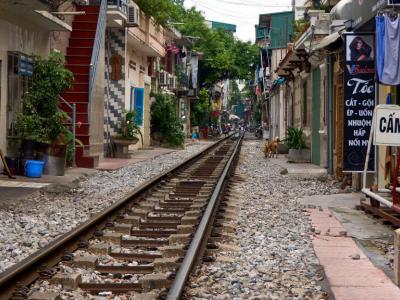
Ngõ 224 Lê Duẩn, situated within Hanoi’s Old Quarter, is famously dubbed as "The Train Street". This narrow alley witnesses a speeding train passing by twice a day, perilously close to the buildings flanking the tracks, which almost entirely occupy the alley. Constructed by the French in 1902, this railway line remains operational as of 2019.
The train whizzes through at 3 pm and 7 pm daily, traversing the route between Hanoi and Ho Chi Minh City to the south. Due to the alley's cramped dimensions, residents are compelled to clear away their personal belongings, including bicycles and even children, before the train's passage. It's a common sight to see locals leisurely seated on the tracks, savoring tea and engaging in games of checkers.
This peculiar street has garnered attention as a tourist attraction in Hanoi. However, in October 2019, local authorities, citing safety concerns and the potential for grave accidents, barred tourists from accessing the area. Tourists frequently halted to capture photographs for social media amidst the narrow confines of the alley. Over time, the street had become a residence for squatters and a haunt for drug addicts, alongside the presence of numerous cafes and residential buildings. The congestion eventually led to the rerouting of a local train on October 6, 2019, prompting the closure of the alley.
To cater to the bustling tourist influx, local cafes have flourished along the street. Owners fret over the impending loss of business due to the closure. According to the VN Express newspaper, a train driver recounted three near-misses with tourists on the tracks, narrowly averting catastrophe, with one incident involving a woman engrossed in photographing the passing train.
For tourists seeking a safe vantage point, outdoor seating areas of the local cafes offer a secure option. Cafe proprietors typically shift their stools closer to the walls and advise patrons to do the same as the train approaches. Many cafes also display train schedules on chalkboards for the convenience of their customers.
The train whizzes through at 3 pm and 7 pm daily, traversing the route between Hanoi and Ho Chi Minh City to the south. Due to the alley's cramped dimensions, residents are compelled to clear away their personal belongings, including bicycles and even children, before the train's passage. It's a common sight to see locals leisurely seated on the tracks, savoring tea and engaging in games of checkers.
This peculiar street has garnered attention as a tourist attraction in Hanoi. However, in October 2019, local authorities, citing safety concerns and the potential for grave accidents, barred tourists from accessing the area. Tourists frequently halted to capture photographs for social media amidst the narrow confines of the alley. Over time, the street had become a residence for squatters and a haunt for drug addicts, alongside the presence of numerous cafes and residential buildings. The congestion eventually led to the rerouting of a local train on October 6, 2019, prompting the closure of the alley.
To cater to the bustling tourist influx, local cafes have flourished along the street. Owners fret over the impending loss of business due to the closure. According to the VN Express newspaper, a train driver recounted three near-misses with tourists on the tracks, narrowly averting catastrophe, with one incident involving a woman engrossed in photographing the passing train.
For tourists seeking a safe vantage point, outdoor seating areas of the local cafes offer a secure option. Cafe proprietors typically shift their stools closer to the walls and advise patrons to do the same as the train approaches. Many cafes also display train schedules on chalkboards for the convenience of their customers.
5) Lenin Monument
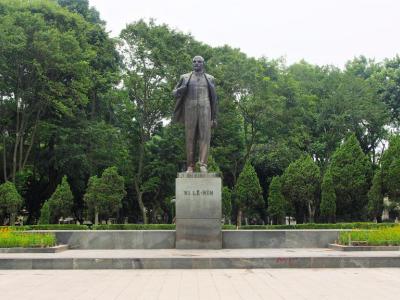
The Lenin Monument or Lenin Statue is a stone sculpture of the Bolshevik Russian revolutionary, Vladimir Ilyich Ulyanov, popularly known as Lenin. The statue is located on a playground in Duong Dien Bien Phu Street in Hanoi called Lenin Park.
The Lenin statue was erected in Thong Nhat Park in 1980 to commemorate the 110th anniversary of Lenin. It was a gift from the USSR to the Vietnamese people. The statue was later placed at the location that was renamed Lenin Park. It now faces Hanoi’s Military History Museum.
The present Lenin Park is a playground frequented by locals. In the morning synchronized Tai Chi exercises are performed here. Aerobics classes are held in the mornings for people of all ages. In the evening the park becomes crowded because it is a popular playground for children. Badminton players and soccer teams also practice here.
The Lenin statue stands in the triangular Lenin Park amidst palm trees. It is one of the few statues of Lenin left in the world and is a reminder of the impact the USSR had in its heyday on world politics including that of Vietnam and the support it provided for revolutionary movements all over the world.
The Lenin statue was erected in Thong Nhat Park in 1980 to commemorate the 110th anniversary of Lenin. It was a gift from the USSR to the Vietnamese people. The statue was later placed at the location that was renamed Lenin Park. It now faces Hanoi’s Military History Museum.
The present Lenin Park is a playground frequented by locals. In the morning synchronized Tai Chi exercises are performed here. Aerobics classes are held in the mornings for people of all ages. In the evening the park becomes crowded because it is a popular playground for children. Badminton players and soccer teams also practice here.
The Lenin statue stands in the triangular Lenin Park amidst palm trees. It is one of the few statues of Lenin left in the world and is a reminder of the impact the USSR had in its heyday on world politics including that of Vietnam and the support it provided for revolutionary movements all over the world.
6) Temple of Literature (must see)
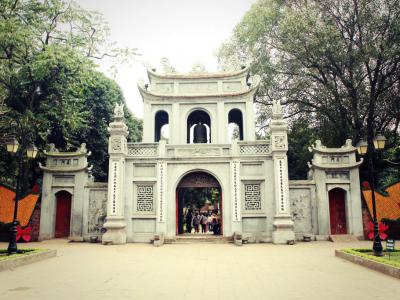
The Temple of Literature, dedicated to the Chinese Philosopher is one of Hanoi’s oldest structures. There are many temples of literature across Vietnam but the Hanoi temple is the oldest and the most important among them. It is also the venue of the country’s earliest university.
The Temple of Literature was founded by Emperor Ly Thanh Tong in 1070 a few years after the establishment of the city of Hanoi. The University established six years later admitted children from the royal family and students from the families of Mandarins. In 1484, Emperor Le Thanh Tong erected steles to record the achievements of students who were awarded doctorates by the university. It ceased to function in 1802 when it was shifted to a new venue.
The temple has five courtyards with boundary walls. Two courtyards have trees, some of which are over a hundred years old. One courtyard has a pond surrounded by sheltered pavilions and steles with details of students who earned doctorates at the university. The Courtyard of the Sage Sanctuary has a building called the Great House of Ceremonies. The house has a large red lacquer figure of Confucius. The last courtyard called the Thai Hoc has a two storey building honoring the founders of the university. There are two square structures on either side of the building to house a drum and a bell.
The Temple of Literature is open from Tuesdays to Sundays and visitors can find mementoes to take home at the souvenir and craft shops near the Great House of Ceremonies.
The Temple of Literature was founded by Emperor Ly Thanh Tong in 1070 a few years after the establishment of the city of Hanoi. The University established six years later admitted children from the royal family and students from the families of Mandarins. In 1484, Emperor Le Thanh Tong erected steles to record the achievements of students who were awarded doctorates by the university. It ceased to function in 1802 when it was shifted to a new venue.
The temple has five courtyards with boundary walls. Two courtyards have trees, some of which are over a hundred years old. One courtyard has a pond surrounded by sheltered pavilions and steles with details of students who earned doctorates at the university. The Courtyard of the Sage Sanctuary has a building called the Great House of Ceremonies. The house has a large red lacquer figure of Confucius. The last courtyard called the Thai Hoc has a two storey building honoring the founders of the university. There are two square structures on either side of the building to house a drum and a bell.
The Temple of Literature is open from Tuesdays to Sundays and visitors can find mementoes to take home at the souvenir and craft shops near the Great House of Ceremonies.
