Custom Walk in Calgary, Alberta by wsummers65_56e4ae created on 2026-06-24
Guide Location: Canada » Calgary
Guide Type: Custom Walk
# of Sights: 9
Tour Duration: 3 Hour(s)
Travel Distance: 5.5 Km or 3.4 Miles
Share Key: VE4ZF
Guide Type: Custom Walk
# of Sights: 9
Tour Duration: 3 Hour(s)
Travel Distance: 5.5 Km or 3.4 Miles
Share Key: VE4ZF
How It Works
Please retrieve this walk in the GPSmyCity app. Once done, the app will guide you from one tour stop to the next as if you had a personal tour guide. If you created the walk on this website or come to the page via a link, please follow the instructions below to retrieve the walk in the app.
Retrieve This Walk in App
Step 1. Download the app "GPSmyCity: Walks in 1K+ Cities" on Apple App Store or Google Play Store.



Step 2. In the GPSmyCity app, download(or launch) the guide "Calgary Map and Walking Tours".
Step 3. Tap the menu button located at upper right corner of the "Walks" screen and select "Retrieve custom walk". Enter the share key: VE4ZF
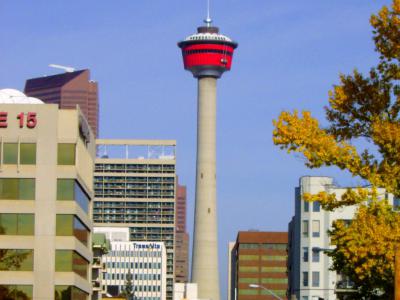
1) Calgary Tower (must see)
Rising above downtown like a confident exclamation point, Calgary Tower reaches 191 metres into the prairie sky. It first appeared in 1967 under the name Husky Tower, built as part of a downtown renewal push and timed neatly with Canada’s centennial celebrations. The project was a joint effort between Husky Oil and Realty Company Limited, and a few years later, in 1971, the tower was officially renamed-simple, direct, and very Calgary. It also earned early bragging rights as a founding member of the World Federation of Great Towers, which is exactly what it sounds like.
The tower was designed by W. G. Milne & A. Dale and Associates and took just fifteen months to complete, a quick turnaround for something this tall. Structurally, it’s no lightweight: the tower can handle winds of up to 161 kilometres per hour and is engineered to withstand earthquakes. One of its quiet engineering feats is the central column, poured continuously over 24 straight days without stopping-a detail easy to miss, but impressive once you know it.
Up top, the views do most of the talking. The observation level gives you a full sweep of the city grid, the rivers, and, on clear days, the distant outline of the Rocky Mountains. If you prefer your skyline with a side of dinner, there’s the revolving Sky 360 restaurant, where the city slowly turns beneath your table while you stay comfortably seated. It’s multitasking at its finest: eat, relax, and sightsee all at once.
At ground level, the tower plugs straight into Calgary’s +15 Skyway network, an elevated indoor walkway system that keeps downtown connected year-round. From here, you can walk indoors to places like the Fairmont Palliser Hotel, One Palliser Square, and EnCana Place. Whether you head up, dine around, or drift off through the skywalks, the Calgary Tower is less a stop-and-go landmark and more a smooth transition between the city’s past ambitions and its modern rhythm.
The tower was designed by W. G. Milne & A. Dale and Associates and took just fifteen months to complete, a quick turnaround for something this tall. Structurally, it’s no lightweight: the tower can handle winds of up to 161 kilometres per hour and is engineered to withstand earthquakes. One of its quiet engineering feats is the central column, poured continuously over 24 straight days without stopping-a detail easy to miss, but impressive once you know it.
Up top, the views do most of the talking. The observation level gives you a full sweep of the city grid, the rivers, and, on clear days, the distant outline of the Rocky Mountains. If you prefer your skyline with a side of dinner, there’s the revolving Sky 360 restaurant, where the city slowly turns beneath your table while you stay comfortably seated. It’s multitasking at its finest: eat, relax, and sightsee all at once.
At ground level, the tower plugs straight into Calgary’s +15 Skyway network, an elevated indoor walkway system that keeps downtown connected year-round. From here, you can walk indoors to places like the Fairmont Palliser Hotel, One Palliser Square, and EnCana Place. Whether you head up, dine around, or drift off through the skywalks, the Calgary Tower is less a stop-and-go landmark and more a smooth transition between the city’s past ambitions and its modern rhythm.
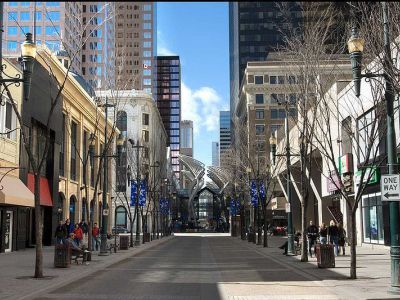
2) Stephen Avenue (must see)
Downtown Calgary is where the city turns up the volume, and Stephen Avenue is right at the centre of it. This pedestrian-only stretch is the main stage for shopping, people-watching, and everyday city life. Cafés spill onto the sidewalks, bars and pubs keep things lively well into the evening, and restaurants cover everything from quick bites to polished dining. If you enjoy browsing-or seriously shopping-this is the place where Calgary shows off its retail confidence, with a mix of high-end stores and small boutiques tempting you at every turn.
Lined along the avenue are major shopping complexes such as The Bay Department Store, Bankers Hall, Scotia Centre, Fashion Central, and the Core Shopping Centre, making it easy to move from one indoor space to the next without losing momentum. You’ll also pass major hotels like the Calgary Marriott and the Hyatt Regency, along with the Telus Convention Centre, which adds a steady flow of visitors to the street. It’s busy, but not chaotic-more like a steady urban rhythm that pulls you along.
Stephen Avenue isn’t just about modern commerce, though. In 1992, it was officially designated a National Historic Site of Canada, and the reason becomes clear when you start looking up. Many of the buildings here date back to the late 19th century and are built from local sandstone. After a devastating fire in 1886 damaged much of the city, these structures were designed to resist future disasters, giving the street its distinctive, solid look.
The avenue takes its name from George Stephen, the first president of the Canadian Pacific Railway and later the first Baron Mount Stephen, linking the street directly to the forces that shaped Calgary’s growth.
As you walk this stretch, take your time. Let the mix of history, architecture, shopping, and street life set the pace. Stephen Avenue isn’t something to rush-it’s one of those places where Calgary explains itself best, one block at a time.
Lined along the avenue are major shopping complexes such as The Bay Department Store, Bankers Hall, Scotia Centre, Fashion Central, and the Core Shopping Centre, making it easy to move from one indoor space to the next without losing momentum. You’ll also pass major hotels like the Calgary Marriott and the Hyatt Regency, along with the Telus Convention Centre, which adds a steady flow of visitors to the street. It’s busy, but not chaotic-more like a steady urban rhythm that pulls you along.
Stephen Avenue isn’t just about modern commerce, though. In 1992, it was officially designated a National Historic Site of Canada, and the reason becomes clear when you start looking up. Many of the buildings here date back to the late 19th century and are built from local sandstone. After a devastating fire in 1886 damaged much of the city, these structures were designed to resist future disasters, giving the street its distinctive, solid look.
The avenue takes its name from George Stephen, the first president of the Canadian Pacific Railway and later the first Baron Mount Stephen, linking the street directly to the forces that shaped Calgary’s growth.
As you walk this stretch, take your time. Let the mix of history, architecture, shopping, and street life set the pace. Stephen Avenue isn’t something to rush-it’s one of those places where Calgary explains itself best, one block at a time.
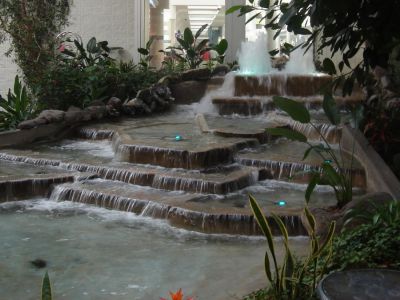
3) Devonian Gardens in Core Shopping Center
You might come to the Core Shopping Centre for errands, fashion, or a last-minute souvenir-but here’s the twist: one of its best features has nothing to do with shopping at all.
Head upstairs and you’ll find the Devonian Gardens, an indoor botanical garden quietly thriving above the retail buzz. More than 500 trees grow here, joined by a living wall, gentle fountains, and winding paths that feel worlds away from escalators and checkout lines. It’s all cared for by the city’s parks department, which explains why it feels more like a greenhouse escape than a mall add-on.
This is a place made for slowing down. You can wander through the greenery, settle into a chair with a book, or claim a table for lunch that somehow feels outdoors, even though you’re still indoors. There’s a public piano waiting for anyone brave-or talented-enough to sit down and play, adding a bit of surprise soundtrack to the space. Families will notice a dedicated children’s play area, giving younger visitors room to burn off energy while adults take a breather.
Best of all, there’s no ticket, no time limit, and no pressure to buy anything. You can drop in for five minutes or stay for an hour, treat it as a shortcut or a destination. In a city known for big skies and open parks, Devonian Gardens proves that even above a shopping centre, Calgary still makes room for calm, green pauses-sometimes exactly where you least expect them.
Head upstairs and you’ll find the Devonian Gardens, an indoor botanical garden quietly thriving above the retail buzz. More than 500 trees grow here, joined by a living wall, gentle fountains, and winding paths that feel worlds away from escalators and checkout lines. It’s all cared for by the city’s parks department, which explains why it feels more like a greenhouse escape than a mall add-on.
This is a place made for slowing down. You can wander through the greenery, settle into a chair with a book, or claim a table for lunch that somehow feels outdoors, even though you’re still indoors. There’s a public piano waiting for anyone brave-or talented-enough to sit down and play, adding a bit of surprise soundtrack to the space. Families will notice a dedicated children’s play area, giving younger visitors room to burn off energy while adults take a breather.
Best of all, there’s no ticket, no time limit, and no pressure to buy anything. You can drop in for five minutes or stay for an hour, treat it as a shortcut or a destination. In a city known for big skies and open parks, Devonian Gardens proves that even above a shopping centre, Calgary still makes room for calm, green pauses-sometimes exactly where you least expect them.
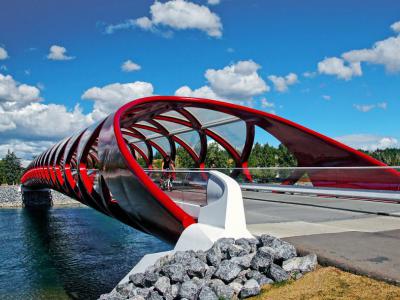
4) Peace Bridge (must see)
The Peace Bridge is a pedestrian and cyclist crossing over the Bow River, spanning about 130.6 meters in length and 8 meters across, with a tubular double-helix truss design that stands roughly 5.85 meters tall. Conceived by Spanish architect Santiago Calatrava and completed in March 2012, this signature red-and-white structure - echoing both national and civic colours - bridges the southern Eau Claire/Downtown pathway with the northern Sunnyside community.
As a sculptural marvel, the bridge’s helical steel frame-comprising around 850 tonnes of steel-withstands without piers in the water, preserving the river’s natural flow and minimizing ecological impact. Covered with curved glass panels and well-lit at night, it offers a sheltered, barrier-free experience for walkers and riders alike. The interior width is split into a 3.7-meter pedestrian walkway and a 2.5-meter cycling lane, helping manage up to 9,000 users daily.
Beyond functionality, the Peace Bridge has quickly become one of Calgary’s most photographed landmarks. Its striking form-likened by many to a giant finger-trap puzzle-provides dynamic sightlines toward the downtown skyline and the serene Bow River, especially during sunrise or twilight. Despite initial controversy over cost and design, it earned accolades as a top architectural project and public space of 2012.
For visitors, the bridge offers more than just a crossing-it’s a walking art installation. The seamless glide between neighborhoods invites exploration of surrounding gems like Eau Claire Market, Prince’s Island Park, and the pathways that line the riverbanks. Whether you’re on foot or bike, crossing during evening illuminations or sunshine-dappled days, the Peace Bridge is a vibrant invitation to connect with Calgary’s urban pulse and riverside beauty.
As a sculptural marvel, the bridge’s helical steel frame-comprising around 850 tonnes of steel-withstands without piers in the water, preserving the river’s natural flow and minimizing ecological impact. Covered with curved glass panels and well-lit at night, it offers a sheltered, barrier-free experience for walkers and riders alike. The interior width is split into a 3.7-meter pedestrian walkway and a 2.5-meter cycling lane, helping manage up to 9,000 users daily.
Beyond functionality, the Peace Bridge has quickly become one of Calgary’s most photographed landmarks. Its striking form-likened by many to a giant finger-trap puzzle-provides dynamic sightlines toward the downtown skyline and the serene Bow River, especially during sunrise or twilight. Despite initial controversy over cost and design, it earned accolades as a top architectural project and public space of 2012.
For visitors, the bridge offers more than just a crossing-it’s a walking art installation. The seamless glide between neighborhoods invites exploration of surrounding gems like Eau Claire Market, Prince’s Island Park, and the pathways that line the riverbanks. Whether you’re on foot or bike, crossing during evening illuminations or sunshine-dappled days, the Peace Bridge is a vibrant invitation to connect with Calgary’s urban pulse and riverside beauty.
5) Prince's Island Park (must see)
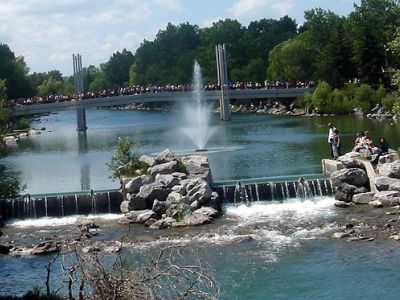
No city visit feels quite right without a pause in its favourite green space, and in Calgary, that role belongs to Prince’s Island Park. This riverside park draws a steady mix of locals and visitors every day, and it’s easy to see why. It’s a place where the city slows down just enough for people to sit back, watch life pass by, and enjoy being outdoors without leaving the urban core behind.
Spread across about 20 hectares, the park comes into its own in summer. Sun-seekers stretch out on the grass, paths fill with walkers and cyclists, and the whole area hums with a relaxed, social energy. Even when the temperatures drop, the park doesn’t go quiet. In winter, the same pathways are taken over by people gliding along on roller blades or cross-country skis, turning the landscape into a cold-weather playground. Tucked into a quieter corner, the River Café adds a softer note, offering a calm spot where conversations linger a little longer.
Nature plays a leading role here, despite the downtown setting. Wetlands attract geese and other wildlife, giving visitors a chance to watch nature at work up close. A lagoon, small fountains, and carefully kept flower beds shape the scenery, while the river itself invites exploration. In warmer months, paddling along the water offers a different view of the park, with the city skyline never far from sight.
Summer also brings crowds for another reason: festivals. Prince’s Island Park regularly hosts events that fill the lawns with music, food stalls, and temporary stages. At the same time, quieter paths wind through the wetland area, where an environmental learning trail explains how this landscape supports wildlife and helps maintain water quality. It’s a reminder that the park is more than a backdrop-it’s an active part of the city’s ecosystem.
For many, this park becomes a favourite memory of Calgary: lively without being overwhelming, central yet calm, and always changing with the seasons. It’s the kind of place people return to, even after they’ve already moved on.
Spread across about 20 hectares, the park comes into its own in summer. Sun-seekers stretch out on the grass, paths fill with walkers and cyclists, and the whole area hums with a relaxed, social energy. Even when the temperatures drop, the park doesn’t go quiet. In winter, the same pathways are taken over by people gliding along on roller blades or cross-country skis, turning the landscape into a cold-weather playground. Tucked into a quieter corner, the River Café adds a softer note, offering a calm spot where conversations linger a little longer.
Nature plays a leading role here, despite the downtown setting. Wetlands attract geese and other wildlife, giving visitors a chance to watch nature at work up close. A lagoon, small fountains, and carefully kept flower beds shape the scenery, while the river itself invites exploration. In warmer months, paddling along the water offers a different view of the park, with the city skyline never far from sight.
Summer also brings crowds for another reason: festivals. Prince’s Island Park regularly hosts events that fill the lawns with music, food stalls, and temporary stages. At the same time, quieter paths wind through the wetland area, where an environmental learning trail explains how this landscape supports wildlife and helps maintain water quality. It’s a reminder that the park is more than a backdrop-it’s an active part of the city’s ecosystem.
For many, this park becomes a favourite memory of Calgary: lively without being overwhelming, central yet calm, and always changing with the seasons. It’s the kind of place people return to, even after they’ve already moved on.
6) Chinatown
Calgary’s Chinatown sits just north of downtown, pressed up against the Bow River, and it’s compact enough to explore without ever feeling rushed. The streets here are lined with restaurants, small shops, and cultural spaces, creating a neighbourhood that feels busy but approachable. You can cross it in minutes-or stretch the visit out with a meal, a browse, or a pause by the river.
This is one of those areas where time is flexible. A focused walk of about half an hour is enough to see the main sights, but Chinatown has a habit of slowing people down. A menu catches your eye, a shop window pulls you in, or a festival sound drifts across the street, and suddenly your short visit turns into a longer stay.
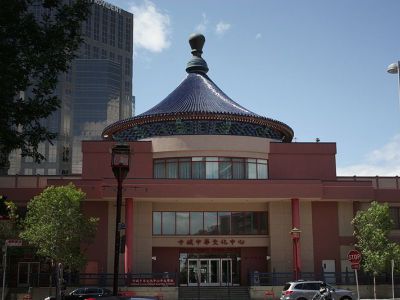
Along the riverfront, Sien Lok Park runs parallel to the water, quietly honoring the first Chinese settlers who helped shape the city. It’s a good place to step off the street and let the river set the tempo. Just across the road stands the Calgary Chinese Cultural Centre, a striking building that houses exhibitions, a museum, and community spaces. Throughout the year, it also becomes a focal point for events, especially during celebrations like the Chinese Lunar New Year, when the area comes alive with color, music, and movement.
Chinatown doesn’t ask for a strict plan. Wander, stop when something interests you, and let the neighbourhood guide the rhythm. It’s a small district, but it leaves a strong impression-and it fits easily into a walk along the river or a longer exploration of the city.
This is one of those areas where time is flexible. A focused walk of about half an hour is enough to see the main sights, but Chinatown has a habit of slowing people down. A menu catches your eye, a shop window pulls you in, or a festival sound drifts across the street, and suddenly your short visit turns into a longer stay.
Along the riverfront, Sien Lok Park runs parallel to the water, quietly honoring the first Chinese settlers who helped shape the city. It’s a good place to step off the street and let the river set the tempo. Just across the road stands the Calgary Chinese Cultural Centre, a striking building that houses exhibitions, a museum, and community spaces. Throughout the year, it also becomes a focal point for events, especially during celebrations like the Chinese Lunar New Year, when the area comes alive with color, music, and movement.
Chinatown doesn’t ask for a strict plan. Wander, stop when something interests you, and let the neighbourhood guide the rhythm. It’s a small district, but it leaves a strong impression-and it fits easily into a walk along the river or a longer exploration of the city.
7) Wonderland Sculpture (must see)
Calgary’s skyline curves just a little at The Bow, a crescent-shaped skyscraper that looks like it leaned into the wind and decided to stay that way. It’s a serious piece of architecture-so serious, in fact, that Azure Magazine once ranked it among the world’s top ten architectural projects. Still, most walking tours pause here for a reason that has nothing to do with offices or glass façades.
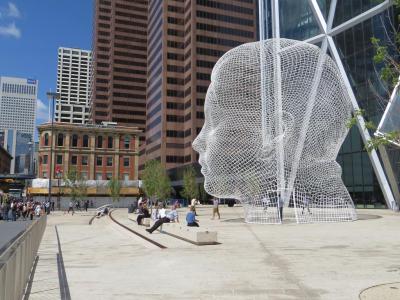
Right out front stands Wonderland Sculpture, a 39-foot-tall wire head created by Spanish artist Jaume Plensa. The sculpture represents a young girl, her face open and transparent, meant to suggest imagination, possibility, and the inner world of youth. It’s light, airy, and slightly surreal-like a thought bubble that escaped into the city.
Unlike most public sculptures, Wonderland invites you inside. Step through the wire framework and suddenly the city surrounds you from a different angle, as if you’re borrowing the viewpoint of all those dreams the artwork is meant to hold.
Set along 6th Avenue and only a short walk from Olympic Plaza, Wonderland is an easy stop-but one that tends to linger in memory. It’s proof that sometimes the most talked-about landmark isn’t the building reaching for the sky, but the artwork quietly watching it.
Right out front stands Wonderland Sculpture, a 39-foot-tall wire head created by Spanish artist Jaume Plensa. The sculpture represents a young girl, her face open and transparent, meant to suggest imagination, possibility, and the inner world of youth. It’s light, airy, and slightly surreal-like a thought bubble that escaped into the city.
Unlike most public sculptures, Wonderland invites you inside. Step through the wire framework and suddenly the city surrounds you from a different angle, as if you’re borrowing the viewpoint of all those dreams the artwork is meant to hold.
Set along 6th Avenue and only a short walk from Olympic Plaza, Wonderland is an easy stop-but one that tends to linger in memory. It’s proof that sometimes the most talked-about landmark isn’t the building reaching for the sky, but the artwork quietly watching it.
8) Old City Hall
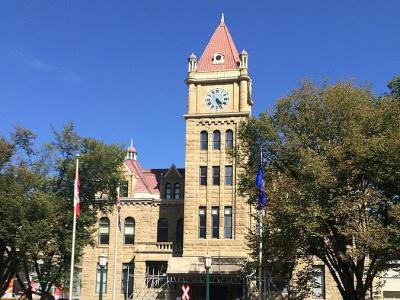
Built in 1911, Old City Hall has been clocking in for municipal duty for well over a century-and it hasn’t missed a shift yet. Designed by architect William M. Dodd in the Richardsonian Romanesque style, the building borrows its look from medieval Europe, specifically 11th- and 12th-century Romanesque churches. Think thick stone walls, deep-set windows, rounded arches, and a solid, no-nonsense symmetry that quietly says, this place means business...
Time, weather, and prairie winters eventually took their toll, so the building has seen several restoration efforts. The most recent came in 2014, when parts of the stone exterior started to crumble-an understandable complaint after a hundred-plus years outdoors. Long before that, its value had already been recognized: it was named a Provincial Historical Resource in 1978 and earned National Historic Site status in 1984. In other words, this is officially important stonework.
What makes Old City Hall especially interesting is that it’s not frozen in the past. It’s still very much alive and working. The building continues to house the mayor’s office and city council, and it remains the setting for Calgary City Council meetings. Decisions shaping the modern city are still being made inside walls that were raised when Calgary was barely out of its early growth stage.
Standing here, it’s easy to see how the city has expanded outward from this point. Glass towers, open plazas, and newer cultural spaces now surround a structure that once stood near the heart of a much smaller settlement. Just a short walk away, you’ll find the Central Library with its bold contemporary design, and Olympic Plaza, a public space tied to the city’s more recent global moment.
Old City Hall doesn’t shout for attention-it doesn’t need to. Instead, it quietly anchors the area, reminding you that Calgary’s story isn’t just about rapid growth and modern skylines, but also about continuity. Same building, same purpose-just a much bigger city around it.
Time, weather, and prairie winters eventually took their toll, so the building has seen several restoration efforts. The most recent came in 2014, when parts of the stone exterior started to crumble-an understandable complaint after a hundred-plus years outdoors. Long before that, its value had already been recognized: it was named a Provincial Historical Resource in 1978 and earned National Historic Site status in 1984. In other words, this is officially important stonework.
What makes Old City Hall especially interesting is that it’s not frozen in the past. It’s still very much alive and working. The building continues to house the mayor’s office and city council, and it remains the setting for Calgary City Council meetings. Decisions shaping the modern city are still being made inside walls that were raised when Calgary was barely out of its early growth stage.
Standing here, it’s easy to see how the city has expanded outward from this point. Glass towers, open plazas, and newer cultural spaces now surround a structure that once stood near the heart of a much smaller settlement. Just a short walk away, you’ll find the Central Library with its bold contemporary design, and Olympic Plaza, a public space tied to the city’s more recent global moment.
Old City Hall doesn’t shout for attention-it doesn’t need to. Instead, it quietly anchors the area, reminding you that Calgary’s story isn’t just about rapid growth and modern skylines, but also about continuity. Same building, same purpose-just a much bigger city around it.
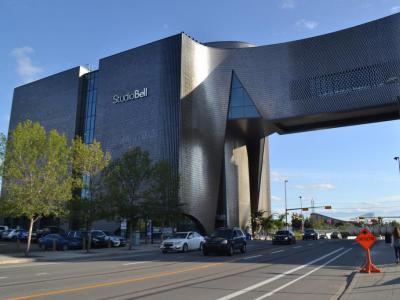
9) Studio Bell - National Music Centre (must see)
Any Calgary walking tour that skips the Downtown East Village is cutting corners. This is where the city first took shape, and Fort Calgary still marks that original starting point. From frontier beginnings, the neighbourhood has grown into one of the city’s most active cultural areas, and its biggest crowd-puller today is the music museum everyone talks about.
Here’s where names get a little tangled. The museum is officially the National Music Centre, but the striking building it occupies is called Studio Bell. Call it one, call it the other-either way, this is one of Calgary’s standout stops, and you’ll hear it mentioned often.
Inside, the experience is anything but passive. The permanent exhibitions are built to be explored, not just observed. Music Mosaic walks through the story of music in Canada, touching not only on performers but also on inventors and broadcasters who shaped how music is made and shared.
The Power of Music takes a more personal angle, inviting visitors to sing in vocal booths, watch live performances, and learn how music affects the body and the brain. Then there’s Making Music, where you’re encouraged to sit down and actually play-from percussion instruments all the way to a baby grand piano.
Another major draw is the Canadian Music Hall of Fame, which celebrates artists who helped put Canadian music on the world stage-among them Alanis Morissette, Shania Twain, Bryan Adams, David Foster, and Leonard Cohen, to mention but a few. The range is wide, spanning different genres and generations, and together they underline just how influential Canada’s music scene has been.
Studio Bell also hosts regular concerts, film screenings, and touring exhibitions. If your timing is right, your visit might include a live performance or a special event layered onto the museum experience. It’s worth checking the official calendar in advance, since tickets are timed and entry is strictly scheduled. The doors are open on weekends from 10 a.m. to 5 p.m.-so plan ahead, show up on time, and let the rhythm of Calgary’s music history pull you in.
Here’s where names get a little tangled. The museum is officially the National Music Centre, but the striking building it occupies is called Studio Bell. Call it one, call it the other-either way, this is one of Calgary’s standout stops, and you’ll hear it mentioned often.
Inside, the experience is anything but passive. The permanent exhibitions are built to be explored, not just observed. Music Mosaic walks through the story of music in Canada, touching not only on performers but also on inventors and broadcasters who shaped how music is made and shared.
The Power of Music takes a more personal angle, inviting visitors to sing in vocal booths, watch live performances, and learn how music affects the body and the brain. Then there’s Making Music, where you’re encouraged to sit down and actually play-from percussion instruments all the way to a baby grand piano.
Another major draw is the Canadian Music Hall of Fame, which celebrates artists who helped put Canadian music on the world stage-among them Alanis Morissette, Shania Twain, Bryan Adams, David Foster, and Leonard Cohen, to mention but a few. The range is wide, spanning different genres and generations, and together they underline just how influential Canada’s music scene has been.
Studio Bell also hosts regular concerts, film screenings, and touring exhibitions. If your timing is right, your visit might include a live performance or a special event layered onto the museum experience. It’s worth checking the official calendar in advance, since tickets are timed and entry is strictly scheduled. The doors are open on weekends from 10 a.m. to 5 p.m.-so plan ahead, show up on time, and let the rhythm of Calgary’s music history pull you in.
