Custom Walk in Graz, Austria by mia_m_schweighofer_9acc75 created on 2026-07-06
Guide Location: Austria » Graz
Guide Type: Custom Walk
# of Sights: 15
Tour Duration: 2 Hour(s)
Travel Distance: 2.9 Km or 1.8 Miles
Share Key: X27L5
Guide Type: Custom Walk
# of Sights: 15
Tour Duration: 2 Hour(s)
Travel Distance: 2.9 Km or 1.8 Miles
Share Key: X27L5
How It Works
Please retrieve this walk in the GPSmyCity app. Once done, the app will guide you from one tour stop to the next as if you had a personal tour guide. If you created the walk on this website or come to the page via a link, please follow the instructions below to retrieve the walk in the app.
Retrieve This Walk in App
Step 1. Download the app "GPSmyCity: Walks in 1K+ Cities" on Apple App Store or Google Play Store.



Step 2. In the GPSmyCity app, download(or launch) the guide "Graz Map and Walking Tours".
Step 3. Tap the menu button located at upper right corner of the "Walks" screen and select "Retrieve custom walk". Enter the share key: X27L5
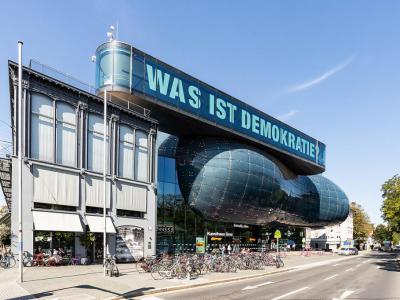
1) Kunsthaus (Art House) (must see)
The Art House is one of Graz’s most unusual modern landmarks and a bold contrast to the city’s historic Old Town. Opened in 2003 as part of Graz’s year as the European Capital of Culture, the building appears almost like an alien spacecraft attached to the façade and cast-iron structure of the historic Iron House department store. Covered with nearly a thousand blue acrylic panels, its shimmering biomorphic form earned it the nickname “Friendly Alien.” Rising beside the Mur River, the futuristic structure deliberately stands apart from the surrounding Baroque rooftops while blending softly into the urban landscape.
Unlike traditional art museums, the Art House has no permanent collection of its own. Instead, as part of the Universalmuseum Joanneum, it hosts changing exhibitions and projects dedicated to contemporary art, design, architecture, photography, film, and multimedia installations, often drawing on works from the museum’s collections.
Given its eccentric exterior, why not start there? Walk along the nearby footbridge to admire the BIX Media Façade, an innovative outer skin embedded with 930 circular fluorescent lamps that turn the building into a massive digital screen.
The building’s interior is often just as fascinating as the exhibitions. Entry is via a long moving walkway, known as the “travelator,” which carries visitors through the structure and into the gallery spaces. To begin your journey, go through the main glass entrance doors into the ground-floor lobby and step onto this slow-moving diagonal belt to glide through an enclosed tube into the main exhibition hall. The interior is defined by vast, flowing forms and a dramatic exhibition deck enclosed beneath the building’s curved shell. The distinctive roof nozzles and light cones bring adjustable daylight into the galleries while framing views of the city.
Last but not least, you can also enter the “Needle,” a cantilevered glass viewing platform that projects from the structure and offers excellent views across Graz. The lookout is accessible by stairs or elevator to the top exhibition level. Walk onto the glass-walled catwalk to reach the viewing platform, where floor-to-ceiling windows offer panoramic views of the red roofs of the Old Town and Castle Hill.
Unlike traditional art museums, the Art House has no permanent collection of its own. Instead, as part of the Universalmuseum Joanneum, it hosts changing exhibitions and projects dedicated to contemporary art, design, architecture, photography, film, and multimedia installations, often drawing on works from the museum’s collections.
Given its eccentric exterior, why not start there? Walk along the nearby footbridge to admire the BIX Media Façade, an innovative outer skin embedded with 930 circular fluorescent lamps that turn the building into a massive digital screen.
The building’s interior is often just as fascinating as the exhibitions. Entry is via a long moving walkway, known as the “travelator,” which carries visitors through the structure and into the gallery spaces. To begin your journey, go through the main glass entrance doors into the ground-floor lobby and step onto this slow-moving diagonal belt to glide through an enclosed tube into the main exhibition hall. The interior is defined by vast, flowing forms and a dramatic exhibition deck enclosed beneath the building’s curved shell. The distinctive roof nozzles and light cones bring adjustable daylight into the galleries while framing views of the city.
Last but not least, you can also enter the “Needle,” a cantilevered glass viewing platform that projects from the structure and offers excellent views across Graz. The lookout is accessible by stairs or elevator to the top exhibition level. Walk onto the glass-walled catwalk to reach the viewing platform, where floor-to-ceiling windows offer panoramic views of the red roofs of the Old Town and Castle Hill.
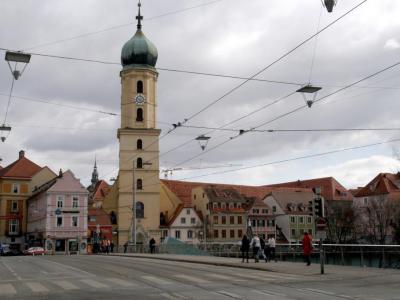
2) Franziskanerkirche (Franciscan Church)
The Franciscan Church is one of the most recognizable landmarks in Graz, standing near the banks of the Mur River at the western edge of the Old Town. The Franciscans have been established here since 1239, and the church has evolved over the centuries into one of the city’s most important places of worship. Much of the present structure reflects Gothic architecture, while later Baroque additions enriched its interior with decorative details and furnishings.
One of the church’s most distinctive features is its unusually tall tower. High towers are rare among Franciscan churches, which traditionally emphasize simplicity, but this one was built because of the church’s strategic location near the city walls. In the 17th century, civic authorities ordered the construction of a fortified tower that could serve defensive purposes. The tower rises above the chancel, with a square lower section, a hexagonal upper stage, and an onion dome topped by a slender spire, making it a prominent feature of the Graz skyline.
The contrast between the lofty 14th-century chancel and the broader, lower nave is particularly notable. During World War II, the chancel tower suffered severe bomb damage and was later restored with a modern interior. Today, light streams through stained-glass windows, illuminating the space and drawing attention to a remarkable gray cast-iron crucifix that appears to float within the sanctuary.
For many visitors, the adjoining Franciscan monastery and cloisters are among the highlights of a visit. The peaceful cloister offers a welcome retreat, while epitaphs lining its walls commemorate generations of Graz citizens and noble families buried here. The monastery remains active, and visitors may even attend Vespers, which are open to the public.
One of the church’s most distinctive features is its unusually tall tower. High towers are rare among Franciscan churches, which traditionally emphasize simplicity, but this one was built because of the church’s strategic location near the city walls. In the 17th century, civic authorities ordered the construction of a fortified tower that could serve defensive purposes. The tower rises above the chancel, with a square lower section, a hexagonal upper stage, and an onion dome topped by a slender spire, making it a prominent feature of the Graz skyline.
The contrast between the lofty 14th-century chancel and the broader, lower nave is particularly notable. During World War II, the chancel tower suffered severe bomb damage and was later restored with a modern interior. Today, light streams through stained-glass windows, illuminating the space and drawing attention to a remarkable gray cast-iron crucifix that appears to float within the sanctuary.
For many visitors, the adjoining Franciscan monastery and cloisters are among the highlights of a visit. The peaceful cloister offers a welcome retreat, while epitaphs lining its walls commemorate generations of Graz citizens and noble families buried here. The monastery remains active, and visitors may even attend Vespers, which are open to the public.
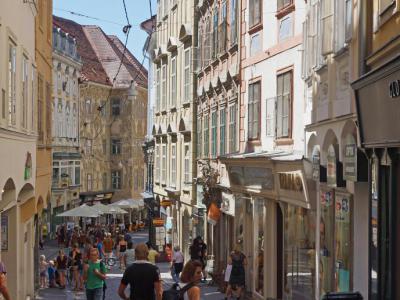
3) Sporgasse (Spur Street) (must see)
Known as the “noble mile” of Graz, Spur Street is one of the city’s oldest and most picturesque streets, linking the Main Square with the foot of Schlossberg Hill. In fact, the street is older than Graz itself. Its origins reach back to Roman times, when it formed part of the Strata Hungarica, an important trade route connecting the Mur Valley with the Roman provincial capital. The street’s name comes from the old German word spor, meaning “spur,” after the spur makers and armorers who lived and worked here during the 14th century.
Today, Spur Street is a lively pedestrian shopping street lined with historic buildings representing centuries of architectural styles. At its lower end, near the Main Square, stands the Luegg House, a richly stuccoed building dating from the 15th and 16th centuries with a striking Baroque façade. Opposite is the Art Nouveau House, recognizable by its floral façade from 1900, although its core dates back to the 16th century. Nearby is the former Inn to the Roman Emperor, a 15th-century building rebuilt in 1755 and distinguished by its elegant Baroque and Rococo decoration.
Further along the street are several notable landmarks, including the Staircase Church, the oldest parish church in Graz, first mentioned in 1343, and the House of the Teutonic Knights, whose arcaded inner courtyard recalls the city’s medieval past. At the upper end of the street stands Saurau Palace, built in 1566 and famous for the dramatic statue of a sword-wielding Turk projecting from its façade. Another historic building is the Golden Pate Inn, dating from the 17th century and known for its round bay window; Queen Elizabeth II dined there during her visit to Graz in 1967.
Despite its long history, Spur Street remains a thriving commercial street, filled with boutiques, cafés, bakeries, jewelry stores, fashion shops, and specialty retailers, continuing a trading tradition that has lasted for nearly two millennia.
Today, Spur Street is a lively pedestrian shopping street lined with historic buildings representing centuries of architectural styles. At its lower end, near the Main Square, stands the Luegg House, a richly stuccoed building dating from the 15th and 16th centuries with a striking Baroque façade. Opposite is the Art Nouveau House, recognizable by its floral façade from 1900, although its core dates back to the 16th century. Nearby is the former Inn to the Roman Emperor, a 15th-century building rebuilt in 1755 and distinguished by its elegant Baroque and Rococo decoration.
Further along the street are several notable landmarks, including the Staircase Church, the oldest parish church in Graz, first mentioned in 1343, and the House of the Teutonic Knights, whose arcaded inner courtyard recalls the city’s medieval past. At the upper end of the street stands Saurau Palace, built in 1566 and famous for the dramatic statue of a sword-wielding Turk projecting from its façade. Another historic building is the Golden Pate Inn, dating from the 17th century and known for its round bay window; Queen Elizabeth II dined there during her visit to Graz in 1967.
Despite its long history, Spur Street remains a thriving commercial street, filled with boutiques, cafés, bakeries, jewelry stores, fashion shops, and specialty retailers, continuing a trading tradition that has lasted for nearly two millennia.
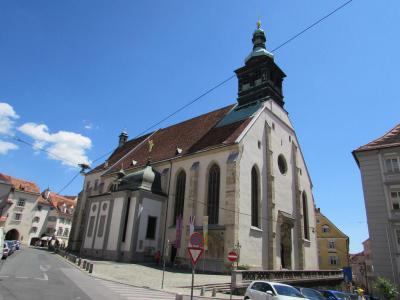
4) Dom (Graz Cathedral)
Standing beside the former imperial mausoleum in the historic heart of Graz, Graz Cathedral is one of the city’s most important Gothic landmarks. Dedicated to Saint Giles, or Saint Aegydius, it occupies a site where an earlier church had stood since 1174. While that original church stood outside the oldest fortifications as a fortified chapel, the present late-Gothic cathedral was begun around 1438 under Emperor Frederick III inside the newly expanded inner ring of defenses, built to integrate directly with his imperial castle complex.
The exterior is relatively restrained, with a walled choir, buttresses, ridge turrets, a large roof turret, metal doors, old tombstones, and a sculpture of Saint Aegydius. Most of the original façade frescoes were later whitewashed, but one remarkable survivor remains: the famous “Picture of the Plagues.” It shows the disasters that struck Styria in 1480: war, plague, and a locust invasion.
Inside, the cathedral is a spacious hall church, with three naves divided by strong pillars and enriched by later side chapels. Visitors can look for the dated plaques in the choir and sacristy bearing Frederick III’s mysterious motto, AEIOU, often interpreted as “Austria is destined to rule the world.” The long choir lies beyond a tall triumphal arch, flanked by two reliquaries on marble plinths. The Baroque high altar, installed in 1733, replaced an earlier Renaissance altar, while the Baroque organ gallery adds to the richly layered interior.
Together with the neighboring Mausoleum of Emperor Ferdinand II and nearby Graz Castle, the cathedral forms one of the city’s finest historic ensembles.
The exterior is relatively restrained, with a walled choir, buttresses, ridge turrets, a large roof turret, metal doors, old tombstones, and a sculpture of Saint Aegydius. Most of the original façade frescoes were later whitewashed, but one remarkable survivor remains: the famous “Picture of the Plagues.” It shows the disasters that struck Styria in 1480: war, plague, and a locust invasion.
Inside, the cathedral is a spacious hall church, with three naves divided by strong pillars and enriched by later side chapels. Visitors can look for the dated plaques in the choir and sacristy bearing Frederick III’s mysterious motto, AEIOU, often interpreted as “Austria is destined to rule the world.” The long choir lies beyond a tall triumphal arch, flanked by two reliquaries on marble plinths. The Baroque high altar, installed in 1733, replaced an earlier Renaissance altar, while the Baroque organ gallery adds to the richly layered interior.
Together with the neighboring Mausoleum of Emperor Ferdinand II and nearby Graz Castle, the cathedral forms one of the city’s finest historic ensembles.
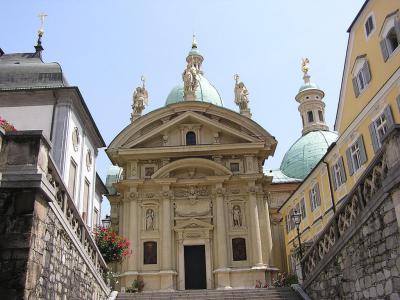
5) Saint Catherine's Church and Mausoleum
The Mausoleum and Saint Catherine’s Church form one of the most impressive Baroque ensembles in Austria and stand among the most important landmarks in Graz. The complex was commissioned in 1614 by the future Holy Roman Emperor Ferdinand II, who was born in Graz in 1578 and educated by the Jesuits. A staunch defender of Catholicism during the Counter-Reformation, Ferdinand chose this site as his final resting place and commissioned his favorite architect, Giovanni Pietro de Pomis, to design both the church and mausoleum.
Construction began in 1614, blending Italian Mannerist influences with the emerging Baroque style. However, de Pomis died before the project was completed, and Ferdinand himself was eventually buried in the unfinished church. The work was finally completed in 1687 under the direction of Johann Bernhard Fischer von Erlach, commissioned by Ferdinand’s grandson, Emperor Leopold I.
The complex consists of Saint Catherine’s Church and the imperial mausoleum beneath the great dome on the right side of the building. Its architecture is particularly striking, combining Austrian Baroque elements with the dramatic appearance of Roman churches. Inside, visitors can admire the magnificent high altar created by Fischer von Erlach in 1696, elaborate stucco decoration, and exceptionally fine ceiling frescoes.
The mausoleum’s vast crypt is one of its most impressive features. Ferdinand II, his mother Maria of Bavaria, and other members of the Habsburg family are buried here. A convex mirror in the crypt allows visitors to appreciate the ceiling paintings from a unique perspective, while the imperial sarcophagi lie below ground level.
For tourists, another highlight is the opportunity to climb the bell tower for panoramic views over Graz’s historic center. Rich in art, architecture, and imperial history, the complex offers a fascinating glimpse into the ambitions and legacy of one of the Habsburg Empire’s most influential rulers.
Construction began in 1614, blending Italian Mannerist influences with the emerging Baroque style. However, de Pomis died before the project was completed, and Ferdinand himself was eventually buried in the unfinished church. The work was finally completed in 1687 under the direction of Johann Bernhard Fischer von Erlach, commissioned by Ferdinand’s grandson, Emperor Leopold I.
The complex consists of Saint Catherine’s Church and the imperial mausoleum beneath the great dome on the right side of the building. Its architecture is particularly striking, combining Austrian Baroque elements with the dramatic appearance of Roman churches. Inside, visitors can admire the magnificent high altar created by Fischer von Erlach in 1696, elaborate stucco decoration, and exceptionally fine ceiling frescoes.
The mausoleum’s vast crypt is one of its most impressive features. Ferdinand II, his mother Maria of Bavaria, and other members of the Habsburg family are buried here. A convex mirror in the crypt allows visitors to appreciate the ceiling paintings from a unique perspective, while the imperial sarcophagi lie below ground level.
For tourists, another highlight is the opportunity to climb the bell tower for panoramic views over Graz’s historic center. Rich in art, architecture, and imperial history, the complex offers a fascinating glimpse into the ambitions and legacy of one of the Habsburg Empire’s most influential rulers.
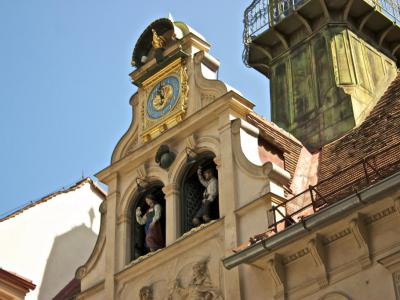
6) Glockenspiel (Carillon)
The Carillon is one of Graz’s most charming and beloved attractions. Located at Glockenspielplatz 4, just a short walk from the Main Square, it occupies a historic building transformed into a musical landmark by wine and spirits merchant Gottfried Maurer. After becoming fascinated by the carillons he encountered during his business travels in Belgium and northern Germany, Maurer decided to bring the idea to Graz. The bells first rang out on Christmas Eve in 1905, creating a spectacle that has delighted generations of residents and visitors ever since.
The highlight takes place three times a day, at 11 a.m., 3 p.m., and 6 p.m. As the music begins, a young woman and a young man dressed in traditional Styrian costume emerge from hidden openings high in the gable. Accompanied by the melodies of 24 bells, the pair dance gracefully before disappearing once again. As the performance reaches its finale, a golden rooster appears above them and crows in approval, adding a touch of humour and surprise.
The music itself is constantly changing. The carillon’s mechanism uses around 800 movable pins on a rotating barrel, allowing different melodies to be programmed. Depending on the season or occasion, visitors may hear folk tunes, Alpine melodies, yodeling songs, Christmas carols, or more modern pieces.
The carillon survived a turbulent history. In his will, Maurer donated it to the city in 1929 on the condition that it be maintained forever. During World War II, the bells were removed and melted down for armaments, silencing the music for years. Fortunately, the carillon was restored in 1956 and continues to enchant audiences today. Modest in scale but rich in character, it remains one of Graz’s most memorable and uniquely local attractions.
The highlight takes place three times a day, at 11 a.m., 3 p.m., and 6 p.m. As the music begins, a young woman and a young man dressed in traditional Styrian costume emerge from hidden openings high in the gable. Accompanied by the melodies of 24 bells, the pair dance gracefully before disappearing once again. As the performance reaches its finale, a golden rooster appears above them and crows in approval, adding a touch of humour and surprise.
The music itself is constantly changing. The carillon’s mechanism uses around 800 movable pins on a rotating barrel, allowing different melodies to be programmed. Depending on the season or occasion, visitors may hear folk tunes, Alpine melodies, yodeling songs, Christmas carols, or more modern pieces.
The carillon survived a turbulent history. In his will, Maurer donated it to the city in 1929 on the condition that it be maintained forever. During World War II, the bells were removed and melted down for armaments, silencing the music for years. Fortunately, the carillon was restored in 1956 and continues to enchant audiences today. Modest in scale but rich in character, it remains one of Graz’s most memorable and uniquely local attractions.
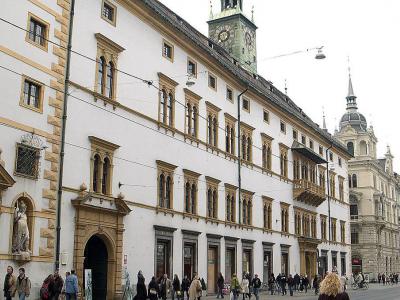
7) Landeszeughaus (Styrian Armory) (must see)
The Styrian Armoury is one of Graz’s most remarkable historic attractions and the largest preserved historical arsenal in the world. Located in the Old Town, just off the Main Square, it was built between 1642 and 1645. At the time, Styria stood on the frontier of the Habsburg Empire and frequently faced threats from the Ottoman Empire. The armoury was created as a vast military warehouse where weapons and equipment could be stored and rapidly distributed in times of conflict.
Even before entering, its exterior is worth admiring. Stand on the pedestrian street directly in front of the building to appreciate the magnificent Baroque portal, flanked by stone statues of Mars and Minerva. Sculpted in 1644, these imposing figures personify war and strategic wisdom, framing a heavy timber gate that historically served as the high-security entrance for guards and municipal troops.
Today, the building houses more than 32,000 historic objects spread across four wooden floors. The collection includes cannons, muskets, lances, halberds, partisans, swords, sabres, helmets, and even armour for horses. As one of the principal arms depots of the Habsburg Empire, the armoury offers a vivid picture of military life during the 16th and 17th centuries. Once you pass through the main entrance doors, walk to the third floor and look down the main central corridor to view the dense rows of infantry polearm and staff-weapon racks. This spectacular aisle displays thousands of historic halberds, spears, and pikes arranged shoulder to shoulder on original pinewood racks.
Yet the most valuable and rare piece of defensive gear on display is found nearby. Remaining on the third floor, navigate toward the equestrian display area to find the final highlight: a masterfully crafted, fully intact 16th-century horse armour. Made by the famous plate armourer Conrad Richter in the arms hub of Augsburg, this incredibly rare artifact consists of meticulously articulated iron plates designed to shield a steed from incoming sword slashes and arrow strikes.
The armoury’s survival is a story in itself. After the Treaty of Karlowitz in 1699 ended the Ottoman threat, the arsenal lost much of its military importance. In 1745, Empress Maria Theresa sought to centralize Austria’s defenses and ordered the weapons transferred to Vienna. The Styrian Estates successfully petitioned to preserve the collection as a memorial to the region’s history, ensuring its survival for future generations.
Even before entering, its exterior is worth admiring. Stand on the pedestrian street directly in front of the building to appreciate the magnificent Baroque portal, flanked by stone statues of Mars and Minerva. Sculpted in 1644, these imposing figures personify war and strategic wisdom, framing a heavy timber gate that historically served as the high-security entrance for guards and municipal troops.
Today, the building houses more than 32,000 historic objects spread across four wooden floors. The collection includes cannons, muskets, lances, halberds, partisans, swords, sabres, helmets, and even armour for horses. As one of the principal arms depots of the Habsburg Empire, the armoury offers a vivid picture of military life during the 16th and 17th centuries. Once you pass through the main entrance doors, walk to the third floor and look down the main central corridor to view the dense rows of infantry polearm and staff-weapon racks. This spectacular aisle displays thousands of historic halberds, spears, and pikes arranged shoulder to shoulder on original pinewood racks.
Yet the most valuable and rare piece of defensive gear on display is found nearby. Remaining on the third floor, navigate toward the equestrian display area to find the final highlight: a masterfully crafted, fully intact 16th-century horse armour. Made by the famous plate armourer Conrad Richter in the arms hub of Augsburg, this incredibly rare artifact consists of meticulously articulated iron plates designed to shield a steed from incoming sword slashes and arrow strikes.
The armoury’s survival is a story in itself. After the Treaty of Karlowitz in 1699 ended the Ottoman threat, the arsenal lost much of its military importance. In 1745, Empress Maria Theresa sought to centralize Austria’s defenses and ordered the weapons transferred to Vienna. The Styrian Estates successfully petitioned to preserve the collection as a memorial to the region’s history, ensuring its survival for future generations.
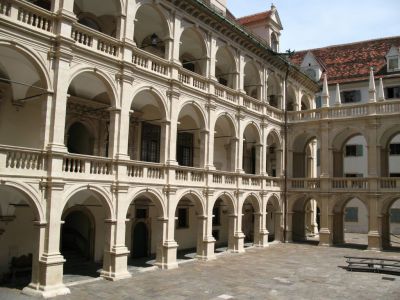
8) Landhaus (Country House)
The Country House of Graz is the perfect place to kick back. One ia awed at the sight of the spacious courtyard. Three floors of arcades, 16th century gargoyles, a bronze fountain, all these form a Mannerist playground. It is the perfect place for feasts, events, concerts, films and the annual Christmas ice crib.
It is a vision of the palaces of Venice come to the Austria. In 1557 the Italian architect Domenico dell'Aglio, a fortress architect who was supervising the restoration of the Castle Hill, started work on the Country House for the Styrian estates. The estates were done with holding their meetings at different places. They needed a place in Graz.
The interior of the Country House is full of Baroque adornments. The Session Hall has a stucco ceiling installed by Johann Angelo Formentini. There are escutcheons, coats of arms, and porcelain stoves decorated with the Austrian Eagle and the Styrian panther. In the Meeting Room the ceiling is decorated with signs of the Zodiac.
In 1631, after the expulsion of the Protestant estates, the Country House chapel got its black and gold Jesuit altar. The altarpiece shows the assumption of the Virgin. The two statues of Saints Catherine and Barbara signify the restoration of Catholicism in Graz.
It is a vision of the palaces of Venice come to the Austria. In 1557 the Italian architect Domenico dell'Aglio, a fortress architect who was supervising the restoration of the Castle Hill, started work on the Country House for the Styrian estates. The estates were done with holding their meetings at different places. They needed a place in Graz.
The interior of the Country House is full of Baroque adornments. The Session Hall has a stucco ceiling installed by Johann Angelo Formentini. There are escutcheons, coats of arms, and porcelain stoves decorated with the Austrian Eagle and the Styrian panther. In the Meeting Room the ceiling is decorated with signs of the Zodiac.
In 1631, after the expulsion of the Protestant estates, the Country House chapel got its black and gold Jesuit altar. The altarpiece shows the assumption of the Virgin. The two statues of Saints Catherine and Barbara signify the restoration of Catholicism in Graz.
9) Altstadt
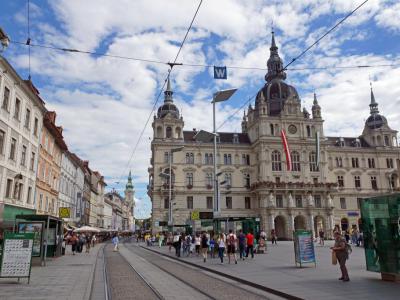
The historical core of Graz, known as the Old Town (Altstadt), is a remarkable showcase of the city's diverse history and architectural development. Recognized as a UNESCO World Heritage Site in 1999, and later expanded in 2010 to include "City of Graz - Historic Center and Eggenberg Castle," this designation underscores the city's commitment to preserving its rich heritage. Graz carefully integrates new architecture into its historic ensemble, which dates back to the Gothic period and beyond.
The Old Town, is renowned for its well-preserved city center, featuring charming Baroque buildings with red roofs, lively fountains, and the imposing presence of a castle atop a hill. This area, which extends into the Inner City district, encapsulates Graz's cultural and historical essence.
Graz's origins can be traced back to the Chalcolithic Age, but it wasn't until the Middle Ages that the city experienced continuous settlement. In the 12th century, the Babenberg dukes transformed Graz into a thriving commercial center. Subsequently, under Habsburg rule, especially during King Rudolph I's reign in 1281, Graz further prospered, becoming the seat of power for the Inner Austrian line of the Habsburgs during the 14th century, with the Schloßberg castle serving as their residence and governing center. The influence of the Renaissance in the 16th century left a lasting impression on Graz, particularly through the contributions of Italian architects and artists.
Today, Graz's Old Town not only preserves its historical heritage but also thrives as a dynamic cultural hub. Visitors can explore numerous museums, government buildings, the cathedral, the Clock Tower, and the enchanting Glockenspiel, all of which contribute to the appreciation of Graz's rich history and architectural legacy.
The Old Town, is renowned for its well-preserved city center, featuring charming Baroque buildings with red roofs, lively fountains, and the imposing presence of a castle atop a hill. This area, which extends into the Inner City district, encapsulates Graz's cultural and historical essence.
Graz's origins can be traced back to the Chalcolithic Age, but it wasn't until the Middle Ages that the city experienced continuous settlement. In the 12th century, the Babenberg dukes transformed Graz into a thriving commercial center. Subsequently, under Habsburg rule, especially during King Rudolph I's reign in 1281, Graz further prospered, becoming the seat of power for the Inner Austrian line of the Habsburgs during the 14th century, with the Schloßberg castle serving as their residence and governing center. The influence of the Renaissance in the 16th century left a lasting impression on Graz, particularly through the contributions of Italian architects and artists.
Today, Graz's Old Town not only preserves its historical heritage but also thrives as a dynamic cultural hub. Visitors can explore numerous museums, government buildings, the cathedral, the Clock Tower, and the enchanting Glockenspiel, all of which contribute to the appreciation of Graz's rich history and architectural legacy.
10) Rathaus (Town Hall)
Graz’s Town Hall has been the center of municipal government since the late 19th century.
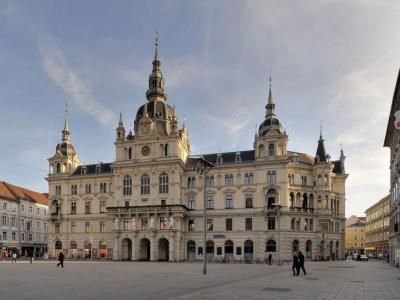
Designed in the Historicist Old German style, the building dominates the Main Square with its richly decorated façade, corner towers, and a tall central tower crowned by a dome and spire. Construction required the demolition of an entire block of buildings, but two property owners refused to sell. Their narrow houses still survive today, protruding directly from the main front façade facing the square.
The project was financed through a tax on wine, and its façade reflects Graz’s civic pride. Niches contain statues of Austrian rulers alongside figures symbolizing art, science, trade, and industry. The building is most impressive when viewed from the center of the Main Square, where its grand proportions form a striking backdrop to the historic surroundings.
Although primarily used for city administration, the interior contains several notable spaces. The two-story council chamber retains its original 19th-century coffered ceiling, wood paneling, chandelier, and clock. Near the main entrance, a painting created in 1971 illustrates the evolution of Graz’s Town Hall through the centuries. Upstairs, the elegant Wedding Hall remains a popular venue for ceremonies, many of which are watched remotely via webcam by family and friends around the world.
Designed in the Historicist Old German style, the building dominates the Main Square with its richly decorated façade, corner towers, and a tall central tower crowned by a dome and spire. Construction required the demolition of an entire block of buildings, but two property owners refused to sell. Their narrow houses still survive today, protruding directly from the main front façade facing the square.
The project was financed through a tax on wine, and its façade reflects Graz’s civic pride. Niches contain statues of Austrian rulers alongside figures symbolizing art, science, trade, and industry. The building is most impressive when viewed from the center of the Main Square, where its grand proportions form a striking backdrop to the historic surroundings.
Although primarily used for city administration, the interior contains several notable spaces. The two-story council chamber retains its original 19th-century coffered ceiling, wood paneling, chandelier, and clock. Near the main entrance, a painting created in 1971 illustrates the evolution of Graz’s Town Hall through the centuries. Upstairs, the elegant Wedding Hall remains a popular venue for ceremonies, many of which are watched remotely via webcam by family and friends around the world.
11) Hauptplatz (Main Square) (must see)
The Main Square has been the heart of Graz since around 1160, when it was laid out by Duke Otakar III. For centuries, this broad market square served as the city's commercial, social, and political center, drawing merchants, travelers, and locals.
The square's distinctive trapezoidal shape reflects its medieval origins. It is surrounded by historic buildings dating from the medieval and late Gothic periods, although many façades were later remodeled in the Baroque and Biedermeier styles. Among the notable buildings are the White House, built in 1710; the Eagle Pharmacy, dating from 1535; and the Citizens' Home to the Great Christoph, which dates from the 17th century.
However, the architectural highlight is undoubtedly Luegg House, a 15th-century building famous for its richly decorated stucco façade and elegant arcades. To make sure you do not miss this masterpiece, stand at the busy northern corner of the square, where the house's façade wraps around the corner and continues onto Spur Street. The stucco façade is covered in deep, flowing floral scrollwork, leaves, and cleverly hidden human faces. Trace the heavy plaster fruit and flower garlands framing the windows, where, if you look closely, you will spot mouths, noses, and expressive faces emerging from the stone foliage.
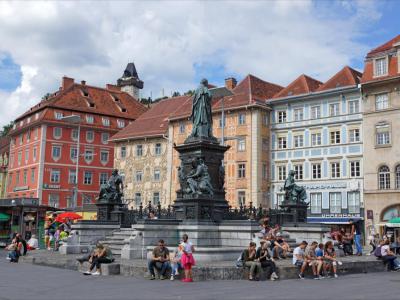
Dominating the northern half of the square since 1878 is the Archduke Johann Fountain. The landmark stands just clear of the central tram tracks, so simply walk toward the base of the fountain. The monument honors Archduke Johann of Austria, one of Styria's most beloved historical figures. Around the central statue stand four female figures representing the region's principal rivers: the Mur, Enns, Drava, and Sann. Allegorical bronze reliefs decorate the pedestal, while fountain basins occupy the four corners.
Not all of the square's history was pleasant. Until the late 18th century, it served as a venue for public punishments, including pillorying and executions. Commoners were often punished in full view of the crowd here, while nobles were typically executed inside the Town Hall. Speaking of which, its main portal is the final highlight. Look directly across the southern edge of the square to locate the Town Hall's grand, palatial entrance, which frames the building's deeply arched front doors. This late 19th-century Historicist entrance is flanked by classical stone columns and ornate balconies, reflecting the architectural ambition of Graz's golden age.
The square's distinctive trapezoidal shape reflects its medieval origins. It is surrounded by historic buildings dating from the medieval and late Gothic periods, although many façades were later remodeled in the Baroque and Biedermeier styles. Among the notable buildings are the White House, built in 1710; the Eagle Pharmacy, dating from 1535; and the Citizens' Home to the Great Christoph, which dates from the 17th century.
However, the architectural highlight is undoubtedly Luegg House, a 15th-century building famous for its richly decorated stucco façade and elegant arcades. To make sure you do not miss this masterpiece, stand at the busy northern corner of the square, where the house's façade wraps around the corner and continues onto Spur Street. The stucco façade is covered in deep, flowing floral scrollwork, leaves, and cleverly hidden human faces. Trace the heavy plaster fruit and flower garlands framing the windows, where, if you look closely, you will spot mouths, noses, and expressive faces emerging from the stone foliage.
Dominating the northern half of the square since 1878 is the Archduke Johann Fountain. The landmark stands just clear of the central tram tracks, so simply walk toward the base of the fountain. The monument honors Archduke Johann of Austria, one of Styria's most beloved historical figures. Around the central statue stand four female figures representing the region's principal rivers: the Mur, Enns, Drava, and Sann. Allegorical bronze reliefs decorate the pedestal, while fountain basins occupy the four corners.
Not all of the square's history was pleasant. Until the late 18th century, it served as a venue for public punishments, including pillorying and executions. Commoners were often punished in full view of the crowd here, while nobles were typically executed inside the Town Hall. Speaking of which, its main portal is the final highlight. Look directly across the southern edge of the square to locate the Town Hall's grand, palatial entrance, which frames the building's deeply arched front doors. This late 19th-century Historicist entrance is flanked by classical stone columns and ornate balconies, reflecting the architectural ambition of Graz's golden age.
12) Murinsel (Island in the Mur) (must see)
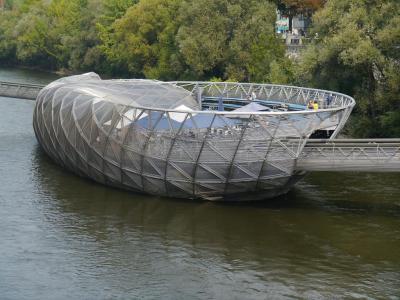
The Mur Island is one of Graz’s most distinctive modern landmarks and a symbol of the city’s transformation during its year as the European Capital of Culture in 2003. Designed by New York artist and architect Vito Acconci, the structure is not a true island but a floating steel-and-glass platform anchored in the middle of the Mur River and connected to both riverbanks by pedestrian bridges. Acconci described his creation as “a bowl that morphs into a dome that morphs into a bowl.” Its futuristic form resembles a partially opened seashell, a floating vessel, or a spacecraft resting on the water.
Although often called an island, Island in the Mur is closer to a ship than a natural island. Firmly anchored to the riverbed and moored to each bank, it was designed to reconnect the river with the city and create an inviting public space. Originally conceived as a temporary installation, it quickly became one of Graz’s most beloved landmarks and was retained as a permanent feature.
At its center is an open amphitheater where curved, sky-blue benches rise in flowing layers that echo the movement of the river below. The amphitheater hosts concerts, readings, performances, and cultural events throughout the year. Beneath the glass dome, a network of walkways and tunnels swirls through the structure, connecting the various spaces. Visitors will also find a blue-and-white café overlooking the water, as well as a playful three-dimensional maze with ropes and a slide for younger visitors.
The Mur Island provides some of the most unusual views in Graz. From its decks, visitors can admire the historic Old Town, the wooded slopes of Schlossberg Hill, and the nearby Art House. After dark, the structure glows with blue light, reflecting on the water below and creating one of the city’s most memorable sights.
Although often called an island, Island in the Mur is closer to a ship than a natural island. Firmly anchored to the riverbed and moored to each bank, it was designed to reconnect the river with the city and create an inviting public space. Originally conceived as a temporary installation, it quickly became one of Graz’s most beloved landmarks and was retained as a permanent feature.
At its center is an open amphitheater where curved, sky-blue benches rise in flowing layers that echo the movement of the river below. The amphitheater hosts concerts, readings, performances, and cultural events throughout the year. Beneath the glass dome, a network of walkways and tunnels swirls through the structure, connecting the various spaces. Visitors will also find a blue-and-white café overlooking the water, as well as a playful three-dimensional maze with ropes and a slide for younger visitors.
The Mur Island provides some of the most unusual views in Graz. From its decks, visitors can admire the historic Old Town, the wooded slopes of Schlossberg Hill, and the nearby Art House. After dark, the structure glows with blue light, reflecting on the water below and creating one of the city’s most memorable sights.

13) Schloßbergrutsche
In the heart of Graz lies an architectural and engineering wonder nestled within the historic Schloßberg - the Schloßberg Slide (Schloßbergrutsche). Announced in mid-2017 and opened to the public in February 2019, it has swiftly become an iconic attraction. Notably, it holds the title of the tallest indoor slide globally, standing at 64 meters tall. This impressive structure is cleverly integrated into the mountain's landscape, winding around the Schloßberg lift within the lift shaft and culminating in a grand exit in the tunnel leading to the lift.
Stretching over a total length of 170 meters, the slide offers a thrilling 40-second ride where adventurers can reach average speeds of 25 km/h. This combination of speed, height, and the slide's winding path offers a unique thrill unmatched by any other slide globally.
A notable feature of the Schloßberg Slide is its innovative design, which includes a change in the direction of rotation of the downward spiral midway through the ride. This twist not only enhances the excitement but also demonstrates the thoughtful engineering behind the slide's construction.
Known as THE SLIDE GRAZ, this attraction transcends being merely a slide; it delivers an unforgettable experience. As participants zoom down multiple turns around the elevator shaft, they're treated to a rush like no other, all while enclosed within the historic Schloßberg. This fusion of history, adrenaline, and modern engineering makes the Schloßberg Slide a must-visit destination for thrill-seekers and culture enthusiasts alike, promising an adventure that will linger in the memory long after the ride concludes.
Stretching over a total length of 170 meters, the slide offers a thrilling 40-second ride where adventurers can reach average speeds of 25 km/h. This combination of speed, height, and the slide's winding path offers a unique thrill unmatched by any other slide globally.
A notable feature of the Schloßberg Slide is its innovative design, which includes a change in the direction of rotation of the downward spiral midway through the ride. This twist not only enhances the excitement but also demonstrates the thoughtful engineering behind the slide's construction.
Known as THE SLIDE GRAZ, this attraction transcends being merely a slide; it delivers an unforgettable experience. As participants zoom down multiple turns around the elevator shaft, they're treated to a rush like no other, all while enclosed within the historic Schloßberg. This fusion of history, adrenaline, and modern engineering makes the Schloßberg Slide a must-visit destination for thrill-seekers and culture enthusiasts alike, promising an adventure that will linger in the memory long after the ride concludes.
14) Uhrturm (Clock Tower) (must see)
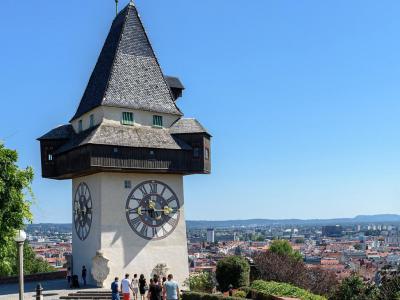
Perched atop Castle Hill and overlooking the rooftops of Graz, the Clock Tower is the city’s most famous landmark and an enduring symbol of the Styrian capital. The tower itself dates to the 13th century and was first mentioned as part of the fortress defenses in 1265, when Castle Hill ranked among the strongest fortifications in the region.
The tower is instantly recognizable for its unusual clock faces. To get a better look, approach the base of the whitewashed tower from the garden terrace paths. Unlike most clocks, the larger hand indicates the hours, while the smaller hand marks the minutes. This arrangement was designed so the hours could be easily read from a distance.
The Clock Tower narrowly escaped destruction during the War of the Fifth Coalition in 1809. Under the terms of the Armistice of Znaim, Napoleon ordered the demolition of the Castle Hill fortifications. However, the citizens of Graz raised funds to pay a ransom and save the tower and its clock.
Standing about 28 meters tall, the tower features a distinctive shingled roof, a weather vane shaped like a rooster, and three historic bells. The oldest, the hourly bell, dates from 1382 and is the oldest bell in Graz. The fire bell, installed in 1645, warned residents of danger, while the “Poor Sinners’ Bell” of 1450 was rung for executions and curfew.
Another notable feature of the tower is the wooden watchman’s gallery. Tilt your head further upward, past the massive clock dials and toward the high shingled roofline, to locate a dark timber balcony wrapping entirely around the upper midsection of the tower. This covered wooden walkway, supported by heavy timber corbels, served as an elevated patrol path where city watchmen continuously paced the perimeter to scan the horizon for fires or approaching enemy armies.
Just below the tower stands a stone dog commemorating a local legend. To find this legendary protector, walk slightly down the stone pathway along the fortification wall just beneath the main tower base. According to tradition, a barking watchdog saved Kunigunde, daughter of Emperor Frederick III, from attackers in 1481.
The tower is instantly recognizable for its unusual clock faces. To get a better look, approach the base of the whitewashed tower from the garden terrace paths. Unlike most clocks, the larger hand indicates the hours, while the smaller hand marks the minutes. This arrangement was designed so the hours could be easily read from a distance.
The Clock Tower narrowly escaped destruction during the War of the Fifth Coalition in 1809. Under the terms of the Armistice of Znaim, Napoleon ordered the demolition of the Castle Hill fortifications. However, the citizens of Graz raised funds to pay a ransom and save the tower and its clock.
Standing about 28 meters tall, the tower features a distinctive shingled roof, a weather vane shaped like a rooster, and three historic bells. The oldest, the hourly bell, dates from 1382 and is the oldest bell in Graz. The fire bell, installed in 1645, warned residents of danger, while the “Poor Sinners’ Bell” of 1450 was rung for executions and curfew.
Another notable feature of the tower is the wooden watchman’s gallery. Tilt your head further upward, past the massive clock dials and toward the high shingled roofline, to locate a dark timber balcony wrapping entirely around the upper midsection of the tower. This covered wooden walkway, supported by heavy timber corbels, served as an elevated patrol path where city watchmen continuously paced the perimeter to scan the horizon for fires or approaching enemy armies.
Just below the tower stands a stone dog commemorating a local legend. To find this legendary protector, walk slightly down the stone pathway along the fortification wall just beneath the main tower base. According to tradition, a barking watchdog saved Kunigunde, daughter of Emperor Frederick III, from attackers in 1481.
15) Schlossberg (Castle Hill) (must see)
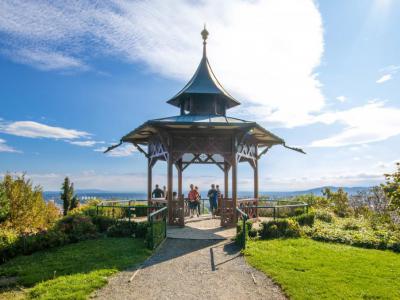
Castle Hill, is the historic heart of Graz and the hill from which the city originally grew. According to legend, the Devil created it after flying over the town with a huge rock, hoping to claim a soul in return for making a high hill. Because it was Easter Sunday, he had no power, so he angrily threw the rock down; its largest fragment became Castle Hill.
Rising to about 470 meters above sea level, Castle Hill has been fortified since at least the 10th century. In the 16th century, Italian architects helped build a major defensive system around 1,300 feet long, with a cable lift used to raise stones to the summit. The fortress was considered one of the strongest in Europe and was never captured, but in 1809 Napoleon ordered much of it demolished. Two of its most beloved structures, the Clock Tower and Bell Tower, survived.
In 1839, the ruins were transformed into a public park, giving Graz one of its finest green spaces. Today, Castle Hill combines history, nature, and panoramic views over the red-tiled rooftops, the Mur River, and the surrounding Styrian countryside. Visitors can reach the summit by climbing the steep stairs, following a winding path, riding the funicular, or taking the glass elevator through the mountain.
Scattered across the hill are remnants of the old fortress, including bastions, walls, tunnels, and viewpoints. The Clock Tower remains the most famous landmark, while cafés, restaurants, gardens, and open lawns make the hill a pleasant place to linger. Cultural life is also part of the experience: one bastion holds an open-air stage, and the Casemate Stage, with a retractable roof and space for more than 1,700 spectators, hosts concerts and events. Inside the hill, tunnels connect to the elevator and include the Fairytale Express, a small train ride for children. Castle Hill is also used during the Elevate Festival of music, art, and politics.
Rising to about 470 meters above sea level, Castle Hill has been fortified since at least the 10th century. In the 16th century, Italian architects helped build a major defensive system around 1,300 feet long, with a cable lift used to raise stones to the summit. The fortress was considered one of the strongest in Europe and was never captured, but in 1809 Napoleon ordered much of it demolished. Two of its most beloved structures, the Clock Tower and Bell Tower, survived.
In 1839, the ruins were transformed into a public park, giving Graz one of its finest green spaces. Today, Castle Hill combines history, nature, and panoramic views over the red-tiled rooftops, the Mur River, and the surrounding Styrian countryside. Visitors can reach the summit by climbing the steep stairs, following a winding path, riding the funicular, or taking the glass elevator through the mountain.
Scattered across the hill are remnants of the old fortress, including bastions, walls, tunnels, and viewpoints. The Clock Tower remains the most famous landmark, while cafés, restaurants, gardens, and open lawns make the hill a pleasant place to linger. Cultural life is also part of the experience: one bastion holds an open-air stage, and the Casemate Stage, with a retractable roof and space for more than 1,700 spectators, hosts concerts and events. Inside the hill, tunnels connect to the elevator and include the Fairytale Express, a small train ride for children. Castle Hill is also used during the Elevate Festival of music, art, and politics.
