Custom Walk in Riga, Latvia by grace_tay_5da45d created on 2026-07-20
Guide Location: Latvia » Riga
Guide Type: Custom Walk
# of Sights: 9
Tour Duration: 2 Hour(s)
Travel Distance: 3.2 Km or 2 Miles
Share Key: UZ5GP
Guide Type: Custom Walk
# of Sights: 9
Tour Duration: 2 Hour(s)
Travel Distance: 3.2 Km or 2 Miles
Share Key: UZ5GP
How It Works
Please retrieve this walk in the GPSmyCity app. Once done, the app will guide you from one tour stop to the next as if you had a personal tour guide. If you created the walk on this website or come to the page via a link, please follow the instructions below to retrieve the walk in the app.
Retrieve This Walk in App
Step 1. Download the app "GPSmyCity: Walks in 1K+ Cities" on Apple App Store or Google Play Store.



Step 2. In the GPSmyCity app, download(or launch) the guide "Riga Map and Walking Tours".
Step 3. Tap the menu button located at upper right corner of the "Walks" screen and select "Retrieve custom walk". Enter the share key: UZ5GP
1) Alberta Iela (Albert Street) (must see)
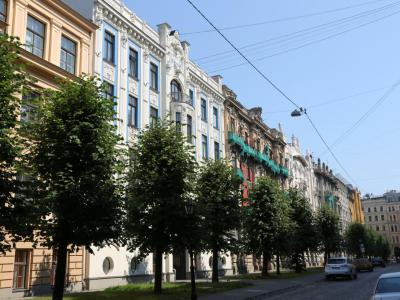
Albert Street (Alberta Iela) in Riga is renowned for its striking collection of Art Nouveau architecture, making it one of the city's most distinguished and visually compelling streets. Constructed between 1901 and 1908, the street is named after Bishop Albert, who is credited with founding Riga in 1201. This connection to the city’s historical roots is celebrated with the street’s name and its architectural grandeur.
The street's most prominent architectural contributions come from Mikhail Eisenstein, a preeminent architect of the early 20th century, known for his extravagant and decorative designs. Eisenstein's works on Alberta Street, including buildings at numbers 2, 2a, 4, 6, and 8, showcase his unique style characterized by romantic nationalism-a theme prevalent in northern European architecture at the time. These buildings are adorned with elaborate sculptures, intricate balconies, and ornate columns that epitomize the Art Nouveau aesthetic.
Other notable architects who contributed to the architectural landscape of Albert Street include Konstantīns Pēkšēns and his pupil Eižens Laube, as well as Baltic and Baltic German architects such as Paul Mandelstamm, Hermann Hilbig, and Heinrich Scheel. Pēkšēns' residence at number 12 now serves as the Riga Art Nouveau Museum, which opened in April 2009 and offers insights into the style and its elements.
In addition to its architectural significance, Alberta Street is a center of academic and diplomatic activity. It houses several institutions of higher education such as the Stockholm School of Economics in Riga, the Riga Graduate School of Law, and the College of Business Administration. Diplomatic missions for Belgium and Ireland are also located here, adding an international dimension to the street.
The entirety of Alberta Street is a testament to the creativity and innovation of the Art Nouveau movement. Eight of the buildings along the street are recognized as architectural monuments of national significance, underscoring their importance in the architectural and cultural heritage of Riga. As a living museum of Art Nouveau, Alberta Street offers both residents and visitors a chance to step back in time and experience the grandeur of early 20th-century European art and architecture.
The street's most prominent architectural contributions come from Mikhail Eisenstein, a preeminent architect of the early 20th century, known for his extravagant and decorative designs. Eisenstein's works on Alberta Street, including buildings at numbers 2, 2a, 4, 6, and 8, showcase his unique style characterized by romantic nationalism-a theme prevalent in northern European architecture at the time. These buildings are adorned with elaborate sculptures, intricate balconies, and ornate columns that epitomize the Art Nouveau aesthetic.
Other notable architects who contributed to the architectural landscape of Albert Street include Konstantīns Pēkšēns and his pupil Eižens Laube, as well as Baltic and Baltic German architects such as Paul Mandelstamm, Hermann Hilbig, and Heinrich Scheel. Pēkšēns' residence at number 12 now serves as the Riga Art Nouveau Museum, which opened in April 2009 and offers insights into the style and its elements.
In addition to its architectural significance, Alberta Street is a center of academic and diplomatic activity. It houses several institutions of higher education such as the Stockholm School of Economics in Riga, the Riga Graduate School of Law, and the College of Business Administration. Diplomatic missions for Belgium and Ireland are also located here, adding an international dimension to the street.
The entirety of Alberta Street is a testament to the creativity and innovation of the Art Nouveau movement. Eight of the buildings along the street are recognized as architectural monuments of national significance, underscoring their importance in the architectural and cultural heritage of Riga. As a living museum of Art Nouveau, Alberta Street offers both residents and visitors a chance to step back in time and experience the grandeur of early 20th-century European art and architecture.

2) Art Noveau Riga
What to buy here: Pampalu pots.
Pottery has existed in Latvia as a craft since the 10th century and, over the centuries, has evolved as a folk craft to the extent that each region of the country has developed its distinctive style, shapes, colors and ornamentation. For example the Vidzeme region is renowned for its massive and clean shapes, while the Latgale region offers shiny, baroque pots. The Kurzeme region reveals to the world jogs which astound with their monumental and aesthetic forms. One thing most do share in common is the decoration with mythological signs and symbols.
In Riga, these pots can be found with the original addition of peat bog plant roots. These roots have many uses, among which is balneotherapy, a traditional spa treatment.
If you are interested in something special, then you are welcome at Art Noveau Riga, the only store specializing in art noveau souvenirs. On the road towards this shop you will all be able to visually savour an architecture district which is excuisite for its distinctive and curious buildings and constructions. The prices for the Latvian traditional pots start at approximately $20.
Pottery has existed in Latvia as a craft since the 10th century and, over the centuries, has evolved as a folk craft to the extent that each region of the country has developed its distinctive style, shapes, colors and ornamentation. For example the Vidzeme region is renowned for its massive and clean shapes, while the Latgale region offers shiny, baroque pots. The Kurzeme region reveals to the world jogs which astound with their monumental and aesthetic forms. One thing most do share in common is the decoration with mythological signs and symbols.
In Riga, these pots can be found with the original addition of peat bog plant roots. These roots have many uses, among which is balneotherapy, a traditional spa treatment.
If you are interested in something special, then you are welcome at Art Noveau Riga, the only store specializing in art noveau souvenirs. On the road towards this shop you will all be able to visually savour an architecture district which is excuisite for its distinctive and curious buildings and constructions. The prices for the Latvian traditional pots start at approximately $20.
3) Riga Cathedral (must see)
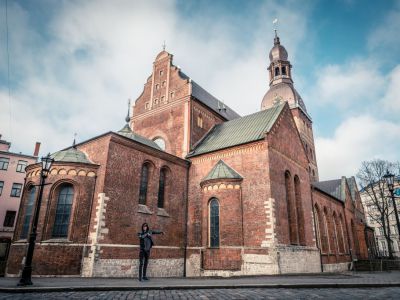
Riga Cathedral, formally known as The Cathedral Church of Saint Mary, is the Evangelical Lutheran cathedral located in Riga. It serves as the seat of the Archbishop of Riga. The cathedral is one of Latvia's most iconic landmarks, often featured in paintings, photographs, and television travelogues, and is noted for its weathercock, similar to other historic churches in the city.
The church was established near the River Daugava in 1211 by Livonian Bishop Albert of Riga, who hailed from Lower Saxony in northwestern Germany. It is recognized as the largest medieval church in the Baltic states and has undergone numerous modifications throughout its history. Notable figures associated with the cathedral include David Caspari, rector of the cathedral school in the late 17th century, and his son Georg Caspari, who also served at the cathedral.
In a 1923 referendum, the Lutheran Church was compelled to share the cathedral with the Roman Catholic Church. However, this decision was reversed in the 1931 Latvian Riga Cathedral referendum, restoring it solely to the Lutheran Church. During the Soviet occupation from 1939 to 1989, religious services were banned, and the cathedral functioned as a concert hall. The Museum of the History of Riga and Navigation was housed in the cathedral's southern wing during this period. Religious services resumed in 1991, and the cathedral is now actively used by the Evangelical Lutheran Church of Latvia.
A prominent feature of the Riga Cathedral is its organ, built by E.F. Walcker & Sons of Ludwigsburg, Germany, in 1882-83 and inaugurated on January 31, 1884. During World War II, a recording captured the sound of battle as Latvian composer Lūcija Garūta played the organ for a cantata.
The church was established near the River Daugava in 1211 by Livonian Bishop Albert of Riga, who hailed from Lower Saxony in northwestern Germany. It is recognized as the largest medieval church in the Baltic states and has undergone numerous modifications throughout its history. Notable figures associated with the cathedral include David Caspari, rector of the cathedral school in the late 17th century, and his son Georg Caspari, who also served at the cathedral.
In a 1923 referendum, the Lutheran Church was compelled to share the cathedral with the Roman Catholic Church. However, this decision was reversed in the 1931 Latvian Riga Cathedral referendum, restoring it solely to the Lutheran Church. During the Soviet occupation from 1939 to 1989, religious services were banned, and the cathedral functioned as a concert hall. The Museum of the History of Riga and Navigation was housed in the cathedral's southern wing during this period. Religious services resumed in 1991, and the cathedral is now actively used by the Evangelical Lutheran Church of Latvia.
A prominent feature of the Riga Cathedral is its organ, built by E.F. Walcker & Sons of Ludwigsburg, Germany, in 1882-83 and inaugurated on January 31, 1884. During World War II, a recording captured the sound of battle as Latvian composer Lūcija Garūta played the organ for a cantata.
4) Cathedral Square (aka Dome Square)
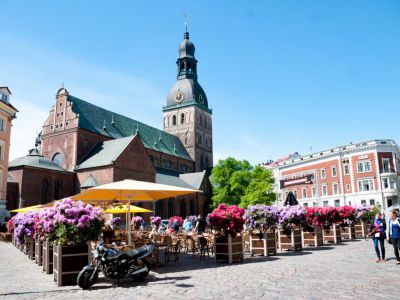
Another of Old Riga's cobblestone squares lies squarely in front of the Riga Cathedral. Commonly called the Dome Cathedral, this is one of Riga's trademark buildings. The word "Dome" comes from the German "Dom," which also means cathedral. It is considered to be the largest medieval church in the Baltics.
The church was built on the river in 1211 by Livonian Bishop Albert of Riga from Lower Saxony. It was Roman Catholic until a 1923 referendum forced it to be shared with the Lutheran Church. During the Soviet Era, the church was used as a concert hall. Religious services were restarted in 1991, and today it is used by the Evangelical Lutheran Church of Latvia.
Cathedral Square is the site of various events during the year, including a popular Christmas Market. It's a great place for souvenirs and local delicacies. But no matter what time of the year you stop through, there's bound to be something going on. From art installations and cultural festivals to bustling sidewalk cafes and great people watching, Cathedral Square is at the center of it all.
The church was built on the river in 1211 by Livonian Bishop Albert of Riga from Lower Saxony. It was Roman Catholic until a 1923 referendum forced it to be shared with the Lutheran Church. During the Soviet Era, the church was used as a concert hall. Religious services were restarted in 1991, and today it is used by the Evangelical Lutheran Church of Latvia.
Cathedral Square is the site of various events during the year, including a popular Christmas Market. It's a great place for souvenirs and local delicacies. But no matter what time of the year you stop through, there's bound to be something going on. From art installations and cultural festivals to bustling sidewalk cafes and great people watching, Cathedral Square is at the center of it all.
5) House of Blackheads (Melngalvju Nams) (must see)
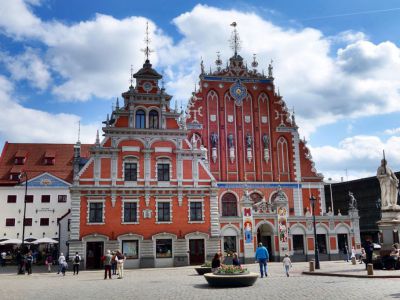
The House of the Black Heads is now a museum celebrating commerce in Riga. The building was originally erected in 1334 and has dominated Town Hall Square for centuries.
It was built by the Brotherhood of the Black Heads, a local guild made up of unmarried Riga merchants, shipowners, and foreigners. The organization was active from the middle of the 14th century until about 1940, although a chapter in Hamburg still meets. It began as a military society but gradually transitioned into a social organization.
The House of Black Heads was meant to be a meeting place for the society, where they would host banquets and cultural events. The first decorated Christmas tree was displayed on the square outside in 1510.
The building was destroyed during World War II--first leveled by Germans bombs in 1941 and then further demolished by the Soviets in 1948. As it stands today, the building was reconstructed in the late 1990s. Locals donated a few Euros each person to put a brick in the wall during an event called "I Build the House of the Black Heads."
The building has been rebuilt to its previous glory and is open to the public. The upper levels have grand ballrooms where some of Riga's most posh cultural events occurred. There are also spaces used by former Presidents of Latvia, as this house was used as the Presidential residence between 2012 and 2016.
Most interesting are the cellars, which were buried and re-excavated during the rebuilding and restoration efforts. Here you can walk through original 14th-century corridors in the authentic underground of medieval Riga. This space was used to store goods and is now used as an exhibit space.
The museum is open Wednesdays through Sundays. On the last Sunday of every month, they hold a free one-hour-long guided house tour, available in both English and German.
It was built by the Brotherhood of the Black Heads, a local guild made up of unmarried Riga merchants, shipowners, and foreigners. The organization was active from the middle of the 14th century until about 1940, although a chapter in Hamburg still meets. It began as a military society but gradually transitioned into a social organization.
The House of Black Heads was meant to be a meeting place for the society, where they would host banquets and cultural events. The first decorated Christmas tree was displayed on the square outside in 1510.
The building was destroyed during World War II--first leveled by Germans bombs in 1941 and then further demolished by the Soviets in 1948. As it stands today, the building was reconstructed in the late 1990s. Locals donated a few Euros each person to put a brick in the wall during an event called "I Build the House of the Black Heads."
The building has been rebuilt to its previous glory and is open to the public. The upper levels have grand ballrooms where some of Riga's most posh cultural events occurred. There are also spaces used by former Presidents of Latvia, as this house was used as the Presidential residence between 2012 and 2016.
Most interesting are the cellars, which were buried and re-excavated during the rebuilding and restoration efforts. Here you can walk through original 14th-century corridors in the authentic underground of medieval Riga. This space was used to store goods and is now used as an exhibit space.
The museum is open Wednesdays through Sundays. On the last Sunday of every month, they hold a free one-hour-long guided house tour, available in both English and German.
6) Town Hall Square (must see)
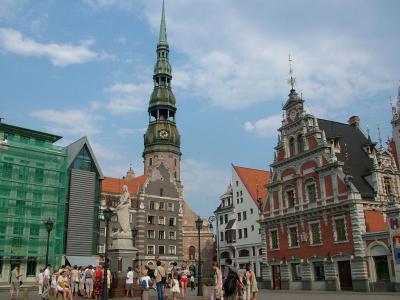
This cobblestone town square marks the center of Old Riga. It's surrounded by beautiful architecture, including the House of the Black Heads and Riga City Hall.
In the center of the Square stands a statue of Roland. He was Charlemagne's nephew and a Frankish military leader. His reputation for stringent but just governance has led to him becoming a symbol of justice in Northern Germany. The statue has stood next to the town's well since 1897.
However, the Square's biggest claim to fame is that it was the site of the first lit and decorated Christmas tree in 1510. There is a plank marking the location, and, of course, a tree is decorated here every year during the holidays.
Bombs leveled Town Hall Square and its surrounding buildings during World War II. Everything you see today was rebuilt in the years following the war. The House of the Black Heads was reopened in 1999, and the Town Hall Building in 2003.
The Square is a great place to begin your explorations of Riga--the narrow cobblestone streets wind through some of the most beautiful architecture you'll find. The scene is especially stunning at night when the buildings are lit for maximum effect.
In the center of the Square stands a statue of Roland. He was Charlemagne's nephew and a Frankish military leader. His reputation for stringent but just governance has led to him becoming a symbol of justice in Northern Germany. The statue has stood next to the town's well since 1897.
However, the Square's biggest claim to fame is that it was the site of the first lit and decorated Christmas tree in 1510. There is a plank marking the location, and, of course, a tree is decorated here every year during the holidays.
Bombs leveled Town Hall Square and its surrounding buildings during World War II. Everything you see today was rebuilt in the years following the war. The House of the Black Heads was reopened in 1999, and the Town Hall Building in 2003.
The Square is a great place to begin your explorations of Riga--the narrow cobblestone streets wind through some of the most beautiful architecture you'll find. The scene is especially stunning at night when the buildings are lit for maximum effect.
7) Saint Peter's Church (must see)
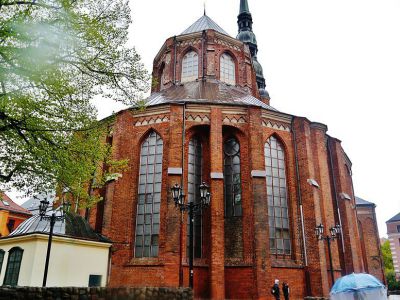
You can trace the history of this beautiful church back to 1209. Having such a long story to tell, it's not surprising that the tales are traced to the building styles of various periods. The church has Gothic, Romanesque, and Baroque elements.
Little remains of the original Gothic construction. Only the central section of the church, including the outer nave walls and a few pillars, remain from those early years.
The second construction period was overseen by master builder Johannes Rumeschottel from Germany. This was in 1409, but work was interrupted by wars and the plague. Nevertheless, by the late 15th century, the church had a mighty basilica with three aisles and vaulted ceilings. It also sported a new bell tower, 136 meters (446 feet) tall, with a steeple.
The final construction period occurred in the late 1600s when the western facade and new bell tower were built after a devastating fire in the city. Many of the furnishings and the vaulted ceiling were refurbished as well. When finished, the new tower and steeple was the tallest wooden structure in Europe.
The church was reconstructed after artillery fire destroyed it during World War II. The bronze candelabrum--a standing lantern--was taken from the church to Wloclawek, Poland. It was displayed there until 2012 when it was returned to Riga.
The steeple was completed in 1970, and the clock tower in the early 1970s. The rooster atop the steeple weighs 158 kilograms and includes 140 grams of gold plating. The bell plays the Latvian folk melody "Riga Resounds" five times a day, and the bell chimes hourly. There is an elevator that takes guests up the tower, where you can take in the view of Riga from a height of 72 meters (236 feet).
Today, the church is owned by the Evangelical Lutheran Church of Latvia. Services resumed here in 1991. In addition to the view from the tower's top, strolling through the art collection and seeing the beautiful nave are must-dos in Riga.
Little remains of the original Gothic construction. Only the central section of the church, including the outer nave walls and a few pillars, remain from those early years.
The second construction period was overseen by master builder Johannes Rumeschottel from Germany. This was in 1409, but work was interrupted by wars and the plague. Nevertheless, by the late 15th century, the church had a mighty basilica with three aisles and vaulted ceilings. It also sported a new bell tower, 136 meters (446 feet) tall, with a steeple.
The final construction period occurred in the late 1600s when the western facade and new bell tower were built after a devastating fire in the city. Many of the furnishings and the vaulted ceiling were refurbished as well. When finished, the new tower and steeple was the tallest wooden structure in Europe.
The church was reconstructed after artillery fire destroyed it during World War II. The bronze candelabrum--a standing lantern--was taken from the church to Wloclawek, Poland. It was displayed there until 2012 when it was returned to Riga.
The steeple was completed in 1970, and the clock tower in the early 1970s. The rooster atop the steeple weighs 158 kilograms and includes 140 grams of gold plating. The bell plays the Latvian folk melody "Riga Resounds" five times a day, and the bell chimes hourly. There is an elevator that takes guests up the tower, where you can take in the view of Riga from a height of 72 meters (236 feet).
Today, the church is owned by the Evangelical Lutheran Church of Latvia. Services resumed here in 1991. In addition to the view from the tower's top, strolling through the art collection and seeing the beautiful nave are must-dos in Riga.
8) Vecriga (Old Town)
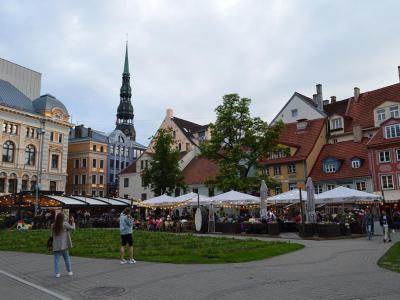
Vecrīga, or Old Riga, serves as the historical heart of Riga, situated within the Central District on the eastern side of the Daugava River. This neighborhood is celebrated for its historic churches and cathedrals, including the Riga Cathedral, Saint James's Cathedral, and Saint Peter's Church. These religious structures, along with its comprehensive collection of Renaissance, Baroque, and Medieval architecture, contribute to Vecrīga's charm and historical significance.
Originally, Vecrīga encompassed the entire city of Riga before its expansion in the late 19th century. The area was historically fortified with a wall, except on the side facing the riverbank of the Daugava. Following the demolition of this wall, the adjacent river waters were redirected to create the Riga City Canal, adding a picturesque element to the area.
In recognition of its cultural and historical value, Vecrīga is included in the UNESCO World Heritage Site listing for the "Historic Centre of Riga," which also covers most of the surrounding Central district. The early 1990s saw significant changes in Vecrīga’s accessibility, as its streets were closed to regular traffic. Now, only residents and local delivery vehicles with special permits can access the area, preserving its tranquil and historic atmosphere.
Notably, Vecrīga is not just a relic of the past but a living part of the city, showcasing not only ancient architectural styles but also the distinct Art Nouveau style, particularly through the works of Mikhail Eisenstein, a renowned architect both locally and internationally. This blend of architectural styles and the area’s rich history make Vecrīga a key destination for both visitors and scholars alike, offering a unique glimpse into the layered past of Riga.
Originally, Vecrīga encompassed the entire city of Riga before its expansion in the late 19th century. The area was historically fortified with a wall, except on the side facing the riverbank of the Daugava. Following the demolition of this wall, the adjacent river waters were redirected to create the Riga City Canal, adding a picturesque element to the area.
In recognition of its cultural and historical value, Vecrīga is included in the UNESCO World Heritage Site listing for the "Historic Centre of Riga," which also covers most of the surrounding Central district. The early 1990s saw significant changes in Vecrīga’s accessibility, as its streets were closed to regular traffic. Now, only residents and local delivery vehicles with special permits can access the area, preserving its tranquil and historic atmosphere.
Notably, Vecrīga is not just a relic of the past but a living part of the city, showcasing not only ancient architectural styles but also the distinct Art Nouveau style, particularly through the works of Mikhail Eisenstein, a renowned architect both locally and internationally. This blend of architectural styles and the area’s rich history make Vecrīga a key destination for both visitors and scholars alike, offering a unique glimpse into the layered past of Riga.
9) Central Market (must see)
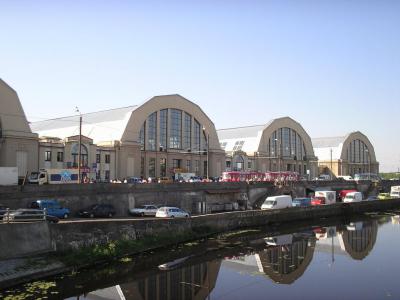
Riga's Central Market is Europe's largest market and bazaar. The enormous building was constructed by repurposing five old German Zeppelin hangars. The total covered area inside the pavilions is 72,300 square meters (778,000 square feet), and it houses more than 3,000 vendor booths.
Riga's location on the River Daugava has always made it a center for trade. The Central Market was conceived in the 1920s. An international competition was held, and the winner's idea of using the metal frames of abandoned World War I Zeppelin hangars was a hit.
Construction was completed in 1930. Only the top parts of the hangars could be used, but the effect remained. Finishing touches on the buildings were done in the Art Deco style of the time. A tunnel system under the buildings allows for goods to be transported to vendors without going through the floor. It also connects to the river for deliveries.
When the market is not held, the space is used for other events and exhibitions. Along with Old Riga, the Market was added as a UNESCO World Heritage Site in 1998. The Zeppelin hangars are five of the only nine remaining in the world.
The Market is a must-see stop for foodies or anyone looking for delectable, Latvian-grown treats. Each pavilion has a category--dairy, meats, vegetables, fish, and gastronomy products. In addition, the outdoor area also has stalls and hosts the Night Market and the Clock Farmers Market.
Riga's location on the River Daugava has always made it a center for trade. The Central Market was conceived in the 1920s. An international competition was held, and the winner's idea of using the metal frames of abandoned World War I Zeppelin hangars was a hit.
Construction was completed in 1930. Only the top parts of the hangars could be used, but the effect remained. Finishing touches on the buildings were done in the Art Deco style of the time. A tunnel system under the buildings allows for goods to be transported to vendors without going through the floor. It also connects to the river for deliveries.
When the market is not held, the space is used for other events and exhibitions. Along with Old Riga, the Market was added as a UNESCO World Heritage Site in 1998. The Zeppelin hangars are five of the only nine remaining in the world.
The Market is a must-see stop for foodies or anyone looking for delectable, Latvian-grown treats. Each pavilion has a category--dairy, meats, vegetables, fish, and gastronomy products. In addition, the outdoor area also has stalls and hosts the Night Market and the Clock Farmers Market.
