Custom Walk in Calgary, Alberta by ainsworthkatherine_f9954a created on 2026-07-26
Guide Location: Canada » Calgary
Guide Type: Custom Walk
# of Sights: 6
Tour Duration: 3 Hour(s)
Travel Distance: 6.8 Km or 4.2 Miles
Share Key: 7JQP5
Guide Type: Custom Walk
# of Sights: 6
Tour Duration: 3 Hour(s)
Travel Distance: 6.8 Km or 4.2 Miles
Share Key: 7JQP5
How It Works
Please retrieve this walk in the GPSmyCity app. Once done, the app will guide you from one tour stop to the next as if you had a personal tour guide. If you created the walk on this website or come to the page via a link, please follow the instructions below to retrieve the walk in the app.
Retrieve This Walk in App
Step 1. Download the app "GPSmyCity: Walks in 1K+ Cities" on Apple App Store or Google Play Store.



Step 2. In the GPSmyCity app, download(or launch) the guide "Calgary Map and Walking Tours".
Step 3. Tap the menu button located at upper right corner of the "Walks" screen and select "Retrieve custom walk". Enter the share key: 7JQP5
1) Calgary Tower (must see)
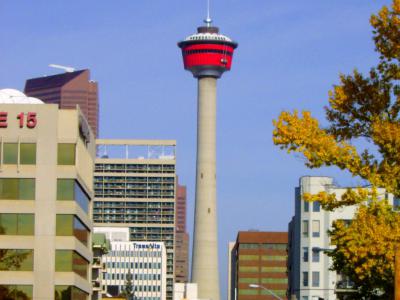
Rising above downtown like a confident exclamation point, Calgary Tower reaches 191 metres into the prairie sky. It first appeared in 1967 under the name Husky Tower, built as part of a downtown renewal push and timed neatly with Canada’s centennial celebrations. The project was a joint effort between Husky Oil and Realty Company Limited, and a few years later, in 1971, the tower was officially renamed-simple, direct, and very Calgary. It also earned early bragging rights as a founding member of the World Federation of Great Towers, which is exactly what it sounds like.
The tower was designed by W. G. Milne & A. Dale and Associates and took just fifteen months to complete, a quick turnaround for something this tall. Structurally, it’s no lightweight: the tower can handle winds of up to 161 kilometres per hour and is engineered to withstand earthquakes. One of its quiet engineering feats is the central column, poured continuously over 24 straight days without stopping-a detail easy to miss, but impressive once you know it.
Up top, the views do most of the talking. The observation level gives you a full sweep of the city grid, the rivers, and, on clear days, the distant outline of the Rocky Mountains. If you prefer your skyline with a side of dinner, there’s the revolving Sky 360 restaurant, where the city slowly turns beneath your table while you stay comfortably seated. It’s multitasking at its finest: eat, relax, and sightsee all at once.
At ground level, the tower plugs straight into Calgary’s +15 Skyway network, an elevated indoor walkway system that keeps downtown connected year-round. From here, you can walk indoors to places like the Fairmont Palliser Hotel, One Palliser Square, and EnCana Place. Whether you head up, dine around, or drift off through the skywalks, the Calgary Tower is less a stop-and-go landmark and more a smooth transition between the city’s past ambitions and its modern rhythm.
The tower was designed by W. G. Milne & A. Dale and Associates and took just fifteen months to complete, a quick turnaround for something this tall. Structurally, it’s no lightweight: the tower can handle winds of up to 161 kilometres per hour and is engineered to withstand earthquakes. One of its quiet engineering feats is the central column, poured continuously over 24 straight days without stopping-a detail easy to miss, but impressive once you know it.
Up top, the views do most of the talking. The observation level gives you a full sweep of the city grid, the rivers, and, on clear days, the distant outline of the Rocky Mountains. If you prefer your skyline with a side of dinner, there’s the revolving Sky 360 restaurant, where the city slowly turns beneath your table while you stay comfortably seated. It’s multitasking at its finest: eat, relax, and sightsee all at once.
At ground level, the tower plugs straight into Calgary’s +15 Skyway network, an elevated indoor walkway system that keeps downtown connected year-round. From here, you can walk indoors to places like the Fairmont Palliser Hotel, One Palliser Square, and EnCana Place. Whether you head up, dine around, or drift off through the skywalks, the Calgary Tower is less a stop-and-go landmark and more a smooth transition between the city’s past ambitions and its modern rhythm.
2) Stephen Avenue (must see)
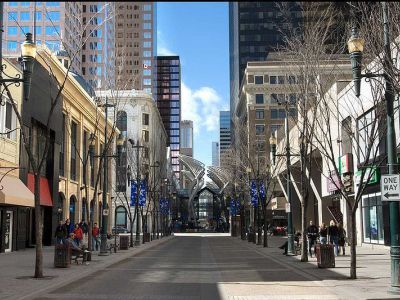
Downtown Calgary is where the city turns up the volume, and Stephen Avenue is right at the centre of it. This pedestrian-only stretch is the main stage for shopping, people-watching, and everyday city life. Cafés spill onto the sidewalks, bars and pubs keep things lively well into the evening, and restaurants cover everything from quick bites to polished dining. If you enjoy browsing-or seriously shopping-this is the place where Calgary shows off its retail confidence, with a mix of high-end stores and small boutiques tempting you at every turn.
Lined along the avenue are major shopping complexes such as The Bay Department Store, Bankers Hall, Scotia Centre, Fashion Central, and the Core Shopping Centre, making it easy to move from one indoor space to the next without losing momentum. You’ll also pass major hotels like the Calgary Marriott and the Hyatt Regency, along with the Telus Convention Centre, which adds a steady flow of visitors to the street. It’s busy, but not chaotic-more like a steady urban rhythm that pulls you along.
Stephen Avenue isn’t just about modern commerce, though. In 1992, it was officially designated a National Historic Site of Canada, and the reason becomes clear when you start looking up. Many of the buildings here date back to the late 19th century and are built from local sandstone. After a devastating fire in 1886 damaged much of the city, these structures were designed to resist future disasters, giving the street its distinctive, solid look.
The avenue takes its name from George Stephen, the first president of the Canadian Pacific Railway and later the first Baron Mount Stephen, linking the street directly to the forces that shaped Calgary’s growth.
As you walk this stretch, take your time. Let the mix of history, architecture, shopping, and street life set the pace. Stephen Avenue isn’t something to rush-it’s one of those places where Calgary explains itself best, one block at a time.
Lined along the avenue are major shopping complexes such as The Bay Department Store, Bankers Hall, Scotia Centre, Fashion Central, and the Core Shopping Centre, making it easy to move from one indoor space to the next without losing momentum. You’ll also pass major hotels like the Calgary Marriott and the Hyatt Regency, along with the Telus Convention Centre, which adds a steady flow of visitors to the street. It’s busy, but not chaotic-more like a steady urban rhythm that pulls you along.
Stephen Avenue isn’t just about modern commerce, though. In 1992, it was officially designated a National Historic Site of Canada, and the reason becomes clear when you start looking up. Many of the buildings here date back to the late 19th century and are built from local sandstone. After a devastating fire in 1886 damaged much of the city, these structures were designed to resist future disasters, giving the street its distinctive, solid look.
The avenue takes its name from George Stephen, the first president of the Canadian Pacific Railway and later the first Baron Mount Stephen, linking the street directly to the forces that shaped Calgary’s growth.
As you walk this stretch, take your time. Let the mix of history, architecture, shopping, and street life set the pace. Stephen Avenue isn’t something to rush-it’s one of those places where Calgary explains itself best, one block at a time.
3) Peace Bridge (must see)
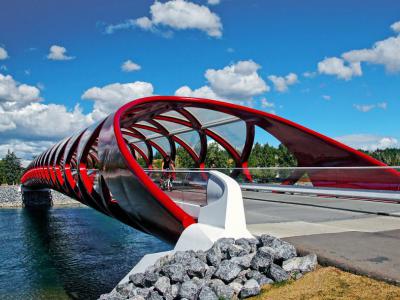
The Peace Bridge is a pedestrian and cyclist crossing over the Bow River, spanning about 130.6 meters in length and 8 meters across, with a tubular double-helix truss design that stands roughly 5.85 meters tall. Conceived by Spanish architect Santiago Calatrava and completed in March 2012, this signature red-and-white structure - echoing both national and civic colours - bridges the southern Eau Claire/Downtown pathway with the northern Sunnyside community.
As a sculptural marvel, the bridge’s helical steel frame-comprising around 850 tonnes of steel-withstands without piers in the water, preserving the river’s natural flow and minimizing ecological impact. Covered with curved glass panels and well-lit at night, it offers a sheltered, barrier-free experience for walkers and riders alike. The interior width is split into a 3.7-meter pedestrian walkway and a 2.5-meter cycling lane, helping manage up to 9,000 users daily.
Beyond functionality, the Peace Bridge has quickly become one of Calgary’s most photographed landmarks. Its striking form-likened by many to a giant finger-trap puzzle-provides dynamic sightlines toward the downtown skyline and the serene Bow River, especially during sunrise or twilight. Despite initial controversy over cost and design, it earned accolades as a top architectural project and public space of 2012.
For visitors, the bridge offers more than just a crossing-it’s a walking art installation. The seamless glide between neighborhoods invites exploration of surrounding gems like Eau Claire Market, Prince’s Island Park, and the pathways that line the riverbanks. Whether you’re on foot or bike, crossing during evening illuminations or sunshine-dappled days, the Peace Bridge is a vibrant invitation to connect with Calgary’s urban pulse and riverside beauty.
As a sculptural marvel, the bridge’s helical steel frame-comprising around 850 tonnes of steel-withstands without piers in the water, preserving the river’s natural flow and minimizing ecological impact. Covered with curved glass panels and well-lit at night, it offers a sheltered, barrier-free experience for walkers and riders alike. The interior width is split into a 3.7-meter pedestrian walkway and a 2.5-meter cycling lane, helping manage up to 9,000 users daily.
Beyond functionality, the Peace Bridge has quickly become one of Calgary’s most photographed landmarks. Its striking form-likened by many to a giant finger-trap puzzle-provides dynamic sightlines toward the downtown skyline and the serene Bow River, especially during sunrise or twilight. Despite initial controversy over cost and design, it earned accolades as a top architectural project and public space of 2012.
For visitors, the bridge offers more than just a crossing-it’s a walking art installation. The seamless glide between neighborhoods invites exploration of surrounding gems like Eau Claire Market, Prince’s Island Park, and the pathways that line the riverbanks. Whether you’re on foot or bike, crossing during evening illuminations or sunshine-dappled days, the Peace Bridge is a vibrant invitation to connect with Calgary’s urban pulse and riverside beauty.
4) Wonderland Sculpture (must see)
Calgary’s skyline curves just a little at The Bow, a crescent-shaped skyscraper that looks like it leaned into the wind and decided to stay that way. It’s a serious piece of architecture-so serious, in fact, that Azure Magazine once ranked it among the world’s top ten architectural projects. Still, most walking tours pause here for a reason that has nothing to do with offices or glass façades.
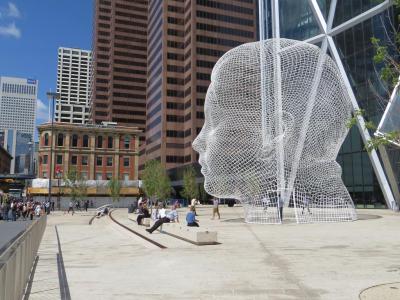
Right out front stands Wonderland Sculpture, a 39-foot-tall wire head created by Spanish artist Jaume Plensa. The sculpture represents a young girl, her face open and transparent, meant to suggest imagination, possibility, and the inner world of youth. It’s light, airy, and slightly surreal-like a thought bubble that escaped into the city.
Unlike most public sculptures, Wonderland invites you inside. Step through the wire framework and suddenly the city surrounds you from a different angle, as if you’re borrowing the viewpoint of all those dreams the artwork is meant to hold.
Set along 6th Avenue and only a short walk from Olympic Plaza, Wonderland is an easy stop-but one that tends to linger in memory. It’s proof that sometimes the most talked-about landmark isn’t the building reaching for the sky, but the artwork quietly watching it.
Right out front stands Wonderland Sculpture, a 39-foot-tall wire head created by Spanish artist Jaume Plensa. The sculpture represents a young girl, her face open and transparent, meant to suggest imagination, possibility, and the inner world of youth. It’s light, airy, and slightly surreal-like a thought bubble that escaped into the city.
Unlike most public sculptures, Wonderland invites you inside. Step through the wire framework and suddenly the city surrounds you from a different angle, as if you’re borrowing the viewpoint of all those dreams the artwork is meant to hold.
Set along 6th Avenue and only a short walk from Olympic Plaza, Wonderland is an easy stop-but one that tends to linger in memory. It’s proof that sometimes the most talked-about landmark isn’t the building reaching for the sky, but the artwork quietly watching it.
5) Glenbow Museum (must see)
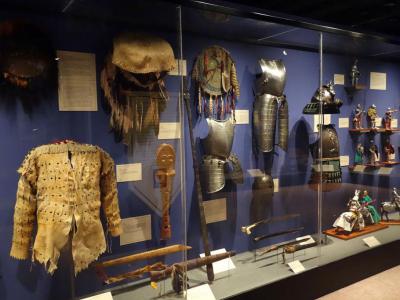
A trip to Calgary is certainly incomplete without a visit to Glenbow Museum. This museum features a total of 20 galleries with 93,000 square feet of exhibition space. As this largest museum in Western Canada displays over one million objects, it is recommended to keep an entire day for your visit here.
You will find four permanent collections here including Ethnology, Cultural history, Mineralogy and Military history. As you browse through the collections, you will learn a lot of interesting things about Canada and its rich history.
Over 100,000 objects from all over the world are on display at the cultural history collection. Right from the 1800s, you will gain a deep insight into the life, culture and history of Western Canada.
This museum also features the largest military collection in Western Canada. Displaying over 26,000 items, this collection features Asian, European and North American firearms and other interesting artifacts spanning five centuries.
Browse through the Glenbow ethnology collection to find at least 48,000 items that take gives you a peek into those indigenous people of North America’s Northern Plains. Glenbow Museum also features Canadian medals, decorations and orders and Japanese arms and armor. Browse through the mineralogy collection to find interesting semi-precious and precious stones as well as minerals from across the world.
Editor's Note: Glenbow Museum building is closed for a major renovation and is expected to reopen in 2026.
You will find four permanent collections here including Ethnology, Cultural history, Mineralogy and Military history. As you browse through the collections, you will learn a lot of interesting things about Canada and its rich history.
Over 100,000 objects from all over the world are on display at the cultural history collection. Right from the 1800s, you will gain a deep insight into the life, culture and history of Western Canada.
This museum also features the largest military collection in Western Canada. Displaying over 26,000 items, this collection features Asian, European and North American firearms and other interesting artifacts spanning five centuries.
Browse through the Glenbow ethnology collection to find at least 48,000 items that take gives you a peek into those indigenous people of North America’s Northern Plains. Glenbow Museum also features Canadian medals, decorations and orders and Japanese arms and armor. Browse through the mineralogy collection to find interesting semi-precious and precious stones as well as minerals from across the world.
Editor's Note: Glenbow Museum building is closed for a major renovation and is expected to reopen in 2026.
6) Fort Calgary (must see)
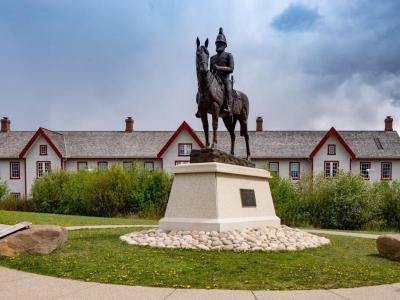
Fort Calgary came into being in 1875, thanks to a federal order with a very specific goal: put an end to the whiskey trade that had taken root at the meeting point of the Bow and Elbow rivers. Law, order, and fewer questionable drinks-that was the plan.
Choosing the exact location fell to the F Troop of the North-West Mounted Police, led by Ephrem A. Brisebois, who arrived from Fort Macleod with determination and limited equipment. To cross the Bow River, they improvised with a tarpaulin stretched over a wagon box. The first man to step onto the riverbank was Corporal George Clift King, a detail that earned him the informal title of Calgary’s first citizen. No plaque at the time, just cold water and good timing...
Construction followed using spruce logs floated down from upstream and locally sourced pine. The fort included the basics: men’s quarters, storage buildings, stables, and a guard room. Early on, it went by practical names like “Bow Fort” or “The Elbow.” An attempt to name it after Brisebois failed-popularity matters, even in the 1870s.
Ultimately, in 1876, the fort officially became Fort Calgary-courtesy of Colonel James Macleod, Commissioner of the North-West Mounted Police, who had spent time in Scotland and proposed this name after a small hamlet on the Isle of Mull.
As the settlement grew, so did the fort. Parts were dismantled to make way for new barracks in 1882, and by 1888, a two-storey building stood here, large enough to house 100 men.
Today, Fort Calgary remains one of the clearest places to trace the city’s beginnings-a stop where Calgary’s story starts to sound less like legend and more like real life, boots, logs, rivers, and all...
Choosing the exact location fell to the F Troop of the North-West Mounted Police, led by Ephrem A. Brisebois, who arrived from Fort Macleod with determination and limited equipment. To cross the Bow River, they improvised with a tarpaulin stretched over a wagon box. The first man to step onto the riverbank was Corporal George Clift King, a detail that earned him the informal title of Calgary’s first citizen. No plaque at the time, just cold water and good timing...
Construction followed using spruce logs floated down from upstream and locally sourced pine. The fort included the basics: men’s quarters, storage buildings, stables, and a guard room. Early on, it went by practical names like “Bow Fort” or “The Elbow.” An attempt to name it after Brisebois failed-popularity matters, even in the 1870s.
Ultimately, in 1876, the fort officially became Fort Calgary-courtesy of Colonel James Macleod, Commissioner of the North-West Mounted Police, who had spent time in Scotland and proposed this name after a small hamlet on the Isle of Mull.
As the settlement grew, so did the fort. Parts were dismantled to make way for new barracks in 1882, and by 1888, a two-storey building stood here, large enough to house 100 men.
Today, Fort Calgary remains one of the clearest places to trace the city’s beginnings-a stop where Calgary’s story starts to sound less like legend and more like real life, boots, logs, rivers, and all...
