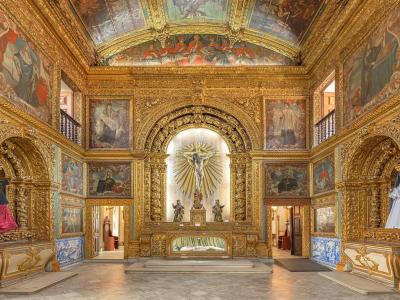


Capela Dourada (Golden Chapel), Recife
The Golden Chapel, known in Portuguese as Capela Dourada, was built between 1696 and 1724 by the Third Order of Saint Francis as part of a larger Franciscan complex. It served as a private place of worship for members of this lay brotherhood, reflecting their position within colonial society. Its design follows Baroque traditions introduced from Portugal, combined with techniques and materials developed by local artisans.
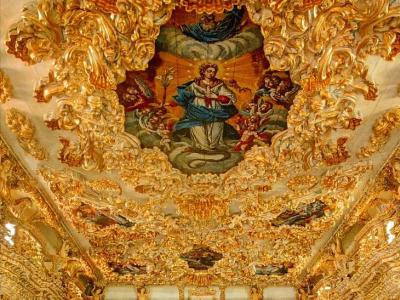
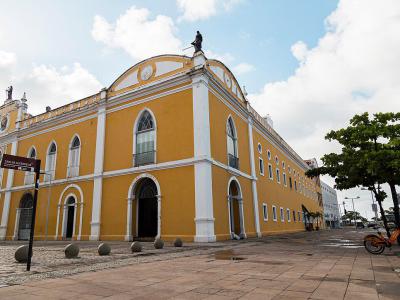
The exterior is restrained, giving little indication of the interior. Inside, carved wood covered in gold leaf fills the walls, ceilings, and altars with floral motifs, angels, and religious symbols. The main altar forms the central focus, while some alcoves contain life-sized saint dioramas, including the Lord of the Steps, a rock image set with rubies, noted for its intense realism.
In the sacristy, the walls are lined with Portuguese azulejo tiles depicting moral and religious scenes. The room also contains large cabinets carved from jacaranda wood, rising to about three meters, and a stone washbasin brought from Estremoz in Portugal. Nearby, in the Church of the Third Order, a painting of the crucifixion of Franciscan monks shows executioners whose faces have been gradually scratched away by devotees, reflecting acts of protest and devotion over time.
The exterior is restrained, giving little indication of the interior. Inside, carved wood covered in gold leaf fills the walls, ceilings, and altars with floral motifs, angels, and religious symbols. The main altar forms the central focus, while some alcoves contain life-sized saint dioramas, including the Lord of the Steps, a rock image set with rubies, noted for its intense realism.
In the sacristy, the walls are lined with Portuguese azulejo tiles depicting moral and religious scenes. The room also contains large cabinets carved from jacaranda wood, rising to about three meters, and a stone washbasin brought from Estremoz in Portugal. Nearby, in the Church of the Third Order, a painting of the crucifixion of Franciscan monks shows executioners whose faces have been gradually scratched away by devotees, reflecting acts of protest and devotion over time.
Want to visit this sight? Check out these Self-Guided Walking Tours in Recife. Alternatively, you can download the mobile app "GPSmyCity: Walks in 1K+ Cities" from Apple App Store or Google Play Store. The app turns your mobile device to a personal tour guide and it works offline, so no data plan is needed when traveling abroad.
Download The GPSmyCity App



Capela Dourada (Golden Chapel) on Map
Sight Name: Capela Dourada (Golden Chapel)
Sight Location: Recife, Brazil (See walking tours in Recife)
Sight Type: Religious
Sight Location: Recife, Brazil (See walking tours in Recife)
Sight Type: Religious
Nearby Sights



Walking Tours in Recife, Brazil

Create Your Own Walk in Recife
Creating your own self-guided walk in Recife is easy and fun. Choose the city attractions that you want to see and a walk route map will be created just for you. You can even set your hotel as the start point of the walk.
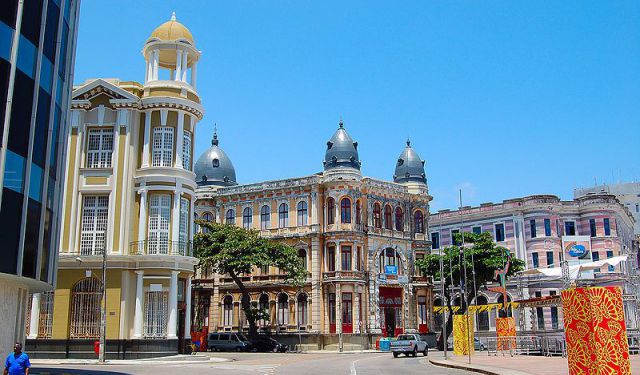
Recife Introduction Walking Tour
In addition to the many rivers, bridges and peninsulas making up most of what's unique about Recife, the main city of the Brazilian state Pernambuco is also famous for its historic downtown area originated in the 16th century. Follow this orientation walk and learn about the past and present of this exiting destination!
Tour Duration: 2 Hour(s)
Travel Distance: 3.5 Km or 2.2 Miles
Tour Duration: 2 Hour(s)
Travel Distance: 3.5 Km or 2.2 Miles