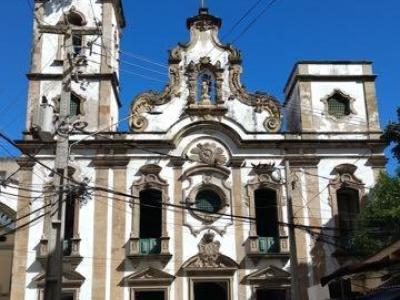


Church of Our Lady of the Rosary of Black Men, Recife
The Church of Our Lady of the Rosary of Black Men developed in the 17th century through a brotherhood of enslaved and freed Africans and their descendants. It functioned as both a place of worship and a support network, where members helped secure freedom for others and ensured burials for those excluded from official cemeteries. This role made the church an important center of community life within colonial society.
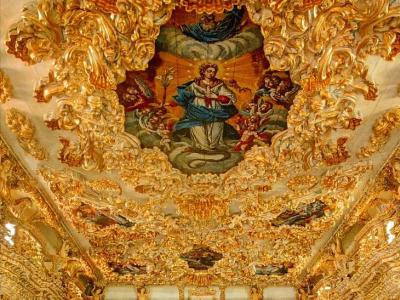
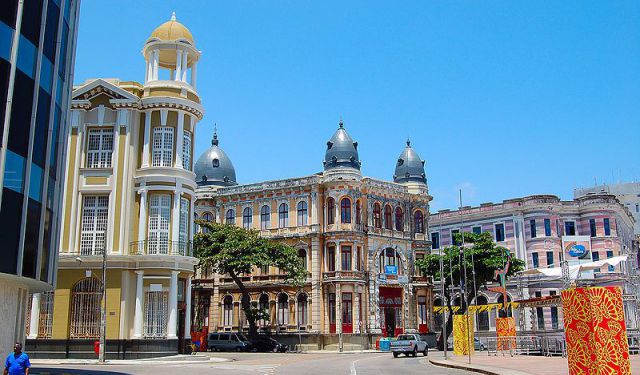
The building has a Baroque origin, with later changes in the 18th century introducing Rococo and Neoclassical elements. Its exterior is simple, marked by a central entrance and a bell tower. Inside, the decoration is more detailed, with carved wooden altarpieces, gilded surfaces, and painted panels. A ceiling painting shows the Virgin Mary surrounded by dark-skinned cherubs, while a carved rosary on the pediment replaces the coat of arms commonly found on other churches.
The church is also linked to cultural traditions formed within the brotherhood. Ceremonies that crowned symbolic Congo kings and queens combined music and procession and later contributed to the development of Maracatu. Inside, altars dedicated to Saint Benedict, Saint Ephigenia, and Saint Balthazar, along with other Black saints, reflect Afro-descendant devotion and show how Catholic practices were combined with African traditions over time.
The building has a Baroque origin, with later changes in the 18th century introducing Rococo and Neoclassical elements. Its exterior is simple, marked by a central entrance and a bell tower. Inside, the decoration is more detailed, with carved wooden altarpieces, gilded surfaces, and painted panels. A ceiling painting shows the Virgin Mary surrounded by dark-skinned cherubs, while a carved rosary on the pediment replaces the coat of arms commonly found on other churches.
The church is also linked to cultural traditions formed within the brotherhood. Ceremonies that crowned symbolic Congo kings and queens combined music and procession and later contributed to the development of Maracatu. Inside, altars dedicated to Saint Benedict, Saint Ephigenia, and Saint Balthazar, along with other Black saints, reflect Afro-descendant devotion and show how Catholic practices were combined with African traditions over time.
Want to visit this sight? Check out these Self-Guided Walking Tours in Recife. Alternatively, you can download the mobile app "GPSmyCity: Walks in 1K+ Cities" from Apple App Store or Google Play Store. The app turns your mobile device to a personal tour guide and it works offline, so no data plan is needed when traveling abroad.
Download The GPSmyCity App



Church of Our Lady of the Rosary of Black Men on Map
Sight Name: Church of Our Lady of the Rosary of Black Men
Sight Location: Recife, Brazil (See walking tours in Recife)
Sight Type: Religious
Guide(s) Containing This Sight:
Sight Location: Recife, Brazil (See walking tours in Recife)
Sight Type: Religious
Guide(s) Containing This Sight:
Nearby Sights

Walking Tours in Recife, Brazil

Create Your Own Walk in Recife
Creating your own self-guided walk in Recife is easy and fun. Choose the city attractions that you want to see and a walk route map will be created just for you. You can even set your hotel as the start point of the walk.
Recife Introduction Walking Tour
In addition to the many rivers, bridges and peninsulas making up most of what's unique about Recife, the main city of the Brazilian state Pernambuco is also famous for its historic downtown area originated in the 16th century. Follow this orientation walk and learn about the past and present of this exiting destination!
Tour Duration: 2 Hours
Travel Distance: 3.5 Km or 2.2 Miles
Tour Duration: 2 Hours
Travel Distance: 3.5 Km or 2.2 Miles
City Walks Overview
