


House of Menander, Pompei
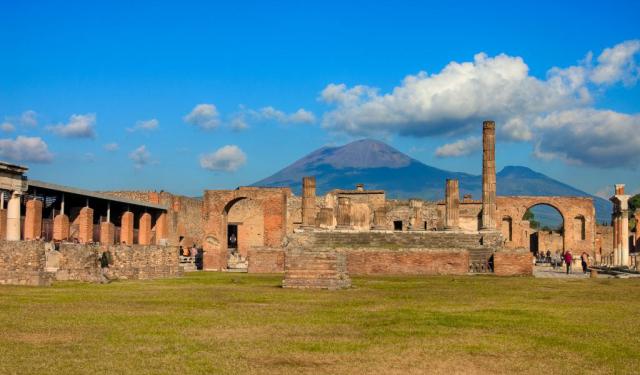
The House of Menander is one of Pompeii’s largest and most impressive residences, located in the southern half of the city centre. Its massive scale and central position indicate that it belonged to the prominent Poppaei family, wealthy aristocrats connected to Poppaea Sabina, the second wife of Emperor Nero. Built in a style strongly influenced by Classical Greek architecture, the house is especially notable for the large, stately Doric columns surrounding its central peristyle.
The residence beautifully reflects Pompeii’s role as a place of elite Roman leisure. Its layout expands across an entire city block, integrating lavish reception rooms, spacious private quarters, service areas, and even a private, mosaic-tiled bath complex. Instead of commercial greeting slogans, the grand atrium features dramatic frescoes depicting theatrical masks alongside tragic scenes from the Trojan War, immediately signalling the owner’s high cultural standing to visiting guests.
The property’s modern name comes from a well-preserved fresco found in an exedra niche on the peristyle wall, showing the ancient Greek dramatist Menander seated and reading from a scroll. Beyond its architectural beauty, the house is legendary among archaeologists for a spectacular discovery made during its 1930s excavation: a hidden chest in the underground cellar containing a treasure trove of 118 pieces of high-quality Roman silver tableware, along with gold jewellery and coins, packed away before the family fled.
The residence beautifully reflects Pompeii’s role as a place of elite Roman leisure. Its layout expands across an entire city block, integrating lavish reception rooms, spacious private quarters, service areas, and even a private, mosaic-tiled bath complex. Instead of commercial greeting slogans, the grand atrium features dramatic frescoes depicting theatrical masks alongside tragic scenes from the Trojan War, immediately signalling the owner’s high cultural standing to visiting guests.
The property’s modern name comes from a well-preserved fresco found in an exedra niche on the peristyle wall, showing the ancient Greek dramatist Menander seated and reading from a scroll. Beyond its architectural beauty, the house is legendary among archaeologists for a spectacular discovery made during its 1930s excavation: a hidden chest in the underground cellar containing a treasure trove of 118 pieces of high-quality Roman silver tableware, along with gold jewellery and coins, packed away before the family fled.
Want to visit this sight? Check out these Self-Guided Walking Tours in Pompei. Alternatively, you can download the mobile app "GPSmyCity: Walks in 1K+ Cities" from Apple App Store or Google Play Store. The app turns your mobile device to a personal tour guide and it works offline, so no data plan is needed when traveling abroad.
Download The GPSmyCity App



House of Menander on Map
Sight Name: House of Menander
Sight Location: Pompei, Italy (See walking tours in Pompei)
Sight Type: Attraction/Landmark
Guide(s) Containing This Sight:
Sight Location: Pompei, Italy (See walking tours in Pompei)
Sight Type: Attraction/Landmark
Guide(s) Containing This Sight:
Nearby Sights

Walking Tours in Pompei, Italy

Create Your Own Walk in Pompei
Creating your own self-guided walk in Pompei is easy and fun. Choose the city attractions that you want to see and a walk route map will be created just for you. You can even set your hotel as the start point of the walk.
Pompeii Introduction Walk II
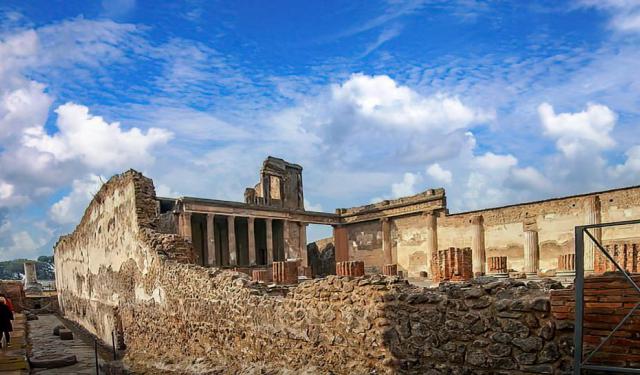
Frozen at the moment it was buried under the thick blanket of ash and pumice, the city of Pompeii (now excavated) remains a unique window into the past, offering a snapshot of everyday life back in the 1st century AD Roman Empire. Aside from causing quick and unexpected death to the city, the huge eruption of Vesuvius in 79 AD did have one positive outcome - it preserved everything (properties,... view more
Tour Duration: 3 Hours
Travel Distance: 2.3 Km or 1.4 Miles
Tour Duration: 3 Hours
Travel Distance: 2.3 Km or 1.4 Miles
Pompeii Introduction Walk I
Modern-day Pompei is best known for its ancient predecessor, the Roman city of Pompeii, that fell victim to the massive eruption of Mount Vesuvius in 79 AD. The ruins of Pompeii, first uncovered in the late 18th century, were declared a World Heritage Site by UNESCO in 1997. Presently, this is one of the most popular tourist attractions in Italy, drawing annually up to 2.5 million visitors.
The... view more
Tour Duration: 2 Hours
Travel Distance: 2 Km or 1.2 Miles
The... view more
Tour Duration: 2 Hours
Travel Distance: 2 Km or 1.2 Miles
City Walks Overview
