


Notre Dame des Doms (Avignon Cathedral), Avignon
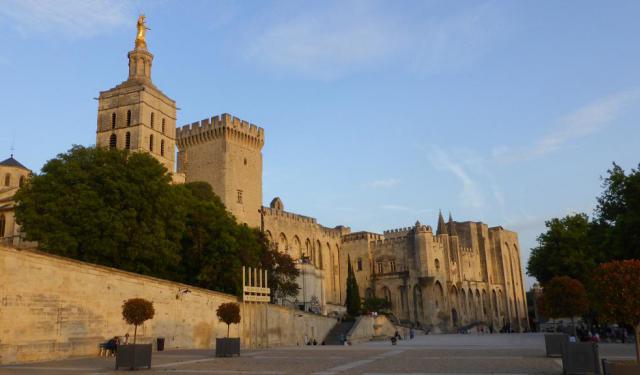
Standing on Palace Square, facing the Palace of the Popes, look to your left, toward the northern end of the square. Just beside the enormous Gothic palace, slightly higher up, stands Avignon Cathedral, also known as Notre-Dame des Doms. This is the seat of the Archbishop of Avignon and one of the city's oldest religious sites.
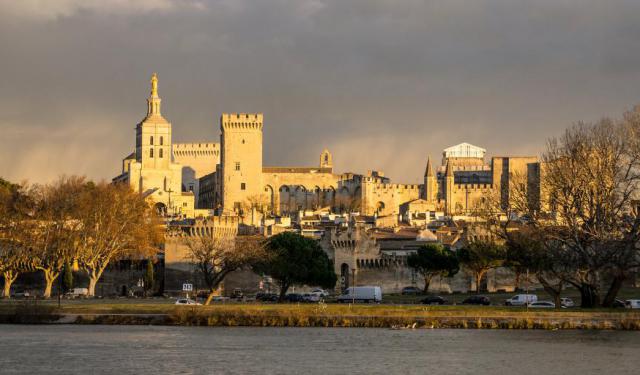
You can easily identify the cathedral by its square stone bell tower, topped with a large golden statue of the Virgin Mary. Added in 1859, the six-meter-high statue is visible from many parts of Avignon. Unlike the Gothic palace next door, the cathedral has a relatively simple Romanesque appearance, with thick stone walls and rounded arches.
The cathedral's history goes back many centuries. According to tradition, an earlier basilica stood here but was destroyed during Saracen raids in 731. The present cathedral dates mainly from the 12th century, with the year 1111 traditionally given as its consecration date.
There are different theories about the origin of its name. One connects it to the Latin “domus episcopalis,” translating to "bishop's house," while another associates it with the nearby Rocher des Doms, the rocky hill overlooking the Rhône River.
Architecturally, the cathedral is predominantly Provençal Romanesque, with Gothic and Baroque additions from later periods. Several side chapels were added in the 14th century, during the Avignon papacy.
Now, step inside and look straight ahead along the central nave. Notice the thick stone pillars and rounded arches. After a two-year restoration, completed in 2016, the once-dark interior became brighter, making its paintings, sculptures, and decorative details easier to appreciate.
Continue toward the center of the church and look up at the impressive octagonal dome above the crossing, where the nave meets the transept. This is one of the cathedral's notable Romanesque features.
Next, approach the choir at the far end of the nave. Near its entrance, look for the 12th-century marble episcopal throne, decorated with carved animals, including a lion and an ox.
From here, explore the side chapels. One particularly interesting feature is the elaborate Gothic tomb of Pope John XXII, who ruled from Avignon between 1316 and 1334. Located in a chapel adjoining the sacristy, the monument is recognizable by its intricate stone carvings.
The cathedral's bell tower also houses an impressive ensemble of 35 bells. Today, Notre-Dame des Doms remains an active place of worship, with regular religious services.
Want to visit this sight? Check out these Self-Guided Walking Tours in Avignon. Alternatively, you can download the mobile app "GPSmyCity: Walks in 1K+ Cities" from Apple App Store or Google Play Store. The app turns your mobile device to a personal tour guide and it works offline, so no data plan is needed when traveling abroad.
Download The GPSmyCity App



Notre Dame des Doms (Avignon Cathedral) on Map
Sight Name: Notre Dame des Doms (Avignon Cathedral)
Sight Location: Avignon, France (See walking tours in Avignon)
Sight Type: Religious
Guide(s) Containing This Sight:
Sight Location: Avignon, France (See walking tours in Avignon)
Sight Type: Religious
Guide(s) Containing This Sight:
Nearby Sights




Walking Tours in Avignon, France
Create Your Own Walk in Avignon
Creating your own self-guided walk in Avignon is easy and fun. Choose the city attractions that you want to see and a walk route map will be created just for you. You can even set your hotel as the start point of the walk.
Discover Avignon's Architectural Jewels on Foot
Centuries of history in Avignon are well seen in the stones of some of France’s best preserved architectural monuments. The city's architecture may well not be as diverse as elsewhere in the country, but it is really difficult to find another place whose history is just as complicated and dynamic as Avignon's.
Being one of only two cities on earth that can claim to be the... view more
Tour Duration: 1 Hour
Travel Distance: 2.4 Km or 1.5 Miles
Being one of only two cities on earth that can claim to be the... view more
Tour Duration: 1 Hour
Travel Distance: 2.4 Km or 1.5 Miles
A Walk Through Avignon's Medieval Old Town
The thing about a wall around a city is to keep unwanted visitors out. But the massive walls encircling Avignon tend to keep visitors in. And the visitors don't mind it. Is this a mystery? Not when one considers what is inside the walls of Avignon. And forget driving. Park the car and walk.
First encounter is the Popes' Palace. This awesome mountain of a palace was built in the 1300s.... view more
Tour Duration: 2 Hours
Travel Distance: 3 Km or 1.9 Miles
First encounter is the Popes' Palace. This awesome mountain of a palace was built in the 1300s.... view more
Tour Duration: 2 Hours
Travel Distance: 3 Km or 1.9 Miles